서 론
구기자 (Licium Chinensis Miller)는 가지과의 구기자속의 목본식물로 우리나라를 비롯한 중국, 유럽 등지에서 자생하 거나 재배되고 있는 생약재이다. 나무전체는 전초 (全草)라고 하며 열매를 구기자 (Lycii fructus), 잎을 구기옆, 뿌리의 껍질 을 지골피 (Lycii Cortex Radicis, LCR)라 하며 부위에 따라 약효가 달라 그 용도가 다르게 사용되고 있다.1) 구기자의 효능 으로는 신경보호 작용으로 치매 예방 가능성,2) 당뇨쥐3)와 고 콜레스테롤식4)의 쥐에서 고지혈증 억제 작용, 당뇨쥐에서 혈당
및 항산화능이 보고되었으며3) 백내장과 망막병증에 대한 예 방 효과5)도 있었다. 구기자 열매와 함께 구기엽 및 지골피에 대 하여도 혈당강하작용 및 혈압 저하작용, 동맥경화증의 예방 등의 효능이 보고된 바 있다.6) 또한 구기자와 구기엽의 추출물 이 tyrosinase 활성을 저해하고 melanin 합성을 저해하여7) 미 백 효과를 갖는 재료로 사용할 가능성도 보였다. 지골피의 다 량성분은 당이지만8) 미량 주요 성분으로 tannic acid, betaine, β-sitosterol glucoside, scopoletin, kukoamine 등이 보고된 바 있다.9) 최근 본 연구진에 의하며 pheolic amide인 trans-N- caffeoyltyramine (CFT) 및 dihydro-N-caffeoyl- tyramine (DHCFT)이 지골피에서 분리 동정되었다.10) Takashi 등9)의 보 http://dx.doi.org/10.4163/kjn.2012.45.5.411
지골피와 생강 정제 추출물이 고지방식이 흰쥐의 체내 지질과 혈청 Cytokine 수준에 미치는 영향
박은정
·
최상원·
조성희§대구가톨릭대학교 식품영양학과
Effects of the purified extracts from Lycii Cortex Radicis and ginger on lipid status and serum cytokine levels in rats fed high fat diet
Park, Eun-JungㆍChoi, Sang-WonㆍCho, Sung-Hee§
Department of Food Science and Nutrition, Catholic University of Daegu, Daegu 712-702, Korea
ABSTRACT
The present study was to investigate the effects of Lycii Cortex Radicis (LCR), the root bark of lycium (Lycium chen- ese Miller) and ginger (Gin) on body lipid status and serum levels of cytokines. Sprague-Dawley (SD) male rats weigh- ing 193.6 ± 16.8 g were divided into five groups, including one low fat (LF) and four high fat groups, i.e. HF-Control, HF- LCR, HF-Gin and HF-LCR + Gin groups. Diets for HF-LCR, HF-Gin and HF-LCR + Gin groups contained purified extracts having 0.2 g LCR tyramine, ginerol and 0.1 g tyramine plus 0.02 g gingerol per kg, respectively. Compared with those of the HF-Control total serum cholesterol level decreased, and HDL-cholesterol level increased in the HF-LCR group and serum triglyceride levels decreased in the three experimental groups fed the purified extracts. Liver cholester- ol level was lower in the HF-LCR group than the HF-Control group, but triglyceride levels, which were increased by high fat diets were not changed by significantly by LCR or ginger extracts. Fecal lipid excretion was higher in the HF-LCR and HF-Gin groups, but cholesterol excretion was lower in the HF-Gin group than in the HF-Control group. The activities of liver cytosolic glucose-6-phosphate dehydrogenase and malic enzyme were lower in the HF-LCR + Gin group than in the HF-Control group. Serum adiponectin levels did not differ among the five groups, while leptin level was lower in the HF-Gin group and C-reactive protein levels were lower in the HF-Gin and the HF-LCR + Gin groups than in the HF- Control group. It is concluded that LCR can be utilized as an ingredient for lipid-lowering functional foods in the form of purified extract and addition of small amount of ginger extract would be useful for reducing one of the inflammatory cy- tokines to help prevent atherosclerosis. (Korean J Nutr 2012; 45(5): 411 ~ 419)
KEY WORDS: Lycii Cortex Radicis, ginger, serum lipid, malic enzyme, C-reactive protein.
접수일:2012년 9월 10일 / 수정일:2012년 9월 25일 / 채택일:2012년 9월 28일
§To whom correspondence should be addressed.
E-mail: [email protected]
© 2012 The Korean Nutrition Society
This is an Open Access article distributed under the terms of the Creative Commons Attribution Non-Commercial License (http://creative- commons.org/licenses/by-nc/3.0/) which permits unrestricted non-commercial use, distribution, and reproduction in any medium, provided the original work is properly cited.
고에 따르면 지골피의 메탄올 추출물은 angiotensin I 전환효 소 (Angiotensin Converting Enzyme, ACE)의 억제활성이 있어 혈압강하 효능을 예상할 수 있다고 하였으며 Kim 등11)은 당뇨에도 효능을 기대할 수 있는 것으로 보고하였다. 또한 당 뇨 생쥐에서 지골피의 혈청 콜레스테롤 및 중성지방의 저하효 과를 확인하였으며,12) UV에 의한 피부 손상13) 및 CCl4에 의한 간 손상을 억제14) 한다는 보고가 있다. 본 연구진은 전보 (前 報)15)에서 지골피에서 tyramine들, CFT 및 DHCFT와 매우 유사한 구조를 가진 trans-N-p-coumaroyltyramine 및 trans- N-feruloyl-3-methoxy- tyramine이 3-hydroxy 3-methylglu- taryl (HMG) CoA reductase와 acyl-CoA: cholesterol acyl- transferase (ACAT) 활성을 저해하고 LDL 산화를 억제함을 보고한 바 있다. 이러한 작용은 혈청 콜레스테롤을 낮추고 동 맥경화를 억제할 수 있는 가능성을 시사하고 있다.
생강 (Zingiber officinale Roscoe)은 생강과(Zingiberac- esae)에 속하는 아열대 및 열대 원산의 다년생 초본 식물의 하나로서, 근경을 주로 식용하며, 특유한 향기와 매운맛으로 인하여 오랫동안 향신료로서 사용되어 왔다. 건생강은 약재로 생강성분인 oleoresin, 에센셜 오일 등은 화장품용으로 이용 하고 있다. 생강의 전체 고형분의 40~60%를 전분이 차지하 고 있으며 미량 주요성분으로는 증류성분인 hydrocarbon류, ketone류, alcohol류 등과 향기성분으로 zingiberene, γ-ca- dinene 등, 그리고 정유성분인 zingiberol, zingiberene 등의 확인되어 있다.16) 정유 성분 중 생강의 매운맛을 내는 주 성분 인 6-gingerol은 항산화 작용을 가진 것17)으로 알려졌으며, 그 외에도 생강의 항균작용,18) 항염증 및 항혈전작용19) 등이 보고 되고 있다. 생강을 첨가한 된장을 섭취시킨 쥐의 종양세포에서 항암효과20)를 보인 바 있고 생강의 gingerol, shogaol, oleoo- resin 분획이 자연 살해 세포 (NK cell) 기능을 활성화시켜 면 역기능을 증진시킨다고21) 보고되었다. 본 연구진의 전보15)에서 10-gingerol은 ACAT 활성 저해 효과가 탁월하고 LDL 산화 억제 효과도 있음을 보여 지골피 tyramine 성분들과 함께 고 지혈증 및 동맥경화 예방 효과 가능성을 보였다.
전보15)에서 1차 에탄올 추출물의 형태로 지골피와 생강을 동물에게 섭취시켰을 때 식이효율과 체중의 증량이 원활치 못 하며 혈청 지질 농도 개선 효과가 다소 미흡하였다. 이는 지골 피와 생강의 1차 에탄올 추출물에 tyramine이나 gingerol과 같은 활성물질의 함유량 문제와 공존하는 다른 성분들의 함 량도 관련된 것으로 판단되었다. 따라서 본 연구에서는 지골 피와 생강의 2차 정제 추출물을 제조하고 식이 내 활성물질들 의 양이 동일한 수준이 되도록 하여 동물식이 실험을 시도하 였다. 식이실험 종료 후 실험동물들의 체내 지질상태, 지방산 합성 관련 효소 활성과 함께 동맥경화 발생에 영향을 준다고
알려진 염증 관련 cytokine들,22,23) adiponectin과 C-reactive protein의 수준도 조사하여 이를 보고하고자 한다.
재료 및 방법
지골피와 생강으로부터 정제 추출물 제조
지골피 분말 (약 1 kg)에 10배 해당하는 양의 80% 에탄올 을 가하여 환류 냉각장치가 부착된 추출기로 2회 반복 추출 하여 1차 에탄올 추출물을 얻었다. 여기에 10배의 증류수를 가하여 현탁시킨 후 methylene chloride, ethyl acetate 및 n- butanol을 순차적으로 2회 반복 분획하여 2차 분획물들을 얻 었다. 이 중 지골피 tyramine이 주로 함유되어 있는 ethyl ace- tate 분획물을 지골피 정제 추출물로 하여 실험식이에 사용하 였다. 이 지골피 정제 추출물의 tyramine 함량은 11.81%이었 다. 껍질을 제거하여 수세한 생강 (약 2 kg)에 100% 에탄올을 가하여 환류 냉각하여 생강의 1차 에탄올 추출물을 얻었다.
이 1차 추출물을 80% 에탄올에 용해한 후 hexane, methylene chloride, ethyl acetate 및 n-butanol을 순차적으로 2회 반복 분획하여 2차 분획물들을 얻었다. 이 2차 분획물 중 gingerol 성분이 가장 많이 함유된 methylene chloride 분획을 생강 정 제 추출물로 하여 동물실험에 사용하였으며 이 정제 추출물 내의 gingerol 함량은 29.02%였다.
동물사육
실험동물은 (주)오리엔트사 (Bio Orient Co. Kyunggi-do, Korea)를 통해 체중 150 ± 10 g의 Sprague-Dawley종 수컷 흰쥐를 구입하여 사용하였다. 동물실험실의 사육환경은 항온 (20~22℃), 항습 (55~65%)을 유지시키고 08:00에서 20:00까 지 12시간 간격으로 명암주기를 유지하며 개개의 stainless cage에서 사육하였다. 처음 1주일간 예비사육기간에는 일반 고형사료 (삼양배합사료, 실험동물용)를 급여하였고 본 실험 에서는 조제 식이를 급여하였다. 본 식이의 기본 구성은 AIN- 93G24) 조성에 근거하였으며, 식이성분으로 사용한 mineral mix 와 vitamin mix는 Central Lab. Animal Inc. (Seoul) 제품을, casein은 Teklad사 (Teklad Test Diet, Madison, USA), 옥수 수 전분은 삼양사 큐원 제품, cellusose는 Sigma-Aldrich (St.
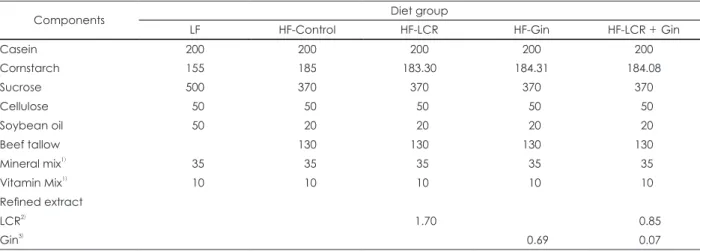
Louis, USA) 제품을 설탕, 대두유 및 쇠기름 (beef tallow)은 시장에서 구입하였다. 예비사육 후, 동물들을 난괴법에 의해 군당 9마리씩 5개의 군으로 나누어 본 실험을 수행하다. 즉, 저지방식이군 1군을 저지방 참조군 (LF)으로, 대조군 (HF- Control)과 3군의 시험군들은 모두 고지방식이를 하였다. LF 와 HF-Control식, 고지방식이에 지골피 정제 추출물 (HF-L- CR), 생강 정제 추출물 (HF-Gin), 지골피와 생강 정제 추출물
을 같이 첨가한 식이 (HF-LCR + Gin)의 조성은 Table 1과 같 으며 이 식이들을 급여한 동물들을 각각 해당 군으로 명명하 였다. 지골피와 생강의 정제추출물은 HF-LCR과 HF-Gin식 이에 tyramine과 gingerol의 함량이 0.02% (w/w)되게 각각 의 정제 추출물을 kg 식이당 1.70 g, 0.69 g을 첨가하였다. 이 수준은 홍화씨 serotonin들의 효능을 보기 위하여 동물실험 식이에 첨가했던 수준을 근거로 하였다.25) 전보15)의 동물실험 에서 gingerol 함량이 0.02% 이상일 때 식이섭취와 체중 증가 저조와 상당한 문제가 발생한 바가 있다. 따라서 지골피와 생 강 추출물의 복합 효과를 보기 위한 HF-LCR + Gin군의 식 이는 지골피 정제 추출물을 HF-LCR식이의 1/2 수준인 0.01%
로 하고 생강 2차 추출물은 부작용이 적을 것으로 예상되는 0.002% 수준으로 조제하였다. 총 식이 기간 4주 동안 식이섭 취량은 매일 측정하고 체중은 3일 간격으로 체 측정하였다. 동 물실험은 대구가톨릭대학교 실험동물 관리규정에 의거하여 시행되었다.
분석 시료의 준비
4주의 사육기간 종료 전날 12시간 절식시킨 실험동물을 에 테르로 마취시킨 뒤 개복하여 복부 하대정맥으로부터 채혈하 여 vaccutainer 시험관에 수거하였다. 채혈한 혈액은 3,000 rpm에서 15분간 원심분리하여 혈청을 분리한 후 지질 측정용 시료는 4℃에 보관하였고 나머지는 -70℃ deep freezer에 보 관하였다가 분석에 사용하였다. 혈액 채혈 후 즉시 간을 적출 하여 무게를 잰 다음 액체 질소로 냉각시킨 알루미늄 clamp 로 눌러 급속 동결시킨 후 분석 시까지 -70℃에 보관하였다.
지방조직도 부위별로 적출하여 각각 무게를 측정하였다. 분변 수집은 실험동물 희생 전 3일 동안 시행하여 변의 중량을 측 정하였고, -70℃ deep freezer에 보관하였다가 동결 건조기에
서 일정량에 달할 때까지 건조한 후 분쇄하여 실험에 사용하 였다. 적출하여 -70℃에 보관하였던 간 조직의 일부를 빙냉하 에서 1.15% KCl 용액으로 균질액을 제조한 후에 단계적으로 원심분리하여 얻은 cytosol 분획을 지방산 합성 관련 효소인 glucose 6-phosphate dehydrogenase (G6PDH)와 malic en- zyme의 효소활성을 측정하는데 이용하였다.
지질 분석
실험동물로부터 얻은 혈청에서 총콜레스테롤, HDL-콜레스 테롤과 중성지방 (triglyceride, TG)은 효소 kit (Asan Co., Ko- rea)를 사용하여 정량하였다. 간 조직의 지질은 Folch 등26)의 방법을 따라 추출한 후 클로로포름에 용해된 지질추출물을 일정량 시료로 취하여 질소 가스로 건조시킨 후 triton X-100 과 ethanol 혼합액 (1 : 1, w/w)으로 처리하고27) 효소 kit (Asan Co., Korea)를 사용하여 측정하였다. 변 중의 지질도 건조된 분 변을 사용하여 Folch 등26)의 방법으로 추출하고 중량법으로 총지질 함량을 측정하고 콜레스테롤 함량은 간조직과 같은 효소법으로 측정하였다.
지방산 합성 관련 효소 활성 측정
G6PDH 및 malic enzyme의 활성도는 효소반응의 기질인 NADP (Sigma-Aldrich, St. Louis, USA)가 효소에 의하여 의 해 NADPH로 환원되는 정도를 측정하여 구하였다. G6PDH 의 경우, 55 mM tris-HCl 완충용액 (pH 7.8), 3.3 mM MgCl2, 6 mM NADP, 및 0.1 M glucose-6-phosphate를 함유하는 반 응혼합액에 효소원인 간조직 cytosol 20 μL를 첨가한 후 340 nm에서 흡광도 변화를 측정하였다.28) G6PDH 활성도 단위는 cytosolic protein 1 mg당 1분간 생성된 NADPH의 nmole로 나타내었다.20) Malic enzyme의 경우 반응혼합액이 67 mM tri- ethanolamine (pH 7.4), 3.3 mM L-malate, 5.0 mM MnCl2,
Table 1. Composition of the five experimental diets (g/kg diet)
Components Diet group
LF HF-Control HF-LCR HF-Gin HF-LCR + Gin
Casein 200 200 200 200 200
Cornstarch 155 185 183.30 184.31 184.08
Sucrose 500 370 370 370 370
Cellulose 50 50 50 50 50
Soybean oil 50 20 20 20 20
Beef tallow 130 130 130 130
Mineral mix1) 35 35 35 35 35
Vitamin Mix1) 10 10 10 10 10
Refined extract
LCR2) 1.70 0.85
Gin3) 0.69 0.07
1) AIN-93G formular 2),3) Dried ethyl acetate and methylene chloride fractions from ethanol extracts of Lycii Cortex Radicis and ginger, repectively, as desribed in ‘Materials and Methods’
및 0.3 mM NADP로 구성되었을 뿐29) G6PDH의 활성 측정과 같았다. 간조직 cytosol 단백질 정량은 bovin serum albumin 을 표준품으로 사용하여 Biuret 방법30)에 의하여 정량하였다.
혈청 Cytokine 및 GPT, GOT 측정
혈청 adiponectin 농도는 enzyme-linked immunosorbent assay법에 따라 Mouse/Rat High Molecular Weight Adipo- nectin ELISA Kit (Shibayagi Co., Ltd, Japan)를 사용하였다.
혈청 leptin 농도는 Rat Leptin ELISA Kit (Millipore, U.S.A) 를, 혈청 CRP 농도는 Rat C-Reactive Protein (CRP) ELISA Kit (BD Biosciences, USA)를 사용하여 측정하였다. 간 손상 지표인 혈청 glutamic oxaloacetic transaminase (GOT)와 glu- tamic pyruvic transaminase (GPT) 활성도는 kit 시약 (Asan Co., Korea)을 사용하여 측정하였다.
통계처리
모든 실험결과에 대한 통계 처리는 SPSS (IBM SPSS Statis- tical Package 20) program을 이용하였다. 각 실험군 간 차이 는 분산분석 (ANOVA 검정)을 수행하였으며 p < 0.05 수준 에서 Tukey test로 검정하였다.
결 과
체중증가량, 식이효율 및 지방조직 무게
실험군들의 초기 및 식이 급여 4주 후의 체중과 체중증가량,
식이섭취량과 식이효율에 대한 결과가 Table 2에 나타나 있다.
전체 실험군의 초기 체중은 193.6 ± 16.8 g로 군 간의 차이는 없었다. 실험식이 4주 동안의 체중증가량은 저지방식이군인 LF군에 비하여 HF-Control군이 유의적으로 높았다 (p < 0.05). 고지방식이를 실험군인 지골피 첨가군인 HF-LCR과 지 골피와 생강 첨가군인 HF-LCR + Gin군은 LF군에 비하여 높은 경향이었으나 HF-Control군에 비하여는 낮은 경향이었 고 HF-Gin군은 HF-Control군에 비하여 유의적으로 낮아 (p
< 0.05) LF군과 차이가 없었다. 식이섭취량은 LF군에 비하 여 고지방식이를 한 HF-Control군 및 HF-LCR군, HF-Gin 군, HF-LCR + Gin군이 높거나 높은 경향이었다. 식이효율도 LF군에 비하여 HF-Control군, HF-LCR군, HF-LCR + Gin 에서 높은 경향이었으나 HF-Gin군은 식이섭취량에 비하여 체중 중가량이 높지 않아 식이효율이 낮아 LF군 수준이었다.
실험군들의 체중 100 g당 지방조직량을 부위별로 나타내는 결과와 총 지방량 값이 Table 3에 나타나 있다. 부고환지방과 복부지방의 무게가 LF군에 비하여 고지방식이를 한 HF-Con- trol군과 HF-LCR, HF-Gin, HF-LCR + Gin군이 대체로 높 았지만 고지방 식이를 한 4군 간의 차이는 없었다. 견갑골 지 방과 신장지방의 무게는 군간 유의한 차이는 없었다. 네 조직 의 지방량 합계는 LF군에 비하여 HF-Control군, HF-LCR과 HF-LCR + Gin군은 유의하게 높았으나 (p < 0.05) HF-Gin 군은 HF-Control군 보다 낮은 경향을 보였다.
Table 2. Body weights, food intakes and food efficiency ratios of the five groups of rats fed experimental diets for four weeks Group1) Initial BW2) (g) Final BW (g) BW gain (g) Food intake (g) Food efficiency ratio
LF 191.3 ± 15.13)NS 390.7 ± 23.7b 199.4 ± 25.4b 658.6 ± 24.7b 0.30 ± 0.03b
HF-Control 191.9 ± 17.9 430.0 ± 36.0a 238.1 ± 25.3a 712.8 ± 54.2ab 0.33 ± 0.02a HF-LCR 192.7 ± 13.6 419.9 ± 27.2ab 227.2 ± 22.4ab 706.2 ± 70.9ab 0.32 ± 0.03ab
HF-Gin 195.3 ± 17.5 404.8 ± 19.4b 209.5 ± 22.6b 740.7 ± 60.1a 0.25 ± 0.09b
HF-LCR + Gin 196.7 ± 16.1 424.6 ± 24.5a 227.9 ± 27.1ab 700.8 ± 46.9b 0.32 ± 0.02ab 1) LF and HF; 5% and 15% (w/w) fat in diet without test extracts, HF-LCR, and HF-Gin; 15% fat and 0.02% tyramine and gingerol from root bark of Lycium chenese Miller and ginger, respectively, HF-LCR + Gin; 15% fat and 0.01% LCR tyramine and 0.002% gingerol 2) Body weight 3) Values are means ± SD from nine rats and those with different alphabet letters in the same column are signifi- cantly different at p < 0.05. NS, not significant
Table 3. Relative weights of fat pad at various regions in the five groups of rats fed experimental diets for four weeks
Group1) Subscapular Epididymal Kidney Abdominal Total
(g/100 g BW)
LF 0.19 ± 0.072)NS 0.83 ± 0.21b 0.53 ± 0.10NS 1.39 ± 0.24b 2.97 ± 0.47b
HF-Control 0.20 ± 0.05 1.06 ± 0.20a 0.63 ± 0.08 2.08 ± 0.29a 3.96 ± 0.35a
HF-LCR 0.20 ± 0.06 1.09 ± 0.20a 0.63 ± 0.10 2.07 ± 0.19a 3.99 ± 0.36a
HF-Gin 0.20 ± 0.05 0.94 ± 0.15ab 0.62 ± 0.15 1.90 ± 0.28a 3.65 ± 0.50ab
HF-LCR + Gin 0.19 ± 0.04 1.03 ± 0.19a 0.62 ± 0.15 2.04 ± 0.39a 3.89 ± 0.68a
1) LF and HF; 5% and 15% (w/w) fat in diet without test extracts, HF-LCR, and HF-Gin; 15% fat and 0.02% tyramine and gingerol from root bark of Lycium chenese Miller and ginger, respectively, HF-LCR + Gin; 15% fat and 0.01% LCR tyramine and 0.002% gingerol 2) Values are means ± SD from nine rats and those with different alphabet letters in the same column are significantly different at p < 0.05. NS, not significant
혈청 및 간조직과 변의 지질 함량
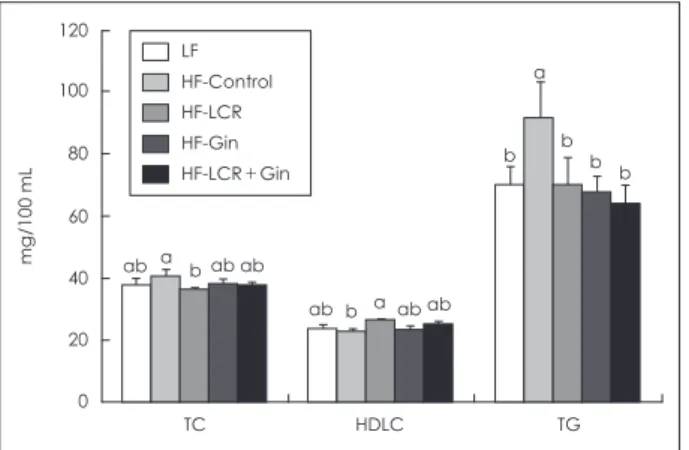
실험군들의 혈청 총 콜레스테롤 (TC), HDL-콜레스테롤 (H- DLC), 중성지방 (TG)의 수준이 Fig. 1에 나타나 있다. 혈청 TC 및 HDLC는 LF군에 비하여 HF-Control군이 유의적으로 변 화하지 않았으나 TG 수준은 HF-Control군이 LF군에 비하 여 유의적으로 증가하였다 (p < 0.05). 지골피 첨가군인 HF- LCR군의 TC 수준이 HF-Control군에 비하여 유의적으로 감 소하였으나 (p < 0.05) 생강 참가군인 HF-Gin 및 HF-LCR + Gin 군에서는 감소하는 경향만을 보였다. 실험군들의 HDLC 수준은 TC 수준의 반대 경향을 나타내었다. 즉, HF-LCR군 이 HF-Control에 비하여 유의적으로 높았고 (p < 0.05) HF- Gin군과 HF-LCR + Gin 군에서는 증가하는 경향만을 보였 다. 반면 혈청 TG 수준은 HF-Control군에 비하여 세 시험군 들 (HF-LCR, HF-Gin, HF-LCR + Gin군)이 유의적으로 낮 아 (p < 0.05) LF군의 수준과 유사하였다.
간조직 중의 콜레스테롤과 중성지방 (TG) 함량은 Fig. 2에 보여지는 바와 같다. 실험군들의 간조직의 콜레스테롤 함량은 혈청 콜레스테롤 결과에서 보여준 바와 같은 경향으로 HF- Control군에 비하여 HF-LCR군이 유의적으로 낮고 LF 및 HF-Gin, HF-LCR + Gin군들은 낮은 경향을 보였다. 간조직 의 중성지방 함량은 고지방식이의 영향으로 HF-Control와 나 머지 세 실험군 (HF-LCR, HF-Gin, HF-LCR + Gin군)에서 LF군에 비해 증가하였다. 그러나 혈청 중성지방 수준의 결과 와 달리 HF-Control군에 비해 나머지 세 실시험군들에서 중 성지방 함량이 유의하게 낮지 않았고, 단지 HF-LCR + Gin 군에서만 낮은 경향이 보였다.
식이 마지막 3일의 분변 중의 총 지질과 콜레스테롤 배설량
이 Fig. 3에 나타나 있다. LF군에 비해 고지방식이를 급여한 HF-Control군 및 세 실험군들 (HF-LCR, HF-Gin, HF-LCR + Gin군)의 지질 배설량이 대체로 증가하였다. 분변의 총지질 배설량은 HF-LCR군과 HF-Gin군에서 HF-Control군에 비 하여도 증가하였고 콜레스테롤의 배설은 HF-LCR군은 HF- Control군과 같은 수준이었으나 HF-Gin군에서는 감소하여 LF군의 수준이었다.
간조직의 G6PDH와 Malic enzyme 활성도
체내 NADPH를 생성하여 지방산 및 콜레스테롤 합성에 필 요한 reducing equivalent를 공급해 주는 반응을 촉매하는 주
120 100 80 60 40 20 0
mg/100 mL ab ab ab
ab b ab ab
b b
b b
a
a
a b
TC HDLC TG LF
HF-Gin HF-LCR + Gin HF-Control HF-LCR
Fig. 1. Serum lipid levels in the five groups of rats fed experimental diets for four weeks. LF and HF; 5% and 15% (w/w) fat in diet with- out test extracts, HF-LCR, and HF-Gin; 15% fat and 0.02% tyramine and gingerol from root bark of Lycium chenese Miller and ginger, respectively, HF-LCR + Gin; 15% fat and 0.01% LCR tyramine and 0.002% gingerol. Bars are means ± SE from nine rats and those with different alphabet letters in the same types of lipid are significant- ly different at p < 0.05.
Fig. 2. Liver lipid levels in the five groups of rats fed experimental diets for four weeks. LF and HF; 5% and 15% (w/w) fat in diet with- out test extracts, HF-LCR, and HF-Gin; 15% fat and 0.02% tyramine and gingerol from root bark of Lycium chenese Miller and ginger, respectively, HF-LCR + Gin; 15% fat and 0.01% LCR tyramine and 0.002% gingerol. Bars are means ± SE from nine rats and those with different alphabet letters in the same types of lipid are signifi- cantly different at p < 0.05.
Fig. 3. Fecal lipid excretions in the five groups of rats fed experi- mental diets for four weeks. LF and HF; 5% and 15% (w/w) fat in diet without test extracts, HF-LCR, and HF-Gin; 15% fat and 0.02%
tyramine and gingerol from root bark of Lycium chenese Miller and ginger, respectively, HF-LCR + Gin; 15% fat and 0.01% LCR tyr- amine and 0.002% gingerol. Bars are means ± SE from nine rats and those with different alphabet letters in the same types of lip- id are significantly different at p < 0.05.
LF
HF-Gin HF-LCR + Gin HF-Control HF-LCR 20
18 16 14 12 10 8 6 4 2 0
mg/g tissue
ab ab ab
ab
a
a
a a
b
b
Cholesterol TG
250 200 150 100 50 0
mg/day c
b
b a a b
a a
ab
ab Total lipid Cholesterol
LF
HF-Gin HF-LCR + Gin HF-Control HF-LCR
요 효소인 G6PDH와 malic enzyme의 활성이 Table 4에 나 타나 있다. G6PDH의 활성은 고지방식이로 증가하는 경향이 었으나 유의하지 않았고, HF-Control군에 비하여 지골피와 생강 복합군인 HF-LCR + Gin군이 유의하게 낮아졌다 (p < 0.05). 한편 malic enzyme의 활성은 고지방식이로 오히려 낮 아지는 경향이었으며 HF-LCR + Gin군이 HF-Control군에 비하여 유의하게 낮아진 점 (p < 0.05)은 G6PDH 활성 결과 와 같았다.
혈청 cytokine 함량과 GOT, GPT 활성도
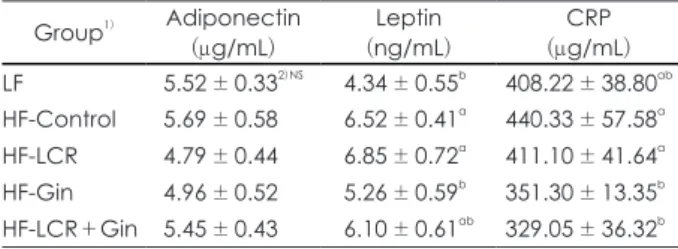
Table 5에 adiponectin, leptin 및 CRP의 혈청농도가 나타 나 있다. Adiponectin은 실험군간에 차이를 보이지 않았지만 leptin은 HF-Control군과 지골피 첨가군인 HF-LCR군이 LF 군에 비하여 유의적으로 증가하였고 (p < 0.05) 생강첨가군 인 HF-Gin군은 HF-Control군에 비하여 유의적으로 낮아 LF군과 유사한 수준이었다. HF-LCR + Gin군도 HF-Control 군에 비하여 낮은 경향이었으나 유의적이지 않았다. CRP의 농도가 HF-Control군에서 LF군에 비하여 높아지는 경향이 었고 HF-Gin군과 지골피와 생강 복합 첨가군인 HF-LCR +
Gin군에서 HF-Control군에 비하여 유의적 감소를 보였다 (p
< 0.05). 간 손상 지표인 혈청 GOT, GPT 활성은 5개의 실험 군 간에 차이가 없었다 (Table 6).
고 찰
본 연구에서 지골피의 tyramine 유도체 함량이 전보15) 보다 높아 지골피 추출물 첨가로 혈청 및 간조직 콜레스테롤의 감 소가 뚜렷하게 나타난 것으로 생각된다. 전보15)에서는 식이에 지골피의 1차 에탄올 추출물에 의한 흰쥐들의 지골피 tyrami- ne의 섭취는 본 연구에서 섭취시킨 양 (0. 2g/kg 식이)의 1/3과 2/3 수준이었다. 또한 본 연구에서는 지골피 추출물이 정제되 었으므로 전보에서 콜레스테롤 저하 작용에 참여했으리라고 예상되는 올리고당이 배제되었다고 생각한다. 따라서 in vitro 에서 보여 준 지골피 tyramine의 HMG CoA reductase 활성 저해15)와 in vivo에서 혈청 콜레스테롤 저하 효과의 관련성을 더 확실하게 보여 주고 있다. 간조직의 콜레스테롤 함량의 감 소 효과도 지골피 성분의 HMG CoA reductase 활성 저해가 주요 기전으로 생각되며 acyl-CoA: cholesterol acyltrans- ferase (ACAT)활성 변화15)의 영향이 적어 보인다. 왜냐하면 생강의 주 기능 성분인 gingerol의 ACAT 활성 저해가 in vitro 연구에서 매우 컸지만15) 본 연구에서 생강 추출물 섭취로 간 조직이나 혈청 중성지방의 수준이 다른 실험군에 비하여 더 낮지 않았기 때문이다. 본 실험에서 지골피 정제 추출물 섭취 로 HDL-콜레스테롤의 증가가 뚜렷하여 동맥경화지수를 감 소시키는 요인이 된 것이 1차 에탄올 추출물 섭취에서 볼 수 없었던 사항이다. 천연식물들의 HDL-콜레스테롤 증가 효과 는 이미 홍화씨 polyphenol,25) 감귤류 bioflavonoid들,31,32) 작 약 추출물과 resveratrol,33) 해조류 대황34) 및 오디주35)를 사용 한 동물실험에서 보고된 바 있어 다양한 phytochemical의 작 용으로 본 연구의 결과도 같은 맥락으로 생각된다. 지골피 정 제 추출물 섭취군 (HF-LCR)에서 대변으로 콜레스테롤 배설
Table 4. Activities of liver cytosolic glucose-6-phosphate dehydro- genase (G6PDH) and malic enzyme in the five groups of rats fed experimental diets for four weeks
Group1) G6PDH Malic enzyme
(nmole NADPH/min/mg protein)
LF 15.52 ± 1.752)ab 13.95 ± 1.96a
HF-Control 18.05 ± 1.20a 13.05 ± 0.60a
HF-LCR 18.67 ± 2.32a 13.74 ± 0.90a
HF-Gin 16.56 ± 1.68ab 11.97 ± 0.88ab HF-LCR + Gin 15.47 ± 0.80b 11.12 ± 0.70b 1) LF and HF; 5% and 15% (w/w) fat in diet without test extracts, HF-LCR, and HF-Gin; 15% fat and 0.02% tyramine and gingerol from root bark of Lycium chenese Miller and ginger, respective- ly, HF-LCR + Gin; 15% fat and 0.01% LCR tyramine and 0.002%
gingerol 2) Values are means ± SE from nine rats and those with different alphabet letters in the same column are significantly dif- ferent at p < 0.05
Table 5. Serum levels of adiponectin, leptin and CRP in the five groups of rats fed experimental diets for four weeks
Group1) Adiponectin
(μg/mL) Leptin
(ng/mL) CRP
(μg/mL) LF 5.52 ± 0.332)NS 4.34 ± 0.55b 408.22 ± 38.80ab HF-Control 5.69 ± 0.58 6.52 ± 0.41a 440.33 ± 57.58a HF-LCR 4.79 ± 0.44 6.85 ± 0.72a 411.10 ± 41.64a HF-Gin 4.96 ± 0.52 5.26 ± 0.59b 351.30 ± 13.35b HF-LCR + Gin 5.45 ± 0.43 6.10 ± 0.61ab 329.05 ± 36.32b 1) LF and HF; 5% and 15% (w/w) fat in diet without test extracts, HF-LCR, and HF-Gin; 15% fat and 0.02% tyramine and gingerol from root bark of Lycium chenese Miller and ginger, respective- ly, HF-LCR + Gin; 15% fat and 0.01% LCR tyramine and 0.002% gin- gerol 2) Values are means ± SE from nine rats and those with dif- ferent alphabet letters in the same column are significantly dif- ferent at p < 0.05. NS: not significant
Table 6. Serum GOT and GPT levels in the five groups of rats fed experimental diets for four weeks
Group1) GOT GPT
(IU/L)
LF 97.31 ± 3.172)NS 24.75 ± 3.11NS
HF-Control 103.38 ± 2.46 26.87 ± 2.54
HF-LCR 95.92 ± 3.77 29.34 ± 1.80
HF-Gin 91.50 ± 5.82 28.06 ± 2.09
HF-LCR + Gin 103.44 ± 4.04 26.48 ± 2.19 1) LF and HF; 5% and 15% (w/w) fat in diet without test extracts, HF-LCR, and HF-Gin; 15% fat and 0.02% tyramine and gingerol from root bark of Lycium chenese Miller and ginger, respective- ly, HF-LCR + Gin; 15% fat and 0.01% LCR tyramine and 0.002% gin- gerol 2) Values are means ± SE from nine rats. NS: not significant
이 유의적이지는 않지만 대조군 (HF-Control) 보다 증가하는 경향을 보인 것도 HDL을 통한 체내 콜레스테롤 배설 기전이 증가되고 있는 것으로 보여진다. 혈청 HDL-콜레스테롤 함량 과 중성지방의 함량은 서로 상반되는 경우가 많다고 보고되어 있으며36) 본 연구 결과에서도 이러한 현상을 보여 주고 있다. 최 근 들어 혈청 중성지방 수준이 동맥경화 위험인자로서의 위상 이 높아지고 있는 것37)을 감안할 때 중성지방 저하 효과를 가 진 물질의 중요성도 증대한다고 본다. 지골피 (HF-LCR) 및 생 강 (HF-Gin), 지골피와 생강 복합군 (HF-LCR + Gin)에서 대 조군 (HF-Control)에 비하여 혈청 및 간조직의 중성지방이 낮 은 것은 (p < 0.05) 이들의 전체 체지방량, 더 나아가서 체중도 대조군에 비하여 낮은 점과 일치한다. 이는 세 실험군에서 지 방축적이 적었음을 의미하여 이것은 실험군들에게서 총지질 배설의 증가와 지방산 합성 효소의 활성 효소 저하와 관련이 있는 것으로 보인다. 본 연구의 생강 정제 추출물 섭취 (HF- Gin)는 전보에 비하여 gingerol의 함량이 낮아 식이 섭취에 문 제가 없었던 것으로 추정되나 식이효율은 낮았고 체중증가량 과 체지방의 절대량도 다른 군에 비하여 낮았다. 이는 Shin 등 의 연구 결과와 같으나38) 식이섭취에 문제가 없었으므로 매운 맛이 작용하였다고 단정하기는 어렵고 체지방 축적을 저해하 는 기전이 작용한 것으로 보인다. 그러나 이런 기전은 지골피 정 제 추출물 (0.1 g/kg)에 소량의 생강 정제 추출물 (0.02 g/kg) 을 혼합하여 섭취시킨 복합급여군 (HF-LCR + Gin)에서 더 잘 나타난 것으로 보인다. 이 복합급여군 (HF-LCR + Gin)은 생강 정제추출물 단독 급여군 (HF-Gin)과 달리 식이효율이 감소하지 않았으나 혈청 중성지방 저하 효과와 함께 lipogenic enzyme인 G6PDH와 malic enzyme의 활성도 뚜렷이 감소하 였기 때문이다. 이들 효소 활성은 식이에 따라 유도되는 대표 적인 효소들이므로39,40) in vivo에서의 효소활성 변화가 mRNA 전사 수준이 관련될 것으로 예상된다.41) Lipogenic enzyme의 유도에 영향을 주는 요인으로 절식 후 고탄수화물식이,39) 지방 의 종류40)와 같은 다량영양소가 잘 알려져 있으나 최근에 해 삼 성분42) 및 sesamin43)에 의한 유전자 발현을 통한 활성 변화 가 보고되었다. 따라서 본 연구의 지골피 tyramine 및 생강의 gingerol에 의한 lipogenic 유전자 발현 조절이 가능하다고 여겨지며 이에 대하여 차후 연구가 기대된다. 또한 지골피 정 제 추출물 단독 섭취 (HF-LCR)에서는 이 효소들의 활성이 변화하지 않아 이들의 복합 효과에 대한 규명도 아울러 요구 된다.
지골피에서 분리한 tyramine 유도체 2종과 생강의 10-gin- gerol이 in vitro에서 LDL 산화를 억제하는 효과가 전보15)에 서 보고된 바 있다. 산화 변형된 LDL은 지단백질 표면의 인지 질에서 지방산을 유리시켜 리소 (lyso)인지질을 형성하고 또한
반응성이 강한 지질과산화물과 카보닐 화합물을 생성한다.
이 반응성이 높은 물질들에 의하여 adhesion molecule, che- mokine, 염증성 cytokine 및 대식세포와 혈관세포의 활성을 유발하는 물질들이 분비되며 대표적인 염증성 cytokine들은 interleukin (IL)-1, IL-6 및 TNF-α다. IL-6 및 TNF-α는 지방 조직에서도 분비되는데 비만일 경우 증가된다. 이 cytokine들 은 혈관 내피의 민무늬근육세포 증식을 유발할 뿐 아니라 간 에서 분비되는 다른 염증물질인 CRP의 합성을 자극하여 염 증상태를 상승시킨다. 허혈성 심질환자에게서 산화 LDL 증가 가 24~44%인데 비하여 혈청 CRP는 정상의 10배 이상 증가 됨을 관찰하였다.44) 반면 지방조직에서 분비되는 adiponectin 은 염증 억제 기능을 가지고 있다. 본 연구 결과에서 지골피 정 제 추출물 단독 섭취군 (HF-LCR)에서는 혈청 adiponectin과 CRP 수준이 대조군 (HF-Control)과 다르지 않았으나 생강 추 출물군 (HF-Gin)과 지골피와 생강 복합군 (HF-LCR + Gin) 에서는 CRP의 감소가 뚜렷하여 (p < 0.05) CRP 감소에 생강 추출물 성분이 관여함을 알 수 있었다, 이는 생강의 gingerol 이 항산화능과 함께 항염증에 효과가 있다는 보고45)와 일치하 는 것으로 보인다. 지골피와 생강 추출물 복합 급여 시에는 생 강 추출물의 농도가 생강 추출물 단독 섭취군에 비하여 1/10 인데도 CRP 감소효과가 분명하여 지골피와 생강의 적절한 배 합이 CRP 억제에 중요하게 작용한 것으로 사료된다. 비만생 쥐에게 조릿대 열수 추출물을 투여한 결과도 본 연구에서와 같이 adiponectin의 변화 없이 CRP의 감소가 나타나46) 염증 에 대한 CRP 변화의 중요성을 부각시키고 있다. 차후 연구에 서 지골피 tyramine과 생강의 gingerol의 CRP 분비에 대한 상세한 조사가 요구된다. 혈청 leptin 양은 실험군들의 체지방 량과 매우 높은 상관관계 (r = 0.661, p = 0.000)를 보였으나 (data not shown) 혈청 adiponectin은 실험군 간에 차이도 없 었고 체지방량과의 상관관계도 없었다. Adiponectin은 정상 쥐의 지방조직에서는 높게 발현되지만 비만이나 당뇨 쥐에서 는 감소하여 비만과 음의 상관성이 보고되고 있다.47,48) 본 연구 에서 시행한 고지방식이로 인한 낮은 수준의 비만으로는 지 방량과의 상관성을 보이지 못한 것으로 생각되며 이는 Kim 등46)의 결과와도 일치한다.
본 연구 결과를 종합하면 지골피와 생강의 분획 정제 추출 물의 지질대사와 염증 관련인자에 대한 영향에 다소 차이가 있으나 단독 또는 적절히 배합하여 지질대사 개선용으로 활용 할 수 있을 것으로 보인다. 지골피의 정제 추출물은 본 연구에 서 사용한 수준에서 간의 부담을 주지 않고 기능성 식품 재료 로 활용할 수 있을 것으로 생각된다. 그러나 생강은 지골피 추 출물의 1/10 정도가 신체에 위해를 주지 않을 것으로 판단되 며 이럴 경우 단독 사용 보다는 지골피 성분과 복합 사용할 때
지질대사 개선과 염증 억제 효과를 을 기대할 수 있다고 판단 된다. 기능성 식품의 효능을 높이기 위하여 지골피의 유효 생 리성분인 tyramine들을 지골피로부터 분리 정제하여 활용할 수도 있겠으나 그 수율이 100 g당 1.66 mg으로 매우 낮았다.
따라서 분리된 tyramine 유도체의 확실한 구조를 참조하여 합성할 경우 경제성을 높일 수 있다. 본 연구진에서 이미 me- thylferulate와 feruloyl-N-butylamide를 합성하여 in vitro 에서 HMG CoA reductase와 ACAT 활성 억제를 조사한 결 과 상당한 억제 효과를 볼 수 있었다 (미발표 결과). 다만 이 러한 합성 물질을 기능성 식품에 활용하기 위하에 이 물질들 을 급여하는 차후의 동물실험이 요구된다.
요약 및 결론
천연물 유래 고지혈증 억제물질을 개발하기 위한 연구의 일 환으로 본 연구에서는 지골피와 생강 정제 추출물을 첨가한 식이를 193.6 ± 16.8 g의 Sprague-Dawley 숫쥐에게 섭취시 켜 체내 지질과 cytokine 수준을 조사하였다. 총 실험군은 저 지방식이군 (LF), 고지방대조군 (HF-Control), 지골피 추출물 군 (HF-LCR), 생강 추출물군 (HF-Gin) 지골피와 생강 추출 물 복합군 (HF-LCR + Gin)으로 HF-LCR 및 HF-Gin 식이에 각각 지골피 tyramine과 gingerol이 0.02%, HF-LCR + Gin 식이에는 지골피 tyramin 0.01%와 gingerol 0.002%가 함유 되게 하였다.
1) 식이 4주 후의 체중증가량은 HF-Control군이 LF 군에 비하여 유의적으로 증가하였고 HF군에 비해 HF-Gin군이 유의적으로 낮았고 다른 군들에서는 차이가 나타나지 않았다.
식이효율에서는 HF-Control군에 비해 LF군과 HF-Gin군이 유의하게 낮았다. 지방조직의 무게 (체중 100 g당)는 HF-Con- trol군이 LF군보다 유의적으로 증가하였고 (p < 0.05) 생강 추출물 급여에 의하여 감소경향이 있었다.
2) HF-Control군에 비해 HF-LCR군에서 혈청 총콜레스테 롤 수준은 유의적으로 감소하고 HDL-콜레스테롤 수준은 유 의적으로 증가하였다 (p < 0.05). 혈청 중성지방 함량은 HF- Control군에 비하여 나머지 4군에서 유의적으로 모두 낮았 다. 간조직의 총콜레스테롤 함량은 HF군이 가장 높았고 HF- LCR군이 HF-Control군에 비해 유의적으로 낮았다 (p < 0.05). 고지방식이 (HF-Control)로 증가한 간조직의 중성지방 함량은 HF-LCR + Gin군에서만 감소하는 경향을 보였다.
3) LF군에 비해 고지방식이를 한 5군 모두 분변 중 총지질 배설량이 현저히 증가하였으며 HF-LCR군과 HF-Gin군이 HF-Control군에 비하여도 증가하였다 (p < 0.05).
4) Glucose-6-phosphate dehydrogenase와 malic enzyme
의 활성은 HF-Control군에 비해 HF-Gin군에서 감소 경향을 보였고 HF-LCR + Gin군에서 유의하게 감소하였다 (p < 0.05).
5) 혈청 adiponectin의 농도는 군 간에 차이가 없었으나 혈 청 leptin의 농도는 HF-Control군에 비해 LF군과 HF-Gin군 에서 유의하게 낮았다 (p < 0.05). 혈중 CRP농도는 HF-Gin 군과 HF-LCR + Gin군에서 유의하게 낮았다 (p < 0.05). 혈 청 GOT와 GPT는 군 간에 차이가 없었다.
이러한 결과들을 종합해 보면, 본 연구에서 사용한 지골피 정제 추출물을 체내 지질저하 기능성 식품에 제조에 활용할 수 있을 것으로 사료되며 생강 추출물을 소량 더할 경우 염증 항진 cytoikine 생성 억제능이 추가되어 동맥경화 예방에 그 활용도가 높을 것으로 기대된다.
Literature cited
1) Potterat O. Goji (Lycium barbarum and L. chinense): Phytoche- mistry, pharmacology and safety in the perspective of tradition- al uses and recent popularity. Planta Med 2010; 76(1): 7-19 2) Yu MS, Lai CS, Ho YS, Zee SY, So KF, Yuen WH, Chang RC.
Characterization of the effects of anti-aging medicine Fructus ly- cii on beta-amyloid peptide neurotoxicity. Int J Mol Med 2007;
20(2): 261-268
3) Kim OK. Antidiabetic and antioxidative effect of Lycii fructus in streptozotocin-induced diabetic rats. Korean J Pharmacogn 2009; 40(2): 128-136
4) Han SH, Park SH. Effect of Lycii fructus powder on lipid metab- olism in 1% cholesterol fed rats. Korean J Food Cult 2008; 23(4):
521-528
5) Jeon YH, Moon JW, Kweon HJ, Jeoung YJ, An CS, Jin HL, Hur SJ, Lim BO. Effects of Lycii fructus and Astragalus membrana- ceus mixed extracts on immunomodulators and prevention of di- abetic cataract and retinopathy in streptozotocin-induced diabe- tes rat model. Korean J Med Crop Sci 2010; 18(1): 15-21 6) Shon YG. Experimental studies of the effects of Lycii fructus,
Lycii cortex radicis and Lycii folium on hypertension, hypergly- cemia and hyperlipidemia [master’s thesis]. Seoul: Kyung Hee University; 1993
7) Kim DH, Lee SY, Kim NK, Youn BK, Jung DS, Choi EY, Hong SR, Yoon JY, Kang MH, Lee JY. Moderating effects of skin hy- perpigmentation from Lycii fructus and Lycii folium extracts. J Korean Soc Appl Biol Chem 2011; 54(4): 270-278
8) Park JS, Seo GW, No JG, Cho IS, Park JH. Characteristics of the Gigolphy (Lycii cortex Radicis) wine. Korean J Med Crop Sci 1995;
3(2): 128-134
9) Morota T, Sasaki H, Chin M, Sato T, Katayama N, Fukuyama K, Mitsuhashi H. Studies on the crude drug containing the angio- tensin I converting enzyme inhibitor (I). On the active principles of Lycium chinense Miller. Jpn J Pharmacogn 1987; 41(3): 169- 10) Kim EO, Son WR, Kwon SO, Choi SW. Antilipidemic activity of 173 phenolic compounds isolated from plant sources. Abstracts from Annual Meeting of Korean Society of Food Sci & Technology;
2010 June 16-18; Incheon. p.247. Abstract No. p.11-75
11) Kim DJ, Kim JM, Kim TH, Baek JM, Kim HS, Choe M. Effects of mixed extract from Lycium chinense, Cordyceps militaris, and Acanthopanax senticosus on glucose-regulating enzymes of Hep-
G2 in hyperglycemic conditions. J Korean Soc Food Sci Nutr 2010;
39(9): 1257-1262
12) Gao D, Li Q, Liu Z, Li Y, Liu Z, Fan Y, Li K, Han Z, Li J. Hypo- glycemic effects and mechanisms of action of Cortex Lycii Radi- cis on alloxan-induced diabetic mice. Yakugaku Zasshi 2007; 127 (10): 1715-1721
13) Ahn BY, Gwak JS, Ryu SH, Moon GS, Choi DS, Park SH, Han JH. Protective effect of water extract of Lycii Cordex Radicis on lipid peroxidation of rat skin exposed to ultraviolet B radiation.
Agric Chem Biotechnol 2002; 45(4): 218-222
14) Kim SH, Cho YJ. Protective effect of EA fraction of Lycii Cortex Radix on the hepatic damage in mice induced by CCl4. Korean J Orient Med Pathol 1997; 11(2): 63-71
15) Cho SH, Park EJ, Kim EO, Choi SW. Study on the hypochloles- terolemic and antioxidative effects of tyramine derivatives from the root bark of Lycium chinense Miller. Nutr Res Pract 2011; 5 (5): 412-420
16) Connell DW, Sutherland MD. A re-examination of gingerol, sho- gaol, and zingerone, the pungent principles of ginger (Zingiber officinale Roscoe). Aust J Chem 1969; 22(5): 1033-1043 17) Lee BS, Ko MS, Kim HJ, Kwak IS, Kim DH, Chung BW. Sepa-
ration of 6-gingerol from ginger (Zingiber officinale Roscoe) and antioxidative activity. Korean J Biotechnol Bioeng 2006; 21(6):
484-488
18) Sheo HJ. The antibacterial action of garlic, onion, ginger and red pepper juice. J Korean Soc Food Sci Nutr 1999; 28(1): 94-99 19) Thomson M, Al-Qattan KK, Al-Sawan SM, Alnaqeeb MA, Khan
I, Ali M. The use of ginger (Zingiber officinale Roscoe) as a poten- tial anti-inflammatory and antithrombotic agent. Prostaglandins Leukot Essent Fatty Acids 2002; 67(6): 475-478
20) Park KY, Lee SJ, Lee KI, Rhee SH. The antitumor effect in sar- coma-180 tumor cell of mice administered with Japanese apricot, garlic or ginger Doenjang. Korean J Food Cookery Sci 2005; 21 (5): 599-606
21) Tejasari D. Evaluation of ginger (Zingiber officinale Roscoe) bio- active compounds in increasing the ratio of T-cell surface mole- cules of CD3+CD4+ : CD3+CD8+ in-vitro. Malays J Nutr 2007;
13(2): 161-170
22) Kim CJ. Atherosclerosis and inflammation. J Korean Soc Lipidol Atheroscler 2001; 11(4): 413-419
23) Park CY, Yoo HJ. Inflammation and obesity. J Korean Soc En- docrinol 2004; 19(2): 97-108
24) Reeves PG, Nielsen FH, Fahey GC Jr. AIN-93 purified diets for laboratory rodents: final report of the American Institute of Nu- trition ad hoc writing committee on the reformulation of the AIN- 76A rodent diet. J Nutr 1993; 123(11): 1939-1951
25) Cho SH, Lee HR, Kim TH, Choi SW, Lee WJ, Choi Y. Effects of defatted safflower seed extract and phenolic compounds in diet on plasma and liver lipid in ovariectomized rats fed high-choles- terol diets. J Nutr Sci Vitaminol (Tokyo) 2004; 50(1): 32-37 26) Folch J, Lees M, Sloane Stanley GH. A simple method for the iso-
lation and purification of total lipides from animal tissues. J Biol Chem 1957; 226(1): 497-509
27) Omodeo Salè F, Marchesini S, Fishman PH, Berra B. A sensitive enzymatic assay for determination of cholesterol in lipid extracts.
Anal Biochem 1984; 142(2): 347-350
28) Bergmeyer HU. Glucose-6-phosphate dehydrogenases. In: Berg- meyer HU, editor. Methods of Enzymatic Analysis, 2nd English ed. New York: Academic Press; 1974. p.458-459
29) Geer BW, Krochko D, Oliver MJ, Walker VK, Williamson JH. A comparative study of the NADP-malic enzymes from Drosoph- ila and chick liver. Comp Biochem Physiol B 1980; 65(1): 25-34 30) Layne E. [73] Spectrophotometric and turbidimetric methods for
measuring proteins. Methods Enzymol 1957; 3: 447-454
31) Jeong TS, Choi MS, Park YB, Bok SH. Cholesterol-lowering or antiatherogenic effects of citrus bioflavonoids and their mecha- nisms. Food Ind Nutr 2000; 5(2): 21-26
32) Monforte MT, Trovato A, Kirjavainen S, Forestieri AM, Galati EM, Lo Curto RB. Biological effects of hesperidin, a Citrus fla- vonoid. (note II): hypolipidemic activity on experimental hyper- cholesterolemia in rat. Farmaco 1995; 50(9): 595-599
33) Suh SH, Lee HR, Rhee SJ, Choi SW, Cho SH. Effects of Peonia seed extracts and resveratrol on lipid metabolism in rats fed high cholesterol diets. J Korean Soc Food Sci Nutr 2003; 32(7): 1102- 34) Kim YM, Han CK, Bang SJ, Park JH. Effects of laminaran from 1107
Eisenia bicyclis on serum lipids in rats fed high cholesterol diet.
J Korean Soc Food Sci Nutr 2006; 35(7): 841-846
35) Kim HJ, Choi SW, Cho SH. Effects of various mulberry products on the blood glucose and lipid status of streptozotocin-induced diabetic rats. Korean J Nutr 2010; 43(6): 551-560
36) Jeppesen J, Hein HO, Suadicani P, Gyntelberg F. Relation of high TG-low HDL cholesterol and LDL cholesterol to the incidence of ischemic heart disease. An 8-year follow-up in the Copenhagen Male Study. Arterioscler Thromb Vasc Biol 1997; 17(6): 1114-1120 37) National Cholesterol Education Program, National Heart, Lung,
and Blood Institute, National Institutes of Health. Third report of the expert panel on detection, evaluation, and treatment of high blood cholesterol in adults (Adult Treatment Panel III). 2002. NIH Publication No. 02-5215
38) Shin JH, Lee SJ, Sung NJ. Effects of Zingiber mioga, Zingiber mio- ga root and Zingiber officinale on the lipid concentration in hy- perlipidemic rats. J Korean Soc Food Sci Nutr 2002; 31(4): 679- 39) Tepperman HM, Tepperman J. Patterns of dietary and hormonal 684
induction of certain NADP-linked liver enzymes. Am J Physiol 1964; 206: 357-361
40) Stumpo DJ, Kletzien RF. Regulation of glucose-6-phosphate de- hydrogenase mRNA by insulin and the glucocorticoids in prima- ry cultures of rat hepatocytes. Eur J Biochem 1984; 144(3): 497- 41) Suh M, Kim HM, Na HK, Cho Lee SH. Effects of dietary n-3 fats 502
on hepatic glucose-6-phosphate dehydrogenase and malic enzy- me in rat. Korean Biochem J 1990; 23(3): 395-401
42) Zhang B, Xue C, Hu X, Xu J, Li Z, Wang J, Yanagita T, Xue Y, Wang Y. Dietary sea cucumber cerebroside alleviates orotic ac- id-induced excess hepatic adipopexis in rats. Lipids Health Dis 2012; 11(1): 48
43) Ide T, Ono Y, Kawashima H, Kiso Y. Interrelated effects of diho- mo-γ-linolenic and arachidonic acids, and sesamin on hepatic fat- ty acid synthesis and oxidation in rats. Br J Nutr 2012; 1-14 44) Suh J, Byun JD, On YK, Hyon MS, Kim SK, Kwon YJ. Oxidized
LDL and inflammatory markers in ischemic heart disease. Kore- an J Med 2003; 64(5): 535-541
45) Dugasani S, Pichika MR, Nadarajah VD, Balijepalli MK, Tandra S, Korlakunta JN. Comparative antioxidant and anti-inflamma- tory effects of [6]-gingerol, [8]-gingerol, [10]-gingerol and [6]- shogaol. J Ethnopharmacol 2010; 127(2): 515-520
46) Kim EY, Jung EY, Lim HS, Heo YR. The effects of the Sasa bo- realis leaves extract on plasma adiponectin, resistin, C-reactive protein and homocysteine levels in high fat diet-induced obese C57/BL6J mice. Korean J Nutr 2007; 40(4): 303-311
47) Matsuzawa Y, Funahashi T, Kihara S, Shimomura I. Adiponec- tin and metabolic syndrome. Arterioscler Thromb Vasc Biol 2004;
24(1): 29-33
48) Havel PJ. Control of energy homeostasis and insulin action by ad- ipocyte hormones: leptin, acylation stimulating protein, and ad- iponectin. Curr Opin Lipidol 2002; 13(1): 51-59