The Antioxidative Effect of Ethanol Extracts from Lithospermum erythrorhizon Siebold & Zucc ., Xanthium strumarium Linn , and Lonicera japonica
Min-Hwa, Jung1, Su-Seon Lee2, Si-Hyang Park2 and Hye-Jung Hwang3*
1Department of Beauty Art, Seokyeong University, Seoul 136-704, Korea
2R&D Center, Sunmarine Biotech, Kyeongsang National University, Jinju 660-701, Korea
3Department of Food and Nutrition, Dongbusan College, Busan 612-715, Korea Received April 4, 2013 /Revised May 27, 2013 /Accepted May 28, 2013
In this study, we examined the antioxidative activities of ethanol extracts obtained from three plants;
Lithospermum erythrorhizon Siebold & Zucc., Xanthium strumarium Linn, and Lonicera japonica, which have traditionally been used as drugs in Eastern medicine in Korea. Their extraction yields were 7.01%, 2.92%, and 7.95% in Lithospermum erythrorhizon Siebold & Zucc., Xanthium strumarium L, and Lonicera japonica, respectively. The contents of the phenolic compounds were 4.3±0.1 μg/ml, 5.4±0.1 μg/ml, and 4.6±0.1 μg/ml in Lithospermum erythrorhizon Siebold & Zucc., and Xanthium strumarium L, respectively.
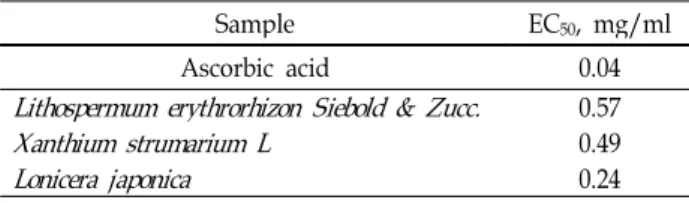
Furthermore, the radical scavenging activity measured through the DPPH assay appeared highest in the Lonicera japonica's extract, and its EC50 was 0.24 mg/ml. Compared to the control, the xanthine oxidase inhibiting activities of all extracts were effective at 0.01 mg/ml concentration. Superoxide radi- cal scavenging activity in Lithospermum erythrorhizon Siebold & Zucc. and Lonicera japonica was more than 80%, with a concentration of 50 mg/ml. OH radical scavenging activity was 40% in the three plants, with a concentration of 50 mg/ml scavenging activity. From our results, we demonstrated that the ethanol extracts of three medicinal plants have antioxidant activities and could be potential candi- dates for natural antioxidants.
Key words : Antioxidant, Lithospermum erythrorhizon Siebold & Zucc., Xanthium strumarium Linn, Lonicera japonica
*Corresponding author
*Tel:+82-51-540-3854, Fax:+82-51-540-3676
*E-mail : [email protected]
This is an Open-Access article distributed under the terms of the Creative Commons Attribution Non-Commercial License (http://creativecommons.org/licenses/by-nc/3.0) which permits unrestricted non-commercial use, distribution, and reproduction in any medium, provided the original work is properly cited.
Journal of Life Science 2013 Vol. 23. No. 5. 643~649 DOI : http://dx.doi.org/10.5352/JLS.2013.23.5.643
서 론
현재 지구상에서 이용되고 있는 식물은 20,000만여 종에 달 하나 이중 수십 여 종만이 식용 가능하다고 보고되고 있고, 우리나라의 경우 약 900여 종의 이용 가능한 약용식물이 분포 하고 있다[21]. 각종 천연물 특히, 식용식물이나 한방생명자원 은 많은 종류의 생리활성 물질을 함유하며[15, 20], 오랫동안 식품으로 이용하거나 여러 가지 질병에 대한 치료 및 예방의 용도로 사용되어 왔으나 이의 효능에 대한 과학적 근거를 명 확히 제시하지 못하여 상대적으로 그 활용도가 낮았다. 그러 나 최근 건강에 대한 관심이 높아지면서 동양의학에서 주로 이용되고 있는 한방생명자원을 활용하기 위한 연구가 활발히 진행되고 있다[14]. 예로부터 생약제로 사용된 어성초는 이뇨, 강심, 해열 및 배농작용, 항균작용, 피부의 염증에 효과가 있으 며[23], 항균활성[25], 항염증작용[6], 해독작용[2]이 있는 것으
로 보고되었다. 한방에서 해열, 소염, 진통제 등으로 사용되고 있는 목단피는 항염증효과와 항산화 효과[1]를 가지고 있으며, 초피 추출물의 항암효과[12], 강황, 파고지, 석곡, 오미자, 호장 근 추출물 등의 항균성이 우수하다는 연구[3] 등이 있다.
지치(芝草: Lithospermum erythrorhizon Sieb. et Zucc.)는 지 치과의 다년생 초본 식물로서 우리나라의 강원도, 제천 등의 야산에 주로 자생하고 지치 뿌리는 예로부터 우리나라, 중국 과 일본에서 한약재와 식용색소로 이용되었다[14]. 한방에서 혈액순환 촉진, 해열, 해독 작용에 주로 이용하거나 토혈, 혈 뇨, 변비, 화상, 습진, 요로 감염 등을 치료하는데 사용하여 왔다[12]. 지치에 대한 연구로는 acethylshikonin 및 shikonin 에 의한 항염증과 창상 치유 촉진 효과, shikonin과 그 유도 체 화합물에 의한 항종양 작용, 항미생물 효과가 밝혀져 있 다[29].
창이자(蒼耳子:Xanthium strumarium L.)은 국화과 식물로 서 도꼬마리의 열매로, 전국 각지에 널리 분포하고 있으며 특 히 길가나 황폐지 등에서도 자생력이 강한 한해살이풀로써 꽃이 지고 난 뒤 길이 1 cm 가량 되는 많은 가시를 가진 열매가 달리며 속에 있는 두 개의 씨가 한약재로 쓰이고 있다. 창이자 는 중이염, 알레르기 비염 또는 취비증 같은 염증질환에 치료 제로 사용되어온 한국의 전통 약재로써[8], 면역 증강, 세균
및 진균류 등에 대한 향균효과[9, 19], 다양한 암세포 주에 대한 함암효과 및 항변이원성효과[10] 등에 관한 연구가 있다.
인동초(忍冬草:Lonicera japonica Thunberg, 일명: 금은화)는 사철 푸른 떨기나무에 속하며 플라보노이드, 탄닌, 알칼로이 드, 루테루닌, 이노시톨, 사포닌, 로니세린 성분을 함유하고 있으며, 이러한 성분이 폐경, 비경, 해열, 해독 효과가 있다.
이중 루테오린은 평활근에 작용하여 진정작용, 이뇨작용을 보 이는 것으로 알려져 있다. 또한 민간에서는 면역 부활작용, 소염작용, 진통작용, 이뇨작용 등의 다양한 약리작용이 있는 것으로 전해지고 있다. 인동초의 flavonoid 성분으로서는 lu- teolin, apigenin, apigenin 등이 알려져 있다[23, 24].
이에 본 연구는 다양한 유용성분과 생리활성을 가지고 있는 3종의 약용식물(지치, 창이자, 인동초)들을 ethanol로 추출하 여 총 페놀함량, DPPH radical 소거능, xanthine oxidase 저해 능, ROS 소거능을 측정함으로써 한약재의 항산화 활성을 알 아보고자 하였다.
재료 및 방법 재료 및 시약
본 실험에 사용한 한약재 지치(Lithospermum erythrorhizon Siebold & Zucc.), 창이자(Xanthium strumarium L), 인동초 (Lonicera japonica)는 (주) 화림한약 (Busan)에서 건조된 상태로 구입하여 사용하였다. 실험에 사용된 시약 중 1,1-di- phenyl-2-picrylhydrazy (DPPH), xanthine oxidase, hydrox- anthine, folin phenol, 및 2’,7’-Dichlorodihydrofluorescein di- acetate (DCFDA) 등은 Sigma-Aldrich사(St. Louis, MI, USA) 에서 구입하여 사용하였으며, 추출 용매 및 그 외 시약은 일급 또는 특급 시약을 사용하였다.
시료의 추출
시료로 사용된 한약재 건조물의 무게의 5배량의 70% etha- nol을 가하여 실온에서 7일 동안 유효 성분을 추출하였다. 이 를 여과한 다음 회전식진공농축기로 감압 농축 후 건조하여 수율을 측정하였다. 실험 전까지 -20℃에 보관하면서 적정 농 도로 ethanol에 용해하여 실험에 사용하였다.
총 폴리페놀 함량 측정
총 페놀 함량은 Foline-ciocalteau법[27]을 변형하여 측정하 였다. 각각의 시료를 0.1 mg/ml, 1.0 mg/ml, 10.0 mg/ml의 농도로 조제한 뒤 20 μl를 취한 후 1 N Folin-ciocalteau 시약을 50 μl, 증류수 790 μl를 첨가한 후 상온에서 5분간 반응시켰다.
20% sodium carbonate를 150 μl를 첨가한 후 다시 2시간 동안 반응하여 765 nm에서 흡광도를 측정하였다. 공시험은 증류수 를 이용하였으며, 결과는 gallic acid를 standard로 한 표준 검 량 곡선을 작성한 후 페놀 함량을 정량하였다.
DPPH radical 소거 활성
DPPH 라디칼 소거 활성은 Park 등의 방법[16]에 따라 측정 하였다. 즉 시험관에 시료 용액 500 μl를 넣고, 500 μl의 ethanol 과 250 μl의 0.5 mM 1,1-diphenyl-2-picrylhydrazyl (DPPH) /ethanol 용액을 첨가하여 25℃의 실온에서 30분 동안 방치한 후, 517 nm에서 흡광도를 측정하였다. 대조구는 시료 대신 500 μl의 탈이온수를 사용하였으며, Blank 시험은 DPPH와 증류수 대신 750 μl의 ethanol을 사용하였다.
Xanthine oxidase 저해 활성
Xanthine oxidase 활성은 Stirpe 법[25]에 따라 측정하였다.
즉 시료 1 ml에 1.9 ml의 50 mM potassium phosphate buffer (pH 7.5)와 기질로써 1 ml의 20 ug/ml hypoxanthine를 가한 다. 0.1 ml의 0.25 unit/ml xanthine oxidase를 가하여 37℃에 서 15분간 반응시킨 후 1 N HCl 1 ml를 가하여 반응을 정지시 킨 다음 290 nm에서 흡광도를 측정하였다. 대조구는 시료 대 신 시료를 녹인 ethanol을 상기와 같은 방법으로 행하였으며 효소의 저해율은 반응 용액 중에 생성된 uric acid의 백분율로 써 나타내었다.
Inhibition rate%)= (1-시료 첨가시의 효소 활성도×100) 대조구의 효소 활성도
활성산소 측정
Reactive oxygen species (ROS) 제거능을 측정하기 위해 DCFDA 측정법[21]을 이용하여 측정하였다. 99.9%의 에탄올 에 용해한 1 mM 2',7'-Dichlorodihydrofluorescein diacetate (DCFDA)와 3차 증류수에 용해한 600 U/ml Esterase를 -20℃
에 stock solution으로 저장하였으며, 실험실 1mM DCFDA와 600 U/ml Esterase를 혼합하여 37℃에서 20분간 배양하여 조 제된 2',7'-dichlorodihydrofluorescein (DCFH)는 사용 전까지 암소에서 냉동보관 한 뒤 100배 희석하여 라디칼 소거능 측정 에 사용하였다.
Superoxide radical scavenging activity
O2-생성량은 130 μl의 50 mM potassium phosphate buffer (pH 7.4)에 시료 10 μl와 10 μl의 20 mM menadion을 넣어 37℃에서 5분간 shaking 한 후 100배 희석한 DCFH용액 50 μl를 첨가하여 O2-와의 반응하여 20분간 생성된 형광의 변화 를 excitation wavelength 485 nm 및 emission wavelength 530 nm에서 측정하였다.
Hydroxyl radical scavenging activity
Fenton 반응에 따라 시료 10 μl와 50 mM potassium phos- phate (pH 7.4) 130 μl에 10 mM FeSO4 540 μl와 1.35 mM H2O220 ml를 섞은 혼합액 190 μl를 가하여 37℃에서 5분간 반응 후 100배 희석한 DCFH 용액 50 μl를 첨가하여 DCFH
용액이 OH와 반응하여 20분간 생성된 형광의 변화를 ex- citation wavelength 485 nm 및 emission wavelength 530 nm 에서 측정하였다.
통계처리
본 연구의 모든 실험 결과는 3회 이상 반복으로 평균값으로 나타내었다. 통계분석은 Student's t-test를 이용하였으며, 각 각의 시료에 대해 평균 ± 표준편차로 나타내었다. 각 시료군에 대한 유의성 검증은 분산분석을 한 후p<0.05 수준에서 각 실 험군 평균값간의 유의성을 검증하였다.
결과 및 고찰 추출 수율 및 총 페놀 함량
한약재 건조물 무게의 5배량의 70% ethanol을 가하여 실온 에서 7일 동안 유효 성분을 추출한 수율을 측정한 결과는 Table 1과 같다. 각 한약재의 추출 수율은 창이자가 2.92%로 가장 낮았으며 인동초가 7.95%로 가장 높게 나타났다. Kang 등[7]에 의하면 천연 추출물의 항산화활성이 높게 인정된다 하더라고 추출 추율이 낮으면 경제성이 없다고 하였다. 현재 산업적으로 생산되는 탈지미강 추출물의 추출 수율이 7-10%
인 것을 감안할 때 창이자는 경제성 면에서 다소 부적합할 것으로 판단된다.
Total phenol 함량
일반적으로 식물체가 가지는 페놀성 물질이 항산화 활성과 높은 관련이 있는 것으로 알려져 있다[5]. 페놀성 화합물은 식 물계에 널리 분포되어 있는 2차 대사산물의 하나로서 다양한 구조와 분자량을 가지며, 자유 라디칼을 수용 할 수 있는 phe- nolic hydroxyl 기를 가지기 때문에 단백질 및 기타 거대 분자 들과 결합하는 성질을 가지며, 항산화, 항균, 항암 등의 생리기 능을 가진다[2, 26]. 이러한 성질 때문에 페놀성 화합물을 건강 유지와 질병 예방을 위해 식품이나 의료 등에 많이 이용되고 있다. 본 연구에서 사용한 지치, 창이자, 인동초 에탄올 추출물 의 페놀성 화합물 함량은 각각 4.3±0.1, 5.4±0.1, 4.6±0.1 μg/ml 으로 창이자가 가장 많은 페놀성 화합물을 함유하고 있는 것 으로 나타났다.
DPPH radical 소거활성
DPPH는 짙은 자색을 띄는 화학적으로 유도되는 비교적
Table 1. Yields of 70% ethanol extracts from medicinal plant
Sample Extraction
yield (%) Lithospermum erythrorhizon Siebold & Zucc. 7.01 Xanthium strumarium L 2.92
Lonicera japonica 7.95
안정한 radical로서, 항산화 물질에 의해 전자를 공여 받으면 환원되어 고유의 자색이 엷어지면서 노란색으로 탈색되는 성 질을 가지고 있다[2, 22]. 일종의 전자공여능을 측정하는 방법 으로 DPPH의 환원 정도를 기준으로 측정물질의 환원력과 항 산화력을 가늠하게 된다[28]. 한약재 추출물을 0.01, 0.1, 1.0, 5.0, 10.0 mg/ml의 농도로 처리한 후 DPPH radical 소거능을 조사하고, DPPH radical 소거 활성을 50% 저하시키는 EC50값 을 나타내었다(Table 3). 각 추출물의 EC50값은 0.24-0.57 mg/ml 농도범위에서 나타났으며, 그 중 인동초의 radical 소 거능이 가장 우수한 것으로 나타났다. Park [18]의 연구에 따르 면 10.0 mg/ml의 농도에서 물 추출물의 경우, 국화 63%, 당귀 49.6%, 작약 49.6%, 황기 17.3%이었으며, 에탄올 추출물의 경 우, 감초 63.8%, 대추 48.8%, 국화 30.2% 천궁 15.3%의 radical 소거능을 가짐을 확인하였다. 즉, 물 추출물이 에탄올 추출물 에 비하여 높은 소거능을 확인할 수 있었다. 또한 Kim 등[11]
에 의하면 재배 지치의 용매 분획물의 IC50은 n-hexane 70.90 μg/ml, chloroform 89.82 μg/ml, ethyl acetate 312.64 μg/ml, n-butanol 분획물 946.95 μg/ml로 용매 극성 차이에 따라 활성 도가 순차적으로 떨어졌다고 하였다. 따라서 DPPH radical 소거능은 추출시 용매, 추출 조건 등에 따라 다소 활성의 차이 가 나타나는 것으로 판단된다.
Xanthine oxidase 저해작용
한약재 추출물의 xanthine oxidase (XOase)의 저해 활성을 측정한 결과는 Table 4와 같다. XOase는 xanthine을 기질로 하여 uric acid를 생성하는 과정에서 superoxide radical을 생 성하는 효소이다[4, 30]. 생체 내 유리기 생성계중 하나인 XOase는 purine, pyrimidine, pteridine, aldehyde류 및 heter- ocyclic compound 등의 대사에 관여하는 비특이적 효소로서 생체 내에서는 주로 purine체의 대사산물인 hypoxanthine을 xanthine으로, xanthine을 다시 산화시켜 uric acid를 생성하 는 반응의 촉매로 작용한다[4]. 0.01 mg/ml 농도 구간에서 각
Table 2. Total polyphenolics contents of the medicinal plant ex- tracts
Sample μg/ml
Lithospermum erythrorhizon Siebold & Zucc. 4.3±0.1 Xanthium strumarium L 5.4±0.1
Lonicera japonica 4.6±0.1
Table 3. The EC50 value of DPPH antiradical activity
Sample EC50, mg/ml
Ascorbic acid 0.04
Lithospermum erythrorhizon Siebold & Zucc. 0.57 Xanthium strumarium L 0.49
Lonicera japonica 0.24
Table 4. Xanthine oxidase inhibit activity of medicinal plant extract
Sample Concentration (mg/ml) Xanthine oxidase inhibit activity (%)
Control 100.0±2.2
Ascorbic acid
0.01 89.4±1.5*
0.05 57.7±4.3*
0.1 39.2±0.8*
0.5 23.9±5.2*
1 -
Lithospermum erythrorhizon Siebold & Zucc.
0.01 75.6±0.5*
0.05 71.2±0.3*
0.1 72.6±7.5*
0.5 50.2±4.3*
1 44.1±6.0*
Xanthium strumarium L
0.01 61.7±3.1*
0.05 59.1±6.3*
0.1 53.8±8.4*
0.5 52.2±13.4*
1 48.7±2.7*
Lonicera japonica
0.01 71.9±2.2*
0.05 61.8±1.6*
0.1 51.9±2.9*
0.5 48.4±4.2*
1 41.5±4.7*
*p<0.05; compared with control group.
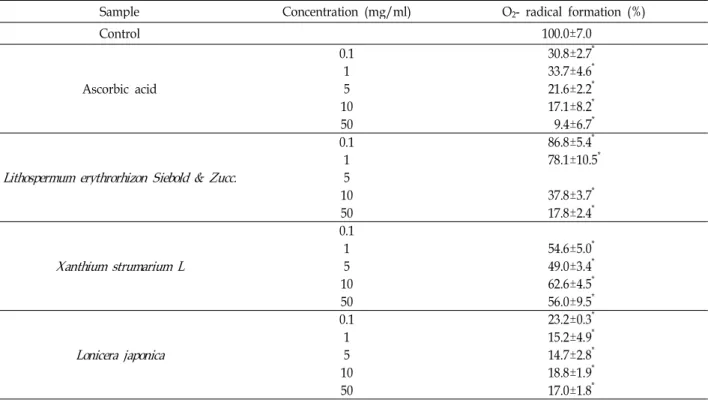
Table 5. O2- radical formation activities of medicinal plant extracts
Sample Concentration (mg/ml) O2- radical formation (%)
Control 100.0±7.0
Ascorbic acid
0.1 30.8±2.7*
1 33.7±4.6*
5 21.6±2.2*
10 17.1±8.2*
50 9.4±6.7*
Lithospermum erythrorhizon Siebold & Zucc.
0.1 86.8±5.4*
1 78.1±10.5*
5
10 37.8±3.7*
50 17.8±2.4*
Xanthium strumarium L
0.1
1 54.6±5.0*
5 49.0±3.4*
10 62.6±4.5*
50 56.0±9.5*
Lonicera japonica
0.1 23.2±0.3*
1 15.2±4.9*
5 14.7±2.8*
10 18.8±1.9*
50 17.0±1.8*
*p<0.05; compared with control group.
추출물들은 대조구로 사용된 ascorbic acid 보다 약 2-3배 높은 저해 활성을 보였으며, 그 중 페놀화합물 함량이 가장 높게 나타났던 창이자의 효소 활성저해작용이 가장 높은 것으로
나타났다. 이는 총페놀함량과 XOase저해활성이 비례관계를 보인다고 한, 민 등[16]의 결과와 일치한다. 그러나, 농도가 증 가할수록 저해 활성은 다소 낮게 증가하는 것을 확인할 수
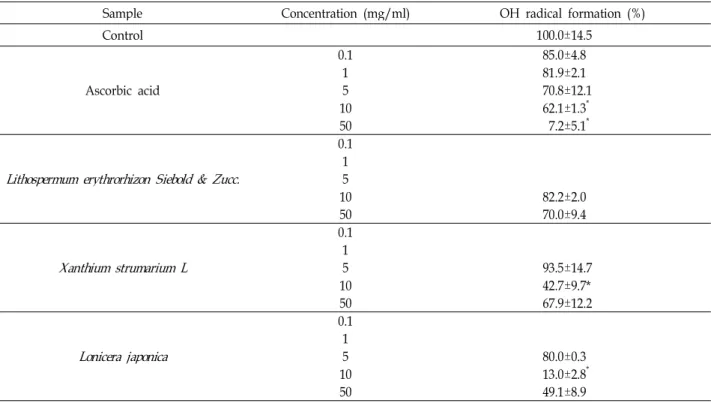
Table 6. OH radical formation activities of medicinal plant extract
Sample Concentration (mg/ml) OH radical formation (%)
Control 100.0±14.5
Ascorbic acid
0.1 85.0±4.8
1 81.9±2.1
5 70.8±12.1
10 62.1±1.3*
50 7.2±5.1*
Lithospermum erythrorhizon Siebold & Zucc.
0.1 15
10 82.2±2.0
50 70.0±9.4
Xanthium strumarium L
0.1 1
5 93.5±14.7
10 42.7±9.7*
50 67.9±12.2
Lonicera japonica
0.1
15 80.0±0.3
10 13.0±2.8*
50 49.1±8.9
*p<0.05; compared with control group.
있었다(Table 4).
Superoxide radical 소거활성
한약재 추출물의 superoxide radical 소거 활성을 측정한 결과는 Table 5와 같다. 한약재 추출물을 0.01, 0.1, 1.0, 5.0, 10.0 mg/ml의 농도로 처리하였을 때, 창이자의 경우 1.0 - 5.0 mg/ml의 농도 구간에서 50% O2-소거 활성을 보였으나, 다른 농도 구간에서는 다소 낮은 소거활성을 보였다. 인동초의 경 우 0.1mg/ml와 5.0 mg/ml의 농도에서 ascorbic acid보다 높 은 활성을 보였다. OH 소거 활성은, 인동초가 5.0 mg/ml와 10.0 mg/ml의 농도 구간에서 높은 소거 활성을 보였다(Table 6).
이상의 결과들로부터 한약 재료로 널리 이용되고 있는 3종 의 약용식물(지치, 창이자, 인동초)에 대한 기능성 소재로써의 이용 가능성을 확인하였다. 즉, 지치, 창이자, 인동초 에탄올 추출물의 총 페놀함량은 각각 4.3±0.1 μg/ml, 5.4±0.1 μg/ml, 및 4.6±0.1 μg/ml로 나타났으며, DPPH radical 소거능은 인동 초가 0.24 mg/ml에서 EC50이 나타났으며 나머지 2종 모두 높 은 DPPH radical 소거능을 보였다. Xanthine oxidase 저해능 은 0.01 mg/ml의 농도에서 한약재 3종 모두 대조구로 사용된 Ascorbic acid보다 더 높은 활성을 나타내었다. 페놀화합물의 xanthine oxidase저해활성이 탁월한 것은 이미 잘 알려진 바이 며[13], 본 연구에서 사용된 지치, 창이자 및 인동초 추출물은 1.0 mg/ml 이하 농도에서 50% 이상의 xanthine oxidase 저해 활성을 나타내었으므로 xanthine oxidase 저해에 탁월한 효능
을 가진 것으로 사료된다. 그 외에도 superoxide radical 소거 활성은 지치와 인동초가 50 mg/ml의 농도에서 80% 이상의 소거활성을 보였으며, OH radical 소거활성은 50 mg/ml의 농도에서 40% 이상의 소거활성이 나타났다. 따라서, 지치, 창 이자, 인동초 모두 높은 항산화 활성을 가지고 있으며, 기능성 소재로 활용 가능성이 시사된다.
References
1. Boo, Y. C. and Jeon, C. O. 1993. Antioxidants ofTheae Folium and Moutan cortex. J Korean Agric Chem Biotechnol 36, 326-331.
2. Choe, M., Kim, D. J., Lee, H. J., You, J. K., Seo, D. J., Lee, J. H. and Chung, M. J. 2008. A study on the glucose-regulat- ing enzymes and antioxidant activities of water extracts from medicinal herbs.J Korean Soc Food Sci Nutr37, 542-547.
3. Do, J. R., Kim, K. J., Jo, J. H., Kim, Y. M., Kim, B. S., Kim, H. K., Lim, S. D. and Lee, S. W. 2005. Antimicrobial, anti- hypertensive and anticancer activities of medicinal herbs.
Korean J Food Sci Technol 37, 206-213.
4. Duke, E. J., Joyce, P. and Ryan, J. P. 1973. Characterization of alternative molecular forms of xanthine oxidase in the mouse. J Biochem131, 187-190.
5. Han, S. K. 2004. Anthioxidant effect of fermented Salicornia herbacea L. liquid with EM (effective microorganism) on pork. Korean J Food Sci Ani Res 24, 298-302.
6. Hwang, B. Y., Lee, J. H., Koo, T. H., Kim, H. S., Hong, Y.
S., Ro, J. S., Lee, K. S. and Lee, J. J. 2002. Furanoligularenone, an eremophilane fromLigularia Fischeri, inhibits the LPS in- duced production of nitric oxide and prostaglandin E2 in macrophage RAW-264.7 cells. Planta Med68, 101-105.
7. Kang, W. S., Kim, J. H., Park, E. J. and Yoon, K. R. 1998.
Antioxidative property of Turmeric (Curumae Rhizoma) etha- nol extract. Korean J Food Technol 30, 266-271.
8. Kim, H. M., Yi, J. M. and Lim, K. S. 1999. Magnoliae flos inhibits mast cell-dependent immediate-type allergic reactions. Pharmacol Res39, 107-111.
9. Kim, H. S. and Shin, J. O. 1997. Isolation and antimicrobial activity of Xanthium strumarium L. extract. Korean J Appl Microbiol Biotechnol 25, 183-188.
10. Kim, H. S., Lee, I. S., Yeo, S. H.. Seong, L. S. and Yu, T.
S. 2003. Isolation and characterization of antitumor agents fromXanthium strumarium L. Korean J Biotechnol Bioeng18, 324-328.
11. Kim, J. S. and Kang, M. H. 2010. Antioxidant activity of solvent fractions from cultivated and wild gromwell. J Korean Soc Food Sci Nutr 39, 789-795.
12. Kim, S. H. and Park, K. Y. 1993. Inhibitory effects of chinese papper on the mutagenicity and the growth of MG-63 hu- man osteosarcoma cell.Korean J Appl Microbiol Biotechnol21, 628-634.
13. Lee, K. S., Ahn, D. K., Shin, M. K. and Kim, C. M. 1998.
In the encyclopedia of oriental herbal medicine. Jungdam Pubishing Co., 4657-4663.
14. Lee, Y. S., Choi, J. B., Joo, E. Y. and Kim, N. W. 2007.
Antioxidative activities and tyrosinase inhibition of water extracts fromAilanthus altissima.J Korean Soc Food Sci Nutr 36, 1113-1119.
15. Nguyen, M. T., Awale, S., Tezuka, Y., Tran, Q. L., Watanabe, H. and Kadota, S. 2004. Xanthine oxidase inhibitory activity of Vietnamese medicinal plants. Biol Pharm Bull 27, 1414-1421.
16. Min, K. J., Song, J. W., and Cha, C. G. 2008. The antioxidative and antitumor activity of extracts ofAgrimonia pilosa. J Fd Hyg Safety 23, 149-156.
17. Park, S. M., Jung, H. J., Han, S. H., Yeo, S. S., Kim, Y. W., Ahn, H. G., Kim, H. S. and Yu, T. S. 2005. Antifungal activity of extract fromXanthium strumarium L. against plant patho- genous fungi. J Life Sci 15, 255-262.
18. Park, Y. S. 2002. Antioxidative activities and contnets of
polyphenolic compound of medicinal herb extracts. J Fast Asian Soc Dietary Life12, 23-31.
19. Park, E. Y., Murakami, H., Mori, O. and Matsumura, Y. 2005.
Effects of protein and peptide addition on lipid oxidation in powder model system. J Agric Food Chem53, 137-144.
20. Perry, L. M. 1990. Medicinal plants of East and Southeast Asia: attributed properties and uses.The MIT Press, London. 431.
21. Rim, Y. S., Park, Y. M., Park, M. S., Kim, K. Y., Kim, M.
J. and Choi, Y. H. 2000. Screening of antioxidants and anti- microbial activity in native plants. Korean J Med Crop Sci 8, 342-350.
22. Shin, M. O. 2010. The antioxidative and antimicrobial effects of internal organs of aplysia kurodai fractions.J Korean Soc Food Sci Nutr 39, 1433-1438
23. Son, K. H., Kim, J. S., Kang, S. S., Kim, H. P., Chang, H.
W. 1994. Isolation of flavonoids from Lonicera japonica.
Korean J Pharmacog 25, 24-27.
24. Son, K. H., Park, J. O., Chung, K. C., Chang, H. W., Kim, H. P., Kim, J. S. and Kang, S. S. 1992. Flavonoids from aerial parts of Lonicera japonica. Arch Pharm Res 15, 365-370.
25. Song, J. H., Kim, M. J., Kwon, H. D. and Park, I. H. 2003.
Antimicrobial activity of fractional extracts fromHouttuynia cordata root. J Korean Sci Nutr 32, 1053-1058.
26. Tabata, M., Tsukada, M. and Fukui, H. 1987. Antimicrobial activity of quinone derivatives fromEchium lysopsiscallus cultures. Planta Med44, 234-236.
27. Taga, M. S., Miller, E. E. and Pratt, D. E. 1984. Chia seeds as a source of natural lipid antioxidants. J Am Oil Chem Society61, 928-993.
28. Yeo, S. G., Park, Y. B., Kim, I. S., Kim, S. B. and Park, Y.
H. 1995. Inhibition of xanthine oxidase by tea extracts from green tea, oolong tea and black tea.J Korean Soc Food Nutr 24, 154-159.
29. Yu, H. E., Leaniza, M. M., Bae, Y. J., Lee, D. H., Park, J.
S., Kwak, H. S., Kim, H. K. and Lee, J. S. 2005. Screening and extraction condition of antiaging bioactive substances from medicinal plants. J Korean Soc Food Sci Nutr 34, 1136-1142.
30. Ziegler, D. W., Hutchison, H. D. and Kissing, R. E. 1971.
Induction of xanthine oxidase by virus infections in new- born mice. Infect Immun 3, 237-242.
초록:한약재에탄올 추출물의 항산화 효과 정민화1․이수선2․박시향2․황혜정3*
(1서경대학교 미용예술학과, 2마린바이오 테크, 3동부산대학교 식품영양과)
본 연구에서는 한약 재료로 널리 이용되고 있는 3종의 약용식물(지치, 창이자, 인동초)을 기능성 소재로 이용하 기 위하여 총 페놀함량, DPPH radical 소거능, xanthine oxidase 저해능 등의 실험을 통해 한약재의 항산화 활성 을 살펴보았다. 지치, 창이자, 인동초의 수율은 각 7.01%, 2.92%, 7.95%, 총 페놀함량은 각 4.3±0.1 μg/ml, 5.4±0.1 μg/ml, 4.6±0.1 μg/ml를 함유하고 있었다. DPPH radical 소거능은 인동초가 0.24 mg/ml에서 EC50이 나타났으며 나머지 2종 모두 높은 DPPH radical 소거능을 보였다. Xanthine oxidase 저해능은 0.01 mg/ml의 농도에서 한약 재 3종 모두 대조구로 사용된 ascorbic acid보다 더 높은 저해 활성을 나타내었다. 그 외에도 Superoxide radical 소거활성은 지치와 인동초가 50 mg/ml의 농도에서 80% 이상의 소거활성을 보였으며, OH radical 소거활성은 50 mg/ml의 농도에서 40% 이상의 소거활성이 나타났다. 이상의 결과로부터 지치, 창이자, 인동초 모두 높은 항 산화 활성을 가지고 있으며, 기능성 소재로 활용 가능함을 확인하였다.