• 검색 결과가 없습니다.

Molecular and Physiological Aspects of Breeding Program for Development of Hybrids between Abalones Distributed in the Coast of Korea

N/A
N/A
Protected

Academic year: 2021

Share "Molecular and Physiological Aspects of Breeding Program for Development of Hybrids between Abalones Distributed in the Coast of Korea"

Copied!
6
0
0

로드 중.... (전체 텍스트 보기)

전체 글

(1)

Molecular and Physiological Aspects of Breeding Program for Development of Hybrids between Abalones Distributed in the Coast of Korea

Jong Kyu Lee

1,2

, Yong Bae Seo

1,2

, Gun-Do Kim

1

* and Han Kyu Lim

3

*

1

Department of Microbiology, College of Natural Sciences, Pukyong National University, Busan 48513, Korea

2

Institute of Marine Life Science, Pukyong National University, Busan 48513, Korea

3

Department of Marine and Fisheries Resources, College of Natural Sciences, Mokpo National University, Jeonnam 58554, Korea Received October 24, 2016 /Revised October 28, 2016 /Accepted October 28, 2016

Abalones are gastropod mollusks belonging to the genus Haliotis. Fishery products are continuously declining worldwide while abalone production from aquatic farms has considerably increased. Although abalones are regarded as very important marine resources and considered to have big potential in sea-food farming industry around world, the slow growth rate of Pacific abalones is considered to be one of the most serious problems. For the genetic improvements in cultured abalone, advances in vari- ous breeding techniques for abalone have been reached through the introduction of selection, cross- breeding, hybridization, and polyploidy in several commercially important abalone species. Six species of abalone have been reported to be distributed along the coasts of Korea: Haliotis discus hannai, Haliotis discus discus, Haliotis madaka, Haliotis gigantea, Haliotis diversicolor diversicolor, and Haliotis di- versicolor supertexta. The hybridization between these abalones may be one of the advanced tech- nologies, and the preliminary experiments of interspecific hybrids between abalone species distributed in northern pacific areas including Korea, China, and Japan have been conducted. In this study, we reviewed the phylogenetic relationship of northern pacific abalone species which have the potential traits for aquaculture in Korea and their identifications. We also examined the development of molec- ular markers and some other aspects of the genetic approaches for successful development of hybrids.

Key words : Abalone, breeding, growth, heterosis, hybridization

*Corresponding authors

*Tel : +82-61-450-2395, Fax : +82-61-452-8875

*E-mail : [email protected] (Han Kyu Lim)

*Tel : +82-51-629-5618, Fax : +82-51-629-5619

*E-mail : [email protected] (Gun-Do Kim)

This is an Open-Access article distributed under the terms of the Creative Commons Attribution Non-Commercial License (http://creativecommons.org/licenses/by-nc/3.0) which permits unrestricted non-commercial use, distribution, and reproduction in any medium, provided the original work is properly cited.

Journal of Life Science 2016 Vol. 26. No. 10. 1218~1223 DOI : http://dx.doi.org/10.5352/JLS.2016.26.10.1218

서 론

전복(abalone)은 우리나라를 포함해 전 세계적으로 사용되 는 고급 식량자원이다. 전 세계적으로 온대 및 열대 지역에 약 57 여종이 보고되고 있다[14]. 1970년대 이후 기후 변화와 남획으로 인해 자연산 전복 자원이 감소함에 따라 어업에 의 한 공급은 줄어 들고 있으며, 대신 양식에 의한 생산량이 증가 하고 있다[15]. 우리나라 역시 1970년대에 양식 사업을 시작, 현재 완도 지역을 중심으로 중국에 이어 세계 2번째 전복 양식 생산국이 되었다[40]. 중국, 일본 및 한국의 양식 전복은 3국 해안에 분포한 북방전복(Haliotis discus hannai)이 주 종을 이루 고 있다. 어업에 의한 전복의 생산량은 줄고 양식 생산은 증가 하였으나, 전체 생산량이 소비자 수요의 증가를 따르지 못하 고 있는 실정이다. 자원 보존을 위해 어업에 의한 생산은 각

국에서 줄여야 하는 추세이고, 따라서, 양식을 통한 생산량 증가에 많은 노력이 필요한 시점이다.

전복 양식을 통한 생산성 증가를 위해 다양한 방법들이 시 도되고 있으며, 2000년도에 들어서 각 주요 전복 양식 국가들 은 개별 국가의 고유 지역 양식 종을 이용해 새로운 양식용 품종개발을 위한 선발육종 연구를 진행하고 있다. 중국은 중 국 지역의 북방전복과 일본 지역의 북방전복 간의 교배를 통 하여 개발된 품종을 양식에 활용하고 있으며[10], 호주의 경우 지역 종인 H. laevigata (greenlip)와 H. rubra (blacklip)의 종간 교잡(interspecific hybridization)을 통하여 새로운 품종인 Tiger 전복을 개발한 사례가 있다[33].

품종개발은 그 지역 소비자와 생산자의 기호도가 반영된 목표 형질의 설정, 양식과 품질 개량 지식 및 기술을 기반으로 올바른 계획의 수립이 필요한 장기 과제이다. 본 총설은 국내 에 서식하는 전복 종 간의 종간교잡에 의한 양식용 품종 개발 에 있어서 고려해야 할 사항들과 시행되어 온 예비 실험 결과 들에 대하여 살펴보고자 한다.

본 론

한국 분포 전복 종

국내 연안에 서식하는 전복은 형태 및 생태학적 차이에 따

- Review -

(2)

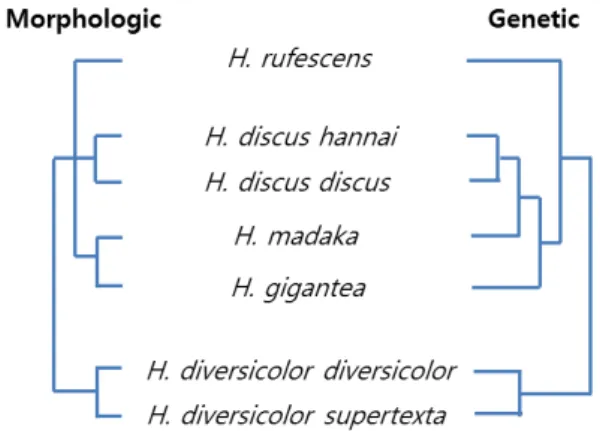
Fig. 1. Cladogram of Pacific abalones according to their morpho- logic (left) and genetic (right) relationship.

라 북방전복(H. discus hannai), 둥근전복(H. discus discus), 왕전 복(H. madaka), 말전복(H. gigantea), 마대오분자기(H. diversi- color diversicolor), 오분자기(H. diversicolor supertexta)로 분류되 고 있다[40]. 대부분이 패각(Shell)의 형태적 차이에 따른 것이 다. 중국, 일본, 그리고 한국의 주요 양식 대상종인 북방전복은 중국, 일본, 한국에서 발견되는 한류성 전복이며, 아종인 둥근 전복은 다른 아종인 북방전복과는 형태적으로 뚜렷한 차이가 없으나 난류성 전복의 생태적 차이를 보여, 서식처에서 차이 가 나타난다[19]. 다른 난류성 전복인 왕전복, 말전복은 둥근전 복과 서식처를 공유하는 종들로서 한국에서는 제주도 일대와 독도 지역에 주로 서식하고 있다고 알려져 왔다. 왕전복의 경 우, 둥근전복이나 말전복과 비교해서 수심이 더 깊은 곳에서 주로 서식한다. 1977년에 Habe에 의하여 기존에 말전복과 차 이를 보이는 왕전복이 제안되었다[16]. 오분자기와 마대오분 자기는 동남아 일대에 널리 서식하는 것으로 알려져 있고, 우 리나라에서는 제주도 일대가 주요한 서식지로 알려져 있다.

한국에 서식하는 주요 연안 종들의 계통학적 관계는 RAPD (Random Amplification of Polymorphic DNA)분석을 통하여 처음 조사되었는데, 오분자기는 북방전복, 둥근전복, 말전복 과 계통학적으로 분리되며 말전복은 다시 북방전복 및 둥근전 복과 유전적으로 거리가 멀다는 결과가 보고되었다[21]. 한국 연안의 6종을 대상으로 URP (Universal Rice Primers)를 이용 한 RAPD 분석에서도 비슷한 결과가 도출되었으며 특히, 왕전 복은 말전복 보다 오히려 북방전복과 둥근전복에 더 가깝다고 보고되었다[7]. 일본 연안의 북방전복, 둥근전복, 왕전복, 그리 고 말전복을 대상으로 MS (microsatellite) marker를 이용한 분석에서도 북방전복, 둥근전복, 왕전복은 서로 가까운 관계 인반면 말전복은 보다 먼 관계로 밝혀져 기존에 보고된 여타 결과와 일치함을 보였다[46]. Sperm lysin 유전자를 이용한 계 통분석에서 동북아 종인 북방전복과 말전복은 상당히 먼 지역 적 거리에도 불구하고 오분자기 보다는 서북미 지역의 전복과 더 높은 유연 관계를 보여주었다[23, 24]. Karyotyping 결과, 오분자기의 chromosome 개수는 32 쌍(2n=32), 북방전복, 둥 근전복, 왕전복, 말전복의 chromosome 개수는 36 쌍(2n=36) 을 가지고 있는 것으로 밝혀져[9, 36, 37, 52], 이 결과 역시 오분자기는 나머지 4 종과 유전적으로 거리가 멀다는 것을 증명하였다.

유전적 거리가 가까운 4 종류의 전복(북방전복, 둥근전복, 왕전복, 말전복) 중, 말전복은 북방전복, 둥근전복, 왕전복과 조금 먼 관계에 있으며, 북방전복과 둥근전복이 매우 가까워, 형태적으로나 유전적으로 서로 아종 관계임을 보여주고 있다.

그러나 왕전복의 경우 형태 및 유전적 관점에서 일치하지 않 고 있다. 왕전복의 경우 형태학적으로는 말전복에서 분리된 종이지만, 유전자 분석 결과로는 북방전복과 둥근전복에 더 가깝기 때문이다(Fig. 1). 일본 연안에서 이들 간의 자연 교잡 종(wild hybrids)들이 보고된 [12, 13, 43] 점을 고려하면, 이들

4 종은 공통 조상으로부터 지역적 환경적 생리적 요인에 따라 분화된 종들로 보아야 할 것이다. 왕전복의 분류학적 위치를 논하기 위해서는 보다 많은 자료가 필요하나, 왕전복에 대한 형태적 분류, 지역 집단의 구조(population structure) 등에 대 한 연구가 미미한 실정이다.

종 판별 및 분자 마커

북방전복 및 둥근전복의 경우는 선발육종에 의한 양식용 품종개발을 위해 2004년부터 각 지역 자연산을 이용한 family 가 구축되어 오고 있으나, 왕전복이나 말전복에 대한 구축 사 례가 보고되어 있지는 않다[40]. 따라서, 교잡에 사용 될 초기 집단은 자연산 전복들에 의해 구축되어야 될 것이다. 교잡종 개발에 사용 될 각 종별 초기집단(base population) 구축에 있어서, 서식지를 공유하는 전복류(둥근전복, 왕전복, 말전복) 나 생리적으로 공존할 수 있는 영역(한류와 난류의 공존 지역, 독도)에서 채집된 자연산 전복의 경우 그 형태만으로는 판별 이 용이 하지 않을 수 있다. 또한, 양식 전복이나 복원 사업에 의해 해양으로 방류되어 유입된 양식 전복들이 있을 수도 있 다[42]. 따라서, 분자 마커들을 활용한 정확한 판별이 요구된 다. 이러한 분자 마커들은 종간의 명확한 구분뿐만 아니라, 초기집단 및 교잡종 세대의 유연관계 분석이나 개체 혹은 집 단 간의 유전적 다양성의 차이(genetic variability), 근교약세 (inbreeding depression)를 측정하는 수단이 된다[20, 42].

종 구별을 위해 isozyme, nuclear 18S rDNA, RAPD, mi-

tochondrial 16S rDNA, COI, nuclear ITS-1, MS marker들을

이용한 다양한 판별 방법들이 보고되었다[5, 13, 21, 38, 43,

46, 54]. 북방전복, 둥근전복, 왕전복, 말전복의 유전적 유연관

계를 대부분 실험에서 도출할 수는 있으나, 18S rDNA는 두

아종 북방전복 및 둥근전복, 그리고 오분자기와 마대오분자기

에서 차이가 나타나지 않았으며[54], nuclear ITS-1, mt16S

rDNA, COI 역시 구별이 가능 하다고 하였으나, 각 종에 대한

대상 개체 수가 늘어 날수록 종 내 변이가 늘어나 구별이 잘

되지 않았다고 보고하고 있다[47]. Mitochondrial gene이나 ri-

(3)

bosomal gene을 활용한 판별은 비교적 유연관계가 먼 종들 간에는 잘 활용될 수 있으나, 매우 가까운 종들 사이에선 활용 하기 어려운 방법이다. 조사 대상 개체수가 늘어 날수록 각 유전자의 종내 변이율이 유사종 간의 변이율과 중첩되는 경향 을 보이기 때문이다. 따라서, 각 종에 대하여 소수의 개체 분석 에서 판별의 가능성을 말하는 것은 주의가 요구된다. 다수의 개체를 대상으로 유전자 마커를 분석하고 이를 활용하는 것이 보다 더 정확한 방법이 될 것이다.

Sekino 등은 9 종의 서로 다른 종들을 대상으로 각 종에 대하여 채집된 개체의 판별에 다수의 MS marker를 사용하였 다[46]. 북방전복에서 개발된 24 개의 MS marker들을 다른 종에 대하여 적용해 본 결과, 북방전복과 유연 관계가 멀어 질 수록 marker들에 의한 PCR 증폭이 감소함을 보였다. 이는 개별 MS marker primer가 작용하는 DNA 염기서열이 유연관 계가 멀어 질수록 변이가 있을 가능성이 높고, 이로 인하여 PCR 산물이 만들어 지지 않을 가능성이 높아지기 때문이다.

한 종에서 개발된 MS marker에 대한 다른 종에서의 사용 가능 여부를 “transferability”라고 한다. 또한, 이들은 증폭된 산물 의 길이 변이를 Distance-based assignment 및 Bayesian mod- el-based clustering 기법을 통하여, 90% 혹은 그 이상의 확률 로 북방전복, 둥근전복, 왕전복, 말전복 판별이 가능함을 보였 다. 형태학적 판별과 더불어 많은 유전자 마커를 사용할 수록 판별에 대한 정확도는 높아진다.

MS marker의 개발에는 많은 시간이 소요되지만 일단 개발 이 된다며, 비교적 짧은 시간과 경비로 종 판별뿐만 아니라 다른 응용에도 폭넓게 사용 될 수 있다. 현재까지 북방전복을 대상으로 많은 연구자들에 의해 많은 수의 MS marker가 개발 되었으나[3, 6, 18, 26-28, 44, 45, 49, 59], 왕전복이나 말전복에 대한 MS 마커의 개발은 거의 이루어 지지 않았다[53]. 왕전복 의 경우 멸종위기 대상 종으로 지정되어 있을 정도로 자연산 자원이 줄어 들었으며, 유전자 분석 및 한국 서식 왕전복 집단 (population)에 대한 연구도 전무하다. 이러한 위기에 처한 제 주도 지역의 왕전복과 아울러, 비교적 어업에 의한 집단의 감 소가 드물며 자연 상태를 유지해 온 서식지 발굴이 필요하며, 독도 지역의 왕전복 집단이 그 중 하나의 후보로 꼽히고 있다.

독도 지역은 한류와 난류가 만나는 독특한 환경을 가지고 있 어서 이 지역엔 북방전복, 둥근전복, 왕전복 그리고 말전복이 모두 서식하며, 독도 지역의 북방전복에 대한 유전적 다양성 이 기타 타 지역의 북방전복에 비해 높다고 보고되고 있다[41].

독도 지역의 왕전복 집단도 비슷한 경향을 보일 것으로 예상 되지만, 채집된 독도산 전복의 판별은 형태만으로 판별하는 것은 주의가 필요하다.

각 종에 대하여 다양한 family를 구축하고 유지해야 하는 이유는 전복의 생식 양식에서 기인한다. 전복의 암 수 각 한 마리에서는 상당수의 sperm과 egg를 얻을 수 있기 때문에, 대부분 생식 양식이 broodstock의 암수 몇 쌍에서 시작되며,

이로 인해 세대가 거듭 될 수록 근교계수의 상승으로 근교약 세현상이 나타날 수 있다[42]. 완도 지역 북방전복의 양식형태 또한 개별 업체에 따라서 이러한 경향을 보인다. 근교계수의 상승을 막거나 늦추기 위해서는 적어도 50 쌍 이상을 사용해 야 한다는 보고가 있다[8]. 따라서, 각 종에 대하여 다수의 fam- ily 구축과 유지가 필요하다고 할 수 있다. 호주에서 진행된 greenlip과 blacklip 교잡종 개발에서 각 종에 대한 많은 fam- ily 구축이 선행된 예가 있다[29].

예비 교잡종 실험

교잡종 실험의 진행에 있어서 고려될 형질 및 특징에는 여 러 가지가 있다. 상업적으로 가치가 높으면서 대부분의 산업 계에서 요구되는 형질은 성장률(growth rate)이다. 중국과 일 본에서 이루어진 예비 교잡종 실험의 결과들을 살펴보면, 수 정율(fertilization rate), 생존율(survival rate), 그리고 주요 대 상 형질인 성장률에 대한 보고가 있다[17, 22, 25, 34, 35, 39, 48, 50, 51, 55-58, 60]. 아울러, 교잡종의 생식력(reproduction) 및 병원 저항성(disease tolerance)에 대한 보고가 있다[2, 32].

말전복은 다른 종과의 교잡에서 비교적 낮은 수정율을 보인

다. 이는 유전적 거리가 멀어 질 수록 수정율은 낮아 진다고

볼 수 있다[4]. 왕전복은 말전복에 비해 북방전복이나 둥근전

복과 더 높은 수정율을 보인다. 하지만, 맛에 대한 기호도 평가

는 아직 실시 되지 않았다. 이와 같은 다양한 형질과 맛에 대한

기호도의 고려 또한 경제적 생산에 적합한 교잡종 선정에 활

용될 필요가 있다. Luo 등은 북방전복과 말전복 교잡종에서

성장과 관련된 4가지 형질(shell length, width, height, apex

height)이 body weight와 positive correlation을 보이며, 북방

전복 암놈 × 말전복 숫놈(DG) 교잡종은 shell height, 말전복

암놈 × 북방전복 숫놈(GD) 교잡종은 shell width와 body

weight와 높은 상관관계를 보인다고 보고하였다[31]. 물리적

생물학적 환경 변화에 따른 교잡종의 반응에 대한 연구도 진

행되고 있다. Ahmed 등은 북방전복, 왕전복, 말전복, 이들간

의 교잡종에서 사육밀도(stocking density)의 차이에 따라 먹

이 섭취율(feeding rate) 및 성장율이 차이를 보이며, 각각에

대하여 다른 관리 전략이 필요하다고 지적했다[1]. Liang 등은

온도 변화가 교잡 전복의 생리학적 상태에 많은 영향을 주며,

부모들에 비해 질병이나 온도 스트레스에 더 저항성이 있어

보인다고 보고하였다[30]. Di 등은 북방전복과 말전복 간의 교

잡종이 보이는 heterosis 기작을 이해하기 위해, 근육을 대상으

로 한 단백질 발현 양상 분석을 실시한 결과, 발현 차이 정도가

순수 부모 F1 세대(purebred)에서 최대치를 보이며, 교잡종

F1들의 발현 차이 정도는 순수 부모 F1 세대의 중간 정도의 양상

을 보인다고 보고하였다[11]. 또한, 대부분 발현 차이를 보이는

단백질은 에너지 대사와 스트레스 반응에 관련된 것들이며,

대사관련 단백질은 additive 효과, stress-induced 단백질은

additive 혹은 over-dominance를 보인다고 보고하였다[11].

(4)

결 론

호주의 Tiger abalone의 경우와 같이, 정확한 목표와 기반 시설, 유지 및 관리 지식, 양식 및 진보된 양식 기술 지식들이 집약되어, 통합적 체계에 따라 진행된 선례는 드물며, 대부분 은 각 국가의 지역 종을 활용한 교잡종 예비 실험에서 결과들 이 도출되고 있다. 실험군에 따라, 같은 종 내 차이, 실험 시설, 방법의 차이에서 보이는 환경적 오차에 기인한다고 할 수 있 으므로 직접적인 비교는 어렵다고 할 수 있다. 그러나 교잡으 로 인한 positive heterosis가 관찰되며, 종 간 수정률 비교에서 일관된 차이의 경향이 관찰된다. 상업적으로 중요한 가치를 지니는 형질은 생산성 즉 성장률일 것이다. 북방전복은 전 세 계적으로 맛의 기호도에서 선호되는 종이며, 왕전복과 말전복 은 북방전복이나 둥근전복에 비해 거대 종이다. 교잡을 통해 형질에 모두 뛰어난 교잡종 개발이 중요한 목표가 될 것이다.

이 목표의 달성을 위해서는 성공적인 개발 및 지속적 생산을 위한 각 종의 basal population 구축, variation을 측정할 분자 마커의 개발, 최적의 생산 환경 관리 및 유지를 위한 기술 개 발, 교잡종의 생리 활성적 특성 조사를 위한 연구가 필요할 것이다.

감사의 글

이 논문은 농림축산식품부·해양수산부·농촌진흥청·산림청 Golden Seed 프로젝트 사업(213004-04-4-SB820)에 의해 이루 어진 것임.

References
1. Ahmed, F., Koike, Y., Strussmann, C. A. and Watanabe, S.

2013. Effect of density on growth and feed consumption of the abalones Haliotis discus discus, H. gigantea, H. madaka and their hybrids. Aquac. Int. 21, 969-986.

2. Ahmed, F., Koike, Y., Strussmann, C. A., Yamasaki, I., Yokota, M. and Watanabe, S. 2008. Genetic characterization and gonad development of artificially produced inter- specific hybrids of the abalones, Haliotis discus discus Reeve, Haliotis gigantea Gmelin and Haliotis madaka Habe. Aquac.

Res. 39, 532-541.

3. An, H. S., Lee, J. H., Dong, C. M., Noh, J. K., Kim, H. C., Park, C. J., Park, K. D., Min, B. H., Park, J. W. and Myeong, J. I. 2010. New polymorphic microsatellite markers in Pacific abalone Haliotis discus hannai and their application to genetic characterization of wild and aquaculture populations. Genes Genomics 32, 413-418.

4. An, H. S., Jee, Y. J., Han, S. J., Kim, B. L., Kim, E. M. and Park, I. S. 2007. Induction of a new hybrid between Haliotis gigantea Gmelin (♀) and H. discus discus Reeve (♂). Kor.

J. Genet. 29, 239-244.

5. An, H. S., Jee Y. J., Min, K. S., Kim, B. L. and Han, S. J.

2005. Phylogenetic analysis of six species of Pacific abalone (Haliotidae) based on DNA sequences of 16s rRNA and cy- tochrome c oxidase subunit I mitochondrial genes. Mar.

Biotechnol. 7, 373-380.

6. An, H. S. and Han, S. J. 2006. Isolation and characterization of microsatellite DNA markers in the Pacific abalone, Haliotis discus hannai. Mol. Ecol. Resour. 6, 11-13.

7. An, H. S., Park, J. Y., Myeong, J. I. and An, C. M. 2013.

Genetic relationships of Pacific abalone (Haliotidae) species determined using universal rice primer-polymerase chain reaction fingerprinting. Genet. Mol. Res. 12, 6309-6318.

8. Bentsen, H. B. and Olesen, I. 2002. Designing aquaculture mass selection programs to avoid high inbreeding rates.

Aquaculture 204, 349-359.

9. Cai, M., Ke, C., Luo, X., Wang, G., Wang, Z. and Wang, Y. 2010. Karyological studies of the hybrid larvae of Haliotis diversicolor supertexta female and Haliotis discus discus male.

J. Shellfish Res. 29, 735-740.

10. Deng, Y., Liu, X., Zhang, G. and Wu, F. 2010. Heterosis and combining ability: a diallel cross of three geographically iso- lated populations of Pacific abalone Haliotis discus hannai Ino. Chin. J. Ocean. Limnol. 28, 1195-1199.

11. Di, G., Luo, X., You, W., Zhao, J., Kong, X. and Ke, C. 2015.

Proteomic analysis of muscle between hybrid abalone and parental lines Haliotis gigantea Reeve and Haliotis discus han- nai Ino. Heredity 114, 564-574.

12. Fukagawa, A. and Tachiyama, T. 1997. Possibility of re- production in first and second generations of hybrid ab- alone, Haliotis discus discus × Haliotis discus hannai. Bull.

Fukuoka Prefect. Mar. Tech. Res. Center 7, 31-33.

13. Fujino, K., Sasaki, K. and Wilkins, N. P. 1980. Genetic stud- ies on the Pacific abalone III Differences in electrophoretic patterns between Haliotis discus Reeve and H. discus hannai Ino. Bull. Jpn. Soc. Sci. Fish. 46, 543-548.

14. Geiger, D. L. 1999. Distribution and biogeography of the recent Haliotidae (Gastropoda: Vetigastropoda) World-wide.

Boll. Malacol. 35, 57-120.

15. Gordon, H. R. and Cook, P. A. 2013. World abalone supply, markets, and pricing: 2011 update. J. Shellfish Res. 32, 5-7.

16. Habe, T. 1977. Miscellaneous knowledge about mollusks 8:

Nordotis madaka is a new species. Chiribotan 9, 93-94.

17. Hara, M. 1992. Breeding of abalone-cross and selection. Fish Genet. Breeding Sci. 18, 1-12.

18. Hara, M. and Sekino, M. 2005. Genetic difference between Ezo-awabi Haliotis discus hannai and Kuro-awabi H. discus discus populations: microsatellite-based population analysis in Japanese abalone. Fish. Sci. 71, 754-766.

19. Ino, T. 1953. Biological studies on the propagation of Japanese abalone (genus Haliotis). Bull. Tokai reg. Fish. Res.

Lab. 5, 1-102.

20. Jeong, D. S., Park, C. J. and Jeon, C. Y. 2008. Genetic varia- bility and population structure of Pacific abalone Haliotis discus hannai sampled from stocked areas using micro- satellite DNA markers. J. Kor. Fish. Soc. 41, 466-470.

21. Kim, S. K., Jung, Y. H., Han, S. H., Oh, Y. S., Ko, M. H.

and Oh, M. Y. 2000. Phylogenetic relationship among

(5)

Haliotis spp. distributed in Korea by the RAPD analysis. Kor.

J. Genet. 22, 43-49.

22. Koike, Y., Sun, Z. and Takashima, F. 1988. On the feeding and growth of juvenile hybrid abalones. Suisan Zoshoku 36, 231-235.

23. Lee, Y. H., Ota, T. and Vacquier, V. D. 1995. Positive se- lection is a general phenomenon in the evolution of abalone sperm lysine. Mol. Biol. Evol. 12, 231-238.

24. Lee, Y. H. and Vacquier, V. D. 1995. Evolution and system- atics in Haliotidae (Mollusca: Gastropoda): inferences from DNA sequences of sperm lysine. Mar. Biol. 124, 267-278.

25. Li, F., Zhou, S., Tian, Y. and Ke, C. 2000. Preliminary studies on hybridization of three species of abalone. Mar. Sci.

Qingdao-Chinese Edition 24, 39-41.

26. Li, Q., Park, C. and Kijima, A. 2002. Isolation and character- ization of microsatellite loci in the Pacific abalone, Haliotis discus hannai. J. Shellfish Res. 21, 811-815.

27. Li, Q., Shu, J., Zhao, C., Liu, S., Kong, L. and Zheng, X.

2010. Characterization of genic microsatellite markers de- rived from expressed sequence tags in Pacific abalone (Haliotis discus hannai). Chin. J. Ocean. Limnol. 28, 46-54.

28. Li, Q. and Akihiro, K. 2007. Sequences characterization of microsatellite DNA sequences in Pacific abalone (Haliotis discus hannai). J. Ocean Univ. China 6, 47-52.

29. Li, X. 2008. Abalone aquaculture subprogram: Selective breeding of farmed abalone to enhance growth rates (II).

FRDC Final Report.

30. Liang, S., Luo, X., You. W., Luo, L. and Ke, X. 2014. The role of hybridization in improving the immune response and thermal tolerance of abalone. Fish Shellfish Immunol. 39, 69-77.

31. Luo, X., Ke, C. and You, W. 2013. Estimates of correlations for shell morphological traits on body weight of interspecific hybrids abalone (Haliotis discus hannai and Haliotis gigantea).

J. Shellfish Res. 32, 115-118.

32. Luo, X., Ke, C., You, W. and Wang, D. 2010. Factors affect- ing the fertilization success in laboratory hybridization be- tween Haliotis discus hannai and Haliotis gigantea. J. Shellfish Res. 29, 621-625.

33. Mateos, H. T., Lewandowski, P. A. and Su, X. Q. 2010.

Seasonal variations of total lipid and fatty acid contents in muscle, gonad and digestive glans of farmed Jade Tiger hy- brid abalone in Australia. Food Chem. 123, 436-441.

34. Momma, H. 1990. Breeding test on abalone. NOAA Tech.

Rep. NMFS 92, 71-74.

35. Miyaki, K., Niiyama, H. and Tabeta, O. 1995. Growth and survival of artificial hybrid abalone, Nordotis gigantea ♀ × N. discus ♂ under laboratory rearing conditions. Suisan Zoshoku 43, 401-405.

36. Miyaki, K., Matsuda, M. and Tabeta, O. 1999. Karyotype of the giant abalone, Nordotis madaka. Fish. Sci. 65, 317-318.

37. Miyaki, K., Tabeta, O. and Kayano, H. 1997. Karyotypes of the two species of abalones Nordotis discus and N. gigantea.

Fish. Sci. 63, 179-180.

38. Naganuma, T., Hisadome, K., Shiraishi, K. and Kojima, H.

1998. Molecular distinction of two resemblant abalones,

Haliotis discus discus and Haliotis discus hannai by 18S rDNA sequences. J. Mar. Biotechnol. 6, 59-61.

39. Nie, Z. and Wang, S. 2004. The status of abalone culture in China. J. Shellfish Res. 23, 941-946.

40. Park, C. J. and Kim, S. Y. 2013. Abalone aquaculture in Korea. J. Shellfish Res. 32, 17-19.

41. Park, C. J., Lee, J. H., Noh, J. K., Kim, H. C., Min, B. H.

and Myeong, J. I. 2009. Genetic characteristics of Pacific ab- alone, Haliotis discus hannai in Dokdo Island, Korea. Kor. J.

Malacol. 25, 197-201.

42. Park, C. J., Nam, W. S., Myeong, S. L., Kang, J. Y. and Kim, K. K. 2014. Inbreeding depression of Pacific abalone, Haliotis discus hannai by inbreeding mating experiments. Kor. J.

Malacol. 30, 415-419.

43. Sasaki, K., Kanazawa, K. and Fujino, K. 1980. Zymogram differences among five species of the abalones from the coasts of Japan. Bull. Jpn. Soc. Sci. Fish. 46, 1169-1175.

44. Sekino, M., Kobayashi, T. and Hara, M. 2006. Segregation and linkage analysis of 75 novel microsatellite DNA mark- ers in Pacific crosses of Japanese abalone (Haliotis discus han- nai) using the 5’-tailed primer method. Mar. Biotechnol. 8, 453-466.

45. Sekino, M., Saido, T., Fujita, T., Kobayashi, T. and Takami, H. 2005. Microsatellite DNA markers of Ezo abalone (Halio- tis discus hannai): a preliminary assessment of natural pop- ulations sampled from heavily stocked areas. Aquaculture 243, 33-47.

46. Sekino, M. and Hara, M. 2007. Individual assignment tests proved genetic boundaries in a species complex of Pacific abalone (genus Haliotis). Conserv. Genet. 8, 823-841.

47. Seo, Y. B., Kang, S. C., Choi, S. S., Lee, J. K., Jeong, T. H., Lim, H. K. and Kim, G. D. 2016. Phylogenetic study of genus Haliotis in Korea by cytochrome c oxidase subunit I and RAPD analysis. J. Life Sci. 26, 406-413.

48. Sun, Z., Chang, L. and Song, Z. 2005. Effects of hybrid- ization between Haliotis discus hannai and Haliotis discus.

Fish. Sci. 24, 1-3.

49. Sun, X., Zhen, M. and Yang, G. 2007. Development of 15 polymorphic genic microsatellite DNA markers of Pacific abalone Haliotis discus hannai. Mol. Ecol. Resour. 7, 604-606.

50. Wan, J., Wang, X., Pan, J., Li, B., Li, Z., Bao, Z., Yan, J. and Fang, J. 2001. RAPD analysis of the genetic change in parent abalone and their hybrids. J. Ocean Univ. China 31, 506-512.

51. Wan, F., Bao, Z., Zhang, Q. and Wang, X. 2004. Comparative studies on the molecular genetic diversities among Haliotis discus hannai, H. discus discus and their hybrids. High Tech.

Letters 10, 93-96.

52. Wang, H., Luo, X., You, W., Dong, Y. and Ke, C. 2015.

Cytogenetic analysis and chromosomal characteristics of the polymorphic 18S rDNA of Haliotis discus hannai from Fujian, China. PLoS One 10, e0113816.

53. Wang, M., Bao, Z. and Zhan, A. 2011. Eighteen polymorphic microsatellite markers in the Xishi abalone, Haliotis gigantea.

Conserv. Genet. Resour. 3, 669-671.

54. Wang, Z. Y., Ho, K. C., Yu, D. H., Ke, C. H., Mak, W. Y.

and Chu, K. H. 2004. Lack of genetic divergence in nuclear

(6)

초록:한국산 전복을 이용한 교잡종 개발

이종규

1,2

․서용배

1,2

․김군도

1

*․임한규

3

*

(

1

부경대학교 자연과학대학 미생물학과,

2

부경대학교 해양생명과학연구소,

3

국립목포대학교 해양수산자원학과)

전복은 전복과 전복속에 속하는 복족류 연체동물로, 전 세계적으로 어업에 의한 식용전복의 공급은 감소하고, 양식에 의한 전복생산은 증가하고 있다. 한국, 일본, 중국을 포함해 전 세계적으로 전복은 중요한 해양 식량자원이 며, 양식 산업에 있어서도 그 비중이 증가되고 있긴 하나, 그 느린 성장 속도가 가장 큰 문제점 중의 하나로 여겨 진다. 선별, 종내교잡, 종간교잡, 배수체 등과 같은 여러 진보된 기술의 도입을 통하여 전복의 주요 양식 품종을 개발하기 위한 연구가 시도되고 있다. 양식용 전복품종개발을 위하여, 한국 해안에 서식하고 있는 전복은 6종 (Haliotis discus hannai, 북방전복; Haliotis discus discus, 둥근전복; Haliotis makada, 왕전복; Haliotis gigantea, 말전복;

Haliotis diversicolor diversicolor, 마대오분자기; Haliotis diversicolor supertexta, 오분자기) 간의 교배를 통한 교배종 개발이 유용한 기술 중의 하나가 될 수 있으며, 한국, 중국, 그리고 일본에 서식하는 종 간의 교배종 연구가 활발히 진행 되어 오고 있다. 유용한 잠재적 형질을 가진 한국 산 전복들의 계통학적 관계와 이들의 종 판별에 대해서 살펴볼 것이며, 이들 종들로부터 개발된 분자 마커의 현황과, 성공적인 양식용 교잡종 개발에 있어서 고려해야 할 유전적 사항들에 대하여 알아보고자 한다.

and mitochondrial DNA between subspecies of two Haliotis species. J. Shellfish Res. 23, 1143-1146.

55. Yan, J., Sun, H. F., Fang, J., Zhang, X., Chen, J. and Zhang, C. 1999. Study on the technology of crossbreeding abalones Haliotis discus discus and Haliotis discus hannai Ino. Mar. Fish.

Res. (Progress in Fishery Sciences) 01: Available from URL:

http://en.cnki.com.cn/Article_en/CJFDTOTAL-HYSC 199901006.htm.

56. Zhang, Q. and Niu, M. 2000. Studies on high production of hybridization breeding of abalone. Mar. Sci. Qingdao- Chinese Edition 24, 11-13.

57. Zhang, G., Que, H., Liu, X. and Xu, H. 2004. Abalone mar-

iculture in China. J. Shellfish Res. 23, 947-950.

58. Zhang, Z., Xu, B. J., Zhang, L. B., Sun, H., He, Q. G., Wang, S. W., Sun, X. W. and Liu, X. 2011. Isolation of 106 micro- satellite markers for the Pacific abalone from a trinucleo- tide-enriched library. Biochem. Genet. 49, 625-637.

59. Zhang, Z. 2011. Development of 127 novel microsatellite markers for the Pacific abalone, Haliotis discus hannai. J.

World Aquac. Soc. 42, 423-434.

60. Zheng, S. 2006. Preliminary study on hybridization between Haliotis sieboldii and Haliotis discus hannai. Fujian J. Agric. Sci.

21, 296-298.

수치

Fig.  1.  Cladogram  of  Pacific  abalones  according  to  their  morpho- morpho-logic  (left)  and  genetic  (right)  relationship.

참조

관련 문서

In a statement to Kuwait News Agency (KUNA) on the sidelines of a meeting of the Arab Parliament's Foreign Affairs Political and National Security

The meeting was attended by Assistant Foreign Minister for GCC Affairs, Ambassador, Nasser Al-Muzayyen, and Deputy Assistant Foreign Minister for the Office of the

“ Sheikh Nasser has a written message from HH the Amir, Sheikh Sabah Al-Ahmad Al-Jaber Al-Sabah to the Chinese President, Chi Gen Beng related to enhancing mutual

On his part, CEO of Express Roads Authority, Saud Al-Naqqi said that the heavy rains of the previous day led to clogging parts of the express

Kuwait will celebrate on Sunday the fourth anniversary of the UN honoring and proclamation of His Highness the Amir, Sheikh Sabah Al-Ahmad Al-Jaber Al-Sabah as

• 이명의 치료에 대한 매커니즘과 디지털 음향 기술에 대한 상업적으로의 급속한 발전으로 인해 치료 옵션은 증가했 지만, 선택 가이드 라인은 거의 없음.. •

The proposal of the cell theory as the birth of contemporary cell biology Microscopic studies of plant tissues by Schleiden and of animal tissues by Microscopic studies of

It considers the energy use of the different components that are involved in the distribution and viewing of video content: data centres and content delivery networks