중등학교 과학 교사의 교수유형에 따른 학생들의 과학 불안도
김영신, 서유선, 임수민, 이효녕, 윤회정*
경북대학교
Secondary School Students’ Science Anxiety in Relation to Their Science Teachers’ Teaching Styles in Korea
Youngshin Kim, Yoo-sun Seo, Soo-min Lim, Hyonyong Lee, Heojeong Yoon*
Kyungpook National University A R T I C L E I N F O A B S T R A C T
Article history:
Received 28 March 2014 Received in revised form 22 May 2014
9 June 2014
Accepted 24 June 2014
The purpose of this study was to survey secondary school science teachers' teaching styles and to recognize students' science anxiety about science teachers' different teaching styles. One hundred seventy-four science teachers and 2,122 students participated. The teaching style questionnaire and the science anxiety measurement scale (SAMS) with teaching style were administered to teachers and students, respectively.
Teaching styles were analyzed in terms of teacher's individual variables, such as gender and school level.
The science anxiety related to each teaching style was analyzed and compared in terms of students’
gender and school level. The results were as follows. First, the secondary school science teachers were classified into four types based on their teaching styles: expert, provider, facilitator and enabler. Most teachers fell under the expert style category and the least under enabler style. This indicated that numerous science teachers in secondary school employ a teacher-directed style rather than a student-centered style in class. Second, students felt the highest science anxiety with experts and the lowest science anxiety with enablers. The students’ science anxiety showed statistically significant differences with different teaching styles (p<.05). Even though female students felt higher science anxiety than male students towards all four teaching styles, no statistically significant gender differences were found. Middle school students were more influenced by teaching style than high school students. Some suggestions were made for teachers to reduce students’ science anxiety in classes based on results.
Keywords:
teaching styles, science anxiety, science teacher, secondary school students
* 교신저자 : 윤회정 ([email protected]) http://dx.doi.org/10.14697/jkase.2014.34.4.0367
Ⅰ. Introduction
Science teachers should endeavor to increase interaction with students and engender students' interests in science by engaging them into various educational activities (Masnick & Klahr, 2003; Revard
& Straw, 2000). Those educational activities are performed mainly in the class, thus the class environment is important in developing of proactive interaction and enhancing interests in science. The class environment is influenced by different variables, such as characteristic, transition, and context variables (Kim, 2001a). Teachers' characteri- stics such as their belief, value or pedagogical choice are able to influence on classroom environment. Such teacher related variables are defined as characteristic variables. Transition variables are directly related to teacher and students interactions occurred in teaching- learning process. The behaviour of teacher or students in class environment are included in transition variables. Context variables are the ones expected to interact with the characteristic variables during the class. Such variables correlate with output variables, namely changes in cognitive, affective, and psychomotor domains, which may
occur as an offshoot of the class (Kim, 2001a).
For an effective teaching and learning, the well-balanced development of the aforementioned three variables should be pursued.
However, significant emphasis has been placed on cognitive perspective in most secondary schools in Korea (Kim, 1993). They have focused on exam preparation oriented learning for university entrance and emphasized rote learning. It resulted failure in enhancement of students’ interests in science and attainment of positive attitude toward science learning (Kim, 1993). Science education researchers have pointed out that the promotion of affective characteristics is critical in school curriculum, but not much has been done to realize this (Anderson & Bourke, 2000).
Affective domain focuses on feelings, emotions, and attitudes (McNabb, 1997). Anderson & Bourke (2000) subdivides affective domain into seven subclasses: attitudes, interest, values, preferences, academic self-esteem, locus of control, and anxiety. Among them, they designated anxiety as a factor giving the greatest impact on learning.
Anxiety is a feeling of nervousness. It has been a topic of interest since 1970s. Mallow (1986) firstly introduced the concept of anxiety
Journal of the Korean Association for Science Education
Journal homepage: www.koreascience.org
in science. He defined science anxiety as a fear of individual or society toward scientific theory or concepts, scientist, and activities related to science. Westerback and Long (1990) emphasized the meaning of science anxiety in the context of science learning.
Mallow (1986) mentioned laboratory class, science lecture, and exam situation as three different contexts that could foster science anxiety. Wynstra and Cummings (1993) reported science anxiety was composed of several factors. They suggested six major categories of science anxiety, which are danger anxiety, test anxiety, math and problem solving anxiety, squeamish anxiety, performance anxiety, classroom anxiety. Science anxiety is believed to be triggered by several causes; ranging from bad experiences in past science classes, negative memory with science teachers, a shortage of role models and fixed ideas about gender and race along with stereotypes of scientists as featured in the mass media (Udo et al., 2004). Many studies indicated that science contents and class circumstances caused science anxiety (Kim, 2001a; Kim, 2006; Lee, 2002a; Mallow, 1986).
Kim (2001a) and Kim (2006) reported that students felt science anxiety from science contents introduced in a class. Lee (2002a) reported that science anxiety appeared to be mostly observed in the context of experiment along with the situation in which the science class takes place.
Anxiety becomes a direct or an indirect barrier to learning. Its impact is extended to the thinking processes and daily activities of the person who is experiencing it (Czerniak & Chialelott, 1984).
Moreover, anxiety disturbs students’ recollection and memory from the initial learning stage and impedes to perform academic achievement (Tobias, 1979). Mallow (1986) and Westerback and Long (1990) reported negative impacts of science anxiety on learning and emphasized the need for elimination of students’ science anxiety.
Variables such as gender, age, academic achievement, attitude that possibly affect science anxiety have been studied (Chiarelott &
Czerniak, 1987; Kim, 1993; Kim, 2001b). Different teaching program or strategy have developed to reduce students' science anxiety (Lee, 2002b; Kweon, 2005). Lee (2002b) and Kweon (2005) implemented emotional intelligence improvement program and project approach to eliminate students' science anxiety and obtained positive results.
According to Jeong and Kim (2011), elementary students' science anxiety were influenced by their teacher's teaching style. A teaching style is considered as an influential factor that makes a difference in student’s learning (Emer et al., 2002; Opdenakker & Damme, 2006;
Kuchinskas, 1979). Because a teacher generally plays a fundamental role in class and gives substantial influences to their students (Leung
et al., 2003; Schmidt, 2004). Schmidt (2004) revealed that under-standing the teacher’s teaching method would help determine which among the factors of class teaching, learning skills, and some traditional factors produced the best effect in the process of learning.
Teaching methods influence on students’ attitude towards the subject and students’ degree of achievement (Heimlich & Norland, 2002;
Kassab et al., 2006; Labillois & Lagace-Seguin, 2007; Opdenakker
& Damme, 2006; Zhang, 2004). In addition, the consistent teaching style also influences students’ learning attitudes, self-concepts, and point of view (Hancock et al., 2000; Kwon & Min, 2004; Min, 2002).
However, the influence of teaching style on students' science anxiety has not been fully revealed yet.
The purpose of the study was to examine the effects of teaching style, as a critical factor in class, on science anxiety of secondary school students. For this purpose, a survey of a teachers’ teaching style and a measurement of students' degree of science anxiety were conducted. The results of the study will be utilized as basic data for the efforts to help reduce students’ anxiety towards science.
Ⅱ. Methodology 1. Participants
To examine the teaching styles of science teachers, a survey of 174 science teachers in secondary schools was conducted (67 male and 107 female). Of these, 87 science teachers were selected from middle schools, while the remaining 87 science teachers were selected from high schools. A total of 2122 students were participated in survey for assessing the degree of science anxiety. They were randomly selected from schools where teacher participants work. Of the surveyed students, 1387 were middle school students and 735 were high school students while 1082 were males and 1040 females.
2. Instrumentation
a. Teaching style questionnaire
The Teaching Belief Scale (TBS), developed by Van Tilburg and Heimlich (Heimlich, 1990), was modified and complemented to examine the teachers’ teaching styles. The face validity of final version of teaching style questionnaire was verified by science education experts. Teaching style questionnaire consists of a total of 22 questionnaires with true-or-false items. It assesses two categories;
‘student inclusion’ and ‘teacher sensitivity to the students.’ Eleven items (from 1 to 11) assess ‘student inclusion’; while other eleven items (from 12 to 22) assess ‘teacher sensitivity to the students.’ The reliability coefficient of the pilot test was 0.68.
In TBS, teachers are categorized into four types depend on their teaching styles, namely: expert, provider, facilitator, and enabler (Heimlich, 1990). The expert teacher shows low scores in both ‘student inclusion’ and ‘teacher sensitivity to the students’; the provider shows low scores in ‘student inclusion’ but high scores in ‘teacher sensitivity to the students’; the facilitator shows high scores in ‘student inclusion’
but low scores in ‘teacher sensitivity to the student’s; and the enabler
shows high scores in both ‘student inclusion’ and ‘teacher sensitivity
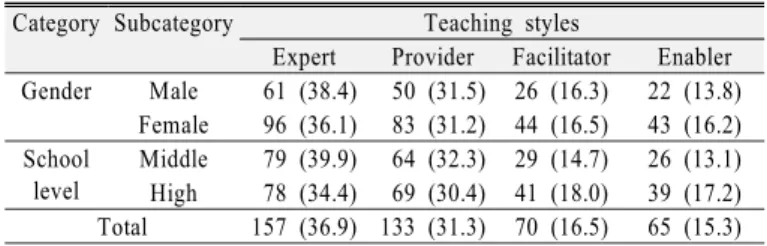
Table 1. A distribution of teaching styles of secondary school science teachers
number of teachers (%) Category Subcategory Teaching styles
Expert Provider Facilitator Enabler Gender Male 61 (38.4) 50 (31.5) 26 (16.3) 22 (13.8)
Female 96 (36.1) 83 (31.2) 44 (16.5) 43 (16.2) School
level
Middle 79 (39.9) 64 (32.3) 29 (14.7) 26 (13.1) High 78 (34.4) 69 (30.4) 41 (18.0) 39 (17.2) Total 157 (36.9) 133 (31.3) 70 (16.5) 65 (15.3)
to the students’.
b. Science Anxiety Measurement Scales (SAMS) with teaching style
The Science Anxiety Measurement Scale (SAMS) was developed by Lee (1992) for middle school students. A Science Anxiety Measurement scales (SAMS) with teaching style is complemented form of SAMS. It was developed to assess students' science anxiety towards the teaching style of a science teacher. By adopting four types of teaching styles suggested by Heimlich (1990), four types of measurement were developed. At the beginning of each type of measurement, the typical characteristics of teacher in the teaching styles were described. Students were asked to read the description of one of four types of teacher and then required to indicate their level of anxiety towards the science teacher described.
SAMS with teaching style assesses in five dimensions namely,
‘science learning content’, ‘scientific-principle demonstration’,
‘science evaluation’, ‘teacher’s characteristics’, and ‘science-related situational performance’. Among the total thirty eight items, eleven, seven, eight, six and six items are related to ‘science learning content’,
‘scientific-principle demonstration’, ‘science evaluation’, ‘teacher’s characteristics’, and ‘science-related situational performance’, respectively. Each item consists of five-point Likert scale (1 for
‘strongly disagree’ – 5 for ‘strongly agree’). The internal consistency (Chronbach’s α coefficient) was found to be 0.93.
3. Data collection and analysis
The teaching style questionnaire was mailed to teachers in 17 middle schools and 13 high schools randomly selected from across the nation. Out of 240 questionnaires 174 of them were returned. The SAMS with teaching style and test manuals were also mailed to them.
Four types of measurement were randomly distributed with a pro-rata consideration of the number of students. Teachers were required to understand the test manuals thoroughly before administration of the test. Prior to the test, a verbal explanation was provided by teachers to give a guideline to students. The measurement was conducted for 15-20 minutes. The collection rate of the science anxiety measurement was 80.6%. Total of two thousand one hundred and twenty two measurement was used for analysis. Among them five hundred and twenty two, five hundred and fifty two, five hundred and forty eight, and five hundred were responses for expert, provider, facilitator, and enabler teachers, respectively.
The teaching style questionnaire allocates discriminated scores for each item from 1 to 11 point. The total score for each category (‘student inclusion’ and ‘teacher sensitivity to the students’) was obtained by sum of scores for items answered ‘true’. Then the total score of each category was divided by the number of items with a
‘true’ answer for each category. The point where the score for ‘student inclusion’ and that for ‘teacher sensitivity to the students’ meet indicates the teacher’s teaching style. The expert teaching style had the same score range of 0.0-7.9 for both ‘teacher sensitivity to the students’ and ‘student inclusion’; the provider teaching style scored 6.0-11.0 for ‘teacher sensitivity to the students’ and 0.0-7.9 for ‘student inclusion’; the facilitator teaching style scored 0.0-7.9 for ‘teacher sensitivity to the students’ and 6.0-11.0 for ‘student inclusion’; and the enabler teaching style scored 6.0-11.0 for both ‘student inclusion’
and ‘teacher sensitivity to the students’ (Heimlich, 1990).
Each item in SAMS with teaching style was scored 1 point for
‘strongly disagree’ – 5 point for ‘strongly agree.’ In the case of positive questions, scores were allocated in reverse. Students obtained high scores were regarded as showing a high degree of science anxiety.
The analysis of data was performed by one-way ANOVA using the Windows SPSS 12.0K program.
Ⅲ. Findings and discussion
1. Analysis of science teachers' teaching styles
The distribution of four teaching styles related to the individual characteristics (gender and school level) of the science teachers were examined. The results are shown in Table 1. Overall, the expert style appeared to be dominant with 157 (36.9%) teachers employing it, followed by the provider style (31.3%), the facilitator style (16.5%), and the enabler style (15.3%). The expert style was the most dominant one for both male and female teachers. Also it was the most dominant style for both middle and high school. Regardless of gender and school level, similar trends were obtained that expert style was the most dominant teaching style employed by the teachers followed by the provider, facilitator, and enabler styles.
Judging from the results of the survey, most teachers were ‘expert’
and ‘provider’ who employed lower student inclusion in their teaching.
It implies that science teachers mainly lead the class rather than
encourage students to participate in class. This coincides with the
findings obtained by Kil (1999) and Park (2003) that secondary school
teachers generally employed a teacher-focused teaching approach in
Korea. Jeong and Kim (2011) performed a similar research with
elementary school teachers in Korea. They found that the provider
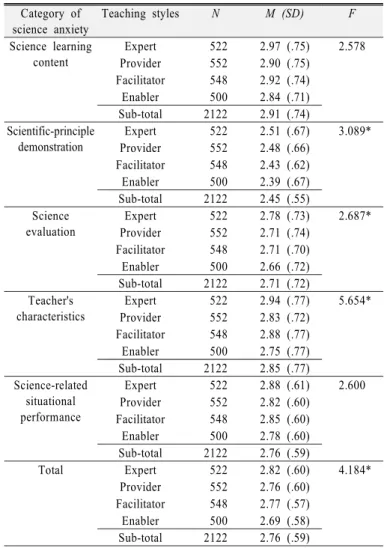
Table 2. The result of one-way ANOVA for students' science anxiety with different teaching styles
Category of science anxiety
Teaching styles N M (SD) F
Science learning content
Expert 522 2.97 (.75) 2.578
Provider 552 2.90 (.75) Facilitator 548 2.92 (.74)
Enabler 500 2.84 (.71)
Sub-total 2122 2.91 (.74) Scientific-principle
demonstration
Expert 522 2.51 (.67) 3.089*
Provider 552 2.48 (.66) Facilitator 548 2.43 (.62)
Enabler 500 2.39 (.67)
Sub-total 2122 2.45 (.55) Science
evaluation
Expert 522 2.78 (.73) 2.687*
Provider 552 2.71 (.74) Facilitator 548 2.71 (.70)
Enabler 500 2.66 (.72)
Sub-total 2122 2.71 (.72) Teacher's
characteristics
Expert 522 2.94 (.77) 5.654*
Provider 552 2.83 (.72) Facilitator 548 2.88 (.77)
Enabler 500 2.75 (.77)
Sub-total 2122 2.85 (.77) Science-related
situational performance
Expert 522 2.88 (.61) 2.600
Provider 552 2.82 (.60) Facilitator 548 2.85 (.60)
Enabler 500 2.78 (.60)
Sub-total 2122 2.76 (.59)
Total Expert 522 2.82 (.60) 4.184*
Provider 552 2.76 (.60) Facilitator 548 2.77 (.57)
Enabler 500 2.69 (.58)
Sub-total 2122 2.76 (.59)
style was dominant (31.5%), and it was followed by expert style
(31.1%), enabler style (20.0%), and facilitator style (17.4%). The findings are similar to this study in the aspect that the teacher-centered styles (provider and expert styles) are more dominant than student-centered styles (enabler and facilitator styles). However, there is a difference between elementary and secondary school teachers within teacher and student-centered styles, respectively. Compared to elementary school teachers, more secondary school teachers employed expert styles than provider styles. Similarly, more secondary school teachers adopted facilitator styles than enabler styles. Expert and facilitator style are characterized as showing a lower teacher sensitivity to the students than provider and enabler styles. Teacher sensitivity to the students is a teacher's ability to recognize students' personality and characteristics (Heimlich, 1990). Therefore, the results implied that elementary school teachers were more susceptible to students' characteristics and showed higher understanding of students than secondary school teachers.
Heimlich (1990) reported different findings from this study. He classified American teachers’ teaching styles and found that most of them employed enabler styles. The difference in the findings can be best explained by educational environment. Korean secondary school science teachers tend to explain scientific facts or theories with focus on its memorization and put emphasis on understanding of contents and hard facts make students prepare for university entrance exams (Kim et al., 2005). Exam preparation oriented education seems to discourage teachers from adopting different teaching methods in class.
Moreover, the ratio of students to teachers in Korea is relatively high compared to other countries (Hwang, 2004), which makes it difficult for a teacher to meet the needs of their individual students and adopt a teaching method that is tailor-made for the needs of all their students.
2. Analysis of students’ science anxiety with different teaching styles
An one-way ANOVA was performed to examine the effects of teaching style on students' science anxiety. The results of total science anxiety with five categories are shown in Table 2.
In total, the expert style showed the highest average (2.82), followed by the facilitator style (2.77), the provider style (2.76), and the enabler style (2.69). There was a statistically significant difference (p<.05) in the degrees of science anxiety of the students depends on teaching style. In all five categories of science anxiety, students experienced the highest degree of science anxiety when the science teacher employed the expert teaching style. And they experienced the lowest degree of science anxiety to enabler teaching style. There was a statistically significant difference in three categories of science anxiety (p<.05), which were 'scientific-principle demonstration', 'science evaluation', and 'teacher’s characteristics'.
The aforementioned results indicated that teaching style of teacher
affected the degree of the students’ science anxiety. Students appeared to experience less anxiety when the teacher understood them better and encouraged them to participate in class. A great number of secondary science teachers, however, employed the expert teaching style, which was characterized as adopting low student participation and understanding.
The average science anxiety score was found to be 2.76. It was similar to the score reported by Kim (2001b). She measured science anxiety of over two thousand secondary school students, where the average score was found to be 2.77. In the fact that students showed the highest degree of anxiety in relation to 'science learning content' coincided with the findings of Kim (2001b) and Kim (2006).
Students’ gender: The gender difference in the degree of science
anxiety with different teaching style was examined. The results are summarized in Table 3. Both male and female students showed the highest degree of science anxiety on expert teaching style and the lowest degree of science anxiety on enabler teaching style. There appeared to be no statistically significant difference among the four teaching styles in terms of the degree of science anxiety felt by both male and female students.
However, the comparison of average degree of total science anxiety
Table 3. The result of one-way ANOVA of students' science anxiety by gender
Gender Teaching style N M (SD) F
Male Expert 278 2.72 (.58) 2.499
Provider 269 2.66 (.58)
Facilitator 274 2.70 (.56)
Enabler 261 2.59 (.57)
Sub-total 1082 2.67 (.57)
Female Expert 244 2.95 (.61) 2.604
Provider 283 2.85 (.59)
Facilitator 274 2.84 (.57)
Enabler 239 2.81 (.57)
Sub-total 1040 2.86 (.59)
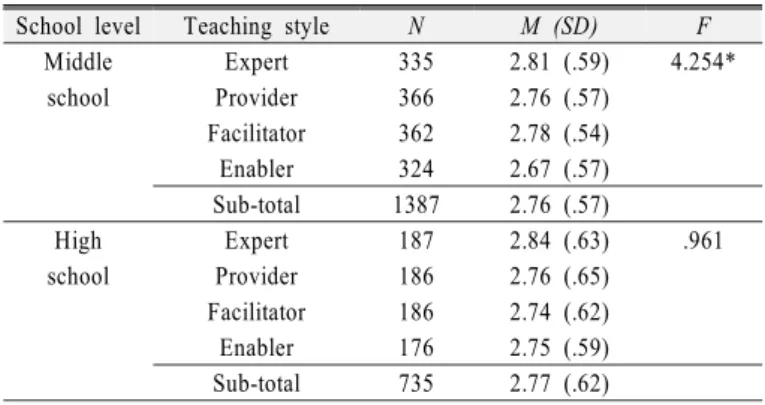
Table 4. The result of ANOVA of students' science anxiety by school level
School level Teaching style N M (SD) F
Middle Expert 335 2.81 (.59) 4.254*
school Provider 366 2.76 (.57)
Facilitator 362 2.78 (.54)
Enabler 324 2.67 (.57)
Sub-total 1387 2.76 (.57)
High Expert 187 2.84 (.63) .961
school Provider 186 2.76 (.65)
Facilitator 186 2.74 (.62)
Enabler 176 2.75 (.59)
Sub-total 735 2.77 (.62)
felt by male and female students revealed that female students experienced greater science anxiety compared to male students, with average science anxiety degrees of 2.86 and 2.67, respectively. It coincides with results obtained by Kim (2001b) and Jeong and Kim (2011). Kim (2001b) reported that female students felt higher degree of science anxiety than male counterpart in all subcategory of science anxiety. Among them significant difference was appeared in subcategory of ‘science learning contents’, especially contents related with mathematics. Jeong and Kim (2011) conducted a research with primary school students. They found higher scores of science anxiety for female students than male students even though there was no statistical difference.
School level: The correlation between the degrees of science anxiety
with different teaching style and their school level was examined. The result of one-way ANOVA is shown in Table 4. The middle school students showed the highest degree of science anxiety when the science teacher employed the expert teaching style (2.81), followed by the facilitator teaching style (2.78), the provider teaching style (2.76), and the enabler teaching style (2.67). High school students showed the highest degree of science anxiety when the science teacher employed the expert teaching style (2.84), followed by the provider teaching style (2.76), the enabler teaching style (2.75), and the facilitator teaching style (2.74). There appeared to be a statistically significant difference (p<.05) in science anxiety among four different teaching styles for middle school students. However, no significant difference was shown for high school students. Such results implied that middle school students were more influenced by teachers’
teaching style and more relyed on teacher.
There was a slight difference between average degree of total science anxiety felt by middle school (2.76) and high school (2.77) students. The results coincide with those obtained by Czerniak and Chiarlott (1984). They reported that there was no correlation between students’ school level and their degree of science anxiety. However, contradictory results were reported by Jeong and Kim (2011) and Lee (1992). According to them, students’ science anxiety increased as their grade went up. Jeong and Kim (2011) measured elementary school
students' science anxiety with same instrument used in this work. The average score of science anxiety of fourth grade students was 1.96.
The average score was 2.12 and 2.25 for fifth grade and 6th grade students, respectively. Even though students' average score increased as the grade became higher, all of them were relatively lower than scores obtained in this study. Moreover, the difference in score between 6th grade students and middle school students was 0.51, which was larger than other grade levels. It seems that there is a substantial increase in science anxiety between elementary and middle school levels. However, no significant difference between middle and high school levels observed because score of science anxiety of middle school students was relatively high enough.
Ⅳ. Conclusion and implications
This study aimed to examine teaching styles of secondary school teachers and to compare the degree of students’ science anxiety on different teaching style. The following conclusions were reached based on the findings: First, the expert style was found to be the most commonly used among four different teaching styles. It was followed by provider, facilitator, and enabler style. The teaching styles found to be the most commonly used (the expert and provider styles) are characterized showing low student inclusion and low teacher sensitivity to students compared with those that were least used (the facilitator and enabler styles). It implied that a large number of teacher performed teacher-centered teaching and did not provide enough opportunities to students for class participation. No significant changes in teachers’ teaching styles were observed in terms of their gender and school levels.
Second, the average degree of the students’ science anxiety did
not appear to be high compare to other previous works. However,
students showed the highest degree of science anxiety when a teacher
employed the expert style while the lowest degree of science anxiety
when a teacher employed the enabler style. There was a statistically
significant difference between students’ science anxiety and teaching
style (p<.05). Especially, significant differences were shown in three
category of science anxiety; 'scientific-principle demonstration',
'science evaluation', and 'teacher’s characteristics'. There appeared to be no significant differences in the degree of the science anxiety felt by male and female students according to teacher’s teaching style.
Although a significant difference was shown in the degree of middle school students’ science anxiety according to teacher’s teaching style (p<.05).
It was found that teacher's teaching style influenced on students' science anxiety. The expert teaching style appeared to cause the highest science anxiety, while the enabler teaching style made the lowest science anxiety. Relation to science anxiety, various factors such as scientific contents, lack of understanding in scientific formulas and problem solving abilities, or evaluation affect on students' science anxiety. In the aspect of teaching style, students' scientific anxiety with different teaching style has been explained related to general characteristics of different teaching style. However, it needs to be studied how teaching style related factors, such as value, belief, attitude, and behavior of teacher, influence students' scientific anxiety in detail. It would be a guideline for teachers to plan their teaching.
The expert teaching style that a lot of secondary school science teachers in Korea employed made students feel the greatest degree of science anxiety. In addition, enabler teaching style least used for secondary school teachers caused the least science anxiety. It implies that there is a significant need for changing teaching style of teachers.
Therefore, teachers should recognized that their students possibly affected by their teaching styles and their actions in class. Then efforts should made to create comfortable and less stressful learning environment by interacting more with students and understanding their needs.
Especially, middle school teachers need to be more careful about their teaching styles, because middle school students are more susceptible to teacher’s teaching style. For more effective teaching-learning process, it is recommended to teachers to employ various teaching method reflecting students’ interests and needs, consider different teaching style that could reduce students’ anxiety, and encourage students’ participation rather than merely lead the class.
References
Anderson, L. W., & Bourke, S. F. (2000). Assessing affective characteristics in the schools. Mahwah, NJ: Lawrence Erlbaum.
Chiarelott, L., & Czerniak, C. (1987). Science anxiety: Implications for science curriciulum and teaching. Clearing House, 60(5), 202-205.
Czerniak, C., & Chiarelott, L. (1984). Science anxiety: An investigation of science achievement, sex and grade level factors. (ERIC Document Reproduction Service No. ED243672).
Emer, D., Mclarney, A., Goodwin, M., & Keler, P. (2002). Which group teaching styles best promote information gain for adults with mental disorder? Journal for Specialists in Group Work, 27(2), 205-232.
Hancock, D. R., Nichols, W. D., & Jones, J. (2000). The impact of teachers' instructional strategies and students' anxiety levels on students' achievement in eighth grade German and U.S. classrooms. Journal of Research and Development in Education, 33(4), 232-240.
Heimlich, J. E. (1990). Measuring teaching style: A correlation study between the Van Tilburg/Heimlich sensitivity measure and the Myers-Briggs type indicator of adult educators in Ohio. Unpublished doctoral dissertation, The Ohio State University, Columbus.
Heimlich, J. E., & Norland, E. (2002). Teaching style: Where are we now?
New Directions for Adult and Continuing Education, 93, 17-25.
Hwang, K. J. (2004). A study on solving educational problems in secondary school. Korean Social studies Association, 11(2), 251-275.
Jeong, J., & Kim, Y. (2011). An analysis of elementary school students’
science anxiety according to teaching styles for science class.
Elementary Science Education, 30(1), 1-9.
Kassab, S., Al-Shboul, Q., Abu-Hijleh., M., & Hamdy, H. (2006). Teaching styles of tutors in a problem-based curriculum: Students' and tutors' perception. Medical Teacher, 28(5), 460-464.
Kil, Y. (1999). An analysis of the teaching behaviors and teaching methods used by the secondary school teachers. The Journal of curriculum studies, 17(1), 301-331.
Kim, B. (1993). The relationship between students' science anxiety and achievement. Journal of the Korean Association for Research in Science Education, 13(3), 341-358.
Kim, H. (2006). The study on science anxiety of the first grade students in information industrial high school. Master's thesis, Korea National University of Education, Chung-Buk.
Kim, J. (2001a). Subject pedagogic terminology encyclopedia. Jigu Publishing Co. Seoul, Korea.
Kim, J. (2001b). Main factors forming science anxiety and differences in the science anxiety based on gender, academic level, school year, and the college department. Master's thesis, Ewha Womans University, Seoul.
Kim, K., Kwon, B. D., Kim, C. J., & Choe, S. U. (2005). Beliefs about gifted education and classroom practices of the science teachers at science academy in Korea. Journal of Korean Association for research in Science Education, 25(4), 514-525.
Kuchinskas, G. (1979). Whose cognitive style makes the difference?
Educational Leadership, 36, 269-271.
Kweon, H. E. (2005). The effects of project approach on science process skills, science anxiety and science-related attitudes of elementary school students. Master's thesis, Seoul National University of Education, Seoul.
Kwon, N., & Min, Y. (2004), The investigation on the criteria for the analysis of teaching styles. The Journal of Curriculum Studies, 22(1), 75-100.
Labillois, J. M., & Lagace-Seguin, D. G. (2007). Does a good fit matter?
Exploring teaching styles, emotion regulation, and child anxiety in the classroom. Early Child Development and Care, 179(3), 303-315.
Lee, J. (1992). Development of the science anxiety measurement scale and ananalysis of the tendency about the secondary school students' science anxiety. Master's thesis, Korea National University of Education, Chunk-Buk.
Lee, K. (2002a). A Study on the analysis of science-anxiety of high school students. Master's thesis, Korea National University of Education, Chunk-Buk.
Lee, K. (2002b). The effect of the emotional intelligence improvement program application in middle school science learning. Master's thesis, Ewha Womans University, Seoul.
Leung, K. K., Lue, B. H., & Lee, M. B. (2003). Development of a teaching style inventory for tutor evaluation in problem-based learning. Medical Education, 37(5), 410-416.
Mallow, J. V. (1986). Science anxiety: Fear of science and how to overcome it. NewYork: Thomond.
Masnick, A. M., & Klahr, D. (2003). Error matters: An initial exploration of elementary school children's understanding of experimental error.
Journal of Cognition and Development, 4(1), 67-98.
McNabb, J. G. (1997). Key affective behaviors of students as identified by a select group of secondary school teachers using the SCANS categories. Journal of Industrial Teacher Education, 34(4), Retrieved from http://scholar.lib.vt.edu/ejournals/JITE/v34n4/html/mcnabb.html.
Min, Y. (2002). An analysis of teaching styles in Korean school teachers.
Unpublished doctoral dissertation, Korea National University of Education, Chunk-Buk.
Opdenakker, M. C., & Damme, J, V. (2006). Teacher characteristics and teaching styles as effectiveness enhancing factors of classroom practice.
Teaching and Teacher Education, 22(1), 1-21.
Park, D. (2003). A study on obstructing factors inimprovement of secondary school teachers' teaching method. Master's thesis, Yonsei University, Seoul.
Revard, L. P., & Straw, S. B. (2000). The effect of talk and writing on learning science: An exploratory study. Science Education, 84(5), 566-591.
Schmidt, K. (2004). A Model to integrate online teaching and learning tools into the classroom. The Journal of Technology Studies, 30(2), 86-92.
Tobias, S. (1979). Anxiety research in educational psychology. Journal of
Educational Psychology, 71(5), 573-582.
Udo, M. K., Ramsey, G. P., & Mallow, J. V. (2004). Science anxiety and gender in student taking general education science course. Journal of Science Education and Technology, 13(4), 435-446.
Westerback, M. E., & Long, M. J. (1990). Science knowledge and the reduction of anxiety about teaching earth science in exemplary teachers as measured by the science teaching state-trait anxiety inventory. School Science and Mathematics, 90(5), 361-374.
Wynstra, S., & Cummings, C. (1993). High school science anxiety. The Science Teacher, 60(7), 18-21.
Zhang, L. F. (2004). Thinking styles: University students' preferred teaching styles and their conceptions of effective teachers. The Journal of Psychology, 138(3), 233-252.