A Study on the Recruitment and Selection of Secondary Science Teachers in Korea
1)Youngsun Kwak * and Yang-Rak Lee
Korea Institute for Curriculum and Evaluation, Seoul 110-230, Korea
Abstract: In this research, we investigated the historical development and ways of improvement of the teacher employment test (TET, hereafter) in Korea. This paper consists of three parts. The first part details the secondary science teacher education system in Korea. The second part elaborates upon the development of the TET since 1990's. The third part provides conclusion by addressing ways to improve science teacher education and employment systems in Korea.
After all, the keen competition for teacher education and the demanding entry test ensure that secondary science teachers are selected from a pool of candidates with high academic achievement. Korean teacher employment system in general places more weight on subject knowledge. Although we cannot simply conclude that Korean science teachers must have profound knowledge in the subject matter and are competent in pedagogy, it stands to reason that the teachers could be more competent in performing their roles than those of many western countries with an acute shortage of teachers. We also suggested future directions and ways of improvement regarding teacher education and the TET in Korea.
Keywords: teacher employment test, teacher education, subject knowledge, teaching competency
Introduction
Koreans have traditionally placed great importance on education as a means for self-fulfillment as well as for social advancement. Today, Korea boasts one of the highest literacy rates in the world. It is a well recognized fact that Korea’s well-educated people have been the primary source of the rapid economic growth that the nation has achieved over the past three decades. With limited natural resources, the key asset of Korea has been human resources. Education and preparation of quality teachers are, therefore, important priorities in Korea. Since the quality of education cannot exceed the quality of teachers, the Korean Ministry of Education, Science and Technology (MEST, hereafter) has been carrying out various policies to improve the quality and capacity of teachers. Examples include the 1995 ‘educational reformation plan’ and the 2001 ‘comprehensive plan for teacher profession development’.
Primary and secondary teachers in Korea enjoy a relatively stable profession both socially and economically, while they maintain a civil official status(Kim and Han, 2002). This is why the teaching profession is favored by excellent human resources.
That is, most students who enter the department of science education at the colleges of education are from the upper group in the College Entrance Examination, and this trend has become more evident since the financial crisis in the late nineties in Korea.
In order to become a secondary school science teacher, students need to attend education programs run by teacher development institutes to acquire a teacher’s certificate. In Korea, there are three kinds of institutes where prospective teachers are educated:
Teacher educating institutes, General universities, and Graduate schools of education. Completing the four- year education at the university does not in itself qualify the graduates for teaching in public schools.
City or provincial superintendents select teachers from
(해 설)
1) The draft of this paper has been presented in the 54th summer conference of the Korean Association for Science Education.
*Corresponding author: [email protected]
*Tel: 82-2-3704-3577
*Fax: 82-2-3704-3570
those who hold teacher’s certificates, every December through open competition. The competition for secondary teachers is very high, e.g., over 20:1 every year. Upon their graduation from the college of education, teacher candidates are conferred the
“Second grade teacher”, which makes them eligible to apply for the national level teacher employment test.
The graduates are only awarded a teacher’s certificate which enables them to be eligible for teaching in private schools, but to qualify to teach in public schools, certificate holders are required to pass a very demanding national examination, called the Teachers Employment Test (TET, here after).
Regarding teacher employment, Korea hires teachers at the school district level with the requirement of an employment test measuring mastery of subject matter content and pedagogical theory and methods. This paper examines the historical development of the TET in Korea. In this article, we will explore the major trend in Korean teacher employment system, and propose a TET framework which could incorporate knowledge-based standards of professional practice.
By examining recent changes in TET and teacher accountability in education system in Korea, we hope to investigate some implications for the design of teacher employment test based on the analysis. This paper consists of three parts. The first part details the secondary science teacher education system in Korea.
The second part of this paper elaborates upon the development of the TET from 1990's until 2009. The third part of this paper concludes with discussions about ways to improve science teacher education and employment systems in Korea.
Major changes in teacher employment
The Korean MEST sets its belief in the fact that
‘the quality of education cannot exceed the quality of teachers’, and is carrying out various policies to improve the quality and capacity of teachers (MEST, 2010). Since 1992, public school teachers have been selected through open competition, so called ‘an open
competition exam for the selection of the secondary public school teacher candidates’. Private schools have the full authority of employing the teachers who have the certificate.
Before 1990, graduates of national education colleges had a preferential right of employment in the public school since they had been subsidized with an obligation to serve as teacher after graduation. That is, students teachers of the national universities were guaranteed a teaching position in a public school. In 1990, however, graduates from the private university presented a petition for the violation of the constitutional right of equity and the right of job choice. Upon granting the petition, the ‘article 47 of Rules for the Public Educational Personnel and Staff Act’ revised to ensure open competition of teacher recruitment. The first open competition exam for the selection of public secondary teachers was conducted in November, 1991.
The metropolitan and provincial offices of education formed ‘the committee for teacher recruitment’ and commissioned a research institute such as KEDI or KICE to develop and score TET questions. The selection and employment of teachers is achieved by this open test held by the metropolitan and provincial offices of education for the public schools in different parts of Korea. The schools determine the number of vacancies for science education in a city or region.
Then the students with the top scores on the TET at that office of education are recruited for the teaching position.
TET consists of two phases. The first phase is a
written examination in general education, subject
matter, and subject-specific education areas. The
second phase consists of essay test, interviews,
teaching performance test, and so on. The second
phase varies depending on the provincial education
bureau. The performance and teaching ability as a
teacher is the main concern of this phase. Since 1991,
specific details of the TET has been changed
gradually. As might have been expected TET has had
serious impacts on the curriculum of teacher education
institutes.
TET during 1992-1996
During this period, the first phase of the TET consisted of multiple-choice questions about general education and subject matter areas. For each subject area, the exam committee consisted of one college professor and many in-service secondary science teachers, which couldn't reflect university level subject matter knowledge and resulted in low-level questions requiring fact memorization and algorithmic problem solving.
TET during 1997-2008
During 1997-2008, the first phase of the TET consisted of a written test on pedagogy (20%) and the major field (80%).
2)A written test on general education (pedagogy) consisted of multiple-choice questions. The major field test was essay test that consisted of questions about subject matter areas (52-
56 points) and science education (24-28 points, that is 30-35%). Since 1998, Korea Institute of Curriculum and Evaluation (KICE) has been in charge of the development and scoring of questions for the first phase of the TET. The composition of the first phase of the TET is summarized in Table 1.
Core subjects from each science area are listed in the regulations of the Ministry of Education for Teachers Employment Test, which is in accordance with the curriculum of science teacher training institute. In case of ‘Common Science’, science subject matter areas include physics and physics experiments, chemistry and chemistry experiments, biology and biology experiments, Earth science and Earth science experiments, etc. A sample essay question about science education from 2008 are shown in the following.
The second phase of the TET has been administrated by the 16 metropolitan and provincial offices of education. Through the first phase of the
TET, 130% of the required numbers of teachers were screened. It is very demanding and competitive since almost all teacher certificate holders take the TET.
There follows part of the conversation between a science teacher and two students concerning whether glasses are solid or not.
T: Let's find out what solid is using specific cases.
S1: If solid is hard and has a fixed shape and size, then powder is not solid.
S2: Since we can see crystals in powder with a magnifying glass and crystals are hard with a fixed shape and size, powder is solid.
S1: Are you saying any object with crystals is only solid? According to the textbook, glass is amorphous solid.
S2: Since solid with crystals is only solid, I think, glass is not solid.
S1: Glass, however, is hard so it's solid.
T: After a long time, the bottom part of glass gets thicker because glass has fluidity. Something with fluidity is liquid.
S1: Sir, I thought glass is solid. In that case, is my thought wrong?
T:
Based on the above conversation, explain why the debate between two students started in one line. In addition, how can the teacher respond to S1's question in light of social constructivist perspectives in two lines. [3 points]
Table 1. Components of TET from 1997 to 2008
Content Proportion in TET Item type Relevant knowledge
1st period (60min)
Education in general
(PK) 20% 50 Multiple choice items General pedagogical knowledge
2nd period (150min)
Science subject areas
(SMK) 54% Open-ended items Subject matter knowledge
Science Education
(PCK) 26% Open-ended items Pedagogical content knowledge
2) Before 2005, the proportion of general education in the TET was 30% but the low quality of multiple choice items of general pedagogy was criticized compared with essay test items of content-specific pedagogy, which led to a 10 percent reduction from 2005.
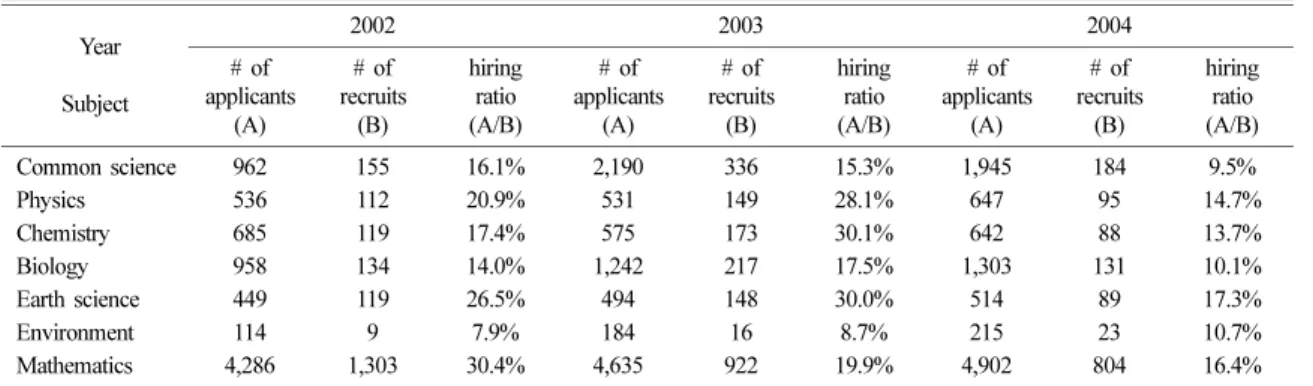
Table 2 shows the competitive rate for secondary science teachers who took the TET in 2002-2004.
This ratio varies depending on the district and the subject.
TET after 2009
Starting 2009, new teachers will be appointed through an intensive three-stage qualification system, according to an announcement by the Ministry of Education & Human Resources Development
3)on October 1, 2007.
Teacher candidates will be required to first sit for a multiple choice written test that consists of questions about general education (20%), subject matter areas (70-65%) and science education (30-35%). Through the first phase of the TET, 200% of the required numbers of teachers were screened. In the second phase of the TET, teacher candidates take an essay test which consists of subject matter areas (65-45%) and science education (35-55%). Through the second
phase, 150% of the required numbers of teachers were screened. The third phase consists of in-depth interviews on teacher aptitude and practical class instruction ability including lab and experimental abilities for science candidates. The third phase of the TET has been administrated by the 16 metropolitan and provincial offices of education.
The change comes as an effort to improve the current qualification system, which requires only two stages of evaluation, with too much weight placed on a candidate’s rote memory. By revising the TET system, the education ministry seeks to select teachers of excellence who possess adequate academic quality, good personality and a high level of professionalism.
In summary, the keen competition for teacher education and the demanding entry test ensure that secondary science teachers are selected from a pool of candidates with high scholastic achievement. Korean teacher employment system in general places a high premium on subject knowledge. Although we cannot
3) The past name of MEST before 2008. Ministry of Education & Human Resources Development and Ministry of Science &
Technology were integrated into the ministry of Education, Science and Technology in 2008.
Table 2. Competition Rate for Secondary Science Teacher Employment Test (2002-2004)
Year
Subject
2002 2003 2004
# of applicants
(A)
# of recruits
(B)
hiring ratio (A/B)
# of applicants
(A)
# of recruits
(B)
hiring ratio (A/B)
# of applicants
(A)
# of recruits
(B)
hiring ratio (A/B)
Common science 962 155 16.1% 2,190 336 15.3% 1,945 184 9.5%
Physics 536 112 20.9% 531 149 28.1% 647 95 14.7%
Chemistry 685 119 17.4% 575 173 30.1% 642 88 13.7%
Biology 958 134 14.0% 1,242 217 17.5% 1,303 131 10.1%
Earth science 449 119 26.5% 494 148 30.0% 514 89 17.3%
Environment 114 9 7.9% 184 16 8.7% 215 23 10.7%
Mathematics 4,286 1,303 30.4% 4,635 922 19.9% 4,902 804 16.4%
Table 3. Components of TET from 2009
Selection
phase Subject Types of
questions
N of questions
Time (min.)
Points alloted for each question
Total points
Proportion of sub-areas Science
education
Science contents
First phase
General education
Multiple-choice
test 40 70 0.5 20
Major area Multiple-choice
test 40 120 1.5-2.5 80 30-35% 70-65%
Second phase Major area essay test (I) 2 120 20-30 50
35-55% 65-45%
Major area essay test (II) 2 120 20-30 50
simply conclude from this that Korean science teachers must have profound knowledge in the subject matter and are competent in pedagogy, it is reasonable to expect that these teachers are more competent in performing their roles than in many western countries where there is an acute shortage of teachers.
Discussion and future directions
Before we discuss about how to improve teacher quality, we need to examine issues surrounding the quality of the teacher employment system in Korea.
Three visions for improving the quality of teacher education have been identified as the profession- alization, deregulation, and social justice agendas for teacher education (Zeichner and Conklin, 2005). And Korean teacher education system has also been under the influence of two of these three agendas and the social justice agenda has been gradually incorporated as multicultural education in teacher education with increasing diversity in student population.
The professionalization agenda for reform has emphasized the articulation of a knowledge base for teaching in the form of competencies or standards that address many different aspects of teaching. Major influences of the professionalization agenda on teacher education in Korea are as follows:
First, in accordance with the professionalization agenda, teacher education in Korea also tries to pursue longer teacher education programs and higher standards to enter the teaching career. Along this line of argument, professionalization position also involve efforts to strengthen the professional education and fieldwork components of teacher education programs.
Underlying these efforts to articulate a professional knowledge base for teaching through standards and performance-based assessment is a view of the teacher’s knowledge base as praxis-oriented knowing.
When we articulating teachers’ professional knowledge base, we need to incorporate teachers’ professional practices where teachers constantly make important decisions and judgments in how they interact with their students to facilitate their learning.
Second, under the influence of the professionalization agenda, the new version of TET in Korea, which will be implemented from 2009 recruitment, has incorporated a performance-based assessment system based on candidates’ demonstrating proficiency on a set of teaching standards.
By contrast, the deregulation agenda has focused on the importance of content knowledge and verbal ability in teaching and has asserted that how to teach can best be learned on the job though an apprenticeship rather than in a teacher education program. Let alone the deregulation agenda, including Korea in the East Asian countries, people tend to believe that anyone with in-depth content expertise could teach, and content expertise is automatically accompanied by pedagogical knowledge. That is, the more the teacher knows the science subject matter, the better she could teach. People seldomly blame the teacher’s poor communication skills or ways to teach, but they are harsh when the teacher shows lack of her subject matter expertise.
Overall, the development in teacher education has moved away from the craft apprenticeship model towards the concept of a learned profession where discovering the science and theories of teaching has been the focus of the teacher educators as the route to teacher professionalization (Childs and McNicholl, 2007; Collins, 2004).
The history of TET in Korea has evolved as different notions of teacher expertise and competency have been advocated. The overall tendency, however, has been to prioritize the science content knowledge.
It was argued by the stakeholders that it was through the acquisition of deep content knowledge in discipline areas that the quality of secondary teaching would be enhanced.
In addition, according to a comparative research on
Korean and United Kingdom teachers’ attitudes
towards the aims of practical work in mathematics
education, the Korean teachers valued practical work
for finding facts and arriving at new principles, as a
creative activity, to verify facts, to elucidate theoretical
work, and to help remember facts and principles more
than UK teachers (Leung, and Park, 2002; Ma, 1999).
The UK teachers valued practical work for seeing problems and seeking new ways to solve them, promoting a logical reasoning thinking, developing an ability to cooperate, and developing a critical attitude.
The Korean teachers viewed the practical as content- focused and fact-oriented. The UK teachers viewed mathematics as more focused on investigating problems and constructing new knowledge. Ma (1999) concluded that Korean teachers tended to have a positivistic approach to knowledge, which is shaped by Korean cultural context where the habit of competition and emphasis on factual knowledge prevail. Although this study was about mathematics, we can get some insight into Korean teachers’ attitude towards science teaching.
Within this cultural context, where subject matter content are highly valued, not only in their teacher education program but also in TET, teacher candidates have to pass academic content examinations in their science subject matter knowledge.
Korean education system has traditionally taken a centralized approach with the central government developing, designing, and executing policies and standards for school finance, curriculum, textbooks, assessment, and teacher preparation (Kim and Han, 2002). Western countries, however, have a decentralized system of education with local communities have more autonomy to decide how schools are funded, what students should learn, how they are assessed, and who can become teachers.
In this context, Korea also has a strong centralized teacher selection mechanism, which is questioned of its own quality in assuring teaching quality. Including teacher employment system, we need to examine what kind of teachers we want to prepare and what kind of teachers we want them to become. Ideally, we want to prepare and select teachers with a strong aptitude for teaching, strong content knowledge, strong both generic and subject-specific pedagogical theory, and a significant degree of teaching practice.
In this section, we want to explore possible future developments in teacher education and employment in
Korean context.
Articulation of teaching competencies or standards
Like other professionals, teachers need a sound body of knowledge to draw from when deciding how to proceed in complex situations. Before we incorporate various teaching standards advocated by the professionalization agenda, we need to think about what kind of science teachers we want to educate for our children.
The western countries tend to focus on the teacher’s competency on pedagogy while the east Asian countries tend to focus on the teacher’s competency on subject matter. Compared with their American counterparts, the East Asian teachers are clearly more competent in the subject matter that they teach.
Considering only about 47% of American secondary teachers today hold an academic major in their subject assignments, Korean science teachers are relatively well prepared in terms of science content knowledge (Darling-Hammond and Sykes, 1999). According to a comparative study between the East and the West which looked into teacher’s reported teaching, the Shanghai teachers in the study are more competent than the US teachers in terms of a “profound understanding of the subject matter that they teach”
(Ma, 1999).
The first step to improve the teacher quality is to ensure that only capable, well-prepared individuals become teachers. There is some debate, however, as to whether teacher tests truly identify ineffective teachers.
Within this context, we need to examine what should be the knowledge base for beginning teachers, or components of standards or competencies. What constitutes teacher expertise and what kind of teachers do we want to screen through the TET? This issues relates to the teacher professionalization agenda, which advocates teachers being professionals who have an extensive knowledge base of conceptions, beliefs, and practices, a knowledge base that is shared within a professional community.
However, little analysis has been undertaken of the
constituent elements of knowledge bases of a typical science teachers. While few may dispute that students learn more from effective teachers, there is less agreement about what contributes to effective teaching.
Some say it’s deep subject matter knowledge. Others say it’s the ability to employ research-based instructional techniques. After all, to prepare effective teachers, we need a balance of core knowledge, skills and personal qualities (Cochran-Smith and Zeichner, 2005). Other than raising standardized achievement test scores, we want teachers to encourage students’
critical thinking, problem solving, and aesthetic learning to meet the future needs of their students (OECD, 2005).
The quality of, however, Korean TET in assessing teacher candidates’ knowledge and skills are questionable, and Korean TET is still relying on tests that may have little relationship to classroom practice.
Some critics of Korean TET say that Korean teacher candidates can’t prepare the TET with the university’s teacher education program so they have to attend private institutes convened around “Noryangjin”
to pass the TET (KICE, 2008). In the private institute, teacher candidates are trained to get a good score as they cover materials from the last exams. Even through highly competitive selection process, therefore, it’s hard to assure the quality of beginning teachers who have succeeded in the TET. Novice science teachers tend to teach in a rather procedural manner or following a formulaic rules even though they have a good grasp of the underlying concepts behind the formula and procedural knowledge (Kwak, 2007).
That is, the novice teachers are weak in their ability to guide students in genuine scientific investigations, and their reported teaching was very procedural. All their images of teaching and subject matter knowledge have been directly from their college textbooks and TET exam questions and their own learning experience throughout their own schooling, not from their teacher preparation programs and methods courses. After at least 16 years’ experience as learners, beginning teachers have incorporated “a default teaching repertoire”
that has learned unintentionally by observation of
one’s own teachers (Russell and Martin, 2007).
As mentioned earlier, TET has had a great influence on what should be taught in the teacher education program. Through revamping, therefore, teacher education program we need to make sure that teacher candidates don’t need to go to private institutes to prepare the TET. This argument leads to the next argument.
Incorporating PCK components in the TET It seems that Korean students are taught by teachers who are relatively competent in the science subject matter, albeit using rather traditional teaching method involving mostly procedural teaching and a lot of teacher talk. An obvious question that arises is that if these Korean teachers are competent in the subject matter, why are they teaching in a procedural rather than a conceptual manner? Is it because they are unable to access their conceptual knowledge in their teaching or is it a matter of choice?
It’s time to ask how to teach rather than what to teach in the science classroom. In Korea, most of competent science teachers give up deep understanding for a wide content coverage in the secondary schools where many students find science lessons are boring and difficult to understand. This has resulted in boring science lessons and students’ avoidance of science and engineering tracks.
There are implicit but shared beliefs between Korean science teachers that the science teacher's duty is to efficiently deliver the content in a given time period so that students get a good score to pass any kind of standardized tests. Most of novice science teachers’ teaching features clear and simple procedures and formulas, which forces students to memorize without knowing what each term in a formula represents.
That is, novice science teachers choose to teach in a procedural manner which they think will work better as far as students’ performance in examinations is concerned.
Additionally, some have argued that requiring more
academic content courses in a pre-service teacher
education program does not necessarily address the
acquisition of the pedagogical content knowledge that is needed to be able to teach the academic content to diverse learners (Shulman, 1986). In 1986, Shulman proposed a specialized knowledge base for teaching that distinguishes teaching profession from subject matter specialists.
Effective teaching in science depends largely on the extent and richness of a teacher’s pedagogical content knowledge (Shulman, 1986, 1987). Some contend that undue emphasis on content knowledge oversimplifies the nature of teaching (Darling-Hammond, 1999).
Shulman argues that typical teacher-education programmes focus too much attention on content knowledge at the expense of pedagogic content knowledge, and therefore they fail to equip beginning teachers adequately (Kanes and Nisbet, 1996).
The core of knowledge base of teaching profession is PCK that is built and developed as teachers teach specific topics in their subject area. PCK is influenced by the transformation of three other knowledge bases:
subject matter knowledge (SMK), pedagogical knowledge (PK), and knowledge of context (Grossman, 1990).
PK includes knowledge of instructional principles, classroom management, learners and learning, and educational aims that are not science specific.
We can expect that there should be some relationship between science teachers’ subject matter knowledge (SMK) and science teaching effectiveness.
According to the studies of the relationship between a teacher’s science background (usually in the form of the number of science courses taken) and teaching effectiveness, the results are less conclusive. That is, SMK is necessary but not sufficient for effective teaching (Abell and Lederman, 2007). The effect of SMK could be mediated by other types of teacher knowledge.
The teacher education and the TET in Korea have implied that more SMK is needed to produce highly quality teachers. Since 2005 TET, the portion of general pedagogy was reduced from 30% to 20%, and the reduced 10% was transferred to science education.
Before 2005, the proportion of science education questions was 20-30%, but after 2005 that was
increased 30-35%.
The rationale for this cutback of PK portion was that there was overlap between questions about PK and questions about science education. A gradual increase of science education portion in the TET along with reduction of PK questions is desirable, but we need to examine the quality of science education questions in the TET.
Even with the new 2009 TET system where a high proportion of science education questions, we can't assure high quality teachers will be screened through the new TET. What is indispensible and most required in teaching science should be included in TET, which acts as a gatekeeper to be a teacher. In other words, some aspects related to science PCK should be included in science education questions of TET. Since the implementation of TET including the new TET system, preparing for solving science education questions in the TET haven’t helped the beginning teachers to better prepare classroom teaching. An experienced teacher who have served as an examiner contested that we need to define a baseline of core pedagogical requirements for newly qualified teachers including knowing and understanding the learning needs of individual students, the ability to communicate effectively in the classroom context to stimulate learning.
A: But at the hearings of the revision of TET, teacher candidates welcomed a new suggestion to reduce the portion of science education questions in the TET. The reason they welcomed that idea is that they don't think science education questions shown in TET have nothing to do with teaching competence.
This suggests that science education questions should be validated.
In other words, teachers need knowledge other than
SMK and PK. Teachers need knowledge about
students’ ways of thinking about key ideas in the
science curriculum and pedagogical strategies for
addressing students’ personal theories and supporting
them in learning about specific science ideas (Kwak,
2007). This type of knowledge should be examined in
the TET. That is, we need to incorporate assessment
of the teacher candidate’s PCK in the TET, where PCK is understood as the teacher’s knowledge about how to transform SMK of specific science topics into viable instruction.
In the essay test of the TET effective from 2009, we need to develop PCK related questions where we can assess the teacher candidate’s science subject specific teaching expertise, which can’t be prepared private institute through problem solving drills. When we develop PCK related questions for the TET that can be solved based on the teacher candidate’s experiences of methods courses and clinical experiences of student teaching. That is, the essay test in the TET could assess subject matter pedagogy, a combination of deep subject and pedagogical knowledge, that facilitates effective professional practices in schools.
In addition to this, teacher education programs in the university should ensure the relevance of teacher preparation to not only the needs of the schools but also the needs of teacher candidates who apply for the TET.
Taking Collective Responsibility for Professional Standards
Collective responsibility for standards is a key element of both professionalism and professionalization (Darling-Hammond, 1990). Teachers’ authority in matters of gate-keeping and quality control is a crucial component of professionalization (Van Maanen and Barley, 1984). The knowledge base of a professional is drawn from a body of common practices and wisdom accumulated by practitioners and scholars throughout history. Lawyers hold collective responsibility for professional standards through the bar. Doctors hold collective responsibility for professional standards through a board. If you want to become a lawyer, you are entering a profession, and the profession of being a lawyer is controlled by lawyers. After all, acknowledged professionals such as lawyers or physicians themselves determines the standards for entry into the profession. The professional association of teachers, however, has not historically held any equivalent power.
There is a profound misconception in education regarding the meaning of professional. Since education is too important to be left to teachers, outside experts such as administrators or politicians should define what good teaching is, which is not valid considering the professionalization movement of teacher education.
Concerns over a loss of professional autonomy for teachers have emerged in the 1980’s teacher professionalization movement (Van Maanen and Barley, 1984).
Professionals, characterized as autonomy, are empowered by virtue of the authority granted to them by society to specify standards of appropriate practice (Van Maanen and Barley, 1984).
When we set what is expected of teacher candidates, we need to incorporate the voices of field professionals, that is experienced teachers. Experienced teachers as field professionals should be given an opportunity to voice the attributes they would like in beginning teachers.
Korean teacher education and hiring system features an emphasis on teacher qualifications, with rigorous requirements for years of study, content knowledge and certification, and less concern with teacher performance. Teacher assessment as well as TET should involve and emphasize classroom performance, which will lead to more role taking of experienced teachers as evaluators.
We need to give experienced teachers a majority voice so that they can make some input about what good teaching is and what constitute quality teaching practices. We need to translate the expertise of experienced teachers into desirable performance outcomes that can be assessed in TET’s performance assessment part.
Both in teacher education and TET, there should be
some kind of exchange between theoretical principles
on the one hand, and teacher expertise, on the other
hand, whereby these two types of input interact and
refine each other. Teacher knowledge can become a
more fundamental input for that knowledge base of
teaching. That is, the contribution of teachers as
professionals to their common knowledge base should
become more substantial (Verloop et al., 2001).
In addition, the TET assessment panel should be co-led by experienced teachers, or clinical educators, where they set and maintain standards for the profession. For this purpose, university-based teacher educators need to engage in rigorous discussions with expert teachers about quality teaching. Through this collective responsibility for professional standards, we can also avoid a theory-practice division in learning to teach. If possible, furthermore, teachers themselves should be conducting the evaluations in the TET performance assessment part.
In addition to sharing the responsibility in teacher preparation, field professionals should share assessment of the teacher candidate’s practical expertise. The success of teacher candidates’ teaching performance should be evaluated by practicing teachers by observing and critiquing teacher candidates' teaching in action.
Conclusions
Through the participation of all teacher education parties in an assessment process in TET, the teacher education community can develop a culture of continuous improvement where a range of standards is established in the teaching profession at various stages of development. From initial training to further professional development, it is important to provide professional development support for teachers throughout the teaching career. That is, teacher learning should be a continuum, something that happens across the whole professional life of a teacher (Feiman-Nemser, 2001).
According to deregulation agenda, it has asserted that most of the professional content about pedagogy, learning and classroom management can best be learned on the job through an apprenticeship rather than in a teacher education program whose key focus is on teaching content and methods rather than the promotion of the ongoing personal-professional qualities of the teacher candidates. What is it then for teachers to need to know and master prior to assuming full responsibility for a classroom and how
to support beginning teachers to teach?
On the other hand, Korean teacher education concurrently has been going through new challenges.
First, with the public demand for teacher evaluation, a standards movement within the profession of teaching has occurred. Through articulating teaching standards, an improved image of teaching in the community has emerged.
Second, there is a strong focus on practical aspects of teaching where practice teaching in the field is emphasized. As has been the case in other countries, many preservice teachers saw the school practicum as the most valued component of teacher training. The severe critique has raised the quality of beginning teachers who succeed in the highly competitive TET but their teaching quality is still questionable.
In addition, Korean teacher education system lack a coherence in professional development support across the teaching career where little or no systematic assistance is provided for the beginning teacher. The movement to introduce an induction program is another effort to professionalize teaching and teacher education in Korea.
In particular, the induction is critical to both the quality of teaching and the quality of learning in schools. The induction phase provides beginning teachers with the foundation for long-term and sustained professional and personal growth. When ideally implemented, it also affords opportunities for collaborative problem solving and decision making, which is rare in the teaching profession. KICE has developed a pilot teacher induction program focused on instructional consulting program (KICE, 2008).
Central to any type of induction program is commitment to learning in the field, or the apprenticeship model of teacher training. According to this apprenticeship model, the beginning teacher observe classroom teaching competencies modelled by mentor teachers, replicate observed practices in ever greater degrees of complexity, and engage in reflection of their own and others’ practices. We learn to teach more by what is modeled then by what is told.
It is important to note that we don’t want to reinvent
the apprenticeship model of teacher development that characterized the teacher training of the early 1900s.
School-based teacher training may be in danger of returning of a craft apprenticeship model of teacher training, which features the de-intellectualization of teacher education in the 19th and early 20th century (Zeichner and Conklin, 2005). Compared with the previous craft apprenticeship model, the apprenticeship training during the induction features reflective practices with a range of concepts and theories that are evidence-based and have stood the test of strong debate in the professional community.
During the induction period, however, beginning teachers should learn how to translate knowledge into practices or how to make the tacit explicit through the apprenticeship model or learning to teach on-the-job.
Induction has to do with bridging a gap between science teaching knowledge and practices. This induction can provide beginning teachers with reflective practices through praxis where theory and practice are dialectically related. In other words, during the induction beginning teachers need opportunities to develop their PCK through critical reflection on their own and others' classroom practice. The focus of the induction, however, should be on assistance rather than assessment.
Most of the beginning science teachers often teach in ways similar to how they were taught throughout schooling. This apprenticeship of observation is important in shaping what it means to challenge beginning teachers’ prior experiences in order to influence their own practice of science teaching.
Through reflecting upon their own experiences of learning to teach during the induction period, beginning teachers can have an opportunity to rethink their conception of teaching as telling. During the induction phase, beginning teachers need to incorporate the seeds for the development of PCK, subject-specific pedagogy.
Beginning teachers are socialized during the first couple of years of their teaching and then they are resistant to change their learned habit. Professionalization rather than socialization for the beginning science
teacher, therefore, is encouraged most through the mentor’s modeling of learning to teach. The future vision of the pilot induction program is to build a learning community of reflective teachers dedicated to excellent practice through a network of support, professional exchange and sharing. In addition, induction program should be seen as one of the stages of professional development of teachers along the continuum of a lifelong learning process.
There is no quick fix or simple way to improve teacher quality. At various stages during teachers’
careers (from preparation to induction to staff development), quality measures are required. These days, Korean science teachers are confronted with the performative and audit cultures where the public demand not only teacher evaluation but also periodical renewal of teaching certificate.
To keep up with the teacher professionalization movement as well as to provide students with a better learning opportunity, we need to reconstruct how and why teachers teach science rather than what they teach in the classroom. To improve hows and whys of Korean science teaching, we need to reconsider what to assess in the TET and what to teach in the university-based teacher education.
References
Abell, S.K. and Lederman, N.G., 2007, Handbook of Research on Science Education. Mahwah, NJ, Lawrence Erlbaum Associates, USA, 1330 p.
Childs, A. and McNicholl, J., 2007, Investigating the rela- tionship between subject content knowledge and peda- gogical practice through the analysis of classroom discourse. International Journal of Science Educaton, 29, 1629-1653.
Cochran-Smith, M. and Zeichner, K.M., 2005, Studying Teacher Education: The Report of the AERA Panel on Research and Teacher Education. Lawrence Erlbaum Associates, NJ, USA, 804 p.
Collins, C., 2004, Envisaging a new education studies major: What are the core educational knowledges to be addressed in pre-service teacher education? Asia-Pacific Journal of Teacher Education, 32, 227-240.
Darling-Hammond, L., 1999, Target time toward teachers.
Journal of Staff Development, 20, 31-36.
Darling-Hammond, L. and Sykes, G. (eds.), 1999, Teach- ing as the learning profession: Handbook of policy and practice. Jossey-Bass, San Francisco, USA, 464 p.
Feiman-Nemser, S., 2001, From preparation to practice:
Designing a continuum to strengthen and sustain teach- ing. Teachers College Record, 103, 1013-1055.
Gess-Newsome, J., 1999, Pedagogical content knowledge:
An introduction and orientation. In Gess-Newsome, J.
and Lederman, N.G. (eds.), Examining pedagogical con- tent knowledge, Kluwer, Dordrecht, USA, 3-17.
Grossman, P.L., 1990, The making of a teacher: Teacher knowledge and teacher education. Teachers College Press, NY, USA, 185 p.
Kanes, C. and Nisbet, S., 1996, Mathematics-teachers' knowledge bases: Implications for teacher education.
Asia-Pacific Journal of Teacher Education, 24, 159-171.
KICE, 2008, Research on Pedagogical Content Knowledge (PCK) in Social Studies, Mathematics, Science and English with Focus on Instructional Consulting for Sec- ondary Beginning Teachers. KICE Report RRI 2007-3- 3, Seoul, Korea, 403 p.
Kim, E. and Han, Y., 2002, Attracting, Developing and Retaining Effective Teachers: Background Report for Korea. KEDI Report OR 2002-8, Seoul, Korea, 116 p.
Kwak, Y., 2007, The Research on Pedagogical Content Knowledge in Science Teaching. KICE Report ORM 2008-31-3, Seoul, Korea, 253 p.
Leung, F.K.S. and Park, K.M., 2002, Competent Students, Competent Teachers? International Journal of Educa-
tional Research, 37, 113-129.
Ma, L., 1999, Knowing and Teaching Elementary Mathe- matics. Lawrence Erlbaum Associates, Publishers, NJ, USA, 192 p.
MEST, 2010, Manual for Assessment of Teacher Profes- sional Development. MEST, Seoul, Korea, 175 p.
OECD, 2005, Teachers Matter: Attracting, Developing and Retaining Effective Teachers, OECD, Paris, 240 p.
Russell, T. and Martin, A.K., 2007, Learning to teach sci- ence. In Abell, S.K. and Lederman, N.G. (eds.), Hand- book of Research on Science Education. Lawrence Erlbaum Associates, NJ, USA, 1151-1178.
Shulman, L.S., 1986, Those who understand: Knowledge growth in teaching. Educational Researcher, 15, 4-14.
Shulman, L.S., 1987, Knowledge and teaching: Founda- tions of the new reform. Harvard Educational Review, 57, 1-21.
Van Maanen, J. and Barley, S., 1984, Occupational Com- munities: Culture and control in organizations. Research in Organizational Behavior, 6, 287-365.
Verloop, N., Driel, J.V., and Meijer, P., 2001, Teacher knowledge and the knowledge base of teaching. Interna- tional Journal of Educational Research, 35, 441-461.
Zeichner, K.M. and Conklin, H.G., 2005, Teacher educa- tion programs. In Cochran-Smith, M. and Zeichner, K.M. (eds.), Studying teacher education: The report of the AERA Panel on Research and Teacher Education.
Lawrence Erlbaum, NJ, USA, 645-736.
Manuscript received: April 6, 2009 Revised manuscript received: March 15, 2010 Manuscript accepted: March 2, 2010