• 검색 결과가 없습니다.

Students' Voluntary Teaching Activities in Science Schools

N/A
N/A
Protected

Academic year: 2021

Share "Students' Voluntary Teaching Activities in Science Schools"

Copied!
6
0
0

로드 중.... (전체 텍스트 보기)

전체 글

(1)

making” for high school students, (4) “Wave motion in strings” for high school students. This paper describes how the students prepared the teaching materials and what they obtained from the teaching activities.

Keywords: Engineering education, Students’ activity, Science school, Teaching skill, Communication skill

I. Introduction 1)

Nowadays in Japan, it is said that young people tend to leave from science and engineering. We notice that the education in the elementary school on science is fairly good but when it proceeds to the middle high school and the senior high school, the learning time spending on science at the school becomes shorten. Furthermore, recent university students seem to become lacking in scientific sense, the literacy on science and engineering as well as motivation to engineering.

Our purpose is to cultivate the literacy in science and engineering to children and young people. The first goal of our program is to develop an educational program on the literacy of science and engineering and construct a system that the student themselves plan, perform and evaluate a science and engineering program. The second is to construct a place of co-education among students and school children. The third is to deepen children’s in- terest to science and engineering and encourage university students to improve the communication skill on science and engineering.

The Center for Innovation and Creativity Development of The University of Tokushima has promoted the system

Received 4 October, 2011; Revised 12 June, 2012 Accepted 10 September, 2012

† Corresponding Author: [email protected]

for the university students those are engaged in teaching in science schools for elementary school children and middle high school and senior high school students. Some examples were presented in the First Asian Conference on Engineering Education (ACEE 2009) held in Busan, Korea and appeared in the special edition of Journal of Engineering Education Research (1, 2, 3, 4, 5). In this paper, we present the further activity performed in 2010.

II. The Center for Innovation and Creativity Development

1. Activity of The Center for Innovation and Creativity Development

The Center for Innovation and Creativity Development of The University of Tokushima was founded in 2004.

The objectives of this center are to develop a creative learning method, to practice it for ensuring the effective- ness, and to make it in publication for practical use.

Fig. 1 shows the organization and the role of The Center for Innovation and Creativity Development. There are four responsibilities, i.e., planning, execution, evaluation and coalition.

1. The Department of Planning designs creative methods

for education and learning.

(2)

Fig. 1 The organization of the Center for Innovation and Creativity Development

2. The Department of Execution provides guidance and support for student activities.

3. The Department of Evaluation develops innovative evaluation method of student’s outcomes.

4. The Department of Coalition distributes the outcomes of activities and constructs a coalition with other universities, industries, high schools, and local societies.

We strongly insist the catchwords to the students for daily activities: “independence”, “coordination” and

“creation”. The meaning of “independence” is that students should have their own solid opinion and the ability of clear explanation to others. “Coordination” means that student should cooperate or co-work for searching new and great ideas which could not be found out easily by a single person. “Creation” will be the results of activities of independency and coordination.

2. Innovation Plaza as the space of student's voluntary activity

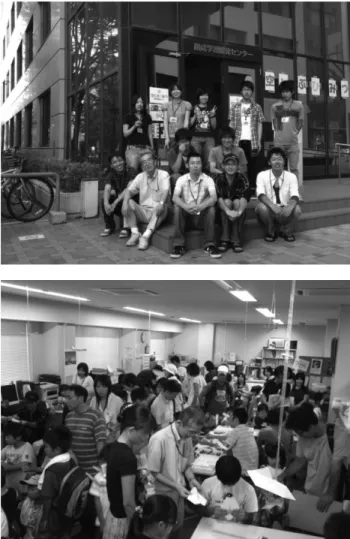
The most important thing is we need to develop an ability of student’s creativity. In order to perform this, it is important to prepare a practicing field or space for the students. Fig. 2 shows the building used for a space for the students to practice thinking and performing. We named this space as the “Innovation Plaza”. The first and the second floors of this building belong to our center.

The first floor is used for meeting as well as presentation

Fig. 2 Student staffs in front of the Innovation Plaza (top) and science experience festival (bottom)

and the second floor is for mechanical and electrical workshop. After taking a safety lecture and training working machines, the students receive a license and they can freely use various kind of working machines equipped in the workshop.

We propose three concepts to the students for forming project teams and for practicing activities.

1. Project-based activity: Students should propose a subject with a clear object which is planned by themselves.

2. Team activity: More than two persons should come together to form a team.

3. Activity beyond a fence of field and grade: Students

should join and make a team beyond their field and

their age.

(3)

Fig. 3 Learning Pyramid (Ref. National Training Laboratories)

3. Learning through Experience

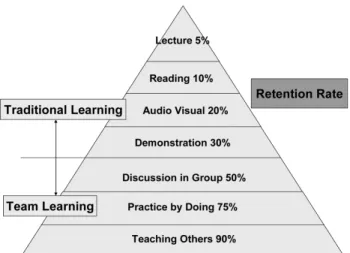
Fig. 3 is called as the “Learning Pyramid”. It shows the average retention rate through various learning methods.

The retention means how much % of the learned materials is memorized in your mind.

If students learned from the lecture, i.e. the teacher teaches from the front of the room and only makes the lecture on one way, the retention rate is very low as small as 5% only. If they read books by themselves, it will be 10 %. If the teacher demonstrates some experiments using experimental devices in front of them, it will be 30%. The next three cases of team learning shows the improvement in retention rate. If there are many dis- cussions among the group members or if they practice something by themselves, the retention rate will be raised to 50 and 75%. To teach someone is the most effective way to learn. In this case, the retention rate becomes 90%.

In order to teach someone, you must learn more and more. You must research not only the materials on the lecture but many related materials on similar topics.

III. Students' Teaching Activities in Science Schools

1. Science Handicraft Class for Children

Science handicraft classes were held four times under

Fig. 4 Children in the science handicraft class (top) and wind chime making (bottom)

the theme of “Wonder in Light, Sound, Temperature and Force” at the Kamojima Community Center near Tokushima City. In the class of “Wonder in Light”, the teacher as well as the student staffs gave a lecture and experiments on lens, prism, slit and reflection lattices. Thereafter, children made a telescope with convex and concave lenses with the help of student’s advice. In the class “Wonder in Sound”, student staffs taught children about three elements of sound and then helped them to make a wind chime. In the rest of the two classes, children had a lecture on the temperature and force following a handicraft experience to make a thermometer and a beam balance.

2. “Family Science School” for Children and Parents

“Family Science School” was held at “Asutamu Land” in

(4)

Fig. 5 “Family Science School” at “Asutamu Land”. Student staff explains the principle of thermometer (top).

Children measure the temperature of ice and water mixture (bottom)

Tokushima Prefecture in order to enhance scientific literacy.

A series of four classes focused on the measurement of length, temperature, weight and energy were planned for elementary school children and their family. Four university students joined this school performance where they taught children the introduction of each theme and the way of experiments. After a brief explanation, the children made a basic experiment on the measurement of length, tem- perature, weight and energy with the help of student staffs.

3. “Tatara Steel Making” for High School Students Tatara is an old Japanese iron making method which

Fig. 6 Tatara project members make a lecture on tatara steel making to high school students (top) and guide them on tatara making (bottom)

was developed about 1500 years ago in Japanese history.

At the time, they did not have an iron ore in Japan,

therefore, they used iron sand, i.e. small particles of iron

oxide, to make a bulk of iron and steel with charcoal as

a fuel. The members of Tatara project have tried to

reproduce the ancient iron making system. From five years

ago, the members teach Tatara steel making method to

high school students. They went to Sadamitsu Technical

High School in Tokushima Prefecture and made a lecture

on the introduction of metallurgy and the principle of

Tatara steel making. After lecturing, the students of the

high school came to the university campus and performed

Tatara steel making under the guidance of the project

members.

(5)

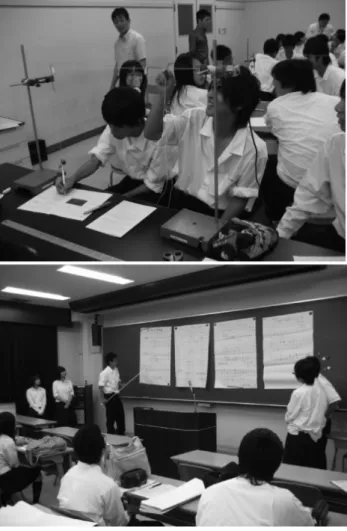
the lecture on vibration taught by a teacher, university students assisted high school students in performing ex- periment and helped them for making presentation materials.

The high school students made an experiment, analyzed

Fig. 7 High school students make an experiment on vi- bration of string (top) and make a presentation on their results (bottom)

10 to 15 minutes but they had spend many hours to study and prepare the contents of the presentation. Teaching something to other people improves not only communication skill but also knowledge on particular topic. They must plan of teaching and prepare the materials of the work.

All activities is a good experience of their student life.

The students participating in the class for elementary school children realized the difficulties in teaching. On the other hand, those who participated in the class for senior high school students realized their lack of knowledge in a deep scale for teaching. The students learned a lot of skills for teaching, communication as well as profound thinking in the subjects of science.

The followings are the example that the university stu- dents gained through the science school.

y Great difference exists between own knowledge and explaining to others.

y In order to explain something to others, a lot of knowledge is needed.

y Communication skill is necessary for teaching children clearly.

V. Conclusion

The university students engaged in making the schedule,

the textbook for science schools, trained themselves for

teaching, and finally performed teaching as well as as-

sisting the elementary school children and high school

students in science school classes. From these experiences

through the teaching to others, they enhanced their skills

of science communication and science literacy.

(6)

The authors would like to express sincere thanks for the support of Japan Science and Technology Agency.

Reference

1. H. Ukida, Y. Aika, K. Achi, Y. Ishihara, J. Kuroda, G.

Kosaki, S. Suzuki and Y. Nagata, “Robot Manufacturing Class for Children Led by University Students”, Journal of Engineering Education Research, 13 (2) Special Edition:

78-81, (2010).

2. S. Kamitani, Y. Arai, Y. Konishi, S. Nakanishi, T. Oshima, J. Yamaguchi, A. Ishii, K. Minagawa and M. Yasuzawa,

“A Senior High School Chemistry Laboratory Class Observed by University Students”, Journal of Engineering Education Research, 13 (5) Special Edition: 15-19, (2010).

3. M. Naim, S. Tsuzuki, S. Fujisawa and T. Hanabusa, “A Way to Further Understanding of Basic Engineering Principle by Supervising Junior High School Students through Sets of Science Experiment”, Journal of Engineering Education Research, 13 (5) Special Edition: 25-28, (2010).

4. M. Yasuzawa, K. Minagawa, S. Kamitani, Y. Arai, Y.

Konishi, S. Nakanishi, T. Oshima, J. Yamaguchi and A.

Ishii, “Production of Chemistry Laboratory Class for Senior High School Freshmen”, Journal of Engineering Education Research, 13 (5) Special Edition: 55-60, (2010).

5. K. I. Hwang, “An Introduction Class on the Tidal Power Generation for Elementary School Students by University Students”, Journal of Engineering Education Research, 13 (5) Special Edition: 3-7, (2010).

Hanabusa, Takao

Takao Hanabusa received the Bachlor Degree of Engineering from Tokushima University in 1967, the Master Degree of Engineering from Tokushima University in 1969, and the Doctor Degree of Engineering from Osaka University in 1982.

He had worked at The University of Tokushima during 1969 to 2010. He is now Emeritus Professor of The University of Tokushima and works at The Center for Innovation and Creativity Development of The University of Tokushima as an advisor.

His major research field is X-ray stress measurement and engineering education.

E-mail: [email protected]

Tsuzuki, Shozo

Shozo Tsuzuki received the Bachelor Degree of Engineering from Ehime University in 1972 and the Master Degree of Engineering from Naruto University of Education in 2004.

He is now Assistant Professor of The Univesity of Tokushima and works at The Center for Innovation and Creativity Development. His interesting research area is history of science and engineering.

E-mail: [email protected]

수치

Fig.  1  The  organization  of  the  Center  for  Innovation  and  Creativity  Development
Fig. 3 is called as the “Learning Pyramid”. It shows the  average  retention  rate  through  various  learning  methods
Fig.  5  “Family  Science  School”  at  “Asutamu  Land”.  Student  staff  explains  the  principle  of  thermometer  (top)
Fig.  7  High  school  students  make  an  experiment  on  vi- vi-bration  of  string  (top)  and  make  a  presentation  on  their  results  (bottom)

참조

관련 문서

The Effects of Using Mind Maps as a Learning Tool on Middle School Students Interest and Academic Achiveements in Science.. Integrated Teaching Methd of Learning

Israel’s computer science education in middle schools is provided through integration with natural science and technology subjects, but in high school it

This study was to analyze the articulation between chemistry contents of science textbooks at elementary and middle school level, to survey students' perceptions

The class was for 42 students(22 elementary school students, 20 middle school students), and the questions, cognition of the necessity for accessibility, behavior

The effects of argumentation-based teaching and learning strategy on cognitive development, science concept understanding, science-related attitude, and argumentation in

Abstract: Science teaching-anxiety and science teaching-efficacy are influential factors in teachers’ teaching practices and behaviors. In order to encourage elementary teachers to

It was found that elementary school teachers’ self-images of science teaching for four science subjects (physics, chemistry, biology, and earth science) were more

The purpose of this study is to investigate the effects of pre-service teachers of elementary school who take courses in 'Science and Textbook Research' on science teaching