Security Analysis and Improvements of a
Biometrics-based User Authentication Scheme Using Smart Cards
Young-Hwa An *
스마트 카드를 이용한 생체인식 기반 사용자 인증 스킴의 안전성 분석 및 개선
안 영 화 *
1)Abstract
Many biometrics-based user authentication schemes using smart cards have been proposed to improve the security weaknesses in user authentication system. In 2010, Chang et al. proposed an improved biometrics-based user authentication scheme without concurrency system which can withstand forgery attack, off-line password guessing attack, replay attack, etc. In this paper, we analyze the security weaknesses of Chang et al.’s scheme and we have shown that Chang et al.’s scheme is still insecure against man-in-the-middle attack, off-line biometrics guessing attack, and does not provide mutual authentication between the user and the server. And we proposed the improved scheme to overcome these security weaknesses, even if the secret information stored in the smart card is revealed. As a result, the proposed scheme is secure for the user authentication attack, the server masquerading attack, the man-in-the-middle attack, and the off-line biometrics guessing attack, does provide the mutual authentication between the user and the remote server.
And, in terms of computational complexities, the proposed scheme is more effective than Chang et al.’s scheme.
▸Keyword : Authentication, Biometrics, Man-in-the-Middle Attack, Mutual Authentication
∙제1저자 : 안영화
∙투고일 : 2011. 12. 21, 심사일 : 2012. 01. 06, 게재확정일 : 2012. 01. 28.
* 강남대학교 컴퓨터미디어정보공학부(Division of Computer and Media Information Engineering, Kangnam University)
※ 이 논문은 2010년도 강남대학교 교내연구비 지원에 의한 것임
요 약
스마트카드를 이용한 생체인식 기반 사용자 인증 스킴이 인증 시스템에서 안전성 취약점을 개선하기 위해 제안 되고 있다. 2010년 Chang 등은 위조 공격, 오프라인 패스워드 추측 공격, 재생 공격 등에 안전한 개선된 생체인식 기반 사용자 인증 스킴을 제안하였다. 본 논문에서는 Chang 등의 스킴에 대한 안전성을 분석하고, Chang 등의 스킴이 중간자 공격, 오프라인 생체인식 추측 공격 등에 취약하고, 사용자와 서버 사이에 상호인증을 제공하지 못함 을 증명하였다. 그리고 본 논문에서는 이와 같은 안전성 취약점들을 개선한 인증 스킴을 제안하였다. 안전성 분석 결과, 제안된 스킴은 사용자 가장 공격, 서버 가장 공격, 중간자 공격, 오프라인 생체인식 추측 공격 등에 안전하고, 사용자와 서버 사이에 상호인증을 제공하고 있음을 알 수 있다. 그리고 계산 복잡도 관점에서 제안된 스킴은 Chang 등의 스킴보다 효율적임을 알 수 있다.
▸Keyword : 인증, 생체인식, 중간자 공격, 상호인증
I. Introduction
With the increasing of users using commercial services through networks, the user authentication scheme using smart card has been becoming one of important security issues. However, security weaknesses have been exposed in the user authentication scheme due to the careless password management and the sophisticated attack techniques. Several schemes[1-6] have been proposed to improve security, efficiency, and cost.
Recently, personal biometrics information, such as fingerprints, faces, irises, hand geometry, and palm-prints, etc. has been used to design biometrics-based user authentication schemes[7-10]. There are several advantages of using biometrics key as compared to traditional passwords.
• Biometric keys cannot be lost or forgotten.
• Biometric keys are very difficult to copy or share.
• Biometric keys are extremely hard to forge or distribute.
• Biometric keys cannot be guessed easily.
• Someone’s biometrics is not easy to break than others.
As described the above, biometrics-based remote user authentication schemes are inherently more reliable and
secure than traditional password-based remote user authentication schemes.
In 2004, Jin et al.[7] proposed two-factor auth entication scheme using fingerprint data and tokenized pseudo random number. Using this new scheme proposed by Jin et al., in 2010, Li and Hwang[9 proposed an efficient biometrics-based remote user authentication scheme using smart cards.
However, in 2010, Chang et al.[10] pointed out that Li and Hwang’s scheme allowed an attacker to perform off-line guessing attack. And Chang et al. proposed an improved biometrics-based user authentication scheme without concurrency system that is secure against forgery attack, off-line guessing attack, and replay attack.
In this paper, if an attacker can access a user’s smart card and extract the values stored in the smart card by monitoring the power consumption[11-12], we show that Chang et al.’s scheme is not secure against man-in-the middle attack, off-line biometrics guessing attack, and does not provide mutual authentication between the user and the server. And we propose the improved scheme to overcome these security weaknesses, while preserving all their merits, even if the secret information stored in the smart card is revealed.
This paper is organized as follows. In section II, we
briefly review Chang et al.’s scheme. In section III,
we describe the security weaknesses of Chang et al.’s
scheme. The proposed scheme is presented in section
IV, and its security analysis and performance
evaluations are given in section V. Finally, the
conclusions are given in section VI.
II. Review of Chang et al.’s Scheme
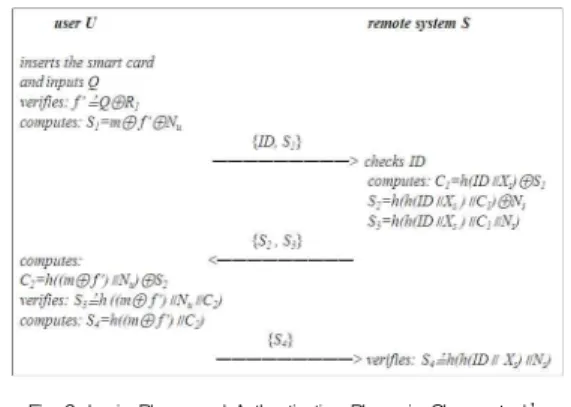
In this section, we briefly review Chang et al.’s scheme[10]. The security of this scheme is based on hash function and random nonce to withstand the forgery attack, the off-line guessing attack and the replay attack. Chang et al.’s scheme is divided into three phases: registration phase, login phase, and authentication phase. We present the illustration of registration phase in Fig. 1. and login and authentication phase in Fig. 2. And the notations used in this paper are listed below:
• U: The user
• S: The server
• R: The registration centre
• ID: Identity of user
• X s : Secret information kept by the server
• Q: Biometric information of the user
• N u : A nonce chosen by user
• N s : A nonce chosen by server
• h(): One-way hash function
• ∥: Concatenation
• ⊕: Exclusive-OR operation
• A≟B: Whether A equals B or not
2.1 Registration Phase
This phase works whenever the user registers to the registration centre and obtains the smart card.
1) The user submits his identifier ID and the personal biometrics Q to the registration centre through a secure channel.
2) Upon receiving the information, the registration centre selects a random number R 1 , and then computes f=Q
⊕R 1 and m=h(ID∥X s )⊕f, where R 1 is the first time random secret to protect the biometrics.
3) The registration centre issues the information {ID, h(), R 1 , f, m} to the smart card and sends it to the user through a secure channel.
Fig. 1. Registration Phase in Chang et al.’s Scheme
2.2 Login Phase
This phase works whenever the user wants to login to the remote server.
Fig. 2. Login Phase and Authentication Phase in Chang et al.’s Scheme
1) The user inserts his smart card into a card reader and provides the personal biometrics Q on the specific device.
2) The smart card computes f’=Q⊕R 1 , and verifies whether f’equals f or not.
3) If it holds, the smart card generates a random nonce N u and computes S 1 =m⊕f’⊕N u .
4) And then, the user sends the message {ID, S 1 } to the remote server.
2.3 Authentication Phase
This phase works whenever the remote server received the user’s login request.
1) The server checks the format of ID. If it holds, the server computes C 1 =h(ID∥X s )⊕S 1 .
2) The server computes S 2 =h(h(ID∥X s )∥C 1 )⊕N s and
S 3 =h((h(ID∥X s )∥C 1 )∥N s ), where N s is a random
nonce selected by server.
3) The server sends the message {S 2 , S 3 } to the user.
4) Upon receiving the message, the smart card computes C 2 =h((m⊕f’)∥N u )⊕S 2 , and verifies whether S 3
equals h((m⊕f’)∥N u ∥C 2 ) or not.
5) If it holds, the user authenticates the server as a legal server, and then computes S 4 =h((m⊕f’)∥C 2 ).
6) The user sends the message {S 4 } to the server.
7) Upon receiving the message, the server verifies whether S 4 equals h(h(ID∥X s )∥N s ) or not.
8) If it holds, the server authenticates the user as a legal user and accepts the user’s login request.
After performing the above three phases, Chang et al.’s scheme provides the mutual authentication between the user and the server.
III. Security Weaknesses of Chang et al.’s Scheme
In this section, we analyze the security of Chang et al.’s scheme. To analyze the security weaknesses, we assume that an attacker can access a user’s card and extract the values stored in the smart card by monitoring the power consumption[11-12] and intercept the messages communicating between the user and the server.
3.1 Man-in-the-Middle Attack
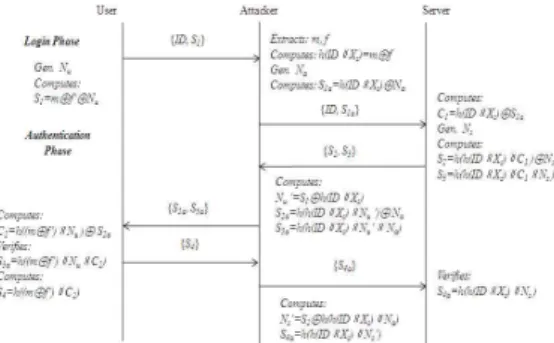
Under the above assumption, after an attacker extracts m, f from a user’s smart card, he can easily derive h(ID∥X s ) by computing m⊕f=h(ID∥X s ). Now the attacker with the computed value can perform the man-in-the-middle attack like the following steps. The processing of the man-in-the-middle attack is illustrated in Fig. 3.
1) The attacker intercepts the login message {ID, S 1 } of other user, where S 1 is m⊕f’⊕N u comp uted by the server in the login phase. Then he computes S 1a =h(ID∥X s )⊕N a , where N a is a random nonce generated by the attacker.
2) The attacker sends the forged message {ID, S 1a } to the server.
3) Upon receiving the forged message, the server checks the validity of ID. If it holds, the server accepts the login request message generated by the attacker.
4) The server computes the following equations, and then the server sends the reply message {S 2 , S 3 } to the user .
C 1 = h(ID∥X s )⊕S 1a
S 2 =h(h(ID∥X s )∥C 1 )⊕N s
S 3 =h(h(ID∥X s )∥C 1 ∥N s )
where N s is a random nonce generated by the server.
5) The attacker intercepts the reply message {S 2 , S 3 }, and then computes S 2a =h(h(ID∥X s )∥N u ’)⊕N a and S 3a
=h(h(ID∥X s )∥N u ’∥N a ), where N u ’ is the value N u
by computing S 1 ⊕h(ID∥X s ).
6) Then the attacker sends the forged reply message {S 2a , S 3a } to the user.
7) Upon receiving the forged reply message, the smart card computes C 2 =h((m⊕f’)∥N u )⊕S 2a , and then verifies whether S 3a equals h((m⊕f’)∥N u ∥C 2 ) or not.
If it holds, the user accepts the forged message generated by the attacker. Thus the attacker is authenticated by the user.
8) The smart card computes S 4 =h((m⊕f’)∥C 2 ), and then the user sends the message {S 4 } to the server for mutual authentication.
9) The attacker intercepts the message {S 4 } of the user, and then computes S 4a =h(h(ID∥X s )∥N s ’), where N s ’ is the value N s by computing S 2 ⊕h(h(ID∥X s )∥N a ).
10) The attacker sends the forged message {S 4a } to the server.
11) Upon receiving the forged message, the server verifies whether S 4a equals h(h(ID∥X s )⊕N s ) or not.
If it holds, the server accepts the forged message generated by the attacker. Thus the attacker is authenticated by the server.
As described the above, the attacker can masquerade as
the legal user while talking to the server and masquerade as
the legitimate server while talking to the user.
Fig. 3. Man-in-the-Middle Attack
3.2 Biometrics Guessing Attack
As described the above, we assume that the attacker can extract the secret values (f, R 1 ) from the legal user’s smart card by some means. Now, the attacker can easily find out the biometrics information of the user by computing the Q=f
⊕R 1 . In Chang et al.’s scheme, this biometrics information is very important secret value because it is necessary to confirm personal identity in registration and login phase. If an attacker gets this secret biometrics information, the attacker can use it to impersonate a legal user who wants to register with this system.
3.3 Mutual Authentication
As described the above, such as the man-in-the-middle attack, Chang et al.’s scheme fails to provide the mutual authentication between the user and the remote server. That is, if the attacker can extract the secret values (f, m) from the legal user’s smart card and intercepts the messages communicating between the user and the server, the attacker can impersonate the legal user easily by computing the equation S 1a =h(ID∥X s )⊕N a . Also, if the attacker can extract the secret values (f, m) from the legal user’s smart and intercepts the messages, the attacker can masquerade the legal remote server easily by computing the equation S 2a =h(h(ID∥X s )∥N u * )⊕N a and S 3a =h(h(ID∥X s )∥N u * ∥N a ).
IV. The Proposed Scheme
In this section, we propose an improved Chang et al.’s scheme which can withstand the man-in-the-middle attack,
the biometrics guessing attack and the insider attack. The proposed scheme is divided into three phases: registration phase, login phase and authentication phase. The registration phase is illustrated in Fig. 4. Also, the login and authentication phase is illustrated in Fig. 5.
4.1 Registration Phase
This phase works whenever the user registers to the registration centre and obtains the smart card.
Fig. 4. Registration Phase in the Proposed Scheme
1) The user submits his identifier ID and the
personal biometrics Q to the registration centre through a secure channel.
2) Upon receiving the information, the registration centre generates random number R 1 , and then computes f=Q
⊕R 1 and m=h(ID∥X s )⊕f, where R 1 is the first time random secret to protect the biometrics.
3) The registration centre issues the information {ID, m, h(), R 1 } to the smart card and sends it to the user through a secure channel.
4.2 Login Phase
This phase works whenever the user wants to login to the remote server.
Fig. 5. Login Phase and Authentication Phase in the Proposed Scheme
1) The user inserts his smart card into a card reader and provides the personal biometrics Q on the specific device.
2) The smart card computes f’=Q⊕R 1 , and verifies whether f’ equals f or not.
3) If it holds, the smart card generates a random nonce N u and computes:
S 1 =m⊕f’⊕N u
C 1 =h(S 1 ∥N u )
4) And then, the user sends the message {ID, S 1 , C 1 } to the remote server.
4.3 Authentication Phase
This phase works whenever the remote server received the user’s login request.
1) The server computes N u ’=h(ID∥X s )⊕S 1 , and then verifies whether C 1 equals h(S 1 ∥ N u ’) or not.
2) If it holds, the server accepts the login message from the user and authenticates the user as a legal user.
3) And then the server generates N s and computes the following equations.
S 2 =h(h(ID∥X s )∥N u ’)⊕N s
C 2 =h(S 2 ∥N s )
4) The server sends the message {S 2 , C 2 } to the user.
5) Upon receiving the message, the smart card computes N s ’=h((m⊕f’)∥N u )⊕S 2 , and verifies whether C 2
equals h(S 2 ∥N s ’) or not.
6) If it holds, the user accepts the reply message from the server and authenticates the server as a legal server.
After performing the above three phases, the proposed scheme provides the mutual authentication between the user and the server.
V. Security Analysis and Performance Evaluations of the Proposed Scheme
In this section, we will provide the security analysis of the proposed scheme based on one-way
hash function and personal biometrics. Also we will evaluate the performance of the proposed scheme in terms of computation.
5.1 Security Analysis
To analyze the security of the proposed scheme, we assume that can access a user’s smart card and extract the values stored in the smart card by some means[11-12], and intercepts the messages communicating between the user and the server. Here, we only discuss the user impersonation attack, the server masquerading attack, the man-in-the-middle attack, the biometrics guessing attack, and the mutual authentication.
5.1.1 User Impersonation Attack
To impersonate as the legal user, an attacker attempts to make the forged login request massage which can be authenticated to the server. However, the attacker cannot impersonate as the user by forging the login request massage, because the attacker does not compute the forged message S 1 * or C 1 * without knowing the remote server’s secret value X s and the user’s personal biometrics Q. Hence, the attacker has no chance to login by launching the user impersonation attack.
5.1.2 Server Masquerading Attack
To masquerade as the legal server, an attacker attempts to make the forged reply massage which can be masqueraded to the user when receiving the user’s login request message. However, the attacker cannot masquerade as the server by forging the reply massage, because the attacker does not compute S 2 * or C 2 *
without knowing the remote server’s secret value X s and the user’s personal biometrics Q. Hence, the attacker has no chance to be masqueraded as the legal server to the user by launching the server masquerading attack.
5.1.3 Man-in-the-Middle Attack
To perform the man-in-the-middle attack, an attacker
attempts to make the forged massages {ID, S 1a }, {S 2a , S 3a }
and {S 4a } each phase. However, the attacker cannot perform
the forged massages, because the attacker does not compute
these forged messages without knowing the remote server’s
secret value X s and the user’s personal biometrics Q, even if
the attacker has known the secret information in the user’s smart card. Hence, the attacker cannot impersonate as the legal user while communicating to the server, and cannot masquerade as the legitimate server while communicating to the user.
5.1.4 Biometrics guessing attack
To perform the biometrics guessing attack, the attacker attempts to extract the secret values from the user’s smart card under the described assumption. Then the attacker attempts to derive the user’s personal biometrics Q by computing Q=f⊕R 1 in the registration phase. However, the attacker cannot guess the user’s personal biometrics Q, because the attacker does not know the secret value f computed by the server. Hence, the proposed scheme withstand against the off-line biometrics guessing attack.
5.1.5 Mutual Authentication
As described the above subsection, such as the user impersonation attack and the server masquerading attack, the proposed scheme provide the mutual authentication between the user and the remote server. Namely, even if the attacker can extract the secret information in the user’s smart card, the user can be authenticated to the server and the server can be authenticated to the user.
Because the attacker cannot attempt to make the forged messages each phase without knowing the remote server’s secret value X s and the user’s personal biometrics Q.
security components
Chang et al.’s scheme
the proposed scheme User Impersonation Attack possible impossible
Server Masquerading
Attack possible impossible
man-in-the-middle attack possible impossible biometrics guessing
attack
possible impossible
mutual
authentication impossible possible
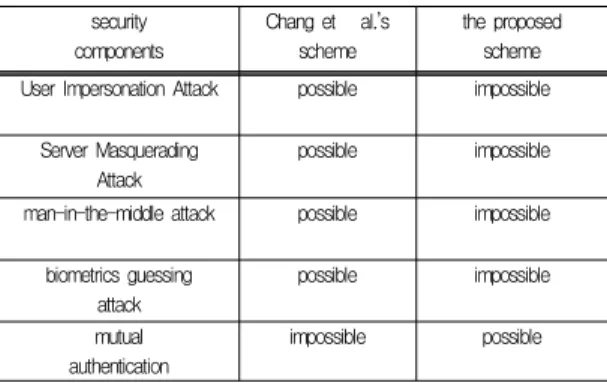
Table 1. Security comparison of the proposed scheme to Chang et al.’s scheme
From the above studies, the security comparison of the proposed scheme to Chang et al.’s scheme is summarized in Table 1. We can see that the proposed scheme is relatively more secure than Chang et al.’s scheme.
5.2 Performance Evaluations
In this section, we evaluate the efficiency of the proposed scheme in terms of the computational complexities by comparing with Chang et al.’s scheme. In Table 2, we can see that the proposed is relatively more effective in terms of computational complexities than Chang et al.’s scheme, even if the proposed scheme does provide the security against the various attacks.
phase Chang et al.’s
scheme the proposed
scheme registration
phase
1TH+2TX 1TH+2TX
login phase 3TX 1TH+3TX
authentication
phase 7TH+3TX 6TH+3TX
Table 2. Computational complexities comparison of the proposed scheme to Chang et al.’s scheme
*TH: the time for performing a one-way hash function, TX: the time for performing a exclusive-OR operation