공유리더십이 직무재창조(Job crafting)에 미치는 영향:
학습목표지향성과 지식공유의 매개효과
The Effect of Shared Leadership on Job Crafting: Mediating Role of Learning Goal Orientation and Knowledge Sharing
이지은, 오상진
서울과학종합대학원대학교 경영학과
Ji-Eun Lee([email protected]), Sang-Jin Oh([email protected]) 요약
본 연구는 조직의 업무성과 향상에 중요한 요인으로 논의되고 있는 직무재창조를 유도할 수 있는 이론적, 실무적 시사점을 제시하기 위하여 유관변인을 탐색하고 변인들 간의 영향관계를 실증하는 것을 목적으로 하였 다. 이를 위하여 공유리더십, 학습목표지향성, 지식공유를 예측변인으로 선정하여 공유리더십과 직무재창조의 관계에서 학습목표지향성과 지식공유의 매개효과를 확인하고자 하였다. 가설은 선행연구와 사회인지이론, 정 서사건이론 등에 기초하여 설정하였다. 자료는 국내 다양한 조직에서 재직하고 있는 직장인 318명을 대상으로 온라인으로 설문을 실시하여 수집하였다. 수집된 데이터의 신뢰성과 유효성은 SPSS 25.0과 AMOS 25.0에 의해 검증되었으며 가설은 SPSS프로세스 매크로 3.0으로 분석하였다.
연구결과 공유리더십은 구성원의 학습목표지향성과 지식공유, 그리고 직무재창조에 각각 정(+)의 영향을 미 치고, 공유리더십과 직무재창조의 관계에서 학습목표지향성과 지식공유가 매개효과를 가지는 것이 확인되었 다. 본 연구 결과는 구성원의 직무재창조를 촉진하는 공유리더십의 효과성을 제시함으로써 공유리더십의 활성 화를 위한 시스템 마련과 구성원들의 학습목표지향성, 지식공유를 강화하기 위한 시사점과 향후 연구방안을 논의하였다.
■ 중심어 :∣공유리더십∣직무재창조∣학습목표지향성∣지식공유∣
Abstract
Job crafting has gained prominence in organizational practice as an important factor to cultivate positive performance, the purpose of this study is to present theoretical and practical implications of job crafting by examination of the effective variables that induce job crafting. We verify the correlation between shared leadership and job crafting and the mediating effect of learning goal orientation and knowledge sharing in the relationship between these two variables. Hypotheses were established on the basis of precedent research and various theories including social cognitive theory and affective events theory. The data were collected by conducting online surveys of 318 office workers who have served in various domestic organizations. The reliability and validity of the collected data were verified by SPSS 25.0 and AMOS 25.0, and the hypotheses were analyzed by SPSS process macro 3.0.
The study found that shared leadership yields positive effects on the learning goal orientation, knowledge sharing and job crafting of participants respectively and that learning goal orientation and knowledge sharing have a mediating effect in the relationship between shared leadership and job crafting. The results of this study present the effectiveness of shared leadership to facilitate the job crafting and implications and future research measures for the organization to develop a system for activating shared leadership, and for strengthening learning goals orientation and knowledge sharing.
■ keyword :∣Shared Leadership∣Job Crafting∣Learning Goal Orientation∣Knowledge Sharing∣
접수일자 : 2020년 09월 21일
수정일자 : 2020년 10월 12일 심사완료일 : 2020년 10월 12일
교신저자 : 오상진, e-mail : [email protected]
I. Introduction
The current rapidly changing business environment is described as the era of volatility, uncertainty, complexity, and ambiguity or VUCA [1]. In order to respond to the current COVID-19 pandemic situation companies are reorienting their strategic direction and sustaining their competitive advantage by improving their organizational competencies.
Attention is drawn to adopting key actions for enhancing performance and organizational effectiveness of personnel in the organization in order to flexibly cope with changes in the business and organizational environment[2].
Among these changes, personnel are increasingly required to make proactive job corrections through continuous learning and skills development.
The traditional job design was a top-down approach in which an organization or manager organized, modified and communicated the contents of a job and then conveyed them to its members[3]. It has been argued that this approach is ineffective for motivating personnel, and does not significantly affect the performance of the organization[4]. Therefore, as an alternative, a bottom-up approach in which employees themselves redesigned units or areas of the task has come to the forefront.
Job crafting, first presented by Wrzesniewski and Dutton[5] refers to employee contribution to organizational performance through the control of task boundaries and areas of association, thereby redefining work in a proactive and autonomous manner[6]. In the referenced studies on job crafting, employee self-efficacy[7] and the effect of individual characteristics such as initiative[8] on job
crafting were addressed because an individual's own characteristics affect the motivation to redefine his or her job areas and duties more than external factors[9]. Although the organization emphasizes leadership in motivating its members and encouraging them to participate voluntarily in securing competitiveness as an important factor in maintaining its competitive advantage[10], studies attempting to verify the relationship between structural factors such as leadership and job crafting have not been as active.
Previous research on leadership types affecting job crafting focused on vertical relationships with one leader, including transformational leadership, empowering leadership, and servant leadership [11-13]. But, Hitchcock and Willard[14] said this vertical relationship could be an obstacle to team performance. While organizations are seeking to respond flexibly to rapid changes in the management environment by introducing a horizontal team system, organizations that had adopted a team system proved that shared leadership is more effective in team performance than vertical leadership[15]. So, attention has been drawn to shared leadership in which various employees exercise collective passion and expertise and have the power of leadership together[16]. The discriminatory nature of shared leadership turns all employees into sources of leadership[17]. So, through authority of leadership given to each person, an inherent motivation to expand impact and ownership of work is strengthened and can stimulate job crafting[18].
The personal characteristics affecting a job
crafting are leading personality[19] and high
self-efficacy[20][21] among others. A learning
goal orientation and a proclivity for knowledge sharing, which appear to be the leading and voluntary characteristics of individual members, were suggested as prerequisites for job crafting.
This is because a learning goal orientation is the willingness to acquire new skills or knowledge to develop one's capabilities in new situations. Changing one's job form can be accepted as a learning opportunity and a challenge, prompting the crafting of one's own jobs[22]. In addition, knowledge sharing can be defined as a voluntary action that contributes to the enhancement of the organization's capabilities by exchanging knowledge assets held by each employee with other members and spreading them within the organization[23]. It is possible to enhance job crafting in such a way that it changes the way participants perform their duties, thereby improving their relationships with other members. Participants may explore and receive the knowledge they need and incorporate their previously held and newly received knowledge in order to utilize the newly created knowledge[24].
Meanwhile, learning goal orientation is characterized by continuous learning, with the belief that one can develop one's own ability[25]. It can be promoted by shared leadership, where each employee takes the initiative in self-improvement to achieve their own potential[26], making positive and optimistic assessments of oneself through active communication among members and making efforts to overcome difficult situations. In addition, it can be inferred that learning goal orientation can promote knowledge sharing because a person with high learning goal orientation recognizes knowledge sharing as a prerequisite for learning, and strives to develop
technology and promote knowledge not only for oneself but also for other colleagues[27].
Another leading factor affecting knowledge sharing is shared leadership, as support and consideration of shared leadership encourages members to actively participate in knowledge sharing and increases their willingness to share knowledge as the vision and values of the organization are shared. Huh[28] and Moon[29]
presented empirical validation that a horizontal structure and distributed influence of shared leadership have a positive effect on knowledge sharing by promoting productive communication and active feedback of members.
Based on the above theoretical explanations and prior research, the purpose of this study is, first, to systematically demonstrate the effect mechanisms of shared leadership on job crafting by establishing shared leadership as a structural factor in exploring factors that may enhance job crafting, and by assuming learning goal orientation and knowledge sharing as a personal factor. Second, we would like to examine the mediating effects of active and leading individual characteristic variables of employees, such as learning goal orientation and knowledge sharing, to identify factors that can strengthen the organization's capabilities.
Third, based on the results of these studies, we
would like to provide companies seeking ways
to strengthen the capacity of effective
organizations with implications that can
promote the job crafting of members through
the introduction and importance of shared
leadership, and the promotion of learning goal
orientation and knowledge sharing.
Ⅱ. Theoretical Background 1. Shared leadership
Shared leadership is a kind of horizontal and distributed leadership exercised by all of employees based on their dynamic mutual impact[30]. Pearce[31] described the process as a simultaneous and continuous interaction of employees and a continuation of formal and informal leaders as characteristic of shared leadership, while Carson, Tesluk, and Marrone [32] described it is the process that leadership is distributed and circulated among employees with the most knowledge and skills in a given situation.
The core concept of shared leadership is divided into two parts: distributed influence and collective leadership. Distributed influence is a concept based on social network theory, which is caused by the concentration of influence among employees by two or more shared leadership. This is a concept that describes the role of leadership[33], which describes the process and condition of the emergence of shared leadership. Collective leadership is a role theory-based concept that refers to the state in which all employees perform leadership roles at the same time and describes how they emerged and the consequences of shared leadership[34].
The method of measurement of shared leadership is largely divided into two types, depending on the researchers. First, it is a method of measuring the level of horizontal leadership at the team level by transcribing the questions of various leadership, such as directive, transformational, transactional and empowering leadership, focusing on measuring distributed influence[35]. Second, network
density and concentration rate among employees are measured assuming that all exercise leadership around collective leadership measurements[36]. However, with the second method of measurement, it is difficult to analyze qualitative characteristics due to unclear criteria and influences. In this study, the measurement tools developed by Ensley, Hmieleski, and Pearce [37] were used.
2. Learning goal orientation
The goal orientation established in the 1970s refers to the concept of presenting different responses by giving different perception, interpretation and motivation in the context of achieving a task[38][39]. Dweck and Legggett [39] said that giving and responding to the different meanings of the tasks they are carrying out, and choosing their own unique ways of motivating themselves, is because each individual has a different goal orientation.
The concept of goal orientation varies among researchers. Nicholls[40] and Dweck[38] divided the goal oriented model into learning goal orientation and performance goal orientation and defined learning goal orientation as acquiring new knowledge and skills and actively carrying out challenging or difficult tasks to promote steady self improvement. On the other hand, a person with a high performance goal orientation accepts challenging a new task as a risk factor to show his or her own deficient ability, as he or she tries to be recognized by others and avoid negative assessments[41].
VanderWalle[42] then divided the goal
orientation into three categories: learning goal
orientation, performance-prove goal
orientation, and performance-avoid goal
orientation. First, learning goal orientation
refers to the inner desire to develop oneself by mastering new situations and acquiring new skills or knowledge[43]. Second, performance- prove goal orientation refers a tendency to demonstrate one’s abilities, seek positive feedback about one’s performance compared with others. Finally, it was explained that the performance-avoid goal orientation indicates a tendency to avoid difficult tasks to avoid negative evaluation from others and might be associated with defensive behavior.
Research on past learning goal orientation has been done on the impact of students on their academic achievement, motivation, and learning transition[44][45]. Recently, research has also been conducted on the impact of learning goal orientation of leaders and employees on organizational performance, creativity and innovative behavior. Because the key factors to the organization’s effectiveness are its employees’ quick response to changes in business environment, perception and response of changes, and employees’ direction of behavior and motivation. Likewise, employees with more skills and knowledge improve job performance[45]. The learning goal orientation of the employees greatly affects their actions to improve their performance, such as setting goals, learning activities, and feedback-seeking and is a key variable in their individual knowledge activities. In this study, since learning goal orientation is aimed at verifying the relationship of effects on knowledge sharing and job crafting by increasing intrinsic motivation. VanderWalle[42]'s learning goal orientation among his goal orientation concepts has been mainly studied.
3. Knowledge sharing
Knowledge sharing refers to the behavior of employees voluntarily and consciously sharing information, know-how, and job-related knowledge with other members[27]. Bock, Zmud, Kim, and Lee[46] described it as the individual's willingness to share the knowledge created or acquired by the individual with other members and Gupta and Govindarajan[47]
described it as a flow of knowledge that allows other members to use it in performing their duties by disclosing their own knowledge to other members and spreading it within the organization.
Amid the growing importance of efficient knowledge management to strengthen the organization's viability and competitiveness[48], knowledge sharing is the core of knowledge management[49]. It is receiving attention as an important factor in the organization's performance by researchers. The preceding studies presented four factors affecting knowledge sharing: characteristics of knowledge[50], personal factors, relational factors, and structural factors[51]. First, the characteristics of knowledge mean the value, complexity, and implicitness of knowledge[50], second, personal factors mean the characteristics and the psychological state of the knowledge transferor and the knowledge receiver. Third, as relational factor, it includes the mutual impact on communication and trust.
Finally, structural factors focus on
organizational structure, organizational culture,
leadership and reward system. Especially
because knowledge sharing is a voluntary
activity[52], knowledge sharing is most
effectively facilitated when employees possess
strong will, motivation, and recognition of the
leader's efforts to create an environment for
knowledge sharing[50].
4. Job crafting
Job crafting is an activity in which employees make their own changes to a given task, as well as attempt to make their work more meaningful[5] by attempting new methods of performance to improve the completeness of the task, make effort to improve the quality of their relationships with other members, and interpret the purpose of the task as meaningful[53]. The key to job crafting is not the way in which the manager of the organization designed the task and delivered it to the employees in a top-down manner but each employee's pursuit of active change in their work[54].
Job crafting is generated by three needs of individuals: First, the desire to establish control of work[55], second, the desire to create a positive self-image in the organization and third, the desire to maintain relationships with other members[56] and people make efforts for job crafting to meet these needs. Employees change attitudes or psychological states through job crafting and these changes have benefits/characteristics, which occur continuously, over time[57].
The components of job crafting are largely divided into two models: First, presented by Wrzesniewski and Dutton[5] task crafting, relational crafting, and cognitive crafting. Task crafting is changing the boundaries of a task which refers to adding, emphasizing, and redesigning tasks to cultivate task variety, identity, and significance. Relational crafting is a change in the area of a relationship, which refers to building, reframing, and adapting relationships to facilitate meaningfulness at
work. Finally, cognitive crafting means reframing the way employees see their job by expanding, focusing, and linking perceptions to infuse their work with significance and value.
The second model of job crafting was described by Times and Bakker[58] as job demands and job resources, which vary the level of job demands and job resources depending on the abilities and preferences of the employees and they presented three aspects of crafting: increase the level of job resources, increase the level of job demand and decrease the level of job demand. An increase in the level of job resources means employees endeavor to gain more job resources to deal with job demands. An increase in the level of job demands is creating more challenges to use all employee skills and a decrease in the level of job demands means reducing tasks when task requirements exceed employee abilities. The purpose of this study is to verify the learning goal orientation, which is the individual element of the employees by shared leadership, and the impact on job crafting through the direct and indirect channels of knowledge sharing, so the components of job crafting presented by Wrzesniewski and Dutton[5] were used.
Ⅱ. Research Hypothesis
1. Shared leadership and learning goal
orientation, knowledge sharing, job crafting
The relationship between shared leadership
and learning goal orientation can be explained
by social cognitive theory. Social cognition
theory is that learning occurs when personal
factors and external social support factors
affect each other in both directions. Shared leadership can act as external social support, which can affect employees' active personal factors to induce, motivate, and improve their competencies for common objectives and tasks[59].
Locke and Latham[60] supported the interaction between personal and social support factors, arguing that such interaction would increase when employees recognized the environment in which their goal oriented behavior was accepted. It has been studied that the employees' goal orientation varies depending on the type of leadership that is one of the social support factors[61][62]. Sun, Jie, Wang, Xue, and Liu[63] proved that the learning goal orientation of the team is stimulated by the shared leadership to improve team creativity, which encourages employees to engage in constructive opinion exchanges, thereby motivating them to absorb mutually beneficial views and explore new ideas to develop their ability to accomplish tasks[64], they emphasized that the learning goal orientation of the team should be the basis of the impact of shared leadership on team creativity. At the individual level, a similar mechanism can be applied and in a team that exhibits a good shared leadership, employees led greater individual performance through self-development to reach their potential[65].
Jeong and Hong[66] said that shared leadership allows employees to recognize their role expansion, induce concentration on organizational purposes and their tasks, make new and challenging efforts in the process of achieving their own job performance. Although there is still a lack of research on the impact of shared leadership on the learning goal
orientation, all employees themselves practice their influence as leaders, recognize themselves as part of the team, thereby increasing trust in the team and teammates[67]. This environment is the basis for improving communication and promoting intrinsic motivation[68]. It can be inferred that shared leadership affects learning goal orientation to improve one's ability.
Hypothesis 1: Shared leadership will have a positive effect on the learning goal orientation of employees.
According to Hoch[69], a shared leadership is where all employees participate in decision making collaboratively and share responsibilities for outcomes. In a team where shared leadership is strongly represented, members present their own unique ideas and encourage others to participate in information sharing, thereby contributing to team performance through improved effective decision making and creative problem solving.
When all employees are involved in the decision making of a team or organization, they are motivated to perform their duties, and have a high level of job enthusiasm and challenging tendencies[70] with continuous communication and close interaction to achieve and improve the organization's goals[71] by actively sharing their information, skills and experiences[72]. So, the team will lead mutual learning to strengthen the individual competency of its members and achieve team results.
In this regard, a study by Bligh, Pearce, and
Kohles[73] argued that shared leadership leads
to knowledge creation through the process of
sharing, coordinating and integrating the
various experiences, backgrounds, approaches,
ideas and abilities each member has. Also, Wu and Cormican[74] confirmed that the active interaction brought by shared leadership accelerates the flow of knowledge and promotes team creativity. Park and Cha[75]
showed that verified knowledge sharing plays a mediating role in the impact of shared leadership on management performance and emphasized that shared vision and goals promote the intention of knowledge sharing.
The relationship between shared leadership and knowledge sharing can be explained in terms of social capital theory that the relationship and network with other co-workers can mobilize the resource of employees. Active interaction with the network formed by shared leadership led to greater trust, and the ability and belief necessary to mobilize the resources that all members possessed[76]. Therefore, based on the theoretical background and social capital theory, we propose the following hypothesis.
Hypothesis 2: Shared leadership will have a positive effect on the knowledge sharing of employees.
According to Wrzesniewski and Dutton[5], job crafting is triggered by the employees' recognition of an environment in which job crafting is possible, and by the autonomy of task performance and the confidence that active feedback between members can effectively perform their tasks[20].
Shared leadership is selected as a structural factor to satisfy this environment because cohesion of shared leadership creates active communication and interaction with coworkers, and increases the job crafting that seeks new
ways of task performance based on the psychological safety as they feel social support from coworkers[77][78]. Based on the affective events theory[79] that the experience of events that cause emotional reactions in an organization or a team will affect the attitude of its members, the relationship between shared leadership and job crafting can be explained.
The horizontal and relationship-oriented communication and feedback of the shared leadership enable employees to have a positive image of themselves, recognize their value and increase their self-efficacy to overcome difficulties[16], this positive emotion and response motivate voluntary job crafting.
A study by Hong and Kwon[80] on hotel millennial generation found that shared leadership has a positive effect on job crafting, stressing that an environment where active job performance is possible leads to more active job crafting. The active interaction through shared leadership gives members the opportunity to observe their peers' actions, competencies, contributions believing in one's abilities with colleagues, and having confidence that one's efforts can fit into the team[81].
Although research on the relationship between shared leadership and job crafting is not actively conducted, based on the theoretical background and affective events theory, we predict the following hypothesis.
Hypothesis 3: Shared leadership will have a positive effect on the job crafting of the employees.
2. Learning goal orientation, job crafting, knowledge sharing
A person with a high learning goal orientation
is characterized by learning the necessary knowledge for the task through strengthening his or her ability to successfully perform the task and actively engaging with people both inside and outside of the organization[39][82].
Brett and VanderWalle[83] stated that the employees who have high level of learning goal orientation achieve positive results by actively learning to improve their skills and finding various ways to accomplish tasks, and this individual's initiative can be the motivation for job crafting because it creates opportunities in the given environment and exerts drive for active problem solving[84].
Other personal factors promoting job crafting were found to be positive psychological capital[85] and self-efficacy[86].
A person with a high learning goal orientation wants to improve his or her competencies to continue self improvement and shows a strong sense of self efficacy that his or her efforts bring success[87]. Based on these beliefs, it can be inferred that the quality of relationships with people should be improved and that the leading tasks should be designed[88]. According to the self-determination theory[89], when the individual's desire for competence, connection, and autonomy are fulfilled, intrinsic motivation can be fortified, and self-regulation and psychological well-being can be promoted. It can be presumed that the desire of employees' is gratified through learning goal orientation, their motivation is strengthened, and it leads employees to voluntary job crafting. Although prior research on the relationship between the two variables is not actively conducted yet, Matsuo[22] confirmed the effect of learning goal orientation on job involvement with the mediating role of the job crafting and explained
that the learning goal orientation seeks to strengthen the intrinsic motivation of the employees to carry out their tasks more challengingly. Hence, we propose the following hypothesis.
Hypothesis 4: The learning goal orientation of members will have a positive effect on job crafting.
Knowledge sharing is a voluntary behavior, it is difficult to occur only with the organization's system. Knowledge sharing is influenced by the characteristics of knowledge senders and receivers. So, Knowledge senders must have the belief that what they know can be helpful to coworkers and the intrinsic motivation to share knowledge willingly. The receivers must have the initiative to find the necessary knowledge to perform their tasks and the absorption capacity to integrate acquired knowledge with their own knowledge[90]. These prior studies on personal characteristics and relationships with knowledge sharing indicates positive effects of self- efficacy[91], responsibility, fulfillment[92], goal orientation[27] and psychological safety[93].
Shariq, Mukhtar, and Anwar[94] said that
employees with high learning goal orientation
would set standards for what they would
achieve by participating in active knowledge
acquisition and knowledge development,
choosing a direction to reach the standards and
deciding the way to achieve themselves. Also,
Wang and Noe[95] said that knowledge
providers' high learning goal orientation
considers knowledge sharing as an opportunity
to learn because they have the perception that
knowledge they want to share must be fully
understood to be effectively delivered to other members.
From the perspective of goal setting theory[96] which refers to self-set goals motivating individuals to provide indicators of interest and behavior, mobilize and sustain efforts, and develop relevant strategies for achieving goals. If employees set goals, the motivation for the task and the level of immersion in the goal will be advanced, thereby improving their performance. In this process, active knowledge sharing can be produced. In fact, Matzler and Mueller[27] confirmed that learning goal orientation had a positive effect on knowledge sharing, noting that people with learning goal orientation wanted to improve not only themselves but also colleagues' competencies through learning and perceived knowledge sharing as a prerequisite for learning. Menguc, Auh, Kim, and Spyropoulou[97] demonstrated that learning goal orientation has a positive effect on knowledge sharing behavior, arguing that learning goal orientation creates a strong intrinsic incentive to improve one's knowledge and ability and considers knowledge sharing as a way to achieve one's goal.
Hypothesis 5: Learning goal orientation will have a positive effect on knowledge sharing.
3. Knowledge sharing and job crafting According to the prior studies on knowledge sharing, Chen, Zhang, and Vogel[98] said that knowledge sharing, from employees' voluntary motivations, enhances interaction with other members by actively communicating with and by sharing their ideas or knowledge with colleagues. Wang and Noe[95] consider
knowledge sharing as an extra role behavior, voluntary knowledge sharing creates psychological trust in other members and knowledge providers have a positive emotion about their own ability to share knowledge with others[99]. The relationship between knowledge sharing and job crafting can be explained based on the affective event theory[79], knowledge sharing promotes expectations to improve relationships with other members and ascertains the usefulness of one's knowledge[46]. This may affect a positive self-image to promote job crafting and a desire to continue a relationship. Also, Leana, Appelbaum, and Shevchuk[100] stated that employees are involved in job crafting, it is within an organization or team though, knowledge sharing and cooperation among the employees is necessary. Based on this, positive results are achieved. Previous research on the relationship between knowledge sharing and job crafting was not actively conducted but Park[24] empirically examined that shared tasks knowledge in a team level had a positive effect on job crafting, especially relational crafting was achieved because knowledge sharing improves relations with members and share more experience and knowledge.
Hypothesis 6: Knowledge sharing will have a positive effect on job crafting.
4. The mediating effect of learning goal orientation and knowledge sharing between shared leadership and job crafting.
Learning goal orientation and knowledge
sharing are likely to play a mediating role in
the process in which shared leadership affects the job crafting. Many prior studies have shown that learning goal orientation and knowledge sharing take mediating role between structural factors such as leadership and organizational culture and the behavior of employees[101-105].
Shariq, Mukhtar, and Anwar[94] examined the impact of knowledge-oriented leaders on knowledge sharing, demonstrating that learning goal orientation plays a mediating role, mentioned employees with high level of learning goal orientation involved in knowledge exploration, knowledge development and sharing acquired knowledge with coworkers.
Lee and Song[106] verified the full mediating effect of learning goal orientation in the relationship between shared value and innovative behavior, which confirmed that the employees have learning goal orientation by sharing organizational culture and strengthening their suitability with the organization. In this process, the value of mutual knowledge sharing and skills with other members plays an important role.
Meanwhile, Lee, Lee, and Seo[107] highlighted the mediating role of knowledge sharing in the relationship between shared leadership and innovative behavior, stressed that communication of shared leadership leads to active knowledge sharing and appropriate extraction of knowledge within the team, and thereby, employees' utilization of cognitive resources is increased. Song[104] examined the positive relationship of shared leadership on innovative behavior and the mediating role of knowledge sharing between the two variables, argued that shared leadership promotes innovative behavior by providing a relational
and environmental atmosphere for active knowledge sharing among members.
As the results of the precedent studies suggest, the following hypothesis are established by confirming that learning goal orientation and knowledge sharing could play a mediating role in the relationship between shared leadership and job crafting.
Hypothesis 7. Learning goal orientation of employees will have a mediating effect between shared leadership and job crafting.
Hypothesis 8. Knowledge sharing will have a mediating effect between shared leadership and job crafting.
Ⅳ. Research Method 1. Research Model
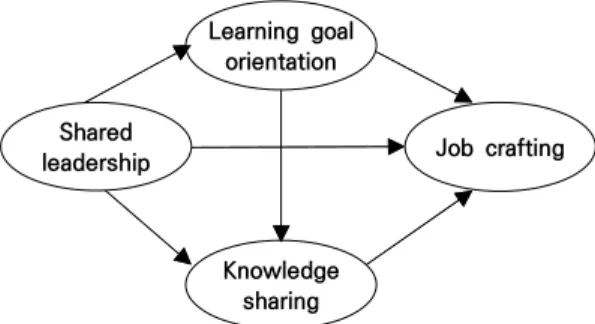
Job crafting
Knowledge sharing Shared
leadership
Learning goal orientation
Figure 1. shows the research model of this study
2. Defining and Measuring Variables 2.1 Shared leadership
Shared leadership is that all members exercise
collective leadership. We used measurement
tool, 12 questions with five-point scale from
Chung[108] which were developed by Ensley,
Hmieleski, and Pearce[37]. Shared directive
leadership questions include: "Team members establish my performance goals," and shared transactional leadership include: "My team members give me positive feedback when I perform well." Shared transformational leadership questions include, "My team members show enthusiasm for my effort," and shared empowering leadership questions include "Our team members encourage me to work together" etc.
2.2 Learning goal orientation
Learning goal orientation is defined as trying to develop and improve one's own competencies by familiarizing oneself with new technology acquisition and situation. Among the goal-oriented measuring tools developed by VanderWalle[42] five questions for learning goal orientation were used as a five-point scale.
Examples of questions include "I am willing to select a challenging work assignment that I can learn a lot from" etc.
2.3 Knowledge sharing
Knowledge sharing refers to the process of creating new knowledge through the interaction of delivering and receiving experience and knowledge with colleagues. The measurement tool was from Kim[109], who translated questions developed by Van den Hooff, Elving, Meeuwsen, and Dumoulin[110] into six questions on a five-point scale. Some examples of the questions are "I provide knowledge and information when my coworkers request it.", "I receive knowledge from coworkers and apply it to my work" etc.
2.4 Job crafting
Job crafting means adjusting the area of work
beside performing the given tasks presented in the job description, frequency and area of interaction with people involved in the work, and redefining the meaning of the work. Using the 'Korean version of job crafting scale' developed by Lee[111] based on the measurement tools of Wrzesniewski and Dutton[5], 15 questions were measured on a five-point scale. An example of task crafting with 5 questions is " I find a way to demonstrate my strengths when carrying out my work," an example of relational crafting with 5 questions is "I find colleagues who can exchange emotional support at work," and an example of cognitive crafting with 5 questions is "think about how my work can contribute to society“ etc.
Ⅴ. Research Results
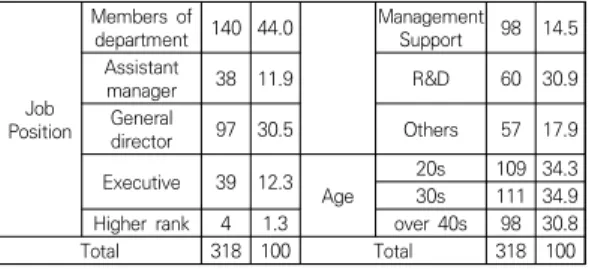
1. Demographic Characteristics of Samples To test our model and hypotheses we conducted an online survey from November 25 to December 01, 2019 to employees in diverse sectors at industrial firms in South Korea as job crafting is applied to various jobs and job categories[112]. A total of 318 copies of the survey were used for the final analysis. The demographic characteristics of the respondents to the survey are shown in [Table 1] below.
Table1. Demographics characteristics of Respondents Classification N % Classification N %
Gender Male 157 49.4
Year of Service
5y less 166 52.2 Female 161 50.6 5-10y less 79 24.8 Education
High school 38 11.9 10-15y less 45 14.2 Junior college 67 21.1 over 15y 28 8.8
Bachelor’s
degree 175 55.0 Task
Manufacturin g/Technology 75 23.6 Master’s
degree 38 11.9 Sales 28 8.8
2. Verification of reliability and validity of measuring tools
The Cronbach's Alpha coefficient was validated by the SPSS 25.0 program to verify the internal consistency of this study. The reliability analysis determined that the Cronbach's Alpha value of all variables was higher than 0.7 as shown in [Table 2], reliability was ensured.
To verify the single dimensionality of the measurement variables used in this study, the AMOS 25.0 program conducted for Confirmation Factor Analysis(CFA). First, the goodness of fit for the study model was evaluated in consideration of the simplicity of the model, and the verification results were χ 2=559.610(p=.000), GFI=.884, AGFI=.857, NFI=.904, CFI=.954, RMSEA=.051. The acceptance level of goodness of fit was excellent, so eligibility of the research was found. In addition, 11 variables with significantly lower factor loadings were eliminated, most of measured variables were 0.7 or higher, and t-value (t>12.618) were all statistically significant. As shown in Table 2, the Average Variance Extracted (AVE) and the Construction Reliability (CR) respectively meet the reference values (AVE > .5, CR >.7) to verify the validity of the measured items, which are considered to have convergent validity.
3. Correlation analysis result of latent variables
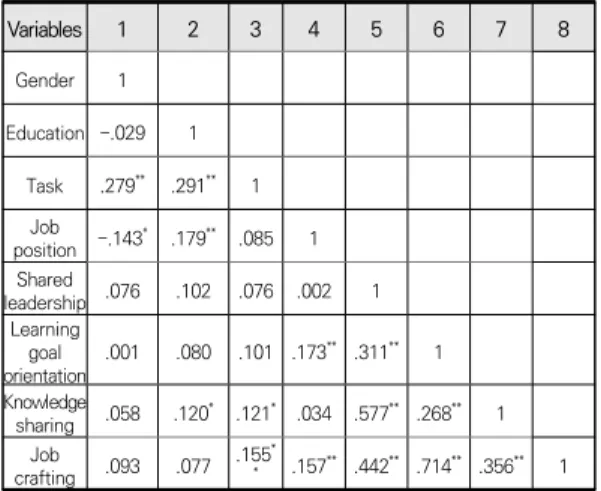
Prior to the hypothesis test, looking at the correlation of variables included in the research model, the shared leadership, learning goal orientation, knowledge sharing, and job crafting each represented a positive correlation. It was also found that education has a positive correlation with knowledge sharing, task has a positive correlation with knowledge sharing and job crafting, and job position has a positive correlation with learning goal orientation, knowledge sharing and job crafting.
Table 2. Reliability and the confirmatory factor analysis result
PositionJob
Members of
department 140 44.0 Management Support 98 14.5 Assistant
manager 38 11.9 R&D 60 30.9
General
director 97 30.5 Others 57 17.9
Executive 39 12.3 Age 20s 109 34.3
30s 111 34.9 Higher rank 4 1.3 over 40s 98 30.8
Total 318 100 Total 318 100
VariablesMea mentsure
Variables Factorial
Loading t se AVE CR Cronb
ach's α
Shared leadership
2 0.666 13.035 0.044
.666 .941 .927 4 0.713 14.282 0.045
6 0.76 15.595 0.043
7 0.775 16.038 0.041
9 0.794 16.67 0.041
10 0.825 17.65 0.039
11 0.84 18.148 0.043
12 0.841 18.185 0.041 Learning
goal orientation
1 0.783 13.947 0.04
.702 .922 .899
2 0.727 17.49 0.036
3 0.848 18.003 0.036 4 0.811 16.939 0.039
5 0.84 16.275 0.041
Knowledge sharing
3 0.71 14.626 0.043
.747 .922 .876 4 0.832 18.377 0.042
5 0.848 17.142 0.043 6 0.814 18.089 0.041
Job crafting
1 0.801 16.573 0.042
.664 .952 .893
2 0.8 16.553 0.041
3 0.823 17.254 0.04
7 0.781 15.024 0.048 8 0.792 15.294 0.053
9 0.68 12.594 0.049
11 0.748 14.923 0.042 13 0.726 14.305 0.044 14 0.814 16.824 0.042
15 0.817 16.94 0.04
χ²=559.610(p=.000),GFI=.884,AGFI=.857,NFI=.904,CFI=.954, RMSEA=.051
Variables 1 2 3 4 5 6 7 8 Gender 1
Education -.029 1 Task .279** .291** 1 position -.143Job * .179** .085 1
Shared
leadership .076 .102 .076 .002 1 Learning
goal
orientation .001 .080 .101 .173** .311** 1 Knowledge
sharing .058 .120* .121* .034 .577** .268** 1 craftingJob .093 .077 .155* * .157** .442** .714** .356** 1 Table 3. Correlation Analysis
p <0.05 *, p < 0.01 ** Spearman Correlation Analysis
4. Hypothesis test
In this study, the bootstrap method was used to verify the correlations, shared leadership, learning goal orientation, knowledge sharing and job crafting on SPSS Process Macro 3.0. In addition, gender, education, job position, and task were used as control variables based on prior research. The results were presented as follows.
p < 0.05 *, p < 0.01 ** SL : Shared leadership, LGO : Learning goal orientation, KS : Knowledge sharing, JC : Job crafting
According to the analysis results, the shared leadership gives significant positive effects on learning goal orientation(t=6.4965), knowledge sharing (t=12.2663) and job crafting (t=9.1204) respectively. Therefore, hypotheses 1, 2 and 3 have been supported. The bootstrap confidence intervals do not include zero. Therefore, this hypothesis test shows that shared leadership increase the learning goal orientation, knowledge sharing and job crafting of employees. It was also shown that learning goal orientation (t=16.1010) and knowledge sharing (t=2.0475) of the employees had a significantly positive relations to their job crafting.
Therefore, hypotheses 4, 5 and 6 were supported. The higher the learning goal orientation and knowledge sharing of employees, the higher their job crafting. Finally, the learning goal orientation(t=5.1100) of employees was shown to have a significant positive relation to their knowledge sharing.
Therefore, the higher learning goal orientation of the employees, the higher the knowledge sharing.
Table 5. Result of mediating effect by bootstrapping method
SL : Shared leadership, LGO : Learning goal orientation, KS : Knowledge sharing, JC : Job crafting
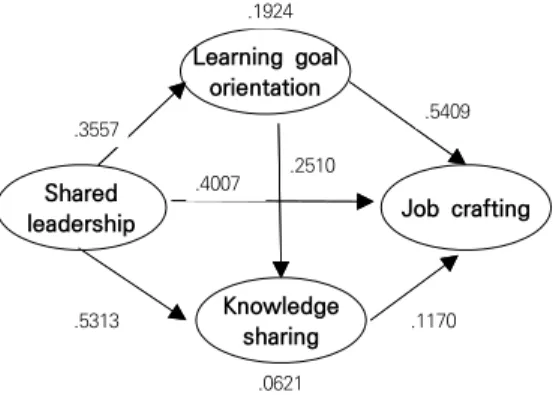
The results of the analysis show that parameter learning goal orientation and indirect effects of knowledge sharing are turned out to be .1924, .0621 respectively and the bootstrap confidence intervals were also [.1190, .2695], [.0038, .1255] does not contain zero so hypothesis 7 and 8 have been supported.
Hypothesis (path) Path
coefficient t LLCI ULCI R2 Gender .0772 1.5670 -.0197 .1742 .7678 Education -.0279 -.9488 -.0858 .0300 .7678 Job position .0319 1.5318 -.0091 .0728 .7678
Task .0128 .9101 -.0149 .0405 .7678
Hypothesis
1(SL ->LGO) .3557 6.4965** .2480 .4635 .3886 Hypothesis
2(SL -> KS) .5313 12.2663** .4461 .6165 .5840 Hypothesis
3(SL -> JC) .4007 9.1204** .3142 .4871 .4947 Hypothesis
4(LGO-> JC) .5409 16.1010** .4748 .6070 .7669 Hypothesis
5(LGO-> KS) .2510 5.1100** .5055 .7151 .0990 Hypothesis
6(KS -> JC) .1170 2.0475* .0046 .2294 .5047 Table 4. Hypothesis test
Hypothesis
(path) Indirect
effect BootLLCI BootULCI Adoption status Hypothesis 7
(SL→LGO→ JC) .1924 .1190 .2695 Supported
Hypothesis 8
(SL→ KS → JC) .0621 .0038 .1255 Supported
Therefore, the learning goal orientation and knowledge sharing of employee are considered to take a positive mediating role between shared leadership and job crafting.
.0621 Learning goal
orientation
Knowledge sharing
Job crafting Shared
leadership .3557
.5313
.5409
.1170 .4007 .2510
.1924
Figure 2.shows the result of the research model.
Ⅴ. Conclusions and Suggestions 1. Summary of studies
In order to improve the job crafting of employees, the purpose of the study was to propose an integrated framework of structural and personal factors affecting job crafting. We select shared leadership, one of the structural factors of the organization, and to identify the mediating role of the learning goal orientation and the knowledge sharing as individual factors in the relationship between these variables. The results of the study are as follows.
First, shared leadership has a positive effect on job crafting. This is consistent with the findings of prior studies that job crafting is more active in an environment where active job performance is allowed[5][80]. In the cohesion brought by shared leadership, employees feel a sense of psychological safety and perceive it as an environment where job crafting is possible.
In addition, social support is felt through
cooperation, mutual understanding and active communication among members, and the more they recognize social support, the more positive feeling they have for carrying out job crafting.
Second, shared leadership has a positive effect on learning goal orientation and knowledge sharing. This is the result of the extension of the study by Sun, Jie, Wang, Xue, and Liu[63] that the learning goal orientation of the team is stimulated by shared leadership.
Since the learning goal orientation of the team is a process in which members absorb instructive points from each other and persistently find new ideas to enhance their understanding of work and develop team competencies[64]. It is meaningful that the employees themselves have expanded the learning goal orientation at the team level to the individual level by demonstrating the impact relationship between learning goal orientation and shared leadership as a process of improving individual competencies. It supported the results of Wu and Cormican[74], Park and Cha[75] that shared leadership promotes knowledge sharing, which can be interpreted that the horizontal and relationship-oriented effects of shared leadership creates an environment in which knowledge sharing can be actively carried out.
Third, both learning goal orientation and knowledge sharing have positive influence on job crafting. This is similar to Matsuo's[22]
study, which emphasizes that learning goal
orientation is the driver of job crafting to
improve the employees and seems to reinforce
the inherent motivation to lead the task
performance in an improved direction. It can
also be said the result is the same line with
Park's[24] study that verified that shared task
knowledge has a positive influence on job crafting. Through knowledge sharing, employees have more confidence, a more positive self-image, and stronger motivation to build better relationships, thereby promoting job crafting
Fourth, the learning goal orientation and knowledge sharing of employees play a mediating role respectively, in the relationship in which shared leadership effects positively on job crafting. Naami, Shamsi, and Khajeh[113]
demonstrated the mediating effect of learning goal orientation in the relationship between transformational leadership and adaptive performance, while allowing employees to learn to improve their own problem solving skills with the intellectual stimulation of transformational leadership. In this way, teams that exercise shared leadership also recognize the environment in which they share leadership roles and responsibilities, they pursue learning to exercise their potential and capabilities by strengthening their motivation. Also, shared leadership encourages the learning goal orientation of employees to focus on information and knowledge related to tasks in order to achieve their goals, thereby actively exploring knowledge and promoting knowledge sharing.
2. Implications and Limitations
Based on the results of this study, we suggest the following theoretical implications.
First, previous research on the effects of shared leadership were much more focused on team-level variables, including team involvement, team performance, and team effectiveness than on the individual factors, but this study presents the impact of shared
leadership on individual factors: learning goal orientation, knowledge sharing, and job crafting, while supporting research on the effect of shared leadership on individual variables, including organizational trust, communication, knowledge sharing. In particular, it is meaningful to verify the effects of shared leadership on the individual factors in a distributed influence perspectives context.
Second, this study supports the results of precedent research on the leverage of leadership on job crafting, but it additionally proves, for the first time, the influence of shared leadership on job crafting. Previous research on the leadership forms that impact/strengthen job crafting were only conducted on empowering leadership, transformational leadership, and authentic leadership. Therefore, this study provides a leadership perspective that contributes to further development of job crafting literature. It might be easier to use job crafting strategies of seeking resources and challenges when personnel have shared leadership that encourages learning goal orientation and knowledge sharing.
Third, the individual employee's capabilities and personal traits are essential to maximize the benefits of leadership[114]. That is meaningful for identifying whether learning goal orientation and knowledge sharing play a role as supportive personal traits for generating the positive effects of shared leadership.
The practical implications of this study are as follows.
First, shared leadership enables employees to
recognize the increase in their job resources
and expect performance creation by taking
initiative in job crafting. The organizations
need to provide environmental conditions that encourage employees to enhance their competencies and proactive behavior, induce them to set clear and specific goal through shared leadership, and support employees to be part of the collective decision-making process by creating a horizontal climate.
Second, even if organizations encourage shared leadership, ineffective results may occur if employees do not have the expertise.
Therefore, companies should provide a foundation for expanding opportunities for employees to exercise shared leadership in a situation, with confidence, by providing policies and systems that enhance their expertise, thereby enhancing learning goal orientation that induces their continuous self-development.
At the same time, companies should make an effort to promote employees’ active expression of their opinions by establishing communication channels where knowledge and information can be actively exchanged.
Despite the above implications, we suggest the directions for future research while presenting the following limitations of this study.
First, we used the self-report questionnaire to measure variables, it is difficult to verify that objective phenomenon measurements have been made because respondents reflect individual recognition and common method bias might occur. Therefore, it will be necessary for future studies to use various measurement methods, such as interviews and observations, to ensure objectivity.
Second, it is necessary to verify the moderate effect of job characteristics in the process in which shared leadership affects job crafting. As Hackman and Lawler[115] accentuated the job
characteristics affect the attitude and behavior of employees through their emotional responses, identifying the impact of shared leadership on individual variables such as learning goal orientation, knowledge sharing, and job crafting depending on job characteristics may give meaningful implications.
Third, the data from this study were collected using convenience sampling from employees in various industries, thus the structural homogeneity of measurement conditions was not secured. Future studies will require a study that has selected a group of respondents for a single organization and expanded to the level of analysis of the organizational unit in consideration of potential variables such as corporate culture and organizational climate.
참 고 문 헌
[1] R. R. Magee, Strategic leadership primer, U.S.
Army War College, P.A., 1998.
[2] H. Kang, B. Xu, and J. Ku, “Job crafting:
comprehensive model of voluntary job redesign,” Quarterly Journal of Labor Policy, Vol.15, No.3, pp.29-61, 2015.
[3] A. B. Bakker, E. Demerouti, and A. I.
Sanz-Vergel, “Burnout and work engagement:
The JD-R approach,” Annual Review of Organizational Psychology and Organizational Behavior, Vol.1, pp.389-411, 2014.
[4] M. K. Murray, C. Biron, and C. L. Cooper, Concluding comments: Distilling the elements of successful organizational intervention implementation, In C. Brion, M.
K. Murray and C. Cooper (Eds.), Improving organizational interventions for stress and well-being: Addressing process and context, Taylor & Fransis Group, Routeldge, 2012.
[5] A. Wrzesniewski and J. E. Dutton, “Crafting a job: Revisioning employees as active crafters of their work,” Academy of Management Review, Vol.26, No.2, pp.179-201, 2001.
[6] J. M. Berg and A. Wrzensniewski, “Perceiving and responding to challenges in job crafting at different ranks: When proactivity requires adaptivity,” Journal of Organizational Behavior, Vol.31, No.2, pp.158-186, 2010.
[7] J. H. Lee, D. S. Cho, and S. J. Oh, “The Impact of Employees’ Emotional Intelligence on Job Crafting,” International Journal of Contents, Vol.17, No.5, pp.658-676, 2017.
[8] S. S. Chae, “The influence of proactive personality on job crafting and organizational outcomes for hotel employees in Seoul,” The Tourism Science Society of Korea, Vol.42, No.6, pp.147-172, 2018.
[9] J. M. Berge, A. M. Grant, and V. Johnson,
“When callings are calling: Crafting work and leisure in pursuit of unanswered occupational callings,” Organization Science, Vol.21, No.5, pp.973-994, 2010.
[10] S. Y. Kim, “The effects of CEO leadership style on the organizational culture, motivation, organizational effectives of public sports center staffs,” Korean Alliance for Health, Physical education, Recreation and Dance, Vol.48, No.6, pp.291-300, 2009.
[11] A. Balvik, Y. L. Balvik, and P. M. Tang,
“Servant leadership, employee job crafting, and citizenship behaviors: A cross-level investigation,” Cornell Hospitality Quarterly, Vol.58, No.4, pp.364-373, 2017.
[12] H. J. Wang, E. Demerouti, and P. L. Blanc,
“Transformational leadership, adaptability, and job crafting: The moderating role of organizational identification,” Journal of Vocational Behavior, Vol.100, pp.185-195, 2017.
[13] S. Thun and A. B. Bakker, “Empowering leadership and job crafting: The role of
employee optimism,” Stress and Health, Vol.34, No.4, pp.573-581, 2018.
[14] D. E. Hitchcock and M. L Willard, Why teams can fail and what to do about it:
essential tools for anyone implementing self-directed work teams, Irwin Professional Publishing, Chicago, 1995.
[15] C. L. Pearce, Y. Yoo, and M. Alavi, Leadership, social work, and virtual teams.
Improving leadership in nonprofit organization, Jossey-Bass, 2004.
[16] J. K. Lee and W. J. Choi, “A study on effectiveness of shared leadership,” Korean Journal of Business Administration Conference, No.10, pp.177-185, 2017.
[17] C. L. Pearce, C. C. Manz, and H. P. Sims Jr,
“The roles of vertical and shared leadership in the enactment of executive corruption:
Implications for research and practice,” The Leadership Quarterly, Vol.19, No.3, pp.353-359, 2008.
[18] S. Y. Kim, S. H. Bae, H. G. Kim, and S. I.
Ahn, “The effect of job crafting behavior on innovative behavior-focused on mediating effect of work engagement,” Korean Academy of Human Resource Management, Vol.23, No.5, pp.1-26, 2016.
[19] A. B. Bakker, M. Tims, and D. Derks,
“Proactive personality and job performance:
The role of job crafting and work engagement,” Human Relations, Vol.65, No.10, pp.1359-1378, 2012.
[20] P. Kanten, “The antecedents of job crafting:
Perceived organizational support, job characteristics and self-efficacy,” European Journal of Business and Social Sciences, Vol.3, No.5, pp.113-128, 2014.
[21] C. Niessen, D. Weseler, and P. Kostova,
“When and why do individuals craft their jobs? The role of individual motivation and work characteristics for job crafting,” Human relations, Vol.69, No.6, pp.1287-1313, 2016.
[22] M. Matsuo, “Effect of learning goal orientation on work engagement through job crafting,” Personnel review, Vol.48, No.1, pp.220-233, 2019.
[23] R. M. Grant, “Toward a knowledge-based theory of the firm,” Strategic Management Journal, Vol.17, No.S2, pp.109-122, 1996.
[24] H. K. Park, The hierarchical linear relationship among job crafting, individual and teal level variables of employees in large corporations, Doctoral dissertation, Seoul National University, 2015.
[25] C. S. Dweck, C. Y. Chiu, and Y. Y. Hong,
“Implicit theories and their role in judgments and reactions: A word from two perspectives,” Psychological inquiry, Vol.6, No.4, pp.267-285, 1995.
[26] J. D. Houghton, C. P. Neck, and C. C.
Manz, Self-leadership and superleadership, In Shared leadership: Reframing the hows and whys of leadership, Thousand Oaks, CA, 2003.
[27] K. Matzler and J. Mueller, “Antecedents of knowledge sharing-Examining the influence of learning and performance orientation,”
Journal of Economic Psychology, Vol.32, No.3, pp.317-329, 2011.
[28] M. G. Huh, “Social capital, knowledge creation, and innovation,” Korean Journal of Management, Vol.19, No.1, pp.41-78, 2011.
[29] E. J. Moon, The influence of community learning circle members' self-directed learning ability upon knowledge sharing and mediation effect of shared leadership, Master's dissertation, Chung-Ang University, 2014.
[30] C. L. Pearce and C. C. Manz, “The new silver bullets of leadership: The importance of self-and shared leadership in knowledge work,” Organizational Dynamics, Vol.34, No.2, pp.130-140, 2005.
[31] C. L. Pearce, “The future of leadership:
Combining vertical and shared leadership to transform knowledge work,” Academy of Management Perspectives, Vol.18, No.1, pp.47-57, 2004.
[32] J. B. Carson, P. E. Tesluk, and J. A.
Marrone, “Shared leadership in teams: An investigation of antecedent conditions and performance,” Academy of Management Journal, Vol.50, No.5, pp.1217-1234, 2017.
[33] D. J. Brass, A social network perspective on human resources management. Networks in the Knowledge Economy, Oxford University Press, New York, pp.283-323, 2003.
[34] H. J. Bang, The effects of shared leadership and psychological safety climate on team performance, team commitment, and change-oriented organizational citizenship behavior: The role of team reflexivity as a mediator, Doctoral dissertation, Sungkyunkwan University, 2013.
[35] C. L. Pearce and J. A. Conger, Shared leadership: Reframing the hows and whys of leadership, Sage Publications, 2002.
[36] A. Grille and S. Kauffeld, “Development and preliminary validation of the shared professional leadership inventory for teams (SPLIT),” Psychology, Vol.6, No.1, pp.75-92, 2015.
[37] M. D. Ensley, K. M. Hmieleski, and C. L.
Pearce, “The importance of vertical and shared leadership within new venture top management teams: Implications for the performance of startups,” The Leadership Quarterly, Vol.17, No.3, pp.217-231, 2006.
[38] C. S. Dweck, “Motivational processes affecting learning,” American psychologist, Vol.41, No.10, pp.1040-1048, 1986.
[39] C. S. Dweck and E. L. Leggett, “A social-cognitive approach to motivation and personality,” Psychological review, Vol.95, No.2, pp.256-273, 1988.
[40] J. G. Nicholls, “The development of the