• 검색 결과가 없습니다.

The acoustic realization of the Korean sibilant fricative contrast in Seoul and Daegu

N/A
N/A
Protected

Academic year: 2021

Share "The acoustic realization of the Korean sibilant fricative contrast in Seoul and Daegu"

Copied!
8
0
0

로드 중.... (전체 텍스트 보기)

전체 글

(1)

말소리와 음성과학 제4권 제1호 (2012) pp. 67~74

The acoustic realization of the Korean sibilant fricative contrast in Seoul and Daegu

Holliday, Jeffrey J. 1)

ABSTRACT

The neutralization of /sʰ/ and /s*/ in Gyeongsang dialects is a culturally salient stereotype that has received relatively little attention in the phonetic literature. The current study is a more extensive acoustic comparison of the sibilant fricative productions of Seoul and Gyeongsang dialect speakers. The data presented here suggest that, at least for young Seoul and Daegu speakers, there are few inter-dialectal differences in sibilant fricative production. These conclusions are supported by the output of mixed effects logistic regression models that used aspiration duration, spectral mean of the frication noise, and H1-H2 of the following vowel to predict fricative type in each dialect. The clearest dialect difference was that Daegu speakers’ /sʰ/ and /s*/ productions had overall shorter aspiration durations than those of Seoul speakers, suggesting the opposite of the traditional

“/s*/ produced as [sʰ]” stereotype of Gyeongsang dialects. Further work is needed to investigate whether /sʰ/-/s*/ neutralization in Daegu is perceptual rather than acoustic in nature.

Keywords: Daegu, fricatives, Gyeongsang, neutralization

1. Introduction

Korean has two contrastive sibilant fricatives, /sʰ/ and /s*/, which are referred to in this paper as "lenis-aspirated" and "fortis", respectively, following Chang (in press). The articulatory gestures and acoustic cues that signal this contrast in the Seoul dialect are well-described (Kagaya, 1974; Park, 1999; T. Cho et al., 2002; H.

Kim et al., 2010; inter alia). It is generally believed, however, that Gyeongsang dialects do not maintain this contrast at all, and that in these dialects /s*/ is phonetically realized as [sʰ]. That is, the contrast is realized as [sʰ]-[s*] in Seoul but is neutralized to [sʰ]- [sʰ] in Gyeongsang dialects. Kenstowicz and Park (2006) discussed the lack of the /sʰ/-/s*/ contrast as a general phenomenon of Gyeongsang dialects. They refer to it as an "s* > sʰ sound change", although they acknowledge that more educated speakers might have a robust contrast. There thus seems to be some level of

1) The Ohio State University, Department of Linguistics, [email protected]

Received: February 6, 2012 Revised: March 12, 2012 Accepted: March 19, 2012

speculation and a limited amount of phonetic data concerning the nature of the /sʰ/-/s*/ contrast in Gyeongsang dialects. Lee (2002) provided a more thorough discussion of the /sʰ/-/s*/ contrast in the Busan dialect, but her acoustic measures were limited to the durations of the frication, aspiration, and following vocalic intervals.

While the notion of a singular "Gyeongsang dialect" exists in people's minds and the lack of an /sʰ/-/s*/ contrast is often mentioned as a general feature of the "Gyeongsang dialect" (cf.

Lee & Ramsey, 2000: 63), the Gyeongsang region is home to

several distinct dialects whose acoustic (and especially segmental)

properties are not fully understood. This paper presents the results

of a more extensive acoustic comparison between the sibilant

fricative productions of speakers from Seoul and Daegu, a city in

the Gyeongsang region. We report that the production data do not

support an account of /sʰ/ and /s*/ being acoustically neutralized in

the speech of young Daegu speakers. Our findings from Seoul

speakers generally agree with previous studies of the Seoul dialect.

(2)

1.1 Seoul sibilant fricatives 1.1.1 Production

Acoustic studies of Seoul Korean word-initial /sʰ/ and /s*/ have suggested that several cues contribute to the contrast. The most robust cue may be the presence of aspiration after the frication in /sʰ/. This has been found to be a reliable cue in differentiating the two sibilants in non-high vowel environments, especially before /a/

(Yoon, 1999; Ahn, 1999; Chang, 2007; H. Kim et al., 2010).

Aspiration is barely present, if at all, in high vowel contexts such as /sʰi/ and /sʰu/, making the /sʰi/-/s*i/ and /sʰu/-/s*u/ contrasts not well-differentiated with respect to aspiration duration. The presence of aspiration has an effect on the duration of the frication noise as well (T. Cho et al., 2002; Chang, 2007). The frication period is generally shorter in /sʰ/ than in /s*/, although when aspiration duration is included the total segment length of /sʰ/ is longer than that of /s*/.

Other studies have found that spectral tilt, as measured by H1-H2, is generally higher in /sʰ ​ / than in /s*/, although this difference is smaller in high vowel environments (Ahn, 1999;

Chang, 2007). A higher H1-H2 is generally associated with a breathy phonation type, whereas a lower (negative) H1-H2 value is associated with a creaky phonation type. These results parallel the patterns found in the lenis, aspirated, and fortis stop categories (T.

Cho et al., 2002), with /sʰ/ patterning with lenis and aspirated stops and /s*/ patterning with fortis stops.

Fundamental frequency (ƒ0) measured in the vowel following the fricative has also been suggested as a possible cue to the /sʰ/-/s*/

contrast, but previous studies have shown its contribution to be minimal. Ahn (1999) found that the ƒ0 in /s*a/ was significantly higher than that in /sʰa/, but T. Cho et al. (2002), Kagaya (1974), and Chang (2007) found no significant relationship between fricative type and the ƒ0 of the following vowel.

Fewer studies have looked at differences in the spectral mean of frication noise, which is known to reflect the size of the front cavity of a lingual fricative (see Jongman et al. (2000) for a good review of the use of spectral moments in categorizing fricatives).

Baik (1998) and S. Kim (2001) showed that /s*/ generally involves more linguo-palatal contact than /sʰ/, along with a smaller front cavity. T. Cho et al. (2002) showed that /s*/ had a higher spectral mean than /sʰ/, which is the acoustic consequence we should expect based on the articulatory patterns. S. Kim (2001) also found spectral mean to be higher in /s*/ than in /sʰ/, but the trend was weaker than in T. Cho et al. (2002).

1.1.2 Perception

At least two studies have looked at the perception of Korean word-initial /sʰ/ and /s*/ by native listeners. Yoon (1999) synthetically manipulated several acoustic parameters to determine which ones contribute most to the percept of /sʰ/ and /s*/ by native Korean listeners. He found that the duration of the aspiration following the frication was the most significant cue, with a longer period of aspiration creating the percept of /sʰ/. This result agrees with Holliday (2010) who also found that a longer aspiration duration was associated with /sʰ/ perception, and also that native listeners were less accurate at identifying /sʰ/ and /s*/ in high vowel contexts where the aspiration does not differentiate the categories very well (e.g. /sʰi/-/s*i/ and /sʰu/-/s*u/).

1.2 Gyeongsang dialects

The acoustic properties of Gyeongsang dialects have not been examined as thoroughly as those of the Seoul dialect, and even among the acoustic studies of Gyeongsang dialects very few have looked at their segmental properties. In order to view the purported Gyeongsang fricative neutralization in a broader phonetic context we will first review some findings related to the three-way stop contrast, and then discuss the purported neutralization of sibilant fricatives.

1.2.1 Stops

The most thorough study of the acoustic properties of the stops in a Gyeongsang dialect has been M. Cho (2004), who compared the word-initial stop productions of speakers from Seoul (n=20) and Daegu (n=20). Overall, she found that Daegu speakers' lenis stops tended to have shorter VOT values than those of Seoul speakers, and that their lenis stops were closer in VOT to those of fortis stops than of aspirated stops: she characterized the Daegu lenis stops as having a "fortis-like quality" ("경음적 성격"). In a more recent study, Holliday and Kong (2011) compared the acoustic correlates of the stop productions of speakers from Seoul, Daegu, and Jeju. Their results largely agreed with those of M. Cho (2004), and found that Daegu speakers, especially males, were more likely to have shorter VOT values in their lenis stops.

1.2.2 Sibilant fricatives

There has been one recent study that has examined the acoustic

properties of Seoul and Busan sibilant fricatives. Lee (2002)

measured the frication and aspiration duration in the fricative

productions of speakers from Seoul and Busan. The purpose of

Lee's (2002) study, however, was not to test whether Busan

(3)

speakers differentiate /sʰ/ and /s*/ in production: it was assumed from the outset that they do not. Rather, she was looking for phonetic evidence to support the phonological claim that tensing is unproductive in the Busan dialect. She found that in non-high vowel contexts (/a/, /ʌ/, /ɛ/, /o/) Seoul speakers had a robust difference in aspiration duration between /sʰ/ (48 ms) and /s*/ (15 ms). In high vowel contexts (/u/, /ɨ/, /i/) the difference between /sʰ/

(20 ms) and /s*/ (8 ms) was less robust. Busan speakers displayed similar trends, except that overall aspiration duration was shorter:

mean aspiration duration in non-high vowel contexts was 38 ms for /sʰ/ and 6 ms for /s*/, and in high vowel contexts it was 3 ms for /sʰ/ and 1 ms for /s*/. Judging from these differences in aspiration duration, then, it appears that neither Seoul nor Busan speakers make a robust difference between /sʰ/ and /s*/ in high vowel contexts, but that both make a robust difference in non-high vowel contexts. These results agree with Seoul production data from Yoon (1999) and Chang (2007).

1.2.3 Fricative neutralization

The only published data on fricatives in a Gyeongsang dialect, then, does not agree with the widely accepted belief that Gyeongsang /s*/ is phonetically realized as [sʰ]. If Gyeongsang /s*/

surfaces as [sʰ], then we would expect Gyeongsang /s*/ to have a longer aspiration duration, and thus be more perceptually similar to Seoul [sʰ]. Rather, results from Lee (2002) suggest exactly the opposite: aspiration duration of Busan /s*/ was 6 ms before non-high vowels and 1 ms before high vowels. These values are far below anything measured for /sʰ/ in Seoul in any previous study, which runs counter to the commonly cited example of

"Gyeongsang dialect": pronouncing /s*al/ (쌀, "rice") as /sʰal/ (살,

"flesh"). Lee (2002) acknowledges that this neutralization probably varies with factors such as gender, age or education level, but it is nevertheless prevalent in the everyday speech of Busan speakers.

In trying to understand neutralization, it is important to distinguish acoustic neutralization from perceptual neutralization. If two categories have distributions of acoustic correlates that significantly or completely overlap, we can say that the two categories are acoustically neutralized. Even if there are acoustic differences between the categories, however, it is possible for the categories to be perceptually neutralized. That is, listeners may still perceive the categories as the same even if there are acoustic differences between them. Perceptual neutralization could be the result of some auditory process, or it could be the consequence of a stereotype: Gyeongsang speakers could be perceived as neutralizing /sʰ/ and /s*/ simply because that is what listeners

believe they do. The common belief that "Gyeongsang speakers neutralize /sʰ/ and /s*/", then, could be a reflection of acoustic neutralization (and thus perceptual neutralization as well), or just perceptual neutralization alone. The goal of this paper is to introduce some production data from young Daegu speakers and argue that it does not support the notion that /sʰ/ and /s*/ are acoustically neutralized in Daegu.

2. Methods

2.1 Participants

The participants were 12 Seoul speakers (6 male, 6 female) and 13 Daegu speakers (6 male, 7 female), all born between 1980 and 1991. The hometowns of the participants and each participants' parents are listed in <Table 1>. Note that subject sf2 was born in Baengnyeongdo but moved to Seoul at age 6.

ID Speaker's

hometown

Mother's

hometown Father's hometown

sm1 Seoul Seoul Seoul

sm2 Seoul Gangwon Gangwon

sm3 Seoul Daegu Gyeongsang

sm4 Seoul Seoul Seoul

sm5 Seoul Incheon Gyeongsang

sm6 Seoul Gyeongsang Gyeonggi

sf1 Seoul Jeolla Jeolla

sf2 Baengnyeongdo Jeolla Baengnyeongdo

sf3 Seoul Daegu Gyeongsang

sf4 Seoul Seoul Seoul

sf5 Seoul Jeolla Jeolla

sf6 Seoul Seoul Seoul

dm1 Daegu Goryeong Cheongdo

dm2 Daegu Goryeong Gumi

dm3 Daegu Gaya Hapcheon

dm4 Daegu Uiryeong Daegu

dm5 Daegu Sangju Sangju

dm6 Daegu Daegu Gunwi

df1 Daegu Daegu Daegu

df2 Daegu Daegu Daegu

df3 Daegu Goryeong Yeongcheon

df4 Daegu Daegu Daegu

df5 Daegu Daegu Gwangju

df6 Daegu Daegu Daegu

df7 Daegu Daegu Daegu

Table 1. Demographic information.

2.2 Materials

Each participant read a word list that contained 19 /sʰ/-initial

and 19 /s*/-initial words, balanced across vowel contexts. The

word-initial position was chosen because the acoustic properties

of the sibilant fricatives are both well understood and the most

(4)

clearly differentiated in this position (T. Cho, 2002). The list contained stop- and affricate-initial words as well, but they were not analyzed for this study. The fricative-initial words are listed in <Table 2>.

Vowel /s

h

/-initial /s*/-initial

/a/

/s

h

am.sʰip/ "thirty"

/sʰaŋ.ʨʰu/ "lettuce"

/sʰa.kwa/ "apple"

/sʰa.ta/ "to buy"

/sʰal.ta/ "to live"

/s*aŋ.tuŋ.i/ "twins"

/s*al.tʰoŋ/ "a rice bin"

/s*a.ta/ "to wrap"

/s*ak.s*ak/ "rubbing palms"

/s*am.pap/ "wrapped rice"

/ɛ/ /sʰɛk.k*al/ "color" /s*ɛ.k ɨn.s*ɛ.k ɨn/ "calmly"

/i/

/sʰi.kʲɛ/ "clock"

/sʰik.tʰak/ "table"

/sʰi/ "poem"

/sʰi.rʌ/ "(I) don't like (it)"

/s*ip.ta/ "to chew"

/s*ik.s*ik/ "gasping"

/s*i/ "seed"

/s*i.rɨm/ "Korean wrestling"

/o/

/sʰo.ri/ "sound"

/sʰon.nim/ "guest"

/sʰo.kɨm/ "salt"

/s*o.ka.ri/ "a fish"

/s*ot.ta/ "to pour /s*o.ta/ "to shoot"

/u/

/sʰu.pak/ "watermelon"

/sʰuk.ʨɛ/ "homework"

/sʰu.to/ "capital"

/s*u.sʰi.ta/ "to throb"

/s*uk.sʰɨ.rʌp.ta/

"embarrassed"

/s*uk/ "mugwort"

/ɨ/

/sʰɨ.nim/ "monk"

/sʰɨ.sʰɨŋ/ "teacher"

/sʰɨ.mu/ "twenty"

/s*ɨ.ta/ "to write"

/s*ɨ.ki/ "writing"

/s*ɨ.rɛ.ki/ "trash"

Table 2. Word list.

2.3 Procedure

The Seoul participants were recorded in Seoul, in a quiet room at either a church or the participant's home. The Daegu participants were recorded in a recording studio on the Yeungnam University campus. Participants read the word list at a comfortable reading pace, inserting approximately 1 second between words. No carrier sentence was used because the procedure was originally designed for novice L2 Korean data collection, and the use of a carrier sentence would be burdensome to non-native participants.

Aspiration duration was calculated as the difference between the onset of aspiration and the onset of voicing. Tokens with no measurable aspiration were marked as having an aspiration duration of zero. Frication duration was measured as the difference between the onset of frication and the onset of aspiration (or the onset of voicing, if no aspiration was present).

H1-H2 was measured from a 25 ms Hamming window beginning at vowel onset. ƒ0 was measured 20 ms after vowel onset.

Spectral mean was measured from a 40 ms Hanning window from 1 to 22.5 kHz centered at the midpoint of the combined period of frication and aspiration.

3. Results

For each acoustic measure discussed above (aspiration duration, frication duration, H1-H2, ƒ0, and spectral mean) we will present data from both dialect groups. Because there are multiple data points collected from each speaker, the pooled data points are not independent from each other and it would be inappropriate to use a t-test to infer whether /sʰ/ and /s*/ are independent from each other along each acoustic dimension. Instead, the distributions of each acoustic measure will be shown in histograms, and then mixed-effects logistic regression models will be used to infer the degree to which each acoustic measure contributes to the contrast.

3.1 Distribution of acoustic cues

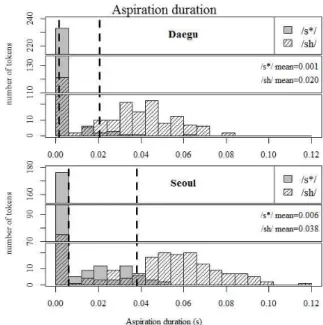
As in Lee (2002), Daegu speakers had shorter aspiration durations for both /sʰ/ and /s*/ than Seoul speakers did.

Histograms in <Figure 1> show the aspiration duration for both fricative categories in both dialects. Two trends can be observed.

First, fricatives of both categories tend to be more aspirated in Seoul than in Daegu. This runs counter to our expectation that Gyeongsang /s*/ is produced as [sʰ]. The vast majority of Daegu /s*/ tokens were not aspirated at all. Second, there does not appear to be any sort of merger in the Daegu dialect along this dimension. If there were neutralization in aspiration duration in Daegu, we should expect to see overlapping distributions for the Daegu data but not the Seoul data.

Figure 1. Histograms showing the aspiration duration

for both fricative categories in both dialects. Note that

a large number of tokens of each category had a

duration of zero.

(5)

Figure 2. Histograms showing the frication duration for both fricative categories in both dialects.

The distributions of frication duration are shown in <Figure 2>. Here we see what looks like slightly more overlap in the Daegu dialect. The mean of the Daegu /s*/ distribution is slightly lower than that of the Seoul /s*/ distribution, putting it closer to /sʰ/. There are still two clear separate peaks for Daegu /sʰ/ and /s*/, however, suggesting that even in this dimension there is not true neutralization.

Figure 3. Histograms showing the distribution of H1-H2 values for both fricative categories in both dialects and genders. Each plot is overlaid with a normal curve for each fricative category to clarify the shapes of the distributions.

The distributions of H1-H2 are shown in <Figure 3>. There is no observable difference in distributions between the two dialects.

Note that female speakers in both dialects have some H1-H2 values that extend below the range of males' values, which indicates a more tense or pressed voice quality.

Figure 4. Histograms showing the distributions of ƒ0 across both fricative types in both dialects and genders.

Figure 5. Histograms showing the distributions of spectral mean across both fricative types in both dialects and genders.

The distributions of ƒ0 are shown in <Figure 4>. As expected,

ƒ0 did very little to separate the fricative categories in either

dialect. We might expect it to do even less in the Daegu dialect

due to the presence of pitch accents on words, which should

(6)

prevent ƒ0 from being used to signal fricative type. Lastly, the distributions of spectral mean are shown in <Figure 5> . In all dialect-gender groups /s*/ has a slightly higher distribution than /sʰ/. These results agree with prior studies (S. Kim, 2001; T. Cho et al., 2002) that found that the spectral mean of /s*/ is higher than that of /sʰ/.

3.2 Mixed effects regression models

Logistic regression, which is an inferential statistical technique for predicting a categorical response based on one or more parameters, can be used to help us understand which acoustic cues correlate with the /s

h

/ and /s*/ categories in Seoul and Daegu. Because there are multiple data points for each speaker it would violate the assumption of independence if we built a single logistic regression model for each dialect group. A mixed effects regression model, which incorporates both fixed effects (those we are trying to predict) and random effects (those that vary between speakers but which we are not necessarily trying to predict), is a method that lets us look at differences across dialects while making an allowance for intra-dialectal variation (see Jaeger, 2008, for a more detailed discussion of the advantages of mixed effects models). A mixed effects model will return coefficients for each of the fixed effects (for each dialect) and random effects (for each speaker), which function as slopes with which we can interpret and plot the effect of each acoustic cue on the /sʰ/-/s*/

contrast. Here, we used the lme4 package in R (Bates and Maechler, 2009) to build mixed effects logistic regression models for each gender-dialect group.

Because ƒ0 has not been shown to contribute anything to the fricative contrast it was excluded from the models. Frication duration was excluded as well because it was strongly negatively correlated with aspiration duration for /s

h

/ (Pearson's r = -0.775 for Daegu, r = -0.742 for Seoul). The final models included aspiration duration, spectral mean, and H1-H2 as both fixed effects and also as random effects nested within subject. Each parameter was normalized before being entered into the models.

The output of the models are the slope values and p-value of each parameter. The slope value tells us the direction and magnitude of the effect of the parameter (e.g. is a higher value of the parameter more likely to indicate /sʰ/ or /s*/, how much so?), whereas the p-value tells us how likely that effect could be obtained by pure chance.

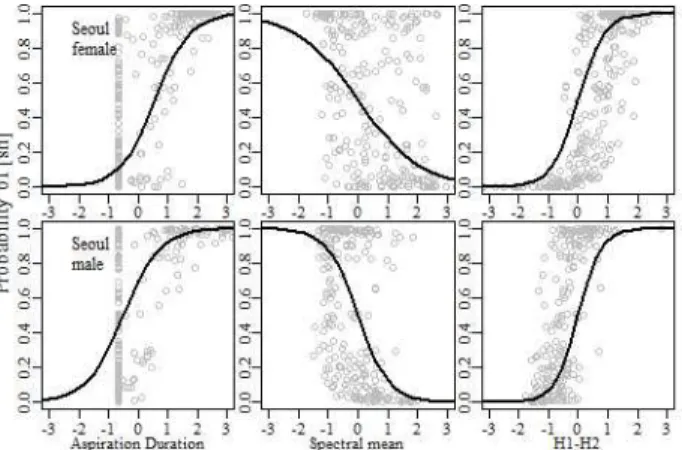
All three parameters were significant (p < 0.05) for each gender-dialect group. That is, aspiration duration, spectral mean, and H1-H2 all contributed to the /sʰ/-/s*/ contrast for both men

and women and for both Seoul and Daegu speakers. <Figure 6>

and <Figure 7> show the probability curves derived from the output of the regression models and can be determined easily from the x- and y-axes. For each group, a higher value of aspiration duration and H1-H2 increased the likelihood of a token being /sʰ/, whereas a higher value for the spectral mean made a token less /sʰ/-like. The slopes of the curves are similar across genders and dialects, and all lines were solid, indicating that all slope values were significant. To be certain that there was no difference between dialects two more models were built, one for each gender, with dialect as an interaction term with each acoustic parameter. The results of these models were the same except that none of the dialect interaction terms were significant, suggesting that there may be no differences between the two dialects in terms of these acoustic dimensions.

Figure 6. Probability curves for the Seoul dialect showing each acoustic measure being plotted against the likelihood of a token being /sʰ/.

Figure 7. Probability curves for the Daegu dialect

showing each acoustic measure being plotted against the

likelihood of a token being /sʰ/.

(7)

4. Discussion and Conclusion

The data presented in this paper failed to show any evidence for acoustic neutralization of the /sʰ/-/s*/ contrast in the Daegu dialect.

The clearest difference between the two dialects was the shorter aspiration duration in both fricative types in the Daegu dialect. In this section we will frame these results in the context of other acoustic data from Gyeongsang dialects, and the implications of these findings on our understanding of Korean perceptual dialectology.

4.1 Daegu stop production

M. Cho (2004) did a thorough investigation of stop production in the Daegu dialect, and she found that Daegu speakers had shorter VOT values for their lax stops than Seoul speakers did.

Holliday and Kong (2011) replicated this finding several years later. It should be noted that VOT in stops and aspiration duration in fricatives are measuring a very similar thing: how long after the release of an oral constriction do the vocal folds begin to vibrate.

When VOT and aspiration are viewed like this, the results presented in this paper should not be surprising, and can be taken as possible evidence for a "fortis-like quality" in Daegu fricative production. Both the lenis-aspirated /sʰ/ and the fortis /s*/ in this study were produced by Daegu speakers with effectively shorter VOT than Seoul speakers, much like the lax stops of M. Cho (2004) and Holliday and Kong (2011).

The results presented here should be somewhat surprising when we consider that the typical direction of the purported fricative neutralization in Gyeongsang dialects is /s*/ neutralizing to [sʰ], and not the other way around. That is, we should expect Daegu tense fricatives to have a longer aspiration duration, a higher spectral mean, and other /sʰ/-like qualities, but we see no evidence for such a trend in the speakers tested here.

4.2 Geographical and socioindexical considerations One factor that must be considered when interpreting the results of this study is the age of the participants. Although Gyeongsang fricative neutralization is a culturally salient dialectal feature, few recent studies have surveyed its extent either geographically or generationally. T. Kim (1990) conducted a dialect survey of the South Gyeongsang region and found that fricative neutralization occurred mainly in Ulju, Miryang, Yangsan, and other areas east of the Nakdong River. Although T.

Kim's study focused on South Gyeongsang province and did not discuss Daegu in detail, he claimed that Daegu's location east of

the Nakdong river and inclusion in the historical "Gyeongsang Left province" ("경상좌도"), along with Gyeongju, Ulju, and other villages, led to it being in the historically neutralized region. T. Kim claimed that Daegu remains in the fricative neutralized region today.

T. Kim's data was collected between July 1989 and October 1990, and thus provides a relatively recent starting point from which further dialect studies can be carried out. Lee (2002) claims that fricative neutralization probably depends on several socioindexical factors, suggesting that more educated speakers may be less likely to neutralize. Although the results presented in this paper do not show any significant gender differences, the speakers were all college students and thus highly educated and young. It could be the case the older Daegu speakers or those who have received less formal education could neutralize the way T. Kim suggested.

4.3 Future work: The perception of Gyeongsang fricatives

We are not aware of any studies that have investigated the perception of Gyeongsang fricatives by listeners of any dialect. It is possible for Daegu fricatives to be neutralized in perception even if they are not neutralized in production. There are two ways in which this could happen. The first possibility is that the acoustic differences between the fricatives are not auditorily salient. This may be unlikely in the case of Daegu fricatives, however, simply because the differences between Daegu fricatives pattern so closely to those of Seoul fricatives.

The second possibility is that Gyeongsang fricative neutralization exists as a stereotype in the minds of listeners, and that even "correct" productions of /s*/ by a Daegu speaker would be judged as incorrect by a Seoul listener. Only a perception experiment could address that question, which shall remain for future work.

Acknowledgments

I would like to thank the members of Phonies at OSU for their

helpful feedback on an earlier version of this manuscript, and Mary

Beckman for suggesting the layout and code for <Figure 1>. I

would also like to thank Kyuchul Yoon and Yeonkyeong Lee for

the assistance I received while staying in Daegu. This research

was supported by a grant from the National Science Foundation

(#1024286) awarded to Mary Beckman and myself.

(8)

References

Ahn, H. (1999). An acoustic investigation of the phonation types of post-fricative vowels in Korean, Harvard Studies in Korean Linguistics, Vol. 8, 57-72.

Baik, W. (1998). On tensity of Korean fricatives (Electropalatographic study), Korean Journal of Speech Sciences, Vol. 4, 135-145.

Bates, D. & Maechler, M. (2009). lme4: Linear mixed- effects models using S4 classes. R package version 0.999375-32.

http://CRAN.R-project.org/package=lme4

Chang, C. (2007). Korean fricatives: Production, perception, and laryngeal typology, UC Berkeley Phonology Lab Annual Report 2007, 20-70.

Chang, C. (In press). The production and perception of coronal fricatives in Seoul Korean, Korean Linguistics, Vol. 15.

Cho, M. (2004). An acoustic study of the stops of the Seoul and Daegu dialects, MA thesis, Korea University.

Cho, T., Jun, S. & Ladefoged, P. (2002). Acoustic and aerodynamic correlates of Korean stops and fricatives, Journal of Phonetics, Vol. 30, No. 2, 193-228.

Holliday, J. (2010). An acoustic study of L2 perceptual acquisition of Korean fricatives, Harvard Studies in Korean Linguistics, Vol.

13, 17-32.

Holliday, J. & Kong, E. (2011). Dialectal variation in the acoustic correlates of Korean stops, Proceedings of the 17th International Congress of Phonetic Sciences, 878-881.

Jaeger, T. F. (2008). Categorical data analysis: Away from ANOVA's (transformation or not) and towards logit mixed models, Journal of Memory and Language, Vol. 59, 434-446.

Jongman, A., Wayland, R. & Wong, S. (2000). Acoustic characteristics of English fricatives, Journal of the Acoustical Society of America, Vol. 108, No. 3, 1252-1263.

Kagaya, R. (1974). A fiberscopic and acoustic study of the Korean stops, affricates and fricatives, Journal of Phonetics, Vol. 2, 161-180.

Kenstowicz, M. & Park, C. (2006). Laryngeal features and tone in Kyungsang Korean: a phonetic study, Studies in Phonetics, Phonology and Morphology.

Kim, H., Maeda, S., Honda, K. & Hans, S. (2010). The laryngeal characterization of Korean fricatives: Acoustic and aerodynamic data, In Susanne Fuchs, Martine Toda and Marzena Zygis, eds., Turbulent Sounds: An Interdisciplinary Guide, 143-166, Berlin:

Mouton de Gruyter.

Kim, S. (2001). The interaction between prosodic domain and

segmental properties: domain initial strengthening of fricatives and Post Obstruent Tensing rule in Korean, MA thesis, University of California, Los Angeles.

Kim, T. (1990). A study on geographical differentiations in Kyeongsangnam-do dialects, Ph.D. Dissertation, Konkuk University.

Lee, I. & Ramsey, S. R. (2000). The Korean Language, Albany:

SUNY Press.

Lee, K. (2002). Comparison of acoustic characteristics between Seoul and Busan dialect on fricatives, Speech Sciences, Vol. 9, No. 2, 223-235.

Park, H. (1999). The phonetic nature of the phonological contrast between the lenis and fortis fricatives in Korean, Proceedings of the 14th International Congress of Phonetic Sciences, 424-427.

Yoon, K. (1999). A study of Korean alveolar fricatives: An acoustic analysis, synthesis, and perception experiment, MA thesis, University of Kansas.

∙ Holliday, Jeffrey J.

The Ohio State University, Department of Linguistics 222 Oxley Hall, 1712 Neil Avenue

Columbus, OH USA

Tel: +1 614-292-8878, Fax: +1 614-292-8833 Email: [email protected]

Area of interest: Phonetics

2007~present: PhD student

수치

Table  1.  Demographic  information.
Figure  1.  Histograms  showing  the  aspiration  duration  for  both  fricative  categories  in  both  dialects
Figure  2.  Histograms  showing  the  frication  duration  for  both  fricative  categories  in  both  dialects.
Figure  6.  Probability  curves  for  the  Seoul  dialect  showing  each  acoustic  measure  being  plotted  against  the  likelihood  of  a  token  being  /sʰ/

참조

관련 문서