• 검색 결과가 없습니다.

Individual differences in autistic traits and variability in production patterns: a case of affricates by young Seoul Korean speakers

N/A
N/A
Protected

Academic year: 2021

Share "Individual differences in autistic traits and variability in production patterns: a case of affricates by young Seoul Korean speakers"

Copied!
7
0
0

로드 중.... (전체 텍스트 보기)

전체 글

(1)

Journal of the Korean Society of Speech Sciences Vol.7 No.1 (2015.03.31) www.speechsciences.or.kr

ISSN 2005-8063, pp. 125~131 http://dx.doi.org/10.13064/KSSS.2015.7.1.125

Individual differences in autistic traits and variability in production patterns:

a case of affricates by young Seoul Korean speakers

Kang, Soyoung

1)

· Kong, Eun Jong

2)

Seo, Misun

3)

ABSTRACT

The current study explores whether speaker variability in the fronted articulations of Seoul Korean affricates can be explained by cognitive differences measured by individual autistic traits. The goal was to explore Yu’s (2010; 2013) proposal that individual differences in cognitive style can be an important factor in speakers’ use of sound variants. The spectral peak frequencies (SPF) of affricates relative to those of fricatives, reported in Kong et al. (2014), were used to acoustically represent the relative degree of anterior place of constriction. When these individual SPFs were related to the scores of Autistic-Spectrum Quotients (Baron-Cohen et al., 2001), a correlation was found for the male speakers, but not for the female speakers, such that speakers of more anterior affricate productions scored low in AQs. Discussion is made with respect to how these findings are in line with Yu’s proposal.

Key words: individual differences, autistic traits, affricates, fronted articulation, spectral peak frequency

1. Introduction

Variability in speech sounds is considered indisputable and sources for such variability may include linguistic environments where the target sound occurs (i.e., context-induced change), or language external factors such as language contact, gender, or socio-economic class of the language user (e.g., Labov, 1990). It has recently been suggested that in addition to these factors, the language user’s internal characteristic such as cognitive processing style may also add variability to the realization of speech sounds (Yu, 2010; 2013, notably). Based on the idea that individual language users may differ in their cognitive processing style described in Ausburn and Ausburn (1978), Yu suggests that these individual differences may have impact on processing of

1) Hongik University, [email protected]

2) Korea Aerospace University, [email protected], corresponding author

3) Hannam University, [email protected] Received: January 31, 2015

Revised: March 17, 2015 Accepted: March 17, 2015

speech sounds. Particularly, he argues that some individuals with a specific cognitive profile have a less tendency to consider contextual effect in speech perception, which may lead them to mis-parse the target segment and ultimately to start to produce the new variant. Inspired by Yu’s hypothesis that a specific cognitive characteristic may be responsible for the introduction and subsequent use of a novel form of a given speech segment, the current study investigates whether the emergence of the new variant of affricates produced by young Seoul Korean, namely, a more fronted articulation of Korean affricates, can also be associated with the speakers’ cognitive ability and their individual differences.

Cognitive styles and Autism-Spectrum Quotient: According to Ausburn and Ausburn (1978), cognitive style “refers to psychological dimensions that represent consistencies in an individual’s manner of acquisition and processing information”.

What has also been assumed is that differences in cognitive style

may result in differences in the way individuals process various

aspects of cognitive domain including language, thought,

perception or problem solving. Differences in this cognitive style

may make different people behave differently at the face of the

(2)

same task because the way information is processed and the way solutions to certain tasks are extracted may not be the same.

It has been suggested that the effects of individual differences in cognitive processing style described above may be associated with autistic spectrum as estimated in the Autism-Spectrum Quotient test (AQ: Baron-Cohen et al., 2001). The AQ is a short, self-administered survey with 50 questions, which assesses five subscales, i.e., social skills, communication, attention to detail, attention-switching, and imagination. The test is structured in such a way that the higher an individual scores in the test, the more autistic s/he is. According to American Psychiatric Association, symptoms of autism spectrum disorder may include difficulty in using and understanding language, the tendency to focus on a few topic areas, or general lack of social skills for making friends or reading others’ facial expressions, to name a few. Although the AQ test is a clinically tested screening tool for identifying individuals with the autism spectrum condition, it has been shown that autistic traits are found on a continuum even for adults with normal intelligence; students in sciences tend to mark higher AQ score, i.e., more autistic than those in humanities or social sciences, and males are found to have more autistic traits than females (Baron-Cohen et al., 2001). Although autism is a pathological condition, these results from the AQ test seem to give support to some stereo-typed portrayal of ‘mad scientists’ in popular movies, who are often unsociable and obsessed with details. Indeed, the winners of British mathematics Olympiad scored significantly higher on the AQ test than normal adults (Baron-Cohen et al., 2001).

What is interesting and relevant is the existence of association between individual cognitive differences as estimated from the AQ test and speech perception. Stewart and Ota (2008), for example, found that groups of individuals with varying degree of AQ showed differences in using lexical knowledge in the recognition of words with an ambiguous segment (Ganong effect;

Ganong, 1980); for the target word that can be identified as kiss vs. giss, individuals with higher AQ (more autistic) were less influenced by the status of a lexical item in perceiving the ambiguous target sound.

Similarly, Yu (2010; 2013) also found association between the AQ scores and the degree of phonetic compensation in the perception of an ambiguous sibilant, which can be classified as /s/ or /ʃ/. Phonetic compensation refers to the hearer’s ability to factor out the contextual influence and to retrieve the target sound intended by the speaker. For example, the same ambiguous stimulus has been found to be identified differently in

two different vowel contexts (Mann & Repp, 1980; Mitterer, 2006). Listeners are found to perceive the ambiguous target as /s/ more before /u/ than before /a/ because they take into account the lowered noise frequencies in a rounded vowel like /u/. What Yu (2010; 2013) found is that phonetic compensation is not only correlated with the listener’s gender but also with the AQ scores;

females with lower AQ tend to do less compensation. This would mean that female speakers with lower AQ might perceive a target as /ʃu/ more often and even possibly start to produce it as /ʃu/ when others still perceive it as /su/.

This difference in the degree of compensation for phonetic environment from the hearer’s part has relevance to Ohala’s (1993) model of sound change, as well. Ohala’s model puts a heavy emphasis on the hearer in the initiation of sound change.

Normally, the hearer is good at reconstructing a target sound intended by the speaker even if it is affected by its conditioning environment. However, in some cases on a certain time point, some hearers may fail to correct and thus to reconstruct the intended target sound of the speaker, possibly introducing a new form and leading to sound change. Yu’s results further specify Ohala’s hearer-based model of sound change by providing cues on what type of hearers are less likely to correct contextual effect. On top of this, Yu suggests that those same individuals who do less compensation might also be responsible for the subsequent spread of the novel forms in the speech community;

they are the ones with better social skills and communication ability and have wider social contact, and therefore, their utterances have a potential to obtain social significance (Labov, 1990, most notably). In sum, Yu’s proposal draws attention to the possible association of the speaker’s cognitive profile with the way an innovative form of a sound emerges in the speech community.

Recent variants of Seoul Korean affricates can provide us with a chance to explore Yu’s proposal above by examining a link between the speakers’ cognitive differences and their use of Korean affricate variants with more fronted place of articulation.

It is true that there has been disagreement concerning Korean affricates’ place of articulation; some claim that Korean affricates are alveolars (H-S Kim, 1997, 1999, 2001), while others claim that they are palato-alveolars (C-W. Kim and S-C. Ahn, 1983;

W. Huh, 1964), alveo-palatals (Hume, 1990; Shin, 1998), or palatals (Y-K. Kim-Renaud, 1974). Recent studies further proposed a systematic relationship between the fronted articulation and speakers’ age and gender (Anderson et al., 2004;

Kong et al., 2014). Kong et al. (2014) examined the productions

(3)

of affricates by a 42 gender-balanced group of young Seoul Korean adult speakers, acoustically estimating the constriction locations of affricates relative to that of fricatives, which are unarguably considered alveolar; the closer the acoustic values of the affricates to those of the fricatives, the more fronted the affricate articulation is. Findings showed that the tendency for a more fronted articulation was stronger for female speakers than for male speakers of Korean, although the pattern was limited to word-medial lenis affricates before /a/. This finding was interpreted in two different ways with respect to the systematic speaker variations: first, this gender-differentiated pattern is a social index such as gender marking, or alternatively this may be a part of ongoing process of sound change led by female speakers.

The current study aims to examine whether the use of fronted variants of Seoul Korean affricates is related to individual differences in cognitive style, measured by autistic traits, without being committed to one (gender marking) or the other (sound change) interpretation. According to Yu, hearers with low AQ tend to show less compensation for phonetic context, resulting in bigger inventories of variant sounds and the potential for introducing a new form. We will attempt to see if this relationship between speech perception and cognitive style may be obtained in production as well using Korean affricates.

2. Experiments

2.1 Participants and task

21 male and 21 female speakers, aged between 20 and 27 participated in the production study and the written survey of AQ questions. We recruited speakers of each gender from the departments of engineering, business administration and liberal arts considering the AQ differences among different academic disciplines reported in Baron-Cohen et al. (2001). All of the participants were Seoul Korean speakers with no hearing or language problems.

The task for the participants was to read a list of words written in the Korean orthography (Hangul) at their natural speaking rate. The recordings were made in a quiet room with a Marantz digital recorder (PMD661) and a hand-held unidirectional microphone (Shure SM81) at a 44,100 Hz sampling rate and 16 bit quantization. The 42 speakers also completed the 50 AQ survey questions (a Korean translated version of Appendix 1 in Baron-Cohen et al., 2001) by choosing one of four options as their response: (1) strongly agree, (2)

slightly agree, (3) slightly disagree, and (4) strongly disagree.

The example questions include “I prefer to do things with others rather than on my own” and “I would rather go to a library than a party.”

2.2 Materials

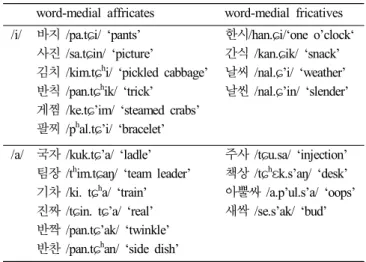
The word list contained the target consonants / ㅈ ㅉ ㅊ/ and / ㅅ ㅆ/ word-medially followed by either /a/ or /i/ (Table 1).

These two vowel contexts were chosen to serve as the different reference of the constriction locations; the fricatives before /i/ are known to be palatalized whereas those before other vowels are to be alveolar. The participants also read words that contained word-initial affricates and fricatives, and stops with a three way laryngeal contrast as filler items.

word-medial affricates word-medial fricatives /i/ 바지 /pa.tɕi/ ‘pants’

사진 /sa.tɕin/ ‘picture’

김치 /kim.tɕ

h

i/ ‘pickled cabbage’

반칙 /pan.tɕ

h

ik/ ‘trick’

게찜 /ke.tɕ’im/ ‘steamed crabs’

팔찌 /p

h

al.tɕ’i/ ‘bracelet’

한시/han.ɕi/‘one o’clock‘

간식 /kan.ɕik/ ‘snack’

날씨 /nal.ɕ’i/ ‘weather’

날씬 /nal.ɕ’in/ ‘slender’

/a/ 국자 /kuk.tɕ’a/ ‘ladle’

팀장 /t

h

im.tɕaŋ/ ‘team leader’

기차 /ki. tɕ

h

a/ ‘train’

진짜 /tɕin. tɕ’a/ ‘real’

반짝 /pan.tɕ’ak/ ‘twinkle’

반찬 /pan.tɕ

h

an/ ‘side dish’

주사 /tɕu.sa/ ‘injection’

책상 /tɕ

h

ɛk.s’aŋ/ ‘desk’

아뿔싸 /a.p’ul.s’a/ ‘oops’

새싹 /se.s’ak/ ‘bud’

Table 1. a list of words with the word-medially elicited target consonants before /i/ or /a/

2.3 Analysis

Acoustic analysis of spectrum peak frequency: The affricate and fricative productions from the 42 speakers were acoustically examined by analyzing the spectral characteristics of the frication portion of the speech signal. The frequency at the spectral peak (from 500Hz to 22050Hz) was automatically identified in Praat from the power spectrum of 15ms analysis window to serve as an acoustic indicator of the constriction location as previous studies showed that it could reliably differentiate the fricative categories with place differences (e.g., English /s/ vs. /ʃ/ in Jongman et al., 2000, Shadle, 1985, Holliday et al., 2010); a higher spectral peak frequency is known to indicate a more anterior place of articulation.

Measure of individuals’ relative frontedness of affricate

articulation: Using the acoustic measures, we made simple

(4)

calculations of subtracting the spectral peak frequencies of affricates before /a i/ from those of fricatives before /a i/. Each individual’s averaged differences between affricates and fricatives are used to indicate how differently each individual speaker realized their affricates from fricatives in terms of the place of articulation: Smaller differences (or negative values) would mean that constriction locations of the affricates are close to those of the fricatives and thus smaller differences imply that affricates are produced anterior to those with greater differences of spectral peak frequencies.

Measure of individual AQ: The responses collected from 42 participants were scored by assigning either “1” point or “0”

point faithful to the method employed in Baron-Cohen et al.

(2001). The 50 AQ questions are structured into two ways: a set of questions where any degree of agreement indicates more autistic nature and the other set of questions where any degree of disagreement display less autistic nature. The one point was given for the responses of “strongly agree” or “slightly agree”

for the agreement set of questions and also given for the responses of “strongly disagree” or “slightly disagree” for the disagreement set of questions. The score sum of the 50 questions was used as an individual AQ values: The greater the value is, the more autistic that individual is. There were 7 missing responses in total. We filled in each of missing items with the mean of the individual’s average across other items and the item average across other subjects.

2.4 Results

<Figure 1> presents the averaged spectrum of frication portion of the affricates and the fricatives. The patterns show that the means of the spectral peak frequencies (solid lines) were more distant between affricates and fricatives in males’ productions than females’ productions before /a/ word-medially. Before /i/

where the alveolar fricatives are allophonically palatalized, the means of the spectral peak frequencies were close between fricatives and affricates in both genders. Note that the overall higher frequencies in female speakers than in male speakers are attributed to the anatomical differences between two genders. In addition to this biological difference, the interaction between the gender and the consonant manner (fricatives vs. affricates) was found before /a/ vowel in the word-medial position (two right panels in <Figure 1>). The mixed-effects model with an interaction term (manner × gender) was compared with the model without the interaction term, resulting in significantly improved fit of the complex model (χ = 12.014, df = 1, p <

0.001). This indicates that the affricate productions by female speakers were made at more fronted place of constriction than those by male speakers in this particular phonetic context.

Figure 1. Averaged spectrum of affricates and fricatives in word-medial position separated by post-consonant vowel conditions (/i/ and /a/) and speaker’s gender. Vertical lines represent the means (solid) and the standard deviations (dotted).

The amplitudes of the fricatives were plotted with 20dB down in order to visualize them without overlapping with those of the

affricates.

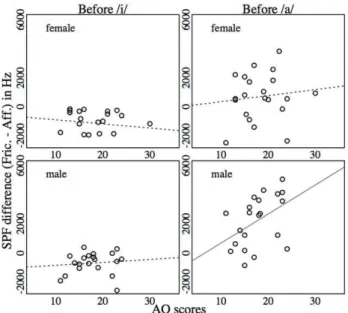
These individuals’ values of spectral peak frequency differences before /a/ at word-medial position were regressed as a function of their AQ scores (<Figure 2>). The distributions of AQ scores were not significantly different between males and females based on the t-test [t = 0.49, df = 38.719, p-value = 0.62]. It can be observed that there was no systematic linear relationship between spectral peak frequency differences and AQ scores for both male and female speakers’ word-medial productions before /i/ (left panels in <Figure 2>). A simple linear regression model confirmed that the slope was not statistically significant [female model: β= -28.29, p = .52, r

2

=-0.03; male model: β= 20.21, p = .64, r

2

=-0.04]. Unlike the patterns before /i/ vowel, there was a gender-related difference in how consistently the spectral peak frequency differences before /a/ vowels were regressed with the AQ scores. For female speakers, the AQ scores did not reliably predict greater differences of the spectral peak frequencies between fricatives and affricates [β=41.21, p = .6, r

2

=-0.037]. In contrast, for male speakers, there was a systematic trend where smaller SPF differences were associated with lower AQ scores (right panel).

This positive slope was statistically significant [β = 199.99, p =

.042, r

2

=.16]. This result indicates that male speakers

(5)

producing an innovative form (i.e., anterior articulation) of affricates showed less autistic traits.

Figure 2. Spectral peak frequency differences between fricatives and affricates elicited word-medially as a function of AQ scores.

The panels were separated by speakers’ gender and post-consonantal vowel contexts. Solid line indicates the coefficient from a simple linear regression was significant at the

level of p < .05.

3. Discussion and conclusion

The current study examined whether the degree of an anterior articulation in Korean affricates produced by young Seoul speakers is related to individual cognitive differences as measured by Autism-Spectrum Quotient (AQ). Our findings show that the degree of frontedness as measured by SPF differences in the frication portion between fricatives and affricates is highly suggestive of correlation with AQ in the context where gender difference exists, i.e., before /a/ in word-medial position. Male speakers with lower AQ showed the smaller magnitude of the SPF differences between fricatives and affricates, i.e., more anterior articulation.

This finding seems to be compatible with Yu’s (2010, 2013) hypothesis that individuals with certain cognitive profile i.e., those with lower AQ are more likely to adopt a newer form of sound within the speech community with a potential of spreading the new form in the future. Unlike the meaningful correlation between male anterior production and AQ, no correlation was found between anteriority of affricates and AQ in the female production. The lack of correlation between anteriority in

female’s affricates and AQ seems to arise from the fact that there is less variability in female speakers’ production compared to male speech (standard deviation for females: 1297 Hz, standard deviation for males: 1395 Hz) and the mean of differences between affricates and fricatives is smaller in female speech than in male speech, which implies that females’ affricate production is already considerably fronted.

One thing to note is that although Yu’s idea has been experimented mainly through perception studies, our data came from production. It has been argued, however, that there is a close link between speech perception and production. The existence of this close link is supported by one of the main ideas of the exemplar model (Johnson, 1997; Pierrehumbert, 2002) that the selected exemplar in production would be the one that is most probable and nearest to the center of the distribution of a target segment in language users’ remembered perceptual space. Empirical data supporting this close relationship were found in Beddor, Harnsberger and Lindemann (2002), and Harrington, Kleber and Reubold (2008), among others. For example, according to Harrington et al. (2008), young standard Southern British English speakers aged between 18 and 20 had the more fronted production of /u/ and also the fronted perceptual boundary for the vowel /u/ on the /i-u/ continuum than old speakers over the age of 50. Considering this close link between perception and production, individual differences in cognitive style measured by AQ can be a source for using an innovative form not only in perception but also in production. Of course, our findings in the production should be further confirmed in perception studies for better understanding of the relationship between cognitive styles as measured by AQ and the use of the new form in Korean affricates. This is currently under investigation by the authors.

Finally, we would like to be cautious in interpreting the

nature of the fronted articulation of the Seoul Korean affricates

over the question whether this gender-related pattern is a gender

marking or an example of sound change. Despite the ambiguous

nature of these phenomena, we found that there is a consistent

relationship with the speakers’ cognitive style. As Yu argued,

this might suggest that the cognitive aspect of individual

language users should be considered in accounting for the

phonetic variation.

(6)

References

Ahn, S-C. (1985). Korean palatals revisited. Papers presented at the annual meeting of Linguistic Society of America, Mineapolis, M.N.

Anderson, V., Ko, I., & O’Grady, W. (2004). A palatographic investigation of place of articulation in Korean coronal obstruents, Korean Linguistics, Vol. 12, 1-24.

Ausburn, L.J., & Ausburn, F.B. (1978). Cognitive Styles: Some information and implications for instructional design.

Educational Communication and Technology, Vol. 26, No.4, 337-354.

Baron-Cohen, S., Wheelwright, S., Skinner, R., Martin, J., &

Clubley, E. (2001). The Autism-Spectrum Quotient (AQ):

evidence from Asperger Syndrome/high-functioning autism, males and females, scientists and mathematicians. Journal of Autism and Developmental Disorders, Vol. 31, 5-17.

Beddor, S. P., Harnsberger, J. D., & Lindemann, S. (2002).

Language-specific patterns of vowel-to-vowel coarticulation:

Acoustic structures and their perceptual correlates. Journal of Phonetics, Vol. 30, 591 –627.

Ganong, W.F. (1980). Phonetic categorization in auditory word recognition. Journal of Experimental Psychology, Vol. 6, 110 – 125.

Harrington, J., Kleber, F., & Reubold, U. (2008). Compensation for coarticulation, /u/-fronting, and sound change in Standard Southern British: an acoustic and perceptual study. Journal of the Acoustical Society of America, Vol. 123, 2825-2835.

Holliday, J. J., Beckman, M. E., & Mays, C. (2010). Did you say susi or shushi? Measuring the emergence of robust fricative contrasts in English- and Japanese-acquiring children.

Proceedings of INTERSPEECH 2010. 1886-1889.

Huh, H. (1964). “Chiǔmko,” [The study of Korean Dentals]

Kukŏkukmunhak Vol. 27.

Hume, E. (1990). Front vowels, palatal consonants and the rule of Umulaut in Korean. In Carter, J., Dèchaine, R.M., Philip, B. &

Sherer, T. (eds.), North East Linguistic Society, 20. Amherst, MA: GLSA.

Jongman, A., Wayland, R. & Wong, S. (2000). Acoustic characteristics of English fricatives, Journal of the Acoustical Society of America, Vol. 108, 1252-1263.

Johnson, K. (1997a) Speech perception without speaker normalization: an exemplar model. In K. Johnson and J.W.

Mullennix (eds.) Talker Variability in Speech Processing. San Diego: Academic Press, 145-166.

Kim, C-W & Ahn, S-C (1983). Palatalization in Korean revisited.

Paper presented at the 58

th

Annual meeting of the Linguistic Society of America. Minneapolis, MN.

Kim, S-G. (1976). Palatalization in Korean. Ph.D. Dissertation, University of Texas Austin.

Kim, H-S. (1997). The place of articulation of Korean affricates observed in LPC spectra, The Korean Journal of Speech Sciences, Vol. 3, 93-103.

Kim, H-S. (1999). The place of articulation of Korean affricates revisited. Journal of East Asian Linguistics Vol. 8. 313-347.

Kim, H-S. (2001). The place of articulation of the Korean plain affricate in intervocalic position: an articulatory and acoustic study. Journal of International Phonetic Association. Vol. 31, No. 2, 229-257.

Kim-Renaud, Y-K. (1974). Korean Consonantal Phonology. Ph.D.

Dissertation, University of Hawaii.

Kong, E., Kang, S., & Seo, M. (2014). Gender difference in the affricate productions of young Seoul Korean speakers. Journal of Acoustical society of America Express Letters, Vol. 136, No.

4, 329-335.

Labov, W. (1990). The intersection of sex and social class in the course of linguistic change, Language Variation & Change, Vol.

2, 205 –254.

Mann, V. & Repp, B. (1990). Influence of vocalic context on the perception of the [ʃ] and [s] distinction, Perception &

Psychophysics, Vol. 28, No. 3, 213 –228.

Mitterer, H. (2006). On the causes of compensation for co-articulation: Evidence for phonological mediation, Perception

& Psychophysics, Vol. 68, No.7, 1227-1240.

Ohala, J. J. (1993). The phonetics of sound change. In Charles Jones (ed.), Historical Linguistics: Problems and Perspectives.

London: Longman. 237-278.

Shin, J. (1998). An articulatory study of Korean / ㄷ, ㄸ, ㅌ, ㅈ, ㅉ, ㅊ/. Kukŏhak 31 [Study of Korean]. 한국어 /ㄷ, ㄸ, ㅌ, ㅈ, ㅉ, ㅊ/의 조음적 특성에 관한 연구. 국어학 31.

Stewart, M. I., & Ota, M. (2008). Lexical effects on speech perception in individuals with ‘autistic’ traits, Cognition Vol.

109, 157-162.

Pierrehumber, J. (2002) Word-specific phonetics. Laboratory Phonology VII, Mouton de Gruyter, Berlin, 101-139.

Shadle, C. (1985). The Acoustics of Fricative Consonants. Ph.D.

Dissertation, MIT.

Yu, A. (2010). Perceptual compensation is correlated with

individuals’ “autistic” traits: Implications for models of sound

change, PLoS ONE, Vol. 5(8): e11950. doi:10.1371/journal.

(7)

pone.0011950.

Yu, A. (2013). Individual differences in socio-cognitive processing and the actuation of sound change. In Alan C. L. Yu (ed.) Origins of sound change: Approaches to phonologization.

201-227. Oxford:Oxford University Press

∙Kang, Soyoung

Hongik International Language Institute, Hongik University 94 Wausan-ro, Mapo-gu, Seoul, 121-791

Tel: 02-320-1368 Fax: 02-320-1374 Email: [email protected]

Areas of interest: psycholinguistics, phonetics

∙Kong, Eun Jong

Dept. of English, Korea Aerospace University 100 Hanggongdae-gil, Hwajeon-dong, Deokyang-gu Goyang-si, Gyeonggi-do 412-791, Korea

Tel: 02-300-0338 Fax: 02-300-0493 Email: [email protected]

Areas of interest: Phonetics (speech production and perception), L1 & L2 acquisition

∙Seo, Misun

Dept. of English Language & Literature, Hannam University 133 Ojeong-dong, Daedeok-gu

Daejeon-si, 306-791, Korea

Tel: 042-629-7320 Fax: 042-629-7321 Email: [email protected]

Areas of interest: Phonology, L1 & L2 acquisition

수치

Table  1.  a  list  of  words  with  the  word-medially  elicited  target  consonants  before  /i/  or  /a/
Figure  1.  Averaged  spectrum  of  affricates  and  fricatives  in  word-medial  position  separated  by  post-consonant  vowel  conditions  (/i/  and  /a/)  and  speaker’s  gender
Figure  2.  Spectral  peak  frequency  differences  between  fricatives  and  affricates  elicited  word-medially  as  a  function  of  AQ  scores

참조

관련 문서