1. Introduction
Incheon is located west of the capital of South Korea, Seoul. It occupies a total area of 992 km² and is bordered on the west by the Yellow Sea, the north by North Korea, the southwest by the Chungnam-do region, and the southeast by the Gyeonggi-do region. In addition, Incheon is divided into 10 districts and contains 168 total myeon and dongs (administrative divisions equivalent to several blocks).
With about 2.9 million inhabitants, Incheon is the third largest city in Korea after Seoul (9.7 million) and Busan (3.4 million) (KOSIS Population Data). Despite this ranking, Incheon has long been a maritime and industrial extension of the capital. Located only 30 km from Seoul, where a bulk of the decision making for the country takes place, Incheon is connected to Seoul by a metro, bus, and road system. Most consider Incheon a suburb of Seoul.
Incheon’s distance from major maritime shipping routes and limited water availability due to extreme tides has hindered its logistics
modernization and has left Busan and Gwangyang with 95% of container traffic (2002) (Fremont, 2005). However, the situation seems to have recently turned in Incheon's favor with the city being the target of large-scale investments. The current free economic zone projects and extended reach of the international airport will help drive Korea to become the
"hub" of finance and logistics in Northeast Asia (Lee, 2003). However, are current developments able to fill Incheon's logistical gaps and allow it to grow to the status of "global city" and become more than just a suburb of Seoul?
Incheon’s history shows that its development is organically linked to that of the nearby capital. We will see if the recent period of development has followed the same historical path or has diverged on a new one that will allow Incheon to assert itself as a global city.
Growth in Seoul's Periphery Brief Historical Background
Colonial times –The region was founded in the early 1400s. Before that date, Incheon was
* Institute for urban policy Research, Previous Research
** Professor, Dept. of Urban Policy and Administration
A critical analysis of the Incheon Free Economic Zone:Can Incheon move beyond being a gateway to Seoul?
Dakota McCarty*ㆍJu Moon Park**13)
Abstract: : Incheon, South Korea, is a rapidly growing port city that has long held an important role in the country. While for most of its history it has been considered more of a coastal extension of Seoul, it is now trying to grow from that role and become a global city. National and local initiatives and acts have led to the Incheon Free Economic Zone (IFEZ). This large zone connects three smaller districts into one large project.
The goal of the project is to assert Incheon as its own city and go beyond its role as merely a gateway to Seoul. However, as most large-scale projects go, there are multiple issues and constraints faced by the IFEZ.
This paper analyzes the project and gives critique on how the project could possibly achieve its goal more quickly.
Key Words : IFEZ, Incheon, urban planning
called Inju, and before that, it was Michuhol dating back to as early as 18 BC. The official opening of the port as an international hub was in 1883 (Hattendorf,2007). The arrival of Japanese, Chinese, American, and European settlers at the end of the nineteenth century illustrates the strategic position of Incheon.
Despite being a mere coastal village of 4, 700 inhabitants at the time, it was an important port for the capital of the Joseon Kingdom.
Through this port gateway, goods circulated along the Gyeongin line, which still exists today, connecting Incheon to Seoul due to the poor navigability of the Han River(Hattendorf,2007).
During the Second World War, the development of Incheon was largely fueled by warehouses serving the interests of Japan;
before that, between 1882 and 1910, it saw the growth of the rice industry and breweries;
then, between 1911 and 1930, after the invasion of Japan, it grew in the weaving and milling industries; after that, between 1931 and 1945, it saw the emergence of heavy manufacturing and armament (Johnson, 1982).
By the end of the Second World War, Incheon was the first tonnage port in Korea (Hattendorf. 2007). However, the major sea routes being of little benefit to Incheon leading to the decay of its port site, it began to suffer.
To remedy this, the authorities planned a reconstruction of the port, which allowed manufacturing industries to take up residency.
These industries grew and then constituted the bulk of the city’s economic base, a trend reinforced by the “Open Port Traffic Act” of 1961 (Hattendorf, 2007).
Gate to Seoul – The construction of the Gyeongin Express way in 1968 marked the emergence of this industrial corridor. It was the
site of spectacular urban growth fueled by the large rural to urban immigration of people and the diffusion of industrial activities moving away from Seoul.
Incheon’s economy remained heavily based on industry (iron and steel, metallurgy, and basic chemical manufacturing) but also still included more traditional industries (textiles, glass, and wood). In this sense, Incheon is not much different from other port-based gateways to major cities such as Port Klang to Kuala Lumpur, or Tianjin to Beijing. Incheon was developed as an immediate extension of Seoul to the sea for the purpose of processing of low value-added products. Due to the large amount of urbanization of Seoul, it was unable to construct the adequate facilities to produce these good. Many of these emerging industries required a port for easy shipment, and large warehouses and industrial equipment that consumes too much space to be housed in Seoul (figure 1).
figure 1 (adapted from Ducruet (2010)) :
Like other Korean industrial hubs, the rapid growth led to the deterioration of the urban environment and the growth of activities along
the port and the communication routes (Ducruet, 2006).
While Incheon was experiencing growth in its industrial sector, national territorial policies seemed to ignore the city. For example, those of the first free economics zones in cities further south (Masan, Gumi, and Iksan) were all developed to allow industrial take off to further support Korea’s economic growth as a
“Dragon". These zones were established with the goal of developing exports and broadening the industrial redeployment and investment outside the capital region (Chandra 2013). These new initiatives were further pushed by the rise of "Tigers" and China’s economy; these urged the Korean government to find new ways to attract foreign investment.
In the wake of Korea's spectacular growth beginning in the 1970s, coastal cities such as Incheon, Busan, and Ulsan have seen their populations explode. However, they remain very specialized in industrial and port activities, with Seoul retaining most of the decision-making powers.
Incheon has the additional advantage of benefiting from having a hinterland that holds almost half of the Korean population, and having a close proximity to the capital. While Incheon enjoys a privileged status that gives it great management autonomy, it nevertheless remains dependent on the development of a single metropolitan agglomeration whose primacy over the rest of the country is difficult to counterbalance despite the repeated efforts of regional policies.
Globalization and new strategies
During the July 2016 Global Business Frontier proclamation ceremony, Mayor Yoo stressed the importance of creating an economic bloc around Incheon, saying, “It is high time that the Pan-Yellow-Sea economic bloc was created around Incheon, and the IFEZ is expected to serve as the prime mover to make this a reality.” He added, “I believe the IFEZ will be the vanguard in advancing the era of Incheon’s economic independence needed to ensure citizens’ happiness” (IFEZ 2016)
Incheon, the new Global Business Frontier – Incheon was selected for this new project primarily for its geographic location in the heart of the East Asian economic markets—that is, between Japan and China and close to their respective major economic capitals, and of course due to its location in relation to Seoul (figure 2) (Ahn 2004). The strategic location of the airport puts it a 3.5 hour flight distance from 51 large cities, with a combined population of nearly two billion people (Jeon, 2005). Domestically, more than half of Korea's population is in its hinterland, giving it a large share of the national markets (Fleming, 1994).
figure 2 (IncheonInternationalAirport):
A series of laws promoting foreign direct investment (FDI), including the 1998 “Foreign Investment Promotion Act”, supported by the Korea Trade-Investment Promotion Agency and managed by the Korea Investment Service Center, aim to increase the number of free economic zones in Korea. Among these projects which favor the coasts, those of Incheon (2900 km²) are far ahead of those of Busan (1400 km²) and Gwangyang (1500 km²).
Building on a territory already 30% polderized (Chung, Kato, 1998), ongoing projects will quite literally add more to Incheon through land reclamation, especially through projects such as
"Techno Town" in Songdo, and the building of Yeongjeong-do to house the airport. It seems that Incheon is currently the subject of one of the largest private development projects in history, as well as the site of one of the world's largest land reclamation projects (1,000 km²) (Kim, 2011).
Governance of the IFEZ – The status of the Incheon Free Economic Zone (IFEZ) is governed by the Free Economic Zone Act. Like any Korean free economic zone, it priorities projects in various sectors: production, services, high technology, logistics, business tourism, hotels, leisure parks, and facilities for reception of international conferences. The act provides for a total exemption from income tax for the first three years (50% in the following two years) and exemptions for acquisition and registration taxes; as well, an exemption on the property tax are provided for five years (50% for the next three years) (Gale Company, 2004). The FEZ comprises three districts: Songdo, Cheongna, and Yeongjong (figure 3).
figure 3 (IFEZA in 2005):
Songdo, a new city to the south (figure 4) – This sector aims to become a new city in both residential and industrial terms. The establishment of various corporations and their knowledge bases were planned. An investment of more than US$1.5 billion in this 13, 159-acre territory is hoped to lead to the city being completed by 2020 with a population of 252,000 people(Kim,2011,IFEZA2007).
figure 4 (IncheonMetropolitanCouncil2003):
Yeongjong, an area to the west that includes Incheon International Airport (figure 5)–These 34,183 acres of land mainly contain Incheon
International Airport. Because of the airport, the projects on this island have a mainly logistical and commercial value to facilitate the distribution of goods. An expected population of mostly airport workes and visitors is 144,800 (Lee,2003). To improve accessibility of the island to the mainland, Incheon Bridge has been built connecting Songdo and the airport. There is also a large tourist complex on nearby Muui Island with a new bridge currently under construction to boost connectivity over the current passenger ferry(IFEZA2007).
figure 5 (IncheonMetropolitanCouncil2003):
Cheongna, an area to the north near the current port (figure 6)– There were plans for 4,394 acres in this territory to house 90,000 people by the end of the works in 2008. There are plans for a horticultural and floral complex, training areas, gyms, theme parks, and golf courses. It is a business and residential sector that is also the site of the GM Daewoo Cheongna Technology Research Center (IFEZ General Development Map by Region) (IFEZA2007).
figure 6 (IncheonMetropolitanCouncil2003):
In general, the land has been planned heavily for tourism infrastructures. In 2003, the plan was to have more than 40% of the territory devoted to it. In the second row, we find logistics and transport (both air and sea) (IFEZ 2009). Then, industries and research share the rest of the territory with residential developments (figure 7).
figure 7: Land Use Planning (IncheonMetropolitanCity)
Tourism and Leisure 40%
Residential 7%
Logistics and Transport 28%
Commerciale, Industrial, and R&D 15%
Other 10%
With the IFEZ stating a total amount of over US$2 billion in investment, the local application of these principles is limited by the weight of private actors, given the importance of Foreign Direct Investment (FDI) in financing the project (about 93%). The already developed industrial zone is based on partnerships with American companies such as VaxGen (pharmaceutical), Gale (construction), and Hightech BIO Complex Celltrion, which has partnered with the Korean group POSCO for the development of biotechnology.
However, the financial power of Korean and foreign private investors is disproportionate to the IFEZ's ability to control the development of its districts. Moreover, the institutional status of the Incheon Free Economic Zone Authority (IFEZA) remains relatively ambiguous, to the extent that the IFEZ is the responsibility of both the State (the Ministry of the Economy and Finance) and the City of Incheon. The public-private power and state-city ownership continues to fuel the debate on the possibility of an independent system for the IFEZ.
◾Between local and global integration
◾Local integration and development
The "Pentaport" – At the network level, free economic zone projects are part of the global concept of a "Pentaport,” a local innovation inspired by the examples of places like Dubai and Hong Kong to optimize the air-sea transfer of goods.
The Incheon pentaport is targeting the connection of airports, commercial ports, passenger ports, teleports, and free trade zones to make the city the logistics hub of the Yellow Sea (Lee, 2003). There have been numerous developments and changes in recent history to support this goal. The move of the International Airport from Gimpo in 2001, the development of the North Port between 1995 and 2011, the container terminal planned by the Port of Singapore(PSA) in 2004, the Gyeongin canal development between 1997 and 2011. After many years of neglect of the port, a myriad improvements have been made to Incheon's infrastructure.
In addition, the connection of the various districts planned for the anticipated increase in daily commuters: the link between Songdo and
Cheongna (second Belt Highway Seoul, 2008);
the link between Songdo and the airport with the new Incheon cable stay bridge; links between Songdo and southern Gyeonggi Province (Gyeongin Highway Bridge, 2008); links between Cheongna and West Incheon (extension of Gyeongin Highway); and finally, a rail link to the airport from Seoul and new stations adding to the current Incheon metro.
The recent success of the international airport, in terms of traffic and quality of service, proves the success of the project in a way. This has recently been confirmed by the comparative analysis of urban-port functions in Europe and Asia (Ducruet, César, 2006):
Incheon is improving its logistics platform and is growing to join the same category as Keelung, Port Klang, and Tianjin.
On January 18, 2018, the Incheon International Airport opened its second terminal.
After the large success of the first terminal, the newly opened one promises to prove quicker and more comfortable services. As well, it has a stronger focus on culture and provides many special cultural spaces. The size of Terminal 2, is about 77% of the size of Terminal 1, however, there is about three times the amount of space at customs and immigration to provide quicker processing for international visitors. This expansion paired with new smart services such as self-check in, self-bag drop, etc aim to reduces the time of immigration service by 30% (IFEZ Journal 2018).
As with any transport node, the multiplication of links does not always result in a harmonious development of the places closest to the new facilities, especially since the links are established within pre-existing economic and demographic structures, which are reinforced by their grip on the surrounding space (Ducruet 2006). Thus, the insertion of Incheon into the global air and logistics networks is not
necessarily synonymous with endogenous development but rather with the redistribution of Seoul's global functions into its immediate space.
The 3 districts and their place in the system – It is questionable whether the choice of sites selected for the development of the free economic zones is relevant. On the one hand, the discontinuities created in the urban fabric emphasize their isolation from traditional neighborhoods. The peripheral location of Yeongjong corresponds to the desire to develop the new airport, built intentionally far from the city to minimize noise pollution. But on the other hand, the inherited industrial landscape, visible especially near Songdo (Namdong complex), does not fit well with the IFEZ's concern to attract residents and tertiary activities. Basically, the break with older urban structures is inevitable because of the inherent logic of new cities.
◾The emergence of a new world city?
The attraction of new functions –It is possible to have an idea ofthe functional orientation of the FEZ staking into account the expected allocation of land (figure3,4,5). Of course, the figures do not reflect the actual occupancy of space or the amount of investment, and obviously, different activities use varying amounts of space. First come the landscape, airport, and port functions; then, far behind, the residential, tourist, and sports/leisure functions.
Financial-intensive functions are shared between Songdo and Cheongna for industry, research, and trade. Songdo provides for the reception of 7,900 households, or 22,900 people (Songdo Techvill); Cheongna has to accommodate about 90,000 residents. Songdo specializes more in cultural, educational
(Technopark, Techno Valley, Incheon National University, Yonsei University, Songdo Global Campus, etc.), and logistics activities. Yeongjong is characterized by its airport function (international logistics complexes near the terminals), landscape, and tourism (coastal recreation), while Cheongna stands out with sports (golf courses), tourist, and industrial (e.g.
medical research) functions.
Due to large investments from IT, Bio, and new growth industry companies, the IFEZ has been at the forefront of the fourth industrial revolution. In Fortune Magazine's 2018 Fortune 500 list of top companies(Fortune Magazine, 2018), 11 of the 500 were located within the IFEZ—companies such as Boeing, BMW, and Cisco. These companies enhance the status of the IFEZ and expand its opportunities
However, the question still remains, are these ingredients enough to make Incheon a new global city, especially against its Asian competitors?
A project with limited cultural and tourist influence – It seems that the weak point of the project is at the cultural level, which can also prove to be a weakness for the global integration of Incheon, a founding objective of the IFEZ.
The central position of the international airport in the project is a definite asset, but it is very possible that the flows have no direct link with the local economy and are actually directed towards Seoul and the rest of the country. In particular, it seems unlikely that the ex nihilo creation of a leisure and business environment alone will make it possible to attract tourists and develop tourist activity.
Moreover, despite its size, the IFEZ is only one of the projects being developed in Korea.
Other FEZs have quite similar projects: the
"New Administrative City" 150 km south of Seoul displays a highly cultural value and
"Saemangeum" (401 km²) in the province of North Jeolla has also developed a coastal tourism project. In addition, the city and the port of Busan show major development in tourism with their waterfront projects and the development of the New Busan Port that opened in 2006 (Fremont, 2005).
Furthermore, competition is present in the rest of Asia: Shanghai is growing, with its Pudong area booming (Martin 2003). We see that the specificity of the IFEZ project is not proven; it lacks original content and may, in spite of its importance, simply contribute to strengthening the functions and identity inherited from Incheon being Seoul's coastal hub.
The IFEZ is the largest investment of its kind in Korea, being part of the government's desire to obtain a significant share of the East Asian market. To support this commitment, the government has introduced several laws to encourage foreign investment, all of which are managed by the Korea Trade Investment Agency and the Korea Investment Service Center. Their goal is clear: to turn South Korea into a commercial maritime and financial hub.
Following this desire, several other zones with liberal economic policies exist in Korea. These areas are mainly located near the water to facilitate transport logistics.
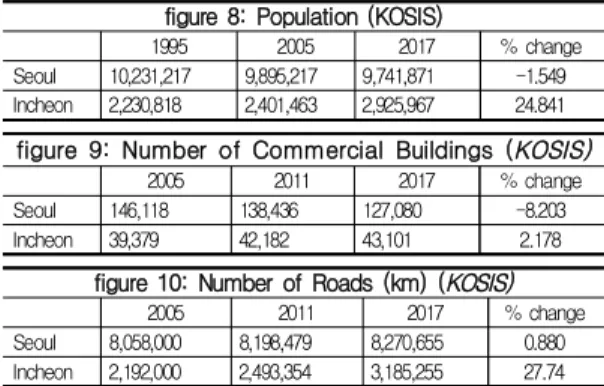
Positive outcomes –Since 2005, the city has been growing more rapidly compared to Seoul.
It can be noted that the population of Seoul is stable and even slightly down over the years, unlike Incheon, which has increased considerably(figure8). We can also see the same phenomenon with the amount of commercial buildings and roads built in the city(figure9,10).
figure 8: Population (KOSIS)
1995 2005 2017 % change
Seoul 10,231,217 9,895,217 9,741,871 -1.549 Incheon 2,230,818 2,401,463 2,925,967 24.841 figure 9: Number of Commercial Buildings (KOSIS)
2005 2011 2017 % change
Seoul 146,118 138,436 127,080 -8.203
Incheon 39,379 42,182 43,101 2.178
figure 10: Number of Roads (km) (KOSIS)
2005 2011 2017 % change
Seoul 8,058,000 8,198,479 8,270,655 0.880
Incheon 2,192,000 2,493,354 3,185,255 27.74
This significant increase in economic and demographic activity can be explained largely by the IFEZ. It is a zone where the laws of the free market are applied, where there is no economic barrier, where bureaucracy is limited, and where pricing and tax decreases on companies are established. This free economic zone allows the promotion and establishment of foreign companies and industries in order to favor the commercial exchanges of the host country, valorize the investment of foreign capital, and consequently allows for increased job opportunities in the region.
According to the Report on the Factual Survey of Companies in the IFEZ as of 2016 (IFEZ Journal, 2018), the IFEZ economic production accounted for a little over 50% of Incheon’s exports. In 2016, the IFEZ generated a massive 20.64 trillion won of exports, with Incheon generating a total of 40.84 trillion won.
This shows the IFEZ’s competitiveness and the impact that it has had on the Incheon economy.
This year, 2018, marks the 15th anniversary of the creation of the Incheon Free Economic Zone.The IFEZ was established in October 2003 to lead the development of Incheon towards its goal of being a "Global Business Frontier.”.
The IFEZ has succeeded greatly achieving US
$10.53 billion in Foreign Direct Investment(FDI) (IFEZJournal2018).
Conclusion
Finally, with its past as a port city, a Seoul sea gateway aided by the Gyeongin highway, and its strategic position in East Asia, Incheon moved on to another stage of modernization and urbanization with the establishment of the IFEZ (Fleming 1994). This is an opportunity for the region and allows the country to enter world markets and open up to the world. The IFEZ develops and creates a synergy in the territory and allows an increase in the standard of living of the region’s population while allowing for planning mindful of aesthetics and the environment. Indeed, the IFEZ authorities have intentions of environmentally friendly cities and means of green transport.
The strategy to make Incheon a global city is certainly exemplary, both in terms of the sums involved and the scale of the project. On a larger scale, it puts the city in a position to compete with Asian (Shanghai, Hong Kong, Tokyo) and other global cities to attract capital and investment. Thus, the Incheon Free Zone not only responds to federal policies but also competes directly with the various East Asian economic poles. The examination of the project at different levels by its territorial component, however, puts into perspective the somewhat technocratic speeches of policymakers. The question remains, in terms of local integration, regional complementarity, national coherence, and global appeal, is the IFEZ an adequate tool to achieve, as planned, the transformation of Incheon by 2020?
New York is not considered the center of the world economy based just on the existence of Wall Street. It is a world class city due to its history and experiences that have shaped it into the hot spot it is today. It not only has Wall Street, but also Broadway, Ellis Island, and
many other major global landmarks and destinations. The IFEZA should use this example to develop more strategic planning focused on culture and economics together. One great advantage Korea has is that of Hallyu, the Korean Wave, that's sweeping the world.
Through the combination of unique cultural aspects (such as Hallyu) mixed with economic accomplishments, the IFEZ has a wonderful chance to transform Incheon into a city rich with not only investment but also culture and its own unique character. Unil the IFEZA is able to harmoniously combine its economic initiatives with its cultural ones, it will not be able to transform itself into a unique capital that is comparable to other major cities of the world. Economics alone will not be able to reach the goals set by the city.
It seems that the ongoing process in Incheon masks a larger transformation, that of greater Seoul or even Korea as a whole, in the face of the Chinese industrial boom and the growth of other Asian cities and countries. The IFEZ thus marks the will to artificially accelerate the development of the tertiary sector and add high-value activities, benefiting from the immediate hinterland of the capital region and leaving the southern coastal cities (Busan, Ulsan, Pohang, Gwangyang) with the industrial and port primacy.
References
Ahn, Choong Yang (2004).
GeographiccoverageofnortheastAsia.KoreaInsti tuteforInternationalEconomicPolicy.
Marton, Andrew; Wei Wu
(2003).AcasestudyofthedevelopmentoftheShang haiPudongNewArea.InternationalBusinessJourn alVol.2,Iss.1
Chandra, Vandana; et al. (2013),
LeadingDragonPhenomenon:NewOpportunities
forCatch-UpinLow-IncomeCountries.SSRNElec tronicJournal
Ducruet, César (2010),
FreeeconomiczonesinNorthKoreaandSouthKore a,AtlasMondialdesZonesFranches,Paris:LaDocu mentationFrançaise.
Ducruet, César; Lee, Sung-Woo
(2006),FrontlineSoldiersofGlobalisation:Port–Cit yEvolutionandRegionalCompetition.GeoJournal, vol.67,no.2
Fleming, Douglas; Hayuth, Yehuda (1994), SpatialCharacteristicsofTransportationHubs:Ce ntralityandIntermediacy.JournalofTransportGe ography,vol.2,no.1
Fortune Magazine (2018),
Fortune500,FortuneMagazine.www.fortune.co m/fortune500/list/
Fremont, Antoine; Ducruet, César (2012), TheEmergenceOfAMega-Port-FromTheGlobal ToTheLocal,TheCaseOfBusan.TijdschriftVoorE conomischeEnSocialeGeografie,vol.96,no.4 Gale Company (2004),
www.newsongdocity.com/GeneralInformation/
NSC
Hattendorf, John B (2007)
TheOxfordEncyclopediaofMaritimeHistory.Vol.
4,OxfordUniversityPress
Incheon Free Economic Zone (IFEZ) (2009), Welcome.IncheonFreeEconomicZone.Institutio nalPresentation.IFEZPublicRelationsOffice.
Incheon Free Economic Zone (IFEZ) (2018), GeneralDevelopmentMapbyRegion Incheon Free Economic Zone (IFEZ) (2018),
ifezJournal,IncheonFreeEconomicZoneMagazin e,Vol.80
Incheon Free Economic Zone (IFEZ) (2016), 09-10ifezJournal,IncheonFreeEconomicZoneM agazine
Incheon Free Economic Zone Authority (IFEZA) (2007).
Plannedpopulationanddevelopmentstrategy.
Jeon,Yeongnam
(2005).IncheonInternationalAirportDevelopmen
tPlan.KoreanInstituteforInternationalEconomic Policy.
Johnson (1982)
MITIandtheJapaneseMiracle:TheGrowthofIndus trialPolicy
Kim, Ahn. (2011)
SongdoFreeEconomicZoneinSouthKorea:AMega -projectReflectingGlobalization?,JournaloftheK oreanGeographicalSociety,vol.46,no.5,
Korea Statistical Information Service (KOSIS) Lee, Hunsoo; Yang, Han Mo (2003),
StrategiesforaGlobalLogisticsandEconomicHub:I ncheonInternationalAirport.JournalofAirTransp ortManagement,vol.9,no.2
논문투고일 11월 30일 논문심사일 12월 10일 논문게재일 12월 30일