ISSN 2288-1069 (Online)
http://dx.doi.org/10.12925/jkocs.2016.33.4.741
추출 용매에 따른 아사이 베리(
Euterpe oleracea
Mart.)의 생리활성 및 항산화 활성 비교진동혁․이영근․성종환․김한수
✝ 부산대학교 식품공학과(2016년 7월 18일 접수; 2016년 12월 7일 수정; 2016년 12월 26일 채택)
Comparison of Bioactivities and Antioxidant Activities of Acai Berry ( Euterpe oleracea Mart.) by Different Extraction Solvents
Dong-Hyeok Jin․Young-Geun Lee․Jong-Hwan Seong․Han-Soo Kim✝
Department of Food Science and Technology, Pusan National University, Miryang 50463, Korea (Received July 18, 2016; Revised December 7, 2016; Accepted December 26, 2016)
Abstract : The acai berry (
Euterpe oleracea
Mart.) contains vitamin B complex, vitamin C, anthocyanin and so on. Especially acai berry was seen as nutritionally comparable to blueberry and related berries. The acai berry has significant aging-reducing properties. Compounds have been found to have anti-aging and antioxidant components. Acai berry was extracted with 70%methanol, 70% ethanol and CM (chloroform:methanol=2:1, v/v). After sample and reagents of each experiment was reacted, DPPH radical scavenging activity and ABTS radical scavenging activity, ferric reducing antioxidant power, reducing power were measured to determine the antioxidant capacity, and as results of comparing each extract. Ethanol (70%) extraction was measured highest. Anthocyanin, total phenol, flavonoid also appeared similar to the results. In addition, the antioxidant activities of the extraction solvents were increased significantly with increasing concentrations, but showed lower antioxidant activity than the positive control (ascorbic acid). As a result, antioxidant activities of sample supposed to affect by the anthocyanin, phenol and flavonoid contents.
Keywords : acai berry (Euterpe oleracea Mart.), antioxidative activity, anthocyanin, total phenol, total flavonoid
✝
Corresponding author
(E-mail: [email protected])
1. 서 론
최근 천연물로부터 유래된 생리활성물질이 과 학 기술의 발달과 함께 건강과 질병의 예방에 큰 도움을 주고 있으며, 건강에 대한 관심이 증가하 면서 노화방지 및 항산화와 관련된 수요는 급증 하고 있다[1]. 이에 아사이베리(
Euterpe oleracea
Mart.)는 남미 북부 아마존에 자생하며 보라색을 띠는 둥근 모양의 과일로 씨를 단단한 과육이 감 싸고 있는 열대 과일로[2], 아사이 베리의 생리 활성 물질은 지난 10여 년 동안 상당한 선행 연 구가 진행 되어 항노화 연구와 에너지음료로서 주로 사용되어지고 있다[3]. 특히, 베리류는 polyphenols, phenolic acids, flavonoids 및 carotenoids 화합물의 함량이 높을 뿐만 아니라 vitamin B 복합물과 vitamin C, anthocynin 등 여러 생리 활성물질을 함유하고 있다[4]. 이러한 항산화효과를 가지고 있는 화합물들은 reactive oxygen species (ROS) 및 free radical을 제거 할 수 있는 능력과 이에 대한 상호 작용을 통해 생 활습관병을 예방하는 것으로 알려져 있다[5]. 한 편, 생체 세포는 호기성 호흡 중에 미토콘드리아 내에서 hydorgen peroxide (H2O2)와 hydroxyl radicals (OH-)과 같이 ROS를 유도하는 superoxide를 생성하여 ROS에 노출된다[6].ROS의 증가는 종양 생성과 DNA 손상으로 인한 돌연변이 발생 가능성을 촉진 시킬 수 있다고 한 다[7].
아사이베리의 성분에는 특히 phenolics와 flavonoids, anthocyanins 등의 생리활성물질들로 식품 연구와 대체의약 및 화장품 산업의 천연 항 산화제로서 기능성 식품과 식품 첨가제로 많은 각광을 받고 있다[8]. 또한 생리활성물질인 flavonoid와 phenol compounds가 풍부하여 항염 증, 항암, 심장병 예방 및 항산화 등의 생활습관 병 예방에 탁월한 효과가 있는 것으로 보고되고 있다[9]. 아사이베리는 peroxynitrite (ONOO-) 와 hydroxyl radical을 제거하는데 뛰어난 항산화 능력이 있다고 연구된 바 있으며[10], 또한 아사 이 베리의 열매와 씨앗의 항산화 능력을 비교 측 정하여 보고된 바 있다[11]. 그러나 아사이 베리 를 용매별로 추출한 뒤 생리활성물질의 성분 함 량과 항산화 활성을 측정하여 비교한 연구는 아 직 미비한 실정이다.
따라서 본 연구에서는 항산화 능력을 가지고 있어 건강식품으로 이용되는 아사이 베리를 70%
methanol, 70% ethanol, chloroform:methanol (CM, 2:1, v/v)의 용매별로 추출하여 anthocyanin, total phenol, flavonoid 함량을 측 정하고, 항산화 능력(DPPH radical scavenging activity, ABTS radical scavenging activity) 및 환원력(ferric reducing antioxidant power, reducing power)을 측정하여 아사이 베리의 추출 용매에 따른 항산화능력을 비교하여 건강기능 식 품에 필요한 기초 자료와 생활습관병 예방의 목 적으로 본 실험을 실시하였다.
2. 재료 및 방법
2.1. 실험 재료실험에 사용된 시료는 2015년 3월 아마존에서 자생하는 아사이 베리를 동결건조시켜 분쇄한 것 을 시중에 구입하여 deep freezer (DF-8514, Il-Shin BioBase Co., Daegu, Korea)에서 –80℃
로 보관하며 사용하였다.
2.2. 시료의 추출
시료의 추출은 동결 저장된 아사이 베리 분말 100 g을 취해 70% methanol, 70% ethanol, chloroform:methanol (CM, 2:1, v/v) 용매를 각 10배 가하여(1:10, w/v) 24시간씩 2회 추출한 뒤 여과(filter paper, Advantec, No.2, Tokyo, Japan)하였다. 추출물들은 rotary evaporator (Hei-VAP Advantage, Heidolph, Germany)를 이용하여 40℃에서 감압 농축하여 용매를 제거한 후, 실험에 사용하였다. 시료의 수율은 추출 전 시료 중량에 대한 추출 후 건조 중량 백분율(%) 로 나타내었다.
2.3. Anthocyanin 함량 측정
아사이 베리의 anthocyanin 함량은 pH-differential 방법을 변형하여 측정하였다[12].
즉, 건조된 아사이 베리 분말 0.5 g에 methanol -1 M HCl (85:15, v/v) 15 mL를 가하여 30분 동안 혼합한 뒤 여과하여 분석 시료로 사용하였 다. 시료 1.0 mL에 25 mM potassium chloride buffer (pH 1.0) 2.0 mL를 가하고 또 다른 시험 관에 시료 1.0 mL에 0.4 M sodium acetate buffer (pH 4.5) 2.0 mL를 가한 후 암실에서 20 분간 방치하여 UV/Vis spectrophotometer (SP-200, Analytik Jena Co., Jena, Germany)를
사용하여 510 nm 및 700 nm에서 흡광도를 측 정 하였다.
아사이 베리의 anthocyanin 함량은 cyanidin- 3-glucoside의 몰 흡광계수(ℇ=26,900 M-1cm-1) 를 이용하여 다음 식에 의해 표시하였다[13].
Anthocyanin content =
×
×
×
× A = (A510 nm-A700 nm)pH1.0- (A510 nm-A700 nm)pH4.5. MW = molecular weight of
cyanidin-3-glucoside (449.2 g/mol).
DF = dilution factor.
ℇ = molar absorptivity of cyanidin-3 glucoside (26,900 M-1cm-1).
L = cell path length (1 cm).
2.4. Total phenol 함량 측정
Total phenol 함량은 Folin-Denis` 방법을 변 형하여 실험하였다[14]. 시료 추출액 0.5 mL에 증류수 4.0 mL을 넣고, Folin Denis reagent 0.5 mL를 가한 후, 잘 섞어 3분간 실온에 방치한 뒤 10% sodium carbonate solution 0.5 mL을 첨가 하여 실온에 1시간 방치한 후 700 nm에서 흡광 도를 측정하였다. 표준물질로는 caffeic acid를 사 용하여 시료 1 g당 mg CAE (mg of caffeic acid equivalents)로 나타내었다.
2.5. Flavonoid 함량 측정
Total flavonoid 함량은 시료 추출액 0.5 mL에 10% aluminium nitrate 0.5 mL와 1 M potassium acetate 0.5 mL를 넣은 뒤, 80%
ethanol 2.0 mL를 첨가하여 잘 혼합한 후 40분 간 실온에 방치하여 반응시킨 후 415 nm에서 흡 광도 값을 측정하였다[15]. 이 때 표준물질인 quercetin을 사용해 검량선을 작성하여 시료 1 g 당 mg QE (mg of quercetin equivalents)로 계 산하였다.
2.6. DPPH radical scavenging activity 측정 DPPH (1,1'-diphenyl-2-picrylhydrazyl) radical scavenging activity는 각 용매 별 시료 추출물 1.0 mL와 0.1 mM DPPH 2.0 mL를 혼합하고 실온에서 30분간 반응시킨 후, 반응액을 517 nm
에서 흡광도를 측정하여 나타내었다. 각 시료 추 출물의 free radical scavenging activity는 시료를 첨가하지 않은 DPPH radical의 흡광도가 50%
감소하는데 필요한 시료의 농도인 IC50 (50%
inhibitory concentration)으로 결과를 표시하였다 [16-17]. 이 때 활성 비교를 위하여 positive control로 L-ascorbic acid를 사용하여 같은 방법 으로 흡광도를 측정하였다.
DPPH radical scavenging activity (%) =
×
2.7. ABTS radical scavenging activity 측정 ABTS cation decolorization assay에 의한 방 법[18]을 변형하여 ABTS (2,2-Azino-bis-3- ethylbenzothiazoline-6-sulfonic acid) radical을 이용한 항산화력 측정을 시행하였다. 7 mM ABTS와 2.45 mM potassium persulfate를 1:1 (v/v)의 비율로 섞어 16시간 동안 암소에 방치하 여 ABTS radical을 형성시킨 후, ethanol로 희석 하여 735 nm에서 흡광도 값이 0.70(±0.02)이 되도록 하였다. 희석된 용액 2.9 mL에 시료 추출 액 0.1 mL를 넣은 후 6분 뒤 734 nm에서 흡광 도를 측정하였다. Positive control은 ascorbic acid를 사용하였고 ABTS radical scavenging activity는 다음 식에 의하여 계산하였다.
ABTS radical scavenging activity (%) =
×
2.8. Ferric reducing antioxidant power (FRAP) 측정
FRAP 측정은 환원력을 이용하여 항산화능을 측정하는 방법[19-20]으로 0.3 M sodium acetate buffer (pH 3.6)과 10 mM 2,4,6- tripyridyl-S-triazine (TPTZ) solution, 20 mM ferric chloride를 10:1:1 (v/v/v)로 혼합하여 실 험 직전에 조제하여 사용하였다. 시료 추출액 0.2 mL에 FRAP reagent 3.0 mL를 가하여 30분간 water bath에 방치한 뒤 593 nm에서 흡광도를 측정하였으며 ferrous sulfate를 이용하여 검량선 을 작성한 후 환원력을 표시하였다. Positive control은 ascorbic acid를 사용하였다.
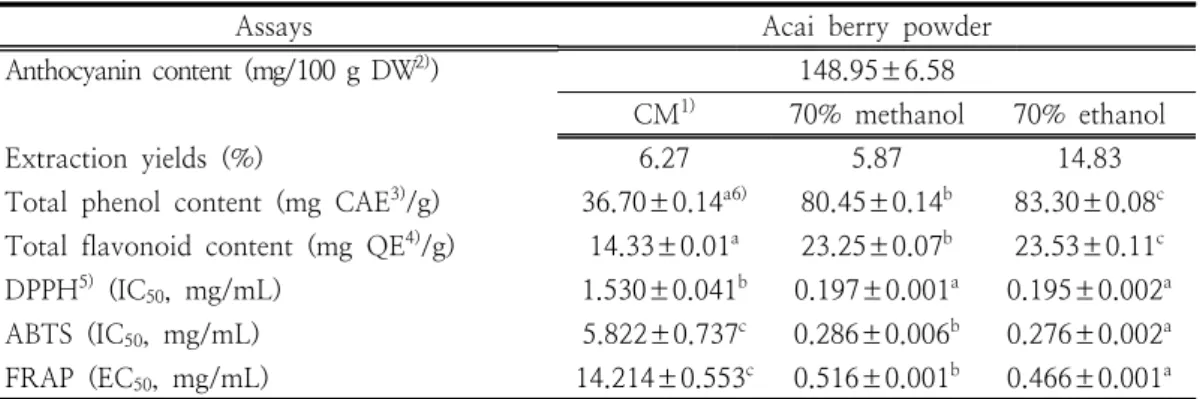
Assays Acai berry powder Anthocyanin content (mg/100 g DW2)) 148.95±6.58
CM1) 70% methanol 70% ethanol
Extraction yields (%) 6.27 5.87 14.83
Total phenol content (mg CAE3)/g) 36.70±0.14a6) 80.45±0.14b 83.30±0.08c Total flavonoid content (mg QE4)/g) 14.33±0.01a 23.25±0.07b 23.53±0.11c DPPH5) (IC50, mg/mL) 1.530±0.041b 0.197±0.001a 0.195±0.002a ABTS (IC50, mg/mL) 5.822±0.737c 0.286±0.006b 0.276±0.002a FRAP (EC50, mg/mL) 14.214±0.553c 0.516±0.001b 0.466±0.001a
1)CM: chloroform:methanol mixture (2:1, v/v). 2)DW: dry weight 3)CAE: caffeic acid equivalents.
4)QE: quercetin equivalents. 5)DPPH radical scavenging activity (DPPH), ABTS radical scavenging activity (ABTS), ferric reducing antioxidant power (FRAP). 6)The values are means±SD (n=3). Values with the different letters in the same row are significantly different (
p
<0.05) by Duncan`s multiple range tests.Table 1. Contents of anthocyanin, total phenol, flavonoid and IC50 values in the antioxidant activity evaluation assays of acai berry (
Euterpe oleracea
Mart.)2.9. Reducing power 측정
아사이 베리의 용매별 추출물에 따른 reducing power의 측정은 각 시료 추출 용액 1.0 mL 에 0.2 M sodium phosphate buffer (pH 6.6) 1.5 mL와 1% potassium ferrycyanide 1.0 mL를 넣 고 50℃의 water bath에서 20분간 반응 시켰다.
반응시킨 혼합액에 10% trichloroacetic acid 1.5 mL를 가하여 섞은 후 3,000 rpm에 10분간 원심 분리하여 분리된 상등액 1.0 mL를 증류수 3.0 mL 그리고 0.1% ferric chloride solution 0.2 mL와 잘 혼합시켜 10분 후 700 nm에서 흡광도 를 측정하였다[21].
2.10. 통계 처리
실험데이터는 3회 반복 측정하였으며, mean±SD (n=3)으로 표현하였다. 또한 실험 군 간의 유의적인 차이는 one-way ANOVA (analysis of variance)로 분석 한 뒤
p
<0.05 수준 에서 Duncan`s multiple range test에 의하여 각 농도 간의 유의성을 검증하였다. 통계처리에 대한 프로그램은 IBM SPSS statistic ver. 22를 사용하 였다.3. 결과 및 고찰
3.1. 수 율아사이 베리의 70% methanol과 70% ethanol 및 chloroform:methanol (CM, 2:1, v/v)의 추출 수율은 Table 1에 나타내었다. 각 용매별 추출 수율은 CM에서 14.83%로 가장 높게 나타났고, 70% methanol에서 6.27%, 70% ethanol에서 5.87% 순으로 나타났다.
3.2. Anthocyanin 함량
아사이 베리 분말의 anthocyanin 함량은 Table 1과 같이 148.95±6.58 mg/100 g DW (dry weight)로 나타났다. Anthocyanin은 적색과 자색 등의 색을 나타내는 과일이나 베리류에 있는 수 용성 천연 색소로 노화방지, 항암, 시력개선 등의 효과가 있는 것으로 알려져 있다[22]. 적치마 상 추 37.3±3.6 mg/100 g [23], 사과 껍질 26.8±6.5 mg/100 g [24]. 블루베리 종의 anthocyanin 함량을 비교한 연구에서는
Vaccinium corymbosum
L. (Northern Highbush) 129.2±3.2 mg/100 g,Vaccinium
corymbosum
L. (Southern Highbush) 92.6±4.6 mg/100 g,Vaccinium ashei
Reade (Rabbiteye)123.9±4.2 mg/100 g,
Vaccinium angustifolium
(Lowbush) 122.7±11.0 mg/100 g, 으로 나타났 다[25]. 따라서, 본 실험에서 아사이 베리의 anthocyanin 함량은 이보다 높은 것으로 확인되 었다.3.3. Total phenol 함량
아사이 베리의 용매별 추출물에서의 총 페놀 함 량은 Table 1에 나타내었으며 70% ethanol 추출 물에서 83.30±0.08 mg CAE/g으로 가장 높게 나왔고, 70% methanol에서 80.45±0.14 mg CAE/g, CM에서 36.67±0.14 mg CAE/g 순으 로 CM에서 가장 낮은 값이 나왔다. Phenol compound의 free radical 제거 능력은 방향족 고 리에 한 개 이상의 hydroxyl기가 있는 phenol 구 조를 가지고 있어 단백질 등 고분자 물질들과 쉽 게 결합하여 수소를 공여하기 때문에 항산화 능 력과 밀접한 관계가 있는 것으로 알려져 있다 [26]. 또한 오가자, 오디, 복분자 및 녹차의 에탄 올 추출물에서 total phenol 함량은 오가자 23.74 mg/g, 오디 20.74 mg/g, 복분자 26.08 mg/g, 녹 차 101.15 mg/g으로 보고되어 있다[27]. 본 연 구에서는 녹차의 추출물보다는 총 페놀 함량이 낮았지만, 녹차를 제외한 시료보다 아사이베리는 높은 총 페놀 함량을 가지고 있는 것으로 확인되 었다.
3.4. Flavonoid 함량
아사이 베리의 각 용매 추출물에서 flavonoid 함량은 Table 1에 나타내었으며, 70% ethanol 추출물에서 23.53±0.11 mg QE/g, 70%
methanol 추출물이 23.25±0.07 mg QE/g으로 비슷하게 나왔으나, CM 추출물에서는 14.33±
0.01 mg QE/g으로 total phenol 함량의 결과와 유사한 함량을 가지고 있는 것으로 측정 되었다.
산복사나무 열매[28]의 에틸아세테이트, 부탄올, 물 분획물이 244.5, 138.1, 5.8 mg/g, 복분자 [29]의 에틸아세테이트, 부탄올, 물 분획물이 77.9, 73.4, 22.7 mg/g의 flavonoid 함량을 가지 고 있다고 보고된바 있다. Flavonoid는 단백질과 상호작용으로 생리적 활성을 띠며, 세포신호전달 체계에 관여하는 인산화효소의 활성을 저해함으 로써 뉴런의 기능 조절, 암세포 전이 및 염증 반 응 억제 등의 효과를 보이는 것으로 보고되어 있 다[30].
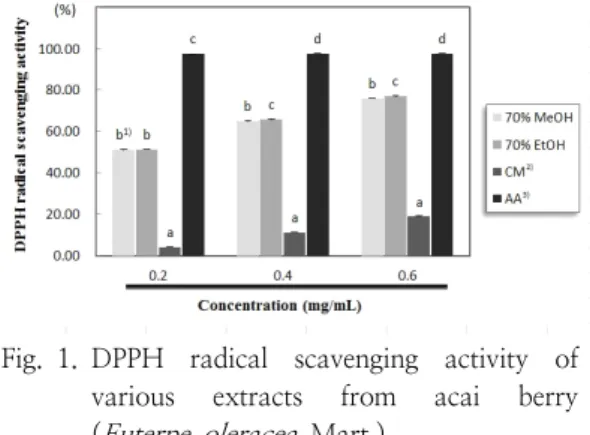
3.5. DPPH radical scavenging activity 아사이 베리의 각 용매별 추출물과 positive control인 ascorbic acid의 DPPH radical 소거능 을 각 농도별로 비교한 결과를 Fig. 1에 나타내었 고, IC50값을 구하여 Table 1에 나타내었다. 각 용매별 추출물을 0.2, 0.4, 0.6 mg/mL의 농도로 맞추어 측정한 결과 대조군인 ascorbic acid (97.47±0.00%, 97.61±0.00%, 97.61±0.00%)를 제외한 추출물에서 농도에따라 점차 유의적으로 radical 소거능이 증가하는 경향을 보였다. 70%
ethanol 추출물에서 농도별로 각각 51.36±
0.16%, 65.67±0.24%, 76.92±0.24%로 추출물 중에 가장 높은 항산화력을 보였으며, 70%
methanol 추출물이 51.08±0.16%, 64.92±
0.28%, 75.89±0.16%로 70% ethanol 추출물과 유사한 항산화력을 보였다. CM 추출물에서는 3.99±0.08%, 11.26±0.16%, 18.81±0.24%로 각 용매 추출물 중 가장 낮은 소거능을 보였다.
Fig. 1. DPPH radical scavenging activity of various extracts from acai berry (
Euterpe oleracea
Mart.).1)The values are means±SD (n=3). Bars with the different letters are significantly different (
p
<0.05) by Duncan`s multiple range tests.2)CM: chloroform:methanol mixture (2:1, v/v) extract. 3)AA: ascorbic acid.
IC50은 70% methanol 추출물과 70% ethanol 추 출물에서 각각 0.197±0.001, 0.195±0.002 mg/mL으로 유의적인 차이가 없이(
p
<0.05) 높은 free radical 소거능을 나타내었고, CM 추출물의 경우 1.530±0.041 mg/mL로 다른 추출물에 비 해 낮은 free radical 소거능을 나타내었다. 국내 산 거봉 포도[31]의 ethanol 및 chloroform 분획 물에서 DPPH radical 소거능의 IC50값은 과피 에서 각각 694.7, 4107.2 μg/mL이며 종자에서각각 136.7, 3502.5 μg/mL으로 과피와 종자 둘 다 극성인 ethanol 분획물에서 더 높은 DPPH radical 소거능을 나타내어 본 연구와 유사한 것 으로 나타났다. DPPH는 비교적 안정된 free radical을 가지고 용매에 녹았을 때 짙은 보라색 을 띄며, 항산화 능력을 가지고있는 물질과 반응 하였을 때 그 정도에 따라 점차 밝은 노란색으로 정색반응을 하는 특징이 있어 항산화 측정에 널 리 이용 된다[32].
3.6. ABTS radical scavenging activity 아사이 베리의 용매 농도별 추출물의 ABTS radical 소거능은 Fig. 2에 나타내었으며, 그 결과 에 의한 IC50값은 Table 1에 나타내었다. ABTS radical 소거능은 각 농도가 높아짐에 따라 유의 적으로 증가하였다(
p
<0.05). 그중 70% ethanol 추출물에서 농도별 37.29±0.32%, 63.96±0.21%, 79.20±0.21%, 70% methanol 추출물에 서 36.92±0.24%, 61.74±0.08%, 78.69±0.29%
로 70% ethanol 추출물의 소거능이 높게 나타났 다. CM 추출물은 농도별로 2.27±0.29%, 4.12±
0.24%, 7.18±0.28%로 추출물 중 낮은 소거능 을 보였다. 또한 IC50 값은 70% ethanol 추출물 이 0.276±0.002 mg/mL로 높은 소거능을 보였 고, 70% methanol 추출물이 0.286±0.006 mg/mL으로 높은 소거능을 가졌으나 CM 추출물 은 5.822±0.737 mg/mL로 낮은 소거능을 보였 다. DPPH는 free radical을 가지고 ABTS는 양이
Fig. 2. ABTS radical scavenging activity of various extracts from acai berry (
Euterpe oleracea
Mart.).1)The values are means±SD (n=3). Bars with the different letters are significantly different (
p
<0.05) by Duncan`s multiple range tests.2)CM: chloroform:methanol mixture (2:1, v/v) extract. 3)AA: ascorbic acid.
온 radical을 가지고 있어서 활성의 차이는 있지 만 DPPH radical 소거능과 ABTS radical 소거능 의 결과는 상관관계를 가지는 것으로 보고되고 있으며[33-34], 본 실험의 결과와 유사하게 나타 났다.
3.7. Ferric reducing antioxidant power (FRAP)
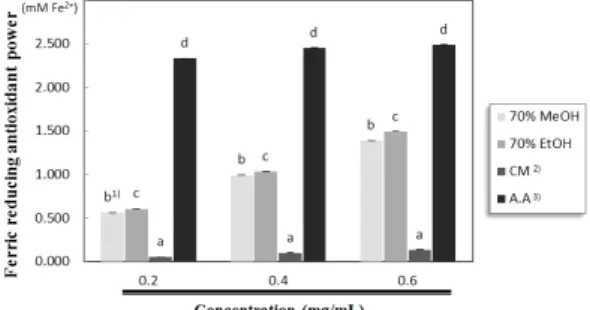
FRAP는 2,4,6-tripyridyl-S-triazine (TPTZ)이 Fe3+와 결합하여 황색의 Fe3+-TPTZ complex를 형성하여 낮은 pH에서 전자공여능이 있는 물질 과 만나면서 Fe2+-TPTZ로 환원되어 청색으로 변 하며, 변색의 정도는 물질의 전자공여능과 비례하 게 된다[35]. 이와 같은 원리로 분석한 아사이베 리의 각 추출물에 따른 FRAP 결과는 Fig. 3에 나타내었고, EC50(값은 Table 1에 나타내었다. 모 든 추출물에서 측정한 흡광도는 농도별로 유의적 인 차이가 있었고(
p
<0.05) 표준물질로 ferrous sulfate를 사용하여 측정한 흡광도를 검량선을 만 들어 환산한 결과 70% ethanol 추출물에서 각 농도별로 0.604±0.001, 1.035±0.001, 1.492±0.002 mM Fe2+로 유의적으로(
p
<0.05) 높게 나타 났으며, 70% methanol 추출물에서 0.562±0.001, 0.991±0.001, 1.389±0.001 mM Fe2+, CM 추출물은 0.049±0.001, 0.093±0.003, 0.136±0.002 mM Fe2+로 가장 낮은 것으로 나 타났고, IC50 또한 70% ethanol 추출물에서 0.466±0.001 mg/mL, 70% methanol 추출물에
Fig. 3. Ferric reducing antioxidant power of various extracts from acai berry (
Euterpe oleracea
Mart.).1)The values are means±SD (n=3). Bars with the different letters are significantly different (
p
<0.05) by Duncan`s multiple range tests.2)CM: chloroform:methanol mixture (2:1, v/v) extract. 3)AA: ascorbic acid.
서 0.516±0.001 mg/mL, CM 추출물에서 14.214±0.553 mg/mL 순으로 관찰되었다. 한편, 뉴질랜드 산 마누카꿀[36]은 0.760±0.081 mM Fe2+/100 g, 사과주스, 코코아음료, 토마토 쥬스 [37]가 각각 0.27, 0.37, 0.48 mM Fe2+/100 g 으로 보고된 것과 비교하였을 때 아사이베리의 항산화력이 매우 우수한 것으로 사료된다.
3.8. Reducing power
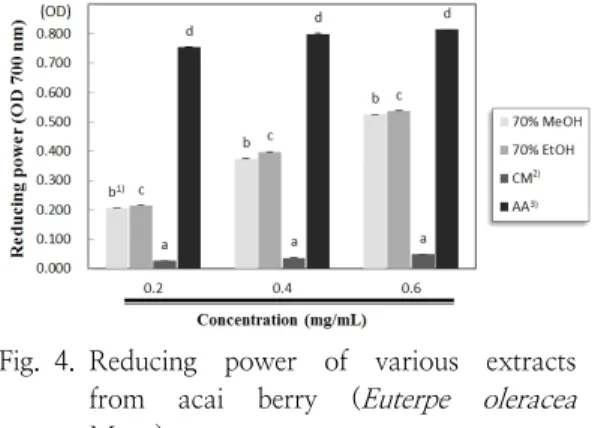
Reducing power의 결과는 Fig. 4에 나타내었 고, 각 용매별 추출물과 ascorbic acid의 농도가 증가함에 따라 유의적으로(
p
<0.05) 흡광도가 증 가하는 것을 보였다. 70% ethanol 추출물에서 각 농도별로 0.215, 0.398, 0.537로 높게 나타났으 며, 70% methanol 추출물에서 0.207, 0.375, 0.525로 높은 활성을 보였다. CM 추출물은 0.026, 0.037, 0.048로 항산화 활성 결과들과 마 찬가지로 낮은 흡광도의 경향을 보였다. 이에 따 라 total phenol, flavonoid 함량과 항산화 활성 이 상관관계가 있는 것을 추정할 수 있었으며, total phenol과 flavonoid 함량이 많을수록 높은 항산화 활성을 보인다는 보고와 유사한 것으로 나타났다[34].Fig. 4. Reducing power of various extracts from acai berry (
Euterpe oleracea
Mart.).1)The values are means±SD (n=3). Bars with the different letters are significantly different (
p
<0.05) by Duncan`s multiple range tests.2)CM: chloroform:methanol mixture (2:1, v/v) extract. 3)AA: ascorbic acid.
4. 결 론
아사이 베리(
Euterpe oleracea
Mart.)의 70%methanol, 70% ethanol, chloroform:methanol (CM, 2:1, v/v) 용매 추출물에서 생리활성물질 및 항산화 활성을 알아보고 아사이베리의 바이오 기능성 식품으로서의 가치를 검토하기 위하여 본 실험을 수행한 결과, 건조 아사이베리 분말에서 anthocynin 성분은 148.95±6.58 mg/100 g DW 로 높은 함량을 가지고 있는 것으로 확인 되었으 며, 각 용매별 추출물에 대하여 total phenol (36.70~83.30 mg CAE/g), flavonoid (14.33~
23.53 mg QE/g) 함량 및 DPPH 소거능, ABTS 소거능, FRAP 및 reducing power는 70%
ethanol≧70% methanol>CM 추출물 순으로 70% ethanol 추출물과 70% methanol 추출물에
서 높은 항산화력을 나타내었다. 또한
anthocyanin, phenolic compound, flavonoids 등 생리활성물질의 함량에 따라 항산화활성이 유의 적으로 증가되는 것으로 나타났다(
p
<0.05). 따라 서 본 연구 결과 아사이 베리의 70% ethanol과 70% methanol 추출물에서 높은 생리활성과 항 산화 활성을 가지고 있었으며 천연항산화 및 기 능성 소재로서 유용한 재료로 활용할 수 있을 것 으로 사료된다.감사의 글
이 논문은 부산대학교 기본연구지원사업(2년) 에 의하여 연구되었음.
References
1. Y. S. Choi, The study of quality characteristics of acaiberry (
Euterpe oleracea
Mart.) powder Sulgidduk,J.
Culinary Res.
, 21, 90 (2015).2. J. Kang, K. M. Thakali, C. Xie, M.
Kondo, Y. Tong, B. Ou, G. Jensen, M.
B. Medina, A. G. Schauss and X. Wu, Bioactivities of acai (
Euterpe precatoria
Mart.) fruit pulp, superior antioxidant and anti-inflammatory properties toEuterpe
oleracea
Mart,Food Chem.
, 133, 671(2012).
3. K. K. L. Yamaguchi, L. F. R. Pereira, C.
V. Lamarao, E. S. Lima and V. F. Veia, Amazon acai: Chemistry and biological activities: A review,
Food Chem.,
179, 137 (2015).4. S. Y. Wang and H. S. Lin, Antioxidant activity in fruits and leaves of blackberry, raspberry, and strawberry varies with cultivar and developmental stage,
J. Agric.
Food Chem.
, 48, 140 (2000).5. H. E. Seifried, D. E. Anderson, E. I. Fisher and J. A. Milner, A review of the interaction among dietary antioxidants and reactive oxygen species,
J. Nutr. Biochem.
, 18, 567 (2007).6. V. G. Grivennikova and A. D.
Vinogradov, Generation of superoxide by the mitochondrial Complex I,
Biochim.
Biophys. Acta Bioenerg.
, 1757, 553 (2006).7. H. Gao, D. Wang, S. Zhang, M. Xu, W.
Yang, P. Yan, Y. Liu, X. Luo, H. Wu, P. Yao, H. Yan and L. Liu, Roles of ROS mediated oxidative stress and DNA damage in 3-methyl-2-quinoxalin benzenevinylketo-1, 4-dioxide-induced immunotoxicity of Sprague–Dawley rats,
Reg. Toxicol. Pharmcol.,
73, 587 (2015).8. E. Menezes, R. Deliza, H. L. Chan and J.
X. Guinard, Preferences and attitudes towards acai-based products among North American consumers,
Food Res. Int.
, 44, 1997 (2011).9. S. Hogan, H. Chung, L. Zhang, J. Li, Y.
Lee, Y. Dai and K. Zhou, Antiproliferative and antioxidant properties of anthocyanin-rich extract from acai,
Food Chem.
, 118, 208 (2010).10. Schauss, A. G., Wu, X., Prior, R. L., Ou, B., Huang, D., Owens, J., et al..
Antioxidant capacity and other bioactivities of the freeze-dried Amazonian palm berry,
Euterpe oleraceae
Mart. (acai),J.
Agric. Food Chem.
, 54, 8604 (2006).11. R. B. Rodrigues, R. Lichtenthaler, B. F.
Zimmermann, M. Papagiannopoulos, H.
Fabricius, F. Marx, et al., Total oxidant scavenging capacity of
Euterpe oleracea
Mart. (acai) seeds and identification of their polyphenolic compounds,J. Agric.
Food Chem.
, 54, 4162 (2006).12. H. S. Kim, Y. Duan, M. A. Kim and S.
H. Jang, Contents of antioxidative components from pulpy and seed in wild haw (
Crataegus pinnatifida
Bunge),J.
Environ. Sci. Int.
, 23, 1791 (2014).13. Y. Wang, J. Zhu, X. Meng, S. Liu, J. Mu, C. Ning, Comparison of polyphenol, anthocyanin and antioxidant capacity in four varieties of
Lonicera caerulea
berry extracts,Food Chem.
, 197, 522 (2016).14. J. G. Kim, H. L. Kim, S. J. Kim and K.
S. Park, Fruit quality, anthocyanin and total phenolic contents, and antioxidant activities of 45 blueberry cultivars grown in Suwon, Korea,
J. Zhejiang University- Science B (Biomed. Biotechnol.),
14, 793 (2013).15. G. H. Kim, Y. Duan, S. C. Lee and H. S.
Kim, Assessment of antioxidant activity of garlic (
Allium sativum
L.) peels by various extraction solvents,J. Korean Oil Chem.
Soc.
, 33, 204 (2016).16. S. S. Hur, Evaluation of physiological activities of
Cnidium officinale
Makino extracts with different solvents,J. Korean Oil Chem. Soc.
, 32, 170 (2015).17. M. S. Blois, Antioxidant determinations by the use of a stable free radical,
Nature
, 181, 1199 (1958).18. A. Floegel, D. O. Kim, S. J. Chung, S. I.
Koo and O. K. Chun, Comparison of ABTS/DPPH assays to measure antioxidant capacity in popular antioxidant-rich US foods,
J. Food Compos. Anal.
, 24, 1043 (2011).19. J. Ortuño, R. Serrano, M. J. Jordán and S. Bañón, Relationship between antioxidant status and oxidative stability in lamb meat reinforced with dietary rosemary diterpenes,
Food Chem.
, 190, 1056 (2016).20. Y. Duan, G. H. Kim, J. H. Seong, H. S.
Chung and H. S. Kim, Antioxidant activities of n-butanol and ethyl acetate extracts from yam (
Dioscorea batatas
DECNE.).J. Korean Oil Chem.
, 32, 599 (2015).21. M. Singhal, A. Paul and H. P. Singh, Synthesis and reducing power assay of methyl semicarbazone derivatives,
J. Saudi Chem. Soc.
, 18, 121 (2014).22. A. Solomon, S. Golubowicz, Z. Yablowicz, S. Grossman, M. Bergman, H. E. Gottlieb, A. Altman, Z. Kerem and M. A.
Flaishman, Antioxidant activities and anthocyanin content of fresh fruits of common fig (
Ficus carica
L.),J. Agric.
Food chem.
, 54, 7717 (2006).23. W. S. Park, H. J. Kim, H. J. Chung, M.
S. Chun, S. T. Kim, S. Y. Seo, S. H.
Lim, Y. H. Jeong, J. W. Chun, S. K. An and M. J. Ahn, Changes in carotenoid and anthocyanin contents, as well as antioxidant activity during storage of lettuce,
J. Korean Soc. Food Sci. Nutr.
, 44, 1325 (2015).24. K. Wolfe, X. Wu and R. H. Liu, Antioxidant activity of apple peels,
J.
Agric. Food Chem.
, 51, 609 (2003).25. R. L. Prior, G. Cao, A. Martin, E. Sofic, J. McEwen, C. O`Brien, N. Lischner, M.
Ehlenfeldt, W. Kalt, G. Krewer and C. M.
Mainland, Antioxidant capacity as influenced by total phenolic and anthocyanin content, maturity, and variety of
Vaccinium
species,J. Agric. Food Chem.
, 46, 2686 (1998).26. R. J. Robbins, Phenolic acids in foods: an overview of analytical methodology,
J.
Agric. Food Chem.
, 51, 2866 (2003).27. J. H. Lee, Y. Kim, S. Lee and S. H. Yoo, Conditions for obtaining optimum polyphenol contents and antioxidant activities of korean berry and green tea extracts,
Korean J. Food Sci. Technol.
, 46, 410 (2014).28. W. B. Kim, S. H. Park, H. S. Hwang, J.
Y. Woo, H. R. Lee, D. Y. Hwang, J. H.
Choi and H. S. Lee, Antioxidative activities and whitening effects of solvent fraction from
Prunus davidiana
(Carriere) Franch. fruit,J. Korean Soc. Food Sci.
Nutr.
, 41, 1363 (2012).29. W. G. Cho, S. K. Han, J. H. Sin and J.
W. Lee, Antioxidant of heating pork and antioxidative activities of
Rubus coreanus
Miq. extracts,J. Korean Soc. Food Sci.
Nutr.
, 37, 820 (2008).30. Y. L. Han, S. Y. Lee, J. H. Lee and S. J.
Lee, Cellular flavonoid transport mechanisms in animal and plant cells,
Korean J. Food Sci. Technol.
, 45, 137 (2013).31. S. J. Park and D. H. Oh, Free radical scavenging effect of seed and skin extracts of black olympia grape (
Vitis labruscana
L.),Korean J. Food Sci.
Technol.
, 31, 121 (2003).32. M. Kumar, K. Sharma, R. M. Samarth and A. Kumar, Synthesis and antioxidant activity of quinolinobenzothiazinones,
European J. Med. Chem.
, 45, 4467 (2010).33. H. Lou, Y. Hu, L. Zhang, P. Sun and H.
Lu, Nondestructive evaluation of the changes of total flavonoid, total phenols, ABTS and DPPH radical scavenging activities, and sugars during mulberry (
Morus alba
L.) fruits development by chlorophyll fluorescence and RGB intensity values,Food Sci. Technol.
, 47, 19 (2012).34. P. C. Wootton, A. Moran and L. Ryan, Stability of the total antioxidant capacity and total polyphenol content of 23 commercially available vegetable juices before and after in vitro digestion measured by FRAP, DPPH, ABTS and Folin-Ciocalteu methods,
Food Res. Int.
, 44, 217 (2011).35. K. I. Berker, K. Guclu, I. Tor and R.
Apak, Comparative evaluation of Fe(III) reducing power-based antioxidant capacity assays in the presence of phenanthroline, batho-phenanthroline, tripyridyltriazine (FRAP), and ferricyanide reagents,
Talanta
,72, 1157 (2007).
36. A. S. Amparo, T. Bolanos, H. Terence, S.
N. Poonam and K. O. A. Richard, A universally calibrated microplate ferric reducing antioxidant power (FRAP) assay for foods and applications to Manuka honey.
Food Chem.,
174, 119 (2015).37. M. H. Carisen, B. L. Halvorsen, K. Holte, S. K. Bohn, S. Dragland, L. Sampson, C. Willey, H. Senoo, Y. Umezono, C.
Sanada, I. Barikmo, N. Berhe, W. C.
Willett, K. M. Phillips, D. R. Jacobs and R. Blomhoff, The total antioxidant content of more than 3100 foods, beverages, spices, herbs and supplements used worldwide,