Alteration in Phenolic Compounds and
Antioxidant Activities of Aronia melanocarpa Ethanol Extracts following Fermentation Using Different Strains of Leuconostoc mesenteroides to
Develop Natural Antibiotic Alternative
1)
Hwang, Joo Hwan*․Kang, Ju Hui*․Lee, Ki Hwan*․Lee, Jae Hoon*․
Lee, Sang Moo*․Kim, Nam Hyung**․Kim, Joo Young***․Kim, Eun Joong****
항생제 대체 천연물질을 위한 아로니아 주정 추출물 개발에 있어 다양한 Leuconostoc mesenteroides 균주를 이용한 발효가
페놀계 화합물 및 항산화활성 변화에 미치는 영향
황주환․강주희․이기환․이재훈․이상무․김남형․김주영․김은중
Antioxidant activity is important for reducing oxidative stress that causes various metabolic disorders. Metabolic disorders are highly related to loss of productivity in livestock. Therefore, development of effective antioxidant compounds originating from plants is important for organic agriculture. Phenolic compounds in edible plants are regarded as major components relevant to antioxidant activity. The present study investigated the changes in antioxidant activity and phenolic compound profiles of Aronia (Aronia meloncarpa) by fermentation using different strains of Leuconostoc mesenteroides. A total of 5 strains of L. mesenteroides were used as starter cultures and their β-glucosidase activities were measured. A total of 6 experiment runs were prepared, one for control (uninoculated) and the others (inoculated) for treatments. For biological activity, antioxidant and antibacterial activities were measured. For phenolic compound profiling, TLC and HPLC analysis were performed. The strains of KACC12313 and KACC12315 showed
* 경북대학교 축산학과 ** ㈜칼스
*** Corresponding author, 상주시농업기술센터([email protected])
**** Corresponding author, 경북대학교 축산학과([email protected])
greater enzyme activity than others. Treatment with KCCM35046 showed strong and broad antibacterial activity against to Listeria monocytogenes. Treatments with KCCM35046 and KACC12315 showed the highest total polyphenol content. The highest antioxidant activity was found in KACC12315 treatment. No remarkable alteration was found in thin layer chromatography (TLC) analysis. In phenolic compound profiling analysis, KCCM35046 showed notable alteration in compound area ratio compared to others and also showed the highest caffeic acid content. In chlorogenic acid, treatments with KCCM35046 and KACC12315 showed great content than others. Treatment with KACC12315 showed the greatest content of trans-ferulic acid. As a result of relative performance indexing analysis, L.
mesenteroides KCCM35046 and KACC12315 were selected as the best strain for
the fermentation of Aronia.
Key words : aronia meloncarpa, leuconostoc mesenteroides, fermentation, phenolic
substance, antioxidantⅠ. Introduction
Phenolic compounds present in edible plants contain various molecules that possess a benzene ring in their structures. Numerous groups are classified based on a number of phenol rings and structural elements associated to the phenol ring. Most of these molecules originate from secon- dary metabolites that are produced by plants to protect themselves against ultraviolet radiation and pathogens (Manach et al., 2004). Traditionally, phenolic compounds were considered as undesirable materials in nutrition since they influenced negatively on nutrient digestion, vitamin and mineral uptake. Recently, however, scientists have reignited an interest in phenolic compounds due to their antioxidant activity (Rodríguez et al., 2009). Antioxidant activity can be defined as a mechanism that scavenges reactive oxygen species (ROS) in the body. The animal body produces ROS unless there is continuing metabolism consuming oxygen. The superoxide radical, hydroxyl radical and hydrogen peroxide are representative examples of ROS. Although ROS in small amounts can be beneficial in growth regulation, an oxidative stress by ROS in large amounts can cause various metabolic disorders (Atmani et al., 2009). Oxidative stress brings about loss of productivity in livestock, for example, ROS increases enzyme matrix metalloproteinase-2 (MMP2) activity and reduces collagen synthesis in beef cattle. Consequently, reduced synthesis of new collagen in intramuscular fibroblast induces meat toughness (Archile- Contreras and Purslow, 2011). Therefore, development of phenolic compounds of plant origin showing effective antioxidant properties is important in organic agriculture.
As mentioned earlier, phenolic compounds have a property to control the aggression by
pathogens. Various lactic acid bacteria have been known to be involved in spontaneous fermentation of edible plants. The reason why lactic acid bacteria can survive in plant material where a large amount of phenolic compounds is present can be found in the biological alteration of phenolic compounds by lactic acid bacteria. The alteration of phenolic compounds can be caused by the action of several enzymes such as β-glucosidase, tannase, phenolic acid decar- boxylase and esterase (Rodríguez et al., 2009). Therefore, intensive alteration of phenolic com- pounds through treatments by these enzymes or the fermentation of lactic acid bacteria that can produce these enzymes can be utilized as a way to improve biological activity of plant material.
Aronia (Aronia melanocarpa) fruit is known as black chokeberry and a plant source rich in phenolic substance. Its extract has numerous health benefits such as cardioprotective, anti- diabetic and hepatoprotective through the function of antioxidant, antimicrobial and antimutagenic activities (Kim et al., 2013; Malinowska et al., 2012).
This study hypothesized that when Aronia is fermented by L. mesenteroides, the β- glucosidase-producing lactic acid bacteria, phenolic compounds can be altered and thus improve its biological activity. And different strains of L. mesenteroides can show different degree of alteration, even they are in same species. The present study investigated antioxidant activity and antibacterial activity of fermented Aronia with different strains of L. mesenteroides and conducted profiling analysis of phenolic compounds.
Ⅱ. Materials and Methods
1. Chemicals and plant
Chemicals and medium used in this study were purchased from Sigma Aldrich (Sigma Aldrich Korea) and Difco (Becton, Dickinson and Company, New Jersey, USA), respectively, unless otherwise stated. Aronia fruit was purchased at local market (Sangju city, Gyeongsangbuk-do, Korea).
2. Bacteria
Five strains of L. mesenteroides and four pathogenic bacteria were used. L. mesenteroides
used were defined based on their strain identification code. L. mesenteroides KCCM35046 and
KCTC3100 strains were purchased at Korean Culture Centre of Microorganism (Seoul, Korea)
and Korean Collection for Type Cultures (Daejeon, Korea), respectively. L. mesenteroides KACC12312, KACC12313 and KACC12315 were purchased at RDA-Genebank Information Centre (Jeonju, Korea). Pathogens used were Staphylococcus aureus (wild type), Listeria mono- cytogenes (KACC0550), Salmonella gallinarum (ATCC9184) and Mannheimia haemolytica (wild type).
3. Culture condition
Aronia broth was prepared using Aronia juice and MRS broth. Briefly, Aronia fruit without stem was ground using cutter miller (Philips, Netherland) and then 10 g of juice were added to sterilized 90 mL of 50% MRS broth (v/v). Starter cultures of L. mesenteroides were maintained using MRS medium and incubated at 30℃. Pathogenic bacteria were maintained using LB medium and incubated at 37℃. Shaking (150 rpm) was employed for liquid cultivation. Starter cultures were inoculated in prepared Aronia broth at 10% ratio (v/v) and fermentation was performed at 30℃ with shaking (80 rpm) for 48 h.
4. Preparation of fermented Aronia ethanol extract
After fermentation, 1 mL of broth was taken for viable cell count and organic acid analyses, and the remaining broth was poured into a glass beaker. The broth was then dried overnight at 60℃ and ground using a pestle and mortar. Dried broth powder was then mixed with 10 times volume of ethanol and extraction was performed overnight at room temperature with shaking (80 rpm). Solid particles in extraction solution were separated through filter paper (Whatman No. 1) and filtrate was concentrated using rotary evaporation system (N-1110, EYELA, Japan). Finally, concentrated filtrate was rehydrated using 10 mL of absolute ethanol and stored in refrigerator until analysis.
5. Experimental design
A total of 6 experimental runs were prepared. The control was not inoculated; for spontaneous fermentation of Aronia and treatments were fermented Aronia with different strains of L.
mesenteroides: treatment 1, KCCM35046; treatment 2, KCTC3100; treatment 3, KACC12312;
treatment 4, KACC12313; and treatment 5, KACC12315.
6. Enzyme activity
β-Glucosidase activity of starter culture was measured by colorimetric analysis. Prepared seed culture and p-nitrophenyl-β-D-glucoside were used enzyme solution and substrate, respectively.
Enzyme assay was performed according to method described in Kim et al. (2007). Enzyme activity Unit was defined as µM of liberated p-nitrophenly during 1 min by 1 turbidity of enzyme solution that measured at 600 nm.
7. Organic acids
Organic acids in fermentation broth were measured using HPLC (Agilent 1100 series, CA, USA) equipped with DAD detector and auto-sampling system. Lactic acid (D and L forms), acetic acid, propionic acid and butyric acid were separated using a column (RezexTM ROA- Organic Acid H+) (Phenomenex, part no 00H-0138-KO). The conditions for separation were, 0.005 N H
2SO
4was used as the mobile phase with 0.6 mL/min flow rate. Separation was performed at room temperature and peaks were detected at 220 nm.
8. Cell yield
Cell yield was determined using viable cell count analysis. The culture broth was serially diluted with sterilized 0.8% NaCl solution until dilution rate reached to 10
7. The diluted solution was spread onto MRS plate medium and then incubated at 30℃ until colonies were visible.
Colony counts on each plate were recorded.
9. Total polyphenol content and antioxidant activity
Total polyphenol concentration in extract was determined according to Juan and Chou (2010) using gallic acid as the standard. Antioxidant activity was measured through determination of free radical scavenging activity. 2,2-Diphenyl-1-picrylhydrazyl (DPPH) was used as free radical and scavenging degree was measured colorimetrically according to Brand-Williams et al. (1995).
Antioxidant activity was calculated as following equation;
Free radical scavenging activity, % = (Black OD
525- Sample OD
525)/Blank OD
525․ 100
10. TLC-DPPH assay
TLC-DPPH analysis was employed to investigate alteration of substance relevant to antioxi- dant activity in extract. Silica gel F254 (Silica gel 60 F254, Merck) was used for separation. For eluent system, three different eluents were prepared as following: EMW (for polar/neutral), ethyl acetate/methanol/water = 40/5.4/5 (80 mL/10.8 mL/10 mL); CEF (for intermediate polarity/acidic), chloroform/ethyl acetate/formic acid = 5/4/1; BEA (for non-polar/basic): benzene/ethanol = 90/
10/1. Separated spots that related to antioxidant activity were visualized by staining with 0.2%
DPPH solution (w/v in methanol). All procedures were performed according to the method described by Masoko and Eloff (2007).
11. Total polyphenol profiling
Profile of phenolic compounds was determined using HPLC (Agilent 1100 series, CA, USA) equipped with DAD detector and auto-sampling system according to Ghasemzadeh and Jaafar (2013). Two mobile phases were prepared and phase (A) was consisted of 2% acetic acid (v/v in 3
rdlayer distilled water) and phase (B) was consisted of 0.5% acetic acid (v/v in 3
rdlayer distilled water)-acetonitrol (50:50, v/v). Gradient elution was employed as following program: 0 min, 95 (A): 5 (B); 10 min, 90:10; 40 min, 60:40, 55 min, 45:55; 60 min, 20:80; and 65 min, 0:100.
12. Relative performance indexing
To summarize different biological activities from treatments and construct index to select the best strain, relative performance indexing was performed using standardization with normal standard distribution. Results from total polyphenol content, antioxidant activity and antibacterial activity were standardized by following equation.
RPI = (A - µ) / σ + 3 (N~3, 1)
where, A is observed data of biological activity and µ and σ are mean and standard deviation
of activity A, respectively.
13. Statistical analysis
Statistical analysis of results was performed using general linear model (GLM), and Duncan’s multiple range test was conducted when P<0.05 was declared. SPSS program (version 18, IBM, USA) was used for statistical analysis.
Ⅲ. Results and Discussion
1. Enzyme activity
Alteration of phenolic substances in plants is reported to be achieved by the action of several bacterial enzymes such as decarboxylase, tannase, reductase, benzyl alcohol dehydrogenase and β-glucosidase (Rodríguez et al., 2009). In this study, β-glucosidase activity from used strains of L. mesenteroides was examined and the result is presented in Fig. 1. A significantly higher enzyme activity was found in treatment 4 (P<0.05).
Fig. 1. β-Glucosidase activities of different L. mesenteroides strains. One unit of enzyme activity was defined as µM of liberated p-nitrophenyl during one minute by one turbidity of cell measured at 600 nm
abc
Different superscripts mean significantly different (P<0.05).
2. Cell yield
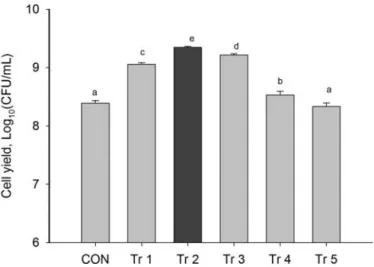
Bacterial cell yields from the control group and treatments are shown in Fig. 2. All treatments showed bacterial cell growth above 10
8CFU/mL. The significantly greatest cell growth was detected in treatment 2 (P<0.05). Interestingly, even control (CON), where no starter culture was inoculated, showed cell growth. As mentioned in the methodology, the medium that contained squeezed Aronia was not sterilized before fermentation. It was speculated that epiphytic bacteria on the surface of Aronia induced spontaneous fermentation.
Fig. 2. Cell yield from fermentation or Aronia with different strains of L. mesenteroides Experimental runs: CON, un-inoculated Aronia; Tr 1, fermented by L. mesenteroides KCCM
35046; Tr 2, fermented by L. mesenteroides KCTC3100; Tr 3, fermented by L. mesenteroides KACC12312; Tr 4, fermented by L. mesenteroides KACC12313; Tr 5, fermented by L.
mesenteroides KACC12315. abcde
Different superscripts mean significantly different (P<0.05).
3. Organic acid production
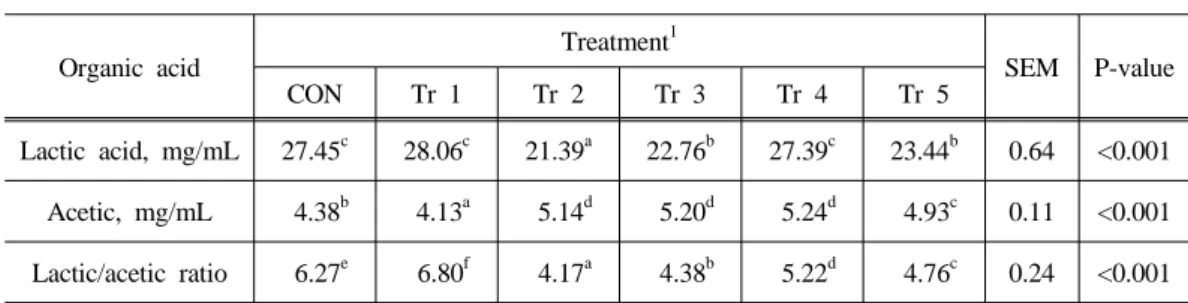
Observed organic acid concentrations are shown in Table 1. Lactate, acetate, propionate and butyrate were investigated and only lactate and acetate were detected in control and treatments.
Significantly higher lactic acid concentrations were found in the control and treatment 1 (P<
0.05). Treatment 2 showed the lowest production of lactic acid (P<0.05). However, treatment 2
showed greater acetic acid production (P<0.05) when compared with other treatments. Although
the same species of lactic acid bacteria were used, organic acid production showed different
patterns among treatments. This may mean that bacteria, even of the same species, can differ in metabolic activity. L. mesenteroides is a hetero-lactic fermentation bacterium that produces many different organic acids including lactic acid. Lactic acid is regarded as an important acid during the ripening process of fruits and acetic acid is important for acquisition of aerobic stability after completion of ripening process since it has stronger anti-microbial activity than the lactic acid (Keles, G. & Demirci, 2011).
Table 1. Lactic and acetic acid productions in Aronia fermentation broth
Organic acid
Treatment
1SEM P-value
CON Tr 1 Tr 2 Tr 3 Tr 4 Tr 5
Lactic acid, mg/mL 27.45
c28.06
c21.39
a22.76
b27.39
c23.44
b0.64 <0.001 Acetic, mg/mL 4.38
b4.13
a5.14
d5.20
d5.24
d4.93
c0.11 <0.001 Lactic/acetic ratio 6.27
e6.80
f4.17
a4.38
b5.22
d4.76
c0.24 <0.001
1
Treatment: CON, control (non-inoculated Aronia); Tr 1, fermented by L. mesenteroides KCCM 35046; Tr 2, fermented by L. mesenteroides KCTC3100; Tr 3, fermented by L. mesenteroides KACC12312; Tr 4, fermented by L. mesenteroides KACC12313; Tr 5, fermented by L. mesenteroides KACC12315.
abcdef
Different superscripts in same row mean significantly different (P<0.05).
4. Biological activity
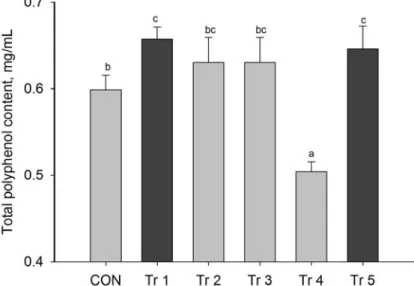
Total polyphenol contents in treatments are shown in Fig. 3. Significantly greater contents of
polyphenol were found in treatment 1 and 5 (P<0.05). Reported polyphenol concentrations from
Aronia are different among studies. The concentration of total polyphenol is about 7 mg/L (Kim
et al., 2013, Malinowska et al., 2012). In this study, Aronia was included at 10% in the
medium, hence detected total polyphenol concentration was comparable. Antibacterial activities
of treatments were summarized in Table 2. Free radical scavenging activities from treatments are
represented in Fig. 4. The greatest antioxidant activity and total polyphenol content were
detected in treatment 5. Interestingly, even though treatment 4 showed the lowest total
polyphenol (P<0.05), its antioxidant activity was high next to treatment 5. Total polyphenol
content and antioxidant activities among treatments showed significantly different patterns
suggesting a remarkable alteration of compounds. However, no notable alteration of compounds
related to antioxidant activity were observed (Fig. 5A~5C). The results of chromatography that
visualized by UV irradiation showed different spot patterns. Detected spots at Rf 0.4, 0.5 and
0.8 in EMW elution system showed different patterns among treatments (Fig. 5D). Different spot
patterns were also found in CEF elution system at Rf 0.25 (Fig. 5E). Compound separation was not properly performed in elution system of BEA (Fig. 5F).
Fig. 3. Effect of different L. mesenteroides strains on total polyphenol content in inocul- ated and un-inoculated Aronia
Experimental runs: CON, un-inoculated Aronia; Tr 1, fermented by L. mesenteroides KCCM 35046; Tr 2, fermented by L. mesenteroides KCTC3100; Tr 3, fermented by L. mesenteroides KACC12312; Tr 4, fermented by L. mesenteroides KACC12313; Tr 5, fermented by L. mesen-
teroides KACC12315. abcDifferent superscripts mean significantly different (P<0.05).
Table . Effect of different L. mesenteroides strains on the antibacterial activity of fer- mented and non-fermented Aronia against animal pathogenic bacteria
Pathogenic bacteria
Treatment
1CON Tr 1 Tr 2 Tr 3 Tr 4 Tr 5
Staphylococcus aureus
ND ND ND ND ND ND
Listeria monocytogenes
ND 10 10 ND 11 12
Mannheimia haemolytica
15 14 ND ND ND ND
Salmonella gallinarum
ND ND ND ND ND ND
1
Treatment: CON, control (non-inoculated Aronia); Tr 1, fermented by L. mesenteroides KCCM 35046; Tr
2, fermented by L. mesenteroides KCTC3100; Tr 3, fermented by L. mesenteroides KACC12312; Tr 4,
fermented by L. mesenteroides KACC12313; Tr 5, fermented by L. mesenteroides KACC12315.
Fig. 4. Effect of different L. mesenteroides strains on antioxidant activities of inoculated and un-inoculated Aronia
Experimental runs: CON, un-inoculated Aronia; Tr 1, fermented by L. mesenteroides KCCM 35046; Tr 2, fermented by L. mesenteroides KCTC3100; Tr 3, fermented by L. mesenteroides KACC12312; Tr 4, fermented by L. mesenteroides KACC12313; Tr 5, fermented by L. mesen-
teroides KACC12315. abcdDifferent superscripts mean significantly different (P<0.05).
Fig. 5. TLC-DPPH analysis of Aronia extract
Plate A to C: Stained by DPPH solution. Plate D to E: Visualized by UV exposure (245 nm).
Line 1, control (un-inoculated Aronia); Line 2, treatment 1 (fermented by L. mesenteroides KCCM
35046); Line 3, treatment 2 (fermented by L. mesenteroides KCTC3100); Line 4, treatment 3
(fermented by L. mesenteroides KACC12312); Line 5, treatment 4 (fermented by L. mesenteroides
KACC12313); Line 6, treatment 5 (fermented by L. mesenteroides KACC12315).
5. Phenolic compound profiling
The present study profiled phenolic compounds in treatment by calculation of area percentages of detected total peaks. The results are shown in Fig. 6. Remarkable change of compound content ratio was found in treatment 2. Three phenolic compounds, caffeic acid, chlorogenic acid and trans-ferulic acids, were measured. Treatment 1 elevated the concentration of caffeic acid and chlorogenic acid than the control (P<0.05) (Fig. 7A and 7B). Treatment 5 showed signifi- cantly increased concentration of chlorogenic and trans-ferulic acid concentrations than the con- trol (P<0.05) (Fig. 7B and 7C).
Fig. 6. Area percentage of detected substance peak from treatment
Fig. 7. Content of caffeic acic (A), chlorogenic acid (B) and trans-ferulic acid (C) in treatments
6. Relative performance indexing
Significantly different results in biological activity by same species of L. mesenteroides were
detected through various analyses. Some treatments were reduced and some were elevated in activity compared to the control where there was spontaneous fermentation. Therefore, the present study applied statistical calculation to deduce the most effective starter culture strain in order to enhance biological activity of Aronia ethanol extract. The result of relative performance indexing is summarized in Table 3. Two strains, L. mesenteroides KCCM35046 and L. mesen- teroides KACC12315 showed significantly strong performances (P<0.05).
Table 3. Relative performance index value of treatment
Treatment
1SEM P value
Tr 1 Tr 2 Tr 3 Tr 4 Tr 5
RPI
210.48
c8.60
b7.09
a7.36
a11.11
c0.46 <0.001
1
Treatment: Tr 1, fermented by L. mesenteroides KCCM 35046; Tr 2, fermented by L. mesenteroides KCTC3100; Tr 3, fermented by L. mesenteroides KACC12312; Tr 4, fermented by L. mesenteroides KACC12313; Tr 5, fermented by L. mesenteroides KACC12315
2
RPI: relative performance index was calculated with standardized values of antioxidant activity, antibac- terial activity and total polyphenol content from each treatment.
abc
Different superscripts in same row mean significantly different (P<0.05).
Ⅳ. Conclusion
The present study was conducted to investigate the alteration of phenolic substance and biological activity of Aronia ethanol extract by different strains of L. mesenteroides. All strains of L. mesenteroides showed proper growth in the medium containing Aronia juice. Biological activities and content of phenolic substance were altered by fermentation. Most effective strains for the fermentation of Aronia in order to enhance biological activity was detected as L.
mesenteroides KCCM35046 and KACC12315.
Ⅴ. Acknowledgement
This research was supported by Kyungpook National University Research Fund, 2012, and
also partly supported by Bio-industry Technology Development Program (312030-4), Ministry of
Agriculture, Food and Rural Affairs.
[논문접수일 : 2014. 11. 6. 논문수정일 : 2014. 11. 7. 최종논문접수일 : 2014. 11. 11.]
References