—
303
—INTRODUCTION
Many fish use the coastal areas as feeding and nursery grounds, including economically important fishes. Fish assemblage in the coastal waters, especially those com- posing commercial and recreational fish, has been wide- ly studied (Jenkins and Wheatley, 1998; Lazzari et al., 1999; Guidetti, 2000; Paperno et al., 2001; Kwak and Klumpp, 2004). Seasonal variation in species composi- tion and abundance of fish in the coastal waters of Korea have been studied using samples obtained by a small trawl (Cha and Park, 1997; Huh and Kwak, 1998a; Lee and Gil, 1998; Huh and Chung, 1999; Huh and An, 2000; Oh, 2003), gill net (Kim and Kang, 1991; Hwang et al., 1997; Cha, 1999; Han et al., 2002), crab pots (An and Huh, 2002), and set nets (Huh and Kwak, 1998b;
Lee, 1998; Hwang, 1998; Hwang et al., 1998; An and Huh, 2002; Huh and An, 2002; Hwang et al., 2006).
The coastal area off Namhae Island is relatively shal- low and eelgrass meadows are frequently found. This water provides a habitat for variety of invertebrates and small fishes, which in turn are the potential food of large
predators including commercially important fish. The studies on fish assemblages in this water to date have been concentrated on community structure using sam- ples with small trawls and winged stow nets on anchors (Huh and Kwak, 1997, 1998a; Hwang, 2007). However, little is known about the fish assemblage catchable by the fyke net although this net is one of the widely used fishing gears in the region especially in the rocky areas.
A few studies have been conducted on fish assemblages with using fyke nets around Korean peninsular. These were included studies on the fluctuation in species com- position and abundances of fishes in the coastal off Ga- deok-Do, and Dol-san, Yeosu, in Korea (Huh and An, 2002; Jeong et al., 2005).
The objective of this study was to examine the sea- sonal variation in species composition and abundance of fishes with a both sides fyke net in the coastal water off Namhae Island, Korea and to determine the relation- ship between environmental factors and fish abundance.
MATERIALS AND METHODS
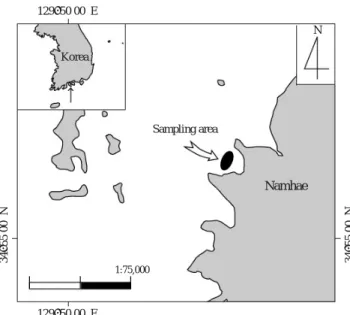
Fish samples were monthly collected by a fyke net in the water off Namhae Island in 2006 (Fig. 1). The sam-
Seasonal Variation in Species Composition and Abundance of Fish Assemblage in the Coastal Water off Namhae Island
By Seok Nam Kwak, Sung-Hoi Huh 1, * and Ha Won Kim 1
Marine Eco-Technology Institute Co., Ltd., Busan 608-830, Korea
1
Department of Oceanography, Pukyong University, Namgu, Busan 608-737, Korea
ABSTRACT Seasonal variation in species composition and abundance of fishes was determined using monthly samples collected by a fyke net in coastal waters off Namhae Island in 2006. The sampling gear, both-side fyke net, is a widely used commercial fishing gear in shallow waters of the region. A total of 89 fish species was collected, the dominant species were Konosirus punctatus, Mugil cephalus, Lateola- brax japonicus, Acanthopagrus schlegeli, Sebastes inermis, Nibea mitsukurii, Clupeapallasii, Pampus echinogaster, Sebastes schlegeli and Limanda yokohamae. They accounted for 61.1% of the total num- ber of individuals and 80.3% of the biomass. The dominant species were primarily composed of small individuals or juveniles of large-sized fishes. Abundance in the number of individuals and biomass showed peaks in April, May and September, and was lowest in January. Temporal change in fish abun- dance was related to the temperature and related factors.
Key words : Both sides fyke net, fish assemblage, Namhae Island
*Corresponding author: Sung-Hoi Huh Tel: 82-51-629-6570, Fax: 82-51-629-6565, E-mail: [email protected]
Accepted : December 26, 2008
http://www.fishkorea.or.kr
pling gear used, a both-side fyke net, was 12 m long, and two rectangular steel frames of 90 cm wide and 75 cm high with 4 steel hoops in both sides. The stretched mesh size was 7 mm and fishes were collected by two nets on each sampling times. Samples were preserved immediately in 10% formalin after capture and later transferred to 70% isopropanol. The specimens were identified according to Masuda et al. (1984), Yoon (2002) and Kim et al. (2005). Fish were measured to the near- est mm (standard length SL) and weighed to the nearest gram in wet weight. Water temperature and salinity were measured in each sampling occasion.
The diversity index H ′ (Shannon and Weaver, 1949) was calculated as:
H ′= =-∑(n
i/N) log (n
i/N)
where n
iis the number of individuals of each i species in a sample and N is the total number of individuals.
Association of fish species, Pianka’s similarity index (Pianka, 1973), A
ijwas calculated as:
A
ij= =[ ∑p
ihp
jh]/[ ∑p
2ih∑p
2jh]
where A
ijis the similarity of species j on species i; p
ihis the proportion of individuals of i in a particular month h; p
jhis the proportion of individuals of j in a particular month h. The Pianka’s similarity index was subjected to an average linkage cluster analysis.
A one-way ANOVA with orthogonal design was used to analyze variations in fish abundance and environ- mental factors with month. The relationships between fish abundance and environmental factors were analyzed using Pearson’s correlation coefficient.
RESULTS
1. Temperature and salinity
Water temperature was low in winter showing a mini- mum of 9.8� C in February, and raised showing a peak of 29.8� C in August (Fig. 2). Salinity ranged from 27.9‰
to 33.3‰ and did not vary greatly, but it dropped to about 27.9‰ in July.
2. Fish species composition
A total of 4,334 fish belonging to 89 species were col- lected during the study (Table 1). Numerically dominant fish were Konosirus punctatus (15.3%), Mugil cephalus (11.1%), Lateolabrax japonicus (7.3%), Acanthopagrus schlegeli (5.9%), Sebastes inermis (5.4%), Nibea mitsu- kurii (4.4%), Clupea pallasii (3.4%), Pampus echino- gaster (3.1%), Sebastes schlegeli (2.6%), and Limanda yokohamae (2.6%), together accounting for 61.1% of the catch. The numerically dominant fish species made up 80.3% of biomass because of the presence of large M.
cephalus (35.4% of biomass) which were high in bio- mass.
The size distributions of principal fish species were depicted in Fig 3. The size ranged 14.1~19.0 cm SL for K. punctatus and 20.1~50.0 cm SL for M. cephalus, L.
japonicus occurred in size ranged from 10.1~25.0 cm SL with peak numbers in 12.1~15.0 cm SL. The frequ- ency was high in size range of 19.1~20.0 cm SL for A.
schlegeli, 10.1~11.0 cm SL for S. inermis, 23.1~24.0 cm SL for N. mitsukurii, 20.1~21.0 cm SL for C. pal- lasi, 14.1~15.0 cm SL for P. echinogaster, 19.1~20.0 cm SL for S. schlegeli, and 18.1~19.0 cm SL L. yoko- hamae.
3. Seasonal variation in abundance of fish
The number of fish species varied from 19 to 53 spe-
Fig. 1. Location of the study area.
34 � 55 ′00 ′′N 34 � 55 ′00 ′′N
129�50′00′′E
Namhae Sampling area
N Korea
1:75,000
129�50′00′′E
0 10 20 30 40
J F M A M J J A S O N D
Temperature (� C)
0 10 20 30 40
Salinity
Month
Fig. 2. Monthly variations of temperature and salinity in the coastal
water off Namhae Island in 2006 (open circle: temperature, black cir-
cle: salinity).
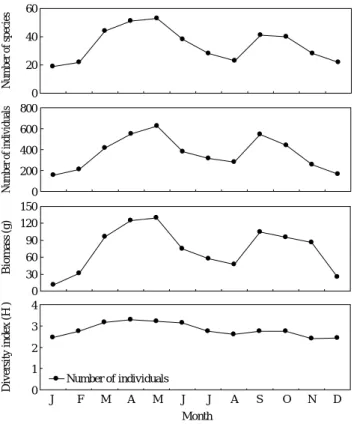
cies with months. The number of species was high in spring and autumn (Fig. 4). Number of individuals was also high in spring and autumn (Fig. 4-b) when most of common species, K. puntatus, M. cephalus, L. japonicus, A. schlegeli, and S. inermis were dominant. Abundance in fish numbers was the lowest in winter. The fish bio- mass was high in April and September when many large M. cephalus, L. japonicus, A. schlegeli and N. mitsukurii were present. The diversity index was relatively higher
from April to June ranged from 2.43~3.29.
Monthly abundance of common fish showed different patterns with each fish species (Fig. 5). For K. punctatus, M. cephalus and L. japonicus showed two peaks in spring and autumn. Peak season in abundance was observed in spring for A. schlegeli, S. inermis, S. schlegeli and L.
yokohamae, in autumn for N. mitsukurii and P. echino- gaster, and in winter for C. pallasii.
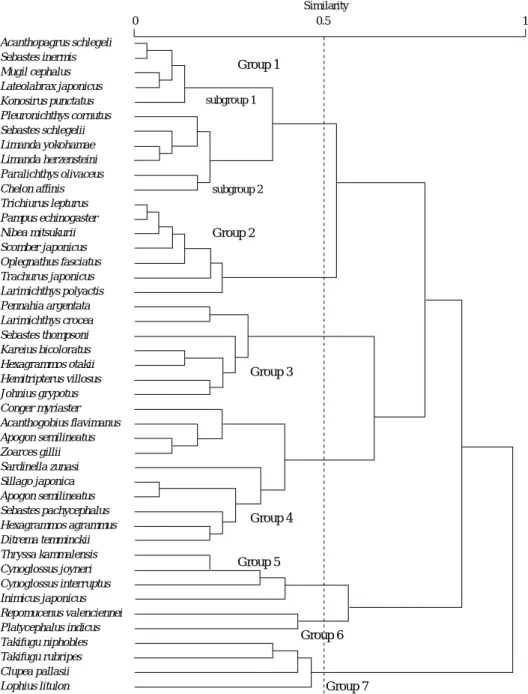
The dendrogram shows seven clusters which identify
Konosirus punctatus 665 15.3 94,174.9 10.6
Mugil cephalus 480 11.1 313,315.6 35.4
Lateolabrax japonicus 318 7.3 109,712.6 12.4 Acanthopagrus schlegeli 255 5.9 80,395.3 9.1
Sebastes inermis 236 5.4 34,510.8 3.9
Nibea mitsukurii 191 4.4 17,739.4 2.0
Clupea pallasii 146 3.4 14,874.0 1.7
Pampus echinogaster 134 3.1 14,270.7 1.6
Sebastes schlegelii 112 2.6 9,712.3 1.1
Limanda yokohamae 111 2.6 22,272.4 2.5
Pleuronichthys cornutus 99 2.3 7,882.2 0.9
Trichiurus lepturus 98 2.3 7,064.3 0.8
Limanda herzensteini 84 1.9 7,861.0 0.9
Paralichthys olivaceus 83 1.9 11,990.2 1.4
Chelon affinis 80 1.8 42,014.5 4.7
Scomber japonicus 69 1.6 11,334.8 1.3
Trachurus japonicus 68 1.6 688.4 0.1
Takifugu niphobles 63 1.5 1,514.7 0.2
Takifugu rubripes 61 1.4 6,806.3 0.8
Oplegnathus fasciatus 58 1.3 3,745.8 0.4
Kareius bicoloratus 57 1.3 8,128.4 0.9
Hexagrammos otakii 56 1.3 3,577.9 0.4
Larimichthys polyactis 53 1.2 4,499.3 0.5
Pennahia argentata 49 1.1 2,376.4 0.3
Hexagrammos agrammus 46 1.1 2,762.0 0.3
Larimichthys crocea 45 1.0 2,778.5 0.3
Ditrema temminckii 44 1.0 2,489.4 0.3
Thryssa kammalensis 40 0.9 798.1 0.1
Hemitripterus villosus 39 0.9 11,628.9 1.3
Johnius grypotus 37 0.9 366.1 ⁄0.1
Sebastes pachycephalus 35 0.8 2,134.8 0.2
Lophius litulon 29 0.7 12,913.3 1.5
Sebastes thompsoni 28 0.6 2,026.4 0.2
Sillago japonica 27 0.6 607.1 0.1
Apogon lineatus 25 0.6 156.5 ⁄0.1
Apogon semilineatus 23 0.5 160.3 ″
Sardinella zunasi 22 0.5 135.6 ″
Acanthogobius flavimanus 20 0.5 430.7 ″
Zoarces gillii 17 0.4 1,025.0 0.1
Inimicus japonicus 16 0.4 3,241.5 0.4
Conger myriaster 15 0.3 734.7 0.1
Repomucenus valenciennei 11 0.3 54.3 ⁄0.1
Cynoglossus joyneri 10 0.2 1,162.8 0.1
Cynoglossus interruptus 10 0.2 1,085.9 0.1
Platycephalus indicus 10 0.2 1,053.0 0.1
Pagrus major 9 0.2 1,036.0 0.1
Nibea albiflora 8 0.2 598.0 0.1
Liparis tanakai 7 0.2 204.3 ⁄0.1
Parapercis sexfasciata 7 0.2 294.7 ″
Chelidonichthys spinosus 7 0.2 678.1 0.1
Pseudorhombus pentophthalmus 6 0.1 662.4 0.1
Sphyraena pinguis 6 0.1 397.8 ⁄0.1
Epinephelus septemfasciatus 6 0.1 662.6 0.1
Stephanolepis cirrhifer 6 0.1 179.9 ⁄0.1
Chirolophis japonicus 5 0.1 325.1 ″
Pholis nebulosa 4 0.1 109.5 ″
Eopsetta grigorjewi 4 0.1 288.2 ″
Leiognathus nuchalis 4 0.1 16.5 ″
Thryssa adelae 4 0.1 28.0 ″
Pholis fangi 4 0.1 72.2 ″
Pseudoblennius marmoratus 4 0.1 126.9 ″
Thryssa hamiltoni 4 0.1 29.9 ″
Favonigobius gymnauchen 3 0.1 9.5 ″
Amblychaeturichthys hexanema 3 0.1 8.9 ″
Engraulis japonicus 3 0.1 10.2 ″
Amblychaeturichthys sciistius 3 0.1 14.7 ″
Chaeturichthys stigmatias 3 0.1 18.2 ″
Xenocephalus elongatus 3 0.1 63.7 ″
Pseudoblennius cottoides 3 0.1 60.2 ″
Liparis tessellatus 3 0.1 179.9 ″
Hypodytes rubripinnis 3 0.1 88.3 ″
Glossanodon semifasciatus 3 0.1 8.8 ″
Stichaeus grigorjewi 3 0.1 125.5 ″
Pholis crassispina 3 0.1 92.1 ″
Rudarius ercodes 3 0.1 17.6 ″
Sebastiscus marmoratus 3 0.1 216.7 ″
Cryptocentrus filifer 3 0.1 12.8 ″
Tridentiger trigonocephalus 2 ⁄0.1 8.0 ″
Acentrogobius pflaumii 2 ″ 10.0 ″
Zebrias zebrinus 2 ″ 22.3 ″
Saurida undosquamis 2 ″ 43.2 ″
Takifugu poecilonotus 2 ″ 78.0 ″
Uranoscopus japonicus 2 ″ 77.5 ″
Hyporhamphus sajoti 2 ″ 14.2 ″
Tribolodon hakonensis 1 ″ 213.8 ″
Pseudaesopia japonica 1 ″ 35.9 ″
Syngnathus schlegeli 1 ″ 5.5 ″
Hapalogenys mucronatus 1 ″ 25.3 ″
Ctenotrypauchen microcephalus 1 ″ 12.1 ″
Total 4,334 100 885,390.1 100.0 Table 1. Total number of individuals and biomass of fish species collected by a fike net in the coastal water off Namhae Island in 2006
Species Total
Species Total
N % B % N % B %
* N: Number of individuals, B: Biomass (g)
the fish species (Fig. 6). The first group was composed of A. schlegeli, S. inermis, M. cephalus, L. japonicus, K.
punctatus, Pleuronichthys cornutus, S. schlegeli, L. yoko- hamae, Limanda herzensteini, Paralichthys olivaceus,
and Chelon affinis, which occurred abundantly almost all over the study period. This group can be further divid- ed into two subgroups: subgroup A contains A. schlege- li, S. inermis, M. cephalus, L. japonicus, and K. puncta-
0 5 10 15 20 25
14 15 16 17 18 19
0 5 10 15 20 25
20 25 30 35 40 45 50
0 5 10 15 20
10 11 12 13 14 15 16 17 18 19 20 21 22 23 24 25 0 5 10 15 20 25 30
16 17 18 19 20 21 22 23 24 25 26
0 10 20 30 40 50
8 9 10 11 12 13 14 0
5 10 15 20 25
16 17 18 19 20 21 22 23 24 25 26 27 28 29
0 10 20 30 40 50 60
18 19 20 21 22 0
10 20 30 40 50
14 15 16 17 18
0 10 20 30 40 50 60
16 17 18 19 20 21 22 23 0
10 20 30 40 50
16 17 18 19 20 21 22 23
Relative frequency (%)
Konosirus punctatus Mugil cephalus
Lateolabrax japonicus Acanthopagrus schlegeli
Sebastes inermis
Pampus echinogaster Clupea pallasii
Nibea mitsukurii
Sebastes schlegeli Limanda yokohamae
Standard length (cm SL)
Fig. 3. Size distributions of principal fishes collected by a fyke net in the coastal water off Namhae Islands in 2006.
tus with relatively high abundance during the study pe- riod, subgroup B composed of P. cornutus, S. schlegeli, L. yokohamae, L. herzensteini, P. olivaceus, and C. affi- nis showing a peak abundance from March to May. The second group was composed of Trichiurus lepturus, P.
echinogaster, N. mitsukurii, Scomber japonicus, Opleg- nathus fasciatus, Trachurus japonicus, and Larimich- thys polyactis. The fishes in this group were abundantly collected in August and September, while few were col- lected in other periods. The third group was composed of Pennahia argentatus, Larimichthys crocea, Sebastes thompsoni, Kareius bicoloratus, Hexagrammos otakii, Hemitripterus villosus, and Johnius gryptopus showing peak abundance from April to June. The fourth group was consisted of Conger myriaster, Acanthogobius fla- vimanus, Apogon semilineatus, Zoarces gillii, Sardinella zunasi, Sillago japonicus, Apogon semilineatus, Sebastes pachycephalus, Hexagrammos agrammus, and Ditrema temminckii with occurrence from March to June. The fifth group was composed of Thryssa kammalensis, Cyno- glossus joyneri, C. inerruptus, and Inimicus japonicus with occurrence from March to May. The seventh group was Takifugu niphobles, T. rubripes, C. pallasi, and L.
litulon which were present mainly in winter.
DISCUSSION
The fyke net is set in shallow water perpendicular to shore such that the net mouth is covered by about 1 meter of water when possible. Fyke net is a common fishing gear collecting a wide size range of pelagic fish which use shallow habitat forming school. A total of 89 fish species was recorded from the coastal water off Namhae Islands and K. punctatus, M. cephalus, L. japo- nicus, A. schlegeli, S. inermis, N. mitsukurii, C. pallassi, P. echinogaster, S. schlegeli, and L. yokohamae were numerically dominant. Most of fish species are pelagic fishes forming schooling, and these fishes were impor- tant in commercial and recreational fishery. For example A. schlegeli, S. inermis, S. schlegeli, and L. yokohamae had high economic value as live fish, and K. punctatus, M. cephalus, L. japonicus, N. mitsukurii, C. pallassi, and P. echinogaster were harvested as a food fish (Kim and Kang 1993; Yoon, 2002). Compared with the stud- ies of fish assemblages in the some coastal areas nearby the study area, non-commercial fishes such as Acentro- gobius pflaumii, Chaeturichthys hexanema, C. sciistius, Repomucenus valenciennei, T. kammalensis, Leiognathus nuchalis, Ilisha elongata, J. grypotus, and Cryptocen- trus filifer were dominated in the trawl catch in the coas- tal water off Namhae Islands (Huh and Kwak, 1998a), and Kwangyang Bay (Oh, 2003), whereas commercial fishes (e.g. K. punctatus, M. cephalus, A. schlegeli, Eng- raulis japonicus, T. lepturus, S. zunasi etc.) were abun- dant in the catch by both-side fyke nets and set nets in the coastal water off Namhae Islands, Dolsan Islands, and Wan Islands (Huh and Kwak, 1998b; Kim et al., 2002; Kim et al., 2003; Jeong et al., 2005; Hwang et al., 2006). These results indicated that higher numbers of commercial fish species were collected with set nets including fyke nets. Such conclusions are in general agreement with other studies of fish assemblages in the coastal area, Korea. Trachurus japonicus, K. punctatus, M. cephalusand, and S. japonicus were common fish species in the coastal water off Gadeok Islands (Huh and An, 2002). Both-side fyke nets were widely used along the shore in the coastal water off Namhae Islands be- cause pelagic fish such as K. punctatus, M. cephalus, L.
japonicus, A. schlegeli, N. mitsukurii, and C. pallassi were effectively caught in the net by the strong tidal current. Hence we suggested that both-side fyke net was a reasonable gear for studies on commercially important pelagic fishes in the coastal area.
Each dominant fish species exhibited a distinct sea- sonal occurrence pattern and different time of peak abun- dance. Peak abundance was observed in September for K. punctatus, N. mitsukurii and P. echinogaster, in May for M. cephalus and L. japonicus, A. schlegeli, S. iner- mis, and in April for L. yokohamae, in December 2006
0 20 40 60
0 200 400 600 800
0 30 60 90 120 150
0 1 2 3 4
Number of individuals
Number of species Number of individuals Biomass (g) Diversity index (H ′)
J F M A M J J A S O N D
Month
Fig. 4. Monthly variations in number of species, number of indivi-
duals, biomass, and diversity index of fish collected by a fyke net in
the coastal water off Namhae Islands in 2006.
for C. pallasii, and in March 2006 for S. schlegeli. These results indicate that life history pattern differ according to the fish in the study area. Peak recruitment and abun- dance of one species was separated several months from other species, with some overlap with another species.
After one fish population increased rapidly, it sustained peak abundance for several months and then decreased sharply. Subsequently, another fish population increased and reached peak abundance. Hence the coastal area off Namhae Islands was partitioned temporally by domi-
0 50 100 150
0 30 60 90
0 20 40 60
0 20 40 60
0 30 60 90
0 20 40 60
0 20 40 60
0 20 40 60
0 10 20 30
J F M A M J J A S O N D 0
10 20 30
J F M A M J J A S O N D
Konosirus punctatus Mugil cephalus
Lateolabrax japonicus Acanthopagrus schlegeli
Sebastes inermis Nibea mitsukurii
Clupea pallasii Pampus echinogaster
Sebastes schlegeli Limanda yokohamae
Number of individuals
Month
Fig. 5. Monthly variations in number of individuals of 10 common fish species collected by a fyke net in the coastal water off Namhae Islands in
2006.
nant fish species in this way. Other studies have shown similar patterns of seasonal variation in fish assemblages of coastal areas, Korea (Huh and Kwak, 1997; 1998a, b;
Huh and Chung, 1999; An and Huh, 2003; Kwak et al., 2006; Kwak and Huh, 2007). For example, peak abun- dance was in spring for M. cephalus, in summer for T.
japonicus, in fall for K. punctatus, and in winter for T.
niphobles in the coastal water off Gadeok Islands (Huh and An, 2002).
Both species composition and abundance of fishes greatly varied with season. Fish were abundant in the
study area were higher during spring and summer (e.g.
May 2006, and September 2006) when temperature was high. Compared with other studies of fish assemblages collected by set nets close to the study area, fluctuations in abundance and species composition of fishes corre- lated with temperature in the coastal water off Dolsan Islands. For example, higher number of individuals and biomass were recorded from spring to summer when temperature was high (Jeong et al., 2005). Temperature effect was clear in the anchovy catch analyzed using samples by bag set net off Wando Islands (Kim et al.,
Similarity
0 1
Group 4
Group 5
Group 6
Group 7 Clupea pallasii
Lophius litulon
0.5
Group 1 subgroup 1
subgroup 2
Group 2
Repomucenus valenciennei Platycephalus indicus Hexagrammos agrammus Ditrema temminckii
Takifugu niphobles Takifugu rubripes Thryssa kammalensis Cynoglossus joyneri Cynoglossus interruptus Inimicus japonicus Sardinella zunasi Sillago japonica Apogon semilineatus Sebastes pachycephalus Conger myriaster Acanthogobius flavimanus Apogon semilineatus Zoarces gillii Kareius bicoloratus Hexagrammos otakii Hemitripterus villosus Johnius grypotus Larimichthys polyactis Pennahia argentata Larimichthys crocea Sebastes thompsoni Nibea mitsukurii Scomber japonicus Oplegnathus fasciatus Trachurus japonicus Pleuronichthys cornutus Sebastes schlegelii
Group 3 Konosirus punctatus
Limanda yokohamae Limanda herzensteini Paralichthys olivaceus Chelon affinis Trichiurus lepturus Pampus echinogaster Acanthopagrus schlegeli Sebastes inermis Mugil cephalus Lateolabrax japonicus
Fig. 6. Dendrogram illustrating the species associations of fishes collected by a fyke net in the coastal water off Namhae Island in 2006.
2002). Several other studies have also demonstrated a positive correlation between temperature and fish abun- dance (Edgar and Shaw, 1995; Huh and Kwak, 1998b;
Huh and Chung, 1999; Lazzari et al., 1999; Paperno et al., 2001; Huh and An, 2002; Oh, 2003; Kwak et al., 2006; Hwang, 2007; Kwak and Huh, 2007). In conclu- sion, the temperature and related factors are the major factor to determine the seasonal variation in species composition of fish in the southern coastal water of Korea.
ACKNOWLEDGMENTS
We are grateful to Bong Jun Seong, Department of Oceanography, Pukyong National University for assis- tance with sampling and data analysis. We also thank Dr. David W Klumpp (AIMS) for his constructive com- ments in structure of English.
REFERENCES
An, Y.R. and S.H. Huh. 2002. Species composition and sea- sonal variation of fish assemblage in the coastal water off Gadeok-do, Korea. 3. Fishes collected by crab pots. J. Kor. Fish. Soc., 35: 715-722. (in Korean) An, Y.R. and S.H. Huh. 2003. Species composition and sea-
sonal variation of fish assemblage in the coastal water off Gadeok-do, Korea. 4. Fishes collected by bottom gill nets. J. Kor. Fish Soc., 36: 686-694. (in Korean) Cha, B.Y. 1999. Species composition of fish in coastal water
off Goeje Island. Kor. J. Ichthyol., 11: 184-190. (in Korean)
Cha, S.S. and K.J. Park. 1997. Seasonal changes in species composition of fishes collected with a bottom trawl in Kwangyang Bay, Korea. Kor. J. Ichthyol., 9: 235- 243. (in Korean)
Edgar, G.J. and C. Shaw. 1995. The production and trophic ecology of shallow-water fish assemblages in south- ern Australia. I. Species richness, size-structure and production of fishes in Western Port Bay, Victoria.
J. Exp. Mar. Biol. Ecol., 194: 53-82.
Guidetti, P. 2000. Differences among fish assemblages asso- ciated with nearshore Posidonia oceanica seagrass beds, rocky-algal reefs and unvegetated sand habitats in the Adriatic Sea. Estuarine Coast. Shelf Sci., 50:
515-529.
Han, K.H., J.C. Son, D.S. Hwang and S.H. Choi. 2002. Spe- cies composition and quantitative fluctuation of fishes collected by trammel net in coastal water of Seok- byeong, Pohang. Korean J. Ichthyol., 14: 109-120.
(in Korean)
Huh, S.H. and S.G. Chung. 1999. Seasonal variation in spe- cies composition and abundance of fishes collected by an otter trawl in Nakdong River Estuary. Bull.
Kor. Soc. Fish. Tech., 35: 178-195. (in Korean) Huh, S.H. and S.N. Kwak. 1997. Species composition and
seasonal variations of fishes in eelgrass (Zostera ma- rina) bed in Kwangyang Bay. Korean J. Ichthyol., 9:
202-220. (in Korean)
Huh, S.H. and S.N. Kwak. 1998a. Seasonal variations in spe- cies composition of fishes collected by an otter trawl in the coastal water off Namhae Island. Korean J.
Ichthyol., 10: 11-23. (in Korean)
Huh, S.H. and S.N. Kwak. 1998b. Species composition and seasonal variations of fishes collected by winged stow nets on anchors off Namhae Island. Bull. Kor.
Soc. Fish. Tech., 34: 309-319. (in Korean)
Huh, S.H. and Y.R. An. 2000. Species composition and sea- sonal variation of fish assemblage in the coastal water off Gadeok-do, Korea. 1. Fishes collected by a small otter trawl. J. Kor. Fish. Soc., 33: 288-301. (in Kor- ean)
Huh, S.H. and Y.R. An. 2002. Species composition and sea- sonal variation of fish assemblage in the coastal water off Gadeok-do, Korea. 2. Fishes collected by three sides fyke nets. J. Kor. Fish Soc., 35: 366-379. (in Korean)
Hwang, S.D. 1998. Diel and seasonal variations in species composition of fishery resources collected by a bag net off Kogunsan-gundo. Kor. J. Ichthyol., 10, 155- 163. (in Korean)
Hwang, S.D., Y.J. Im, Y.C. Kim, H.K. Cha and S.H. Choi.
1998. Fishery resources off Youngkwang I. Species composition of catch by a stow net. J. Kor. Soc. Fish., 31: 727-738. (in Korean)
Hwang, S.D., Y.J. Park, S.H. Choi and T.W. Lee. 1997.
Species composition of fishes collected by trammel net off Heunghae, Korea. J. Kor. Soc. Fish., 30: 105- 113. (in Korean)
Hwang, S.D., J.Y. Kim, J.I. Kim, S.T. Kim, Y.I. Seo, J.B.
Kim, Y.H. Kim and S.J. Heo. 2006. Species compo- sition using the daily catch data of a set net in the coastal water off Yeosu, Korea. Korean J. Ichthyol., 18: 223-233. (in Korean)
Hwang, W.J. 2007. Species composition and seasonal varia- tions in fishes in the eelgrass (Zostera marina) bed in Aenggang Bay, Korea. Ms. Thesis. Pukyong National University, 63pp. (in Korean)
Jenkins. G.P. and M.J. Wheatley. 1998. The influence of
habitat structure on nearshore fish assemblages in a
southern Australian embayment: comparison of shal-
low seagrass, reef-algal and unvegetated sand habitat,
with emphasis on their importance to recruitment. J.
Exp. Mar. Biol. Ecol., 221: 148-172. (in Korean) Jeong, H.H., K.H. Han, C.C. Kim, S.M. Yoon, W.I. Seo,
S.Y. Hwang and S.H. Lee. 2005. Fluctuations in abundance and species composition of fishes collect- ed by both sides fyke nets in Dol-san, Yeosu. Korean J. Ichthyol., 17: 64-72. (in Korean)
Kim, C.K. and Y.J. Kang. 1991. Fish assemblage collected by gill net in the coastal shallow water off Shinsudo, Samchonpo. Bull. Kor. Fish. Soc., 24: 99-110. (in Korean)
Kim, I.S. and Y.J. Kang. 1993. Coloured Fishes of Korea.
Academy Publishing Co, Seoul, 478pp. (in Korean) Kim, I.S., Y. Choi, C.L. Lee, Y.J. Lee, B.J. Kim and J.H.
Lim. 2005. Illustrated book of Korean fish. Kyo-Hak Publishing, Seoul, 615pp. (in Korean)
Kim, J.K., O.I. Choi, D.S. Chang and J.I. Kim. 2002. Fluc- tuations of bag-net catches off Wando, Korea and the effect of sea water temperature. J. Korean Fish.
Soc., 35: 497-503. (in Korean)
Kim, Y.H., J.B. Kim and D.S. Chang. 2003. Seasonal varia- tion of abundance and species composition of fishes caught by a set net in the coastal water off Yeosu, Korea. J. Kor. Fish. Soc., 36: 120-128. (in Korean) Kwak, S.N. and D.W. Klumpp. 2004. Temporal variation in
species composition and abundance of fish and deca- pods in Cockle Bay, North Queensland, Australia.
Aquat. Bot., 78: 119-134.
Kwak, S.N., S.H. Huh and C.G. Choi. 2006. Comparison of fish assemblages associated with eelgrass and adja- cent unvegetated habitats in Jindong Bay. Korean J.
Ichthyol., 18: 119-128.
Kwak, S.N. and S.H. Huh. 2007. Temporal Variation in Species Composition and Abundance of Fish Assem- blages in Masan Bay. Korean J. Ichthyol., 19: 132-
141.
Lazzari, M.A., S. Sherman, C.S. Brown, J. King, B.J. Joule, S.B. Chenoweth and R.W. Langton. 1999. Seasonal and annual variations in abundance and species com- position of two nearshore fish communities in Maine.
Estuaries, 22: 636-647.
Lee, T.W. 1998. Change in species composition of fish in Chonsu Bay 3. Pelagic fish. J. Kor. Fish. Soc., 31:
654-664. (in Korean)
Lee, T.W. and J.W. Gil. 1998. Seasonal variation in species composition of demersal fish off Youngkwang in 1986~87. Korean J. Ichthyol., 10: 241-249. (in Kor- ean)
Masuda, H., K. Amaoka, C. Arago, T. Ueno and T. Yoshino.
1984. The Fishes of the Japanese Archipelago. Tokai Univ. Press, Tokyo, Text and Plates. 437pp + + 370 plates.
Oh, S.H. 2003. Species composition and community struc- ture of fishes in Kwangyang Bay, Korea. Ph.D. The- sis. Yeosu National University, 220pp. (in Korean) Paperno, R., K.J. Mille and E. Kadison. 2001. Patterns in
species composition of fish and selected invertebrate assemblages in estuarine subregions near Ponce de Leon Inlet, Florida. Estuar. Coast. Shelf Sci., 52: 117- 130.
Pianka, E.R. 1973. The structure of lizard communities.
Ann. Rev. Ecol. Syst., 4: 53-74.
Shannon, C.E. and W. Weaver. 1949. The Mathematical Theory of Communication. Illinois Univ. Press, Ur- bana, 117pp.
Yoon, C.H. 2002. Fishes of Korea with Pictorial Key and Systematic List. Academy Publ. Co. Seoul, 747pp.
(in Korean)
남해도 연안해역에서 서식하는 어류군집의 종조성 및 계절변동
곽석남∙허성회
1
∙김하원1
(주)해양생태기술연구소, 1부경대학교 해양학과