—52—
INTRODUCTION
The Korean Peninsula is bounded by water on the east (East Sea), west (Yellow Sea), and south (East China Sea). The collision of diverse water masses between the Yellow Sea and East China Sea produces a good fishing ground (Liu et al., 1990; Jin et al., 2003; Choi et al., 2004; Choi et al., 2008). Especially, commercially im- portant fishes such as Larimichthy polyactis and Trichi- urus lepturus are caught at the southwest sea of Jeju Island, perhaps due to the gathering effect of prey (Ben- thosema pterotum) by a strong cyclonic eddy (Sassa et al., 2008). These good fishing grounds around the Kor- ean Peninsula are under threat from human overexploita- tion, which has imperiled both the diversity and abund- ance of the fishery resource.
The Korean fishery has been in decline since the 1980s and the catch per unit effort (CPUE) has been trending downwards continuously from the middle of 1970s. In addition, the geographical extent of the fishing grounds has been reduced as the result of Korea-Japan and Korea- China fisheries negotiation. A new approach to the fish- eries resources management is needed.
A population structure-based approach that uses mor- phological and genetic methods may help define the management unit and/or its range. If the boundary among various regional populations within species is not clear, it is difficult to evaluate the status of unit resource (Wal-
dman, 2005). By definition, a fish population: (1) has a unique life cycle of its own including a particular spawn- ing ground, (2) experiences an unique demographic ef- fect, (3) is a part of the wider environment whose mor- phological and genetic characteristics are changed by a partial or complete separation from the environment, and (4) responds based on characteristics of its abund- ance and life cycle (Waldman, 2005). Clarification of population structure based on morphological and genetic methods will more clearly define the management unit and its range. This approach has traditionally focused on widely distributed species such as Thunnus thynnus thyn- nus for the purpose of appropriate management for each population (Carlesson et al., 2004). Other studies have addressed characteristics of each population for migra- tory fish species including Scomber japonicus (two popu- lations), Trichiurus lepturus (two populations), Trachurus japonicus (three populations), Larimichthys polyactis (three populations) and Pampus echinogaster (two popu- lations) in Japan, with the aim of increasing the predic- tion of resource fluctuation (as an example, see Yamada et al., 2007). In Korea, the genetic variation of migratory fish populations has been investigated for Ammodytes personatus (Kim et al., 2006, 2008), Arctoscopus japon- icus (Lee, 2008) and Larimichthys polyactis (Kim et al., In progress). Studies such as these are clarifying the de- gree of genetic exchange among fish species inhabiting each coastal area, which will in turn help best manage the fisheries resource of each coastal area.
The present review provides information on character- istics of each sea around the Korean Peninsula, species
Diversity and Conservation of Korean Marine Fishes
By Jin Koo Kim
Department of Marine Biology, Pukyong National University, 599-1, Daeyeon 3-dong, Nam-gu, Busan 608-737, Korea
ABSTRACT Environmental differences of each sea around the Korean Peninsula in terms of factors including topography and complexity of sea current may influence species and genetic diversity of marine fishes. Fish are naturally abundant in the frontal area where various currents or water masses meet. However, this food resource is prone to human overexploitation, threatening the marine ecosys- tem. New fisheries resources management strategies are needed. Such strategies require information about population structure obtained through morphological and genetic methods.
Key words : Korea, marine fish, species diversity, genetic diversity, species conservation, management unit
*Corresponding author: Jin Koo Kim Tel: 82-51-629-5927, Fax: 82-51-629-5931, E-mail: [email protected]
Accepted : June 12, 2009
http://www.fishkorea.or.kr
composition of fish inhabiting each sea and changing research in fish diversity, with the aim of influencing further study that will most effectively manage the Kor- ean fisheries resource.
CHARACTERISTICS OF THE EACH SEA OF KOREA
The mean water depth varies from a maximum of 1,684 meters in the East Sea to only 44 meters in the West Sea. In the middle part of the East Sea, there is the stable polar front formed by the intersection of the East Korean Warm Current (EKWC), which is higher in tem- perature and salinity, and the lower temperature and sali- nity North Korean Cold Current (NKCC). In the East Sea, there is an unstable front formed by the Tsushima Warm Current (TWC) and another warm current (Gong and Son, 1982). In the West Sea, the Yellow Sea Bottom Cold Water (YSBCW) is characterized by low tempera- ture, low salinity and abundant suspended solids under the influence of influx water from the Yangtze River (Choi et al., 2008). The South Sea and Jeju Island are directly affected by the high temperature and salinity TWC separated from Kuroshio Warm Current (KWC).
In particular, Jeju Island is influenced by diverse water masses that include the Chinese Continental Coastal Water (CCCW), YSBCW and Korean Coastal Water (Choi et al., 2003). The diverse topography and charac- teristics of these currents are the origin of fish diversity in the Korean Peninsula.
SPECIES DIVERSITY OF MARINE FISHES IN KOREA
There are 439 known fish species in the East Sea, in- cluding Perciformes (43% of the total species), Scorpae- niformes (19%), Pleuronectiformes (7%) and Tetraodon- tiformes (6%) (Kim and Nam, 2003). These studies were mostly carried out around Pohang except for one (Ryu et al., 2005) that reported 59 species recovered using set and gill nets in Goseong, Kangwon Province, in the far north of South Korea (Table 2). All studies were condu- cted at depths of ⁄50 m; virtually nothing is known of deep sea fish species in the East Sea. The fish fauna in Heunghae north to Pohang is almost the same with that in the South Sea, with the exception of Alcichthys alci- cornis (Hwang et al., 1997). However, the fish fauna in Goseong is clearly different from that in the South Sea.
Ryu et al. (2005) reported frequent occurrence of cold sea water fishes such as Pleurogrammus azonus, Podo- thecus sachi, Eurymen gyrinus, Cottidae spp. Therefore, it is highly possible that there may be two ecosystems clearly distinguished in the East Sea, which is supported
by population structure of Ammodytes personatus (Kim et al., 2006) and Arctoscopus japonicus (Lee, 2008).
In the West Sea, there are 339 known fish species in- cluding Perciformes (41% of the total species), Scorpae- niformes (12%), Pleuronectiformes (9%) and Tetraodon- tiformes (7%) (Lee, 2003). The identity and prevalence of the dominant species is similar to that in the East Sea.
Studies on the fish fauna in the West Sea have been car- ried out from Asan Bay south to Youngkwang (Table 2).
In Youngkwang, trawl studies conducted in 1986 identi- fied Johnius belengeri, Chaeturichthys stigmatias and Pennahia argentata as the dominant species. Another trawl study of the same region carried out in 1995 found Johnius belengeri, Cynoglossus joyneri and Collichthys niveatus to be dominant (Table 2). The diminished catch of Pennahia argentata might be a manifestation of cli- mate-related sea change, although this remains specula- tive. Nonetheless, long-term monitoring of fish fauna is needed to clarify the influence of global warming. Some Korean endemic species such as Ophichthus rotundus, Sebastes koreanus, Repomucenus leucopoeilus and Acen- trogobius pellidebilis reside in the West Sea, of which O. rotundus and R. leucopoeilus are registered as endan- gered species. The high occurrence rate of endemic spe- cies in the West Sea may have resulted from the origin of this body of water. During the ice age that occurred about 15,000 years ago, the sea level decreased and the present-day West Sea disappeared. About 10,000 years ago, the sea was re-established as the ice disappeared.
This cyclical pattern was repeated through the various ice ages (Petit et al., 1999), which may have been pivotal in speciation (Kitamura, 2004).
In the South Sea, there are 301 known species includ- ing Perciformes (41% of the total species), Scorpaenifor- mes (15%), Pleuronectiformes (10%) and Tetraodontifor- mes (7%) (Han, 2003). This pattern of species prevalence is similar to the East and West Seas. Only one species, Raja koreana is considered to be a South Sea endemic species. Since it has become recently available for food instead of Raja pulchra, it requires special management (Kim et al., 2005). Compared to the East and West Seas, more is known for South Sea fish fauna (Table 3). In 1998, the fish fauna at Gadeok-do was investigated using four fishing gears (otter trawl, three sides fyke net, crab pots and bottom gill net). A total of 136 and 110 species were collected from three side fyke net and bottom gill net, respectively, but only 49 species were collected from the otter trawl and crab pots (Table 3), indicating the necessity to investigate fish fauna using appropriate fish- ing gear or more than two fishing gears (Ryu et al., 2005).
In Jeju Island, there are 612 known fish species includ- ing Perciformes (56% of the total species), Scorpaenifor- mes (11%), Tetraodontiformes (7%) and Rajiformes (3%). This differs somewhat from other locales; of note, subtropical fish species were very frequently found (Kim
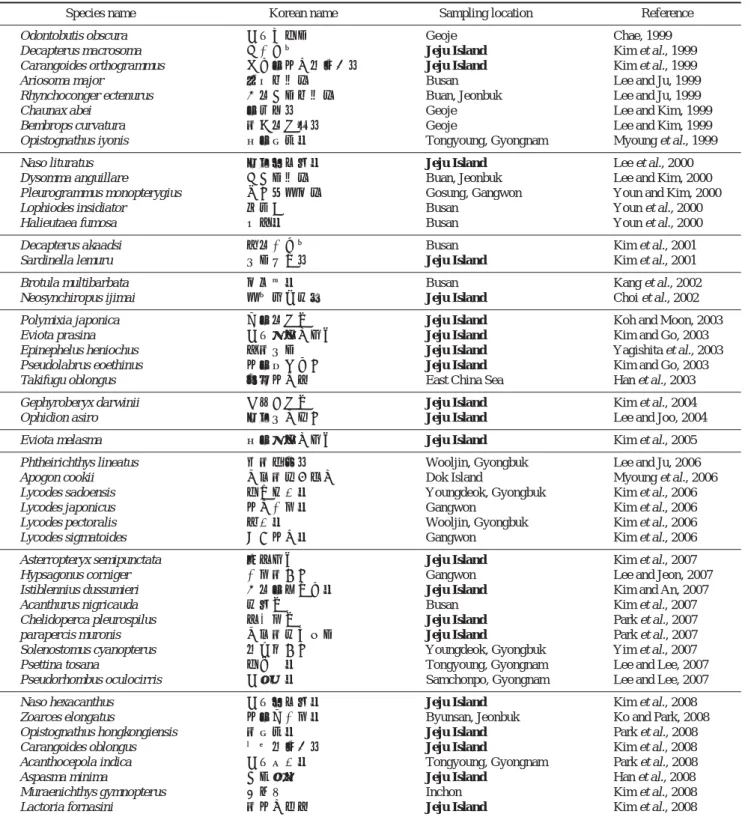
and Lee, 1994). As the surface water temperature incre- ases, subtropical fish species become more prevalent in the South and East Seas including the waters around Jeju Island. The number of newly reported (unrecorded) spe- cies around the Korean Peninsula has been consistently increasing over the past 10 years (Table 1). A total of 47
species were recorded in the Korean Journal of Ichthyo- logy between 1999 and 2008, representing a mean of 4.7 unrecorded species every year. The number of unrecord- ed species (20) peaked in the waters surrounding Jeju Island, representing 42.6% of the total number of species.
Unrecorded species tend to be most prevalent in the area
Table 1. The list of unrecorded fish species from Korea during past 10 years
Species name Korean name Sampling location Reference
Odontobutis obscura 남방동사리 Geoje Chae, 1999
Decapterus macrosoma 긴가라지 Jeju Island Kim et al., 1999
Carangoides orthogrammus 노랑점무늬유전갱이 Jeju Island Kim et al., 1999
Ariosoma major 큰흰붕장어 Busan Lee and Ju, 1999
Rhynchoconger ectenurus 검은꼬리붕장어 Buan, Jeonbuk Lee and Ju, 1999
Chaunax abei 점씬벵이 Geoje Lee and Kim, 1999
Bembrops curvatura 줄굽은눈퉁이 Geoje Lee and Kim, 1999
Opistognathus iyonis 흑점후악치 Tongyoung, Gyongnam Myoung et al., 1999
Naso lituratus 제주표문쥐치 Jeju Island Lee et al., 2000
Dysomma anguillare 긴꼬리장어 Buan, Jeonbuk Lee and Kim, 2000
Pleurogrammus monopterygius 단기임연수어 Gosung, Gangwon Youn and Kim, 2000
Lophiodes insidiator 용아귀 Busan Youn et al., 2000
Halieutaea fumosa 민부치 Busan Youn et al., 2000
Decapterus akaadsi 붉은가라지 Busan Kim et al., 2001
Sardinella lemuru 바리밴댕이 Jeju Island Kim et al., 2001
Brotula multibarbata 수염첨치 Busan Kang et al., 2002
Neosynchiropus ijimai 연지알롱양태 Jeju Island Choi et al., 2002
Polymixia japonica 등점은눈돔 Jeju Island Koh and Moon, 2003
Eviota prasina 남방풀비늘망둑 Jeju Island Kim and Go, 2003
Epinephelus heniochus 볼줄바리 Jeju Island Yagishita et al., 2003
Pseudolabrus eoethinus 무점황놀래기 Jeju Island Kim and Go, 2003
Takifugu oblongus 폭포무늬복 East China Sea Han et al., 2003
Gephyroberyx darwinii 납작금눈돔 Jeju Island Kim et al., 2004
Ophidion asiro 제주바다메기 Jeju Island Lee and Joo, 2004
Eviota melasma 흑점풀비늘망둑 Jeju Island Kim et al., 2005
Phtheirichthys lineatus 열줄빨판이 Wooljin, Gyongbuk Lee and Ju, 2006
Apogon cookii 다섯줄얼게비늘 Dok Island Myoung et al., 2006
Lycodes sadoensis 사도먹갈치 Youngdeok, Gyongbuk Kim et al., 2006
Lycodes japonicus 무늬가시치 Gangwon Kim et al., 2006
Lycodes pectoralis 북갈치 Wooljin, Gyongbuk Kim et al., 2006
Lycodes sigmatoides 굴곡무늬치 Gangwon Kim et al., 2006
Asterropteryx semipunctata 청별망둑 Jeju Island Kim et al., 2007
Hypsagonus corniger 가시줄고기 Gangwon Lee and Jeon, 2007
Istiblennius dussumieri 검은점베도라치 Jeju Island Kim and An, 2007
Acanthurus nigricauda 양쥐돔 Busan Kim et al., 2007
Chelidoperca pleurospilus 별각시돔 Jeju Island Park et al., 2007
parapercis muronis 다섯줄양동미리 Jeju Island Park et al., 2007
Solenostomus cyanopterus 유령실고기 Youngdeok, Gyongbuk Yim et al., 2007
Psettina tosana 사량넙치 Tongyoung, Gyongnam Lee and Lee, 2007
Pseudorhombus oculocirris 남해넙치 Samchonpo, Gyongnam Lee and Lee, 2007
Naso hexacanthus 남방표문쥐치 Jeju Island Kim et al., 2008
Zoarces elongatus 무점등가시치 Byunsan, Jeonbuk Ko and Park, 2008
Opistognathus hongkongiensis 줄후악치 Jeju Island Park et al., 2008
Carangoides oblongus 채찍유전갱이 Jeju Island Kim et al., 2008
Acanthocepola indica 남방홍갈치 Tongyoung, Gyongnam Park et al., 2008
Aspasma minima 꼬마학치 Jeju Island Han et al., 2008
Muraenichthys gymnopterus 갯물뱀 Inchon Kim et al., 2008
Lactoria fornasini 줄무늬뿔복 Jeju Island Kim et al., 2008
strongly affected by the TWC. For example, 12 unrecord- ed species (25.5% of the total) were noted in the eastern area of the South Sea (Busan, Geoje and Tongyoung), and eight species (17%) were noted in the central area of the East Sea (Kangwon and Kyongbuk) (Table 1).
Despite such data, few specimens have been preserved, which have limited taxonomic studies. Systematic stud- ies aimed at the collection, management and preservation of specimens are needed (Kim and Go, 2003).
CHANGE IN FISH DIVERSITY RESEARCH
Taxonomy based on morphology has several draw- backs. First, fishes are classified depending on subjecti- vity and personal experience of ichthyologists. Second, it can be difficult to collect data about homology of cha-
racters. Third, few characters are available in phylogene- tic estimations.
The morphology-based approach has changed follow- ing the publication of the structure of DNA (Watson and Crick, 1953). Subsequently, the extensive genetic data produced was efficiently managed through the establish- ment of Cladistics and with refinements in computer technology (Kim, 2000). As example, 14 substitution models have been developed for sequence analysis and a Modeltest program was developed enabling the select- ion of an optical model (Posada and Crandall, 1998).
The Likelihood method has so-far proven to be the most robust optical model (Whelan et al., 2001).
How has the morphology-based taxonomic system been changed through application of DNA? In the past, the family Salangidae was considered as a sister group of the families Galaxiidae, Osmeridae or the genus Mol-
Table 2. List of fish fauna investigation from the East Sea and West Sea (==Yellow Sea) of Korea
Area Period (times) Gear No. species Dominant species References
Ulsan 1998 (6) Set net 89 Scomber japonicus, Trachurus
Han et al. (2002) japonicus, Thamnaconus modestus
Heunghae 1989 (4), 1990 (3) Three sides fyke net 28 Sebastes inermis, Stephanolepis
Hwang et al. (1997) cirrhifer, Hexagrammos agrammus
Youngil-man 1991 (4) Trawl 59 Repomucenus lunatus, Tridentiger
Lee (1999) trigonocephalus, R. huguenini
Middle East Sea 2004 (3), 2005 (1) Gill net 33 Sebastes inermis, Alcichthys alcicornis,
Yoo et al. (2005) Liparis tanakai
Middle East Sea 2004 (3), 2005 (1) Set net 36 Seriola quinqueradiata, Trachurus
Yoo et al. (2005) japonicus, Gadus macrocephalus
Pohang 1998. 1~12 (12) Three sides fyke net 58 Sebastes inermis, Halichoeres
Han et al. (2002) poecilopterus, Stephanolepis cirrhifer
Ulreung-do 2004 (2) Diving 45 Scorpaenidae, Labridae, Cottidae Myoung et al. (2005)
Youngil-man 2001. 1~2002. 12 (24) Gill net 73 Engraulis japonicus, Pleuronectes
Hong et al. (2008) yokohamae, Thamnaconus modestus
Weolsung 2006 (4), 2007 (4) Stake net, lift net 27 Furcina osimae, Chaenogobius
Choi et al. (2008) gulosus, Chaenogobius annularis
Gunsan 1992. 8~1993. 7 (12) Bottom trawl et al. 98 Cynoglossus joyneri, Repomucenus
Yoo and Choi (1993) ornatipinnis, Harengula zunasi
Younggwang 1986 (6, 8, 11), 1987~3 (4) Trawl 33 Johnius grypotus, Chaeturichthys
Lee and Gil (1998) stigmatias, Argyrosomus argentatus
Gogunsangundo 1997. 4~1997. 11 (9) Long bag set net 53 Pholis fangi, Engraulis japonicus,
Hwang (1998) Ammodyres personatus
Younggwang 1995. 4~1996. 1 (10) Stow net 64 Thryssa kammalensis, Johnius
Hwang et al. (1998) grypotus, Leioganthus nuchalis
Younggwang 1995 (3) Trawl 46 Johnius grypotus, Cynoglossus joyneri,
Hwang et al. (1998) Collichthys niveatus
Chonsu-man 1992. 3~1993. 1 (11) Trawl 63 Engraulis japonicus, Ammodytes
Lee (1998) personatus, Enedrias fangi
Asan-man 1997 (10, 12)~ Seines, beam trawl 43 Favonigobius gymnauchen, Kareius
Hwang and Lee (1999)
1998 (2, 4, 6, 8) (6) bicoloratus
Taean 1996. 5~1999. 7 Set net, gill net, pot 73 Chasmichthys gulosus, Chasmichthys
Lim and Choi (2000) dolihcognathus, Sebastes schlegeli
Gum R. estuary 2003. 2~12 (11) Bag net 73 Sardinella zunasi, Konosirus punctatus,
Hwang et al. (2005) Synechogobius hasta
Taean 2005 (8) Seine net et al. 27 Favonigobius gymnauchen, Luciogobius
Choi and Jang (2007) guttatus, Chaenogobius gulosus
lotus by virtue of its morphology (see Fu et al., 2005).
However, Fu et al. (2005) suggested rearrangement of the family Salangidae into the family Osmeridae based on mitochondrial DNA (mtDNA) analysis. In addition, the family Sundasalangidae originally established by Roberts (1984) could also be appropriate rearrangement from the order Osmeriformes to the order Clupeiformes
based on mtDNA analysis (Ishiguro et al., 2005).
In the age of molecular phylogeny, what kind of strate- gy is required? A successful strategy needs to involve a taxonomic review, which enables reporting of unrecorded or new species and to establish a database. Then, it is necessary to compile the fish specification according to voucher specimens. A strategy also requires systematic
Table 3. List of fish fauna investigation from the South Sea (==East China Sea) including Jeju Island of Korea
Area Period (times) Gear No. species Dominant species References
Shinsu-do 1984. 2~1985. 1 (12) Gill net 32 Hexagrammos otakii, Hexagrammos Kim and Kang (1991) agrammus, Sebastes inermis
Kwangyang 1990. 2~1990. 12 (11) Bottom trawl 54 Leiognathus nuchalis, Konosirus
Cha and Park (1997) punctatus, Liparis tanakai
Namhae-do 1989. 5~1990. 4 (12) Otter trawl 64 Acentrogobius pflaumii, Chaeturichthys Huh and Kwak (1998) hexanema, Chaeturichthys sciistius
Namhae-do 1989. 5~1990. 4 (12) Bag net 56 Engraulis japonicus, Conger myriaster,
Huh and Kwak (1998) Sardinella zunasi
Geoje-do 1996. 2~10 (9) Gill net 43 Stephanolepis cirrhifer, Ditrema Cha (1999)
temmincki, Hexagrammos otakii Nakdong R. 1987. 2~1988. 1 (12) Otter trawl 100 Repomucenus valenciennei,
Huh and Chung (1999) Pholis fangi, Leiognathus nuchalis
Yongwon 1998. 1~12 (12) Beach scines 34 Hyporhamphus intermedius, Lee et al. (2000)
Favonigobius, Pholis nebulosa Gadeok-do 1998. 1~1998. 12 (12) Otter trawl 110 Repomucenus valenciennei, Thryssa
Huh and An (2000) kammalensis, Leiognathus nuchalis
Goheung 1999 (4) Otter trawl 123 Leiognathus nuchalis, Konosirus Han et al. (2001)
punctatus, Engraulis japonicus Wando 1999~2001 (5, 6, 7, 8, 9, 10) Long bag set net 73 Engraulis japonicus, Trichiurus
Kim et al. (2002) lepturus, Hapalogenys mucronatus
Gadeok-do 1998. 1~1998. 12 (12) Three sides fyke net 136 Trachurus japonicus, Konosirus Huh and An (2002) puctatus, Mugil cephalus
Gadeok-do 1998. 1~1998. 12 (12) Crab pots 49 Conger myriaster, Sebastes inermis,
Huh and An (2003) Hexagrammos otakii
Doam-man 2001. 3~2002. 2 (12) Shrimp beam trawl 53 Chaeturichthys hexanema, Cynoglossus Kim et al. (2003) robustus, Acanthogobius flavimanus
Gadeok-do 1998. 1~1998. 12 Bottom gill net 49 Limanda yokohamae, Cynoglossus
Huh and An (2002) abbreviatus, Ditrema temmincki
Yosu 2001. 4~2001. 10 (7) Set net 52 Engraulis japonicus, Trachurus japonicus, Kim et al. (2003) Trichiurus lepturus
Dolsan-do 2003. 3~2004. 2 (12) Fyke net 48 Konosirus punctatus, Mugil cephalus,
Jeong et al. (2005) Liparis tanakai
Dolsan-do 2001~2002 (7), 2003 (9) Set net 40 Sardinella zunasi, Engraulis japonicus, Hwang et al. (2006) Scomberomorus niphonius
Jindong Bay 2002. 1~12 (12) Beam trawl 26 Hexagrammos otakii, Acanthopagrus
Kwak et al. (2006) schlegeli, Lateolabrax japonicus
Masan-man 2004 (2), 2005 (5), 2006 (1) Drift gill net 28 Konosirus punctatus, Mugil cephalus, Huh and Kwak (2007) Engraulis japonicus
Geomo-do 2003. 5~2004. 4 (12) Fyke net 53 Acanthopagrus schlegeli, Konosirus
Hwang and Yoo (2008) punctatus, Apogon lineatus
Mun-sum 1994 (4) Diving, fishing 79 Pomacentridae, Labridae, Scorpaenidae Myoung (1997) Hamduck 1993. 5~1994. 5 (13) Beam trawl 58 Aulichthys japonicus, Syngnathus
Go and Cho (1997) schlegeli, Plotosus lineatus
Southern Jeju 1996. 7~2000. 12 (54) Fishing, fishing boat 140 Scorpaenidae, Tetraodontidae, Carangidae Choi et al. (2003) Cheonjeyeon 2004 (1~9)~ Net 14 Plecoglossus altivelis altivelis, Mugil Hwang et al. (2008)
2007 (1~8) (17) cephalus, Anguilla japonica
Gwideok 2004. 4~2004.12 (9) Set net 17 Trachurus japonicus, Siganus fuscescens,
Cha et al. (2008) Seriola dumerili
collection, identification and management of specimens including muscle tissues for DNA. Furthermore, the stra- tegy should carry out morphology and molecular studies to understand a phylogenetic relationship or population structure.
STRATEGY FOR MANAGEMENT OF MARINE FISHES IN KOREA
With the implementation of the Convention on Biolo- gical Diversity in 1993, each signatory country has been competitively engaged in efforts to securing biological resources for national welfare. In the past, only voucher specimens were conserved using ca. 5% formalin. How- ever, useful genetic information can be gained from muscle or pectoral fin tissues conserved in 100% ethanol.
Genetic information is crucial for an understanding of population characteristics such as genetic diversity or migration. The importance and power of the genetic ap- proach will surely increase as its use expands to other tissues. Moreover, the genetic approach will prove instru- mental in assessing fish diversity changes influenced by national/international fisheries policies and environmen- tal changes such as global warming.
Korea, China and Japan have recognized the necessity of joint management for the maximum sustainability of fisheries resources. But this resolve is not as easily tran- slated to practice due to national differences in fishing policy and fishery condition. As a start, studies on popu- lation structure of common migratory fishes, which com- prise Trichiurus lepturus, Scomber japonicus, Gadus macrocephalus, Pampus argenteus, Pampus echinogas- ter, Larimichthys polyactis, Larimichthys crocea, Penna- hia argentata, Trachurus japonicas and Clupea pallasii (NFRDI, 2005) is crucial for joint management of fisher- ies resources.
A molecular study on the population structure of the small yellow croaker, Larimichtys polyactis from the Yellow and East China Seas utilizing mtDNA and micro- satellite data (Kim et al., in progress) may point the way to a new era of fisheries research. In the past, the small yellow croaker was classified into three populations (Jeolgang, Gangso and Yellow Sea populations Yamada et al., 2007). However, this classification was uncertain.
The ongoing study of Kim et al. has analyzed DNA vari- ation of the small yellow croaker collected from two off- shore regions of both Korea and China, and has already demonstrated that all individuals represent a unique hap- lotype, with no significant difference evident between the sampling localities. Thus, the small yellow croaker in the East China and Yellow Seas may comprise a single population, which might not have otherwise been evident using less sophisticated approaches. Similarly, in the case of two populations of Mediterranean Thunnus thynnus
having different spawning grounds, no difference was evident in mtDNA and microsatellite structure (Carlsson et al., 2004).
On the contrary, there may be genetic difference bet- ween regional populations. In the case of Ammodytes personatus, the East Sea population is clearly distingui- shed from the West and South Sea populations in mtDNA sequence (Kim et al., 2006) and morphology (Kim et al., 2008). This may in part reflect the influence of the cold current ecosystem formed in the north part of polar front in the East Sea.
During the past 40 years, the surface water temperature in the coastal waters of the Korean Peninsula has incre- ased by 0.8�C in the East Sea, 0.97�C in the West Sea and 1.04�C in the South Sea (NFRDI, 2008). Each fish spec- ies has a preferred water temperature range for its own habitat. Therefore, a change in water temperature may cause expansion or reduction of species distribution.
Over a longer-term, this could cause regional extinction of some species. For instance, although both Theragra chalcogramma and Gadus macrocephalus prefer cold water, the difference of catch between the two species is gradually increasing, perhaps due to the difference of their response in hatch success to bottom water tempera- ture (Jung et al., 2008).
The predicted sea level increase caused by global warming could eliminate tidal flats of the West coast of Korea. This would surely lead to the extinction of various species that are dependent on this habitat. Compliance with the Kyoto Protocol would be a prudent course to help minimize such coastal change in Korea and else- where. In addition, establishment of a dedicated climate change research and monitoring facility on Jeju Island would be valuable in monitoring marine ecosystem chan- ge around the Korean Peninsula. Based on species’ distri- bution limitation by factors such as water temperature, monitoring efforts may benefit from species classification ranked in terms of endangered species (e.g., Theragra chalcogramma), threatened species (e.g., Larimichthys crocea), monitored species (e.g., Larimichthys polyactis) and interesting species (e.g., Thunnus thynnus).
REFERENCES
An, Y.R. and S.H. Huh. 2000. Species composition and sea- sonal variation of fish assemblage in the castal water off Gadeok-do, Korea. 1. Fishes collected by a small otter trawl. J. Korean Fish. Soc., 33: 288-301. (in Korean)
An, Y.R. and S.H. Huh. 2002. Species composition and sea- sonal variation of fish assemblage in the coastal water off Gadeok-do, Korea. 2. Fishes collected by three sides fyke nets. J. Korean Fish. Soc., 35: 366-379. (in
Korean)
An, Y.R. and S.H. Huh. 2002. Species composition and sea- sonal variation of fish assemblage in the coastal water off Gadeok-do, Korea. 3. Fishes collected by crab pots. J. Korean Fish. Soc., 35: 715-722. (in Korean) An, Y.R. and S.H. Huh. 2003. Species composition and sea-
sonal variation of fish assemblage in the coastal water off Gadeok-do, Korea. 4. Fishes collected by bottom gill nets. Korea. J. Kor. Fish. Soc., 36: 686-694. (in Korean)
Carlsson, J., J.R. Mcdowell, P. Diaz-Jaimes, J.E.L. Carlsson, S.B. Boles, J.R. Gold and J.E. Graves. 2004. Micros- atellite and mitochondrial DNA analyses of Atlantic bluefin tuna (Thunnus thynnus thynnus) population structure in the Mediterranean Sea. Mol. Eco., 13:
3345-3356.
Cha, B.Y. 1999. Species composition of fish in coastal water off Goeje Island. Korean J. Ichthyol., 11: 184-190.
(in Korean)
Cha, B.Y., D.K. Kim, J.T. Yoon and B.Y. Kim. 2008. Com- position and catch variation of fishes by a set net in the coastal waters off Gwideuk, Jeju Island. Korean J. Ichthyol., 20: 28-35. (in Korean)
Cha, S.S. and K.J. Park. 1997. Seasonal changes in species composition of fishes collected with a bottom trawl in Kwangyang Bay, Korea. Korean J. Ichthyol., 9:
202-220. (in Korean)
Chae, B.S. 1999. First record of odontobutid fish, Odonto- butis obscura (Pisces, Gobioidei) from Korea. Korean J. Ichthyol., 11: 12-16.
Choi, K.H., Y.S. Kim and Y.M. Choi. 2004. Oceanographic conditions on the East China Sea and distribution of demersal organisms caught by bottom trawl in spring and autumn in 1998. J. Kor. Soc. Fish. Res., 6: 112- 125. (in Korean)
Choi, S.H., S.S. Cha and Y. Choi. 2002. First record of the dragonet fish, Neosynchiropus ijimai (Pisces: Callion- ymidae) from Korea. Korean J. Ichthyol., 14: 300-303.
Choi, Y. and J.H. Jang. 2007. Ichthyofauna of Intertidal Zone in the Taean Marine park, Western coast, Korea. Kor- ean J. Environ. Biol., 25: 297-302. (in Korean) Choi, Y., H.H. Lee and J.H. Jang. 2008. Ichthyofauna of the
intertidal zone around the nuclear power plants off Sinweolseong, eastern coast. Korean J. Ichthyol., 20:
313-317. (in Korean)
Choi, Y., J.K. Oh and H.K. Ra. 2003. Fish fauna of the sou- thern coastal waters in Jeju-do, Korea. Korean J. Ich- thyol., 15: 120-126. (in Korean)
Choi, Y.M., J.T. Yoo, J.H. Choi, K.H. Choi, J.K. Kim, Y.S.
Kim and J.B. Kim. 2008. Ecosystem structure and tro- phic level to the oceanographic condition around the waters of Jeju Island. J. Environ. Biol., 29: 419-425.
Fu, C., J. Luo, J, Wu, J.A. López, Y, Zhong, G. Lei and J.
Chen. 2005. Phylogenetic relationships of salangid fishes (Osmeridae, Salanginae) with comments on phylogenetic placement of the salangids based on mitochondrial DNA sequences. Mol. Phylogenet.
Evol., 35: 76-84.
Go, Y.B. and S.H. Cho. 1997. Study on the fish community in the Seagrass belt around Cheju Island. Korean J.
Ichthyol., 9: 48-60. (in Korean)
Gong, W. and S.J. Son. 1982. A study of oceanic thermal fronts in the southwest East Sea. Bull. Fish. Res. Dev.
Agency, 28: 25-54. (in Korean)
Han, K.H. 2003. Fish fauna in the South Sea. In: Son Y.M.
(ed.), Current and Preservation of Korean fishes, The Korean Ichthyological Society, pp. 37-75. (in Korean) Han, K.H., C.C. Kim and S.M. Yon. 2003. Morphology and osteology of the pufferfish, Takifugu oblongus (Tetr- aodontiformes: Tetraodontidae) and first record of the species from Korea. Korean J. Ichthyol., 15: 200- 206. (in Korean)
Han, K.H., J.C. Son, D.S. Hwang and S.H. Choi. 2002. Spe- cies composition and collected by trammel net in coa- stal waters of Seokbyeong, Pohang. Korean J. Ichth- yol., 14: 109-120. (in Korean)
Han, K.H., J.H. Kim and S.R. Baek. 2002. Seasonal varia- tion of species composition of fishes collected by set net in coastal waters of Ulsan, Korea. Korean J. Ich- thyol., 14: 61-69. (in Korean)
Han, K.H., K.S. Yang, D.S. Jin, D.J. Yoo, S.H. Oh and D.S.
Hwang. 2001. Species composition and seasonal vari- ation of the fishes off Koheung Peninsula, Korea.
Korean J. Ichthyol., 13: 143-157. (in Korean) Han, S.H., M.J. Kim, B.Y. Kim, C.M. Choi and C.B. Song.
2008. First record of a clingfish, Aspasma minima (Perciformes: Gobiesocidae) from Korea. Korean J.
Ichthyol., 20: 224-227.
Hawng, S.W., H.B. Hawng, H.S. Noh and T.W. Lee. 2005.
Seasonal variation in species composition of fish col- lected by a bag net in the Geum River estuary, Korea.
J. Kor. Fish. Soc., 38: 39-54. (in Korean)
Hong, B.K., J.K. Kim, K.D. Park, K.A. Jeon, Y.Y. Chun, K.S. Hwang, Y.S. Kim and K.Y. Park. 2008. Species composition of fish collected in gill nets from Youn- gil Bay, East Sea of Korea. J. Kor. Fish. Soc., 41:
353-362. (in Korean)
Huh, S.H. and S.G. Chung. 1999. Seasonal variations in species composition and abundance of fishes collec- ted by an otter trawl in Nakdong river estuary. Bull . Korean Soc. Fish. Tech., 35: 1999. (in Korean) Huh, S.H. and S.N. Kwak. 1998. Seasonal variations in spec-
ies composition of fishes collected by an otter trawl in the coastal water off Namhae Island. Korean J. Ich-
thyol., 10: 11-23. (in Korean)
Huh, S.H. and S.N. Kwak. 1998. Species composition and seasonal variations of fishes collected by inged stow nets on anchors off Namhae Island. Bull Korean Soc.
Fish, Tech., 34: 309-319. (in Korean)
Huh, S.H. and Y.R. An. 2002. Species composition and sea- sonal variations of fish assemblage in the coastal water off Gadeok-do, Korea. J. Korean Fish. Soc., 35:
366-379. (in Korean)
Hwang, H.B. and T.W. Lee. 1999. Seasonal variation in spe- cies composition of fish with depth in Asan Bay.
Korean J. Ichthyol., 11: 52-61. (in Korean)
Hwang, H.B., T.W. Lee, S.W. Hwang and B.J. Kim. 2008.
Monthly species composition of upstream-migrating fish in the Cheonjeyeon Estuary of Jeju, Korea. Kor- ean J. Ichthyol., 20: 210-219. (in Korean)
Hwang, J.H., K.H. Yoo, S.H. Lee and K.H. Han. 2008. Flu- ctuation in the abundance and species composition of fishes collected by a fyke net in the coastal waters of Geumo-do, Yeosu. J. Kor. Fish. Soc., 41: 39-47.
(in Korea)
Hwang, S.D. 1998. Diel and seasonal variations in species composition of fishery resources collected by a bag net off Kogunsan-gundo. Korean J. Ichthyol., 10:
155-163. (in Korean)
Hwang, S.D., J.Y. Kim, J.I. Kim, S.T. Kim, Y.I. Seo, J.B.
Kim, Y.H. Kim and S.J. Huh. 2006. Species compo- sition using the daily catch data of a set net in the coa- stal waters off Yeosu, Korea. Korean J. Ichthyol., 18:
223-233. (in Korea)
Hwang, S.D., Y.J. Lim, H.I. Song, Y.S. Choi and H.T. Moon.
1998. Fishery resources off Youngkwang. II. Species composition of catch by a otter trawl. J. Korean Fish.
Soc., 31: 739-748. (in Korean)
Hwang, S.D., Y.J. Lim, Y.C. Kim, H.G. Cha and S.H. Choi.
1998. Fishery resource off Youngkwang. I. Species composition of catch by a stow net. J. Korean Fish.
Soc., 31: 727-738. (in Korean)
Hwang, S.D., Y.J. Park, S.H. Choi and T.W. Lee. 1997.
Species composition of fish collected by trammel net off Heunghae, Korea. J. Korean Fish. Soc., 30: 105- 113. (in Korean)
Ishiguro, N.B., M. Miya, J.G. Inoue and M. Nishida. 2005.
Sundasalanx (Sundasalangidae) is a progenetic clu- peiform, not a closely-related group of salangids (Osmeriformes): mitogenomic evidence. J. Fish Biol., 67: 561-569.
Jeong, H.H., K.H. Han, C.C. Kim, S.M. Youn, W.I. Seo, S.Y.
Hwang and S.H. Lee. 2005. Fluctuations in abund- ance and species composition of fishes collected by both sides fyke net in Dol-san, Yeossu. Korean J.
Ichthyol. 17: 64-72. (in Korean)
Jin, X., B. Xu and Q. Tang. 2003. Fish assemblage structure in the East China Sea and southern Yellow Sea during autumn and spring. J. Fish Biol., 62: 1194-1205.
Jung, S.G., D.W. Lee, Y.S. Kang, Y.S. Suh, J.Y. Kim and Y.
Gong. 2008, Regime shifts indicated in fishery catch statistics (1968-2007) from Korean coastal waters.
Abstract of PICES Seventeenth Annual Meeting. p.
196.
Kang, C.B., J.K. Kim, J.G. Myoung and Y.U. Kim. 2002.
First record of the goatsbeard brotula, Brotula multi- barbata Temminck and Schlegel, 1846 (Pisces: Ophi- ididae) from Korea. Korean J. Ichthyol., 14: 296-299.
Kim, B.G., C.H. Jung and K.N. Han. 2008. New record of a worm eel Muraenichthys gymnopterus (Anguillifor- mes: Ophichthidae: Myrophinae) from Korea. Korean J. Ichthyol., 20: 318-323.
Kim, B.J. and J.H. An. 2007. New Korean record of the stre- aky rockskipper, Istiblennius dussumieri (Perciformes:
Blenniidae) Korea. Korean J. Ichthyol., 19: 160-163.
Kim, B.J. and Y.B. Go. 2003. First record of the gobiid fish, Eviota prasina from Korea. Korean J. Ichthyol., 15:
73-76.
Kim, B.J. and Y.B. Go. 2003. First record of the labrid fish Pseudolabrus eoethinus from Korea, with comments on usage of the scientific name of “Hwang-nol-re-gi”
in Korean. Korean J. Ichthyol., 15: 114-119.
Kim, B.J. and Y.B. Go. 2003. Fish fauna in Jeju Island. In:
Son Y.M. (ed.), Current and Preservation of Korean fishes, The Korean Ichthyological Society, pp. 77-95.
(in Korean)
Kim, B.J., S.H. Choi and Y.D. Lee. 2005. First record of the gobiid fish Eviota melasma (Perciformes: Gobiidae) from Korea. Korean J. Ichthyol., 17: 221-224.
Kim, B.J., Y.B. Go and H. Imamura. 2004. First record of the trachichthyid fish, Gephyroberyx darwinii (Teleostei : Beryciformes) from Korea. Korean J. Ichthyol., 16:
9-12.
Kim, B.J., Y.J. Lee and Y.B. Go. 2007. First record of the starry goby, Asterropteryx semipunctata (Perciformes:
Gobiidae) from Jeju Island, Korea. Korean J. Ichth- yol., 19: 66-69.
Kim, C.K. and Y.J. Kang. 1991. Fish assemblage collected by gill net in the coastal shallow water off Shinsudo, Samchonpo. Bull. Korean Fish. Soc., 24: 99-100. (in Korean)
Kim, I.S. and W.O. Lee. 1994. Fish fauna from Cheju Island, Korea. Rec. Korean Fish Fauna, 1: 1-51. (in Korean) Kim, I.S., S.Y. Kim and S.J. Hwang. 2006. Four new records
of genus Lycodes (Perciformes: Zoarcidae) from Kor- ea. Korean J. Ichthyol., 18: 273-279.
Kim, J.B., C.K. Kang, D.S. Jang, Y.H. Kim and K.D. Cho.
2003. Fish assemblages collected using a beam trawl
in a sheltered shallow water of Doam Bay in the sou- thern coast of Korea. The Sea, 8: 307-316. (in Korean) Kim, J.K., C.B. Kang, K.H. Han and Y.U. Kim. 2001. A new record of the herring, Sardinella lemuru (Pisces: Clu- peidae) from Korea. Korean J. Ichthyol., 13: 190-194.
Kim, J.K., D.S. Sim and S.D. Jeong. 2005. Sexaul maturity of Raja koreana (Elasmobranchii, Rajoidei) from Korea. Korean J. Ichthyol., 17: 229-235.
Kim, J.K., J.H. Park and K.S. Hwang. 2007. One unrecorded species of Acanthurus nigricauda (Acanthuridae, Per- ciformes) from Korea. Korean J. Ichthyol., 19: 164- 167.
Kim, J.K., J.H. Park, Y.S. Kim, Y.H. Kim, H.J. Hwang, S.J.
Hwang, S.I. Lee and T.I. Kim. 2008. Morphological differences among four geographic populations of Ammodytes personatus (Ammodytidae). J. Ichthyol., 48: 904-910.
Kim, J.K., J.Y. Park and Y.S. Kim. 2006. Genetic diversity, relationship and demographic history of three geogra- phic populations of Ammodytes personatus (Ammo- dytidae) from Korea inferred from mitochondrial DNA control region and 16S rRNA. Korean J. Gene- tics, 28: 343-351.
Kim, J.K., O.I. Choi, D.S. Jang and J.I. Kim. 2002. Fluctua- tion of bag-net catches off Wando, Korea and the ef- fect of sea water temperature. J. Korean Fish. Soc., 35: 497-503. (in Korean)
Kim, J.K., Y.H. Kim, J.Y. Park and G.S. Min. 2009. Micro- satellite and mitochondrial DNA variation of Larimi- chthyspolyactis (Pisces: Sciaenidae) from the Yellow and East China Seas. In progress.
Kim, K.J. 2000. Molecular Data and Phylogeny Reconstru- ction. In: Cho, C.O., P.L. Han, J.M. Kim, M.C. Lee and J.H. Jeong (eds.), Genetics Reviews. World Sci- ence, Seoul, pp. 259-272.
Kim, M.J., B.Y. Kim and C.B. Song. 2008. First record of the thornback cowfish Lactoria fornasini (Ostraciidae, Tetraodontiformes) from Korea. Korean J. Ichthyol., 20: 324-326.
Kim, M.J., B.Y. Kim, S.H. Han, C.H. Lee and C.B. Song.
2008. First record of carangid fish, Carangoides ob- longus (Carangidae, Perciformes) from Korea. Korean J. Ichthyol., 20: 129-132.
Kim, M.J., B.Y. Kim, S.H. Han, D.O. Seo and C.B. Song.
2008. First record of the sleek unicornfish, Naso hexa- canthus (Acanthuridae, Perciformes) from Korea.
Korean J. Ichthyol., 20: 66-69.
Kim, Y.H., J.B. Kim and D.S. Jang. 2003. Seasonal variation of abundance and species composition of fishes caug- ht by a set net in the coastal waters off Yosu, Korea. J.
Kor. Fish Soc., 36: 120-128. (in Korean)
Kim, Y.S. and M.M. Nam. 2003. Fish fauna in the East Sea.
In: Son Y.M. (ed.), Current and Preservation of Kor- ean fishes, The Korean Ichthyological Society, pp.
5-36. (in Korean)
Kim, Y.S., J.R. Koh and Y.U. Kim. 2001. A new record of the carangid fish, Decapterus akaadsi (Pisces, Cara- ngidae) from Korea. Korean J. Ichthyol., 13: 28-31.
Kim, Y.U., Y.S. Kim, G. Ahn and J.K. Kim. 1999. New re- cord of the two carangid fishes (Perciformes, Caran- gidae) from Korea. Korean J. Ichthyol., 11: 17-22.
Kitamura, M. 2004. Quaternary climatic changes and species diversity: responses of marine organisms to glacial- interglacial cycles. Fossiles, 75: 54-59.
Ko, M.H. and J.Y. Park. 2008. First record of Zoarces elon- gatus (Perciformes: Zoarcidae) from Korea. Korean J. Ichthyol., 20: 70-73.
Koh, J.R. and D.Y. Moon. 2003. First record of silvereye fish, Polymixia japonica (Polymixiidae, Polymixiifor- mes) from Korea. Korean J. Ichthyol., 15: 69-72.
Kwak, S.N. and S.H. Huh. 2007. Temporal variation in spe- cies composition and abundance of fish assemblages in Masan Bay. Korean J. Ichthyol., 19: 132-141. (in Korea)
Kwak, S.N., S.H. Huh and C.G. Choi. 2006. Comparisons of fish assemblages associated with eelgrass bed and adiacent Unvegetated habitat in Jindong Bay. Korean J. Ichthyol., 18: 119-128. (in Korean)
Lee, C.L. 2003. Fish fauna in the West Sea. In: Son Y.M.
(ed.), Current and Preservation of Korean fishes, The Korean Ichthyological Society, pp. 97-112.
Lee, C.L. and B.I. Jeon. 2007. First record of Hypsagonus corniger (Agonidae) from Korea. Korean J. Ichthyol., 19: 70-72.
Lee, C.L. and C.S. Lee. 2007. First record of two sinistral flounders (Pleuronectiformes) from Korea. Korean J.
Ichthyol., 19: 365-370.
Lee, C.L. and D.S. Joo. 2004. First record of Japanese cusk- eel, Ophidion asiro (Ophidiidae, Ophidiiformes) from Korea. Korean J. Ichthyol., 16: 317-320.
Lee, C.L. and D.S. Joo. 2006. First record of the remora, Phtheirichthys lineatus (Perciformes: Echeneidae) from Korea. Korean J. Ichthyol., 18: 59-61.
Lee, C.L. and Y.H. Kim. 2003. First record of the flying fish, Cypselurus pinnatibarbatus japonicus (Exocoetidae) from Korea. Korean J. Ichthyol., 15: 186-188.
Lee, C.Y. and D.S. Ju. 1999. First record of two congrid eels (Anguilliformes, Congridae) from Korea. Korean J.
Ichthyol., 11: 23-28.
Lee, C.Y. and J.R. Kim. 1999. First record of two species from the South sea of Korea. Korean J. Ichthyol., 11:
29-32.
Lee, C.Y. and Y.H. Kim. 2000. First record of shortbelly eel, Dysomma anguillare (Synaphobranchidae, Anguilli-
formes) from Korea. Korean J. Ichthyol., 12: 203-207.
Lee, H.W. 2007. Fishery biology of the sandfish, Arctosco- pus japonicus in the East Sea of Korea. Ph.D. Thesis.
Pukyong Nat. Univ., 138pp. (In Korean)
Lee, T.W., H.T. Moon and S.h. Huh. 2000. Seasonal variat- ion in fish species composition in the sheltered shal- low water off Yongwon, Jinhae in the southern coast of Korea. J. Korean Fish. Soc., 33: 243-249. (in Kor- ean)
Lee, T.W. 1998. Change in species composition of fish in Chonsu Bay. 3. Pelagic Fish. J. Korean Fish. Soc., 31:
654-664. (in Korean)
Lee, T.W. 1999. Seasonal variation in species composition of demersal fish in Yongil Bay, east coast of Korea.
J. Korean Fish. Soc., 32: 512-219. (in Korean) Lee, T.W. and J.W. Gill. 1998. Seasonal variation in species
composition of demersal fish off Yongkwang in 1986~87. Korean J. Ichthyol., 10: 241-249. (in Kor- ean)
Lee, W.O., I.S. Kim and B.J. Kim. 2000. First record of the unicornfishes, Naso lituratus (Pisces: Acanthuridae) from Korea. Korean J. Ichthyol., 12: 96-100.
Lim, H.C. and Y. Choi. 2000. Fish fauna of the coastal waters off Taean in the West Sea of Korea. Korean J. Ichthyol., 12: 215-222. (in Korean)
Liu, X., J. Wu and G. Han. 1990. The fisheries resources investigation and division of Yellow and Bohai Seas.
Ocean Press, Beijing, 295pp.
Myoung, J.G. 1997. The fish fauna of Munsom in Cheju-do, Korea. Korean J. Ichthyol., 9: 5-14. 1997 (in Korean) Myoung, J.G., J.H. Park, S.H. Cho and J.M. Kim. 2005.
Fish fauna in coastal waters of Ulleungdo, Korea by scuba investigation in summer. Korean J. Ichthyol., 17: 84-87. (in Korean)
Myung, J.G., S.H. Cho, J.H. Park and J.M. Kim. 2006. First record of the Cook’s cardinalfish, Apogon cookii (Apogonidae, Perciformes) from Korea. Korean J.
Ichthyol., 18: 148-150.
Myung, J.G., S.H. Cho, J.M. Kim and Y.U. Kim. 1999. First record of the jawfish, Opistognathus iyonis (Opistog- nathidae, Perciformes) from Korea. Korean J. Ichth- yol., 11: 139-142.
Myoung, J.G., S.H. Jo, J.M. Kim and Y.U. Kim. 2001. First record of the two driftfish, Psenes maculatus and Psenes cyanophrys (Nomeidae: Perciformes), from Korea. Korean J. Ichthyol., 13: 195-200.
NFRDI (National Fisheries Research and Development Insti- tute). 2008. Ecology and Fishing Ground. Yemun, Busan, 383pp. (in Korean)
NFRDI (National Fisheries Research and Development Insti- tute). 2008. http://www.nfrdi.re.kr.
Park, J.H., J.H. Ryu, J.M. Lee and J.K. Kim. 2008. First re-
cord of a bandfish, Acanthocepola indica (Cepolidae:
Perciformes) from Korea. Korean J. Ichthyol., 20:
220-223.
Park, J.H., J.K. Kim, J.H. Choi and Y.M. Choi. 2008. First record of a jawfish, Opistognathus hongkongiensis (Opistognathidae: Perciformes) from Korea. Korean J. Ichthyol., 20: 74-77.
Park, J.H., J.K. Kim, J.H. Choi, D.S. Chang and J.H. Park.
2007. First record of two perciform fishes, Chelido- perca pleurospilus (Serranidae) and Parapercis muro- nis (Pinguipedidae) from Korea. Korean J. Ichthyol., 19: 246-252.
Petit, J.R., J. Jouzel, D. Raynaud, N.I. Barkov, J.M. Barnola, I. Basile, M. Bender, J. Chappellaz, M. Davis, G.
Delaygue, M. Delmotte, V.M. Kotlyakov, M. Legrand, V.Y. Lipenkov, C. Lorius, L. Pepin, C. Ritz, E. Saltz- man and M. Stievenard. 1999 Climate, and atmosphe- ric history of the past 420,000 years from the Vostok ice core, Antarctica. Nature, 399: 429-436.
Posada, D. and K.A. Crandall, 1998. Modeltest: testing the model of DNA substitution. Bioinformatics, 14: 817- 818.
Roberts, T.R. 1984. Skeletal anatomy and classification of the neotenic Asian salmoniform superfamily Salan- goidea (icefishes or noodlefishes). Proc. Calif. Acad.
Sci., 43: 179-220.
Ryu, B.S. and Y. Choi. 1993. The fluctuation of fish com- munities from the coast of Kunsan, Korea. Korean J.
Ichthyol., 5: 194-207. (in Korean)
Ryu, J.H., B.K. Kim, J.K. Kim and H.J. Kim. 2005. Seasonal variation of species composition of fishes collected by gill net and set net in the middle East Sea of Korea.
Korean J. Ichthyol., 17: 279-286. (in Korean) Sassa, C., K. Yamamoto, Y. Tsukamota and M. Tokimura.
2008. Distribution and biomass of Benthosema ptero- tum in the shelf region of the East China Sea (ECS):
mechanisms of population maintenance. The abstract of PICES seventeenth annual meeting.
Waldman, J.R. 2005. Definition of Stocks. In: Cadrin S.X., K.D. Friedland and J.R. Waldman (eds.), Stock Iden- tification Methods, Academic Press, pp. 7-16.
Watson, J.D. and F. Crick. 1953. Molecular structure of nu- cleic acids: a structure for deoxyribose nucleic acid.
Nature, 171: 737-738.
Whelan, S., P. Lio and N. Goldman. 2001. Molecular phylo- genetics: state-of-the-art methods for looking into the past. Trends in Genetics, 17: 262-272.
Yagishita, N., S.R. Jeon and T. Nakabo. 2003. First record of Epinephelus heniochus (Perciformes: Serranidae) from Korea. Korean J. Ichthyol., 15: 105-108.
Yamada, U., M. Tokimura, H. Horikawa and T. Nakabo.
2007. Fishes and Fisheries of the East China and Yel-
low Seas. Tokai Univ. Press, Kanagawa, 1262pp. (in Japanese)
Yim, H.S., J.H. Park and K.H. Han. 2007. First record of ghost pipefish, Solenostomus cyanopterus (Solenosto- midae: Gasterosteiformes) from Korea. Korean J.
Ichthyol., 19: 360-364.
Youn, C.H. and B.J. Kim. 2000. First record of the atka ma-
ckerel, Pleurogrammus monopterygius (Hexagram- midae: Scorpaeniformes) from Korea. Korean J. Ich- thyol., 12: 250-253.
Youn, C.H., S.H. Huh and C.O. Jo. 2000. First record of the anglerfishes (Pisces: Lophiiformes) from Korea. Kor- ean J. Ichthyol., 12: 254-258.
한국 해산어류의 종다양성 및 보전
김진구
부경대학교 자원생물학과
요 약 : 한반도 주변 3개 해역은 서로 다른 지형과 다양한 해류의 교차로 종다양성의 근간이 된다. 또한, 복 잡한 해류가 만나는 전선 주변으로는 좋은 어장이 형성된다. 그러나, 남획에 의한 자원의 감소 및 EEZ 발효에 의한 어장의 축소는 새로운 수산자원 관리법을 필요로 하게 되었다. 수산자원의 효율적 관리를 위해 우선 다양 한 해양환경에 적응한 지역개체군의 실체를 파악하는 것이 필요하다. 지역개체군의 형태 및 유전에 관한 연구는 자원의 관리단위 및 구역을 명확히 하는 데 기여할 것이다. 최종적으로 해역별 수산자원의 관리방안 제시가 가 능할 것으로 기대된다.
찾아보기 낱말 :한국, 해산어류, 종다양성, 유전적 다양성, 종보전, 관리단위