계절, 부분, 색의 영향에 의한 양배추의 유리 아미노산 함량 변화
오일남1ㆍ최승현1ㆍ박수형2ㆍ임용표3ㆍ안길환1*
1충남대학교 식품공학과, 2국립원예 특작과학원 채소과, 3충남대학교 원예학과
Effect of season, tissue position and color on content of amino acids in cabbage (Brassica oleracea)
Il-Nam Oh1, Seung-Hyun Choi1, Suh-Young Park2, Yong-Pyo Lim3, Gil-Hwan An1*
1Department of Food Science and Technology, Chungnam National University, Gung-Dong 220, Yusung-Gu, Daejon 305-764, Korea
2National Institute of Horticultural & Herbal Science, Imok-Dong 475, Jangan-Gu, Suwon 440-706, Korea
3Department of Horticultural Science, Chungnam National University, Gung-Dong 220, Yusung-Gu, Daejon 305-764, Korea
Received on 7 January 2011, revised on 14 February 2011, accepted on 9 March 2011
Abstract : The contents of free amino acid in cabbage cultivars originated from China and Korea were measured to determine the quality for taste and nutrition. The experimental variables were season (spring-sowing and fall-sowing), leaf position (inside and outside), and the cabbage color (green and red). Eighteen free amino acids were detected at the range of 0-38 mg/g dry weight. The most abundant amino acid was serine(0-128 mg/g). Alanine, aspartate, glutamate, asparagine, histidine, and proline were relatively rich at 2-12 mg/g dry weight. Glycine were significantly increased in spring-sowing cabbages by 2-fold but proline was reversely decreased by 7-fold. The inside parts of cabbages contained significantly more alanine, glutamate, glycine, isoleucine, serine, and valine than the outside ones. The higher contents of isolecuine, leucine, proline, and valine were observed in the red cabbages than the green ones. The significant cross effects of season-color and position-color were also observed, indicating the red and the green cabbages were differently affected by season and tissue position.
Key words : Free amino acid, Season, Position, Color, Cabbage
*Corresponding author: Tel: +82-42-821-6730 E-mail address: [email protected]
I. 서 론
전 세계적으로 소비량이 증가하고 있는 Brassica 속 작 물은 현재 농업(채소)분야에서 매우 중요하게 생각되는 야 채 중 하나이다(Cartea 등, 2008). 양배추와 같은 야채는 매일 섭취되고 있으며 인간에게 영양학적으로 많은 이익을 준다(Hounsome 등, 2009). 양배추는 Brassica 속 작물의 대표적인 예로 원산지는 지중해 연안 일대와 아시아이며, 재배 역사가 가장 오래된 작물 중의 하나이다. 양배추가 속해있는 cruciferous작물은 항암성을 갖는 기능성 성분인 glucosinolates(Hayes 등, 2008), phenolics(Harbaum 등, 2007), β-carotene, vitamin C, lutein, zeaxanthin(Divisi 등, 2006) 등을 함유하고 있다. 이러한 기능성 때문에 성분
추출과 산업적 이용에 관해 연구가 많이 이루어지고 있다 (Yang, 2009). 많은 기능성 성분은 아미노산의 2차 대사산 물인데, glucosinolates중 한 종류인 glucoraphanin은 methionine으로부터 합성되며(Zang 등, 2008), anthocyanins 과 phenolic acids는 phenylalanine으로부터 합성된다 (Lovdal 등, 2010).
아미노산은 생물의 몸을 구성하는 단백질의 기본 구성단 위이다. 흔히 α-아미노산을 간단히 아미노산이라 부른다.
Amine group과 carboxylic acid group을 모두 포함하고 있어, 중성에서 zwitter ion으로 존재하며, 공명 안정화를 취한다. Proline은 실제로는 Amine group을 포함하지 않 기 때문에, 엄밀하게 말해서 아미노산이 아니라, imino acid이다. 그러나 생화학적으로 다른 아미노산과 비슷한 기능을 수행하기 때문에, 아미노산으로 분류한다. 곁사슬 의 성질에 따라 nonpolar, polar, aromatic, positively
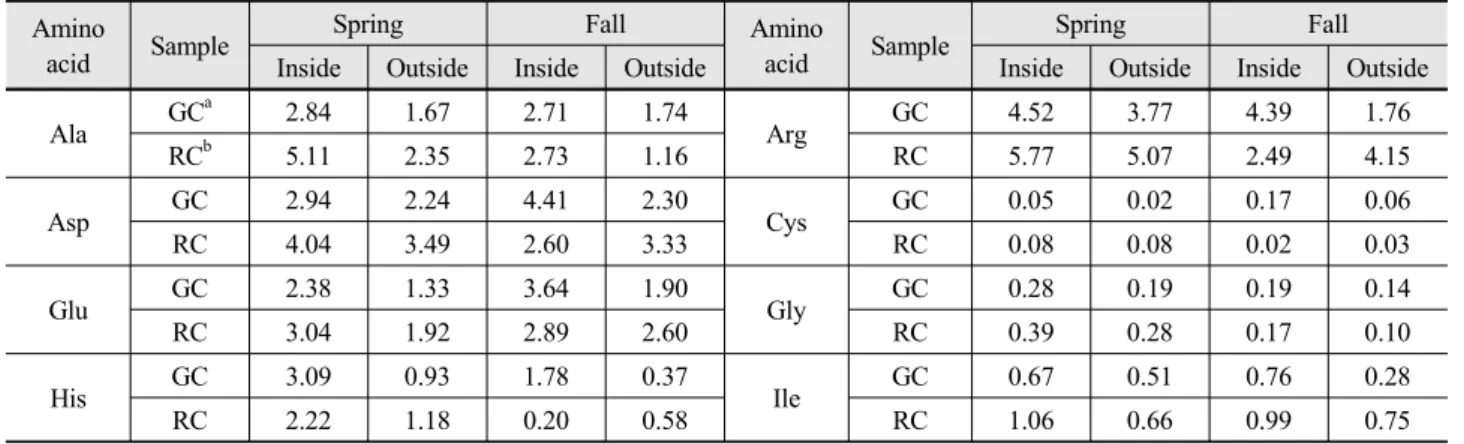
Table 1. Free amino acids in cabbage. (unit: mg/g dry weight).
Amino
acid Sample Spring Fall Amino
acid Sample Spring Fall
Inside Outside Inside Outside Inside Outside Inside Outside Ala GCa 2.84 1.67 2.71 1.74
Arg GC 4.52 3.77 4.39 1.76
RCb 5.11 2.35 2.73 1.16 RC 5.77 5.07 2.49 4.15
Asp GC 2.94 2.24 4.41 2.30
Cys GC 0.05 0.02 0.17 0.06
RC 4.04 3.49 2.60 3.33 RC 0.08 0.08 0.02 0.03
Glu GC 2.38 1.33 3.64 1.90
Gly GC 0.28 0.19 0.19 0.14
RC 3.04 1.92 2.89 2.60 RC 0.39 0.28 0.17 0.10
His GC 3.09 0.93 1.78 0.37
Ile GC 0.67 0.51 0.76 0.28
RC 2.22 1.18 0.20 0.58 RC 1.06 0.66 0.99 0.75
aGC품종(계통)(n=6): GC1=Kyongoong-1ho, GC2=Young-oe, GC3=Shuoyuan, GC4=Bogam-2ho, GC5=Highque-2ho, GC6=Dongbuk.
bRC품종(계통)(n=4): RC1=Joongsanglubia, RC2=Lubia, RC3=Redrooky, RC4=Redshine.
charged, negatively charged등으로 구분되고 있다. 곁사 슬이 수소원자뿐인 글리신(glycine)을 제외하고, 다른 아 미노산은 모두 두 가지 광학 활성을 가져, D형과 L형으로 구분된다(Nelson과 Cox, 2008). 단백질(protein)을 구성 하는 아미노산의 거의 대부분은 L-아미노산 형태로 존재 한다. 사람이 음식으로 섭취하여 얻은 20종의 아미노산은 단백질 또는 생체분자 합성 등에 사용된다. 유리아미노산 의 경우 맛과 연관이 있다 할 수 있겠다. 단맛을 내는 아미 노산은 alanine, lysine, proline, threonine, valine등 이 고, 쓴맛을 내는 것은 arginine, cystine, histidine, leucine, isoleucine, methionine, phenylalanine, tryptophan등 이 있다(Shallenberger, 1993). Glutamate는 mono sodium 염의 형태로 조미료의 원료로 사용되는 umami의 원료가 되며, 수용성 아미노산인 aspartate등은 umami를 내는 맛 의 중요한 요소가 되고 있다.
본 연구에서는 기능성 성분의 원료가 되고 맛에 영향을 미치는 유리아미노산의 함량을 계절(봄・가을), 시료의 부 분(바깥과 안), 양배추의 색(녹색・적색)에 따른 차이를 알 아보았다.
II. 재료 및 방법
1. 재료
양배추는 국립원예특작과학원 채소과에서 재배한 것으 로 2008년 11월에 수확한 것과 2009년 6월에 수확한 것을 사용하였다. 양배추의 품종은 Table 1에 나타내었다. 양배
추를 세로로 자른 후 중심과 바깥쪽 반지름을 반으로 나누 어 바깥과 안으로 나눈 후 동결건조 하였다. 일반 믹서(후 드믹서 HMF-390, 한일전기주식회사, Korea)를 이용하여 동결건조된 시료를 분쇄 하였다. 분쇄된 시료를 이용하여 일회 실험 하였다. Amino aicds mixture standard solution (Type H, Wako, Japan)을 사용하여 검정곡선을 구하였다.
2. 추출
동결건조 시료 0.1 g에 5% trichloroacetic acid(Duksan, Korea) 1.2 ml를 첨가하였고 잘 섞은 후 4℃에서 22,250
×g조건에서 15분간 원심분리(Micro 17r, Hanil science industrial co., Korea) 후 상층액을 취하였다. Sodium diluent(Na220, Pickering Laboratoris Inc., USA)용액 을 이용하여 희석하였고 0.2 ㎛ 필터(Millex-gv 4 mm, Millipore, USA)로 여과하였다(The Korean Society of Food Science and Nutrition, 2000).
3. HPLC와 아미노산분석기를 이용한 분석
HPLC(Waters 2695. Waters, Milford, MA, USA)를 이 용하여 아미노산을 분석하였다. 이온컬럼(sodium amino acid analysis cation exchange 8 ㎛, 30×250 mm, Pickering, USA)을 사용하고, 컬럼의 온도는 48℃로 하였 다. 아미노산 추출물과 ninhydrin시약(Pickering Laboratoris Inc. USA)은 amino acid analyzer(Vector. Pickering Laboratoris Inc., USA)에서 반응시켜 detector(Waters
Table 1. Continued.
Amino
acid Samplea Spring Fall Amino
acid Sample Spring Fall
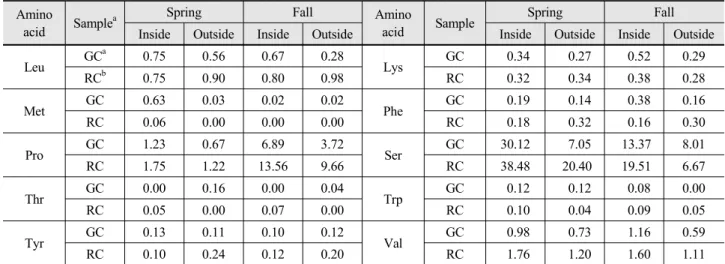
Inside Outside Inside Outside Inside Outside Inside Outside
Leu GCa 0.75 0.56 0.67 0.28
Lys GC 0.34 0.27 0.52 0.29
RCb 0.75 0.90 0.80 0.98 RC 0.32 0.34 0.38 0.28
Met GC 0.63 0.03 0.02 0.02
Phe GC 0.19 0.14 0.38 0.16
RC 0.06 0.00 0.00 0.00 RC 0.18 0.32 0.16 0.30
Pro GC 1.23 0.67 6.89 3.72
Ser GC 30.12 7.05 13.37 8.01
RC 1.75 1.22 13.56 9.66 RC 38.48 20.40 19.51 6.67
Thr GC 0.00 0.16 0.00 0.04
Trp GC 0.12 0.12 0.08 0.00
RC 0.05 0.00 0.07 0.00 RC 0.10 0.04 0.09 0.05
Tyr GC 0.13 0.11 0.10 0.12
Val GC 0.98 0.73 1.16 0.59
RC 0.10 0.24 0.12 0.20 RC 1.76 1.20 1.60 1.11
aGC품종(계통)(n=6): GC1=Kyongoong-1ho, GC2=Young-oe, GC3=Shuoyuan, GC4=Bogam-2ho, GC5=Highque-2ho, GC6=Dongbuk.
bRC품종(계통)(n=4): RC1=Joongsanglubia, RC2=Lubia, RC3=Redrooky, RC4=Redshine.
2487. Waters, Milford, MA, USA)를 이용하여 570 ㎚에 서 검출하였다.
이동상으로는 Na328, Na740, RG011(Pickering Laboratoris inc., USA)를 이용하였다. 처음 Na328 100%로 시작하여 10분까지 Na328 100% 흘려주었고, 10~32분에는 Na328 100%에서 Na740 100%로 gradient, 32~56분까지 Na740 100%유지, 56~56.1분은 Na740 100%에서 RG011 100%로 gradient, 56.1~58분에는 RG011 100%유지, 58~58.1분 은 RG011 100%에서 Na328 100%로 gradient, 58.1~70분 까지 Na328 100%유지로 용매를 흘렸다. 이동상 흐름은 0.30 ml/min로 하였다.
4. 통계처리
SPSS 18.0 을 이용 통계적 처리를 하였다. 계절・시료의 부분・양배추의 색이 아미노산의 생산에 미치는 영향을 측 정하기 위하여 다변량분산분석(MANOVA)를 이용하여 측 정하였다. 아미노산과 다른 아미노산 및 이차대사산물 간 의 상관관계는 피어슨 상관계수(Pearson correlation co- efficient)를 이용하여 측정하였다.
III. 결 과
양배추에서 18종의 유리 아미노산의 함량을 측정하여 양 배추의 품질을 조사하였다(Table 1). 총 아미노산 함량이 가장 높은 것은 GC6(spring・inside)로 163.92 mg/g dry
weight(dw)이고 가장 낮은 것은 GC1(spring・outside)으 로 7.49 mg/g dw(이하 ( )생략)이었다. 필수 아미노산 함 량이 가장 높은 것은 GC1(fall・inside)로 8.29 mg/g dw이 고 가장 낮은 것은 GC3(fall・outside)로 0.35 mg/g dw이 었다. 전체 아미노산의 함량 중 필수 아미노산의 비는 GC6 (fall・outside)가 23.84%로 가장 높았고 GC6(spring・inside)가 1.61%로 가장 낮았으며, 이 결과는 Cho 등(1993)에서 실험 한 돌산갓의 전체 아미노산 함량 중 필수 아미노산의 비인 28.3% 보다 낮게 나왔다. 극성 아미노산(Arg, Asp, Glu, His, Lys, Ser, Thr, Tyr)을 가장 많이 함유한 것은 GC6 (spring・inside)이고, 가장 적게 함유한 것은 GC3(fall・
outside)이였다. 비극성 아미노산(Ala, Cys, Gly, Ile, Leu, Met, Phe, Pro, Trp, Val)을 가장 많이 함유한 것은 GC1 (fall・inside)이고, 가장 적게 함유한 것은 GC4(fall・inside) 였다(Table 1).
Inside와 outside의 각 아미노산 함량 비교시 녹색양배 추(GC)들은 methionine, threonine과 tyrosine을 제외하 고 inside의 함량이 outside의 함량 보다 높게 나왔다. 한 국인이 배추 속을 즐겨먹는 이유 중 하나가 고소한 맛으로, 속잎이 더 많은 아미노산을 함유하여 더 좋은 맛을 내는 것으로 사료된다. 적색양배추(RC)들은 inside와 outside 의 각 아미노산의 함량 비교 시 일정한 규칙을 찾을 수 없었 다(Table 1).
아미노산의 함량과 계절과의 관계에서 glycine은 spring 의 함량이 높고, proline은 spring의 함량 낮다는 유의한 차이를 보였다. 부위에 따른 유의한 차이는 alanine, glutamic
Table 2. Analyses of variance for free amino acids by the factors (season, position, color) in Brassica oleracea.
Amino acid Season Averagea Position Average Color Average
Ala Spring 2.99 Inside 3.35** Green 2.24
Fall 2.09 Outside 1.73 Red 2.84
Arg Spring 4.78 Inside 4.29 Green 3.61
Fall 3.20 Outside 3.68 Red 4.37
Asp Spring 3.17 Inside 3.49 Green 2.97
Fall 3.16 Outside 2.84 Red 3.36
Cys Spring 0.06 Inside 0.08 Green 0.07
Fall 0.07 Outside 0.05 Red 0.05
Glu Spring 2.17 Inside 2.99* Green 2.31
Fall 2.76 Outside 1.94 Red 2.61
Gly Spring 0.29** Inside 0.26* Green 0.20
Fall 0.15 Outside 0.18 Red 0.23
His Spring 1.85 Inside 1.82 Green 1.54
Fall 0.73 Outside 0.76 Red 1.04
Ile Spring 0.72 Inside 0.87* Green 0.55*
Fall 0.69 Outside 0.55 Red 0.86
Lue Spring 0.74 Inside 0.74 Green 0.57**
Fall 0.68 Outside 0.68 Red 0.85
Lys Spring 0.31 Inside 0.39 Green 0.35
Fall 0.36 Outside 0.29 Red 0.33
Met Spring 0.02 Inside 0.02 Green 0.02
Fall 0.01 Outside 0.01 Red 0.01
Phe Spring 0.20 Inside 0.22 Green 0.21
Fall 0.25 Outside 0.23 Red 0.24
Pro Spring 1.22** Inside 5.86 Green 3.13*
Fall 8.46 Outside 3.82 Red 6.54
Ser Spring 24.01 Inside 25.37* Green 14.64
Fall 11.89 Outside 10.53 Red 21.26
Thr Spring 0.05 Inside 0.03 Green 0.05
Fall 0.03 Outside 0.05 Red 0.03
Trp Spring 0.09 Inside 0.10 Green 0.08
Fall 0.06 Outside 0.05 Red 0.07
Tyr Spring 0.15 Inside 0.11 Green 0.11
Fall 0.13 Outside 0.17 Red 0.17
Val Spring 1.17 Inside 1.37* Green 0.86**
Fall 1.11 Outside 0.90 Red 1.41
Total Spring 43.99 Inside 51.35* Green 33.52
Fall 35.82 Outside 28.46 Red 46.29
**Factor is significant at the 0.01 level (2-tailed).
*Factor is significant at the 0.05 level (2-tailed).
aAverage: The average of amino acids that grouped by the factors.
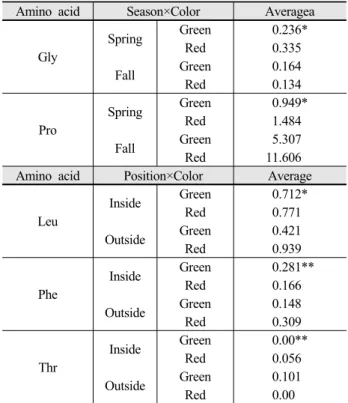
acid, glycine, isoleucine, serine, valine과 총 아미노산 모두 inside의 함량이 높은 것으로 나왔다(Table 2). 색에 따른 유의한 차이는 isoleucine, leucine, proline, valine 모두 적색양배추가 높은 것으로 나왔다(Table 2). 계절과 색 두 가지에 의한 유의 차이에 있어 봄・적색양배추와 가 을・녹색양배추에서 glycine의 함량이 높게 나왔고, 봄・적 색양배추와 가을・적색양배추에서 proline의 함량이 높은 것으로 나왔다(Table 3). 부위와 색 두 가지에 의한 유의한
차이는 안쪽・적색양배추와 바깥쪽・적색양배추에서 leucine 함량이 많은 것으로 나왔고, 안쪽・녹색양배추와 바깥쪽・적 색양배추에서 phenylalanine의 함량이 높은 것으로 나왔 으며, 안쪽・적색양배추와 바깥쪽・녹색양배추에서 threonine 의 함량이 높은 것으로 나왔다(Table 3). 이러한 중요한 cross effect는 적색 및 녹색 양배추의 유전적인 차이에 의 하여 계절 및 잎의 위치에 따른 영향도가 틀린 것을 보여준 다. 계절과 부위 두 가지에 의한 유의한 차이와 계절・부위・
Table 3. Free amino acids showing significances in cross factor effect (season×color and position×color) in Brassica oleracea.
Amino acid Season×Color Averagea
Gly
Spring Green 0.236*
Red 0.335
Fall Green 0.164
Red 0.134
Pro
Spring Green 0.949*
Red 1.484
Fall Green 5.307
Red 11.606
Amino acid Position×Color Average
Leu
Inside Green 0.712*
Red 0.771
Outside Green 0.421
Red 0.939
Phe
Inside Green 0.281**
Red 0.166
Outside Green 0.148
Red 0.309
Thr
Inside Green 0.00**
Red 0.056
Outside Green 0.101
Red 0.00
**Factor is significant at the 0.01 level (2-tailed).
*Factor is significant at the 0.05 level (2-tailed).
aAverage: The average of amino acids that grouped by the factors.
Fig. 1. Amino acids pathway(http://www.genome.jp/, http://plantcyc.org/).
색 세 가지의 유의한 차이는 없는 것으로 나왔다.
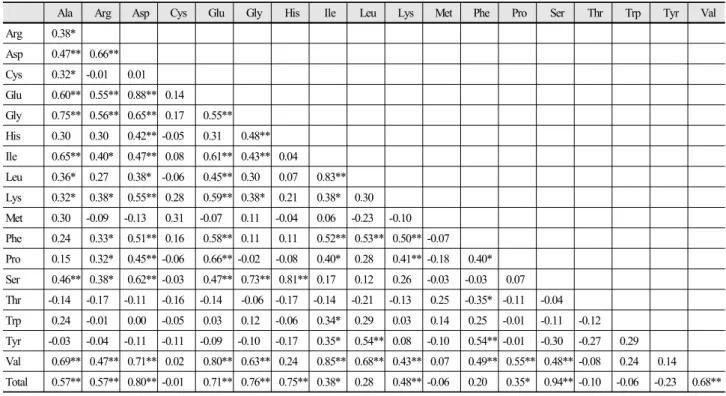
Aspartic acid는 alanine, glutamic acid는 모든 시료에 서의 각각의 총 함량은 125.05 mg/g dw, 99.15 mg/g dw, 97.24 mg/g dw으로 다른 아미노산의 총 함량과 비교 시 세 가지가 비슷한 함량을 갖고 있다(Table 1). 이들은 TCA cycle 중간대사산물로부터 생산되기 때문에(Fig. 1) 서로 영향이 있다고 생각되는데 이들 상호 간 유의하게 높은 상 관계수를 보여주고 있다(Table 4). 또한 여러 아미노산이 이들 세 아미노산으로부터 생산되기 때문에(Fig. 1)이들이 많은 다른 아미노산과 상관성이 있는 것으로 사료된다 (Table 4). Alanine과 cystine은 당에서 생성되는 과정에 서는 서로 떨어져 있으나 cystine에서 alanine으로 전환 시키는 효소에 의해 cystine의 증감에 alanine이 영향을 받는 것으로 보인다.
Tyrosine, phenylalanine, tryptophan은 Fig. 1에서처 럼 chorismate에서부터 만들어지기 때문에 chorismate의 증감에 영향을 받을 것으로 생각된다. 그렇지만 Tyrosine 과 phenylalanine은 pathway에서 붙어 있기에 서로 영향 을 주지만 tryptophan의 경우 다른 두 amimo acids와 서 로 영향이 없는 것으로 보인다(Table 4). Valine, isoleucine, leucine세 가지 또한 pathway에서 가깝고 significance가
Table 4. Pearson correlation coefficients among free amino acids in Brassica oleracea.
Ala Arg Asp Cys Glu Gly His Ile Leu Lys Met Phe Pro Ser Thr Trp Tyr Val Arg 0.38*
Asp 0.47** 0.66**
Cys 0.32* -0.01 0.01 Glu 0.60** 0.55** 0.88** 0.14 Gly 0.75** 0.56** 0.65** 0.17 0.55**
His 0.30 0.30 0.42** -0.05 0.31 0.48**
Ile 0.65** 0.40* 0.47** 0.08 0.61** 0.43** 0.04 Leu 0.36* 0.27 0.38* -0.06 0.45** 0.30 0.07 0.83**
Lys 0.32* 0.38* 0.55** 0.28 0.59** 0.38* 0.21 0.38* 0.30 Met 0.30 -0.09 -0.13 0.31 -0.07 0.11 -0.04 0.06 -0.23 -0.10 Phe 0.24 0.33* 0.51** 0.16 0.58** 0.11 0.11 0.52** 0.53** 0.50** -0.07 Pro 0.15 0.32* 0.45** -0.06 0.66** -0.02 -0.08 0.40* 0.28 0.41** -0.18 0.40*
Ser 0.46** 0.38* 0.62** -0.03 0.47** 0.73** 0.81** 0.17 0.12 0.26 -0.03 -0.03 0.07 Thr -0.14 -0.17 -0.11 -0.16 -0.14 -0.06 -0.17 -0.14 -0.21 -0.13 0.25 -0.35* -0.11 -0.04 Trp 0.24 -0.01 0.00 -0.05 0.03 0.12 -0.06 0.34* 0.29 0.03 0.14 0.25 -0.01 -0.11 -0.12 Tyr -0.03 -0.04 -0.11 -0.11 -0.09 -0.10 -0.17 0.35* 0.54** 0.08 -0.10 0.54** -0.01 -0.30 -0.27 0.29 Val 0.69** 0.47** 0.71** 0.02 0.80** 0.63** 0.24 0.85** 0.68** 0.43** 0.07 0.49** 0.55** 0.48** -0.08 0.24 0.14 Total 0.57** 0.57** 0.80** -0.01 0.71** 0.76** 0.75** 0.38* 0.28 0.48** -0.06 0.20 0.35* 0.94** -0.10 -0.06 -0.23 0.68**
aPC=pearson correlation.
**Factor is significant at the 0.01 level (2-tailed).
*Factor is significant at the 0.05 level (2-tailed).
Table 5. Pearson correlation coefficients between precursor amino acids and phenolics.
Phenolic acids Anthocyanidins Flavonols Gluconasturtiin Glucobrassicin Glucosinolates
Phe 0.06 0.10 0.24 NDb ND ND
Tyr 0.26 0.28 0.39* ND ND ND
Ser 0.10 0.17 -0.05 0.42** 0.65** 0.45**
Total glucosinolates synthesized from tryptophane
Trp 0.15
Total glucosinolates synthesized from homomethionine Total glucosinolates synthesized from dihomomethionine
Met 0.07 -0.07
bND=not determined.
aPC=pearson correlation.
**Factor is significant at the 0.01 level (2-tailed).
*Factor is significant at the 0.05 level (2-tailed).
동시에 나오는 경우가 많은 것으로 보아 서로 관련이 있는 것으로 보인다(Table 4)(Fig. 1). Glycine과 serine의 경우 pathway에서 가깝고 Table 4에서 significance가 동시에 나오는 경우가 많은 것으로 보아 밀접한 영향을 주는 것으 로 생각된다(Fig. 1). 그렇지만 모든 시료의 serine의 총 함량은 가장 높은데 비해 glycine의 함량은 매우 낮은 것으 로 보아 serine에서 glycine의 전환 효소가 glycine에서 serine으로의 전환효소보다 더 많거나 강력한 것으로 생각
된다(Table 1)(Fig. 1). 또한 glycerate-3P로부터 생성되 는 serine의 함량은 성장이 빠른 여름의 속잎에 많았기 때 문에 serine의 생산은 대사외 활성도를 나타내는 것으로 사료된다.
Phenylalanine과 tyrosine 모두 phenolic acids, anthoc- yanidins, flavonols의 전구체 이지만(Fig. 2), 이들 간 상 관관계를 조사하였을 때 tyrosine만이 flavonols와 관련 이 있다고 나왔다(Table 5). Tryptophan과 methionine도
Fig. 2. Metabolic pathway of phenolics. (To p-coumaric from tyrosine way is not proven in Arabidopsis thaliana) (http://plantcyc.org/).
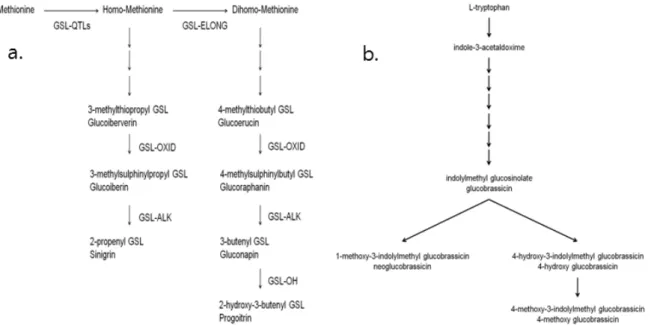
Fig. 3. a. Glucosinolate biosynthesis pathway from methionine, GSL=glucosinolate, QTL=quantitative trait locus, OXID=oxidation, ALK=dioxygenation, OH=hydroxylation(Mithen, et al., 2003). b. Glucosinolate biosynthesis pathway from tryptophan (http://
plantcyc.org/).
glucosinolates의 전구체이지만(Fig. 3) 상관성을 찾아볼 수 없었다(Table 5). 이들 아미노산의 함량이 매우 적어 (<0.63 mg/g dw) 실험상 이들 간의 상관관계 측정이 불가 능 하였던 것으로 사료된다.
IV. 결 론
양배추의 아미노산 함량과 계절・부분・색에 따른 상관관 계 실험결과 아미노산 함량과 계절과의 관계에서 glycine, proline이 유의한 차이를 보였다. 시료의 바깥과 안에 따른 유의한 차이는 alanine, glutamic aicd, glycine, isoleucine, serine, valine과 전체 아미노산(Total) 함량이 있었고, 색
에 따른 유의한 차이는 isoleucine, leucine, proline, valine이 있었다. 계절과 색 두 가지에 의한 유의한 차이는 부분과 색 두 가지에 의한 유의한 차이는 leucine, phe- nylalanine, threonine이었으며, 계절과 부분 두 가지에 의 한 유의한 차이와 계절, 부분, 색 세 가지의 유의한 차이는 없는 것으로 결과가 나왔다. Pathway에서 가까운 아미노 산은 서로 영향을 주는 것으로 보이며 양 방향으로 영향을 주기도 하지만 한 방향으로 영향을 주기도 하는 것으로 보 인다. 양배추에서 glucose대사 과정 중 생성되는 glycerate- 3P에서 전환되는 serine과 TCA cycle주위의 aspartic acid, glutamic acid, alanine의 함량이 많이 검출된 것으로 생 각된다.
감사의 글
본 연구는 농림수산식품부 농림기술개발사업(Project No. 607003-05-3-SB120, 308023-03-1-HD110), 농촌 진흥청 농업과학기술개발 공동연구사업(Project No. 2009 0101-081-109-001-04-00)의 지원에 의해 이루어진 것 이다. 또한 본 과제는 교육과학기술부의 재원으로 한국연 구재단의 지원을 받아 수행된 광역경제권 선도산업 인재양 성사업의 연구결과입니다.
참 고 문 헌
1. Cartea ME, Velasco P, Obregon S, Padilla G, Haro AD.
2008. Seasonal variation in glucosinolate content in Brassica oleracea crops grown in northwestern Spain. Phytochemistry 69(2): 403-410.
2. Cho YS, Park SK, Chun SS, Moon JS, Ha BS. 1993.
Proximate, sugar and amino acid compositions of dolsan leaf mustard (Brassica juncea). J. Korean Soc. Food Nutr.
22(1): 48-52.
3. Divisi D, Di-Tommaso S, Salvemini S, Garramone M, Crisci R. 2006. Diet and cancer. Acta Biomed. 77(2): 118-123.
4. Harbaum B, Hubbermann EM, Wolff C, Herges R, Zhu Z, Schwarz K. 2007. Identification of flavonoids and hydroxy- cinnamic acids in pak choi varieties(Brassica campestris L.
ssp. chinensis var. communis) by HPLC-ESI-MS and NMR and their quantification by HPLC-DAD. Journal of Agricul-
tural and Food Chemistry 55(20): 8251-8260.
5. Hayes JD, Kelleher MO, Eggleston IM. 2008. The cancer chemopreventive actions of phytochemicals derived from glucosinolates. European Journal of Nutrition 47(2): 73-88.
6. Hounsome N, Hounsome B, Tomos D, Edwards-Jones G.
2009. Changes in antioxidant compounds in white cabbage during winter storage. Postharvest Biology and Technology 52(2): 173-179.
7. Lovdal T, Olsen KM, Slimestad R, Verheul M, Lilloand C.
2010. Synergetic effects of nitrogen depletion, temperature, and light on the content of phenolic compounds and gene expression in leaves of tomato. Phytochemistry 71(5-6): 605 -613.
8. Nelson DL, Cox MM. 2008. Lehninger Principles of Bio- chemistry. Freeman WH and Company, 5th ed. pp. 250-300.
New York, USA.
9. Shallenberger RS. 1993. Taste Chemistry. pp. 226-252.
Blackie Academic & Professional. New York Agricultural Experiment Station Cornell Univ., New York, USA.
10. The Korean Society of Food Science and Nutrition. 2000.
Handbook of Experiments in Food Science and Nutrition.
Nutrition ed. pp. 181-191. Hyoil, Korea. [in Korean]
11. Yang MO. 2009. Quality characteristics of Sulgidduk added with cabbage powder. J. East Asian Soc. Dietary Life 19(5):
729-735.
12. Zang YX, Kim JH, Park YD, Kim DH, Hong SB. 2008.
Metabolic engineering of aliphatic glucosinolates in Chinese cabbage plants expressing Arabidopsis MAM1, CYP79F1, and CYP83A1. Biochemistry and Molecular Biology Reports 41(6): 472-478.