Chalcone
유도체들의 사람 유방암세포주 및 사람 섬유육종 세포에 대한
세포득성효과
강 유 라 . 박 민 아 . 조 미 연 . 이 경 희 * • 김정애수 영남대학교 약학대학, *식품영양학과
(Received September 23, 2009; Revised December 9, 2009; Accepted December 10, 2009)
Cytotoxic Effect of Chalcone Derivatives in MCF-7 Human Breast Cancer and HT-1080 Human Fibrosarcoma Cells
Youra Kang, Min-A Park, Mi-Yeon Cho Kyung H ee Lee* and Jung-Ae K im ^
College of Pharmacy and Department of
""Food and Nutrition, Yeungnam University, 214-1 Dae-dong, Gyeongsan 712-749, Korea
Abstract — Xanthohumol, a prenylated chalcone of the Hop plant (Humulus lupulus L.), has been reported to suppress tumor growth. 4-hydroxychalcone and isobavachalcone are chalcone derivatives and they have similar structure with xan- thohumol. In the present study, we investigated the cytotoxic activities of chalcone and its derivatives, 4-hydroxychalcone, xanthohumol, and isobavachalcone, in MCF-7 and adriamycin resistant MCF-7 (MCF-7/ADR) breast cancer cells and HT- 1080 fibrosarcoma cells. In a cell viability assay using 3-[4,5-dimethylthiazol-2-yl]-2,5-diphenyltetrazoIium bromide (MTT) reagent, chalcone and 4-hydroxychalcone decreased cell viability in HT-1080 cells, but not in MCF-7 and MCF-7/ADR cells.
Isobavachalcone showed similar cytotoxicity in HT-1080 cells, and only limited cytotoxicity in MCF-7 and MCF-7/ADR cells at very high concentration (50 jiM). In contrast, xanthohumol showed concentration-dependent cytotoxicity in MCF-7, MCF-7/ADR, and HT-1080 cancer cells. Taken together, the structure-activity relationship of chalcone and its derivatives indicate that chalcones may be valuable cytotoxic compounds against selective cancer types.
Keywords □ chalcone, 4-hydroxychalcone, xanthohumol, isobavachalcone
암은 발암물질이나 유전바이러스에 의해 변형된 세포가 비정 상적으로 증식하여 주위 조직으로 침투하고, 멀리 떨어져 있는 조직까지 퍼져나가 성장하여 생명을 위협하는 질환이다. 암은 현 대사회에서 여전히 완치되기 어려운 질병 중 하나의며 현재 꾸 준히 발병률이 증가하고 있는 추세이다. 암 치료에 사용되고 있 는 방법은 수술, 화학적 요법, 방사선 요법 등을 들 수 있으며 특 히 화학적 요법은 암 치료의 견 과정에서 적용되고 있다. 최근에 는 Tax이과 같은 함함 활성 물질을 천연재료로부터 발굴, 이용하 고자 하는 연구가 활발히 진행되고 었다.
Chalcone은 방향족 케론으로서 flavonoid로부터 생합성 된다.
Chalcone은 식물에 광범위하게 존재하며 생물학적 활성을 나타 낸다. Xanthohumol을 비롯하여 천연에 존재하는 chalcone과 합
본 논문에 관한 문의는 저자에게로 (전화) 053-810-3974 (팩스) 053-810-4654 (E-mail) [email protected]
성에 의하며 만둘어진 chalcone둘의 효능에 대한 연구가 활발히 이루어 지고 있으며 항염증,내 면역조절,* 항암;*'® 항에이즈,® a- glucosidase 저해 효과^* 등 다양한 영역에서 효능을 가지는 것으 로 보고되고 있다.
Chalcone에 속하는 여러 물질 중에서 특히 xanthohumol이 다 양한 약리학적 효과를 지니는 것으로 알려져 있다. Xanthohumol 은 prenyl기를 지닌 chalcone으로 hop식물인 Humulus lupulus
L.에 다량 함유되어 있으며, 항산화 효과, 항유전독성, 항증식 그 리고 암세포의 사멸을 유도하고 암의 초기특성을 저해함에 따라 항암효과도 나타낸다.®■미 최근에는 유방암 세포주와 leukemic cancer 세포주 등에서 xanthohumol이 침윤 억제 효과가 있옴이 밝혀졌으며/3 신생혈관형성 저해, 염증 억제 효과도 가지는 것 밝혀졌다.지 ®' 번면, isobavachalcone이나 44iydroxychalcone 은 이와 구조적 유 성 을 지니고 있옴에도 불구하고 아직 연구 가 활발하게 이루어지지 않고 있다.
여러가지 chalcone 중에서도 특히 xanthohum이이 다양한 약
27
28 강유라 ■벅민아 • 조미연 ■김정애
리학적 활성을 가지는 이유가 그 구조적 특성에 의한 것인지는 명확히 알려져 있지 않다. 따라서 본 연구에서는 chalcone, 4- hydroxychalcone, xanthohumoi, isobavachalcone 의 구 적 차 이에 따른 암세포득성 활성 관계를 비교하고, chalcone이 새로운 항암 선도물질로서의 잠재적인 능력을 평가하고자 하였다.
실 험 방 법
재료
M inimum essential medium(MEM), fetal bovine serum (FBS), peniciUiii/streptomycin(PS)-?r Hyclone-Pierce Co.(Hyclone, Logan, U.S.A.)에서 구입하였다. Trypsin/EDTA는 Gibco Corp.
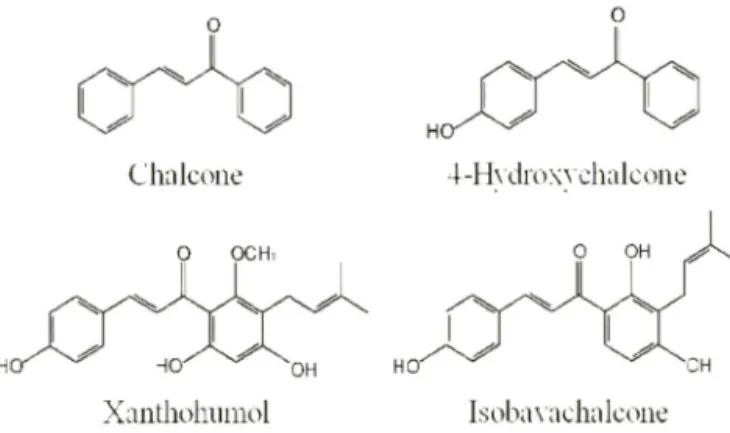
(Paisley, Scotland, UK)에서 구입하였다. 3-[4, 5-dimethylthiazol- 2-yl]-2, 5-diphenyltetrazolium biDmide(MTT), dimethyl sulfoxide (DM SOHf Sigma Chemical Co.(St. Louis, MO, U .S A)에서 구 입하였다. Xanthohum이파 isobavachalcone은 Alexis Co.(San Diego, CA, U .S A)에서 구입하였으며, chalcone과 4-hydroxy- chalcone-Sr Tokyo Chemical Industry Co.(Tokyo)에서 구입하였 다. 각각의 구조식은 Fig. 1에 표시하였다.
세포 배양
유방암 세포주인 MCF-7과 인간 섬유육종세포주인 HT-1080 은 American Type Culture Collection로 부터 분앙 받았으며 adriamycin 저항성을 가지는 유 방 세 포 주 인 MCF-7/ADR은 조 선대학교 강건욱 교수님으로부터 분양 받아 사 § -하였다. HT-1080 -?r 10% fetal bovine serum (FBS) (v/v) 와 lOOIU/m/ penicillin, 100 [ig/ml streptomycin이 첨가된 M EM 배지를 사 용 하 여 37X ,
5% C0 2-humidified incubator에서 배양하였다. 70~80%의 confluence가 되면 1: 5의 비율로 계대 배양을 설시하였다.
세포 생존률 측정
세포 생존률은 3-[4,5-dimethylthiazol-2-yl]-2,5-diphenyltetra-
4-HuiroxvclKilcoiie
Fig. 1 - Chemical structure of chalcone, 4-hydroxychalcone, xantho
humoi, and isobavachalcone.
zolium bromide(MTT) 염색법으로 죽정한다. 96-well microtiter plates(Nunc, Denmark)에 HT-1080을 lxlO\ :ells/well으] 능도 로 seeding한 뒤 xanthohumoi, chalcone 및 그 유도체들을 처러 하고 24시간 후 20 m/ MTT solution(5 mg/m/>을: 각각의 well에 넣는다. 3 7 X incubator에서 4시간 보관한 뒤 배지룰 제거하고 formazan 크리스탈을 용해시키기 위해 DMSO(200m/>를 넣어준 다. Formazan 크리스탈의 앙은 540nm에서 microplate reader (Molecular Devices, Versa MAX Sunnyvale, CA)를 사용하여 optical density(OD)틀 측정한다. 상대적인 세포 생존률은 MTT 에 의해 formazan 크리스탈로 변환된 양을 대조군에 대한 백분 율로 계산한다.
자료분석 및 통계적 검정
실험결과는 평균±표준오차로 표기하였으며 통계분석은 Student's t test로 검 정하였다. P 값이 5% 미만일 때 통계적으로 유의하다고 간주하였다.
실 험 결 과
인간 섬유육종 세포주 HT-1080에 대한 세포 생존를 측정 Chalcone 및 그 유도체들을 인간 섬유육종 세포주인 HT-1080 세포에 농도별로 처리하고 48시간 배양한 후 MTT assay률 설 시하쉬 세포 생존률을 측정하였다. 그 결과, 대조군에 비해 화합 물 모두 농도의존적인 세포 생존률 감소를 나타내었다.
Xanthohumoi, isobavachalcone, chalcone은 10 농도에서부터 세포 생존률이 감소하는 경향을 보였고 유의적인 감소는 2(HiM 에서부터 나타났다. 반면 4-hydroxychalconefi:2 0 |xM에서부터 세 포 생존률이 감소하였으며 5(UiM에서 유의 적인 감소가 나타났 다. 4가지 화합'물들의 세포 생존률을 비교하였을 때 xanthohumoi 이 2 0 에서 80% 가량 세포 생존률을 떨어뜨림로써 가장 큰 세포득성을 나타내었으며 다옴으로 isobavachalcone, chalcone, 4-hydroxychalcone 순으로 세포 생존률을 저하시켰다(Fig. 2A—
2D).
유방암세포주MCF-7파MCF-7/ADR에대한세포생존를측정 유방암 세포주인 MCF-7파 adriamycin 저항성을 지니는 MCF- 7/ADR 세포 생존률에 대한 측정 결과, xanthohumoi은 HT-1080 세포와 마찬가지로 유방암 세포주에서도 농도의존적인 높은 세 포득성을 나타내었으나 chalcone, 4-hydroxychalcone은■ 100 |jM 의 고농도에서도 세포득성을 나타내 보이지 않았으며 iso- bavachalcone은 50 |iM에서 세포 생존률이 유의 적으로 감소히는 것으로 나타났다. 특히 xanthohumoi은 MCF-7 보다 MCF-7/
ADR 세포에서 세포 생존률 감소효과가 더 크게 나타나, adriamycin 등 약물저항성을 보이는 암세포 사멸치료제로서의 가
]. Pharm. Soc. Korea
0 0.1 1 5 10 20 50 100 Xanthohiimol (u M)
1 5 10 20 50
Isobavachalcone (나 M)
(C) (D)
Fig. 2 - Cytotoxic effects of chalcone and its derivatives on MCF-7, MCF-7/ADR, and HT-1080 cancer cells. Cells were plated in a 96-well plate and various concentrations of chalcone (A), 4-hydroxychalcone (B), xanthohumol (C), and isobavachalcone (D) were treated for 48 h.
Cell viability were measured by MTT assay. The bar graphs represent the mean ± SEM from three independent experiments in triplicate. *P<0.05, compared to untreated-control group.
능성이 매우 큼을 시사한다(Fig. 2A -2D ).
고 찰
이견의 여러 연구에 의하면 합성 또는 천연에서 유래한 특정 chalcone은 인간의 암세포주에서 증식억제 효과를 나타낸다7'^®■조바 대장암 세포 성장 억제제로서 chalcone의 잠재성은 hydroxyl 기 의 위치와 수에 따라 달라지며/^^ 자궁암 세포에서는 a-p 이중 결합의 존재, B ring에서 2번 3번 자리의 hydroxylation, prenyl 기의 부재가 chalcone의 암세포증식억제 활성에 중요한 요인으 로 작용함이 보고된 바 있다.과^ 따라서 특정 암세포주에서 chalcone이 증식억제 효과를 가지도록 결정짓는 요인을 찾아내는 것이 중요한 의머를 가질 것으로 관단된다. MTT assay를 이용한 본 설험에서는 4가지 chalcone을 테스트 하였고, xanthohumol은
유방암 세포(MCF-7, MCF-7/ADR)와 인간 섬유육종 세포(HT- 1080) 모두에서 높은 세포득성을 나타내었다. 반면 4-hydroxy- chalcone은 4가지 chalcone 숭에서 가장 약한 세포득성을 나타 내었다. 3가지 세포주에 대한 반응을 보았을 때 xanthohumol을 제외한 3 가지 chalcone은 MCF-7이나 MCF-7/ADR보다 HT- 1080가 더 민감하게 반응하식 농도 의존적으로 높은 세포득성을 나타내었다. 본 실험의 결과에서 chalcone들이 각기 다른 세포득 성을 나타내는 것은 chalcone 분자서1서 처환기의 위치와 특징돌 때문이다. Miranda 등에 의하면 MCF-7에서 xanthohumol은 prenyl기와 methoxy기를 가지므로 세포 증식 억제 활성을 지닌 다고 밝혔다.^^ 본 연구에서도 마찬가지로 prenyl기를 지니는 xanthohum이과 isobavachalcone은• MCF-7에서 세포득성이 현저 한 것으로 나타났으나 prenyl기를 지니지 않는 chalcone과 4- hydroxychalcone의 경우 MCF-7에서 유의할 만한 세포득성이 나
Vol. 54, No. 1, 2010
Xanthohum이과 Chalcone 의유도체들의 암세포득성 비교 29
S
C0
i
I
3
Chalcone M)
(A)
4-HydroxychaIcone (나 M)
(B)
w o o o o o o o M
4 2 0 8 6 4 2 {
I
PI
!
JO%}
o
o
o
o
o
08642
o/o>
30 강유•라 • 박민아 • 조미연 • 김정애
타나지 않았다. 또한 4가지 chalcone 중에서 xanthohumol만이 methoxy기를 가지므로 걸과적으로 다른 chalcone에 비해 가장 강력한 세포 득성을 나타내었다. 한편, HT-1080에서는 4가지 chalcone 모두가 농도의존적으로 세포득성을 나타냄으로써 chalcone 기본 구조에 매우 민감하게 빈움하는 암종으로 관단된다.
Xanthohumol은 인간 섬유육종 세포주와 유방암 세포주 외에 도 결장암", 자궁암% 전립선암 세포 등 다양한 세포주에서 높온■ 세 포득성을 지니며 세포사멸을 유도하는 효과를 나타내는 것으로 보고되고 있다.®'은개^ Chalcone과 4-hydroxychalcone은: 유방암 세 포주에서 세포득성이 없으며, xanthohumol의 구조에서 prenyl기 는 보유하고 있지만 B ring의 hydroxylation 그룹이 부재한 isobavachalcone의 경우 xanthohumol 보다 세포득성 효과가 낮 은 결과로 볼때, 유방암세포는 chalcone 화합물에 prenyl 기 및 B ring의 hydroxylation 그룹의 존재에 민감하게 반응함울 의미 한다. 이러한 chalcone 화합물들의 구조칠성 결과는 항암제로서 의 잠재성이 큰 화합물 구조를 제시하고 있다.
감 사 의 말 씀
이 논문은 2009년 정부(지식경제부)의 지역혁신프로그램 재원 으로 한국산업기술평가관리원의 지원울 받아 수행된 연구임 (RTI04-01-04).
참 고 문 헌
1) De Mello, J. E, De Lima, 0. G., De Albuquerque, M. M., Marini-Bettolo, G. B., Lyra, E D. and Da Silva, E. C. : 0 and C prenylated chalcones with- antineoplastic and antibiotic activities isolated from Lonchocarpus neuroscapha Benth.
Revista Instituto de Antibioticos (Recife) 14, 39 (1974).
2) Ramanathan, R., Tan, C. H. and Das, N. E : Inhibitory effects of 2-hydroxychalcone and other flavonoids on human cancer cell proliferation. Int. J. Oncology 3, 115 (1993).
3) Satomi, Y. : Inhibitory effects of 3'-methyl-3-hydroxy-chalcone on proliferation of human malignant tumour cells and on skin carcinogenesis. Int. J. Cancer. 55, 506 (1993).
4) Yit, C. C. and Das, N. R : Cytotoxic effect of butein on human colon adenocarcinoma cell proliferation. Cancer Lett. 82, 65 (1994).
5) De Vincenzo, R., Scambia, G., Benedetti Panici, R, Ranelletti, E O., Bonanino, G., Ercoli Monache, A., Delle, E, Ferrari, E, Piantelli, M. and Mancuso, S .: Effect of synthetic and naturally occurring chalcones on ovarian cancer cell growth: structure- activity relationships. Anti-Cancer Drug Des. 10, 481 (1995).
6) Colgate, E. C., Miranda, C. L., Stevens, J. E, Bray, T. M. and Ho, E. : Xanthohumol, a prenylflavonoid derived from hops
induces apoptosis and inhibits NF-kappaB activation in prostate epithelial cells. Cancer Lett. 246, 201 (2007).
7) Hsieh, H. K., Lee, T. H., Wang, J. P, Wang, J. J. and Lin, C. N. : Synthesis and anti-inflammatory effect of chalcones and related compounds. Pharm. Res, 15, 39 (1998).
8) Miranda, C. L,, Stevens, J. E, Helmrich, A., Henderson, M. C., Rodriguez, R. J., Yang, Y. H., Deinzer, M. L., Barnes, D. W.
and Buhler, D. R. : Antiproliferative and cytotoxic effects of prenylated flavonoids from hops (Humulus lupulus) in human cancer cell lines. Food Chem. Toxicol. 37, 271 (1999).
9) Delmulle, L., Bellahc^ne, A., Dhooge, W, Comhaire, E, Rodens, E, Huvaere, K., Heyerick, A., Castronovo, V and De Keukeleire, D. : Anti-proliferative properties of prenylated flavonoids from hops (Humulus lupulus L.) in human prostate cancer cell lines. Phytomedicine. 13, 732 (2006).
10) Pan, L., Becker, H. and Gerhauser, C. : Xanthohumol induces apoptosis in cultured 40-16 human colon cancer cells by activation of the death receptor- and mitochondrial pathway.
MoL Nutr. Food Res. 49, 837 (2005).
11) Gerhauser, C., Alt, A., Heiss, E., Gamal-Eldeen, A., Klimo, K., Knauft, J., Neumann, L, Scherf, H. R., Frank, N., Bartsch, H.
and Becker, H. : Cancer chemopreventive activity of Xantho
humol, a natural product derived from hop. Mol. Cancer Ther.
1, 959 (2002).
12) Plazar, J., Zegura, B., Lah, T. T. and Filipic, M. : Protective effects of xanthohumol against the genotoxicity of benzo(a)pyrene (BaP), 2-amino-3-methyiimidazo[4,5-f]quinoline (IQ) and tert- butyl hydroperoxide (^-BOOH) in HepG2 human hepatoma cells. Mutat Res. 632, 1 (2007).
13) Barbara, V, Lara, D., Veerle Van, M., Herman, D., Denis De, K.
and Marc, B .: Antiinvasive effect of xanthohumol, a prenylated chalcone present in hops {Humulus lupulus L.) and beer. Int. J.
Cancer. 117, 889 (2005).
14) Monteghirfo, S., Tosetti, E, Ambrosini, C., Stigliani, S., Pozzi, S., Frassoni, E, Fassina, G., Soverini, S., Albini, A. and Ferrari, N. : Antileukemia effects of xanthohumol in Bcr/Abl- transformed cells involve nuclear factor-kappaB and p53 modulation. MoL Cancer Ther. 7, 2692 (2008).
15) Albini, A., Dell'Eva, R., Ven6, R., Ferrari, N., Buhler, D. R., Noonan, D. M. and Fassina, G. : Mechanisms of the antiangiogenic activity by the hop flavonoid xanthohumol: NF- kappaB and Akt as targets. FASEB J. 20, 527 (2006).
16) Babu, M. A., Shakya, N., Prathipati, P, Kaskhedikar, S. G. and Saxena, A. K. : Development of 3D-QSAR models for 5- Lipoxygenase antagonists; chalcones. Bioorg. Med. Chem. 10, 4035 (2003).
17) Barfod, L., Kemp, K., Hansen, M. and Kharazmi, A. : Chalcones from Chinese liquorice inhibit proliferation of T cells and production of cytokines. Int. ImmunopharmacoL 2,
J. Pharm. Soc. Korea
Xanthohumol 과 Chalcone 의유도체돌의 암세포득성비교 31
545 (2002).
18) Kumar, S. K., Hager, E., Pettit, C., Gurulingappa, H., Davidson, N. E. and Khan, S. R. : Design, synthesis, and evaluation of novel boronic-chalcone derivatives as antitumor agents. J, Med. Chem. 46, 2813 (2003).
19) Ducki, S., Forrest, R., Hadfield, J. A., Kendall, A., Lawrence, N. J., McGown, A. T. and Rennison, D .: Potent antimitotic and cell growth inhibitory properties of substituted chalcones.
Bioorg. Med, Chem. Lett S, 1051 (1998).
20) Cheenpracha, S., Karalai, C., Ponglimanont, C., Subhadhirasakul, S. and Tewtrakul, S. : Anti-HIV-1 protease activity of com
pounds from Boesenbergia pandurata. Bioorg. Med. Chem.
14(6), 1710 (2006).
21) Seo, W D., Kim, J. H., Kang, J. E., Ryu, H. W, Long, M. J. C., Lee, S. H., Yang, M. S. and Park, K. H. : Sulfonamide chalcone as a new class of ^-glucosidase inhibitors. Bioorg. Med. Chem.
Lett. 15, 5514 (2005).
22) Karalee, J. J, X, Richard, A. A. and Donald, J. G. : A Hydroxychalcone Derived from Cinnamon Functions as a Mimetic for Insulin in 3T3-L1 Adipocytes. /. Am. Coll. Nutr.
20, 327 (2001).
Vol. 54, No. I 2010