Background: The objective of this study was to investigate the characteristics and clinical outcomes of critically ill cancer patients admitted to intensive care units (ICUs) in Korea.
Methods: This was a retrospective cohort study that analyzed prospective collected data from the Validation of Simplified Acute Physiology Score 3 (SAPS3) in Korean ICU (VSKI) study, which is a nationwide, multicenter, and prospective study that considered 5,063 pa- tients from 22 ICUs in Korea over a period of 7 months. Among them, patients older than 18 years of age who were diagnosed with solid or hematologic malignancies prior to admission to the ICU were included in the present study.
Results: During the study period, a total of 1,762 cancer patients were admitted to the ICUs and 833 of them were deemed eligible for analysis. Six hundred fifty-eight (79%) had solid tumors and 175 (21%) had hematologic malignancies, respectively. Respiratory problems (30.1%) was the most common reason leading to ICU admission. Patients with hematologic malignancies had higher Sequential Organ Failure Assessment (12 vs. 8, P<0.001) and SAPS3 (71 vs. 69, P<0.001) values and were more likely to be associated with chemotherapy, steroid therapy, and immunocompromised status versus patients with solid tumors. The use of ino- tropes/vasopressors, mechanical ventilation, and/or continuous renal replacement therapy was more frequently required in hematologic malignancy patients. Mortality rates in the ICU (41.7% vs. 24.6%, P<0.001) and hospital (53.1% vs. 38.6%, P=0.002) were higher in hema- tologic malignancy patients than in solid tumor patients.
Conclusions: Cancer patients accounted for one-third of all patients admitted to the studied ICUs in Korea. Clinical characteristics were different according to the type of malignancy. Pa- tients with hematologic malignancies had a worse prognosis than did patients with solid tumor.
Key Words: cancer; critical care; epidemiology; hematologic neoplasm; mortality
Soo Jin Na
1*, Tae Sun Ha
2*, Younsuck Koh
3, Gee Young Suh
1,4, Shin Ok Koh
5, Chae-Man Lim
3, Won-Il Choi
6, Young-Joo Lee
7, Seok Chan Kim
8, Gyu Rak Chon
9, Je Hyeong Kim
10, Jae Yeol Kim
11, Jaemin Lim
12,
Sunghoon Park
13, Ho Cheol Kim
14, Jin Hwa Lee
15, Ji Hyun Lee
16, Jisook Park
17, Juhee Cho
18,
Kyeongman Jeon
1,4; Validation of Simplified Acute Physiology Score 3 in Korean Intensive care unit (VSKI) study group, and the Korean Study Group On Respiratory Failure (KOSREF)
1Department of Critical Care Medicine, Samsung Medical Center, Sungkyunkwan University School of Medicine, Seoul; 2Department of Surgery, Soonchun- hyang University Bucheon Hospital, Bucheon; 3Division of Pulmonary and Critical Care Medicine, Department of Medicine, Asan Medical Center, University of Ulsan College of Medicine, Seoul; 4Division of Pulmonary and Critical Care Medicine, Department of Medicine, Samsung Medical Center, Sungkyunkwan University School of Medicine, Seoul; 5Department of Anesthesiology and Pain Medicine, Anesthesia and Pain Research Institute, Yonsei University College of Medicine, Seoul; 6Division of Pulmonary and Critical Care Medicine, Department of Medicine, Dongsan Hospital, Keimyung University, Daegu; 7Depart- ment of Anesthesiology and Pain Medicine, Ewha Womans University Mokdong Hospital, Seoul; 8Division of Pulmonary and Critical Care Medicine, Depart- ment of Medicine, Seoul St. Mary’s Hospital, College of Medicine, Catholic University of Korea, Seoul; 9Division of Pulmonary and Critical Care Medicine, Department of Medicine, Chungju Hospital, Konkuk University School of Medicine, Chungju; 10Department of Critical Care Medicine, Korea University Ansan Hospital, Ansan; 11Division of Pulmonary and Critical Care Medicine, Department of Medicine, Chung-Ang University College of Medicine, Seoul; 12Division of Pulmonary and Critical Care Medicine, Department of Medicine, Gangneung Asan Hospital, University of Ulsan Medical College of Medicine, Gangneung;
13Department of Pulmonary, Allergy and Critical Care Medicine, Hallym University Sacred Heart Hospital, Anyang; 14Division of Pulmonary and Critical Care Medicine, Department of Medicine, College of Medicine, Gyeongsang Institute of Health Sciences, Gyeongsang National University, Jinju; 15Division of Pulmonary and Critical Care Medicine, Department of Medicine, Ewha Womans University School of Medicine, Seoul; 16Division of Pulmonary and Critical Care Medicine, Department of Medicine, CHA Bundang Hospital, CHA University, Seongnam; 17Department of Multimedia, Seoul Women’s University, Seoul;
18Samsung Advanced Institute of Health Science and Technology, Samsung Medical Center, Sungkyunkwan University School of Medicine, Seoul, Korea
Characteristics and Clinical Outcomes of Critically Ill Cancer Patients Admitted to Korean Intensive Care Units
Original Article
Received: April 20, 2018 Revised: July 16, 2018 Accepted: July 17, 2018 Corresponding author Kyeongman Jeon
Department of Critical Care Medicine and Division of Pulmonary and Critical Care Medicine, Department of Medicine, Samsung Medical Center, Sungkyunkwan University School of Medicine, 81 Irwon- ro, Gangnam-gu, Seoul 06351, Korea Tel: +82-2-3410-3429
Fax: +82-2-3410-6956 E-mail: [email protected]
* The first two authors contributed equally to this study.
Copyright © 2018 The Korean Society of Critical Care Medicine
This is an Open Access article distributed under the terms of Creative Attributions Non-Commercial License (http://
creativecommons.org/li-censes/by-nc/4.0/) which permits unrestricted noncommercial use, distribution, and reproduction in any medium, provided the original work is properly cited.
https://doi.org/10.4266/acc.2018.00143
| pISSN 2586-6052 | eISSN 2586-6060
2017-03-16 https://crossmark-cdn.crossref.org/widget/v2.0/logos/CROSSMARK_Color_square.svg
Acute and Critical Care
INTRODUCTION
The increase in the number of individuals with cancer and their improved prognosis has led to a growing demand for in- tensive care unit (ICU) management [1]. Even with these changes, some physicians consider ICU management in can- cer patients to be a futile effort, and metastatic cancer is a common reason for refusal of ICU admission in practice [2].
Considering the disappointing survival rates of critically ill cancer patients in studies published in the 1980s and 1990s, triaging physicians’ refusal ICU admission to cancer patients seems reasonable [3,4].
However, recent investigations have demonstrated that ad- vances in ICU management have led to an improvement of clinical outcomes in patients with and without cancer admit- ted to the ICU and suggested that critically ill cancer patients should not be excluded from the ICU only because they have cancer [5,6]. Domestic epidemiological data are needed to guide our practice in managing patients with cancer because there are geographic variations in the diagnosis of and type of cancer, but domestic data on clinical characteristics and out- comes in cancer patients are still limited [7]. Therefore, the present study was conducted to investigate the characteristics and clinical outcomes and predictors of mortality in critically ill cancer patients admitted to the ICU in Korea.
MATERIALS AND METHODS
Study Design and Population
This study used data from the Validation of Simplified Acute
KEY MESSAGES
■ Cancer patients accounted for one-third of all patients admitted to the studied intensive care units in Korea.
■ Clinical characteristics were different according to the type of malignancy.
■ Patients with hematologic malignancies had a worse prognosis than did patients with solid tumor.
Physiology Score 3 (SAPS3) in Korean ICU (VSKI) study. The VSKI study, which is a nationwide, multicenter, and prospec- tive study, was conducted by the Korean Study Group on Re- spiratory Failure between July 1, 2010 and January 31, 2011 to evaluate the prognostic performance of the SAPS3 in a large prospective cohort in Korea [8]. It included patients from 22 ICUs (14 medical, six surgical, and two multidisciplinary) in 15 tertiary or university-affiliated hospitals. Only the data from the index ICU admission were included.
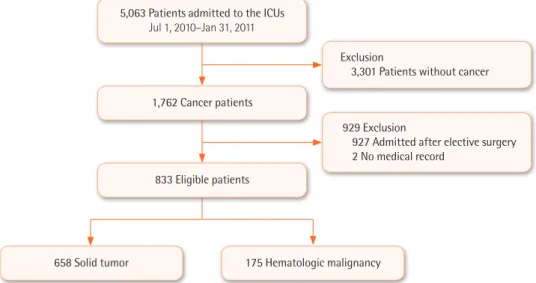
A total of 5,063 patients were admitted to participating ICUs during the study period. Patients who were older than 18 years of age and diagnosed with solid or hematologic malignancies prior to admission to the ICU were eligible for inclusion in the present study. Among them, we excluded patients if they were electively admitted for postoperative care, transferred from other participating ICUs, or if they had no data available re- garding hospital mortality (Figure 1). Patients were followed up until the time of death or hospital discharge. This study was approved by the relevant Institutional Review Board(s) of each participating hospital, and the requirement for informed
Figure 1. A schematic of study participant flow. ICU: intensive care unit.
Exclusion
3,301 Patients without cancer
929 Exclusion
927 Admitted after elective surgery 2 No medical record
658 Solid tumor 175 Hematologic malignancy
5,063 Patients admitted to the ICUs Jul 1, 2010–Jan 31, 2011
1,762 Cancer patients
833 Eligible patients
consent was waived because of the noninterventional nature of the study.
Data Collection and Clinical Outcomes
Patient data were collected using a web-based database. The definitions of variables used in the original SAPS3 model were used for this study [9]. We used the most abnormal set of data from the one hour prior to or after ICU admission to calculate SAPS3. The following data were sourced from the medical charts of the participants: demographic data; location prior to ICU admission; reason(s) for ICU admission; infection and surgical status at the time of ICU admission; laboratory data and physiologic measurements, which were collected within 1 hour before and 24 hours after ICU admission; and treatment(s) received during ICU stay. The severity of illness was assessed by the SAPS3 and Sequential Organ Failure Assessment (SOFA) score. The primary outcome in this study was hospital mortal- ity. Secondary outcomes were ICU mortality, length of hospi- tal stay, and length of ICU stay.
Definition
Cancer was categorized as solid or hematologic malignancy.
Solid tumors were defined as cancer with proven distant (not regional lymph node) metastasis by surgery, computed to- mography scan, or any other appropriate method. Hemato- logic malignancies were defined as tumors of the hematopoi- etic and lymphoid tissue including lymphoma, acute leuke- mia, and multiple myeloma. Infection was defined as the pres- ence of a pathogenic microorganism in a sterile site and/or clinically suspected infection, plus the administration of anti- biotics. Severe sepsis and septic shock were defined as sepsis associated with acute organ dysfunction and sepsis with acute circulatory failure characterized by persistent arterial hypo- tension (i.e., systolic arterial pressure <90 mmHg, mean arte- rial pressure <60 mmHg, or a reduction in systolic blood pres- sure >40 mmHg from baseline) despite adequate volume re- suscitation, respectively [10]. Acute lung injury and acute re- spiratory distress syndrome were defined as arterial oxygen pressure to inspiratory oxygen fraction (PaO2/FiO2) ratio <300 and <200, respectively, with the following criteria: acute on- set, bilateral infiltrates on chest radiography, and pulmonary artery wedge pressure <18 mmHg or clinical evidence of left atrial hypertension. An unplanned ICU admission was de- fined as an admission planned less than 12 hours in advance or any unscheduled admission to the ICU that originated from the emergency department, general ward, operating room, or other location. Performance status was assigned a grade be-
tween 0 and 4 according to the Eastern Cooperative Oncology Group performance status classification [11]. We used the definition of variables employed in the original SAPS3 model to define variables in this study [12].
Statistical Analysis
Data are presented as median and interquartile range (25th and 75th percentiles) for continuous variables and as num- bers (percentages) for categorical variables. Data were com- pared using the Mann-Whitney U-test for continuous vari- ables and the chi-square or Fisher exact test for categorical variables, respectively, where applicable. Logistic regression analyses were performed to identify risk factors for the predic- tion of mortality. Variables that appeared to be related in the univariate analysis with a P-value of less than 0.2 were intro- duced into multivariate regression models using a forward stepwise method. For all analyses, a two-tailed test with a P- value of less than 0.05 was considered to be statistically signif- icant. We used the SPSS version 20.0 (IBM SPSS Corp., Armonk, NY, USA) for statistical analysis.
RESULTS
Baseline Clinical Characteristics
As shown in Figure 1, a total of 1,762 cancer patients were ad- mitted to the ICUs and 833 of them were deemed eligible for analysis. The baseline characteristics of the 833 eligible pa- tients finally included in the present study are described in Table 1. Of these, 554 (66.5%) were male, and the median age was 63 years (range, 53 to 72 years). SOFA score and SAPS3 were 9 (range, 5 to 12) and 69 (range, 60 to 79), respectively.
Unplanned admissions composed 74.4% of all ICU admissions.
The most common reason for ICU admission was respiratory disease (30.1%), followed by surveillance (27.3%), cardiovas- cular disease (24.1%), and digestive disease (5.4%). About half of the patients included in this study had acute infection at the time of ICU admission, and most admissions were not re- lated to surgery.
Comparison of Baseline Characteristics According to Type of Malignancy
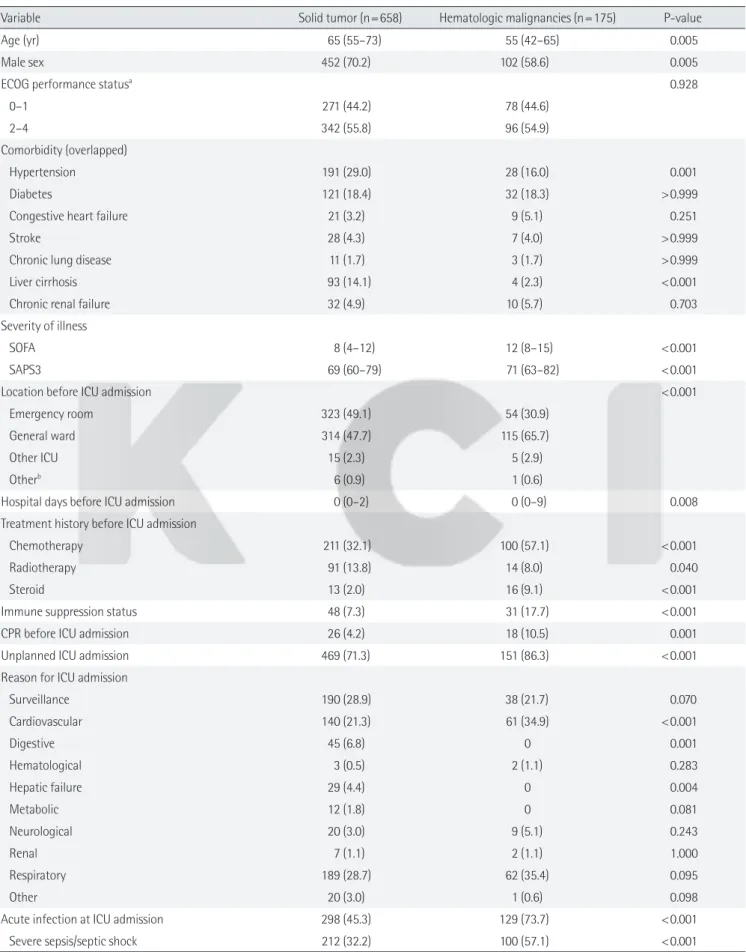
Of the 833 patients, 658 (79%) had solid tumors and 175 (21%) had hematologic malignancies. The patients with solid tumors were typically older and more commonly male versus the pa- tients with hematologic malignancies (Table 2). Performance status and comorbidities were similar between the two groups, except with regard to hypertension and liver cirrhosis. Patients
with hematologic malignancies had higher SOFA and SAPS3 values than did patients with solid tumors. The proportions of patients with a history of chemotherapy (57.1% vs. 32.1%, P<
0.001), steroid therapy (9.1% vs. 2.0%, P<0.001), and compro- mised immune status (17.7% vs. 7.3%, P<0.001) were signifi- cantly higher in the hematologic malignancies group, while, conversely, the proportion of patients who had undergone ra- diotherapy (13.8% vs. 8.0%, P=0.040) was higher in the solid tumor group. Unplanned ICUs admissions occurred more fre- quently among hematologic malignancy patients than among solid tumor patients. Respiratory (35.4% vs. 28.7%, P=0.095) and cardiovascular (34.9% vs. 21.3%, P<0.001) problems were common causes of ICU admission in both groups, with the exception of admission for surveillance. More patients with hematologic cancer showed an acute infection status at the time of ICU admission. In addition, rates of severe sepsis/sep- tic shock were significantly higher in patients with hemato- logic cancer as compared with those with solid cancer (57.1%
vs. 32.2%, P<0.001).
ICU Treatments
The amount of total fluid administered within 24 hours (4,039 ml vs. 3,339 ml, P<0.001) was higher and the use of an inotro- pe/vasopressor (54.8% vs. 44.7%, P=0.017) was more preva- lent, respectively, in patients with hematologic malignancies.
In addition, hematologic malignancy patients more frequent- ly required mechanical ventilation (46.9% vs. 33.3%, P=0.001) and continuous renal replacement therapy (17.6% vs. 9.5%, P=0.004) than did solid tumor patients.
Clinical Outcomes
Overall, 235 patients (28.2%) died in the ICU, while 112 patients (13.4%) died while hospitalized in other wards (Figure 2). Both ICU (41.7% vs. 24.6%, P<0.001) and hospital (53.1% vs. 38.6%, P=0.002) mortality rates were significantly higher in patients with hematologic malignancies than in patients with solid tu- mors. Multivariable logistic regression analysis revealed that age, demonstration of performance status 2 through 4, me- chanical ventilation usage, and SAPS3 in solid tumor patients (Table 3) and mechanical ventilation usage and SAPS3 in he- matologic malignancy patients were significant prognostic predictors for hospital mortality (Table 3).
In the total patient cohort, ICU length of stay and hospital length of stay were 5 days (range, 3 to 10 days) and 20 days (range, 11 to 39 days), respectively. Although the ICU length of stay (5 days vs. 6 days, P=0.160) was similar between patients with solid tumor and those with hematologic malignancies, Table 1. Baseline characteristics of cancer patients admitted to
the ICU
Characteristics Value
Age (yr) 63 (53–72)
Male sex 554 (66.5)
ECOG performance statusa
0–1 349 (44.4)
2–4 438 (55.6)
Comorbidity
Hypertension 219 (26.3)
Diabetes 153 (18.4)
Congestive heart failure 30 (3.6)
Stroke 35 (4.2)
Chronic lung disease 14 (1.7)
Liver cirrhosis 97 (11.6)
Chronic renal failure 42 (5.0)
Severity of illness
SOFA 9 (5–12)
SAPS3 69 (60–79)
Location before ICU admission
Emergency room 377 (45.3)
General ward 429 (51.5)
Other ICU 20 (2.4)
Other 7 (0.8)
Treatment history before ICU admission
Chemotherapy 311 (37.3)
Radiotherapy 105 (12.6)
Steroid 29 (3.5)
Immune suppression status 79 (9.5)
CPR before ICU admission 44 (5.3)
Unplanned ICU admission 620 (74.4)
Reason for admission
Surveillance 228 (27.3)
Cardiovascular 201 (24.1)
Respiratory 251 (30.1)
Neurological 29 (3.5)
Hepatic 29 (3.5)
Digestive 45 (5.4)
Renal 9 (1.1)
Metabolic 12 (1.4)
Hematological 5 (0.6)
Otherb 24 (2.9)
Acute infection at ICU admission 427 (51.3) Severe sepsis/septic shock 312 (37.5) Surgical status at ICU admission
No surgery 736 (88.4)
Emergent surgery 97 (11.6)
Values are presented as median (interquartile range) or number (%).
ICU: intensive care unit; ECOG: Eastern Cooperative Oncology Group;
SOFA: Sequential Organ Failure Assessment; SAPS3: Simplified Acute Physiology Score 3; CPR: cardiopulmonary resuscitation.
aData were available for 787 patients; bIncludes patients with spinal ste- nosis, trauma, urinary incontinence, and mood depression disorder.
Table 2. Baseline and treatment characteristics according to type of malignancy
Variable Solid tumor (n=658) Hematologic malignancies (n=175) P-value
Age (yr) 65 (55–73) 55 (42–65) 0.005
Male sex 452 (70.2) 102 (58.6) 0.005
ECOG performance statusa 0.928
0–1 271 (44.2) 78 (44.6)
2–4 342 (55.8) 96 (54.9)
Comorbidity (overlapped)
Hypertension 191 (29.0) 28 (16.0) 0.001
Diabetes 121 (18.4) 32 (18.3) >0.999
Congestive heart failure 21 (3.2) 9 (5.1) 0.251
Stroke 28 (4.3) 7 (4.0) >0.999
Chronic lung disease 11 (1.7) 3 (1.7) >0.999
Liver cirrhosis 93 (14.1) 4 (2.3) <0.001
Chronic renal failure 32 (4.9) 10 (5.7) 0.703
Severity of illness
SOFA 8 (4–12) 12 (8–15) <0.001
SAPS3 69 (60–79) 71 (63–82) <0.001
Location before ICU admission <0.001
Emergency room 323 (49.1) 54 (30.9)
General ward 314 (47.7) 115 (65.7)
Other ICU 15 (2.3) 5 (2.9)
Otherb 6 (0.9) 1 (0.6)
Hospital days before ICU admission 0 (0–2) 0 (0–9) 0.008
Treatment history before ICU admission
Chemotherapy 211 (32.1) 100 (57.1) <0.001
Radiotherapy 91 (13.8) 14 (8.0) 0.040
Steroid 13 (2.0) 16 (9.1) <0.001
Immune suppression status 48 (7.3) 31 (17.7) <0.001
CPR before ICU admission 26 (4.2) 18 (10.5) 0.001
Unplanned ICU admission 469 (71.3) 151 (86.3) <0.001
Reason for ICU admission
Surveillance 190 (28.9) 38 (21.7) 0.070
Cardiovascular 140 (21.3) 61 (34.9) <0.001
Digestive 45 (6.8) 0 0.001
Hematological 3 (0.5) 2 (1.1) 0.283
Hepatic failure 29 (4.4) 0 0.004
Metabolic 12 (1.8) 0 0.081
Neurological 20 (3.0) 9 (5.1) 0.243
Renal 7 (1.1) 2 (1.1) 1.000
Respiratory 189 (28.7) 62 (35.4) 0.095
Other 20 (3.0) 1 (0.6) 0.098
Acute infection at ICU admission 298 (45.3) 129 (73.7) <0.001
Severe sepsis/septic shock 212 (32.2) 100 (57.1) <0.001
(Continued to the next page)
Variable Solid tumor (n=658) Hematologic malignancies (n=175) P-value
Surgical status at ICU admission <0.001
No surgery 566 (86.0) 170 (97.1)
Emergent surgery 92 (14.0) 5 (2.9)
Initial laboratory variable
White blood cell (mm3) 9,750 (5,320–15,460) 3,640 (250–9,850) <0.001
Total bilirubin (mg/dl) 0.9 (0.6–2.1) 1.1 (0.7–2.3) 0.297
Creatinine (mg/dl) 1.0 (0.7–1.6) 1.1 (0.7–1.8) 0.381
Arterial pH 7.39 (7.30–7.45) 7.40 (7.30–7.46) 0.159
Lactic acid (mmol/l) 2.90 (1.70–5.40) 2.65 (1.50–5.23) 0.468
C-reactive protein (mg/dl) 12.3 (4.3–21.3) 14.5 (6.3–24.3) 0.082
Procalcitonin (ng/ml) 3.64 (0.65–22.87) 8.12 (0.19–27.12) 0.988
NT-proBNP (pg/ml) 681 (161–3039) 965 (315–6070) 0.019
Treatment
Total infused fluids within 24 hr (ml) 3,339 (2,275–4,775) 4,039 (3,001–5,246) <0.001
Inotrope/vasopressor within 24 hr 293 (44.7) 96 (54.8) 0.017
Norepinephrine 251 (38.4) 84 (48.8) 0.012
Vasopressin 53 (8.3) 29 (17.2) 0.001
Dopamine 64 (10.0) 19 (11.3) 0.631
Dobutamine 51 (7.9) 20 (11.8) 0.108
Epinephrine 5 (0.8) 2 (1.2) 0.643
Mechanical ventilation 219 (33.3) 82 (46.9) 0.001
Continuous renal replacement therapy 60 (9.5) 30 (17.6) 0.004
Values are presented as median (interquartile range) or number (%).
ECOG: Eastern Cooperative Oncology Group; SOFA: Sequential Organ Failure Assessment; SAPS3: Simplified Acute Physiology Score 3; ICU: intensive care unit; CPR: cardiopulmonary resuscitation; NT-proBNP: N-terminal prohormone of brain natriuretic peptide.
aData were available for 787 patients; bIncludes patients with spinal stenosis, trauma, urinary incontinence, and mood depression disorder.
Table 2. Continued
Figure 2. A comparison of intensive care unit (ICU) and hospital mortality.
ICU Hospital
100 80 60 40 20 0
Percentage of mortality
P<0.001
P=0.002 Overall Solid tumor
Hematologic malignancy
Table 3. Prognostic factors for hospital mortality
Variable Adjusted
OR 95% CI P-value
Patient with solid tumor
Age 0.96 0.93–0.99 0.019
ECOG performance status 2–4 2.63 1.29–5.37 0.008 Mechanical ventilation 2.85 1.35–6.04 0.006
SAPS3 1.07 1.04–1.10 <0.001
Patient with hematologic malignancies
SAPS3 1.05 1.01–1.08 0.006
Mechanical ventilation 2.41 1.05–5.55 0.039 OR: odds ratio; CI: confidence interval; ECOG: Eastern Cooperative On- cology Group; SAPS3: Simplified Acute Physiology Score 3.
the hospital length of stay (28 days vs. 19 days, P=0.001) was
noticeably longer in hematologic malignancy patients.
DISCUSSION
In this study, we investigated the epidemiology, characteris- tics, and clinical outcomes of critically ill cancer patients in
Korea. Within our cohort, patients with cancer accounted for 34.8% of the total number of patients admitted to participat- ing ICUs during the study period, and respiratory and cardio- vascular diseases were two of the common causes of ICU ad- mission in patients with malignancies. Our percentage of can- cer patients admitted was relatively higher than those seen in the results of other previous studies that were conducted in- volving a mixed population, which ranged from 13.5% to 21.5%
of overall ICU admissions [5,13,14]. Although it is difficult to compare our results to those of other investigations directly because our study did not examine the details of cancer, geo- graphic variations in incidence and type of cancer may have an effect on the gap in the proportion of cancer patients ad- mitted to the ICU [7].
Acute respiratory failure was identified as one of the most common medical conditions causing cancer patients to enter the ICU in previous studies as well as in our study [13,15,16].
The incidence of acute respiratory failure in cancer patients ranges from 10% to 50%, and the risk of respiratory failure is higher in patients with hematologic malignancies, especially in patients who received allogeneic stem cell transplantation, as compared with in patients with solid tumor [6,17,18]. The most common cause of acute respiratory failure is pulmonary infection, but treatment-associated pulmonary toxicities, trans- fusion-related acute lung injury, lung involvement of underly- ing malignancy, and malignant airway obstruction also can cause a case of acute respiratory failure that requires ICU man- agement [18].
Patients with hematologic malignancies have some clinical characteristics different from those of patients with solid tu- mor [13]. In our study, the proportion of patients who received chemotherapy and steroid therapy and that of patients with immunosuppression were higher, and observations of acute infection and severe sepsis/septic shock at the time of ICU admission were more frequent in patients with hematologic malignancies than in patients with solid tumor. In addition to a higher baseline SOFA score, the frequencies of vasopressor use, mechanical ventilation, and continuous renal replace- ment therapy during ICU treatment were all significantly high- er in patients with hematologic malignancies. These findings are consistent with those of previous studies that showed that patients with hematologic malignancies are more likely to de- velop severe sepsis or septic shock in comparison with pa- tients with solid tumor [13]. Neutropenia often occurs in he- matologic malignancy patients due to an association with the underlying malignancy itself or chemotherapy; for example, in our study, the white blood cell counts in hematologic ma-
lignancy patients were significantly lower than those in solid tumor patients, and it is known that neutropenic patients are more vulnerable to bacterial or fungal infections that have the potential to cause sepsis [19,20].
Also, in regard to prognosis, solid tumor patients and he- matologic malignancy patients showed different results. Al- though variations exist with regard to the type of cancer, pa- tients with solid tumor have a global hospital mortality rate of 25% to 40%, and some studies have demonstrated that mor- tality in this population is similar to that in ICU patients with- out cancer [14,21]. On the other hand, the hospital mortality rate of patients with hematologic malignancies is about 40%
to 70%, which is generally worse than that in solid tumor pa- tients [6,22]. In particular, the mortality rate of patients with hematologic malignancies who receive hematopoietic stem cell transplantation is concerning, even in recent studies, at 63% to 75% [23,24]. Hospital mortality rates in solid tumor pa- tients and hematologic malignancy patients in our study were 38.6% and 53.1%, respectively, which were similar to results reported in other countries.
SOFA score, multiple organ failure, the provision of organ support such as vasopressor use or mechanical ventilation, and allogeneic hematopoietic stem cell transplantation are known to be predictors of mortality in patients with cancer [21,22,25,26]. We also confirmed that higher SAPS3 value and mechanical ventilation support were associated with poor prognosis in both solid tumor and hematologic malignancy patients. Furthermore, age and premorbid performance sta- tus were independent prognostic factors for hospital mortality in patients with solid tumor. Some studies have demonstrated that advanced or recurrent cancer is a variable associated with poor outcomes, but others have suggested that cancer status generally does not affect the short-term outcomes of critically ill cancer patients [25,27,28]. Therefore, intensivists need to be careful when considering cancer status in deciding whether to pursue ICU admission for cancer patients.
Although our study investigated the clinical and treatment characteristics, outcomes, and variables associated with mor- tality in cancer patients admitted to the 22 medical and surgi- cal ICUs in the Korea, there are several limitations that should be considered. First, our study did not record detailed data about the type, disease status, and treatment of cancer. Alth- ough some recent studies have suggested that the disease sta- tus of cancer does not adversely affect the short-term outcomes of cancer patients admitted to the ICU, progressive cancer or certain specific conditions, such as those that require mechan- ical ventilation for respiratory failure due to tumor involve-
ment, are associated with poor prognosis [25]. Therefore, fur- ther studies that include additional information on disease status should be conducted to elucidate more accurately the characteristics of and to assess the clinical outcomes in criti- cally ill cancer patients. Also, data about the code status at the time of ICU admission and change(s) in code status during ICU management, which may influence therapeutic decisions and mortality, were not collected. Finally, analyses comparing the cancer patients admitted to the ICU with cancer patients not admitted to the ICU were not performed, and we could not determine whether ICU management is beneficial in can- cer patients with acute deterioration.
In conclusion, the proportion of patients with cancer is high- er in Korea than in other countries, accounting for about one- third of all patients admitted to the ICU. The most common reason for ICU admission in nonsurgical cancer patients was respiratory problems. Patients with hematologic malignancies had higher severity scores and rates of organ support treat- ment and mortality than did those with solid tumor. Mechani- cal ventilation and SAPS3 were independent predictors of hospital mortality in both solid tumor and hematologic ma- lignancy patients.
CONFLICT OF INTEREST
No potential conflict of interest relevant to this article was re- ported.
ORCID
Kyeongman Jeon https://orcid.org/0000-0002-4822-1772
REFERENCES
1. van Vliet M, Verburg IW, van den Boogaard M, de Keizer NF, Peek N, Blijlevens NM, et al. Trends in admission prevalence, illness severity and survival of haematological patients treat- ed in Dutch intensive care units. Intensive Care Med 2014;40:
1275-84.
2. Garrouste-Orgeas M, Montuclard L, Timsit JF, Reignier J, Des- mettre T, Karoubi P, et al. Predictors of intensive care unit re- fusal in French intensive care units: a multiple-center study.
Crit Care Med 2005;33:750-5.
3. Schuster DP, Marion JM. Precedents for meaningful recovery during treatment in a medical intensive care unit: outcome in patients with hematologic malignancy. Am J Med 1983;75:
402-8.
4. Jackson SR, Tweeddale MG, Barnett MJ, Spinelli JJ, Sutherland HJ, Reece DE, et al. Admission of bone marrow transplant re- cipients to the intensive care unit: outcome, survival and prog- nostic factors. Bone Marrow Transplant 1998;21:697-704.
5. Soares M, Caruso P, Silva E, Teles JM, Lobo SM, Friedman G, et al. Characteristics and outcomes of patients with cancer requiring admission to intensive care units: a prospective mul- ticenter study. Crit Care Med 2010;38:9-15.
6. Azoulay E, Mokart D, Pène F, Lambert J, Kouatchet A, Mayaux J, et al. Outcomes of critically ill patients with hematologic malignancies: prospective multicenter data from France and Belgium. A groupe de recherche respiratoire en réanimation onco-hématologique study. J Clin Oncol 2013;31:2810-8.
7. Torre LA, Siegel RL, Ward EM, Jemal A. Global cancer inci- dence and mortality rates and trends: an update. Cancer Epi- demiol Biomarkers Prev 2016;25:16-27.
8. Lim SY, Koh SO, Jeon K, Na S, Lim CM, Choi WI, et al. Valida- tion of SAPS3 admission score and its customization for use in Korean intensive care unit patients: a prospective multi- centre study. Respirology 2013;18:989-95.
9. Metnitz PG, Moreno RP, Almeida E, Jordan B, Bauer P, Cam- pos RA, et al. SAPS 3: from evaluation of the patient to evalua- tion of the intensive care unit. Part 1: objectives, methods and cohort description. Intensive Care Med 2005;31:1336-44.
10. Levy MM, Fink MP, Marshall JC, Abraham E, Angus D, Cook D, et al. 2001 SCCM/ESICM/ACCP/ATS/SIS International Sepsis Definitions Conference. Crit Care Med 2003;31:1250-6.
11. Oken MM, Creech RH, Tormey DC, Horton J, Davis TE, Mc- Fadden ET, et al. Toxicity and response criteria of the Eastern Cooperative Oncology Group. Am J Clin Oncol 1982;5:649-55.
12. Moreno RP, Metnitz PG, Almeida E, Jordan B, Bauer P, Cam- pos RA, et al. SAPS 3: from evaluation of the patient to evalua- tion of the intensive care unit. Part 2: development of a prog- nostic model for hospital mortality at ICU admission. Inten- sive Care Med 2005;31:1345-55.
13. Staudinger T, Stoiser B, Müllner M, Locker GJ, Laczika K, Knapp S, et al. Outcome and prognostic factors in critically ill cancer patients admitted to the intensive care unit. Crit Care Med 2000;28:1322-8.
14. Bos MM, de Keizer NF, Meynaar IA, Bakhshi-Raiez F, de Jonge E. Outcomes of cancer patients after unplanned admission to general intensive care units. Acta Oncol 2012;51:897-905.
15. Darmon M, Thiery G, Ciroldi M, de Miranda S, Galicier L, Raffoux E, et al. Intensive care in patients with newly diag- nosed malignancies and a need for cancer chemotherapy.
Crit Care Med 2005;33:2488-93.
16. Hawari FI, Nazer LH, Addassi A, Rimawi D, Jamal K. Predic-
tors of ICU admission in patients with cancer and the related characteristics and outcomes: a 5-year registry-based study.
Crit Care Med 2016;44:548-53.
17. Chi AK, Soubani AO, White AC, Miller KB. An update on pul- monary complications of hematopoietic stem cell transplan- tation. Chest 2013;144:1913-22.
18. Pastores SM, Voigt LP. Acute respiratory failure in the patient with cancer: diagnostic and management strategies. Crit Care Clin 2010;26:21-40.
19. Bhatt V, Saleem A. Review: drug-induced neutropenia. Patho- physiology, clinical features, and management. Ann Clin Lab Sci 2004;34:131-7.
20. Bodey GP, Buckley M, Sathe YS, Freireich EJ. Quantitative re- lationships between circulating leukocytes and infection in patients with acute leukemia. Ann Intern Med 1966;64:328- 40.
21. Puxty K, McLoone P, Quasim T, Sloan B, Kinsella J, Morrison DS. Risk of critical illness among patients with solid cancers:
a population-based observational study. JAMA Oncol 2015;
1:1078-85.
22. Depuydt PO, Benoit DD, Vandewoude KH, Decruyenaere JM, Colardyn FA. Outcome in noninvasively and invasively venti- lated hematologic patients with acute respiratory failure. Chest 2004;126:1299-306.
23. Platon L, Amigues L, Ceballos P, Fegueux N, Daubin D, Bes-
nard N, et al. A reappraisal of ICU and long-term outcome of allogeneic hematopoietic stem cell transplantation patients and reassessment of prognosis factors: results of a 5-year co- hort study (2009-2013). Bone Marrow Transplant 2016;51:
256-61.
24. Depuydt P, Kerre T, Noens L, Nollet J, Offner F, Decruyenaere J, et al. Outcome in critically ill patients with allogeneic BM or peripheral haematopoietic SCT: a single-centre experience.
Bone Marrow Transplant 2011;46:1186-91.
25. Azevedo LC, Caruso P, Silva UV, Torelly AP, Silva E, Rezende E, et al. Outcomes for patients with cancer admitted to the ICU requiring ventilatory support: results from a prospective multicenter study. Chest 2014;146:257-66.
26. Pène F, Aubron C, Azoulay E, Blot F, Thiéry G, Raynard B, et al. Outcome of critically ill allogeneic hematopoietic stem- cell transplantation recipients: a reappraisal of indications for organ failure supports. J Clin Oncol 2006;24:643-9.
27. Soares M, Salluh JI, Spector N, Rocco JR. Characteristics and outcomes of cancer patients requiring mechanical ventilatory support for >24 hrs. Crit Care Med 2005;33:520-6.
28. Peigne V, Rusinová K, Karlin L, Darmon M, Fermand JP, Sch- lemmer B, et al. Continued survival gains in recent years among critically ill myeloma patients. Intensive Care Med 2009;35:
512-8.