• 검색 결과가 없습니다.

Would a Noninvasive Coronary Physiology Become a Standard and Popular Approach?

N/A
N/A
Protected

Academic year: 2021

Share "Would a Noninvasive Coronary Physiology Become a Standard and Popular Approach?"

Copied!
3
0
0

로드 중.... (전체 텍스트 보기)

전체 글

(1)

See the article “Association of Quantitative Flow Ratio with Lesion Severity and its Ability to Discriminate Myocardial Ischemia” in volume 51 on page 126.

140 https://e-kcj.org

Although the determination of myocardial ischemia is the first step in the evaluation of coronary artery disease, there is still a discrepancy between anatomical stenosis and the functional severity.

1)

The fractional flow reserve (FFR) is a useful index for invasively evaluating lesion-specific myocardial ischemia. Compared with angiography- or intravascular ultrasound-guided percutaneous coronary intervention (PCI), physiology-guided PCI significantly reduces the rate of cardiac events as well as decreases the number of stents and amount of contrast agent.

2-4)

However, the adoption of FFR in routine practice has lagged despite its clinical benefit.

5)

Potential reasons are the lengthy procedure to perform the FFR measurements, equipment and drug costs, and high incidence of patient-related discomfort.

Because the instantaneous wave-free ratio (iFR) derived from resting gradients alone is quicker and does not require the administration of hyperemic agents, it is an alternative to FFR and largescale clinical studies have demonstrated the use of iFR as an alternative to FFR.

6)

Nevertheless, the need for interrogating the stenosis with a pressure wire and cost of the equipment have limited its widespread adoption. Recently less invasive techniques, such as FFR derived from computed tomography and quantitative flow ratio (QFR), have been developed to overcome the weaknesses of invasive physiologic measurements.

QFR is a 3-dimensional quantitative coronary angiography for calculating the FFR from angiographic images and does not require the introduction of an invasive pressure wire in the coronary artery or induction of hyperemia. At least 2 adequate contrast-filled angiographic projections >25° apart (with minimum overlap) were acquired and a 3-dimensional model reconstruction was performed. By utilizing the thrombolysis in myocardial infarction (TIMI) frame counting method, the contrast flow velocity was estimated, and software automatically calculated the contrast QFR value. In the FAVOR pilot study of 73 patients with 84 vessels, the QFR showed good agreement with the pressure wire-determined standard FFR measurements and had an accuracy of 86% for the diagnosis of ischemia defined according to an FFR ≤0.80.

7)

The FAVOR II study, which was an adequately powered multicenter study of 308 patients with 332 vessels, the patient- and vessel-level diagnostic accuracy of the QFR was 92.4% and 92.7%, respectively.

8)

However, the diagnostic accuracy of the QFR versus FFR can differ according to the reference index used to define myocardial ischemia. As the diagnostic performance of the invasive physiological indices was compared using positron emission tomography (PET) as the reference standard,

9)

QFR also should be validated with PET, which is considered the most accurate noninvasive myocardial perfusion imaging to define myocardial ischemia.

Korean Circ J. 2021 Feb;51(2):140-142 https://doi.org/10.4070/kcj.2020.0511 pISSN 1738-5520·eISSN 1738-5555

Editorial

Received: Dec 3, 2020 Accepted: Dec 16, 2020 Correspondence to Chang-Wook Nam, MD, PhD Department of Cardiology, Keimyung University Dongsan Hospital, 1035, Dalgubeol- daero, Dalseo-gu, Daegu 42601, Korea.

E-mail: [email protected]

Copyright © 2021. The Korean Society of Cardiology

This is an Open Access article distributed under the terms of the Creative Commons Attribution Non-Commercial License (https://

creativecommons.org/licenses/by-nc/4.0) which permits unrestricted noncommercial use, distribution, and reproduction in any medium, provided the original work is properly cited.

ORCID iDs Yun-Kyeong Cho

https://orcid.org/0000-0002-0221-0971 Chang-Wook Nam

https://orcid.org/0000-0002-3370-5774 Funding

The authors received no financial support for the research, authorship, and/or publication of this article.

Conflict of Interest

The author has no financial conflicts of interest.

Author Contributions

Conceptualization: Nam CW; Writing - original draft: Cho YK; Writing - review & editing: Cho YK, Nam CW.

Yun-Kyeong Cho , MD, PhD, and Chang-Wook Nam , MD, PhD

Department of Cardiology, Keimyung University Dongsan Hospital, Daegu, Korea

Would a Noninvasive Coronary

Physiology Become a Standard and

Popular Approach?

(2)

The contents of the report are the author's own views and do not necessarily reflect the views of the Korean Circulation Journal.

Dai et al.

10)

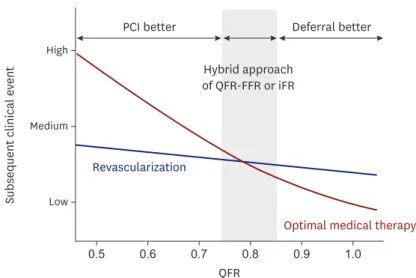
compared the QFR, FFR, and iFR for the response to the different degrees of the anatomical and hemodynamic stenosis severity and diagnostic performance against PET- derived parameters. This was the first study to investigate the association of the QFR with the PET-derived hemodynamic indices in comparison to the invasive physiologic measurements of the FFR and iFR. From 109 patients with 185 vessels, the authors employed the PET-derived relative flow reserve (RFR), coronary flow reserve (CFR), and coronary flow capacity (CFC) as independent references. The QFR demonstrated a similar response to different anatomic and hemodynamic stenosis severities for the FFR or iFR. There was no difference among the diagnostic accuracies of the 3 indices for the CFR. However, its diagnostic performance was inferior to the FFR and iFR when the PET-derived RFR and CFC were used as a reference. The discordance between the QFR and FFR or iFR was associated with a dependency of the QFR on the anatomical stenosis severity and assumption of the hemodynamic status. Because the QFR computations incorporate the TIMI frame count in its calculation algorithm, the presence of microvascular dysfunction may affect the QFR. Accordingly, an invasively measured physiologic assessment has a better performance in defining ischemia-causing stenosis. An advantage of the QFR is the indirect physiologic measurement derived from an anatomic parameter. However, a QFR analysis also requires a learning curve for the image acquisition and subsequent computation. Further, some anatomic issues (e.g., bifurcation lesions, ostial lesions, severe vessel tortuosity, and diffuse long lesions) still remain. In this study, the QFR could not be measured in all cases with an exclusion rate of 33.9%. While awaiting steady evidence that a QFR-based strategy shows an acceptable clinical outcome as compared to the FFR or iFR, a hybrid approach with QFR-FFR or iFR could be the first step toward a reliable assessment (Figure 1). For lesions with a QFR value in the gray zone, additional measurements of the FFR or iFR could improve the discrimination ability. An adoption of a machine learning-based analysis could give a high accuracy and consistent performance, and the use of the QFR could become wider even in the future.

141 https://e-kcj.org https://doi.org/10.4070/kcj.2020.0511

Comparison of QFR, FFR and iFR

High

Medium

Subsequent clinical e vent Low

QFR

Optimal medical therapy Revascularization

Hybrid approach of QFR-FFR or iFR

PCI better Deferral better

1.0 0.9

0.8 0.7

0.6 0.5

Figure 1. QFR-FFR or iFR hybrid approach. In the gray zone of the QFR (0.75–0.85), adoption of an invasive physiologic measurement could improve the diagnostic accuracy.

FFR = fractional flow reserve; iFR = instantaneous wave-free ratio; PCI = percutaneous coronary intervention; QFR

= quantitative flow ratio.

(3)

REFERENCES

1. Cho YK, Nam CW, Han JK, et al. Usefulness of combined intravascular ultrasound parameters to predict functional significance of coronary artery stenosis and determinants of mismatch. EuroIntervention 2015;11:163-70.

PUBMED | CROSSREF

2. Nam CW, Yoon HJ, Cho YK, et al. Outcomes of percutaneous coronary intervention in intermediate coronary artery disease: fractional flow reserve-guided versus intravascular ultrasound-guided. JACC Cardiovasc Interv 2010;3:812-7.

PUBMED | CROSSREF

3. Cho YK, Nam CW. Percutaneous coronary intervention in patients with multi-vessel coronary artery disease: a focus on physiology. Korean J Intern Med 2018;33:851-9.

PUBMED | CROSSREF

4. Lee JM, Choi KH, Doh JH, et al. Long-term patient prognostication by coronary flow reserve and index of microcirculatory resistance: international registry of comprehensive physiologic assessment. Korean Circ J 2020;50:890-903.

PUBMED | CROSSREF

5. Kim JH, Choi W, Kim KC, et al. The current status of intervention for intermediate coronary stenosis in the Korean Percutaneous Coronary Intervention (K-PCI) Registry. Korean Circ J 2019;49:1022-32.

PUBMED | CROSSREF

6. Götberg M, Christiansen EH, Gudmundsdottir IJ, et al. Instantaneous wave-free ratio versus fractional flow reserve to guide PCI. N Engl J Med 2017;376:1813-23.

PUBMED | CROSSREF

7. Tu S, Westra J, Yang J, et al. Diagnostic accuracy of fast computational approaches to derive fractional flow reserve from diagnostic coronary angiography: the International Multicenter FAVOR Pilot Study.

JACC Cardiovasc Interv 2016;9:2024-35.

PUBMED | CROSSREF

8. Xu B, Tu S, Qiao S, et al. Diagnostic accuracy of angiography-based quantitative flow ratio measurements for online assessment of coronary stenosis. J Am Coll Cardiol 2017;70:3077-87.

PUBMED | CROSSREF

9. Hwang D, Jeon KH, Lee JM, et al. Diagnostic performance of resting and hyperemic invasive physiological indices to define myocardial ischemia: validation with

13

N-ammonia positron emission tomography. JACC Cardiovasc Interv 2017;10:751-60.

PUBMED | CROSSREF

10. Dai N, Hwang D, Lee JM, et al. Association of quantitative flow ratio with lesion severity and its ability to discriminate myocardial ischemia. Korean Circ J 2021;51:126-39.

CROSSREF

142 https://e-kcj.org https://doi.org/10.4070/kcj.2020.0511

Comparison of QFR, FFR and iFR

수치

Figure 1. QFR-FFR or iFR hybrid approach. In the gray zone of the QFR (0.75–0.85), adoption of an invasive  physiologic measurement could improve the diagnostic accuracy

참조

관련 문서

♦ A foreign country may subsidize the export of a good that the US also exports, which will reduce its price in world markets and decrease the terms of trade for the US.

The index is calculated with the latest 5-year auction data of 400 selected Classic, Modern, and Contemporary Chinese painting artists from major auction houses..

In summary, in order to detect malicious flows in a target network traffic, the flow correlation index between the target network traffic and the seed flow is calculated,

Cowley (1969): for the same lenses, apertures and system dimension the image contrast must be the same for CTEM and STEM..

So, we proposed a novel method for video event analysis and description on the fundamental of the Domain Knowledge object ontology, the MPEG-7 standard is extended

In this paper, a software policy considering testing time and the number of errors corrected is presented.. The software is tested until a specified testing

Therefore, cTnT is a recommended biomarker for use in the detection of myocardial infarction (MI) and in acute coronary syndromes.[8] Indeed, several authors

In contrast, Chiropractic has shown better result than sports massage in the range of motion of the shoulder joint, Thoracic Scapular rhythm test, and the