• 검색 결과가 없습니다.

Abdominal Impalement Injury Caused by Scaffolding Pipe following a Traffic Accident - A Case Report

N/A
N/A
Protected

Academic year: 2021

Share "Abdominal Impalement Injury Caused by Scaffolding Pipe following a Traffic Accident - A Case Report"

Copied!
4
0
0

로드 중.... (전체 텍스트 보기)

전체 글

(1)

eISSN 2287-1683 pISSN 1738-8767 Journal of Trauma and Injury Vol. 29, No. 1, March, 2016 http://dx.doi.org/10.20408/jti.2016.29.1.33

─ 33 ─

� Case Report �

� Address for Correspondence : Se Youl Lee, M.D.

Department of Surgery, Chonbuk National University Hospital,

20, Geonjiro (634-18, Keumam-dong), Dukjin-gu, Jeonju, Jeollabuk-do, 54907, Korea Tel : 82-63-250-1570, Fax : 82-63-271-6197, E-mail : [email protected]

Submitted : January 18, 2016 Revised : January 28, 2016 Accepted : January 28, 2016

Abdominal Impalement Injury Caused by Scaffolding Pipe following a Traffic Accident - A Case Report

Se Youl Lee, M.D.

1,2

, Jeong Moon Lee, M.D.

1

, Seok Jin Choi, M.D.

3

1

Trauma Team and,

2

Department of Surgery, Chonbuk National University Hospital, Jeonju, Korea,

3

Department of Surgery, Design Hospital, Jeonju, Korea

Traffic accidents involving agricultural machinery have been decreasing, but mortality is still high due to a lack of safety devices such as seat belts. Furthermore, secondary damage, such as abdominal impalement injury caused by loaded materials, is more likely to occur, and this type of injury leads to a poor prognosis. Impalement with pipes is often more fatal than other penetrating injuries because the diameter of the pipe is usually larger in size than other loaded materials.

We report a case of a 72-year-old man with secondary abdominal impalement injury caused by a scaffolding pipe fol- lowing a traffic accident. [ J Trauma Inj 2016; 29: 33-36 ]

Key Words: Scaffolding pipe, Abdominal impalement injury

I. Introduction

In modern society, the development of industry and transportation has led to the increase of trauma patients, with traffic accidents responsible for a high proportion of total trauma occurrence. Regarding traffic accidents in rural areas, those involving agricultural machinery have decreased in number;

however, accident severity has become prominent, because the demography of rural areas has changed.

Rural residents are older in age and there are more female workers.(1) According to the 2014 Traffic Accident Statistics from Korea Road Traffic Authority, traffic accidents involving agricultural machinery have decreased each year, constituting 0.04% (441 cases) of the total 1,129,374 cases.

However, 1.6% (74 deaths) of the total 4,762 deaths from traffic accidents has been caused by agricul-

tural machinery, which is a higher mortality rate than any other type of traffic accident.(2) This higher mortality rate can be explained both by the fact that agricultural machinery is less equipped to protect drivers and passengers than other types of vehicles, and secondary damage from being run over by agricultural machinery or caused by the loaded materials can easily occur.

With a literature review, we report a case of a scaffolding pipe penetrating the abdomen of a culti- vator driver after an accident with a car.

II. Case

A 72-year-old man driving a cultivator had a

traffic accident with a car that was following

behind. He was transferred from another hospital to

our emergency department with a 1-meter long, 3-

(2)

─ 34 ─

- Journal of Trauma and Injury Vol. 29, No. 1 -

cm wide scaffolding pipe that had been loaded in the cultivator penetrating his abdomen from the left back to the left upper quadrant (LUQ) (Fig. 1). He was alert on arrival and his vital signs were as fol- lows: BP, 80/50 mmHg; pulse, 120 BPM; respira- tions, 20/min; and temperature, 36.5。 C. He showed normal pupillary light reflex and normal breath and cardiac sounds on chest auscultation. Abdominal sounds were found to be decreased on auscultation and the greater omentum was visible around the penetration site in the LUQ. He had fractures of the medial malleolus, the left distal nasal bone, and a few scratch wounds.

Results from arterial blood gas analysis on arrival were: pH, 7.33; PaCO

2

, 32.3 mmHg; PaO

2

, 56.6 mmHg; and SaO

2

, 87.5%. However, he showed improvement after oxygen therapy; therefore, endo- tracheal intubation was not performed. CBC and chemistry were measured as follows: Hb, 10.6 g/dl;

WBC, 15,960/mm

3

(neutrophils, 84.2%; lymphocytes, 11.8%), and platelets, 169,000/mm

3

; AST, 59 IU/L;

ALT, 32 IU/L; Amylase, 55 IU/L; BUN, 21 mg/dl; Cr, 1.01 mg/dl; albumin, 3.3 g/dl; Na

+

, 139 mmol/L; K

+

, 3.4 mmol/L; and Cl

-

, 111 mmol/L. PT and aPTT were 13.2s and 36.1s, respectively, within normal range.

Urinalysis detected a hematuria, with an RBC over 30/High-Per-Field (HPF).

The penetrating pipe hindered radiographic imag- ing; thus it had to be cut. An elastic band was used so that the pipe would not move back and forth.

Because the cutter at the hospital was going to

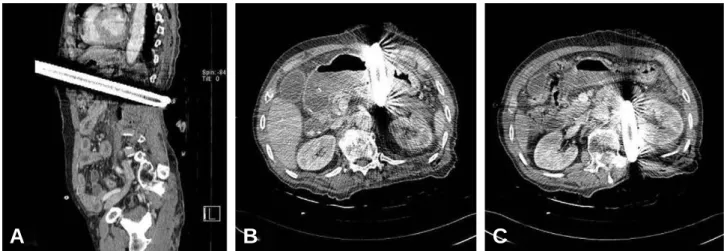
cause too much vibration that would lead to internal organ damage, a manually-operated hydraulic cut- ter (S-55A, IZUMI, Japan) that causes little vibra- tion and flame was borrowed from a nearby 119 sta- tion, an equivalent to 911 in South Korea. The pipe was cut as close as possible to the skin. After the cut surface was wrapped with gauze and SURGI DRAPE (3M, Minnesota, USA), radiographic imaging was performed. On abdominal CT, the pipe was seen to impale the LUQ at about 10 degrees, passing right above the left renal vasculature. A small-sized hemoperitoneum was identified. The left kidney con- trasted relatively well. The left transverse processes of L1 to L3 were fractured and a hematoma in the left iliopsoas was also found (Fig. 2).

An emergency operation was performed. Only abdominal injuries were suspected; therefore, a supine position was selected for the patient on the operation table. First, potadine solution was sprayed on the patient’ s back while in a lateral position and a sterilization drape was put on the table. Then he was brought back to a supine position for another round of potadine spray on the abdomen. During surgery, a small amount of blood was identified in the abdominal cavity. The pipe, which had entered from the back, penetrated the body of the stomach and was abutting the left renal vasculature. The treitz ligament was dissected. The retroperitoneum was approached to reveal the left renal vasculature.

The pipe was removed with the utmost care to avoid causing secondary damage. The bleeding from the left

Fig. 1. Large scaffolding pipe was penetrating through the left back to the left anterior abdomen wall.

A B

(3)

renal vein and iliopsoas was stopped. Debridement was performed on the gastric penetration site and primary closure was performed. For the penetration site on the abdominal wall, tissue debridement was performed and delayed suture was done in 1 week later. Diet was initiated after post-operative day 3 in a graded manner. Because the patient was mak- ing good progress, he had a corrective operation for a left ankle fracture. He was discharged 1 month after the operation.

III. Discussion

Traffic accidents involving agricultural machinery mostly occur in the early morning or at sunset because the driver of the vehicle behind does not recognize it and tends to run into it. In part this is because, farm work usually starts early in the morning and ends at sunset; however, the most agricultural machinery is worn-out and poorly equipped, without safety fea- tures such as reflectors.(3) Because agricultural machinery does not have air bags, seat belts or other safety devices, the driver and passengers are more likely to be injuried in a traffic accident. In addition to the damage of the accident, in rear-end collisions loaded objects can cause secondary dam- age to the people in the agricultural vehicle. In this case, the patient was impaled by a loaded scaffold- ing pipe that was moved forward and penetrated the abdomen after a rear-end collision with a car.

Among impalement injuries, those on the torso, including the chest and the abdomen, require imme-

diate treatment because of accompanying life threatening internal organ damage.(4) In the United States where personal gun possession is widespread, an increasing number of people have been reported to suffer from impalement injury. On the contrary, in South Korea, where personal gun possession is less common, it is usually knives or glass panes that cause stab wounds, a type of impalement injury.(5)

Although, in general, impalement injury by stab wound has a better prognosis than ballistic trauma, torso injury can lead to lethal results because of internal organ bleeding, infection, and organ dam- age. Impalement injury by a pipe after a fall or a traffic accident can cause more serious damage, because the diameter of the pipe is usually bigger in size than a stab wound.(4,6)

Fabian et al.(7) reported that, in penetrating trau- ma, the impaled organs in order of decreasing fre- quency were the small intestine, colon, and liver, with a frequency of 27%, 24%, and 22%, respective- ly. In blunt trauma, however, the liver and spleen are more affected, with a frequency of 39% and 38%, respectively, followed by the kidneys, 11%; small intestine, 5%; large intestine, 4%; pancreas, 2%; and stomach, 0.6%. The difference between penetrating trauma and blunt trauma in the frequency of organ damage is thought to arise from the fact that the extent of internal organ damage in penetrating wounds is proportional to the area that a particular organ occupies.(8)

In abdominal impalement injury, a hemodynami- cally unstable patient needs an immediate emer-

─ 35 ─

Se Youl Lee, et al. Abdominal Impalement Injury Caused by Scaffolding Pipe following a Traffic Accident - A Case Report

Fig. 2. On abdomen computerized tomography, 3 cm sized pipe was penetrated the body of stomach and abutted on left renal vessels.

A B C

(4)

gency operation; however, for a hemodynamically stable patient like the one in this case, the evalua- tion of the degree of abdominal injury through abdominal CT is helpful for surgery.(9) In impale- ment injury by a long object, the object needs to be cut off for examination and surgery. In addition, the object must be tightly fixed to prevent the internal organs injury and care should be taken not to cause secondary damage by any vibration or flame during the cutting process. For our patient, a hydraulic cutter borrowed from a 119 station properly cut the pipe, causing no additional damage.

For an impalement injury caused by a pipe, an emergency operation is necessary for removal. The sharp cut surface should be wrapped with a type of bandage, such as surgical gloves, to reduce scratch injuries. For the patient of this case some gauze was wrapped around the pipe and a sheet of film was applied to seal it to prevent secondary damage and infection.(6,10)

The patient’s position on the operation table depends on the part of the torso that is impaled by an object. That is, a supine position is selected for surgery if the impalement only involves the abdomen. If both the abdomen and the chest are involved, a lateral position is used depending on the location of the chest that is impaled.(6)

Primary or secondary surgery should be promptly initiated according to the degree of internal organ damage after an abdominal impalement injury. If the patient is in a critical condition, a secondary surgery after a minimal ‘damage control surgery’to keep the patient alive is considered helpful.(11,12)

The prognosis of a patient with impalement injury is largely dependent on the severity of infection;

therefore, in addition to antibiotic therapy to mini- mize infection, the injured part should be thorough- ly disinfected before surgery and meticulous clean-

ing during surgery should be implemented.(10) We report, with a literature review, a successfully managed case of a cultivator driver with an abdomi- nal impalement injury caused by a scaffolding pipe after a traffic accident with a car.

REFERENCES

01) Yeo KH, Park CY, Kim HH, Park SC, Yeom SR. Abdomino- perineal Organ Injuries Caused by Cultivators. J Trauma Inj.

2015; 28: 60-6.

02) Available at: http://www.koroad.or.kr/. Accessed November 17, 2015.

03) Cho CY, Kim YS, Lee YJ, Lee MJ. Traffic Safety Technology Proposal for Chungcheong Region. Journal of the Korea Academia-Industrial cooperation Society. 2015; 16:

1524-32.

04) Yun SY, Cheon YJ, Won TH. Clinical Patterns of Penetrating Torso Injury at Emergency Department. J Trauma Inj. 2005;

18: 47.

05) Noh HN, Kim KM, Park JB, Ryu H, Bae KS, Kang SJ.

Clinical Analysis of Patients with Abdomen or Neck-penetrat- ing Trauma. J Trauma Inj. 2010; 23: 107-12.

06) Yang BJ, Yu JM, Kim CS, Lee KC, Ko JC. A Case of Thoraco-abdominal Penetrating Injury with an Scaffolding Pipe following a Falling. J Trauma Inj. 2006; 19: 183-7.

07) Fabian TC, Bee TK. Liver and biliary tract trauma. Trauma 5th ed New York, NY: McGraw-Hill. 2003: 637-62.

08) Nance FC, Wennar MH, Johnson LW, Ingram Jr JC, Cohn Jr I. Surgical judgment in the management of penetrating wounds of the abdomen: experience with 2212 patients. Ann Surg. 1974; 179: 639.

09) Morrison JJ, Clasper JC, Gibb I, Midwinter M. Management of Penetrating Abdominal Trauma in the Conflict Environment:

The Role of Computed Tomography Scanning. World J Surg.

2011; 35: 27-33.

10) Eder F, Meyer F, Huth C, Halloul Z, Lippert H. Penetrating abdomino-thoracic injuries: report of four impressive, spectac- ular and representative cases as well as their challenging surgi- cal management. Arch Surg. 2011; 83: 117-22.

11) Oglesby JE. Twenty-two months’ war surgery in Vietnam.

Arch Surg. 1971; 102: 607-13.

12) Jaunoo S, Harji D. Damage control surgery. International Journal of Surgery. 2009; 7: 110-3.

─ 36 ─

- Journal of Trauma and Injury Vol. 29, No. 1 -

수치

Fig. 1. Large scaffolding pipe was penetrating through the left back to the left anterior abdomen wall.
Fig. 2. On abdomen computerized tomography, 3 cm sized pipe was penetrated the body of stomach and abutted on left renal vessels.

참조

관련 문서

Objectives The purpose of this case is to report the effect of Korean Medicine, especially Electro-acupuncture on strabismus of traffic accident induced abducens

4 Cases of Patients That Improved from Traffic Accident Which Caused Lumbar Spine Compression Fracture by Complex Korean Medical Admission Treatment: Retrospective

Traumatic brain injury, which can be caused by head trauma, can damage the brain, resulting in physical disorders, such as headache, dizziness, and nausea, as well as

(B) Blunt injury damaged to liver right lobe in transverse view of computed tomography.. Liver injury

been largely tried and accepted in hemodynamically stable patients.(2,3) We report a case of hepatic duct confluence injury after blunt abdominal trauma successfully

Several clinical factors have been previously known to be predictive of survival, particularly anatomic location of injury, initial severity of shock and

The purpose of this study is to figure out the effects of Muscle energy techniques on patients with Whiplash injury caused by traffic accidents.. Methods

Objectives The purpose of this case is to report the effect of Korean Medicine, especially Electro-acupuncture on strabismus of traffic accident induced abducens nerve