www.earticle.net
물리화학적 처리가 양돈장 악취저감에 미치는 영향
김희호1 · 하덕민1 · 이재영1 · 신효섭2 · 송준익2 · 김두환1*
경남과학기술대학교1, 연암대학교2
Effects of Physico-Chemical Treatment on Odor Reduction of Swine Farm
Hee-Ho Kim1, Duck-Min Ha1, Jae-Young Lee1, Hyo-Sub Shin2, Jun-Ik Song2 and Doo-Hwan Kim1*
1Gyeongnam National University of Science and Technology, Jinju 52725, Korea
2Yonam College, Cheonan 31005, Korea
ABSTRACT1)
This study was conducted to investigate the effects of a physico-chemical treatment on the reduction of odorous compounds from a swine farm. The physico-chemical treatment consisted of a system with a curtain and a spray of ozonated water. This treatment is a physical one for collecting the exhausted air, odor gas inside the curtain and additionally a chemical treatment because it comprises an ozonated water spray to remove odor compounds by ozone oxidation. Ammonia, hydrogen sulfide, trimethylamine, volatile organic compound, and complex odor were found in high concentrations in the pigsty before and after installation of the physico-chemical treatment system, but the concentration of odorous compounds outside the curtain and on the perimeter of the swine farm decreased significantly (p<0.01). The volume of odorous compounds also showed a similar trend as that for the odorous compound concentration. The results of this study showed that the concentration of all odorous compounds inside the pigsty were high regardless of the season, with spring and winter accounting for the highest values due to minimum ventilation. Outside the curtain and perimeter of the site, the concentration of odorous compounds and odor generation fluctuated according to the ventilation intensity of the pigsty. Almost no odorous compounds were detected in spring and winter when ventilation intensity is low, and high concentrations of odorous compounds were found in summer and autumn (p<0.01). The conclusions of this study are that the concentrations of odorous compounds emitted from pigsties can be reduced by more than 90% by filtering, disassembling and sterilizing the curtain and ozonated water spray system. Therefore, it is expected that this system will alleviate the problems caused by the diffusion of odorous compounds and improve the acceptance levels of intensive pig farming.
(Key words: Odor, Physico-chemical treatment, Swine farm)
Ⅰ. 서론
한국의 축산업은 1980년대 이후 경제발전과 식생활 패턴 의 변화에 따라 빠른 속도로 성장과 발전을 지속하여 왔으 며, 2000년대에 들어 전업화의 급격한 진행과 대규모 축
산경영체가 늘어나는 등 양적 성장을 지속해 왔다. 한국 축 산업의 이러한 지속적인 양적 성장과 고품질, 안전 축산물 에 대한 요구와 동시에 쾌적한 생활환경에 대한 요구의 증 가와 가축사육으로 인한 악취, 대규모 악성 전염병 및 수질 오염을 방지하기 위한 정책적, 제도적 장치들이 강화됨에
* Corresponding author: Doo-Hwan Kim, Department of Animal Resources Technology, Gyeongnam National University of Science and Technology, Jinju 52725, Korea. Tel: +82-55-751-3284, E-mail: [email protected]
This is an Open Access article distributed under the terms of the Creative Commons Attribution Non-Commercial License (http://creativecommons.org/licenses/by-nc-nd/3.0/deed.ko), which permits unrestricted non-commercial use, distribution, and reproduction in any medium, provided the original work is properly cited. The moral rights of the named author(s) have been asserted.
[Provider:earticle] Download by IP 118.70.52.165 at Monday, December 20, 2021 7:53 PM
www.earticle.net
따라 축산경영 환경이 날로 악화되고 있는 실정이다 (MAFRA, 2013).
축산악취는 가축사육 시설에서 발생되는 자극성의 기체 상 물질이 축산농장을 벗어나 사람들의 주거지역으로 확 산되거나 사람의 후각을 직접 자극하여 불쾌감과 혐오감 을 주는 냄새로 정의할 수 있을 것이다. 악취물질은 그 종 류에 따라서 발생원이 다르며 발생량을 어느 정도 저감시 킨다 하더라도 아주 적은 양으로도 취기를 유발하기 때문 에 이에 대한 대책과 방지에는 많은 어려움이 따르고 있 다. 사람의 후각 감각은 개인마다 다르기 때문에 감지한 악취의 질과 강도를 객관적으로 평가 분석하는 것은 쉽지 않다. 일반적으로 악취에 노출되면 악취의 강도와 지속시 간에 따라 정도의 차이는 있지만, 신체 알러지 반응, 식욕 감퇴, 음수량 저하, 호흡기 장애, 설사와 구토, 정신적 스트 레스 등의 심미적 환경공해 요인으로 작용한다고 알려져 있으며, 대규모 양돈장 주변에서 이러한 증상과 고통을 호 소한다는 보고도 있었다(Schiffman, 1998).
최근 우리나라 축산업의 지속가능성 검토와 더불어 가 장 시급하게 해결되어야 할 현안문제가 축산악취로 인한 민원으로 인식되고 있으며, 이에 따라 축산농가의 악취저 감에 대한 관심과 인식이 높아지고 악취저감을 위한 기술 들이 개발되고 축산 현장에 확산되고 있다. 화학첨가제 및 미생물 제제를 이용한 방법, 축사 내부 환기 및 화학적 처 리방법 및 외부로 배출하는 처리 방법 등이 주류를 이루고 있다(Ha and Kim, 2015).
본 연구는 물리화학적 병합처리 즉, 물리적인 악취저감 방법인 커튼을 무창돈사의 측벽에 설치하여 돈사에서 외 부로 배출되는 악취물질을 커튼 내부에 머물게 하고 여기 에 화학적 방법인 오존수를 커튼 내부에 분무하여 돈사에 서 배출되는 악취물질의 양돈장 외부로의 확산을 차단하
여 악취민원을 제거하고자 하는 목적으로 수행되었다.
Ⅱ. 재료 및 방법
1. 조사농장
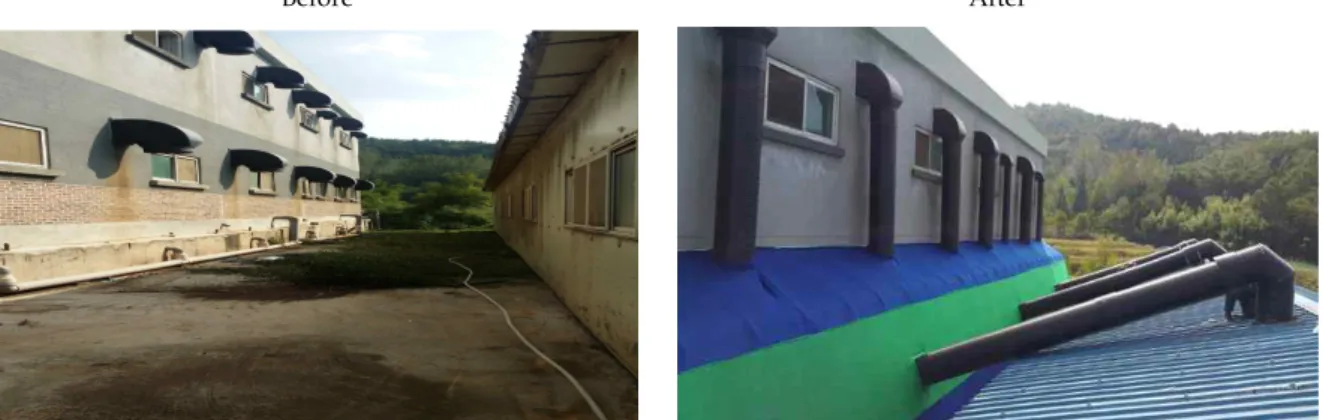
경남 사천시 용현면 소재의 1,000두 규모 양돈장으로 독 립된 복층과 단층 구조의 무창돈사이며, 측벽배기의 복층 돈사와 천정배기의 단층 돈사 사이에 Fig. 1과 같이 오존수 커튼 시스템을 설치하였다.
물리화학적 방법에 의한 악취저감시설 설치 전․후의 양 돈장 내외부 악취 측정은 2015년 8월부터 2016년 11월 까 지 총 16개월 동안 매주 1회씩 측정하였고, 데이터의 객관 성을 유지하기 위해 최대한 맑은 날씨에 실시하였다. 모든 측정시간은 오후 2∼4시로 동일한 시간대에 측정하였다.
2. 악취저감시설
커튼은 스테인리스 재질의 하우스 파이프를 3m(W)×
30m(L)×5.4m(H) 크기로 프레임을 제작하고 폴리에스테르 재질의 차단 커튼을 2겹으로 설치하였다. 측벽배기의 복층 돈사에서 배출되는 배기공기를 커튼 내부로 포집하기 위 해 복층 돈사 배기구에 4m 길이의 주름관을 설치하여 하 부로 유도하였고 천장배기의 단층 돈사는 6m 길이의 주름 관으로 커튼 내부로 포집되도록 하였다.
커튼 내부로 포집된 악취물질이 포함된 배기공기에 오 존수를 분무하였다. 오존수는 다목적 용도의 오존 발생장 치를 활용하여 0.12ppm의 오존을 생성 후 지하수와 결합 하여 별도의 탱크에 저장하며, 커튼 내부에 분무하기 위해
Before After
Fig. 1. Swine farm installed the curtain+ozonated water system.
[Provider:earticle] Download by IP 118.70.52.165 at Monday, December 20, 2021 7:53 PM
www.earticle.net
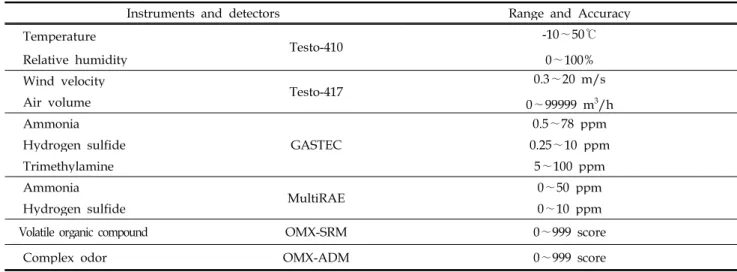
Table 1. Specifications of instruments and detectors
Instruments and detectors Range and Accuracy
Temperature
Testo-410 -10∼50℃
0∼100%
Relative humidity Wind velocity
Testo-417 0.3∼20 m/s
0∼99999 m
3/h Air volume
Ammonia
GASTEC
0.5∼78 ppm
Hydrogen sulfide 0.25∼10 ppm
Trimethylamine 5∼100 ppm
Ammonia
MultiRAE 0∼50 ppm
Hydrogen sulfide 0∼10 ppm
Volatile organic compound OMX-SRM 0∼999 score
Complex odor OMX-ADM 0∼999 score
순환펌프(2.2kw)와 노즐을 이용하여 50~70kgf/cm2압력의 안개분무 형태로 2분 가동과 1분 미가동으로 설정하여 24 시간 커튼 내부에 분사되도록 하였다.
3. 악취 측정
물리화학적 처리에 의한 악취저감시설 설치 전과 후에 돈사 내부, 돈사 외부 및 부지경계에서 악취물질 농도를 측정하였는데, 돈사 내부는 양돈장에서 가장 악취물질 발 생이 많은 육성비육사에서 측정하였으며, 돈사 외부는 악 취저감시설 설치 전에는 배기구에서 1m 지점에서 설치 후 에는 커튼으로부터 1m 지점에서 측정하였고 부지경계는 조사농장의 부지경계선 중 바람이 불어 오는 악취가 가장 심하다고 판단되는 부지경계선 상 두 지점을 선정하여 측 정하였다.
돈사 내외부 환경측정 시 온도와 습도는 온습도계 (Testo-410; Germany)를 사용하였고 풍속과 풍량은 풍량계 (Testo-417; Germany)를 이용하여 측정하였다. 악취농도 측정은 비색관(Gastec-detector tube; Japan)과 휴대용 다중 가스감지기(MultiRAE, USA)들을 사용하였고 측정기기에 대한 사양은 Table 1과 같다. 악취발생량은 악취물질농도 에 풍량을 곱하여 산정하였다.
4. 통계분석
측정 및 조사된 데이터의 통계분석은 SAS program의 GLM(General Linear Model) 방법으로 분석하였으며, 물 리화학적 처리 전후 비교를 위해 악취물질 농도를 모델로
하여 처리 전후와 구간의 상호작용을 삽입하였다. 계절별 악취물질 농도 변화를 알아보기 위해 계절과 구간의 상호 작용을 삽입하였다. 평균값 간 차이의 유무는 SAS program의 ANOVA를 이용하여 비교하였다.
Ⅲ. 결과 및 고찰
1. 악취물질 농도 비교
물리화학적 처리에 의한 악취저감시설 설치 전․후의 악 취저감 효과는 Table 2와 같다. 비색관으로 측정된 암모니 아와 트리메탈아민 농도는 돈사 내․외부와 부지경계선 모 두 처리 후 낮게 나타났다(p<0.01). 황화수소 농도는 돈사 외부가 가장 높았고 부지경계선이 가장 낮았으나 물리화 학적 처리 전․후와 측정위치 간의 상호작용은 인정되지 않 았다.
기기측정에 의한 암모니아 농도는 돈사 외부가 가장 높 게 나타났고(p<0.01), 처리 후 약간 낮아지는 경향을 보였 다(p<0.05). 측정위치와 처리 전․후의 상호작용이 인정되었 다. 황화수소는 돈사 내․외부만 감지되었고 부지경계에서 는 나타나지 않았다. 휘발성 유기화합물과 복합악취는 돈 사 내․외부에 비해 부지경계선이 낮게 나타났으며 처리 전․
후와 측정위치간의 상호작용 또한 인정되었다(p<0.01).
본 연구 결과는 Song 등(2011)이 보고한 돈사 내부에 이 산화염소를 직접 분무하여 암모니아 농도가 9ppm에서 3ppm 이하로 떨어져 약 70%의 저감 효과를 보인다는 결 과와 비교된다. 본 연구에서는 돈사 내부에는 오존수를 분
[Provider:earticle] Download by IP 118.70.52.165 at Monday, December 20, 2021 7:53 PM
www.earticle.net
Table 2. Effects of physico-chemical treatment on odor reduction of swine farm (Unit: ppm)
Indoor Outside Border p value
Before
(n=9) After
(n=5) Before
(n=9) After
(n=5) Before
(n=9) After
(n=5) Place Time Place × time Detecting tube
1)NH
317.1±1.9 6.2±2.5 20±1.9 3.4±2.5 1.9±1.9 0±2.5 <0.01 <0.01 <0.01
H
2S 0.7±0.1 0.3±0.2 0.9±0.1 0±0.2 0±0.1 0±0.2 <0.01 0.13 0.18
(CH
3)
3N 39.1±5.8 18.0±7.8 43.9±5.8 11.2±7.7 8.1±5.8 0±7.7 <0.01 <0.01 <0.01 Detecting instruments
2)NH
314.0±3.6 6.0±4.8 22.0±3.6 4.0±4.8 2.1±3.6 0.6±4.8 <0.01 <0.05 <0.01
H
2S 0.6±0.1 0.3±0.1 1.0±0.1 0±0.1 0±0.1 0±0.1 <0.01 0.39 0.88
VOC
3)37.6±6.0 37.5±8.0 43.8±6.0 5.4±8.0 1.7±6.0 0±8.0 <0.01 <0.01 <0.01 Complex odor
4)998±49.9 432±66.9 999±49.9 390±66.9 92.7±49.9 18.8±66.9 <0.01 <0.01 <0.01
1)
Ammonia, 0.5-78 ppm; Hydrogen sulfide, 0.25-10 ppm; Trimethylamine, 5-100 ppm.
2)
Ammonia, 0-50 ppm; Hydrogen sulfide, 0-10 ppm; VOC, 0-999; Complex odor, 0-999.
3)
VOC (volatile organic compound); Mixed gas contained ethanol, acetone, hydrogen, etc.
4)
Mixed gas contained hydrogen sulfide, methyl mercaptan, ammonia, etc.
무하지 않고 돈사 측벽에 설치된 커튼 내부로 포집된 배기 공기에 오존수를 분무한 결과로 돈사 내부의 암모니아 농 도와 관계없이 돈사 외부로 유출되는 암모니아 농도를 85% 이상 저감 가능하여 화학적 처리방법으로 오존수 분 무가 매우 효과적인 악취저감 방법이라 판단할 수 있을 것 이다.
2. 악취발생량 비교
물리화학적 처리에 의한 악취물질 발생량 변화를 비교 한 결과는 Table 3과 같다. 비색관 측정농도로 환산한 암모 니아 발생량은 돈사 내부가 약간 높았고 물리화학적 처리 후에 현저히 적게 나타났다(p<0.01). 황화수소는 측정위치 와 처리 전․후의 상호작용이 인정되었으며, 트리메틸아민 은 처리 후에 발생량이 적었다(p<0.01).
기기측정에 의한 암모니아 발생량은 돈사 외부에서 가 장 높았으나 물리화학적 처리에 따라 현저하게 감소하는 경향을 보였으나(p<0.05), 돈사 내부는 오히려 더 높은 발 생량을 나타내었다. 황화수소 발생량은 돈사 외부와 부지 경계선에서 감소하였으며(p<0.01), 휘발성 유기화합물과 복합악취 발생량은 돈사 내부를 제외한 돈사 외부와 부지 경계선에서 감소하는 경향을 보였고 상호작용 효과 또한 인정되었다(p<0.01).
따라서 물리화학적 처리에 의한 오존수커튼 시스템은
돈사 내부를 제외한 돈사 외부와 부지경계선에서의 모든 악취물질 발생량 저감효과가 뚜렷하게 나타나 양돈장 악 취저감시설로써 활용 가능성은 충분한 것으로 판단된다. 3. 계절별 악취물질 농도 비교
계절별 악취물질 농도를 비교한 결과는 Table 4와 같다.
비색관 측정에 의한 돈사 내부의 암모니아와 트리메틸 아민 농도는 여름과 가을에 비해 봄과 겨울이 높게 나타났 지만(p<0.01), 커튼 외부에서는 정반대의 측정값을 보였는 데 그 이유는 봄과 겨울에는 최소 환기, 여름과 가을에 최 대 환기를 실시하는 양돈장의 특성이 그대로 반영된 것으 로 판단된다. 황화수소는 돈사 내부에서는 모든 계절에 감 지되었으나 커튼 외부와 부지경계에서는 완전히 제거되는 것으로 나타났다.
기기측정에 의한 암모니아 농도는 돈사 내부가 가장 높 고 커튼 외부와 부지경계선 순으로 낮게 나타났다(p<0.01).
계절별 암모니아 농도는 비색관 측정과 유사한 경향을 보 였고 측정위치와 계절간의 상호작용이 인정되어 돈사 내 부, 겨울이 가장 높은 농도를 나타내었다(p<0.01). 황화수 소는 돈사 내부에서만 감지되었으며 나머지 위치에서는 감지되지 않았다. 이러한 결과는 오존수커튼 시스템 활용 으로 황화수소의 양돈장 외부로의 확산을 차단할 수 있을 것으로 판단된다. 휘발성 유기화합물은 돈사 내부에서 봄
[Provider:earticle] Download by IP 118.70.52.165 at Monday, December 20, 2021 7:53 PM
www.earticle.net
Table 3. Effects of physico-chemical treatment on odorous compounds emission
*(Unit: mg
)Indoor Outside Border p value
Before
(n=9) After
(n=5) Before
(n=9) After
(n=5) Before
(n=9) After
(n=5) Place Time Place × time Detecting tube
1)NH
3157±102 206±136 890±102 1±136 156±102 0±136 <0.05 <0.01 <0.01
H
2S 9±6 15±8 36±6 0±8 0±6 0±8 <0.05 0.08 <0.01
(CH
3)
3N 432±370 574±496 2,427±370 5±496 646±370 0±496 0.11 <0.01 <0.05 Detecting instruments
2)NH
3104±120 210±161 793±120 2±161 197±120 0±161 0.09 <0.05 <0.05
H
2S 7±6 15±8 50±6 0±8 0±6 0±8 <0.01 <0.05 <0.01
VOC
3)476±341 1,327±8 2,304±341 4±8 6±341 0±8 <0.05 0.15 <0.01
Complex odor
4)8,355±7,956 13,815±10,674 58,430±7,956 306±10,674 5,691±7,956 11±10,674 <0.05 <0.05 <0.01
*
Odorus compound concentration×air volume.
1)
Ammonia, 0.5-78 ppm; hydrogen sulfide, 0.25-10 ppm; trimethylamine, 5-100 ppm.
2)
Ammonia, 0-50 ppm; hydrogen sulfide, 0-10 ppm; VOC, 0-999; complex odor, 0-999.
3)
VOC (volatile organic compound); mixed gas contained ethanol, acetone, hydrogen, etc.
4)
Mixed gas contained hydrogen sulfide, methyl mercaptan, ammonia, etc.
Table 4. Effects of physico-chemical treatment on seasonal odor reduction (Unit: ppm)
Detecting tube
1)Detecting instruments
2)NH
3H
2S (CH
3)
3N NH
3H
2S VOC
3)Complex odor
4)Indoor
Spring (n=5) 15.4±1.5 0.3±0.1 44.0±4.7 13.8±1.4 0.1±0.1 51.0±7.2 838±65.1
Summer (n=4) 10.0±1.7 0.4±0.1 21.0±5.2 5.5±1.5 0.2±0.1 14.3±8.1 294±72.8
Fall (n=5) 6.2±1.5 0.3±0.1 18.0±4.7 6.0±1.4 0.3±0.1 37.5±7.2 432±65.1
Winter (n=7) 17.0±1.3 0.5±0.1 51.7±4.0 14.1±1.2 0.2±0.1 63.4±6.1 999±55.0
Outside
Spring (n=5) 1.0±1.5 0±0.1 5.6±4.7 2.2±1.4 0±0.1 0±7.2 41.8±65.1
Summer (n=4) 5.8±1.7 0±0.1 14.5±5.2 5.3±1.5 0±0.1 3.8±8.1 87.5±72.8
Fall (n=5) 3.4±1.5 0±0.1 11.2±4.7 4.0±1.4 0±0.1 5.4±7.2 390±65.1
Winter (n=7) 0±1.3 0±0.1 0±4.0 0.3±1.2 0±0.1 0.3±6.1 6.1±55.0
Border
Spring (n=5) 0±1.5 0±0.1 0±4.7 0.4±1.4 0±0.1 0±7.2 3.6±65.1
Summer (n=4) 0
±1.7 0±0.1 0±5.2 0.8±1.5 0±0.1 0±8.1 0±72.8
Fall (n=5) 0±1.5 0±0.1 0±4.7 0.6±1.4 0±0.1 0±7.2 18.8±65.1
Winter (n=7) 0±1.3 0±0.1 0±4.0 0±1.2 0±0.1 0±6.1 0.6±55.0
P value
Place <0.01 <0.01 <0.01 <0.01 <0.01 <0.01 <0.01
Season <0.01 0.13 0.18 <0.05 0.39 <0.01 <0.01
Place×season <0.01 <0.01 <0.01 <0.01 0.88 <0.01 <0.01
1)
Ammonia, 0.5-78 ppm; hydrogen sulfide, 0.25-10 ppm; trimethylamine, 5-100 ppm.
2)
Ammonia, 0-50 ppm; hydrogen sulfide, 0-10 ppm; VOC, 0-999; complex odor, 0-999.
3)
VOC (volatile organic compound); mixed gas contained ethanol, acetone, hydrogen, etc.
4)
Mixed gas contained hydrogen sulfide, methyl mercaptan, ammonia, etc.
[Provider:earticle] Download by IP 118.70.52.165 at Monday, December 20, 2021 7:53 PM
www.earticle.net
Table 5. Effects of physico-chemical treatment on seasonal odorous compounds emission* (Unit: mg)
Detecting tube
1)Detecting instruments
2)NH
3H
2S (CH
3)
3N NH
3H
2S VOC
3)Complex odor
4)Indoor
Spring (n=5) 458±149 9±11 1,289±479 409±124 3±15 1,511±509 26,401±10,297
Summer (n=4) 484±167 21±13 908±536 248±139 10±17 607±570 14,249±11,513
Fall (n=5) 260±149 15±11 738±479 254±124 15±15 1,480±510 16,731±10,297
Winter (n=7) 634±126 19±10 1,929±405 516±105 10±13 2,212±431 36,392±8,703
Outside
Spring (n=5) 32±149 0±11 228±479 100±124 0±15 0±510 2,485±10,297
Summer (n=4) 57±167 0±13 113±536 54±139 0±17 28±570 838±11,513
Fall (n=5) 1±149 0±11 5±479 2±124 0±15 4±510 308±10,297
Winter (n=7) 0±126 0±10 0±405 14±105 0±13 14±431 247±8,703
Border
Spring (n=5) 0±149 0±11 0±479 11±124 0±15 0±509 135±10,297
Summer (n=4) 0±167 0±13 0±536 11±139 0±17 0±570 0±11,513
Fall (n=5) 0±149 0±11 0±479 3±124 0±15 0±509 11±10,297
Winter (n=7) 0±126 0±10 0±405 0±105 0±13 0±431 6±8,703
p value
Place <0.01 <0.01 <0.01 <0.01 <0.01 <0.01 <0.01
Season 0.61 0.18 0.39 0.23 0.18 0.47 0.63
Place×season 0.23 0.13 0.09 <0.01 0.13 0.66 0.08
*
Odorus compound concentration×air volume.
1)
Ammonia, 0.5-78 ppm; hydrogen sulfide, 0.25-10 ppm; trimethylamine, 5-100 ppm.
2)
Ammonia, 0-50 ppm; hydrogen sulfide, 0-10 ppm; VOC, 0-999; complex odor, 0-999.
3)
VOC (volatile organic compound); mixed gas contained ethanol, acetone, hydrogen, etc.
4)
Mixed gas contained hydrogen sulfide, methyl mercaptan, ammonia, etc.
과 겨울에 높은 농도를 보였으나 물리화학적 처리에 의한 악취제거로 커튼 외부와 부지경계선에서는 거의 대부분 제거되는 것으로 나타났으며 복합악취 또한 돈사 내부는 높은 농도에 비하여 커튼 외부와 부지경계에서는 거의 90% 이상 제거되는 것을 확인할 수 있었다(p<0.01).
Bottcher 등(2000)이 무창돈사 측벽에 볏짚 등을 부착하 여 터널 형태로 만들고 악취를 포집하거나 돈사에서 거리를 띄우고 차단벽을 설치하여 물을 분무하여 악취를 포집할 수 있다고 하였는데, 본 연구에서는 물리화학적 처리를 함으로 써 악취저감 효율을 더 높일 수 있는 것으로 사료된다. 6. 계절별 악취발생량 비교
물리화학적 처리 후의 계절별 악취물질 농도와 풍량에 의한 악취발생량을 비교한 결과는 Table 5와 같다. 비색관 측정에 의한 암모니아 발생량은 돈사 내부에서 겨울이 가 장 높았고 가을이 가장 낮았다.
측정위치로 볼 때 돈사 내부에 비해 커튼 외부와 부지경 계선에서는 악취발생이 적은 것으로 나타났다(p<0.01). 황 화수소는 최대 19±10ppm을 보인 돈사 내부에 비해 커튼 외부와 부지경계선에서는 거의 발생되지 않았다(p<0.01).
트리메틸아민 또한 최대 1,929±405ppm이 발생되는 돈사 내부에 비해 커튼 외부와 부지경계선에서는 95% 이상 제 거되는 것으로 판단된다(p<0.01). 악취발생량이 적을수록 농장 외부로의 확산도 줄어들 것으로 예측되며, 이러한 결 과는 물리화학적 처리가 돈사 내부에서 배출되는 악취물 질이 배출 즉시 오존수커튼 처리에 의해 제거된 결과라 판 단할 수 있을 것이다.
기기측정에 의한 암모니아, 황화수소, 휘발성 유기화합 물 및 복합악취 발생량도 비색관 측정 결과와 유사하여 돈 사 내부에서만 높은 발생량을 보인 반면 커튼 외부와 부지 경계선에서는 낮은 측청치를 보이거나 95% 이상 제거되는 것으로 나타났다(p<0.01).
[Provider:earticle] Download by IP 118.70.52.165 at Monday, December 20, 2021 7:53 PM
www.earticle.net
Ⅳ. 요약
물리화학적 처리에 의한 양돈장 악취저감 효과를 분석 하기 위하여 물리적 처리 방법인 커튼과 화학적 처리 방법 인 오존수 분무를 병합처리 하는 오존수커튼 시스템을 상 업적인 양돈장에 설치하고 처리 및 설치 전․후의 악취발생 특성과 악취저감 효과를 조사한 결과를 요약하면 다음과 같다. 오존수커튼 시스템은 돈사내부의 악취물질과 먼지를 배기구를 통해 커튼 내부로 포집 후 오존수의 강력한 산화 력으로 악취를 제거하는 안정적인 물리화학적 처리 방법 임을 확인하였다. 오존수커튼 시스템 설치 후 돈사 내부의 암모니아, 황화수소, 트리메틸아민, 휘발성 유기화합물 및 복합악취 농도가 높은 반면, 커튼 외부와 부지경계선에서 는 현저하게 감소되었으며, 악취발생량 또한 크게 감소되 었다(p<0.01). 측정위치별 악취물질농도와 악취발생량은 암모니아, 황화수소, 트리메틸아민, 휘발성 유기화합물 및 복합악취 모두 계절에 관계없이 돈사 내부, 커튼 외부 및 부지경계선 순으로 높았다(p<0.01). 돈사 내부의 악취물질 농도는 환기량이 적은 봄과 겨울에 높고 환기량이 많은 여 름과 가을에 낮았으나, 돈사 외부와 부지경계선에서의 악 취물질농도는 돈사 내부와 상반되는 결과를 나타내었다. 이상의 결과를 요약하면, 양돈장에서 배출되는 악취물질은 오존수커튼 시스템에 의한 물리화학적 처리로 90% 이상 저감 가능한 것으로 판단되며, 양돈장 외부로의 악취물질 확산을 효과적으로 차단함으로써 악취민원 제거를 위한 효율적인 악취저감시설로 활용 가능성은 충분한 것으로 사료된다.
사사
본 연구는 2015년도 경남과학기술대학교 연구비 지원으 로 수행되었습니다.
Ⅴ. REFERENCES
1. Block, J. C. 1982. Removal of bacteria and viruses by ozonation, In: Ozonation Manual for Water and Wastewater Treatment. Wiley New York, USA.
2. Bottcher, R. W., Munilla, R. D. and Keener, K. M.
2000. Designs for windbreak walls for mitigating dust
and odor emissions from tunnel ventilated swine buildings. Proceedings of Swine Housing Conference, Des Moines, Iowa, USA, 174-181.
3. Guo, H., Jacobson, L. D., Schmidt, D. R. and Nicolai, R. E. 2003. Evaluation of the influence of atmospheric conditions on odor dispersion from animal production sites. T. ASAE. 46:461-466.
4. Ha, D. M. and Kim, D. H. 2015. The effect of liquid manure circulation system on the odor reduction of swine farm. J. of Agri. Life Sci. 49:57-64.
5. Keener, K. M., Bottcher, R. W., Munilla, R. D., Parbst, K. E. and Van Wickoen, G.L. 1999. Field evaluation of an indoor ozonation system for odor control.
Proceedings of Animal Waste Management Symposium. North Carolina State University, Raleigh, NC. USA. pp.310-313.
6. Kim, D. H., Yang, C. B., Choi, D. Y., Gwack, J. H., Song, J. I. and Gwack, S. J. 2006. Odor survey in swine farm and its reduction strategy. Korea Swine Producers Association. Korea.
7. Kim, D. H. and Kim, I. B. 1999. A review of the odor control from inside of swine production facilities. J.
Lives. Hous. Env. 5:203-216.
8. Kim, K. Y. and Choi, J. H. 2013. Distribution characteristics of odorous compounds concentrations according to type of pig buildings. J. Odor Indoor Environ. 12:27-37.
9. MAFRA (Ministry of Agriculture, Food and Rural Affairs). 2013. The medium- and long-term measures to animal waste recycling.
10. Priem, R. 1977. Deodorization by means of ozone.
Agricult. Environ. 3:229-237.
11. Park, G. H., Oh, G. Y., Jung, K. H., Jung, S. Y. and Cha, G. S. 2005. The Odor characteristics of livestock raising facility J. Kor. Soc. Odor Res. Eng. 4:207-215.
12. Schiffman, S.S. 1998. Livestock odors: Implications for human health and well-being. J. Anim. Sci.
76:1343-1355.
13. Schiffman, S. S., Bennett, J. L. and Raymer, J. H.
2001. Quantification of odors and odorants from swine operations in North Carolina. Agric. Forest Meteor. 108:213-240.
[Provider:earticle] Download by IP 118.70.52.165 at Monday, December 20, 2021 7:53 PM
www.earticle.net
14. Song, J. I., Jeon, J. H., Park, K. H., Yoo, Y. H. and Kim, D. H. 2011. Conducted to verify the effect of chlorine dioxide (ClO2) on odor reduction at a commercial swine facility. J. Lives. Hous. Env.
18(suppl.):43-50.
(Received 06 March 2017, Revised 26 June 2017, Accepted 27 June 2017)
[Provider:earticle] Download by IP 118.70.52.165 at Monday, December 20, 2021 7:53 PM