한국컴퓨터정보학회 하계학술대회 논문집 제22권 제2호 (2014. 7)
91
정보시스템 평가를 위한 과정 기반 다차원 관리 모형 설계
이상원○, 김성현*, 박승범*, 안현섭**
○원광대학교 정보전자상거래학부(융복합창의연구소)
*한국정보화진흥원 빅데이터전략센터
**브라운슈바이크공과대학 경영정보학과
e-mail: [email protected]○, {kimcon, parksb}@nia.or.kr*, [email protected]**
Multi-Dimensional Management Model on the Basis of Process to Evaluate Information Systems
Sangwon Lee○, Sunghyun Kim*, Sungbum Park*, Hyunsup Ahn**
○Division of Information and Electronic Commerce (Institute of Convergence and Creativity), Wonkwang University
*Big Data Strategy Center, National Information Society Agency
**Department of Wirtschaftsinformatik, Technische Universität Braunschweig
● Abstract ●
Public organizations and enterprises have repeated to invest in development or operation of their information systems.
However, these investment projects have been not taken care of in the field of administration and evaluation. Since these information systems projects have unique characteristics such as technology sensitiveness, network effectiveness, embeddedness, and externality, it is not easy to manage and monitor them. Returns of investment for information systems should nonetheless need efficient monitoring and effective analysis for them. In this research, we propose a multi-dimensional management model on the basis of process in order to evaluate information systems.
키워드: Information Systems; Evaluation; Management Model; Monitoring
I. Introduction
The investment projects in developing or operating information systems have been not taken care of in the field of administration and evaluation. Since these information systems projects have unique characteristics such as technology sensitiveness, network effectiveness, embeddedness, and externality, it is not easy to manage and monitor them. Returns of investment for information systems should nonetheless need efficient monitoring and effective analysis for them. In this research, we propose a multi-dimensional management model on the basis of process in order to evaluate information systems.
II. Process Criteria to Evaluate Information Systems
Monitoring and evaluation for information systems
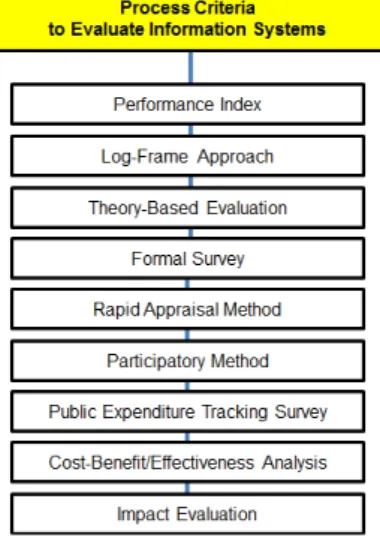
development are the part of responsibility of public officers, chief information officers, and so on. The community in developing information systems focuses on the process, and so the monitoring and evaluation gather more and more attentions. From this perspective, we consider goals, usability, merits, demerits, costs, technologies, time, and other major references. These include the methods of data collection, analysis tools, and types of evaluation. The notion of monitoring or evaluation has nine criteria (performance index, log-frame approach, theory-based evaluation, formal survey, rapid appraisal method, participatory method, public expenditure tracking survey, cost-benefit and cost-effectiveness analysis, impact evaluation) on the basis of process to evaluate information systems (Figure 1).
한국컴퓨터정보학회 하계학술대회 논문집 제22권 제2호 (2014. 7)
92
Fig. 1. Process Criteria to Evaluate Information Systems
III. Multi-Dimensional Management Model
With the above nine process criteria, we propose a multi-dimensional management model on the basis of process in order to evaluate information systems. Each criteria are converted to nine module for the model. The activities of each module are as follows. (1) The performance index checks the progression state toward goals. All the indices should be regulated according to business descriptions. (2) Log-frame approach gives a help to correct definition of goals of projects.
Over-inflexible definitions would disturb creativeness and innovativeness. (3) Theory-based evaluation makes operations of each program or activity understood. This performs a function of early warining. (4) Formal survey makes it easy to collect standardized information under samples or sample hypotheses. This makes it possible to infer the size or scope of effects. (5) Rapid appraisal method gathers things and feedbacks of participants in order to provide needed information to decision makers. (6) Participatory method make
it possible to help participants take part in decision making processes. (7) Public expenditure tracking survey checks the flow of public fund and its arrivals. (8) Cost-benefit and cost-effectiveness analysis compares inputs with outputs from the perspective of finance. (9) Impact evaluation shows the effects of development activities on organizations and environments. These detailed descriptions should be all considered in designing a multi-dimensional management model on the basis of process in order to evaluate information systems.
IV. Conclusions
Even though our proposal include the detailed descriptions of the model, the method how to apply is not excluded.
However, the model casts a shadow to monitoring and evaluating various projects for information systems.
References
[1] S. Hamilton and Norman L. Chervany, "Evaluating Information System Effectiveness - Part I: Comparing Evaluation Approaches," MIS Quarterly, Vol. 5, No. 3, pp. 55-69, 1981.
[2] G. Premkumar and W. R. Kingb, "The evaluation of strategic information system planning," Information & Management, Vol. 26, Iss. 6, pp. 327–340, 1994.
[3] J. W. Lee and S. H. Kim, "Using analytic network process and goal programming for interdependent information system project selection," Computers & Operations Research, Vol. 27, Iss. 4, pp. 367–382, 2000.
[4] W. D. Penniman and W. D. Dominick, "Monitoring and evaluation of on-line information system usage,"
Information Processing & Management, Vol. 16, Iss. 1, pp.
17–35, 1980.
[5] E. Turban, L. Volonino and G. R. Wood, Information Technology for Management, Pearson, 2014.