- 1 -
Effect of Curcuma longa L. on the Obesity and Insulin Resistance in Sprague-Dawley Rats and db/db Mice
Mi-Kyoung You1, Min-Sook Kim1, Dong-Young Rhyu2, and Hyeon-A Kim1†
1
Department of Food & Nutrition, Mokpo National University, Muan 534-729, Korea
2
Deparrtment of Oriental Medicine Resources, Mokpo National University, Muan 534-729, Korea
SD계 랫트와
db/db
마우스에서Curcuma longa
L.가 비만과 인슐린저항성에 미치는 영향유미경1․김민숙1․류동영2․김현아1†
1목포대학교 식품영양학과, 2목포대학교 한약자원학과
Abstract
In this study, the effect of Curcuma longa L. on obesity and insulin resistance was investigated in animals fed a moderate high fat diet. The animals used in this study were normal weight Spargue-Dawley (SD) rats and type 2 diabetic obese db/db mice. Accumulation of abdominal adipose tissue and weight gain were inhibited in the animals fed the C. longa extract. C. longa decreased fasting insulin and HOMA-IR in the SD rats, and effectively decreased blood glucose and hemoglobin A1c in db/db mice. C. longa decreased serum free fatty acid (FFA) level in the SD rats. FFA in db/db mice fed C. longa tended to decrease. C. longa significantly decreased serum triglyceride level. Our results collectively represent that C. longa prevented fat accumulation and insulin resistance in both normal weight SD rats and type 2 diabetic obese db/db mice fed a moderate high fat diet.
Key words:Curcuma longa L., body weight, fat accumulation, insulin resistance, blood glucose
Introduction
1)
Obesity is a risk factor for coronary artery disease, dyslipidemia, hypertension, stroke and type 2 diabetes (1,2).
It has been reported that the risk of diabetes increases by 7.3% for each kilogram of weight gained (3). In addition to general obesity, greater visceral adipose tissue has been shown to be independently associated with insulin resistance, which is a major factor for the metabolic syndrome in older men and women (4). Even normal weight elderly may be at risk for metabolic abnormalities if they have inordinate amounts of visceral abdominal fat. Insulin resistance along with β‐cell failure is the major contributor to the development of type 2 diabetes. Insulin resistance occurs early in the course of type 2 diabetes, typically when glucose values
†Corresponding author. E-mail:[email protected] Phone:82-61-450-2525, Fax:82-61-450-2529
are still within the normal glucose tolerance range (5). Even without diabetes, insulin resistance is a major risk factor for cardiovascular disease and early mortalit (6,7). Although there is a significant correlation between obesity and insulin resistance as well as type 2 diabetes, the pathophysiology of these relationships is not well established.
Curcuma longa L. has been used as a spice and food coloring agent in several foods, including curry, mustard, and potato chips (8). Numerous biological effects of Curcuma longa L. have been associated with curcumin. Several studies have demonstrated its beneficial biological activity, including anti‐inflammatory, antioxidant, anti-carcinogenic, antiviral, anti-infectious and anti-diabetic activities (9,10). Curcumin produced a potential hypoglycemic effect in streptozotocin- induced diabetic animals (11). El-Moselhyet al.(12) observed a hypoglycemic effect of curcumin in rats fed a 40% fat diet and suggested that this effect was associated with the
anti-inflammatory activity. However, the mechanism by which curcumin lowers blood glucose is still not known.
In this study, we investigated the effect ofCurcuma longa L. on the body weight and insulin resistance in Sprague Dawley (SD) rats and db/db mice fed a moderate high fat diet. We used two different animal models to compare the effect of Curcuma longa L. on obesity and insulin resistance;
those with normal body weight and those with overweight.
The db/db mouse has been used as a genetic model of type 2 diabetes. This genetic model has defects in the receptor for the obese gene product, leptin (13), which results in diabetes with hyperinsulinemia, hyperglycemia and extreme obesity (14). We fed the animals a moderate high fat diet, which consisted of 15% fat by weight (about 30% by calorie).
This was selected because total fat is allowed to range from 15~25% of total energy in Dietary reference intakes of Koreans (15). We also used Curcuma longaL. extracts instead of curcumin to investigate its effect as a food ingredient.
Materials and Methods Preparation of Curcuma longa L. extract
Curcuma longa L. powder (50 g) was immersed in 5 L of 50% ethanol at room temperature for 24 h, and this procedure was repeated three times. The extract was concentrated under reduced pressure using a rotary evaporator (Daesin machine industry, Korea) at 60℃ and then freeze-dried. The yield obtained by ethanol extraction was 15.6%.
Animals
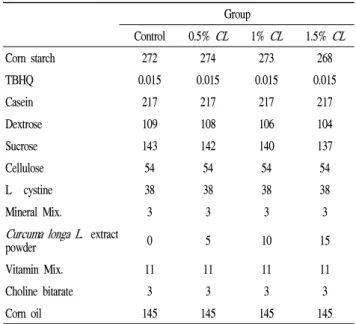
Male Sprague–Dawley (SD) rats, 21 days of age, were obtained from Central Laboratory Animal Inc. (SLC, Inc., Japan) Animals were housed in a climate-controlled room (22±2℃, 50±10% relative humidity) under a 12 h light/dark cycle and provided diet and water ad libitum. The rats were acclimated to a pellet diet for 3 days and then divided into four groups. Animals in the control group were provided a modified AIN-93G control diet (15% fat by weight). Three groups of animals were fed a diet containing 0.5, 1 or 1.5%
of the ethanol extract ofCurcuma longa L. powder for eight weeks (Table 1).
Six week old male db/db mice were also obtained from Central Laboratory Animal Inc (SLC, Inc, Japan). Animals were housed in a climate‐controlled room (22±2℃, 50±10%
relative humidity) under a 12 h light/dark cycle and provided
Table 1. Composition of diet.
Group
Control 0.5%CL 1%CL 1.5%CL
Corn starch 272 274 273 268
TBHQ 0.015 0.015 0.015 0.015
Casein 217 217 217 217
Dextrose 109 108 106 104
Sucrose 143 142 140 137
Cellulose 54 54 54 54
L‐cystine 38 38 38 38
Mineral Mix. 3 3 3 3
Curcuma longa L. extract
powder 0 5 10 15
Vitamin Mix. 11 11 11 11
Choline bitarate 3 3 3 3
Corn oil 145 145 145 145
CON, control; C L, Curcuma Longa L. supplemented group.
Fig 1. Effect ofCurcuma longa L. extract on body weight (a) and adipose tissue weight (b) in Sprague-Dawley rats.
Means with the same letter are not significantly different by Duncan’s multiple range test (p<.05). CON, control; CL, Curcuma Longa L. supplemented group diet and water ad libitum. The mice were acclimated to a pellet diet for 3 days and then divided into two groups.
Animals in the control group were provided a modified AIN-93G control diet (15% fat by weight). The other groups of animals were fed a diet containing 1.5% of the ethanol extract (Table 1).
Body weight and abdominal adipose tissue
The weight of the animals was recorded every week.
Abdominal adipose tissues were removed and weighed after sacrifice.
Biochemical analysis
Fasting blood glucose levels were measured in blood taken from the tail vein using a kit (Medisense 2, Korea) every week. Hemoglobin A1c (in2it analyser, Bio-Rad) was
determined in the blood obtained from the heart after sacrifice.
Serum insulin (Shibayagi, Japan), free fatty acid, triglyceride and total cholesterol (Asan, Seoul) were determined using kits. Homeostasis model assessment of insulin resistance (HOMA-IR) was calculated according to the homeostasis of assessment, as follows (16,17).
Statistical analysis
All data are expressed as the mean±SE. Statistical analyses were performed using the SPSS program (Version SPSS 17, Chicago, IL, USA). Group comparisons were carried out using variance analysis followed by the Duncan's multiple range test. Statistical significance was considered at p<0.05.
Results and Discussion
Effect of Curcuma longa L. on the obesity and insulin resistance in SD rats
Body weight and abdominal adipose tissue
In this study, we investigated the effect ofCurcuma longa L. on obesity and insulin resistance in SD rats and db/db mice. High fat diet has been long used to study glucose tolerance and metabolism and insulin sensitivity in experimental animals and for type 2 diabetes. In Dietary reference intakes for Koreans (15), the total fat intake should range from 15~25% of total energy. For many years, the National cholesterol education program (NCEP) and the American Heart Association (AHA) (18) recommended a fat intake of <30% of total energy. Therefore, we fed animals a 15% fat diet by weight (about 30% by calorie) to investigate the effect of Curcuma longa L. on obesity and insulin resistance induced by a moderate high fat diet.
At the termination of the experiment, a significant decrease in the body weight gain of SD rats fed the Curcuma longa L. extract diet was observed, but no significant differences were observed among the groups fed the diet containing different levels of Curcuma longa L. extract (Fig. 1). The weight of adipose tissue was significantly lower in SD rats fed the 1.5% Curcuma longa L. extract diet than that of animals fed the control diet. While there was a tendency toward lower adipose tissue weight in the 0.5% and 1%
Curcuma longa L. extract diet group at the 8th week.
However, no significant differences were detected among control, 0.5 and 1%Curcuma longa L. extract groups (Fig. 1).
Blood glucose, Serum insulin and HOMA-IR
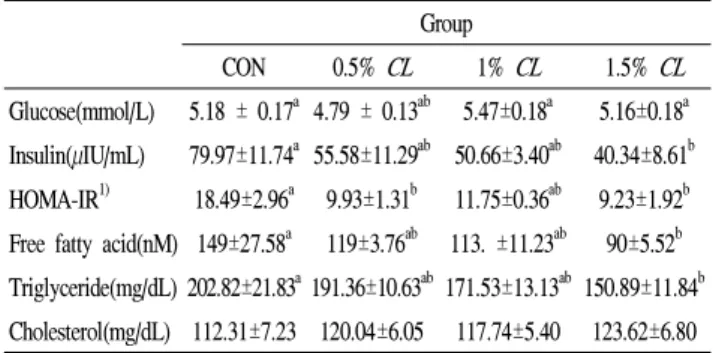
In the SD rats, no significant difference in blood glucose levels was observed among the groups at the termination of the experiment (Table 2). Fasting serum insulin levels were significantly lower in the SD rats fed the 1.5% Curcuma longa L. extract diet than those in the rats fed the control diet (Table 2). Accordingly, HOMA-IR was significantly lower in the 0.5% and 1.5% Curcuma longa L. diet groups than in the control group. Insulin resistance is considered as a major etiologic factor of the metabolic syndrome (19,20).
Hyperinsulinemia has also been suggested as a marker for a cluster of metabolic abnormalities in individuals that do not have diabetes (7). There was no significant difference Table 2. Effect ofCurcuma longaL. on the fasting blood glucose, serum insulin levels, HOMA-IR and serum lipids in high fat fed SD rats
Group
CON 0.5%CL 1%CL 1.5%CL
Glucose(mmol/L) 5.18 ± 0.17a 4.79 ± 0.13ab 5.47±0.18a 5.16±0.18a Insulin(µIU/mL) 79.97±11.74a 55.58±11.29ab 50.66±3.40ab 40.34±8.61b HOMA-IR1) 18.49±2.96a 9.93±1.31b 11.75±0.36ab 9.23±1.92b Free fatty acid(nM) 149±27.58a 119±3.76ab 113. ±11.23ab 90±5.52b Triglyceride(mg/dL) 202.82±21.83a191.36±10.63ab171.53±13.13ab 150.89±11.84b Cholesterol(mg/dL) 112.31±7.23 120.04±6.05 117.74±5.40 123.62±6.80 Values are expressed as mean±SE. Means with the same letter are not significantly different by Duncan’s multiple range test (p<.05). CON, control;CL, Curcuma Longa L. supplemented group.
1)HOMA‐IR was calculated as follows: glucose(mmol/L) x fasting insulin(µIU/mL)/22.5
Fig 2. Effect of Curcuma long L. extract on the body weight (a) and the adipose tissue weight (b) in db/dbmice.
*Significantly different with control (p<.05). CON, control;C L, Curcuma Longa L. supplemented group
in the fasting blood glucose levels among the SD rat groups (Table 2). However, Curcuma longa L.effectively decreased fasting insulin and thereby HOMA-IR. The HOMA model has been used to estimate insulin sensitivity and β-cell
function from fasting insulin and glucose concentrations (16).
Serum lipids
The Curcuma longa L. extract diet lowered serum triglyceride levels in a dose dependent manner. Serum triglyceride levels in the SD rats fed the 1.5%Curcuma longa L. extract diet were significantly lower than that of SD rats fed the control diet (Table 2). However, there was no significant difference in serum total cholesterol levels among the groups (Table 2). Sumner and Cowie (21) demonstrated that fasting TG concentrations could be used to identify insulin resistance in humans, even though ethnic differences in TG levels should be considered.
Effect of Curcuma longa L. on the obesity and insulin resistance in db/db mice
Body weight and abdominal adipose tissue
No significant difference in body weight between the control diet and 1.5%Curcuma longa L. extract diet groups were observed during the experimental period (Fig. 2).
However, theCurcuma longa L. extract significantly lowered the adipose tissue weight (Fig. 2). It has been suggested that maintenance of normal homeostasis of the abdominal adipose tissue is important for the prevention of the metabolic syndrome (22-24). Furthermore, excess accumulation of either visceral abdominal or muscle adipose tissue was reported to be associated with a higher prevalence of metabolic syndrome, particularly in those who are of normal body weight (4,24). Therefore, Curcuma longa L. could prevent high fat diet induced metabolic syndrome in both the normal weight and the obese by prevention of abdominal adipose tissue accumulation.
Blood glucose, Hemoglobin A1c, Serum insulin, HOMA-IR and free fatty acid
As shown in Fig. 3, the 1.5% Curcuma longa L. extract effectively reduced fasting blood glucose levels in db/dbmice during the entire experimental period. Glycosylated hemoglobin was lowered by theCurcuma longa L. extract.
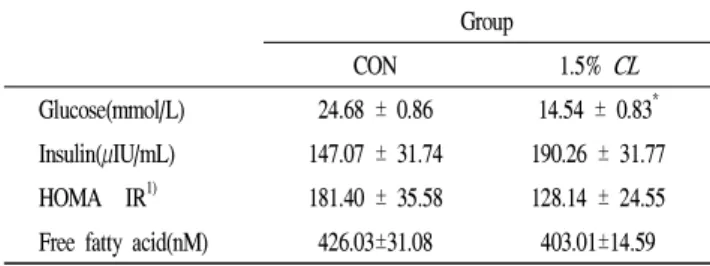
At the termination of experiment, fasting blood glucose levels were significantly lowered by 41% in the Curcuma longa L. extract diet group; however, the fasting serum insulin level was increased by 14.6%, which was not statistically significant compared to the control (Table 3). Accordingly, the HOMA‐IR was lower in the 1.5% Curcuma longa L. diet groups than in the control group, but the difference was not statistically significant (Table 3). Insulin resistance occurs
even when glucose values are still within the normal glucose tolerance range in the course of type 2 diabetes (4). In the present studyCurcuma longa L. was shown to reduce insulin resistance by preventing weight gain and abdominal fat accumulation even in normal weight animals.Curcuma longa L. significantly decreased hemoglobin A1c as well as blood glucose in leptin receptor defected db/dbmice (Fig. 3). In type 2 diabetes, hyperglycemia was induced when increased insulin secretion no longer compensates for insulin resistance.
Therefore, increased insulin alone was not sufficient to cause diabetes (6,22). Fasting insulin levels were higher in db/db mice fed Curcuma longaL., which contributed to decreased glucose concentrations and hemoglobin A1c. The final outcome was thatCurcuma longa L. significantly decreased blood glucose levels, which reduced HOMA-IR indb/dbmice.
Serum free fatty acid was also lowered by the 1.5%Curcuma longa L. diet, but the difference did not reach statistical Table 3. Effect ofCurcuma longaL. on the fasting blood glucose and serum insulin levels, HOMA-IR and serum free fatty acid in high fat fed db/db mice
Group
CON 1.5%CL
Glucose(mmol/L) 24.68 ± 0.86 14.54 ± 0.83* Insulin(µIU/mL) 147.07 ± 31.74 190.26 ± 31.77 HOMA‐IR1) 181.40 ± 35.58 128.14 ± 24.55 Free fatty acid(nM) 426.03±31.08 403.01±14.59 Values are expressed as mean±SE.*Significantly different with control (p<.05). CON, control; C L, Curcuma Longa L. supplemented group.
1)HOMA‐IR was calculated as follows: glucose(mmol/L) x fasting insulin(µIU/mL)/22.5
Fig 3. Effect of Curcuma long L. extract on the fasting blood glucose and HbA1c in db/dbmice.
*Significantly different with control (p<.05). CON, control;CL, Curcuma Longa L.
supplemented group
significance (Table 2). Excess abdominal obesity results in an increased flux of FFA to the liver, leading to an increase in insulin resistance (25). In addition, a high level of plasma
FFA also causes a further decrease in insulin sensitivity at the cellular level, impair insulin signaling and augment hepatic glucose production. Therefore, Curcuma longa L. can decrease the risk of type 2 diabetes by decreasing free fatty acid flux to the liver and insulin resistance. Hypertriglyceridemia is not absolutely required for diagnosis of the metabolic syndrome. Nevertheless, due to the strong relationship between insulin resistance and hypertriglyceridemia, hypertriglyceridemia is considered one of the most important metabolic syndrome criteria (20,25,26). In conclusion, Curcuma longa L. prevented fat accumulation and insulin resistance in SD rats fed a moderate high fat diet and improved hyperglycemia by decreasing fat accumulation and increasing serum insulin levels in type 2 diabetic obese db/db mice.
요 약
본 실험은Curcuma longaL.의 비만, 인슐린 저항성 효과 에 대해 알아보기 위하여C. longa를 50% 에탄올로 추출물 을 제조한 다음 실험동물을 통하여 알아보았다. 실험동물
로는 정상동물인 SD계 랫트와 2형 당뇨 모델인db/db마우
스를 사용하였고 식이로는 고지방식이(15%fat diet)를 사용 하였고C. longa는 식이에 넣어 제공하였다. SD rat 에서 체중, 총지방량은 1.5% 울금식이군이 대조군보다 유의적 으로 감소하였다. 혈청에서 인슐린, HOMA-IR, TG는 1.5%
울금식이군이 대조군보다 유의적으로 감소하는 것을 관찰 할 수 있었다.db/db마우스에서 체중은 1.5% 울금식이군이 대조군보다 감소하는 경향을 보였으나 유의적이지는 않았 고 총지방량은 1.5% 울금식이군이 대조군보다 유의적으로 감소하는 것을 관찰 할 수 있었다. 본 실험에서 공복 시 혈당은 2주마다 측정하였는데 1.5% 울금식이군이 대조군 보다 유의적으로 감소하였고 hemoglobin A1c도 유의적으 로 감소하는 것을 관찰 할 수 있었다. 공복 시 혈당과 hemoglobin의 유의적인 감소로 인하여 혈청에서 측정한 insulin, HOMA-IR이 감소하는 경향을 보인 것으로 사료된
다. 이상의 결과로 보아 C. longa 추출물은 체중조절 및
혈당조절에 도움이 되는 천연약물로서의 기능성이 입증되 었다고 사료된다.
Acknowledgements
This work(Grants No. 08-01-86) was supported by Business for Cooperative R&D between Industry and Academy Corperation Laboratory funded Korea Small and Medium Business Administration in 2008
References
1. Gower BA, Munoz J, Desmond R, Hailey RH, Jiao X (2006) Changes in intra-abdominal fat in early postmenopausal women: effects of hormone use. Obesity, 14, 1046-1055
2. Castejon MG, Casado AR (2011) Dietary phytochemicals and their potential effects on obesity: A review.
Pharmacol Res, 64, 438-455
3. Koh-Banerjee p, Wang Y, Hu FB, Spoegelman D, Willett WC, Rimm EB (2004) Changes in cody weight and body fat distribution as risk factors for clinical diabetes in us men. Am J Epidemiol, 159, 1150-1159 4. Goodpaster BH, Krishmaswami S, Harris TB, Katsiaras
A, Kritchevsky SB, Simonsick EM, Mevitt M, Holvoet P, Newman AB (2005) Obesity, regional fat distribution and the metabolic syndrome in older men and women.
Arch Int Med, 165, 777-783
5. Leahy HK (2005) Pathogenesis of type 2 diabetes Mellitus. Archi Med Res, 36, 197-209
6. Yang Q, Graham TE, Mody N, Preitner F, Peroni OD, Zabolotny JM, Kotan K, Quadro L, Kahn BB (2005) Serum retinol binding protein 4 contributes to insulin resistance in obesity and type 2 diabetes. Nature, 436, 356-362
7. Despres, JP, Lamarche B, Mauriege P, Cantin B, Dagenais GR, Moorjani S, Lupien PJ (1996) Hyperinsulinemia as an independant risk factor for ischemic heart disease. N Engl J Med, 334, 952-957 8. Okada K, Wangpoentrakul C, Tanaka T, Toyokuni S, Uchida K, Isawa T (2001) Curcumin and especially tetrahydrocurcumin ameliorate oxidative stress-induced renal injury in mice. J Nutr, 131, 2090-2095
9. Sharma S, Kulkarni SK, Chopra K (2006) Curcumin, the active principle of turmeric (Curcuma longa), ameliorates diabetic nephropathy in rats. Clin Exp Pharmacil Physio, 33, 940-945
10. Shishodia S, Singh T, Chatuvedi MM (2007) Modulation of transcription factors by curcumin. Adv Exp Biol, 595, 127-148
11. Pari L, Murugan P (2005) Effect of tetrahydrocurcumin on blood glucose, plasma insulin and hepatic key enzymes in streptozotocin induced diabetic rats. J Basic Clin Physiol Pharmacol, 16, 257-274
12. El‐Moselhy M, Taye A, Sharkawi SS, El-Sisi SFI, Ahmed AF (2011) The antihyperglycenic effect of curcumin in high fat diet fed rats. Role of TNF-α and
free fatty acids. Food Chem Toxidol, 49, 1123-1140 13. Tartaglia LA, Dembski M, Weng X, Deng N, Culpepper
J, Devos R (1995) Identification and expression cloning of a leptin receptor, OB-R. Cell, 83, 1263-1271 14. Coleman DL (1978) Ovese and diabetes: Two mutant
genes causing diabetes-obesity syndroms in mice.
Diabetologia, 14, 141-148
15. The Korean Nutrition Society (2010) Dietary reference intakes for Koreans. 1strevision 2010. Seoul: The Korean Nutrition Society.
16. Matthews DR, Hosker JP, Rudenski A, Naylor BA, Treacher DF, Turner RC (1985) Homeostasis model assessment: insulin resistance and geta-cell function from fasting plasma glucose and insulin concentrations in man.
Diabetologia, 28, 412-419
17. Matsuzawa Y, Funahashi T, Kihara S, Shimomura I (2004) Adiponectin and metabolic syndrome. Arterioscler Thromb Vasc Biol, 24, 29-33
18. Expert pannel in detecton evaluation and treatment of high Blood cholesterol in adults. (2001) Executive summary of the third report of the national cholesterol education program(NCEP) expert panel in detection, evaluation, and treatment of high blood cholesterol in adults(Adult treatment panel III). JAMA, 285, 2486-2497 19. Alberti KG, Zimmet P, Shaw J (2005) The metabolic syndrome-a new world-side definition: IDF epidemiology task force consensus group. Lancet, 366, 1059-1062.
20. Eckel RH, Grundy SM, Zimmet PZ (2005) The metabolic syndrome, Lancet, 365, 1415-1428
21. Sumner AE, Cowie CC (2008) Ethnic differences in the ability of triglyceride levels to identify insulin resisrance.
Atherosclerosis, 196, 696-703
22. Berg AH, Combs TP, Scherer PE (2002) ACRP30/
adiponectin: An adipokine regulating glucose and lipid metabolism. Trends Endocrinol Metab, 13, 84-89 23. Tsao TS, Lodish HF, Fruebis J (2002) ACRP 30, a new
hormone controlling fat and glucose metabolism.
European J Pharm, 440, 213-221
24. Goodpaster BH, Krishnaswami S, Resnick H, Kelley DE, Haggerty C, Harris TB, Schwartx AV, Kritchevsky S, Newman AB (2003) Association between regional adipose tissue distribution and both type 2 diabetes and impaired glucose tolerance in elderly men and women.
Diabetes care, 165, 372-379
25. Bergman RN, Ader M (2000) Free fatty acid and pathogenesis of type 2 diabetes mellitus. Trends Endocrinol Metabol, 11, 351-356
26. Avramiglu RK, Basciano H, Adeli K (2006) Lipid and lipid protein dysregulation in insulin resistant states. Clin Clim Acta, 368, 1-19
(접수 2012년 10월 25일 수정 2012년 12월 27일 채택 2013년 1월 4일)