• 검색 결과가 없습니다.

A Study of Cross-border Trade in Second-hand Goods

N/A
N/A
Protected

Academic year: 2021

Share "A Study of Cross-border Trade in Second-hand Goods"

Copied!
11
0
0

로드 중.... (전체 텍스트 보기)

전체 글

(1)

Abstract

Purpose - The purpose of this research was to examine the regulation and distribution channel of second-hand goods in cross-border trade in order to propose methods of protecting consumers through the international standardization of the in- tensifying second-hand trade and resource recycling.

Research design, data, methodology - This study first defines several concepts relevant to research in international sec- ond-hand goods. Second, a questionnaire and interviews were conducted with manufacturers of second-hand toner cartridges and automobile parts to identify the current status of export and manufacturing.

Results - The study proposes the international standardization of second-hand goods and waste to protect consumers and pro- mote efficient resource recycling.

Conclusions - The results of the study reveal that sec- ond-hand goods (except automobiles) do not have an HSK code to use for import/export data collection. Though used car ex- ports are declining, used cars are increasing. Collecting data on used car parts is impossible because the buyers purchase and ship the second-hand parts.

Keywords : Second-Hand Goods, Recycling of Resource, Guarantee System, International Trade, HSK Code.

JEL Classifications : F10, L50, L60, N70, Q20.

1. Introduction

Many nations have introduced strategies to promote recycling and reduce waste in order to promote environmental con- servation and economic growth. Waste is recovered from the deconstruction and crushing of products and is then traded

* This research was presented at the 2013 KODISA International Summer Conference and was revised in accordance with the comments from two discussants and three peer reviewers.

** First author: Professor, Ph.D. Daejeon Health University, Korea Tel:

+10-6425-4007. e-mail: [email protected].

*** Corresponding author: Professor, Department of Business Administration, Kyungdong University Tel: +82-10-6655-4485. e-mail: [email protected].

overseas or thrown out. Waste products must be disposed ra- tionally, and their appropriate distribution is becoming an im- portant resource recycling system issue. Recycling waste is rea- sonable to do on behalf of significant resources. Second-hand goods such as construction machinery, machine tools, vessels, and aircraft have long been traded, in a trend that now applies to durable consumer goods such as electronics and automobiles. Second-hand goods have caused health, safety, and environmental issues. They also waste resources because few remanufacturing efforts have been taken to extract rare met- als from them. To alleviate these problems, the international trade and efficient recycling of second-hand goods as well as internationally binding standards and tracking of those goods are required. This study examines the mandatory control and dis- tribution channel of second-hand goods and international stand- ard trials designed to protect consumers in the second-hand goods trade. This study focuses on two categories of goods.

The first comprises electronic goods such as mobile phones, PCs, refrigerators, TVs, and automobiles, the data for which are based on trade returns and export statistics kept by the Korea Customs Service. The second category comprises remanufactur- ing goods such as automobile parts and toner cartridges. The study employed questionnaires and telephone interviews with CEOs.

2. Research on Trade in Second-Hand Goods 2.1. Definition of Second Hand-Goods as Recycling

Resource

energy supply, construction, agricultural and stockbreeding production, or other human activities.

Though organic matter is included as waste in the Basel Convention, some nations do not certify it as such (see Figure 1).

The term "recycling" refers to any activity that promotes reuse or remanufacturing for reuse. The recycling of resources targets- renewable resources and the reuse of second-hand goods.

Renewable resources comprise usable resources or potentially usable resource among closed goods or accessories.

Second-hand goods comprisere usable goods that require only Print ISSN: 1738-3110 / Online ISSN 2093-7717

doi: 10.13106/jds.2013.vol11.no11.89.

[Field Research]

A Study of Cross-border Trade in Second-hand Goods*

10)
Eun-Sook Lee**, Kwang-keun Lee***

(2)

cleaning or repair, in contrast to remanufactured goods, pro- duced from the collection, disassembling, cleaning, inspection, adjustment, or reassembling processes. The "extended producer responsibility" underlines the producer's responsibility to recycle wastes, and the producer's rate of recycling is set by Korean law. Export for recycling is regulated by the "Control of Trans-boundary Movements of Hazardous Wastes and Their Disposal." Only PCs among electricity and electronic goods are involved in second-hand goods export.

2.2. Regulation of Second-Hand Goods Trade

While the second-hand goods trade has promoted resource recycling, it has complicated goods disposal because of the goods’ short life expectancy. As developing countries do not have the technology to repair home appliances or automobiles, their second-hand goods quickly become waste and cause pollution. The goods become dumped waste rather than being reused or renewed.

The exhaust from used automobiles causes air pollution, and the cars are abandoned after short periods of use in Mongolia and other west coast countries. Waste disposal exports from de- veloped countries to developing ones are prohibited under the Basel Convention.

The trade and industry departments regulated second-hand goods exports through the Foreign Trade Act and export and import notification processes until 1998. However, these regu- lations were abolished to simplify the procedure. Table 1 de- scribes the import regulations for second-hand goods.

<Table 1> Import embargo on recycling resource

Source: Kojima (2008).

Regulation Contents Notes

Embargo export/import ban

- Basel Convention prohibited export of wastes from developed countries to developing countries for disposal.

- Indonesia: Ban on trade in waste plastics

- Thailand: Ban on waste tires, import embargo on second-hand electronic goods more than three

years old.

Temporary admission &

approval

import/export, preliminary government review of trade

Principle of Basel Convention (need permission of government of

importing nation) import of second-hand machinery needs permission from government of

China.

- import/export of waste in Korea needs permission of Environment

Department.

Inspection before shipment

inspection before shipment by

importing government to

satisfy import standards

Inspection before shipment of reusable resources such as waste

paper, plastics, and iron scrap is obligatory in China.

Inspection before shipment of printed material is obligatory in Indonesia for religious reasons.

Taxation on second-hand goods based production on

year

high taxation rate

on old products High taxation rate on old automobiles in Mongolia.

Enrollment of importers

enrollment system for importers

Enrollment system for reusable resource importers in China.

Enrollment system for waste tires importers in Singapore.

Enrollment of exporters

enrollment system for exporters

Enrollment system for reusable resource exporters in China.

International declaration

Collection of declaration from

export factory

Recycling factory at export site records declaration on internet

business in Taiwan.

Inspection of factory at export site

Inspection of factory at export

site by local government or lain government

Inspection of factory at export site by local government or lain

government in Taiwan.

source: Kojima (2007).

<Figure 1> Definition of recycled substances, second-hand goods, recycled resources, and waste.

(3)

2.3. Standard Judgment of Second-Hand Goods

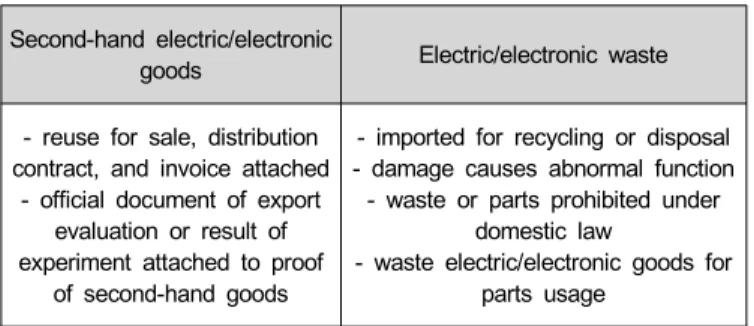
Each nation regulates electric and electronic goods because of the waste goods trade. However, international regulations have not reflected Korea’s regulation or classification of sec- ond-hand electric and electronic goods and waste, as shown in Table 2.

<Table 2> Standards for second-hand electric and electronic goods and waste

Second-hand electric/electronic

goods Electric/electronic waste - reuse for sale, distribution

contract, and invoice attached - official document of export

evaluation or result of experiment attached to proof

of second-hand goods

- imported for recycling or disposal - damage causes abnormal function - waste or parts prohibited under

domestic law

- waste electric/electronic goods for parts usage

Source: Ministry of Environment (2010)

<Table 3> Standards for hazardous electronic goods waste in Australia

Questions Answer Activities

Q1 Is equipment potentially dangerous?

Yes To Q2.

No Equipment is not harmful waste possible to export

without permission.

Q2

Does equipment have documentation to

prove that the equipment is not

waste?

Yes Export without permission if approved as non-waste.

No To Q3.

Q3

Is equipment or part treated as mentioned in the law, such as

for recycling

Yes The equipment is harmful waste and cannot be

exported.

No To Q4.

Q4

Was equipment measured using the

appropriate procedure?

Yes To Q5.

No

Unmeasured equipment is considered harmful waste, so

export is impossible without permission.

Q5

Was measurement based on procedure

used for harmful waste?

Yes Judged to be harmful waste, thus cannot be exported

without permission.

No To Q6

Q6

Are the test results presented as per the

appropriate documentation

procedure?

Yes

As it is non-harmful waste based on test results, the documented equipment can

be exported without permission.

No

The undocumented equipment test results confirmed as waste cannot

be exported without permission.

Source: Australian Department of the Environment and Heritage (2012)

Table 4 describes the advance notice and approval processes for the recovered mobile phone trade pursuant to the mobile phone partnership settled by the Basel Convention in 2006 (Kojima, 2008).

<Table 4> Guidelines for the recovered mobile phone trade

1) Reused goods and goods exported after inspection are treated as brand new.

2) Goods exported without inspection and considered waste require notification.

3) Repaired goods (even though inspected) and harmful waste disposed after repair require notification.

4) Repaired goods (even though inspected) and harmful waste disposed after repair do not require notification.

Even though written consent and the lack of denial is gen- erally considered prior approval, this guideline has no legal force. Table 5 presents Japan’s standards for second-hand TV exports.

<Table 5> Standards for second-hand TVs in Japan

Item Standard Proof from exporter

Year Within 15 years after production

Keep record of individual production year, formation,

maker keep this handy in case it is required

Appearance

The following items cannot be approved for

second-hand export:

- goods in a damaged packing box - goods with damaged

or severely depleted Braun tubes - recalled items or items

recalled because of safety problems

Keep for inspection if required

Confirmation of operation

Communicate inspection confirmation of operation for

Record confirmation of operation of individual item and keep it handy in case it

is required

Packaging &

situation load

- Keep Braun tubes; do not destroy them - use packaging and

careful loading to prevent damage during

transit

Exporter records packaging and loading situation (at least 3)and keeps it handy in case

it is required

Secure second-hand good’s seller

Verify purpose of reusable item with

exporter country

Record seller name, address, and picture of sale location, and keep it handy in case it

is required Source: Ministry of Economy, Trade and Industry (2009)

Thus, both imported and exported goods are regulated. As

(4)

the trade in second-hand goods grows, the need to regulate them as waste Intensifies while trading such goods as renew- able resources intensifies the need to regulate second-hand goods as well. Defining the nature of the resources and goods for export is thus required.

3. International Distribution Channel for Second-Hand Goods

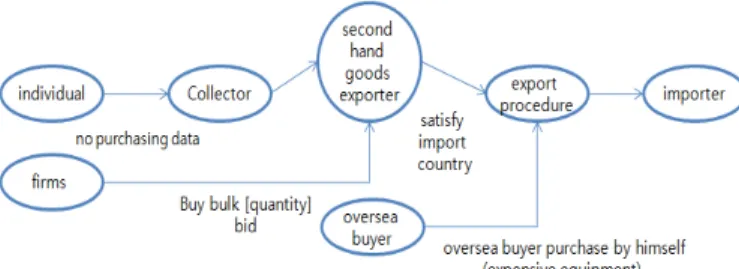
This section reviews the international distribution of sec- ond-hand goods. Figure 2 shows the process of exporting val- uable second-handgoods purchased from collectors.

<Figure 2> Export channel for second-hand goods

There is no source for the pricing and volume of sec- ond-hand PC bulk buying because the business is so small.

Items recorded on traders’ business cards differ because of dif- fering buyer requirements and because expensive items such as medical appliances are traded directly with overseas buyers;

there is thus no export accounting record in such cases. Due to the applicable import regulations, second-hand electric and elec- tronic goods are exported with no second-hand goods mark or are treated as scrap. Korea has difficulty recording its exports because it does not assign an HS code for second-hand goods except for used cars. Japan has assigned an HS code for reus- able items such as TVs, air conditioners, washing machines, re- frigerators, and computers. As second-hand goods imports must pass through a quality approval procedure, they are handledal- most the same as are imports of new products.

<Figure 3> Import channel for second-hand goods

Many illegal import methods have been used to, for example, import goods difficult to pass through the approvals process be- cause of exhaust or noise issues; moreover, some goods are

banned shortly after been imported illegally and are then sold.

In order to avoid customs inspection, motor cycles are docu- mented as import goods such as used motorcycles, used bro- ken motorcycles, or used broken motorcycle parts (motorcycles are excluded by the Air Quality Preservation Act). Noise, vi- bration, and exhaust issues are regulated by the Automobile Management Act. In spite of their high prices, there is no inter- national standard test or pricing for second-hand medical appliances. Tracing the exporters of such appliances is difficult because there is no harmonized system, and the distribution channels are unclear because of the lack of tracking manage- ment

4. Second-Hand Goods and the Production and Export of Remanufacture

This section discusses the production and export of re- manufactured toner cartridges and automobile parts based on telephone interviews and questionnaires conducted with goods remanufacturers.

4.1. Toner Cartridges

Table 6 shows that the domestic production of toner car- tridges reached 7,190 (ea) thousands in 2008 for a value of 6,690 billion won. The number of remanufactured cartridges reached 1850 (ea), about 25.8% of the total, for a value of 820 billion won, about 12.3% of the total value.

<Table 6> Domestic toner cartridge market

Classification 2007 2008

Quantity

(1000 ea) Sum (100

million) Quantity

(1000 ea) Sum (100 million) Genuine

black-white

cartridge 4,450 4,450 4,284 4,284

color

cartridge 680 1,020 1,259 1,589

sub total 5,130 5,470 5,343 5,873

Remanuf actured


black-white

cartridge 1,203 432 1,499 540

color

cartridge 197 158 349 280

sub total 1,400 590 1,848 820

Total 6,530 6.06 7,191 6,693

Source: Korea Cartridge Recycling Association (2008)

As they are less than 30% of the price of manufactured

goods, remanufactured goods have a price-based rate less than

their numbers might otherwise suggest. The number of re-

manufactured toners in Korea is 250 to 300 EA. There are

5,000 EA remanufacture factories in the US, which re-

manufacture 2,700 EA every year. This amount cuts crude oil

expenditures by one ton and eliminates 384 kg worth of solid

(5)

waste. An annual savings of60 thousand tons of crude oil and 23 thousand tons of environmental waste cuts expenses. Thus, remanufacturing induces a large resource recycling effect.

Europe has 1,640 EA remanufacture factories and a 24.7% re- manufactured goods market share. Table 7 below is based on questionnaires and telephone interviews conducted with 50 CEOs of toner remanufacture factories. The table shows that the factories are very small and in the early development stages, as they have fewer than 20 employees and average an- nual sales of about 600 million won.

Although, as Table 8 shows, the number of domestic toner remanufactures is increasing, their sales are decreasing. Thus, the goods’ market prices have clearly not yet been smoothly established.

Waste cartridges are not only a significant resource but can also create environmental pollution. The Korea Cartridge Recycling Association (2006) states that Korea wastes 2,000 ea cartridges every year, among which only 17% are recycled 83%

of wasted cartridges have been reclaimed or incinerated. Our questionnaires suggest that the domestic cartridge remanufacture industry hassystemic weaknesses: it has insufficient manufactur- ing technology and market power, Chinese remanufacturing rep- resents 50% of the global total, and Korea’s remanufacturing enterprises are small. The quality of remanufactured toner car-

tridges and consumer welfare are affected by the inflow of un- licensed Chinese toners, and the small scale of the domestic cartridge remanufacture/refill industry could negatively impact the rest of Korea’s remanufacture industry.

<Table 7> Interviews with cartridge recycling manufacturers

No Company name Number of

employee Phone number Fax Address

1 Simwontech. Ltd 19 02-572-0069 02-3463-0069 Seoul gumchungu gasan-dong 319 hosseo dae venture tower 408

2 Daesungtechnology,

Ltd 21 042-274-6071 042-274-6070 Daejeon donggu sangsodong 622-4

3 Wonwootech. Ltd 10 02-999-0606 02-991-1456 Seoul nowongu wolgye2dong wolgyetechnotown 702

4 Cosmos. Ltd 24 032-544-7060 032-544-7023 Incheon. gyeyanggu hyusungdong 567-2

5 JKOA. Ltd 55 031-906-5646 031-906-5645 Gtunggido goyang ilsangu

janghangdong 557-13

6 EP Land 12 032-865-8386 032-865-8387 Gyunggido goyang ilsangu

janghangdong 557-13

7 Ep Tech 7 02-2634-5808 02-2634-5807 Seoul Gunchungu gasandong 60-5

gabeultrad vally A-806

8 Hanjin Tech 27 032-817-0250 032-817-0252 Incheon namdong gu gojandong670-12

namdonggukgasanup91B13L 9 Haesung Tplon. Ltd 30 02-717-5411 02-717-6437 Seoul yongsangu shinchangdong56-2 10 Cyclon. Ltd 5 (contract work:40) 051-941-0308 051-941-0310 Busan gangsuhgu songjungdong 1506-11 Source: Korea Cartridge Recycling Association (2011)

<Table 8> Remanufactured toner cartridge sales/production

No Company name

Sale (million won) Production (ea)

2010 2011 Percentage

change 2010 2011 Percentage change

1 Simwontech. Ltd 1,400 1,200 ▽14% 28,000 21,000 ▽25%

2 Daesung technology, Ltd 3,100 3,051 ▽ 2% 70,000 74,000 △ 6%

3 Wonwootech. Ltd 175 143 ▽18% 30,000 26,000 ▽13%

4 Cosmos. Ltd 2,913 1,859 ▽36% 80,000 80,000 0%

5 JKOA. Ltd 4,900 4,100 ▽16% 170,000 150,000 ▽12%

6 Ep Land 1,500 1,500 0% 100,000 110,000 △10%

7 Ep Tech 500 600 △20% 20,000 24,000 △20%

8 Hanjin Tech 1,800 2,000 △11% 110,000 120,000 △ 9%

9 Haesung Teplon. Ltd 3,800 3,500 ▽ 8% -  -  -

10 Cyclon. Ltd 1,200 1,200 0% 80,000 100,000 △25%

Total 21,288 19,153 ▽ 10% 688,000 705,000 △ 2%

Source: Korea Cartridge Recycling Association (2011)

(6)

4.2. Automobile Parts

Self-reliance in the domestic remanufacture of automobile parts is insufficient because of hand waving systematization and because manufacturers and module corporations profit from the black market. Hence, no formal data are maintained. The Korea Remanufacturing Industry for Automobile Parts (KRA) states that the domestic parts market has reached three trillion 500 billion won, while the market for remanufactured parts has reached 240 billion won and represented 7% of the market in 2010. The 2,000 remanufacturers could not increase their market share, however, because 60% of them were very small. The number of employees working for automobile parts remanufacturers was es- timated at 4,000, the defective rate was 5 to 10%, and their market price was 20 to 40% of that of new products.

<Table 9> Estimation of automobile parts remanufacturing market Items

Estimated number of remanufact

urers

Estimated number of products

Estimated market scale

(100 million won)

Notes

Generator start motor 270 1,100,000 250  

CV joint 320 1,400,000 240  

Caliper 45 300,000 10  

Power pump 25 200,000 6  

Power steering gear 75 70,000 45  

Transmission 350 50,000 60  

Lower arm/upper arm 15 250,000 20  

Other (shock absorber, injector, catalyst, turbo,

throttle body, fan clutch, water pump, air

flow sensor, high pressure pump, auto

fan, auto pulley)

380 - 1,700

Sub total 1,480 3,370,000 2,331

Source: Korea Automobile Parts Remanufacture Association (2010)

The KRA reports that there are 350 remanufacturers of trans- missions, 320 remanufacturers of CV joints, and 270 re- manufacturers of generators and starter motors. However, there are few remanufacturers of power steering gears and parts (see Table 9). The parts circulating in the market are for brand new cars, and most remanufactured parts are for old models such as the Sonata (I, II, III, and EF), Verna, and Prince, which have been discontinued for over ten years and no longer circulate in the domestic market. The KRA states that exports of remanufac- tured products are very rare. Most remanufactured export prod- ucts consist of parts for new or used car exports. However, their buyers, located in the main exporting regions such as Mongolia, the Middle East, and Africa, dislike remanufactured parts and usually import used parts instead. The credibility of remanufacturing quality is very low, and used parts are often lo- cally disassembled. Given this situation, this study questioned 25 KRA members out of the organization’s total of 400, repre- senting at least 200 million won in annual sales, to learn about the export/import and in/out flow of remanufactured automobile parts. Questionnaires and interviews were used to cover three years of data. Twelve firms responded to the research questions (see Table 10).

The sales amounts, output, export amounts, and export rates of the above firms from 2009 to 2011 are presented in tables 11 to 13, which show that Joowon-retech exported all of the batteries remanufactured in 2009, 99% in 2010, and 97% in 2011 this represents the highest export rate among all the firms.

The export rate is less than 20% of the total sales amount for all firms except Jangsoo shover.

<Table 10> Interviewed automobile parts remanufacturers

No Company name Main product Phone Fax Address

1 Haein Eng power steering 031-797-3311 031-797-0409 gyunggido gwangju

2 Jennis low arm 031-574-7445 031-574-7446 gyunggido namyangju

3 Youngnam Eng constant velocity joint 051-971-0598 051-941-7969 Busan gangsuhgu 4 Daegyo Company constant velocity joint 041-857-7883 041-857-7886 chungnam gongju 5 Daedo Company constant velocity joint 053-586-2975 053-586-2976 Daegu dalsung 6 Donjin Absorber shock absorber 031-372-9183 031-373-9184 Gyunggi osan 7 Jangsu Absorber shock absorber 031-574-5514 031-574-5518 gyunggido namyangju

8 Juwonretech. Ltd battery 032-572-3831 032-572-3832 Incheon seogu

9 Pro Junjang junjang parts 062-955-3399 062-955-3404 Gwangju gwangsan

10 T&T Motors wheel length parts 062-944-8582 062-944-8546 Gwangju gwangsan

11 Daehan Lining caliper 031-446-6038 02-2612-6048 gyunggido siheung

12 Ojung Head engine head 032-568-6341 032-561-6395 Incheon seogu

Source: Korea Automobile Parts Remanufacture Association (2010).

(7)

<Table 11> Export of remanufactured automobile parts (2009)

<Table 12> Export of remanufactured automobile parts (2010)

<Table 13> Export of remanufactured automobile parts (2011)

No Company name Main product

2009 Sale amount

(100 million)

Number of

products (ea) Export amount(100

million) Export rate (%) Number of exports (ea)

1 Haein Eng power steering 5.0 43,000 0.4 8.0% 3,440

2 Jennis low arm 1.6 23,000 0.2 13.5% 3,105

3 Youngnam Eng constant velocity joint 5.6 73,000 - 0.0% -

4 Daegyo Snagsa constant velocity joint 5.0 66,000 0.1 1.0% 660

5 Daedo Sanup constant velocity joint 6.0 75,000 0.5 8.0% 6,000

6 Donjin Absorber shock absorber 2.2 18,000 - 0.0% -

7 Jangsu Absorber shock absorber 3.0 24,000 1.1 36.0% 8,640

8 Juwonretech. Ltd battery 0.7 2,300 0.7 100.0% 2,300

9 Projunjang junjang parts 5.0 42,000 0.4 7.0% 2,940

10 T&T Motors wheel length parts 5.1 18,600 - 0.0% -

11 Daehan Lining caliper 7.0 84,000 1.1 15.0% 12,600

12 Ojung Head engine head 2.5 3,450 0.1 2.5% 86

Source: Korea Automobile Parts Remanufacture Association (2010)

No Company name Main product

2010 Sale amount

(100 million) Number of

products (ea) Export amount(100

million) Export rate (%) Number of exports (ea)

1 Haein Eng power steering 7.0 60,200 0.6 8.5% 5,117

2 Jennis low arm 5.4 77,625 0.8 14.0% 10,868

3 Youngnam Eng constant velocity joint 6.6 86,036 - 0.0% -

4 Daegyo Snagsa constant velocity joint 7.0 92,400 0.1 1.5% 1,386

5 Daedo Sanup constant velocity joint 7.2 90,000 0.6 8.3% 7,470

6 Donjin Absorber shock absorber 2.6 21,273 - 0.0% -

7 Jangsu Absorber shock absorber 3.5 28,000 1.4 39.5% 11,060

8 Juwonretech. Ltd battery 3.9 12,650 3.8 99.0% 12,526

9 Projunjang junjang parts 5.3 44,520 0.4 8.4% 3,740

10 T&T Motors wheel length parts 5.4 19,694 0.1 1.0% 197

11 Daehan Lining caliper 8.0 96,000 1.5 19.0% 18,240

12 Ojung Head engine head 2.8 3,864 0.1 2.9% 112

Source: Korea Automobile Parts Remanufacture Association (2010).

No Company name Main product

2011 Sale amount

(100 million)

Number of

product (ea) Export amount(100

million) Export rate (%) Number of exports (ea)

1 Haein eng power steering 7.5 64,500 0.6 8.5% 5,483

2 Jennis low arm 6.1 87,688 1.0 16.0% 14,030

3 Youngnam Eng constant velocity joint 6.3 82,125 - 0.0% -

4 Daegyo Snagsa constant velocity joint 11.0 145,200 0.1 1.0% 1,452

5 Daedo Sanup constant velocity joint 8.0 100,000 0.8 10.2% 10,200

6 Donjin Absorber shock absorber 2.1 17,182 - 0.0% -

7 Jangsu Absorber shock absorber 4.0 32,000 1.9 47.0% 15,040

8 Juwonretech. Ltd battery 30.0 98,571 29.1 97.0% 95,614

9 Projunjang junjang parts 6.0 50,400 0.6 9.8% 4,939

10 T&T Motors wheel length parts 6.2 22,612 0.1 1.0% 226

11 Daehan Lining caliper 9.0 108,000 1.8 20.0% 21,600

12 Ojung Head engine head 3.2 4,416 0.1 3.3% 146

Source: Korea Automobile Parts Remanufacture Association (2011)

(8)

Table 14 shows the KRA firms’ sales amounts and output trends over the last three years. The domestic output and sales of remanufactured automobile parts have increased. However, most firms had no exports or less than 100 million of exports except for Joowon Retech.

t

Table 15 presents the KRA members’ sales and export amounts, and Table 16 presents their export rates. Even though exports of remanufactured automobile parts have increased, the average annual sales have been less than one billion won and exports less than 10%, which indicates that the export of re- manufactured products is still in the initial phase.

i

Supply and demand difficulties involving used core parts and a focus on the domestic market have caused the export rate to be lower than the domestic market rate. The Middle East, Mongolia, and East Asia are the main import locations for re- manufactured parts, as those countries require them most.

However, most exported parts are over 10 years old, and it is difficult to secure core parts, which restrains export growth.

However, Joo-won Retech transacts directly. Moreover, the sup- ply of and demand for remanufactured batteries are steady, and the product is easy to export.

<Table 14> Sale amount sand production trends for automobile parts remanufacturers (2009 2011) –

No Company name

Sale amount (million won) Number of products (ea)

2009 2010 2011 Percentage change

over 2 years 2009 2010 2011 Percentage change

over 2 years

1 Haein Eng 5.0 7.0 7.5 50% 43,000 60,200 64,500 150%

2 Jennis 1.6 5.4 6.1 281% 23,000 77,625 87,688 381%

3 Youngnam Eng 5.6 6.6 6.3 13% 73,000 86,036 82,125 113%

4 Daegyo Snagsa 5.0 7.0 11.0 120% 66,000 92,400 145,200 220%

5 Daedo Sanup 6.0 7.2 8.0 33% 75,000 90,000 100,000 133%

6 Donjin Absorber 2.2 2.6 2.1 ▽ 5% 18,000 21,273 17,182 95%

7 Jangsu Absorber 3.0 3.5 4.0 33% 24,000 28,000 32,000 133%

8 Juwonretech. Ltd 0.7 3.9 30.0 4186% 2,300 12,650 98,571 4286%

9 Projunjang 5.0 5.3 6.0 20% 42,000 44,520 50,400 120%

10 T&T Motors 5.1 5.4 6.2 22% 18,600 19,694 22,612 122%

11 Daehan Lining 7.0 8.0 9.0 29% 84,000 96,000 108,000 129%

12 Ojung Head 2.5 2.8 3.2 28% 3,450 3,864 4,416 128%

13 Samjung Auto Mission 3.0 3.5 4.0 33% 600 700 800 133%

total 51.7 68.2 103.4 100% 472,950 632,962 813,494 172%

Source: Korea Automobile Parts Remanufacture Association (2011)

<Table 15> Sales and export amounts of remanufactured automobile parts

No Company name Main product 2009 sales

amount 2009 export

amount 2010 sales

amount 2010 export

amount 2011 sales

amount 2011 export amount

1 Haein Eng power steering 5.0 0.4 7.0 0.6 7.5 0.6

2 Jennis low arm 1.6 0.2 5.4 0.8 6.1 1.0

3 Youngnam Eng constant velocity joint 5.6 - 6.6 - 6.3 -

4 Daegyo Snagsa constant velocity joint 5.0 0.1 7.0 0.1 11.0 0.1

5 Daedo Sanup constant velocity joint 6.0 0.5 7.2 0.6 8.0 0.8

6 Dnjin Absorber Shock absorber 2.2 - 2.6 - 2.1 -

7 Jangsu Absorber shock absorber 3.0 1.1 3.5 1.4 4.0 1.9

8 Juwonretech. Ltd battery 0.7 0.7 3.9 3.8 30.0 29.1

9 Projunjang junjang parts 5.0 0.4 5.3 0.4 6.0 0.6

10 T&T Motors wheel length parts 5.1 - 5.4 0.1 6.2 0.1

11 Daehan Lining caliper 7.0 1.1 8.0 1.5 9.0 1.8

12 Ojung Head engine head 2.5 0.1 2.8 0.1 3.2 0.1

Source: Korea Automobile Parts Remanufacture Association (2011)

(9)

4.3. Import-Export/Supply-Demand Problems with used and Remanufactured Products

This study found several problems involving resource reuse and recycling through our interviews with employees in the industry.

4.3.1. Second-Hand Goods

The problems and path analyses are described below.

1) Although Korea has a law and a system for resource re- cycling, the responsibilities of initiators are unclear. There is no law governing managing bodies, responsibilities, or quality certifi- cation because there is no management system for sec- ond-hand goods. Thus, many usable second-hand goods are wasted.

2) Extended producer responsibility certificates record exports as second-hand goods only for PCs. Because second-hand electric and electronic goods are not certified, producers and im- porters consider them recyclable waste. Thus, these sec- ond-hand goods are treated as scrap metal and have no record of being unused resources from overseas.

3) No after-service or component supply process occurs after product sales. In addition, the lack of a managing system for second-hand goods with guarantees causes environmental problems. Products imported as waste and then changed into new products through the manipulation of core components can cause very serious safety issues.

4) The word "Used" is often omitted from export and import declarations for second-hand goods, while waste is also often declared as used goods. Thus, data on export and import dec- larations are not reliable. Furthermore, because second-hand goods have no HSK code, it is impossible to track and collect the data needed to manage the goods.

5) Because data analyses are impossible to standardize across organizations (as the data are closed), few data on sec

ond-hand goods are available. Only one organization, the Korea Custom and Trade Development institute, keeps them, and at a very high cost.

6) Because the trade in second-hand goods occurs through personal networks (e.g., internet, personal trading), it is difficult to develop as an industry or complex distribution channel.

Mapping the routes taken by second-hand goods is impossible because they consist of small collectors, making data collection impossible.

7) Because there are no clear classification criteria, exporters and importers themselves decide if goods are second hand or waste. Moreover, collecting information on exports and imports is impossible because there are no clear expressions for items on export and import declarations (e.g., LCD monitors are in- dicated as "CTR" and PCs as "monitors").

8) There are no international agreements on issues such as the inspection criteria, level criteria, orprice criteria for sec- ond-hand goods exporters and importers follow their own standards. Institutional measures such as those for quality as- surance and distribution channel transparency for second-hand goods are required.

4.3.2. Remanufacture

Though environmental regulations for industrial structures have been in force since 2011, this systemic support is not enough.

Remanufacturing needs not only core second-hand products as raw material but also capital and technical support. The industry faces problems such as its small scale, incapacity, severe mar- ket competition due to its low entrance barrier, insufficient reli- ability, narrow distribution channel, and weak sale force. In addi- tion, illegal Chinese products, technical barriers, and negative consumer views of genuine goods manufacturers are also seri- ous problems.

The institutional problems facing remanufactured products are as follows.

<Table 16> Export ratesof automobile parts remanufacturers over three years (2009 2011) –

No Company name Main product 2009

sales amount 2010

sales amount

2011 sales amount

1 Haein Eng power steering 8.0% 8.5% 8.5%

2 Jennis low arm 13.5% 14.0% 16.0%

3 Youngnam Eng constant velocity joint 0.0% 0.0% 0.0%

4 Daegyo Snagsa constant velocity joint 1.0% 1.5% 1.0%

5 Daedo sanup constant velocity joint 8.0% 8.3% 10.2%

6 Donjin Absorber shock absorber 0.0% 0.0% 0.0%

7 Jangsu Absorber shock absorber 36.0% 39.5% 47.0%

8 Juwonretech. Ltd Battery 100.0% 99.0% 97.0%

9 Projunjang junjang parts 7.0% 8.4% 9.8%

10 T&T Motors wheel length parts 0.0% 1.0% 1.0%

11 Daehan Lining caliper 15.0% 19.0% 20.0%

12 Ojung Head engine head 2.5% 2.9% 3.3%

Source: Korea Automobile Parts Remanufacture Association (2011)

(10)

1) Despite the promotion of environmentally friendly institu- tional structures, the support for propulsion systems is inadequate. There is no institutional system for inducing support from genuine goods manufacturers.

2) Though there are quality certification standards for some articles, quality, performance, and safety guarantees are often not available.

3) There are no HSK codes for remanufactured products yet.

Thus, data on the export/import and inflow/outflow of goods can- not be collected or presented as industry statistics.

4) Violations of the brands, patents, and techniques used by genuine articles are core barriers for the remanufacturing industry.

5) Because small enterprises produce most remanufactured goods, their quality and safety cannot be guaranteed.

6) Government support for the remanufacturing industry is clear as regards resource recycling, but consistent strategies and processes must be followed.

7) In the automobile remanufacturing industry, the inner parts used to replace damaged or consumable genuine articles are required in order to remanufacture without the need for physical changes. However, the supply of and demand for inner parts is a complicated issue.

8) The supply and demand issue involving the core resources of the remanufacturing industry is complicated because genuine goods producers collect all the second-hand parts and then dis- pose of or recycle them.

9) The main used car importing countries that deal with Korea buy almost 80% of Korea’s used cars. Thus, oppor- tunities for remanufacturing are insufficient because of the core supply shortage.

10) Collecting toner cartridges is also difficult because there is no systemic collection program.

5. Legal/Institutional Improvement Plan

Korea’s recycling legal regime has developed into a diversi- fied form of legal control, from the Waste Control Act to the five Resource Saving and Recycling Acts. Also, a volume-rate gar- bage disposal system, extended producer responsibility, and the EcoAS (Equal Credit Opportunity Act) are all now in force. The global resource and energy shortage and climate change have focused attention on the value and sources of waste as a re- cycling resource. Korea has also established strategies such as a zero-waste objective based on green growth and resource re- cycling in response to shrinking natural resources.

This study suggests legal and institutional improvements in resource recycling through a review of the import/export and in- flow/outflow of second-hand goods. In order to promotegreen growth, governments, genuine producers, remanufacturers, and consumers must acknowledge waste as a recyclable resource and increase resource value through reuse and remanufacture.

Institutional support for changing waste into valuable substances or new products is also required. An additional five suggestions are listed below:

1) HSK codes for collecting data on import/export and in- flow/outflow of unused resources:

- HSK codes allow the collection of data and an under- standing of the situation, which enhances the industry’s credibility.

- Designating resources as national unused resources also re- quires HSK codes, which can strengthen management control.

2) Collection of waste and the establishment of a core re- source recycling system:

Systems for the collection of distributed remanufacturable goods are required. Core remanufacturing resources must be supplied to remanufacturers by separating the core from the re- cyclable resources. Future exchanges of recycling resources could be considered in order to use waste as a future resource.

3) Quality guarantee for second-hand goods:

A guarantee system is required for second-hand goods dis- tributors, and aqualification standard is needed in order to in- crease customers’ trust in the goods.

4) Technical support and remanufacturer quality guarantee:

Genuine producers need to provide permission for the use of patents, technical support, quality guarantees, and genuine brand usage, and a remanufacturing standard and strategy are needed to nurture the remanufacturable core.

5) Consumer protection through a chase system for sec- ond-hand goods and remanufacturers:

A chase system for consumer protection that includes safety, health, environmental, and product information should be required. If the systems described in points 3) and 4) are estab- lished, an integrated code system should be enacted to protect the consumers of second-hand and remanufactured goods.

6. Conclusions

6.1. Study Results and Implications

The purpose of this study was to examine the import and ex- port of second-hand and remanufactured goods in order to pro- pose a virtuous cycle through legal improvements. The study found that second-hand goods (except automobiles) have no HSK codes by which to track or collect import/export data.

Though the number of used car exports is declining, the num- ber of used cars is growing. Data collection for used car parts is impossible because their buyers purchase and ship them themselves. This study found that dissolution factories in Daejeon took between 20,000 and 30,000 used cars to pieces and had annual sales of 20 billion won.

Though data collection for home appliances is possible

through an inspection of import and export declarations, the

costs involved make it impossible. Second-hand PCs, as re-

(11)

cycled products, are recorded under the EcoAS. As exporting second-hand PCs is cheaper than recycling them, second-hand PCs are exported at twice the rate at which they are recycled.

There are 1,480 automobile remanufacturers, who create 3,370 thousand products, in a market estimated at 2,33 billion won.

Their production increased 10% from 2009 to 2011, and their exports are growing. The association of toner cartridge re- manufacturers estimates that their products are declining.

Though the toner industry is growing, usage of remanufactured toners is declining, and the competitiveness of the industry is very low because of cheap Chinese imports. HSK codes must be assigned to core second-hand goods, and the import and export of recyclable electric and electronic goods and sec- ond-hand automobile parts must be regulated in order to divide them from waste. The reclamation of core parts, products, and resources in remanufacturing and restraints on reuse should be prohibited in cases of remanufactured exports. Measures in sup- port of the remanufacturing industry should be enacted to pre- vent an outflow of resources.

This study has suggested ways of vitalizing the trade in sec- ond-hand and remanufactured goods and has also suggested that HSK codes are required for the flow of imports and exports in order to collect data, identify wasted resources, establish a recycling system for core resources, provide quality assurance for recycled goods, provide consultancy and quality assurance for remanufacturers, and regulate the tracking of second-hand and remanufactured goods to enhance consumer trust. These initiatives will not only establish guidelines for the trade in sec- ond-hand goods, an increasingly important issue, but will also increase the responsibilities of the suppliers of electronics and automobiles as regards environmental standards and user safety.

6.2. Limitations and Future Research

This research focused on only four electric goods (i.e., mobile phones, PCs, refrigerators, TVs) to represent second-hand goods and on automobile parts and cartridges to represent re- manufactured goods. It is thus impossible to generalize our re- sult to apply to all industrial trends. Additional analyses of the second-hand trade is required through questionnaires and inter- views based on foreign trade statistics and the export amounts reported by EcoAS. An analysis of the trade channels of vari-

ous industries, such as the tiers and apparel industries, is re- quired to increase the safety of the international second-hand goods trade.

Received: September 1, 2013.

Revised: November 14, 2013.

Accepted: November 16, 2013.

References

Australian Government Department of the Environment and Heritage (2012). Criteria for the export and import of used electronic equipment. Retrieved September 11, 2012, from http://www.eday.org.nz/used-electronics_define.pdf.

Kojima Doichi (2007). Asia 3R cycle resource trade. Tokyo, Japan: IDE-JETRO.

Kojima Doichi (2008). Internationalization of Asia Recycle.

Proceedings of the Conference of Japan International Economic Association (pp. 34-41), Tokyo, Japan: JIEA.

Korea Automobile Parts Remanufacture Association (2009). Auto parts remanufacturing Annual Report. Seoul, Korea:

KAPRA.

Korea Automobile Parts Remanufacture Association (2010). Auto parts remanufacturing Annual Report. Seoul, Korea:

KAPRA.

Korea Automobile Parts Remanufacture Association (2011). Auto parts remanufacturing Annual Report. Seoul, Korea:

KAPRA.

Korea Cartridge Recycling Association (2006). Remanufacture of toner cartridge. Seoul, Korea: KCRA.

Korea Cartridge Recycling Association (2008). 2007 Report on toner cartridge remanufacture of domestic /oversea.

Seoul, Korea: KCRA.

Korea Cartridge Recycling Association (2011). 2010 Report on toner cartridge remanufacture of domestic/oversea.

Seoul, Korea: KCRA.

Ministry of Economy, Trade and Industry (2009). Standard of second hand good for export of used TV. Retrieved September 30, 2010, from http://www.meti.go.jp/english/in- formation/data/denan_grace050217.html.

Ministry of Environment (2010). Guideline for imported waste's permission and discrimination. Retrieved September 30, 2011, from

http://www.me.go.kr/web/3244/ndg/common/board/detail.do?idx=32030

8&decorator=ndg&boardId=ndg_policy.

수치

Table 4 describes the advance notice and approval processes for the recovered mobile phone trade pursuant to the mobile phone partnership settled by the Basel Convention in 2006 (Kojima, 2008).
Table 6 shows that the domestic production of toner car- car-tridges reached 7,190 (ea) thousands in 2008 for a value of 6,690 billion won
Table 14 shows the KRA firms’ sales amounts and output trends over the last three years

참조

관련 문서

In view of the essential relevance of mission in history (and not only in the history of religion), on the one hand, and in theology (and not only in missiology),

1 John Owen, Justification by Faith Alone, in The Works of John Owen, ed. John Bolt, trans. Scott Clark, &#34;Do This and Live: Christ's Active Obedience as the

In this study, the different codes were compared and analyzed for the research on decontamination and decommissioning waste generation by using the codes

After liberation, it has been suggested that the objective of Korean police activities and duties are maintenance of social order and public interest, but

trade deficit has lasted for 20 years, and Japan’s current account surplus has also lasted for 22 years, indicating that the evolution of the current

In this study, using concept mapping of a variety of learning techniques in the area of science, especially biology, has a positive effect on learning

This study has a distinguished meaning from existing studies in that it presented a learning method and a teaching plan that are helpful for

Thus, this study has researched the literature study of the current statistic data and study article and field survey in some farm households, analysis