Dental Treatment in a Patient with CINCA Syndrome under General Anesthesia
Ji Min Lee, Ji-Soo Song, Hong-Keun Hyun, Young-Jae Kim, Jung-Wook Kim, Ki-Taeg Jang, Sang-Hoon Lee, Teo Jeon Shin
Department of Pediatric Dentistry, School of Dentistry, Seoul National University
Chronic infantile neurological cutaneous articular (CINCA) syndrome periodically causes fever along with inflammation in multiple organs. Patients with this condition are vulnerable to dental problems due to systemic inflammation. For uncooperative patients, general anesthesia has been widely used to control negative behavior. However, caution should be exercised when administering general anesthesia in these patients because this syndrome is pro-inflammatory. The present case report describes the clinical considerations of the dental treatment of an uncooperative child with CINCA syndrome who was treated under general anesthesia.
Key words : Chronic infantile neurological cutaneous articular syndrome, CINCA syndrome, General anesthesia, Dental caries Abstract
Corresponding author : Teo Jeon Shin
Department of Pediatric Dentistry, School of Dentistry, Seoul National University, 101 Daehak-ro, Jongno-gu, Seoul, 03080, Korea Tel: +82-2-2072-2607 / Fax: 82-2-744-3599 / E-mail: [email protected]
Received May 30, 2017 / Revised August 9, 2017 / Accepted August 9, 2017
Ⅰ. Introduction
Chronic infantile neurological cutaneous articular (CINCA) syndrome, also known as Neonatal Onset Multisystem Inflam- matory Disease (NOMID), is one of the groups of cryopyrin- associated periodic syndromes (CAPS), or periodic fever syn- dromes. CINCA is the most severe type of CAPS and causes fever with inflammation in multiple organs. These diseases are related to mutations of the NLRP3 gene, which is located on chromosome 1[1,2]. NLRP3 is known to encode protein cryopyrin, which can increase the levels of pro-inflammatory, pyrogenic interleukin-1-beta (IL-1β)[2]. IL-1β plays an im- portant role in inflammatory response and various cellular activities. Due to elevated levels of IL-1β, patients with CINCA syndrome have maculopapular skin rash, musculoskeletal problem, periodic fever and flare-up, eye inflammation, and
central nerve system impairment[3]. Before the association be- tween CINCA and upregulated IL-1β was identified, 20% of the children with CINCA died in their early childhood[4].
In the oral environment, IL-1β is known to act as a potential etiological agent for periodontitis[5]. IL-1β is also associated with Streptococcus mutans (S. mutans), which is involved in dental caries[6,7].
Patients with CINCA syndrome are vulnerable to dental dis- eases. In particular, the uncooperative behavior of most chil- dren with CINCA makes it difficult for the clinician to perform dental treatment effectively. In such cases, general anesthesia would be useful. Pro-inflammatory characteristics in patients with CINCA syndrome should be considered before conduct- ing dental treatment under general anesthesia. In this article, we report a case of an uncooperative child with CINCA syn- drome, who was treated under general anesthesia, and discuss
the points that should be taken into consideration before den- tal treatment.
Ⅱ. Case report
A 3-year-old girl with CINCA syndrome was referred to Seoul National University Dental Hospital for multiple caries. She had symptoms of skin rash, elevated levels of inflammatory factors (complete blood count [CBC], 18460-8.1/26.9-763K; erythro- cyte sedimentation rate [ESR], 66; C-reactive protein [CRP] 71.4 mg/dL), and motor disorder of legs immediately after birth.
She was diagnosed with CINCA syndrome based on genetic analysis and had been treated with injectable IL-1β antagonist, anakinra (13 mg). After anakinra injection, her symptoms had subsided and the blood test results were within normal range.
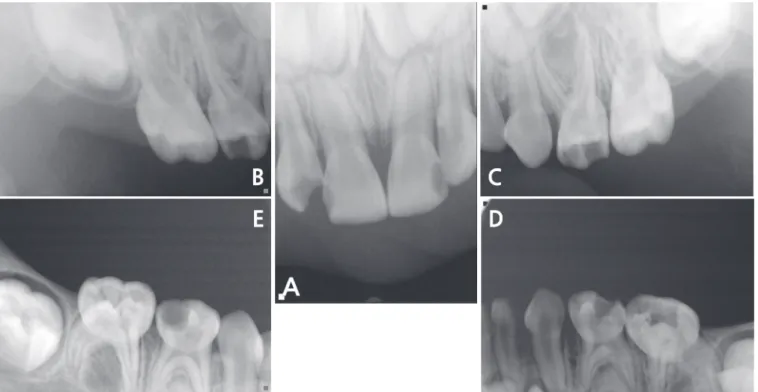
Clinical and radiographic examinations revealed multiple caries (Fig. 1, 2A - 2C). Dental caries were found in the left and right upper anterior primary central and lateral incisors, 1st primary molars, and lower left and right 1st and 2nd pri- mary molars. In addition, an impacted inverted mesiodens was
found between #51, 61, in the periapical region.
Considering the patient’s age and compliance with the dental treatment procedure, dental treatment under general anesthesia was planned. Before treatment, her physician was consulted to ensure that she did not require any premedica- tion. General anesthesia was induced with sevoflurane and maintained with desflurane, nitrous oxide, and oxygen. Maxil- lary anterior teeth except the upper right primary lateral inci- sor were treated with composite resin restoration. Pulpectomy and resin restoration were performed in the upper right lateral incisor. The lower right and left 2nd primary molar were re- stored with composite resin. Pulpotomy and stainless steel crown restoration were performed in the rest of the upper and lower molars (Fig. 2D - F). Finally, fluoride varnish was applied to prevent progression and occurrence of caries. Extraction of impacted mesiodens was postponed due to the risk of dam- age to the permanent tooth germ during surgical intervention.
Successful dental procedure was carried out under general anesthesia. Periodic follow-up was planned (once every 3 months), to maintain oral health.
Fig. 1. Pre-operative periapical radiographs.
Ⅲ. Discussion
CINCA syndrome, the most severe type of CAPS disorder, is a very rare chronic auto-inflammatory disorder. NLRP3 gene mutation, which leads to excessive IL-1β production, is the cause of this syndrome[8]. Currently, the best treatment for pa- tients with CINCA syndrome is administration of one of various IL-1β inhibitors, such as anakinra, rilonacept, and canakinum- ab[9-13]. Anakinra is one of the IL-1 antagonists that inhibits the activity of IL-1α and IL-1β and are commonly used for the treatment of rheumatoid arthritis. Successful management of CINCA syndrome with continued anakinra medication has been reported[9,12-14]. Often, dramatic improvements appear within days to weeks of starting administration of these medi- cations[9,14].
In this case, genetic analyses revealed a mutation in the NLRP3 gene and hence the patient was diagnosed with CINCA syndrome. The patient had typical symptoms of CINCA syn- drome such as skin rash, elevated ESR, elevated CRP levels, and joint disorder. After administration of anakinra, the symp- toms improved.
Since IL-1β is a mediator of inflammatory reaction, elevated IL-1β levels are closely associated with rheumatoid arthritis, type 2 diabetes, and osteoarthritis[15-17]. These patients also have associated dental problems. In the oral environment, up- regulated IL-1β level is associated with dental caries. Some re- ports suggested that increase in the concentration of IL-1β in the saliva is related to the proliferation of S. mutans which is a major microbial species for dental caries formation, especially smooth surface caries and multiple caries[6,7]. Wang et al.[18]
Fig. 2. Intraoral clinical records before (A - C) and after (D - F) dental treatment.
also reported that IL-1β gene is positively correlated with den- tal caries. Therefore, elevated levels of IL-1β can be thought to be one of the contributing factors of dental caries.
IL-1β also affects the periodontal tissue. Many reports re- vealed that IL-1β is correlated with periodontal bone destruc- tion and periodontal tissue inflammation, and aggravates peri- odontitis. For this reason, IL-1β is currently used for an index for periodontitis[19,20]. Elevated IL-1β levels increase the sus- ceptibility to periodontitis, resulting from Aggregatibacter acti- nomycetemcomitans, which is one of the causes of destructive
periodontitis[21]. Thus in patients with CINCA syndrome, the periodontal condition should be assessed regularly.
As mentioned earlier, patients with CINCA syndrome are prone to oral diseases, especially when IL-1β is unregulated.
Moreover, children whose oral health care cannot be main- tained have an increased risk of developing dental caries. De- velopmental delay associated with this syndrome may require behavioral guidance techniques for dental treatment. When children are uncooperative and cannot accept dental treat- ment, general anesthesia could be a helpful behavior manage- ment technique.
Lauro et al.[22] reported that without active infection, even in the presence of fever and chronic aseptic meningitis, gen- eral and regional anesthesia may be adminstered in patients with CINCA without complications. In this case, considering the patient’s age and treatment non-compliance, general an- esthesia was planned. General anesthesia was induced with inhalation anesthetics. Although intravenous anesthetics are reported to have an immune modulatory effect, inhalational anesthetics can be safely used in these patients. However, in patients with CINCA syndrome, general anesthesia may have to be postponed as they have higher chances of developing unexpected fever[22]. Furthermore, inflammation of the laryn- geal muscles during laryngoscopy may hinder airway manage- ment during and after general anesthesia[22]. Therefore, when dental treatments are performed under general anesthesia, dentists should collaborate with anesthesiologists during the perioperative period. Considering joint anomalies that can lead to impairment of function and deformities, careful positioning of these patients is necessary during dental treatment under general anesthesia. As postoperative pain is less likely to in- duce alterations in the immune system, postoperative analge- sic should be considered[23]. However, there are no reports about the stress adversely effects of general anesthesia on the patient’s condition.
Although dental treatment was successfully performed un- der general anesthesia in this case, prevention of oral disease is important. Early detection is essential to prevent and avoid the progression of oral diseases, as more surgical trauma causes more changes in the immune system[23]. Therefore, dentist and dental hygienist must cooperate with other health care providers and family members to provide professional dental and home care. Moreover, observation of eruption of permanent teeth will be necessary as Syed et al.[24] have re- ported an overall delayed eruption of permanent dentition in a 16-year-old girl with CINCA syndrome. However, oral mani- festations in patients with CINCA syndrome has not been well investigated[25].
Ⅳ. Summary
In this case, dental treatment under general anesthesia was successfully performed in a patient with CINCA syndrome.
Before dental treatment, the medical conditions should be thoroughly examined in a patient with CINCA syndrome. Since elevated IL-1β level is associated with dental caries and peri- odontal conditions, professional oral prophylaxis and topical fluoride application should be considered through periodic visits.
References
1. Feldmann J, Prieur AM, de Saint Basile G, et al. : Chronic infantile neurological cutaneous and articular syndrome is caused by mutations in CIAS1, a gene highly expressed in polymorphonuclear cells and chondrocytes. Am J Med Genet A, 71:198-203, 2002
2. Tanaka N, Izawa K, Goldbach-Mansky R, et al. : High inci- dence of NLRP3 somatic mosaicism in patients with chronic infantile neurologic, cutaneous, articular syndrome: results of an International Multicenter Collaborative Study. Arthritis Rheum, 63:3625-3632, 2011.
3. Kuemmerle-Deschner JB : CAPS--pathogenesis, presenta- tion and treatment of an autoinflammatory disease. Semin Immunopathol, 37:377-385, 2015.
4. Hashkes PJ, Lovell DJ : Recognition of infantile-onset mul- tisystem inflammatory disease as a unique entity. J Pediatr, 130:513-515, 1997.
5. Howells G : Cytokine networks in destructive periodontal disease. Oral Dis, 1:266-270, 1995.
6. Cogulu D, Onay H, Eronat C, et al. : Associations of inter- leukin (IL)-1beta, IL-1 receptor antagonist, and IL-10 with dental caries. J Oral Sci, 57:31-36, 2015.
7. Słotwińska SM, Zaleska M : Salivary interleukin-1β and Streptococcus mutans level in oral cavity. Cent Eur J Immu- nol, 37:151-153, 2012.
8. Schroder K, Tschopp J : The inflammasomes. Cell, 140:821- 832, 2010.
9. Goldbach-Mansky R, Dailey NJ, Kastner DL, et al. : Neona- tal-Onset Multisystem Inflammatory Disease Responsive to Interleukin-1β Inhibition. N Engl J Med, 355:581-592, 2006.
10. Sibley CH, Plass N, Goldbach-Mansky R, et al. : Sustained response and prevention of damage progression in pa- tients with neonatal-onset multisystem inflammatory dis- ease treated with anakinra: a cohort study to determine three- and five-year outcomes. Arthritis Rheum, 64:2375- 2386, 2012.
11. Anton J, Calvo I, Arostegui JI, et al. : Efficacy and safety of canakinumab in cryopyrin-associated periodic syndromes:
results from a Spanish cohort. Clin Exp Rheumatol, 33:67- 71, 2015.
12. Chang Z, Spong CY, Stratton P, et al. : Brief Report: Anakin- ra Use During Pregnancy in Patients With Cryopyrin-Asso- ciated Periodic Syndromes. Arthritis Rheumatol, 66:3227- 3232, 2014.
13. Lepore L, Paloni G, Gattorno M, et al. : Follow-up and qual- ity of life of patients with cryopyrin-associated periodic syndromes treated with Anakinra. J Pediatr, 157:310-315, 2010.
14. Granel B, Serratrice J, Weiller PJ et al. : Dramatic improve- ment with anakinra in a case of chronic infantile neurologi- cal cutaneous and articular (CINCA) syndrome. Rheumatol- ogy (Oxford), 44:689-690, 2005.
15. Dinarello CA : Interleukin-1 in the pathogenesis and treat- ment of inflammatory diseases. Blood, 117:3720-3732, 2011.
16. Lee HM, Kim JJ, Jo EK, et al. : Upregulated NLRP3 inflam- masome activation in patients with type 2 diabetes. Diabe- tes, 62:194-204, 2013.
17. Pelletier JP, Martel-Pelletier J, Abramson SB : Osteoarthri- tis, an inflammatory disease: potential implication for the selection of new therapeutic targets. Arthritis Rheumatol, 44:1237-1247, 2001.
18. Wang Q, Jia P, Zhao Z, et al. : Multi-dimensional prioriti- zation of dental caries candidate genes and its enriched
dense network modules. PLoS One, 8:76666, 2013.
19. Oh H, Hirano J, Ogata Y, et al. : Effects of initial periodontal therapy on interleukin-1β level in gingival crevicular fluid and clinical periodontal parameters. J Oral Sci, 57:67-71, 2015.
20. Faizuddin M, Bharathi SH, Rohini NV : Estimation of inter- leukin-1beta levels in the gingival crevicular fluid in health and in inflammatory periodontal disease. J Periodontal Res, 38:111-114, 2003.
21. Kelk P, Claesson R, Johansson A, et al. : IL-1beta secretion induced by Aggregatibacter (Actinobacillus) actinomy- cetemcomitans is mainly caused by the leukotoxin. Int J Med Microbiol, 298:529-541, 2008.
22. Lauro CF, Goldbach-Mansky R, Quezado ZMN, et al. : The Anesthetic Management of Children with Neonatal- Onset Multi-System Inflammatory Disease. Anesth Analg, 105:351-357, 2007.
23. Höhne C, Burkhardt U : Anesthesia in an infant with a CINCA syndrome. Paediatr Anaesth, 18:575-577, 2008.
24. Syed A, Singer SR, Mupparapu M : Dental manifestations of Chronic Infantile Neurologic Cutaneous Articular Syn- drome (CINCA). Oral Surg Oral Med Oral Pathol and Oral Radiol, 117:420, 2014.
25. Scully C, Hodgson T, Lachmann H : Auto-inflammatory syn- dromes and oral health. Oral Diseases, 14:690-699, 2008.
국문초록
CINCA 증후군을 가진 환자의 전신마취 하 치과 치료 : 증례 보고
이지민ㆍ송지수ㆍ현홍근ㆍ김영재ㆍ김정욱ㆍ장기택ㆍ이상훈ㆍ신터전 서울대학교 치의학대학원 소아치과학교실
Chronic infantile neurological cutaneous articular (CINCA) 증후군은 만성 염증성 질환으로, 주기적으로 발열을 일으킨다. 이 증후군 의 환아들은 전신적인 염증으로 인해 치과적 문제에 노출되기 쉽다. 협조가 어려운 환자에 있어서 전신마취는 행동 조절 방법으로 널 리 사용되어 왔으며, CINCA 증후군의 경우 전신적인 염증성 질환이기 때문에 전신마취를 시행할 때 있어 주의를 기울어야 한다. 본 증 례 보고에서는 CINCA 증후군을 가진 비협조적 환아를 전신마취 하 치과 치료 시행한 증례보고와 함께 이러한 환아들에서 치과치료 전 고려사항을 고찰하고자 한다. .