3-페닐-1-이소퀴놀린아민이 신경세포에서 베타 아밀로이드 전구단백질의 대사에 미치는 영향
임재윤#·조원제*
우석대학교 약학대학, *전남대학교 약학대학
(Received November 26, 2010; Revised December 1, 2010; Accepted December 3, 2010)
Effects of 3-Phenyl-1-isoquinolinamine on the Metabolism of β-Amyloid Precursor Protein in Neuroblastoma Cells
Jae-Yoon Leem# and Won-Jea Cho*
College of Pharmacy, Woosuk University, Wanju, Jeonbuk 565-701, Korea
*College of Pharmacy and Research Institute of Drug Development, Chonnam National University, Kwangju 500-757, Korea
Abstract — Alzheimer's disease (AD) is characterized pathologically by the presence of intracellular neurofibrillary tangles and deposition of β-amyloid (Aβ) peptides, which are generated by processing of amyloid precursor protein (APP). It is urgent to develop effective therapies for the treatment of AD, since our society rapidly accelerate aging. Aβ peptides have been believed to be neurotoxic and now are also considered to have effects on the mechanism of memory formation.
Recently, we investigated that a quinoline compound from natural product reduced the secretion of Aβ from the neu- roblastoma N2a cells (NL/N cell line) overexpressing APPswe. In this study, 3-phenyl-1-isoquinolinamine, a synthetic isoquinoline compound was analyzed to determine its effects on the metabolism of APP. It inhibited the secretion of Aβ pep- tides from the N2a NL/N cell line. Beta-site APP cleaving enzyme (BACE) fluorescence resonance energy transfer (FRET) assay revealed that it inhibited BACE activity in a dose dependent manner. Immunoblotting study showed that it inhibited APP stabilization and expression and it slightly increased the stablization and the expression of γ-secreatase component from the N2a NL/N cell line. We suggest that 3-phenyl-1-isoquinolinamine inhibits APP metabolism and Aβ generation by the means of BACE inhibitory mechanism. This is the first report that 3-phenyl-1-isoquinolinamine inhibits the secretion of Aβ peptides from neuroblastoma cells.
Keywords □ Alzheimer's disease, β-amyloid peptides, APPswe, 3-phenyl-1-isoquinolinamine, BACE
한국의 노인인구 비율은 2010년 이미 10%를 초과했으며 2020 년에는 15.6%로 예상되고 있다. 노인인구의 증가는 치매환자의 급속한 증가를 가져오는데, 2000년 치매환자수가 약 28만 명에 서 2010년에는 46만 명으로 급격히 증가됐으며, 2020년에는 약 70만 명에 이를 것으로 추정된다. 이러한 현실은 개인의 삶의 질 을 저하시키며 과다한 의료비 지출로 인하여 국가 경쟁력을 감 소시킴으로써 커다란 사회적 문제로 대두되고 있다.1)한편, acetylcholine esterase 저해제인 donepezil, galantamine 및 rivastigmine 등이 임상에서 사용되고 있으나 부작용이 심하고
효과적인 치료제가 없는 실정이다.2-4)치매(dementia)는 뇌의 위 축과 신경세포의 감소 및 노인 반(senile plaque)의 출현으로 인 한 뇌신경의 비가역적인 파괴가 원인이 되어 기억력과 언어장애, 행동장애 등의 다양한 후천적 인지기능 장애 증상을 수반하는 증 후군을 일컫는다.5) 치매는 알츠하이머형 치매(Alzheimer's disease), 혈관성 치매 및 파킨슨 병에 의한 퇴행성 질환, 갑상선 기능 저하증에 의한 대사성 질환, 뇌종양 또는 감염성 질환 등에 기인하는 기타 치매로 분류된다.6)알츠하이머형 치매환자의 뇌 조직에서는 신경세포 주위에서 생성되는 senile plaque와 세포내 부에서 생성되는 neurofibrillary tangle과 같은 병리학적 특징을 관찰할 수 있다.7,8) Neurofibrillary tangle은 tau protein의 과인 산화에 의하여 형성되며, senile plaque는 세포 밖으로 분비된 β- amyloid(Aβ)가 신경세포 주변에서 응집되어 형성된다.7,8)
#본 논문에 관한 문의는 저자에게로
(전화) 063-290-1575 (팩스) 063-290-1812 (E-mail) [email protected]
종설
알츠하이머형 치매는 familial type과 sporadic type으로 분류 되며, 전체 질환의 90% 이상이 주로 65세 이상의 노인에게 sporadic type으로 나타난다.1)발병원인은 familial type의 경우, amyloid precursor protein(APP), presenilin 1, presenilin 2 등 의 변이 유전자가 알려져 있으며9) sporadic type의 경우는 노화 및 ApoE4 대립형질이 보고되었다.10,11) Aβ의 축적에 의한 senile plaque는 familial type과 sporadic type 모두에서 공통적으로 나 타나는 병리현상이다. Aβ는 베타 아밀로이드 전구 단백질(Amyloid precursor protein, APP)이 2 종류의 protease에 의해 절단되어 생기는데, 아미노 말단을 절단하는 것이 β-secretase,12)카르복 시 말단을 절단하는 것이 γ-secretase이다.13)알츠하이머형 치매 치료제 개발의 표적의 하나인 γ-secretase는 presenilin(PS), nicastrin(NCT), anteria pharynx defective gene(APH)-1, presenilin enhancer gene(PEN)-2 등으로 이루어진 complex 구 조로 존재하며 Notch1, APLP1, ErbB4, Jagged, CD44 등 많은 물질을 기질로 하는 효소이므로 APP 특이적인 저해제를 개발해 야하는 문제점을 안고 있다.14-17)β-secretase는 aspartyl protease 의 특성을 가진 β-site APP cleaving enzyme(BACE)12)로서 BACE knock out 생쥐는 정상적으로 발육해 뇌에서도 특별한 이상은 관찰되지 않았다.18)따라서 BACE 저해제는 생체에 유해 하지 않을 것으로 추측되므로 BACE가 치매 치료제 개발의 중 요한 표적이 되고 있다.
최근 본 연구실에서는 천연물로부터 분리한 퀴놀린 알칼로이 드가 APP의 변이 유전자를 발현하는 신경세포주에서 Aβ의 분 비 저해활성을 관찰하였으며, 몇 가지 합성 이소퀴놀린 알칼로 이드를 대상으로 BACE의 활성을 검정한 결과, 저해활성을 나 타내는 화합물을 얻을 수 있었다.19)본 연구에서는 합성 이소퀴 놀린 알칼로이드 화합물인 3-phenyl-1-isoquinolinamine이 APP 의 변이 유전자를 발현하는 신경세포주로부터 Aβ의 분비를 감 소시켰으며 BACE의 활성을 저해하였기에 그 결과를 보고하고 자 한다.
실험방법
세포주
APP swedish 변이 유전자가 과잉 발현되는 생쥐유래 신경세 포주인 N2a NL/N 세포주를 동경대학의 Iwatsubo 교수로부터 제공받아 10% FBS(Gibco, Grand Island, NY), L-glutamic acid, penicillin/streptomycin, hygromycin이 함유된 Dulbecco's Modified Eagel's Medium(DMEM, Sigma, St. Louis, MO) 배 지에서 37oC, 5% CO2의 조건으로 배양하였다.
시약
β-secretase inhibitor III(Calbiochem, Darmstadt, Germany), protease inhibitor(Sigma, St. Louis, MO), rabbit anti-amyloid precursor protein polyclonal antibody CT(Stressgen, Victoria, Canada), rabbit anti-amyloid precursor protein polyclonal antibody CT20(Calbiochem, Darmstadt, Germany), goat anti- Presenilin 1 polyclonal antibody N-19, goat anti-Nicastrin polyclonal antibody(Santa cruz Biotech., Santa cruz, CA), human amyloid β assay kit(IBL, Kunma, Japan)를 사용하였고 그 밖의 시약은 특급을 사용하였다.
3-phenyl-1-isoquinolinamine 염산염의 합성
사용한 시약은 Aldrich사의 시약을 정제 없이, 용매는 Junsei Fig. 1 − Structure of 3-phenyl-1-isoquinolinamine HCl.
Scheme 1 − Synthesis of 3-phenyl-1-isoquinolinamine.
및 동양화학의 제품을 정제하여 사용하였다. Thin Layer Chromatography는 Kiesel gel 254 silica gel coated plate를, column chromatography에는 Kisel gel 60(70~230 mesh)을 사 용하였으며 1H-NMR은 Bruker AC 80을 사용하였다. 융점은 Electrothermal IA 9200을 사용하여 측정하였으며 IR은 Perkin Elmer 783 Spectrometer를 이용하여 측정하였다. Cho 등의 방 법에 따라 합성하였으며 합성법은 Scheme 1에 요약하였다.20)간 략히 기술하면 N-methyl-o-toluamide와 benzonitrile을 축합하여 생성시킨 isoquinolin-1(2H)-one을 POCl3로 imine chloride로 변 환시킨 후 benzylamine을 K2CO3 존재하에 도입하였다.
Benzylamine은 Pd-C 촉매를 이용한 접촉환원을 통하여 primary amine으로 변환시켰다. 염산염을 생성시키기 위하여 acetone에 amine을 용해시킨 후 c-HCl을 가하였다. 1H-NMR(CDCl3): 8.2~
6.8(10H, m, aromatic-H), 4.53(2H, s, -NH2).
Aβ의 분비에 대한 효과검정
N2a NL/N 세포주로부터 분비되는 Aβ의 양을 측정하기 위해 sandwich ELISA21)를 실시하였다. 1×10⁶세포를 60 mm dish에서 배양하여 serum-free DMEM으로 교환하고 16시간이 경과한 후 DMSO에 용해시킨 3-phenyl-1-isoquinolinamine 또는 양성대조군 인 β-secretase inhibitor III22)를 일정농도로 처리하였다. 24시간 배 양 후, 배양액을 protease inhibitor의 존재 하에 회수하여 시료로 사용하였다. Aβ(35-40) 특이적 monoclonal antibody 또는 Aβ(38- 42) 특이적 polyclonal antibody가 각각 coating된 plate에 100 µl의 시료를 넣고 4oC에서 16시간 동안 반응시키고 7회 세척한 후, HRP conjugation된 Aβ(11-28) 특이적 monoclonal antibody를 4oC에 서 1시간 동안 반응시켰다. 다시 9회 세척한 후 tetramethyl benzidine(TMB) 기질액을 넣고 실온에서 30분간 반응시킨 후 정 지액 100 µl를 첨가하여 450 nm에서 Microplate Reader(Model 680, Bio-Rad, CA)를 이용하여 흡광도를 측정하였다.
β-secretase에 대한 효과검정
β-secretase의 활성을 측정하기 위하여 BACE1(beta site APP cleaving enzyme) FRET assay23)를 실시하였다. β-secretase에 특이적인 형광기질인 rhodamine-EVNLDAEFK-quencher 10 µl/
ml와 3-phenyl-1-isoquinolinamine 또는 양성대조군인 β-secretase inhibitor III를 50 mM sodium acetate(pH 4.5)에 넣어 혼합한 후, BACE1을 첨가하여 37oC에서 1시간 반응시켰다. 2.5 M sodium acetate를 첨가한 후 545 nm(excitation, 12 nm band- width) 및 585 nm(emission, 12 nm bandwidth)에서의 형광을 Infinite F200 fluorometer(Tecan, Union city, CA)로 측정하였다.
단백질 분석
단백질 분석은 Western blotting 방법에 의해 수행하였다.24)
1×10⁶세포를 60 mm dish에서 배양하여 12시간 후에 DMSO에 녹인 3-phenyl-1-isoquinolinamine을 처리하였다. 24시간 후, 배 양액을 상기조건으로 회수하고 PBS로 세척한 세포에 protease inhibitor를 첨가한 cell lysis buffer(150 mM NaCl, 50 mM Tris- HCl, pH 7.4, 0.5% NP-40, 0.5% sodium deoxycholate, 5 mM EDTA)를 넣고 분쇄하여 시료로 사용하였다. 단백질 50 µg을 7%, 14% Tris-glycine SDS-PAGE로 분리한 후, immunoblotting에 의해 APP, sAPP(soluble APP), PS1, NCT 등의 단백질 양상을 검출하였다.
통계처리
각 실험군 간의 유의성 검정은 Student's t-test로 하였으며, P 값이 0.05, 0.01 이하를 기준으로 유의성 여부를 판정하였다.
실험결과 및 고찰
Aβ 분비 저해효과
Aβ는 oligomer를 형성하며 서로 응집하여 신경세포의 폐쇄를 유발함으로써 비가역적인 퇴행성 파괴를 일으킨다.25)특히 치매 환자의 뇌 및 척수액에서 Aβ42 정상인의 경우보다 많이 검출된 다.26)실험에 사용한 N2a NL/N 세포주는 치매환자의 병리와 유 사하게 Aβ42의 분비량이 정상세포에 비해 2배 이상 증가되어 있 어 분비저해 활성을 검색하기에 용이하다.27)
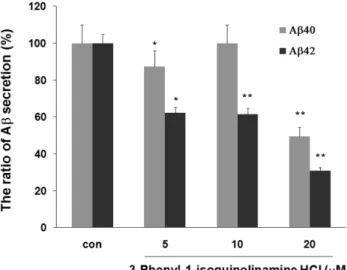
Fig. 2 − The effects of 3-phenyl-1-isoquinolinamine on the secretion of Aβ peptides. N2a NL/N cells were treated with DMSO (control) or 5, 10, and 20µM of 3-phenyl-1-isoquinolinamine for 24 h and collected conditioned media in the presence of protease inhibitor. Quantitative analysis of secreted Aβ x- 40 and Aβ x-42 in the conditioned media was performed using two-site ELISAs. The means±SE from three independent experiments performed in triplicate are shown. The data are indicated as % of those observed in the absence of given compound. *P<0.05, **P<0.01.
이 세포주에 3-phenyl-1-isoquinolinamine을 각각 5, 10, 20 µM 을 처리한 후 배양액으로 분비된 Aβ의 양을 sandwich ELISA 방법으로 측정하여 비교 정량한 결과를 Fig. 2에 나타내었다. 음 성 대조군인 DMSO를 처리한 시료의 Aβ의 양을 100%로 하여 3-phenyl-1-isoquinolinamine 처리시 분비량을 백분율로 표시하 였다. 3-phenyl-1-isoquinolinamine 20 µM 처리시 Aβ40 및 Aβ42의 분비량이 각각 음성대조군의 약 49.5, 30.9%이었으며 유 의성 있게 감소시켰다. 양성 대조군인 β-secretase inhibitor III 도 저해 활성을 나타내었다(자료 미제시). 3-phenyl-1-iso- quinolinamine은 Aβ40에 대해서보다는 Aβ42에 대한 저해활성이 더욱 강하였다. 그리고 5, 10 µM에서의 저해활성의 양상이 농도 비의존적인 특성으로 유사하였는데 이는 비활성의 특징에서 기 인하는 것으로 사료된다. 즉, 10 µM과 20 µM에서의 활성을 비 교하면 농도 의존적으로 증가하는 것을 알 수 있다. 한편, N2a NL/N 세포주에 대한 MTT assay를 실시하였으나 세포독성은 관 찰되지 않았다(자료 미제시).
BACE1 저해효과
서론에서도 기술한 바와 같이, APP의 대사에 관련하는 β- secretase 또는 γ-secretase의 활성이 저해될 경우 Aβ 분비가 감 소된다.28) 3-phenyl-1-isoquinolinamine에 의한 Aβ 분비 감소효 과도 이들 효소활성의 저해가 원인일 것으로 예측되어 β-secretase 의 효소활성을 측정하였으며, BACE1 FRET assay의 결과를 Fig.
3에 나타내었다. 음성 대조군인 DMSO를 처리한 시료의 효소활 성을 100%로 하여 3-phenyl-1-isoquinolinamine 처리시 효소활
성을 백분율로 표시하였다. 3-phenyl-1-isoquinolinamine 5, 10, 20µM을 효소 및 기질과 함께 반응시킨 후, BACE 활성을 측정 하였다. 그 결과 3-phenyl-1-isoquinolinamine 20 µM에서 음성대 조군의 30.75% 활성을 나타내었으며 이는 농도 의존적으로 BACE 활성을 유의성 있게 감소시켰음을 의미한다. 상기실험 결과에서 기술한 3-phenyl-1-isoquinolinamine의 Aβ의 분비저해 활성과 비 교할 경우 동일 농도인 20 µM에서 유사한 저해활성을 나타내었 으며 이는 3-phenyl-1-isoquinolinamine의 Aβ의 분비 저해활성 은 β-secretase를 저해함으로써 기인하는 것을 의미한다. 한편, Western blotting 방법에 의해 3-phenyl-1-isoquinolinamine를 처 리한 후, 세포내 β-secretase의 활성을 그 기질분해 산물인 β-C- terminal fragment(β-CTF)를 통하여 확인한 결과 농도 의존적으 로 β-CTF가 감소되었다(자료 미제시).
APP 및 관련 단백질 양상에 미치는 효과
N2a NL/N 세포주에 3-phenyl-1-isoquinolinamine을 각각 5, 10, 20µM 처리하고 24시간 경과 후, 세포 lysate를 회수하여 Western blotting에 의해 APP의 단백질 양상을 분석한 결과를 Fig. 4에 나타내었다. 3-phenyl-1-isoquinolinamine은 농도 의존 적으로 APP의 단백질 양을 감소시켜 20 µM 처리시 음성대조군
Fig. 4 − The effects of 3-phenyl-1-isoquinolinamine on the protein level of APP. N2a NL/N cells were treated with DMSO (control) or 5, 10, and 20µM of 3-phenyl-1-isoquinolinamine for 24 h and lysed with cell lysis buffer. Detergent lysates or conditioned media were loaded on the 7% SDS-PAGE and analyzed by immunoblotting with rabbit anti-APP polyclonal antibody to detect APP or sAPP. PS1 NT or NCT was detectd on the 14% or 7% SDS-PAGE and analyzed by immunoblotting with rabbit goat anti-Presenilin 1 polyclonal antibody N-19 or goat anti-Nicastrin polyclonal antibody.
Fig. 3 − The effects of 3-phenyl-1-isoquinolinamine on the β- secretase. The activity of β-secretase was accessed by BACE1 FRET assay in the presence of DMSO (control) or 5, 10, and 20µM of 3-phenyl-1-isoquinolinamine. The means SE from three independent experiments performed in triplicate are shown. *P<0.05, **P<0.01.
에 비해 약 20%의 단백질을 검출할 수 있었다. 특히 APP는 일 반적으로 미성숙형과 성숙형이 모두 관찰되지만 20 µM 처리한 세포의 경우 미성숙형의 밴드(*로 표시)는 관찰할 수 없었다.
APP는 ribosome에서 합성된 후, endoplasmic reticulum(ER) 및 golgi체로 이동하며 당의 수식과정을 거쳐 성숙한 APP가 된 후, 다시 trans-golgi network(TGN)를 거쳐 세포막으로 이동한 다. 이 과정에서 α-secretase, β-secretase 및 γ-secretase 등에 의해 대사되어 Aβ, P3, sAPP, CTF를 비롯한 대사물질을 생성
한다.29,30) 20µM의 3-phenyl-1-isoquinolinamine는 세포 밖으로
분비된 sAPP를 증가시켰으며 이는 부분적으로 세포내 APP의 감소에 기인하는 것으로 사료된다. 한편, CTF 분석 결과, α-CTF 의 증가가 관찰되었으며 이는 α-secretase의 활성이 증가되었음 을 의미하는 것이다. α-secretase와 β-secretase는 서로 경쟁적 으로 작용하는 효소로서 3-phenyl-1-isoquinolinamine은 β- secretase를 저해함으로써 α-secretase의 활성을 증가시킨 것으 로 사료된다. 한편, γ-secretase의 구성분자인 PS1의 아미노 말 단 단편인 PS1-N-terminal fragment(NTF)와 NCT는 3-phenyl- 1-isoquinolinamine 농도 의존적으로 약간 증가하는 것으로 관찰 되었다. 이는 3-phenyl-1-isoquinolinamine이 γ-secretase의 안정 성을 증가시켜 분자의 세포내 반감기를 증가시킬 것으로 예측된다.
이상과 같이, 3-phenyl-1-isoquinolinamine이 Aβ42의 분비량을 농도 의존적으로 감소시켰다. 또한, Aβ의 생성에 관여하는 β- secretase의 효소활성도 농도 의존적으로 저해하였다. 향후, 새로 이 합성되는 APP의 경시적인 변화양상을 확인함으로써 APP의 maturation, trafficking, localization에 미치는 영향 및 γ- secretase의 활성에 대한 영향도 분석해야 할 것이다. 최근 천연 의 이소퀴놀린 알칼로이드인 berberine이 β-secretase 저해활성 및 항산화 활성을 갖고 있다는 보고가 있어 치매 치료 약물 개 발 분야에서 많은 관심을 갖고 있다.31,32)본 연구자들이 보고하 는 3-phenyl-1-isoquinolinamine도 치매 약물 개발을 위한 후보 물질로 응용할 수 있으며 치매의 기초 연구에 프로브(probe)로 서 이용될 수 있다고 사료된다.
결 론
3-phenyl-1-isoquinolinamine은 APP의 대사를 down regulation 하며 Aβ의 분비를 감소시켰다. 이것은 β-secretase의 효소활성 을 저해하는 메커니즘에 의한 것으로 사료된다.
감사의 말씀
본 연구에 많은 도움을 준 최부진, 이혜정 연구원에게 감사하 며, Infinite F200 fluorometer를 사용할 수 있게 배려해주신 우 석대학교의 은재순 교수님께도 감사드립니다. 본 논문은 2010학
년도 우석대학교 교내학술연구비 지원에 의하여 연구되었기에 감사드립니다.
참고문헌
1) Bertram, L., Lill, C. M. and Tanzi, R. E. : The genetics of Alzheimer disease: back to the future. Neuron. 68, 270 (2010).
2) Sugimoto, H. : Donepezil hydrochloride: a treatment drug for Alzheimer's disease. Chem. Rec. 1, 63 (2001).
3) Zarotsky, V., Sramek, J. J., and Cutler, N. R. : Galantamine hydrobromide: an agent for Alzheimer's disease. Am. J. Health Syst. Pharm. 60, 446 (2003).
4) Jann, M. W. : Rivastigmine, a new-generation cholinesterase inhibitor for the treatment of Alzheimer's disease.
Pharmacotherapy 20, 1 (2000).
5) Iqbal, K., Sisodia, S. S. and Winblad, B. : Alzheimer's disease:
Advances in etionlogy, pathogenesis and therapeutics. John Wiley
& Sons, Ltd. (2001).
6) Morris, J. C. : Classification of dementia and Alzheimer's disease. Acta Neurol. Scand. 165, 41 (1996).
7) Braak, H., Braak, E. and Strothjohann, M. : Abnormally phosphorylated tau protein related to the formation of neurofibrillary tangles and neuropil threads in the cerebral cortex of sheep and goat. Neurosci Lett. 171, 1 (1994).
8) Kang, J., Lemaire, H. G., Unterbeck, A., Salbaum, J. M., Masters, C. L., Grzeschik, K. H., Multhaup, G., Beyreuther, K.
and Muller-Hill, B. : The precursor of Alzheimer's disease amyloid A4 protein resembles a cell-surface receptor. Nature 325, 733 (1987).
9) Selkoe, D. J. : The cell biology of beta-amyloid precursor protein and presenilin in Alzheimer's disease. Trends Cell Biol.
8, 447 (1998).
10) Strittmatter, W. J., Weisgraber, K. H., Huang, D. Y., Dong, L. M., Salvesen, G. S., Pericak-Vance, M., Schmechel, D., Saunders, A. M., Goldgaber, D. and Roses, A. D. : Binding of human apolipoprotein E to synthetic amyloid beta peptide isoform-specific effects and implications for late-onset Alzheimer disease. Proc. Natl. Acad. Sci. USA 90, 8098 (1993).
11) Corder, E. H., Saunders, A. M., Strittmatter, W. J., Schmechel, D. E., Gaskell, P. C., Small, G. W., Roses, A. D., Haines, J. L.
and Pericak-Vance, M. A. : Gene dose of apolipoprotein E type 4 allele and the risk of Alzheimer's disease in late onset families. Science 261, 921 (1993).
12) Vassar, R., Bennett, B. D., Babu-Khan, S., Kahn, S., Mendiaz, E. A., Denis, P., Teplow, D. B., Ross, S., Amarante, P., Loeloff, R., Luo, Y., Fisher, S., Fuller, J., Edenson, S., Lile, J., Jarosinski, M. A., Biere, A. L., Curran, E., Burgess, T., Louis, J. C., Collins, F., Treanor, J., Rogers, G. and Citron, M. : β-Secretase cleavage of Alzheimer's amyloid precursor protein by the
transmembrane aspartic protease BACE. Science 286, 735 (1999).
13) Selkoe, D. J. : Translating cell biology into therapeutic advances in Alzheimer's disease. Nature 399, 23 (1999).
14) Yu, G., Nishimura, M., Arawaka, S., Levitan, D., Zhang, L., Tandon, A., Song, Y. Q., Rogaeva, E., Chen, F., Kawarai, T., Supala, A., Levesque, L., Yu, H., Yang, D. S., Holmes, E., Milman, P., Liang, Y., Zhang, D. M., Xu, D. H., Sato, C., Rogaev, E., Smith, M., Janus, C., Zhang, Y., Aebersold, R., Farrer, L. S., Sorbi, S., Bruni, A., Fraser, P. and St. George-Hyslop, P. : Nicastrin modulates presenilin-mediated notch/glp-1 signal transduction and βAPP processing. Nature 407, 48 (2000).
15) Lee, S. F., Shah, S., Li, H., Yu, C., Han, W. and Yu, G. : Mammalian APH-1 interacts with presenilin and nicastrin and is required for intramembrane proteolysis of amyloid-β precursor protein and Notch. J. Biol. Chem. 277, 45013 (2002).
16) Steiner, H., Winkler, E., Edbauer, D., Prokop, S., Basset, G., Yamasaki, A., Kostka, M. and Haass, C. : PEN-2 is an integral component of the γ-secretase complex required for coordinated expression of presenilin and nicastrin. J. Biol. Chem. 277, 39062 (2002).
17) Hardy, J. and Selkoe, D. J. : The amyloid hypothesis of Alzheimer's disease: progress and problems on the road to therapeutics. Science 297, 353 (2002).
18) Cai, H., Wang, Y., McCarthy, D., Wen, H., Borchelt, D. R., Price, D. L. and Wong, P. C. : BACE1 is the major -secretase for generation of A peptides by neurons. Nature Neurosci. 4, 233 (2001).
19) Leem, J. Y., et al. : Effect of a quinoline compound from the oriental medicine on the metabolism of β-amyloid precursor protein in neuroblastoma cells. (manuscript in preparation).
20) Cho, W. J., Min, S. Y., Le, T. N. and Kim, T. S. : Synthesis of new 3-arylisoquinolinamines: effect on topoisomerase I inhibition and cytotoxicity. Bioorg. Med. Chem. Lett. 13, 4451 (2003).
21) Wang, R., Sweeney, D., Gandy, S. E. and Sissodia, S. S. : The profile of soluble amyloid β protein in cultured cell media. J.
Biol. Chem. 271, 31894 (1996).
22) Tung, J. S., Davis, D. L., Anderson, J. P., Walker, D. E., Mamo, S., Jewett, N., Hom, R. K., Sinha, S., Thorsett, E. D. and John, V. : Design of substrate-based inhibitors of human β-secretase.
J. Med. Chem. 45, 259 (2002).
23) Kinoshita, A., Fukumoto, H., Shah, T., Whelan, C. M., Irizarry, M. C. and Hyman, B. T. : Demonstration by FRET of BACE interaction with the amyloid precursor protein at the cell surface and in early endosomes. J. Cell. Sci. 116, 3339 (2003).
24) Leem, J. Y., Saura, C. A., Pietrzik, C., Christianson, J., Wanamaker, C., King, L. T., Veselits, M. L., Tomita, T., Gasparini, L., Iwatsubo, T., Xu, H., Green, W. N., Koo, E. H.
and Thinakaran, G. : A role for presenilin 1 in regulating the delivery of amyloid precursor protein to the cell surface.
Neurobiol. Dis. 11, 64 (2002).
25) Citron, M., Westaway, D., Xia, W., Carlson, G., Diehl, T., Levesque, G., Johnson-Wood, K., Lee, M., Seubert, P., Davis, A., Kholodenko, D., Motter, R., Sherrington, R., Perry, B., Yao, H., Strome, R., Lieberburg, I. Rommens, J., Kim, S., Schenk, D., Fraser, P., St George Hyslop, P. and Selkoe. D. J. : Mutant presenilins of Alzheimer's disease increase production of 42- residue amyloid β-protein in both transfected cells and transgenic mice, Nat. Med. 3, 67 (1997).
26) Kuo, Y. M., Emmerling, M. R., Vigo-Pelfrey, C., Kasunic, T. C., Kirkpatrick, J. B., Murdoch, G. H., Ball, M. J. and Roher, A. E. : Water-soluble Aβ (N-40, N-42) oligomers in normal and Alzheimer disease brains. J. Biol. Chem. 271, 4077 (1996).
27) Takahashi, Y., Hayashi, I., Tominari, Y., Rikimaru, K., Morohashi, Y., Kan, T., Natsugari, H., Fukuyama, T., Tomita, T. and Iwatsubo, T. : Sulindac sulfide is a noncompetitive γ-secretase inhibitor that preferentially reduces Aβ 42 generation. J. Biol.
Chem. 278, 18664 (2003).
28) Sambamurti, K., Hardy, J., Refolo L. M. and Lahiri, D. K. : Targeting APP metabolism for the treatment of Alzheimer's disease. Drug Dev. Res. 56, 211 (2002).
29) Skovronsky, D. M., Moore, D. B., Milla, M. E., Doms, R. W. and Lee, V. M. : Protein kinase C-dependent α-secretase competes with β-secretase for cleavage of amyloid-β precursor protein in the trans-golgi network. J. Biol. Chem. 275, 2568 (2000).
30) Nunan, J. and Small, D. H. : Regulation of APP cleavage by α-, β- and γ-secretases. FEBS Lett. 483, 6 (2000).
31) Kulkarni, S. K. and Dhir, A. : Berberine, a plant alkaloid with therapeutic potential for central nervous system disorders.
Phytother Res. 24, 317 (2010).
32) Jung, H. A., Min, B. S., Yokozawa, T., Lee, J. H., Kim, Y. S. and Choi, J. S. : Anti-Alzheimer and antioxidant activities of Coptidis Rhizoma alkaloids. Biol. Pharm. Bull. 32, 1433 (2009).