NMED-01과 NMED-02의 간기능 개선에 대한 인체 효능 평가
박상욱1#, 권용범1, 김기태2, 신선미2, 임강현3, 고흥2, 송미경4, 정윤철4, 김호철4, 박주연1*
1 : 뉴메드 한의과학기술연구소, 2 : 세명대학교 한의과대학 내과학교실, 3 :세명대학교 한의과대학 본초학교실, 4 :경희대학교 한의과대학 본초학교실
A Randomized, Double-blind, Placebo-controlled Study to the efficacy and Safety of NMED-01 and NMED-02 in Mild Alcoholic Liver Subjects.
Sangwoug Park
1#, Yongbeom Kwon
1, Ki Tae Kim
2, Seon Mi Shin
2, Kang-hyun Leem
3Heung Ko
2, MiKyung Song
4, Yoon Chul Jung
4, Hocheol Kim
4, Juyeon Park
1*1 : Korea Institute of Science and Technology for Eastern Medicine, NeuMed Co., Ltd.
2 : Dept. of Internal Medicine, College of Oriental Medicine, Semyung University 3 : Dept. of Herbology, College of Oriental Medicine, Semyung University 4 : Dept. of Herbal Pharmacology, College of Oriental Medicine, Kyung Hee University
ABSTRACT
Objectives : The purpose of this study was to determine whether NMED-01 or NMED-02 improves laboratory test results in participants with liver function disorder.
Methods : This is a randomized, placebo-controlled trial in which participants, treating physicians and data management staff were blinded to treatment group. The study was conducted at Semyung university oriental medicine hospital in Jecheon where participants with high level of serum γ-GTP (60-350 U/L) were enrolled.
The intervention consisted of three times daily ingestion of either two capsules of placebo, NMED-01 (NeuMed.
co. ltd., Seoul), or NMED-02 (NeuMed. co. ltd., Seoul) for twelve weeks. To evaluate the efficacy and safety of NMED-01 and NMED-02, we primarily evaluated the degree of decrement of serum γ-GPT level among three groups. Secondarily the decrement of serum ALT, AST, and triglyceride level in each group were also evaluated. Adverse effects were monitored during the twelve weeks treatment.
Results : The change of γ-GTP level of NMED-01 group was lower than that of placebo group at the end of 12-week administration (28.1±38.7 U/L vs. 9.3±27.0 U/L, p=0.046). Other variables including AST, ALT, and triglyceride level were not significantly reduced. The decrement of γ-GPT, AST, ALT, and triglyceride level of NMED-02 group was not significant. There were no significant adverse effects or toxicities during treatment period.
Conclusions : Participants receiving NMED-01 had improvement in laboratory test results. Despite a modest sample size, our results suggest that NMED-01 are safe and may be potentially effective in improving liver function. However, NMED-02 have lack of a detectable effect in this study.
Key words : Hovenia dulcis, Pueraria lobata, γ-GPT, hepatoprotective effect, alcohol, liver, liver function
서 론1) 술은 일상생활에서 기호음료로서 긴장감 해소나 행복감 추
구에 도움을 주지만 과량 섭취하거나 장기간 섭취하면 알코올
*교신저자 : 박주연, 서울특별시 동대문구 이문로 88 3층 130-831 ·Tel : 02-564-9140 ·E-mail : [email protected]
#제1저자 : 박상욱, 서울특별시 동대문구 이문로 88 3층 130-831 ·Tel : 02-564-9140 ·E-mail : [email protected]
·접수:2013년 10월 23일 ·수정:2013년 11월 05일 ·채택:2013년 11월 05일
자체 또는 알코올 산화 과정에서 생성되는 중간 대사산물에 의해 각종 대사성 질환 및 알코올성 간 질환이 발생할 수 있 다. 알코올성 간 질환은 B형 간염에 이어 만성 간질환 발생 원인의 18.6%를 차지하고 있으며, 사회, 문화, 관례적으로 허용되는 음주에 의해 발병하는 특성 때문에 의료인의 관심이 낮아 발생 빈도가 상대적으로 증가하고 있다1).
알코올성 간 질환을 치료하지 않으면 간경화로 진행되는데 금주 외에는 효과적인 치료방법이 없다2). 현재 치료법으로는 고칼로리, 비타민 무기질이 풍부한 영양식이나 심한 경우에는 당질 코르티코이드, pentoxifylline, anticytokine therapy, 대사개선을 위한 propylthiouracil, 간 섬유화를 억제하기 위 한 colchicine 등이 사용된다3). 이러한 치료제들은 대증요법 에 지나지 않는다.
최근 들어 항산화제가 간세포의 파괴를 억제하는데 효과적 이라는 보고가 늘고 있다4). 항산화제는 대증요법뿐인 기존 치 료제와는 다르게 간을 보호하는 잠재적인 치료제로 기대된다.
밀크씨슬은 천연 항산화제로 간보호 효능이 알려져 있으나5) 알코올성 간 질환에 대해서는 아직 임상적으로 밝혀져 있지 않다. 한방에서 오랫동안 사용되어 온 枳椇子와 葛根은 항산 화 효능과 함께 동물모델에서 간보호 효능이 있다고 밝혀져 있다.
헛개나무(Hovenia dulcis Thunb.)는 갈매나무과의 낙엽교 목으로 우리나라와 일본, 중국 등에 분포하며6-7), 지구자(枳 椇子)라는 한약명으로 『唐本草』에 처음 기재된 이래 열매자 루가 달린 열매 또는 씨를 사용하고 있으며8-9), 甘酸, 平하여 養陰生津, 補中益氣, 潤腸通便, 解酒毒의 효능으로 熱病煩渴, 嘔吐呃逆, 小兒疳積, 小便不利, 飮酒中毒 등에 사용되어 왔다
10). 枳椇子에는 (+)-ampelopsin, laricetrin, myricetin, (+)-gallocatechin 등의 flavonoid류, hovenitin I, II, III 등의 flavonol류, frangulanine 등 alkaloid류11-12), hovenidulciosides A1, A2, B1, B2 등13-14)의 triterpene glycoside류 성분 등이 함유되어 있으며 항산화15-19), 아질산 염 소거19), 알코올 분해6,19-20), 항암21-22), 항돌연변이22), 지질 개선22), 항당뇨15,23), 간보호6,11-12,14,24-29) 등이 보고되어 있다.
칡(Pueraria lobata (Willd.) Ohwi)은 콩과에 속하는 다년 생식물로서 한국, 일본, 중국, 러시아 등지에 분포하며 그 뿌 리를 갈근(葛根), 꽃을 갈화(葛花)라 하여 解肌發表, 生津止 渴, 開胃下食 등의 효능으로 사용되어 왔다30). 葛根에는 daidzin, puerarin, formononetin 등의 isoflavonoid류, soyasapogenol A, kudzusapogenol B 등의 triterpenoid 류, 그리고 polysaccharide, coumarin 계열의 성분 등이 함 유되어 있으며31-32), 혈압강하33), 항염34), 항산화35-36), 알코올 해독37), 간보호 효능38-39)이 보고되어 있다. 특히 alcohol dehydrogenase와 mitochondrial dehydrogenase 저해40-43), puerariaglycoside의 과산화지질 억제 및 항산화 작용 등이 알려져 있다33,35,42,44-45)
.
枳椇子와 葛根은 동물실험을 통하여 간보호 효과가 있는 것 으로 알려져 있다. 枳椇子 에탄올추출물은 사염화탄소(CCl4) 또 는 알코올 유도 급성 간손상 동물모델에서 혈청의 AST, ALT 증가를 억제하고26-28), MDA, hydroxyproline 증가를 억제함 이 보고되어 있다27,29). 枳椇子 열수추출물은 CCl4 또는 D-galactosamine/LPS 유도 간손상 모델에서 혈장 내 AST, ALT, LDH, ALP 수준을 감소시키며6,12,24), 알코올 유도 간손
상 동물모델에서도 혈중 알코올 농도를 저하시키고 혈장 내 AST 수준을 감소시켜 간보호 효과를 나타냄이 보고되었다6,46).
葛根 열수추출물은 사염화탄소 유도 급성 간손상 동물모델 에서 AST, ALP를 유의하게 감소시키고39,47) 에탄올 유도 간 손상 동물모델에서도 ALT, AST를 유의하게 감소시켰다48). 葛根의 주요성분인 puerarin이 간보호 효능이 있는 것으로 알려져 있는데, 사염화탄소 유도 급성 간손상 동물모델에서 항산화 효과에 의하여 AST, ALT의 증가를 억제하였고49), 혈 중 alcohol dehydrogenase와 aldehyde dehydrogenase를 상승시켜 알코올 분해능이 향상된다고 알려져 있다50).
본 연구에서는 장기간 알코올 섭취로 인한 경증 간기능 저 하 피험자를 대상으로 枳椇子 추출물과 葛根 추출물의 간기능 개선 효과 및 안전성을 무작위 이중맹검 위약 대조 시험으로 평가하고자 하였다. 알코올로 인한 간 기능 저하의 경우에는 감마지티피가 가장 민감하게 상승하는 것으로 알려져 있어 유 효성 평가 지표로 γ-GTP의 변화치를 설정하였다. 또한 부가 적인 지표로 간 손상에 의하여 증가한다고 알려진 AST, ALT, 알코올성 지방간과 관련된 triglyceride (TG)도 함께 분석하였다. 이에 따라 만 20세 이상 만 70세 미만의 건강한 성인 남녀 중 알코올 섭취로 인하여 간기능이 손상되어 γ -GTP 60 이상 350 이하의 생화학적 소견을 가지고 있는 피 험자들에게 12주간 枳椇子 추출물(NMED-01) 및 葛根 추출 물(NMED-02)을 섭취시킨 후 γ-GTP, AST, ALT, TG의 변화치를 위약군과 대조하여 관찰하였다.
재료 및 방법
1. 윤리적 고려
본 연구는 세명대학교 부속 제천한방병원에서 임상시험심 사위원회의 승인(IRB no. 2012-09)을 얻어 시작되었으며 임 상시험의 전 과정은 헬싱키 선언 및 임상시험관리기준 (KGCP)의 규정에 따라 수행되었다.
2. 연구대상
본 시험의 피험자는 특별한 과거 질환이 없고 평소 다른 약물을 복용하지 않으며 알코올 섭취로 인하여 γ-GTP가 60 이상 350 U/L 이하인 만 20세 이상 만 70세 미만의 건강한 성인 남녀로 선정하였다. 참여자들은 연구의 목적, 내용 등에 대하여 충분히 설명을 듣고 자의에 의하여 참여를 결정하였 다. 그러나 임신부, 수유부 및 가임여성으로 참여기간 동안 임신 및 수유의 계획이 있는 피험자는 제외시켰으며, 3개월 이내 간기능 관련 약물, 건강기능식품을 복용중이거나 간염보 균자, 급성간염환자 등 심한 간 기능 장애가 있는 환자와 심 질환, 신질환, 담도계 질환, 위장관계 질환, 암 등으로 약물 을 복용 중인 자, 항결핵제나 비스테로이드성 소염진통제, 항 생제 및 CYP450에 영향을 줄 수 있는 항전간제를 복용하는 자는 제외시켰다. 그 외에 정신적 무능력자, 본 연구에 사용 되는 시험약 이외에 현재 연구 개발 중인 다른 시험약을 복용 하고 있는 자와 이전에 약물 과민의 이력이 있는 자는 대상에 서 제외시켰다.
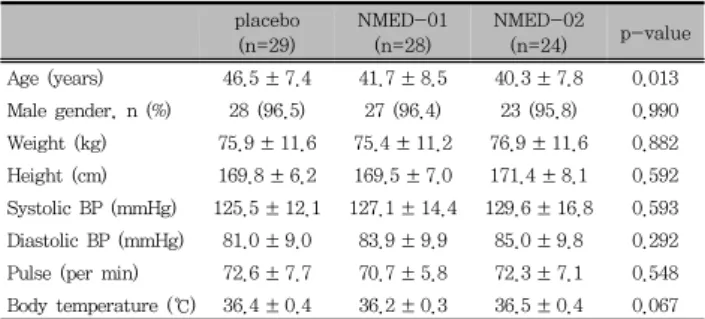
placebo (n=29)
NMED-01 (n=28)
NMED-02
(n=24) p-value Age (years) 46.5 ± 7.4 41.7 ± 8.5 40.3 ± 7.8 0.013 Male gender, n (%) 28 (96.5) 27 (96.4) 23 (95.8) 0.990 Weight (kg) 75.9 ± 11.6 75.4 ± 11.2 76.9 ± 11.6 0.882 Height (cm) 169.8 ± 6.2 169.5 ± 7.0 171.4 ± 8.1 0.592 Systolic BP (mmHg) 125.5 ± 12.1 127.1 ± 14.4 129.6 ± 16.8 0.593 Diastolic BP (mmHg) 81.0 ± 9.0 83.9 ± 9.9 85.0 ± 9.8 0.292 Pulse (per min) 72.6 ± 7.7 70.7 ± 5.8 72.3 ± 7.1 0.548 Body temperature (℃) 36.4 ± 0.4 36.2 ± 0.3 36.5 ± 0.4 0.067
3. 연구방법
본 연구 대상자로 선정된 120명은 통계학자로부터 제공받은 무작위 배정코드에 위해 placebo, NMED-01, NMED-02 군 에 1:1:1의 비율로 무작위 배정되었으며 하루 3회 2캅셀씩 (부형제 포함 2.58 g/day) 12주간 복용하게 하였다. 시험 진 행 중에는 연구자와 피험자 모두 각 피험자가 어느 군에 배정 되어 있는지 알지 못하게 하였으며, 의학적 긴급상황이 발생 하기 전까지 이중눈가림을 해제하지 않았다. 간기능 개선효과 의 비교를 위하여 스크리닝 검사를 포함하여 총 4회의 검사 를 진행하였다. 1차 검사는 스크리닝을 위하여 시행하였고, 2 차는 시료 복용 전 0주차 baseline을 위하여 측정되었다. 3 차 검사는 시료 복용 6주 후 중간 평가를 위하여 시행되었고, 4차 검사는 시료 복용을 12주간 모두 마친 후 시행되었다.
매 검사 시마다 연구 대상자의 시료 복용에 대한 순응도 미 달, 계획서 위반, 동의철회 여부 등을 조사하여 증례기록서에 기록하였다. 1차 유효성 평가 지표로 γ-GTP의 변화치를 설 정하였고 2차 유효성 평가 지표로 AST, ALT, TG의 변화치 를 설정하였다. 본 연구는 2012년 10월 15일에 시작하여 2013년 2월 28일에 완료하였다.
4. 사용 시료
연구 대상자에게 제공된 모든 시료는 ㈜뉴메드에서 제조하 여 동일 용기에 담아 완전하게 밀봉하여 전달되었다.
NMED-01과 NMED-02는 각각 부형제 포함 하루 2,460 mg, 450 mg을 복용하게 제조되어 일정한 모양으로 포장되 었다. 연구책임자의 관리 하에 피험자에게 제공되었으며 시료 의 차이를 알 수 없도록 하였다.
5. 간기능 검사
간기능 관련 검사로 내원 8시간 전부터 금식하게 한 후 전 혈을 채취하여 검사하였다. 이를 통하여 γ-GTP, AST, ALT, TG 수치를 측정하였다.
6. 안전성 검사
본 인체적용시험에서 발생할 수 있는 이상반응을 조사하기 위해 방문 시마다 이상반응을 포함한 피험자의 임상적 상태를 평가하고 이를 증례기록지에 기록하였다. 또한 피험자의 활력 징후를 측정하였고 실험실 검사를 시행하였다. 일반 혈액검사 와 일반화학검사의 내용은 Table 1과 같다.
Table 1. Description of laboratory tests during study process
Laboratory test Contents
Hematology WBC, RBC, Hemoglobin, Hematocrit, Platelets
Chemistry
BUN, Creatinine, Uric acid, Total bilirubin, Albumin, Total protein, Alkaline phosphatase, Glucose, Triglyceride, Total cholesterol, HDL cholesterol, LDL cholesterol Urinalysis pH, Protein, Glucose, WBC, RBC, Specific gravity
7. 통계 분석
연구결과는 per protocol(PP)분석을 시행하였으며 SPSS 12.0을 이용하여 분석하였다. 두 군의 평균 비교는 독립된 표본의 경우 독립표본 t-검정(Independent samples t-test) 을 이용하였고, 짝을 이룬 경우에는 대응 표본 t-검정 (Paired samples t-test)을 이용하였다. 세군 이상인 경우에 는 일원배치 분산분석법(One-way ANOVA)을 이용하였으며, baseline의 연령, γ-GTP, AST, ALT를 공분산분석(ANCOVA) 을 이용하여 보정하였다. p < 0.05에서 통계적으로 유의하다 고 판정하였다.
결 과
1. 시험 대상자의 일반적인 특성 및 탈락자
본 시험에 참여했던 대상자들의 일반적 특성을 Table 2에 정리하였다. 총 인원은 81명이었으며, 남성의 비율이 96%이 었고 평균연령은 43세였다. 성별의 구성이나 체중, 키, 수축 기 혈압, 이완기 혈압, 맥박, 체온 등은 군 간 유의하지 않았 으며(p>0.05) 연령에서 유의하게 차이를 보여 유효성 평가에 서 이를 보정하여 분석하였다.
본 인체적용시험에 참여한 241명을 스크리닝하여 선정/제 외기준 위반으로 121명이 탈락되어 총 120명이 무작위 배정 을 받고 등록되었다. 등록된 대상자 120명 모두 1회 이상 1 차 유효성 평가를 실시하여 시험에 포함되었다. 이 중 동의철 회 6명, 계획서 위반 7명, 복약순응도 2회 연속 80% 미만으 로 2명이 제외되었으며 초기에는 선정기준에 합당하였으나 γ-GTP 수치에 영향을 미치는 당뇨, 고지혈증, 고요산혈증 51,52)을 보인 24명의 피험자는 중지탈락 기준에 해당하여 통계 시 제외되어 최종 81명이 시험계획서에 따라 인체적용 시험을 종료하였다(Fig. 1).
Table 2. Baseline characteristics of study subjects
placebo (n=29)
NMED-01 (n=28)
NMED-02
(n=24) p-valuea p-valueb p-valuec
γ-GTP
Baseline 91.9 ±36.8 125.3 ±64.3 102.8 ±43.1 0.020 0.329 End 82.6 ±33.6 97.3 ±50.5 102.9 ±64.6 0.205 0.173 Change -9.3 ±27.0 -28.1 ±38.7 0.2 ±47.0 0.039 0.389 0.046 p-valued 0.076 0.001 0.986
AST Baseline 29.2 ±8.3 37.8 ±20.6 31.9 ±11.4 0.048 0.316 End 29.9 ±7.9 32.6 ±9.9 34.0 ±14.7 0.245 0.196
Change 0.7 ±8.3 -5.1 ±17.4 2.1 ±9.7 0.113 0.575 0.135 p-valued 0.659 0.132 0.302
ALT
Baseline 37.1 ±13.5 46.3 ±25.9 40.7 ±18.3 0.103 0.419 End 38.7 ±17.5 41.9 ±17.2 41.9 ±16.9 0.479 0.501 Change 1.6 ±11.6 -4.3 ±18.4 1.3 ±14.6 0.152 0.926 0.480 p-valued 0.468 0.226 0.678
TG
Baseline 243.8 ±139.1 227.6 ±131.2 212.0 ±119.2 0.653 0.381 End 202.4 ±73.3 166.9 ±75.6 186.3 ±87.9 0.077 0.472 Change -41.4 ±115.1-60.7 ±120.6 -25.7 ±70.7 0.539 0.561 0.522 p-valued 0.063 0.013 0.088
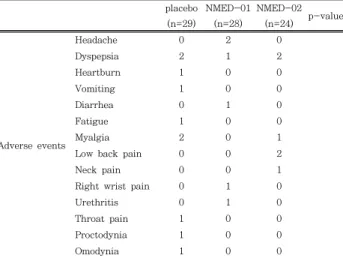
placebo (n=29)
NMED-01 (n=28)
NMED-02 (n=24) p-value
Adverse events
Headache 0 2 0
Dyspepsia 2 1 2
Heartburn 1 0 0
Vomiting 1 0 0
Diarrhea 0 1 0
Fatigue 1 0 0
Myalgia 2 0 1
Low back pain 0 0 2
Neck pain 0 0 1
Right wrist pain 0 1 0
Urethritis 0 1 0
Throat pain 1 0 0
Proctodynia 1 0 0
Omodynia 1 0 0
Fig. 1. Flow of trial subjects through the study.
2. 간기능 수치 변화
간기능 개선효과의 유효성 검사 항목인 γ-GTP, AST, ALT, TG의 결과를 종합하여 Table 3에 정리하였다.
γ-GTP는 12주 후 NMED-01 군과 placebo 군이 각각 28.1 ± 38.7, 9.3 ± 27.0 감소하였으며, NMED-02 군은 0.2 ± 47.0 증가하였다. 독립표본 t 검정 결과 NMED-01 군이 placebo 군에 비하여 통계적으로 유의(p=0.039)하였으 며 NMED-02 군은 유의하지 않았다. 또한, NMED-01 군 만 섭취 전에 비하여 12주 섭취 후에 군 내에서 유의하게 (p=0.001) 감소하였다.
AST는 12주 후 NMED-01 군에서만 감소하였으나 군 내 의 섭취 전과 후는 통계적으로 유의하지 않았으며(p=0.132), 섭취 전과 후의 변화된 수치에 대한 독립표본 t 검정 결과 NMED-01, NMED-02 군은 placebo 군에 비해 통계적 유 의성은 관찰되지 않았다 (각각 p=0.113, p=0.575). ALT 역 시 12주 후 NMED-01 군에서만 감소하였으나 군 내의 섭취 전과 후는 통계적으로 유의하지 않았으며(p=0.226), 섭취 전과 후의 변화된 수치에 대한 독립표본 t 검정 결과 NMED-01, NMED-02 군과 placebo 군 사이에 통계적 유의성은 관찰되 지 않았다 (각각 p=0.152, p=0.926).
TG는 NMED-01, NMED-02 군과 placebo 군 사이에 통계적 유의성은 관찰되지 않았으나 (각각 p=0.539, p=0.561) NMED-01 군에서 가장 크게 감소하였으며 섭취 전과 후를 비교한 결과에서도 NMED-01 군만 유의하게(p=0.013) 감소 하였다.
연령, γ-GTP, AST, ALT의 baseline 값을 보정한 후 각 유효성 평가지표의 변화치를 분석한 결과 γ-GTP에서만 군 간 차이가 유의하게(p=0.046) 나타났으며 AST, ALT, TG의 변화치는 군 간 유의하지 않았다.
Table 3. The change of γ-GTP, AST, ALT and TG level
a : compared between placebo and NMED-01 group: p-value by Student’s t-test
b : compared between placebo and NMED-02 group: p-value by Student’s t-test
c : compared between groups: p-value by ANCOVA (adjustment with baseline)
d : compared within groups: p-value by paired t-test
3. 안전성 분석 결과
안전성 평가는 시험약물을 한 번이라도 투여 받고 적어도 한 번 이상 시험 기관을 방문하여 부작용 여부나 실험실 검사 치 측정을 통해 이상 여부를 확인할 수 있었던 모든 피험자를 대상으로 실시하였으며 안전성을 평가하기 위하여 크게 실험 실 검사의 이상과 임상적으로 측정한 이상반응 자료에 근거하 여 평가하였다.
피험자들이 보고한 이상반응의 빈도와 내용들은 Table 4와 같다. 이 이상반응의 특징은 중증도에 있어서 주로 경증이었 고 위중도에 있어서는 중대하지 않은 것으로 나타났다. 본 연 구와 명확히 관련이 없다고 생각되는 통증의 반응들에는 치료 약물을 병용 투여하였고 대부분의 반응은 일시적으로 나타났 다가 회복되었으며 각 군간 이상반응 출현 빈도는 통계적으로 유의하지 않았다(p>0.05). 한편 중대한 이상반응은 placebo 군에서 골절로 인한 입원으로 1건 관찰되었으며 NMED-01, NMED-02 군에서는 관찰되지 않았다.
실험실 검사 분석 결과. WBC, ALP, total bilirubin, albumin, LDL-C, BUN, creatinine, uric acid의 경우 세 군 모두에서 섭취 전 후에 유의한 변화가 관찰되지 않았다.
한편, RBC, hematocrit, total protein, HDL-C, glucose 는 placebo 군에서 통계적으로 유의하게 변화하였고 platelets은 NMED-01 군에서 통계적으로 유의하게 변화하 였으나 임상적으로 의미가 없는 정상 범위 내에서의 변화였다 (data not shown).
Table 4. Characteristics of adverse events
Toothache 0 0 3
Micro fracture 0 0 1
Hyperglycemia 0 0 1
Hypertension 0 0 1
Total 10 6 12 0.435
Serious adverse events 1 0 0 -
고 찰
알코올을 과다섭취하면 알코올 또는 알코올 산화 과정에서 생성되는 중간 대사산물에 의해 각종 대사성 질환 및 알코올 성 간 질환이 발생할 수 있다. 알코올은 alcohol dehydrogenase, CYP450, catalase에 의해 분해되어 acetaldehyde로 대사되 며 과량의 알코올 대사에 의해 생성된 acetaldehyde는 acetaldehyde-protein 부산물과 지질과산화물을 생성시켜 간독성에 관여한다26,53-54).
담도계 효소의 하나로 간내담도의 내피세포에서 합성되는 γ-GTP는 알코올 섭취의 생리적 지표 로서 잘 알려져 있으며 γ-glutamyl기를 다른 peptide나 1-amino acid에 전이하는 간 특이효소55)로 이의 상승은 담즙정체나 간세포 괴사와 연관 된다. 간장 질환에서 ALP와 유사하나 더 민감하게 반응하는 효소이며 간조직의 손상 시 혈중으로의 유출이 증가되므로 간 기능의 지표 검사에 많이 이용되고 있다56-57). γ-GTP는 남 자에게서 알코올 섭취량이 증가함에 따라 유의하게 증가하였 으며 특히 고도 알코올 섭취는 남, 녀 모두에게서 γ-GTP가 유의하게 상승하는 것으로 알려져 있다58). 이처럼 γ-GTP는 알코올에 민감하게 반응하는 효소이기 때문에 임상에서 음주 력 판정 지표로 많이 이용되고 있으며 습관성 음주자에서 일 반적으로 높고, 알코올성 간염에서 현저히 증가되며59-64), 치 료 후 유의하게 감소된다.
NMED-01을 12주간 섭취한 군에서는 γ-GTP가 섭취 전 에 비하여 유의하게 감소하였을 뿐 아니라 위약군에 비해서도 유의하게 감소되었다. 반면 NMED-02를 섭취한 군에서는 섭 취전후와 위약군과의 비교에서 모두 γ-GTP가 유의하게 감소 되지 않았다. Placebo군, NMED-01군, NMED-02군의 연 령, γ-GTP, AST, ALT의 baseline 값을 보정하여 분석한 결과에서도 γ-GTP 변화치는 세 군의 차이가 유의하게 나타 났다.
NMED-01군에서 혈중 γ-GTP가 유의하게 낮아진 결과는 알코올로 인하여 손상된 간세포가 수복되었다는 것을 의미한 다. 이는 알코올로 유발한 만성 간손상 모델에서 NMED-01 을 먹은 흰쥐가 AST, ALT 증가가 억제되었다는 동물실험 결 과46)와 유사하며 알코올로 인해 손상된 간 기능이 개선되었음 을 나타낸다. NMED-02군은 간 보호와 관련된 많은 선행연 구가 있음에도 불구하고 혈중 γ-GTP의 변화치가 유의하지 않았는데 하루 450 mg의 섭취량은 효능을 나타내기에 부족 한 용량으로 생각된다. 이상의 결과로 보아 NMED-01은 알 코올로 인하여 간세포가 손상되는 것을 막아주거나 손상된 간 세포를 수복시켜 줌으로서 간기능을 개선시키는 것으로 생각 된다.
본 연구에서 모집한 피험자는 γ-GTP가 높은 정상인과 환 자의 경계에 있는 준 건강인으로 AST, ALT, TG 값은 정상 인에 비하여 유의하게 높지 않았다. 급성 간손상의 경우
AST, ALT가 일반적인 참고치의 수십 배까지 상승하고65), 알 코올성 간질환 환자의 경우에도 AST, ALT 수치가 정상범위 보다 높다. 그러나 본 연구는 γ-GTP가 가볍게 상승된 피험 자를 기준으로 모집하였기 때문에 시험 전에도 AST와 ALT 가 정상 범위 내에 있었고 NMED-01과 NMED-02를 투여 한 후에도 변함이 없었다. 알코올성 지방간의 경우 TG가 상 승하는데66) 본 연구에서는 지방간 같은 중증의 알코올성 간 질환이 아니었으며 시험 전에도 정상 참고치 수준이었다. 이 상의 결과로 보아 NMED-01과 NMED-02를 12주간 꾸준히 복용하여도 간 독성을 유발하지 않는 것으로 생각된다.
NMED-01과 NMED-02를 12주간 복용하는 동안 심각한 이상반응이 1건 있었으나 이는 골절에 의한 것으로 약물과는 무관한 것으로 생각된다. 그 외에 이상반응은 위약군과 비슷 한 수준으로 유의한 결과가 아니었다. 이상의 결과로 보아 NMED-01과 NMED-02를 3개월 이상 장기간 투여하더라도 간 독성을 나타내지 않고 부작용이 없는 안전한 약물로 생각 된다.
결 론
본 연구에서는 장기간 알코올 섭취로 인한 경증 간기능 저 하 피험자 만 20세 이상 만 70세 미만의 건강한 성인 남녀 중 γ-GTP 60 이상 350 이하의 생화학적 소견을 가지고 있 는 피험자들에게 12주간 枳椇子 추출물(NMED-01) 및 葛根 추출물(NMED-02)을 섭취시킨 후 γ-GTP, AST, ALT, TG 의 변화치를 위약군과 대조하여 관찰한 결과 다음과 같은 결 론을 얻었다.
1. NMED-01은 섭취 전 후 군 내에서 γ-GTP와 TG가 유의 하게 감소되었으며, 군 간 비교에서도 γ-GTP가 유의하게 감소되어 알코올 섭취로 인해 손상된 간을 보호하는데 도 움을 줄 수 있을 것으로 생각된다.
2. NMED-02를 섭취한 군에서는 섭취전후와 위약군과의 비 교에서 모두 γ-GTP가 유의하게 감소되지 않았다.
3. NMED-01과 NMED-02는 모두 섭취 전 후 군 내 비교 와 군 간 비교에서 AST, ALT, TG의 변화가 없었으므로 간 독성을 유발하지 않는 것으로 생각된다. 그리고 NMED-01과 NMED-02 모두에서 유의한 이상반응은 없 었다.
이상의 결과로 보아 NMED-01은 간독성이나 이상반응 없 이 알코올로 인하여 간세포가 손상되는 것을 막아주거나 손상 된 간세포를 수복시켜 줌으로서 간기능을 개선시키는 것으로 생각된다.
참고문헌
1. Lee HJ. Update and Perspectives on alcoholic liver disease in Korea 2010. Korean J Hepatol. 2010 ;
16(2) : 23-44.
2. Pessione F, Ramond MJ, Peters L, Pham BN, Batel P, Rueff B, Valla DC. Five-year survival predictive factors in patients with excessive alcohol intake and cirrhosis. Effect of alcoholic hepatitis, smoking and abstinence. Liver Int. 2003 ; 23(1) : 45-53.
3. Sohail U, Satapathy SK. Diagnosis and management of alcoholic hepatitis. Clin Liver Dis. 2012 ; 16(4) : 717-36.
4. Zhu H, Jia Z, Misra H, Li YR. Oxidative stress and redox signaling mechanisms of alcoholic liver disease: updated experimental and clinical evidence.
J Dig Dis. 2012 ; 13(3) : 133-42.
5. Hawke RL, Schrieber SJ, Soule TA, Wen Z, Smith PC, Reddy KR, Wahed AS, Belle SH, Afdhal NH, Navarro VJ, Berman J, Liu QY, Doo E, Fried MW.
Silymarin ascending multiple oral dosing phase I study in noncirrhotic patients with chronic hepatitis C. J Clin Pharmacol. 2010 ; 50(4) : 434-49.
6. Kim HT, Kim DD, Ku SK, Kim JW, Lim MK, Oh TH, Lee KW. Therapeutic effects of Hovenia Dulcis Thunb extract on CCl4 induced liver and kidney damage in rats. J Vet Clin. 2011 ; 28(1) : 20-7.
7. Kim SM, Kang SH, Ma JY, Kim HJ. A study on the Extraction and Efficacy of Bioactive Compound from Hovenia dulcis. Korean J Biotechnol Bioeng.
2006 ; 21(1) : 11-5.
8. Chae HB. Alcoholic Liver Disease. Korean J Gastroenterol.
2009 ; 53(5) : 275-82.
9. Korea Food & Drug Administration(KFDA). The Korean Herbal Pharmacopoeia. The KFDA Notification 2013-56.
2013 : 331-2.
10. Textbook Compilation Committee of college of Korean Medicine. Herbology. Seoul : Younglim. 1991 : 734.
11. Yoshikawa M, Murakami T, Ueda T, Yoshizumi S, Ninomiya K, Murakami N, Matsuda H, Saito M, Fujii W, Tanaka T, Yamahara J. Bioactive constituents of Chinese natural medicines. III.
Absolute stereostructures of new dihydroflavonols, hovenitins I, II, and III. Yakugaku Zasshi. 1997 ; 117(2) : 108-18.
12. Na CS, Chung NC, Yang KH, Kim SH, Chung HS, Dong MS. Hepatoprotective and blood alcohol lowering effects of fruit peduncle extract of Hovenia dulcis var. Koreana in the in vitro and in vivo Animal Models. Yakhak Hoeji. 2004 ; 48(1) : 34-40.
13. Yoshikawa M, Murakami T, Ueda T, Matsuda H, Yamahara J, Murakami N. Bioactive saponins and glycosides. IV. Four methyl-migrated 16, 17-seco-dammarane triterpene glycosides from Chinese natural medicine, hoveniae semen seu fructus, the seeds and fruit of Hovena dulcis
THUNB.: Absolute stereostructures and inhibitory activity on histamine release of hovenidulciosides A1, A2, B1, and B2. Chem Pharm Bull. 1996 ; 44(9) : 1736-43.
14. Kim OK. Protective effects of extracts of Hovenia dulcis Thunb on hepatotoxicity in carbon tetrachloride intoxicated rats. J Korean Soc Food Sci Nutr.
2001 ; 30(6) : 1260-5.
15. Ahn BS, Kim JW, Kim HT, Lee DS, Lee KW.
Antioxidant effects of Hovenia Dulcis in the streptozotocin-induced diabetic rats. J Vet Clin.
2010 ; 27(4) : 366-73.
16. Hu W, Lee KB, Wang MH. Antioxidant activities of various extracts of Hovenia dulcis Thunb fruits.
Kor J Plant Res. 2010 ; 23(3) : 207-13.
17. Choi JK, Han HS, Lee YJ. Study on Antioxidant effect of Hoveniae semen cum fructus and Hoveniae ramulus on liver cells isolated from oxidatively stressed Rat. Kor J Herbology. 2009 ; 24(3) : 129-38.
18. Cho JY, Moon JH, Park KH. Isolation and identification of 3-Methoxy-4-hydroxybenzoic Acid and 3-Methoxy-4-hydroxycinnamic acid from hot water extracts of Hovenia dulcis Thunb and confirmation of their antioxidative and antimicrobial activity. Kor J Food Sci Technol. 2000 ; 32(6) : 1403-8.
19. Jeong CH, Shim KH. Some Functional Properties of extracts from leaf and fruit stalk of Hovenia dulcis. Korean J Postharvest Sci Technol. 2000 ; 7(3) : 291-6.
20. An SW, Kim YS, Kim MH, Lee BI, Lee SH, Kwon HI, Hwang B, Lee HY. Comparison of hepatic detoxification activity and reducing serum alcohol concentration of Hovenia dulcis THUNB and Alnus japonica Steud. Kor J Med Crop Sci. 1999 ; 7(4) : 263-8.
21. Lee MK, Kim YG, An SW, Kim MH, Lee JH, Lee HY. Biological activities of Hovenia dulcis THUNB. Kor J Med Crop Sci. 1999 ; 7(3) : 185-92.
22. Hong YL, Kim MH, Ahn C, Lee HY, Kim JD.
Studies on the biological activities of the extracts from Hovenia dulcis Thunb. J Agr Sci, 2000 ; 11 : 1-11.
23. Ji Y, Chen S, Zhang K, Wang W. Effects of Hovenia dulcis Thunb on blood sugar and hepatic glycogen in diabetic mice. Zhong Yao Cai. 2002 ; 25(3) : 190-1.
24. Ma JY, Kim SW. Effect of Hovenia dulcis on liver protection in SD male rats treated with CCl4. Kor J Oriental Med. 2006 ; 12(1) : 103-9.
25. Kim JH, Seo YM, Kim JH, Hyun SH, Lee SK,
Kim CH, Kang MJ, Jeon TW, Yoon SH, Jeong TC. Protective effects of the water extracts of Hovenia dulcis Thunb against ethanol-induced toxicity in primary cultured rat hepatocytes.
Yakhak Hoeji. 2008 ; 52(1) : 56-61.
26. You YH, Jung KY, Lee YH, Jun WJ, Lee BY.
Hepatoprotective effects of Hovenia dulcis fruit on ethanol-induced liver damage in vitro and in vivo. J Kor Soc Food Sci Nutr. 2009 ; 38(2) : 154-9.
27. Du J, He D, Sun L, Han T, Zhang H, Qin L, Rahman K. Semen Hoveniae extract protects against acute alcohol-induced liver injury in mice. Pharm Biol. 2010 ; 48(8) : 953-8.
28. Hase K, Ohsugi M, Xiong Q, Basnet P, Kadota S, Namba T. Hepatoprotective effect of Hovenia dulcis THUNB. on experimental liver injuries induced by carbon tetrachloride or D-galactosamine/lipopolysaccharide. Biol Pharm Bull. 1997 ; 20(4) : 381-5.
29. Fang H, Lin H, Chan M, Lin W, Lin W. Treatment of chronic liver injuries in mice by oral administration of ethanolic extract of the fruit of Hovenia dulcis. Am J Chin Med. 2007 ; 35(4) : 693-703.
30. Kim HC. Herbal Pharmocology. Seoul : Jipmoon.
2001.
31. Arao T, Kinjo J, Nohara T, Isobe R. Oleanenetype triterpene glycosides from Pueraria radix. IV. six new saponins from Pueraria Lobata. Chem pharm bull. 1997 ; 45 : 362-6.
32. Jun M, Fu HY, Hong J, Wan X, Yang CS, Ho CT.
Comparison of antioxidant activities of isoflavones from kudzu root (Pueraria lobata Ohwi). J Food Sci. 2003 ; 68 : 2117-22.
33. Zeng GY, Cheng YS, Fan LL, Zhou YP, Zhang LY. Pharmacologic studies on Puerariae Radix :effects of puerariae flavones on coronary circulation, cardiac hemodynamics and myocardial metabolism in dogs. Chin Med J. 1982 ; 95(2) : 145-50.
34. Huh LH, Kim HC, LeeSJ. Studies on anti-inflammatory activity and its mechanism of daidzein. J Pharmaceut Soc Kor. 1987 ; 31(1) : 154-63.
35. Oh MJ, Lee KS, Son HY, Kim SY. Antioxidative components of Pueraria root. J Kor Soc Food Sci Tech. 1990 ; 22(7) : 792-3.
36. Park CH, Lim SS, Lee DU. Structure-activity relationships of components from the roots of Pueraria thunbergiana having aldose reductase inhibitory and antioxidative activity. Bull Kor Chem Soc. 2007 ; 28 : 493-5.
37. Lee CH, Han SH, Min SG. The effects of Puerariae Radix catechins administration on liver function in carbon tetrachloride-treated rats. J Kor Soc
Food Sci Nutr. 1995 ; 24(5) : 713-9.
38. Lin RC, Guthrie S, Xie CY, Mai K, Lee DY, Lumeng L, Li TK. Isoflavone compounds extracted from Pueraria lobata suppress alcohol preference in a pharmacogenetic rat model of alcoholism.
Alcohol Clin Exp Res. 1996 ; 20(4) : 659-63.
39. Hyun DH, Jung SY, Jung SS, Ha KT, Kim CH, Kim DW, Kim JK, Choi DY, The study of protective effect of Puerariae radix against CCl4-induced hepatotoxicity. Kor J Oriental Physiol Pathol. 2003 ; 17(2) : 297-307.
40. Sato T, Kawamoto A, Tamura A, Tasumi Y, Fujii T. Mechanism of antioxidant action of pueria glycoside(PG)-I (an isoflavonoid) and mangiferin (axanthonoid). Chem Pharm Bull. 1992 ; 40 : 721-4.
41. Keung WM, Vallee BB. Biochemical studies of a new class of alcohol dehydrogenase inhibition from Pueriae Radix. Alcohol Clin Exp Res. 1993 ; 17 : 1254-60.
42. Keung WM, Vallee BL. Kudzu root an ancient chinese source of modern antisotropic agents.
Phytochem. 1998 ; 47 : 499-506.
43. Xie CI, Lin RC, Antony V, Lumeng L, Li TK, Zao ZH, Wang GF. Daidzin apotent selective inhibitor of human mitochondrial aldehyde dehydrogenase.
Proc Natl Acad Sci USA. 1993 ; 90 : 1247-50.
44. Kurihara T, Kikuchi M. Studies on the constituents of flowers V. on the components of Pueria thunbergiana Benth (2). Isolation of new isoflavones glcosides.
Yakugaku Zasshi. 1975 ; 95 : 1283-5.
45. Han SH, Kim JB, Min SG, Lee CH. The effects of Puerariae radix catechins administration on liver function in carbon tetrachloride-treated rats. J Kor Soc Food Nutr. 1995 ; 24(6) : 713-20.
46. Kim YS, Park J, Kwon Y, Lim DW, Song MK, Choi HY, Kim HC. Hepatoprotective effects of Hovenia dulcis extract on acute and chronic liver injuries induced by alcohol and carbon tetrachloride.
Kor J Herbology. 2013 ; 28(4) : 25-32.
47. Woo HJ, Lee JH, Kim YC. Studies on the effects of Puerariae radix and Artemisiae herba on experimental liver damages induced by alcohol, d-galactosamine and CCl4. J Kor Oriental Med Soc. 1997 ; 18(1) : 411-29.
48. Lee JS, Kim ES, Kim SW. Effects of extracts of Pueraria radix on lipid peroxidation in ethanol-administered rats. J Kor Soc Food Sci Nutr. 1999 ; 28(4) : 901-6.
49. Hwang YP, Choi CY, Chung YC, Jeon SS, Jeong HG. Protective effects of puerarin on carbon tetrachloride-induced hepatotoxicity. Arch Pharm Res. 2007 ; 30(10) : 1309-17.
50. Chen X, Li R, Liang T, Zhang K, Gao Y, Xu L.
Puerarin improves metabolic function leading to hepatoprotective effects in chronic alcohol-induced liver injury in rats. Phytomedicine. 2013 ; 20(10) : 849-52.
51. Byun JH, Lee BC, Ham BJ, Chung CS, Hur M, Lee JJ, Choi IG. Comparing biological markers of alcohol dependence in the patients of an alcohol counseling center. Kor Soc Biol Psychiatry. 2006
; 13(4) : 273-8.
52. Byun KS. Clinical and pathologic spectrum of alcoholic liver diseases. Kor J Hepatol. 1997 ; 3(4) : 307-15.
53. Lee HC, Hwang SG, Kang YK, Sohn HO, Moon JY, Lim HB, Jeon BH, Lee DW. Influence of Protaetia brevitarsis extract on liver damage induced by carbon tetrachloride and ethanol in rats. J Life Sci. 2001 ; 11(5) : 405-14.
54. Tuma J, Casey CA. Dangerous byproducts of alcohol breakdown-focus on adducts. Alcohol Res Health. 2003 ; 27(4) : 285-90.
55. Szasz G. A kinetic photometric method for serum γ-glutamyl transpeptidase. Clin Chem. 1969 ; 15(2) : 124-36.
56. Selinger MJ, Matloff DS, Kaplan MM. γ-Glutamyl transpeptidase activity in liver disease: serum elevation is independent of hepatic GGTP activity.
Clin Chim Acta. 1982 ; 125(3) : 283-90.
57. Lee HH, Yoon JS, Song SY. Protective Effect of Lithospermum erythrorhizon on galactosamine induced liver injury. Kor J Microscopy. 2010 ; 40(1) : 29-35.
58. Bae MJ, Oh IH, Park JS, Lee SY, Lee JG, Kim YJ, Jun DW, Yi YH, Cho YH, Choi EJ. The Association between elevated GGT with alcohol consumption and with insulin resistance. Kor J Obese. 2011 ; 20(3) : 113-20.
59. Barouki R, Chobert M, Finidori J, Aggerbeck M, Nalpas B, Hanoune J. Ethanol effects in a rat hepatoma cell line: Induction of γ‐Glutamytransferase.
Hepatology. 1983 ; 3(3) : 323-9.
60. Friedman SL. Acetaldehyde and alcoholic fibrogenesis:
fuel to the fire, but not the spark. Hepatology.
1990 ; 12(3) : 609-12.
61. Yates WR, Petty F, Brown K. Risk factors for alcohol hepatotoxicity among male alcoholics. Drug Alcohol Depend. 1987 ; 20(2) : 155-62.
62. Gjerde H, Amundsen A, SKOG O, Mørland J, Aasland O. Serum Gamma‐glutamyltransferase: an epidemiological indicator of alcohol consumption?.
Br J Addict. 1987 ; 82(9) : 1027-31.
63. Persson J, Magnusson PH. Comparison between different methods of detecting patients with excessive
consumption of alcohol. Acta Med Scand. 1988 ; 223(2) : 101-9.
64. Choi K, Kim BI, Cho YK, Park CY, Sohn JI, Jeon WK, Kim H, Chung ES, Keum DG, Lee HY, Lee SJ. Diagnostic usefulness of serum γ-glutamyl transferase(GGT) activity in fatty liver and relationship with other factors. Kor J Med. 1999 ; 57(6) : 1006-13.
65. Lee EJ, Kwon SY, Seo TH, Yun HS, Sho HS, Kim BK, Choe WH, Lee CH, Kim JN, Yim HJ. Clinical features of acute hepatitis A in recent two years.
Kor J Gastroenterol. 2008 ; 52(5) : 198-303.
66. Subramanian S, Chait A. Hypertriglyceridemia secondary to obesity and diabetes. Biochim Biophys Acta. 2012 ; 1821(5) : 819-25.