The Benefits of Percutaneous Transhepatic Gallbladder Drainage prior to Laparoscopic Cholecystectomy for Acute Cholecystitis
Byeonghun Oh, M.D., Eunyoung Kim, M.D., Eun Jeong Ahn, M.D., Ph.D., Jong-Min Park, M.D., Sei-Hyeog Park, M.D.
Department of Surgery, National Medical Center, Seoul, Korea
Purpose: Several studies have reported that laparoscopic cholecystectomy with percutaneous transhepatic gallbladder drainage (PTGBD) is associated with a reduced duration of surgery and a lower rate of conversion to open laparotomy compared with laparoscopic cholecystectomy without PTGBD and delayed laparoscopic cholecystectomy after conservative therapy. However, these results are contradictory. This retrospective study investigated the safety and usefulness of laparoscopic cholecystectomy combined with pre-operative PTGBD in patients with acute cholecystitis.
Methods: The clinicopathologic data and surgical outcomes of 101 patients who underwent laparo- scopic cholecystectomy between January 2010 and September 2015 were reviewed retrospectively.
Results: Patients in the PTGBD group vs. the non-PTGBD group were significantly older (mean age:
65.47±12.2 vs. 56.32±13.7; p=0.001). Underlying diseases were also significantly more common in the PTGBD group (75.4% vs. 45.5%; p=0.002). There were no significant differences between the two groups in terms of operative time, blood loss, rate of open conversion, postoperative oral intake, and postoperative hospital stay. Total hospital day was significantly longer in the PTGBD group (11.14±7.22 vs. 6.23±5.17; p=0.049). There was no significant difference in the postoperative com- plications between the two groups, and all patients in this study lived.
Conclusion: This study suggested that satisfactory results can be achieved with selective preoperative PTGBD in older and sicker patients with acute cholecystitis.
Keywords: Acute cholecystitis, Laparoscopic cholecystectomy, Percutaneous transhepatic gallbladder drainage (PTGBD)
Received December 1, 2015 Revised January 5, 2016 Accepted February 15, 2016
Corresponding author Sei-Hyeog Park
Department of Surgery, National Medical Center, Euljiro 6-ga, Jung- gu, Seoul 04564, Korea
Tel: +82-2-2260-7114 Fax: +82-2-2269-0750 E-mail: [email protected]
This is an Open Access article distributed under the terms of the Creative Commons Attribution Non-Commercial License (http://
creativecommons.org/licenses/by-nc/4.0/) which permits unrestricted non-commercial use, distribution, and reproduction in any medium, provided the original work is properly cited.
Copyright © 2016 The Journal of Minimally Invasive Surgery. All rights reserved.
Journal of Minimally Invasive Surgery
J Minim Invasive Surg 2016;19(2):63-69
IntroductIon
In recent years, laparoscopic cholecystectomy for nonacute cholecystitis has been widely accepted as a safe and fea- sible procedure due to the development of improved surgical techniques and devices. However, its applicability for acute cholecystitis remains controversial.1-4 The safety3,5,6 and the optimal timing of laparoscopic cholecystectomy1-3,7 have been studied; generally, the outcomes have been good when lapa-
roscopic cholecystectomy is carried out early.1-5 In addition, several studies have evaluated laparoscopic cholecystectomy after selective sustained percutaneous transhepatic gallbladder drainage (PTGBD) for the control of severe inflammation3,8-10 and improvement of cholecystitis-induced disorders. Espe- cially, Chikamori et al.11 reported on 16 laparoscopic chole- cystectomy patients with PTGBD who experienced a reduced duration of surgery and a lower rate of conversion to open laparotomy compared with laparoscopic cholecystectomy pa-
tients who did not receive PTGBD and also those who under- went delayed laparoscopic cholecystectomy after conservative therapy. However, these studies were relatively small, and the results were contradictory. Therefore, this retrospective study researched the safety and the usefulness of laparoscopic cho- lecystectomy combined with pre-operative PTGBD in patients with acute cholecystitis.
MaterIals and Methods
Patients
We retrospectively reviewed a database of 101 patients who had been diagnosed with acute cholecystitis and who under- went laparoscopic cholecystectomy between January 2010 and September 2015. All patients were hospitalized via the emer- gency room; they were informed about the procedure and gave their consent for surgery.
At our institution, acute cholecystitis is defined by the presence of at least three of the following: (1) right upper abdominal pain, (2) a temperature of 38oC or higher, (3) a white blood cell (WBC) count of 10,000/μl or higher (normal:
4,000~10,000/μl), and (4) a gallbladder wall with a thickness of at least 3.5 mm on transabdominal ultrasound or computed tomography. Patients who required a combined surgery on other organs and also those in whom laparoscopic cholecys- tectomy was performed for malignant gallbladder disease were excluded. Patients who received conservative therapy (fasting, intravenous fluids, antibiotics) alone also were excluded. In all, 57 patients who underwent PTGBD before undergoing surgery were included in this study. Laparoscopic cholecystectomy was performed as soon as the general condition of the patient was stabile and there was evident improvement in liver function, renal function, respiratory function, cardiac status, blood co- agulation parameters, and American Society of Anesthesiolo- gist (ASA) status.
The indications for PTGBD are as follows: (1) severe ab- dominal symptoms (severe abdominal pain, evidence of peri- toneal inflammation) with impaction of stones in the neck of the gallbladder and continuous fever (38oC or higher); (2) concomitant jaundice/hepatic dysfunction (total bilirubin >3.0 mg/dl [total bilirubin; normal: 0~1.0 mg/dl], and alanine ami- notransferase [ALT; normal: 3~40 U/l]/aspartate aminotrans- ferase [AST; normal: 10~35 U/l] >500 U/l), and/or sepsis; and (3) the presence of severe underlying disease.
The characteristics of patients (age, gender, history of ab- dominal surgery, co-morbidity, etc.), surgical outcomes and postoperative course, which were compared between the PT- GBD performance group and the control group (open conver- sion, operative time, blood loss, postoperative morbidity and
mortality, total and postoperative hospital days, postoperative oral intake, patients’ sharing of medical cost) were examined.
Surgical techniques
Percutaneous transhepatic gallbladder drainage (PTGBD)
PTGBD was performed within 24 hours of admission. After the administration of local anesthesia, an 8.5F pigtail catheter (Uresil, Chicago, IL, US) was inserted into the gallbladder under ultrasound guidance via a transhepatic route using the Seldinger technique.
Laparoscopic cholecystectomy
Patients were placed in the supine position. A nasogastric tube and Foley bladder catheter were placed to decompress these organs and lessen the chance of their injury by the port trocars. The surgeon stood at the left upper side of the patient, and the first assistant was placed across from the surgeon. The scopist was positioned on the right upper side of the patient.
After general anesthesia was induced, the camera trocar was inserted using the open access technique in the periumbilical area; pneumoperitoneum was established with the insufflation of carbon dioxide. Intraperitoneal pressure was maintained at 12~13 mmHg. The patient was placed in a mild (20~30 degree) reverse Trendelenbug position by rotating the patient slightly to the left. Three additional trocars were inserted, using direct visualization of their sites of intra-abdominal presentation.
The second 12-mm trocar port was placed in the epigastrium about 5 cm below the xiphoid, with its intra-abdominal en- trance site being just to the right of the falciform ligament.
Two smaller 5-mm trocar ports for instruments were then placed: one in the right upper quadrant near the midclavicular line several centimeters below the costal margin, and another quite laterally almost at the same level as the umbilicus.
After full inspection of the intra-abdominal cavity, we at- tempted to expose the cystic duct and artery; these structures were divided with endoscopic heavy scissors after being doubly secured with metal clips both proximally and distally.
We grasped the infundibulum of the gallbladder with forceps through the middle port and removed the gallbladder from its bed in a retrograde manner. The gallbladder was removed us- ing an endo-pouch.
Postoperative management
The nasogastric tube was removed when the patient was alert enough to void, as was the Foley catheter. Pain at the operative site was well controlled with oral medication. Al- though the patients experienced some transient nausea, most were able to receive oral liquids within one or two days and
were discharged within three or four days.
Statistical analysis
All continuous data are presented as the mean±standard deviation. Patients’ universal characteristics were analyzed us- ing frequency analysis. For a comparison of the two groups, the unpaired t-test was used for numerical data, and the Chi- square test was employed for categorical data, along with the Yates correction for continuity where appropriate. To com- pare changes in numerical data in the same group, a paired t- test was used as appropriate. A value of p<0.05 was regarded as significant. Statistical analyses were performed using the Statistical Package for the Social Sciences (SPSS version 21.0, SPSS, Inc.).
results
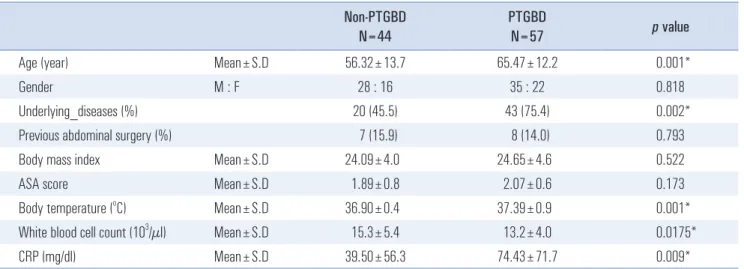
This study included 101 patients who were diagnosed with acute cholecystitis and underwent laparoscopic cholecystec- tomy; 58 of these patients met the criteria for PTGBD. Of these, 57 received PTGBD. The remaining patient was unable to undergo the procedure at that time due to the absence of a radiologist and instead required an emergency laparoscopic cholecystectomy the next day. No direct complications of PT- GBD were noted. All procedures were carried out at our center by the one surgeon experienced in laparoscopy while patients were under general anesthesia. Patient characteristics are shown in Table 1. The patients were divided into two groups.
One group was composed of patients who had PTGBD (PTGBD group). The other was made up of patients without PTGBD (Non-PTGBD group). Patients in the PTGBD group vs. the
non-PTGBD group were significantly older (mean age: 65.47±
12.2 vs. 56.32±13.7, respectively; p=0.001). Underlying diseases were significantly more common in the PTGBD group (75.4%
vs. 45.5%; p=0.002). There was no significant difference in the gender distribution (p=0.818), history of previous abdominal surgery (p=0.793), or body mass index (p=0.522) between the two groups.
Body temperatures (oC) in the PTGBD group and non- PTGBD groups were 37.39±0.9 and 36.90±0.4 (p=0.001), re- spectively. The WBC counts (103/μl) were 15.3±5.4 and 13.2±
4.0 (p=0.0175), respectively, while the C-reactive protein values (mg/d) were 74.43±71.7 and 39.50±56.3 (P=0.009), respectively.
Thus, all of these parameters indicated significantly worse inflammation in the PTGBD group. However, the parameters indicating the general condition of the patients in the PT- GBD group substantially improved immediately following PTGBD: the mean body temperature (oC) decreased from 37.39±0.9 to 36.68±0.368 (p<0.0001), the mean WBC counts (103/μl) fell from 15.3±5.4 to 7.9±1.5 (p<0.0001), and the number of abnormal biochemical parameters decreased from 3.0±1.9 to 1.3±1.1 (p<0.0001). Because the general conditions of the PTGBD group were better, the mean ASA classification for the PTGBD group also improved from 2.30±0.5 to 2.07±0.6 (p<0.0144). Before surgery, the respective ASA classifications were 2.07±0.6 in the PTGBD group and 1.89±0.8 in the non- PTGBD group, a difference that was not significant (p=0.173).
The underlying diseases in both the PTGBD group and the non-PTGBD group are shown in Table 2.
Surgical outcomes and postoperative courses are summa- rized in Table 3. There were no significant differences between the two groups in terms of operative time, blood loss, the rate of open conversion, postoperative oral intake, postoperative
Table 1. Characteristics of patients
Non-PTGBD N=44
PTGBD
N=57 p value
Age (year) Mean±S.D 56.32±13.7 65.47±12.2 0.001*
Gender M : F 28 : 16 35 : 22 0.818
Underlying_diseases (%) 20 (45.5) 43 (75.4) 0.002*
Previous abdominal surgery (%) 7 (15.9) 8 (14.0) 0.793
Body mass index Mean±S.D 24.09±4.0 24.65±4.6 0.522
ASA score Mean±S.D 1.89±0.8 2.07±0.6 0.173
Body temperature (oC) Mean±S.D 36.90±0.4 37.39±0.9 0.001*
White blood cell count (103/µl) Mean±S.D 15.3±5.4 13.2±4.0 0.0175*
CRP (mg/dl) Mean±S.D 39.50±56.3 74.43±71.7 0.009*
ASA = American Society of Anesthesiologist; CRP = C-reactive protein. *p value<0.05.
hospital stay, patients’ sharing of medical cost. But, Total hos- pital day was significantly longer in the PTGBD group (11.14
±7.22 vs. 6.23±5.17; p=0.049). We were unable to identify any significant difference of postoperative complications between the two groups. No patients died during this study.
Complications in the PTGBD group included the follow- ing: bile leak (1 patient), biliary sepsis (1), pleural effusion (2), pneumonia (2), postoperative ileus (1), and postoperative
bleeding (1). Complications in the non-PTGBD group were as follows: oliguria (1 patient), pleural effusion (1), and in- fection of the surgical wound (1) (Table 4). The reasons for conversion to open surgery were Mirrizi’s syndrome in two patients, fibrosis of Calot’s triangle in one patient, gallbladder wall bleeding in one patient, and common bile duct injury in one patient in the PTGBD group. In the non-PTGBD group, the reasons were Mirrizi’s syndrome in two patients, fibrosis Table 2. Underlying diseases
PTGBD
N=57 Non-PTGBD
N=44 Total
Cardiac disease Heart failure 2 2
Atrial fibrillation 1 1 2
Angina 2 2
Hypertension 24 12 36
Pulmonary disease Asthma 2 2
COPD 3 2 5
Old tuberculosis 1 1
Gastrointestinal disease Liver cirrhosis 1 1
Hepatocellular carcinoma 1 1
Hepatitis type B 4 1 5
Hepatitis type C 1 1 2
Intestinal obstruction 1 1 2
Sigmoid colon cancer. 1 1
Pancreatitis 1 1
Stomach cancer. 1 1 2
Gastric ulcer 1 1 2
Gastric ulcer perforation 1 1
Acute appendicitis 4 2 6
Endocrine disease Diabetes mellitus 13 3 16
Hyperthyroidism 1 1
Hypothyroidism 1 1
Vascular disease Cerebral infarction 2 1 3
Internal carotid artery stenosis 1 1
Infective disease Syphillis 1 1 2
AIDS 1 1
Renal disease Chronic kidney disease 1 1 2
Psychiatric disease Dementia 3 3
Total 72 32 104
COPD = Chronic obstructive pulmonary disease; AIDS = Acquired immune deficiency syndrome.
of Calot’s triangle in one patient, and gallbladder bleeding in one patient (Table 5). Postoperatively, all patients experienced complete resolution of their symptoms (100% overall response to laparoscopic cholecystectomy).
dIscussIon
When laparoscopic cholecystectomy was first developed, acute cholecystitis was considered a contraindication for the procedure.12,13 However, with the development of greater tech- nical skills and superior laparoscopic instruments, the number of surgical teams that apply laparoscopic cholecystectomy first in acute cholecystitis patients is increasing. While laparoscopic cholecystectomy has gained a leading role in the treatment of acute cholecystitis despite its reportedly high rates of con- version to open surgery, the optimal timing for laparoscopic
cholecystectomy in patients with acute cholecystitis has been a matter of controversy during the few past decades.14 Most sur- geons agree that the timing of the procedure is an important factor in determining the patient’s treatment outcome. The surgery should ideally be performed as soon as possible. Al- though operation within 72 hours of symptom onset has been suggested,1,2,7 such early surgery is not always possible in clini- cal practice due to logistic difficulties in performing surgery on these patients on an emergent basis. Moreover, emergency surgical procedures sometimes cause serious complications in high-risk patients and cannot be performed in all hospitals.
The selection of early surgical timing forces hemodynamically unstable patients to undergo surgery while they are still in poor general condition.
Some studies have emphasized the safety and the usefulness of laparoscopic cholecystectomy combined with preoperative PTGBD in patients with acute cholecystitis. Chikamori et al.11 reported that 16 laparoscopic cholecystectomy patients with PTGBD experienced a reduced duration of surgery and a lower rate of conversion to open laparotomy compared with those who received either laparoscopic cholecystectomy without PTGBD or delayed laparoscopic cholecystectomy after con- Table 3. Surgical outcomes and postoperative courses
PTGBD
N=57 Non-PTGBD
N=44 p value
Operative time (min) Mean±S.D 100.23±30.8 95.36±36.8 0.472
Blood loss (ml) Mean±S.D 44.49±88.8 41.41±67.8 0.849
Open conversion (%) 5 (8.8) 4 (9.1) 0.956
Postoperative oral intake (days) Mean±S.D 2.86±3.4 2.39±1.5 0.393
Postoperative morbidity (%) 8 (14.0) 3 (6.8) 0.248
Postoperative mortality (%) 0 (0) 0 (0) –
Total hospital stay (days) Mean±S.D 11.14±7.22 6.23±5.17 0.049*
Postoperative hospital stay (days) Mean±S.D 4.26±7.28 4.16±6.51 0.941
Patients’ sharing of medical cost (won) Mean±S.D 2,176,298±1,134,477 1,767,522±1,280,912 0.093
*p value<0.05.
Table 4. Postoperative morbidity PTGBD
N=57
Non-PTGBD
N=44 p vlaue
Bile leakage 1 0
Biliary sepsis 1 0
Oliguria 0 1
Pleural effusion 2 1
Pneumonia 2 0
Postoperative ileus 1 0
Postoperative bleeding 1 0
Wound infection 0 1
Total 8 3 0.248
Table 5. Reasons for open conversion
PTGBD (N=57) Non-PTGBD (N=44)
Total number of patients = 5 Total number of patients = 4 Mirrizi's syndorome 2 Mirrizi's syndorome 2 Fibrosis of Calot's triangle 1 Fibrosis of Calot's triangle 1 Gallbladder wall bleeding 1 Gallbladder wall bleeding 1 Common bile duct injury 1
servative therapy.
Patients who underwent PTGBD in this study were older and were therefore more likely to have comorbid disease compared with the group that did not undergo PTGBD. More- over, the PTGBD group had more severe acute cholecystitis, as determined by the presence of fever, an elevated WBC count, and a raised C-reactive protein level; they also had more cholecystitis-induced disorders that could be classified as severe. Thus, elderly patients who had more general risk factors and were at an increased surgical risk, as well as those with acute cholecystitis of a greater severity, were selected for PTGBD. Spira et al.13 categorized severe cholecystitis-induced symptoms and advanced age as indications for PTGBD prior to laparoscopic cholecystectomy. Interestingly, the average body temperature (oC) was 37.39±0.9 in the PTGBD group and 36.90±0.4 in the non-PTGBD group (p=0.001). The mean body temperature of each group therefore did not indicate a high fever, which would have been over 38oC. Because many patients who feel upper abdominal pain or chills may take over-the-counter medications to relieve these symptoms be- fore visiting the hospital, each group’s mean body temperature had a tendency to be low.
Patients who underwent PTGBD experienced an improve- ment in their general condition. As a result, the preoperative ASA classification in the PTGBD group was not significantly different from that of the non-PTGBD group.
Kim et al.15 observed that the duration of surgery was longer in patients who underwent PTGBD followed by delayed lapa- roscopic cholecystectomy compared with their non-PTGBD group. In contrast, Chikamori et al.11 found that the duration of surgery was shortened when laparoscopic cholecystectomy was performed as soon as possible after PTGBD. In our study, the operative time and amount of blood loss were not signifi- cantly different between the two groups. If patients in the PT- GBD group had not undergone PTGBD, the longer operative time was expected due to their poor conditions. However, the general conditions of patients were improved following PT- GBD, which made the operative time in this group similar to that of the non-PTGBD group.
There was no significant difference with regard to the pe- riod between the operation and the first oral intake (postop- erative oral intake) or the postoperative hospital stay between the PTGBD group and the non-PTGBD group. Feeding was resumed after 2.86±3.4 days in the PTGBD group and after 2.39±1.5 days in the non-PTGBD group, which is consistent with the less-invasive nature of laparoscopic cholecystectomy.
However, total hospital day was significantly longer in the PTGBD group (11.14±7.22 vs. 6.23±5.17; p=0.049). Because of taking time to recover their general condition in PTGBD group, total hospital day of PTGBD group became longer than
that of non-PTGBD group. On average, it took 5.09±2.3 days for patients in PTGBD group to have an operation after un- dergoing PTGBD procedure.
There was no significant difference concerning the pa- tients’ sharing of medical cost between the PTGBD group and the non-PTGBD group (2,176,298±1,134,477 vs. 1,767,522±
1,280,912; p=0.093). Therefore, PTGBD is a useful procedure and patients who have poor conditions will expect an im- provement in their general condition through PTGBD without great expense of medical cost.
The reported complication rate associated with laparoscopic cholecystectomy performed for acute cholecystitis ranges from 10.8% to 15.3%.1-4,8 The complication rates in the PTGBD group and non-PTGBD groups in this study were 14.0% and 6.8%, respectively. The rate of conversion to open surgery in the studies of Texeira et al.,8 Eldar et al.,3 Lai et al.,2 and Suter and Meyer4 were relatively high (24%, 28.5%, 22%, and 15.6%, respectively). In the present study, the conversion rate was 8.8%
in the PTGBD group and 9.1% in the non-PTGBD group, a difference that was not significant (p=0.956). These rates were lower than those of prior studies. When laparoscopic chole- cystectomy is performed for severe cholecystitis, the rate of conversion to open surgery generally is high; thus, PTGBD may have decreased the conversion rate in the present study.
It is important to recognize several limitations in this study.
First, the number of cases was small. Therefore, multicenter participation will be necessary to extract a better outcome.
Second, long-term results were limited due to loss to follow- up. Third, a cost analysis was affected by policies of national health insurance, patients’ social state, patients’ underlying diseases and etc. very much. Fourth, this report may have er- rors common in retrospective studies. Therefore, these limita- tions might have influenced the outcomes.
Despite these limitations, PTGBD is recommended for pa- tients with severe abdominal symptoms caused by gallbladder inflammation, with hepatic dysfunction or sepsis, and with severe comorbid diseases. When PTGBD is performed in pa- tients with severe acute cholecystitis and severe comorbid dis- ease, it buys some time until laparoscopic cholecystectomy can be safely and feasibly carried out. However, the longer laparo- scopic cholecystectomy is delayed after admission, the bigger and denser the fibrosis and adhesions will be. Therefore, lapa- roscopic cholecystectomy should be performed as soon as the patient’s ASA status improves following PTGBD.
references
1) Lo CM, Liu CL, Fan ST, Lai EC, Wong J. Prospective randomized study of early versus delayed laparoscopic cholecystectomy for acute cholecystitis. Ann Surg 1998;227:461-467.
2) Lai PB, Kwong KH, Leung KL, et al. Randomized trial of early versus delayed laparoscopic cholecystectomy for acute cholecysti- tis. Br J Surg 1998;85:764-767.
3) Eldar S, Eitan A, Bickel A, et al. The impact of patient delay and physician delay on the outcome of laparoscopic cholecystectomy for acute cholecystitis. Am J Surg 1999;178:303-307.
4) Suter M, Meyer A. A 10-year experience with the use of lapa- roscopic cholecystectomy for acute cholecystitis: is it safe? Surg Endosc 2001;15:1187-1192.
5) Kum CK, Eypasch E, Lefering R, Paul A, Neugebauer E, Troidl H.
Laparoscopic cholecystectomy for acute cholecystitis: is it really safe? World J Surg 1996;20:43-48; discussion 48-49.
6) Lujan JA, Parrilla P, Robles R, Marin P, Torralba JA, Garcia- Ayllon J. Laparoscopic cholecystectomy vs open cholecystectomy in the treatment of acute cholecystitis: a prospective study. Arch Surg 1998;133:173-175.
7) Chandler CF, Lane JS, Ferguson P, Thompson JE, Ashley SW.
Prospective evaluation of early versus delayed laparoscopic chole- cystectomy for treatment of acute cholecystitis. Am Surg 2000;66:
896-900.
8) Teixeira JP, Saraiva AC, Cabral AC, Barros H, Reis JR, Teixeira A. Conversion factors in laparoscopic cholecystectomy for acute cholecystitis. Hepatogastroenterology 2000;47:626-630.
9) Kiviluoto T, Siren J, Luukkonen P, Kivilaakso E. Randomised trial of laparoscopic versus open cholecystectomy for acute and gan- grenous cholecystitis. Lancet 1998;351:321-325.
10) Eldar S, Sabo E, Nash E, Abrahamson J, Matter I. Laparoscopic cholecystectomy for acute cholecystitis: prospective trial. World J Surg 1997;21:540-545.
11) Chikamori F, Kuniyoshi N, Shibuya S, Takase Y. Early scheduled laparoscopic cholecystectomy following percutaneous transhepatic gallbladder drainage for patients with acute cholecystitis. Surg En- dosc 2002;16:1704-1707.
12) Graves HA Jr, Ballinger JF, Anderson WJ. Appraisal of laparo- scopic cholecystectomy. Ann Surg 1991;213:655-662; discussion 662-654.
13) Schirmer BD, Edge SB, Dix J, Hyser MJ, Hanks JB, Jones RS.
Laparoscopic cholecystectomy. Treatment of choice for symp- tomatic cholelithiasis. Ann Surg 1991;213:665-676; discussion 677.
14) Germanos S, Gourgiotis S, Kocher HM. Clinical update: early sur- gery for acute cholecystitis. Lancet 2007;369:1774-1776.
15) Kim KH, Sung CK, Park BK, Kim WK, Oh CW, Kim KS. Percu- taneous gallbladder drainage for delayed laparoscopic cholecystec- tomy in patients with acute cholecystitis. Am J Surg 2000;179:111- 113.