Received Septemver 27, 2010; Revised October 21, 2010;
Accepted November 1, 2010
Corresponding author: Kim, Woo-Jin and Jung, Hyungtaek Tel: +82 (51) 720-2451
e-mail: [email protected], [email protected] 1225-3480/24364
Systematic Relationships of Korean Freshwater Snails of Semisulcospira , Koreanomelania , and
Koreoleptoxis (Cerithiodiea; Pleuroceridae) revealed byMitochondrial Cytochrome Oxidase I
Sequences
Woo-Jin Kim1, Dae-Hee Kim4, Jun Sang Lee2, In-Chul Bang3, Wan-Ok Lee4 and Hyungtaek Jung1
1Biotechnology Research Division, National Fisheries Research and Development Institute, Busan 619-902, Korea
2Institute of Environmental Research, Kangwon National University, Chunchon 200-701, Korea;
3Department of Marine Biotechnology, Soonchunhyang University, Asan 336-745, Korea
4Central Regional Inland Fisheries Research, National Fisheries Research and Development Institute, Cheongpyeong, Gyeonggi-do 477-815, korea
ABSTRACT
Many freshwater snail taxa are difficult to identify using morphological traits due to phenotypic plasticity. However, using of molecular DNA marker in combination with morphological traits can provide a reliable means for discriminating among freshwater snail taxa including cryptic species. To discriminate among Korean freshwater snail taxa and resolve their systematic relationships, wesequenced a fragment of mtDNA cytochrome oxidase I (COI) gene from 82 specimens collected from ten different sites distributed along the Korean peninsula. We identified more than seven freshwater snail taxa including cryptic species in Korea. Whereas traditional shell morphology of freshwater snails offers only weak discriminatory power for recognizing ‘good’ taxa, DNA sequence data provided positive and reliable identification. In addition, a major Semisulcospira clade was clearly separated from the remaining lineages observed including cryptic species. However, a phylogenetic tree inferred from the COI gene data did not fully resolve systematic relationships among pleurocerid taxa in Korea. Establishing more robust shell characteristics for identifying taxa unambiguously and hence improving traditional key shell morphology characters for freshwater snail species is an urgent requirement and will require more rigorous examination of all nominal taxa. While molecular data generated here will be useful for species identification and for describing the systematic relationships among Korean freshwater snails, further analysis will be required.
Key words: freshwater snail, Semisulcospira, Koreanomelania, Koreoleptoxis, mitochondrial cytochrome oxidase I, systematic relationships
INTRODUCTION
Freshwater snails in the genera Semisulcospira, Koreanomelania, and Koreoleptoxis are widely distributed across East Asia (Davis, 1969). While
snails have long been used for human consumption, over-exploitation, habitat degradation, and water pollution by insecticides and heavy metals have resulted in population declines and loss of species richness and diversity. Restoration efforts based on cytological and reproductive studies have been conducted (Kim et al., 1987; Chang et al., 2000) to address declining snail populations. However, accurate species identification remains problematic and can compromise restoration programs. As an initial step, understanding species delimitation is an important component in developing successful and sustainable
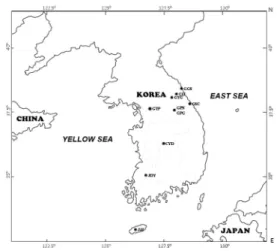
Fig. 1. Map of sampling locations of Korean freshwater snails. Abbreviation of sampling locations are explained in Table 1.
long-term management of wild stocks.
Miyanaga (1942) reported that six nominal species and three subspecies in the genus Semisulcospira occur in Korea, but Kwon and Habe (1979) and Kwon (1990) proposed the existence of two genera, Semisulcospira and Koreanomelania. To further complicate the situation, Burch et al. (1987) suggested the presence of three genera including the genus Koreoptoxis in Korea. Recently, isozyme variation and external radulae analysis (Ko et al., 2001; Lee et al., 2001) identified three genera with seven species.
However, many questions remain unanswered regarding the nature of cladogenesis in these organisms and their systematic relationships.
A number of previous studies have attempted to classify freshwater snail species in Korea belonging to the family Pleuroceridae based on isozyme variation (Burch and Jung, 1987; Kim, 1995; Jeong et al., 1999;
Lee et al., 2001), cytological characteristics (Kim et al., 1987) and morphological characters including shell type and external radulae (Martens, 1905; Ko et al., 2001). Recently, Lee et al. (2007) undertook a phylogenetic analysis of Semisulcospira species using mitochondrial 16S ribosomal RNA (rRNA) and nuclear 28S rRNA genes. Mitochondrial (mt) cytochrome c oxidase I gene (COI) have been widely used for phylogenetic analysis among relatively closely related species.
We investigated the systematic relationships among Semisulcospira, Koreanomelania, and Koreoleptoxis species of Korean freshwater snails based on variation in the COI gene sequence. The results provide baseline information on the phylogenetic relationships among Korean freshwater snails as well as accurate identification of seed and broodstock speciesof snails, both of which are prerequisites for effective freshwater snail management programs and classification of newly unidentified snail taxa.
MATERIALS AND METHODS 1. Sample collection and DNA extraction
Korean freshwater snails identified as belonging to three genera, based on their shell morphology, were sampled from four major drainages in South Korea (
Fig. 1, Table 1). Genomic DNA was extracted from foot muscle using the TNES-urea buffer method (Asahida et al., 1996). The extracted DNA was quantified by a spectrophotometer (Nanodrop) and stored at -20C until use.
2. PCR amplifications and sequence analysis
A universal primer pair (LCO:
GCTCAACAAATCATAAAGATATTGG and HCO:
TAAACTTCAGGGTGACCAAAAAATCA; Folmer et al., 1994) was used to amplify the partial COI gene. PCR reactions performed in 30 l reaction volumes containing 50 ng of genomic DNA, 10 mM Tris-HCl, pH 8.8, 0.1% Triton-X-100, 5 mM KCl, 1.5 mM MgCl2, 0.2 mM of each dNTP, 5 pmol of each primer, and 0.5 units EX-Taq DNA polymerase (TaKaRa).
Amplification was carried out using a PTC-200 thermocycler (MJ research) under the following conditions: an initial denaturation at 95℃ for 5 min followed by 35 cycles of 30 s at 95℃, 30 s at 58℃, 1 min at 72℃, and a final extension period of 10 min at 72℃. PCR products were visualized by electrophoresis in a 1.5% agarose gel after staining with ethidium bromide. PCR products were purified using a Qiagen PCR purification kit. The purified products were directly sequenced using the HCO and LCO primers with a BigDye Terminator Cycle Sequencing Ready Reaction Kit on an ABI 3100xl automated sequencer
Taxa Sampling locations Abbreviation Sample number
GenBank accession no.
S. libertina Jeju-si, Jeju-do, Korea JJJ 10 HM991871
S. gottschei Inje-gun,Gangwon-do, Korea GIJ 9 HM991872-5
S. gottschei Yangpyeong-gun, Gyeonggi-do, Korea GYP 7 HM991876
S. forticosta Samcheok-si, Gangwon-do, Korea GSC 8 HM991877-8
S. tegulata Damyang-gun,Jeollanam-do, Korea JDY 4 HM991879
S. coreana Yanggu-gun,Gangwon-do, Korea GYG 7 HM991880-1
S. coreana Goseong-gun,Gangwon-do, Korea GGS 10 HM991882-3
S. coreana Yeongdong-gun, Chungcheongbuk-do, Korea CYD 7 HM991884-7 Koreanomelania
nodifila Pyeongchang-gun, Gangwon-do, Korea GPN 10 HM991888-9
Koreoleptoxis
globus ovalis Pyeongchang-gun, Gangwon-do, Korea GPG 10 HM991890-3
*Juga nigrina U.S.A. 1 EF586984
*Designated outgroup for our phylogenetic analyses.
Table 1. Freshwater snail species used in this study, their sampling locations, abbreviations and GenBank accession numbers
(Applied Biosystems).
3. Statistical analysis
Nucleotide sequence data analyzed in this study were deposited in GenBank under accession numbers HM991871-HM991893. The resulting sequences were edited and aligned using SeqMan II (DNASTAR). For clarity and convenience, all sequences were trimmed to the same length after removal of primer sites.
Estimates of nucleotide and haplotype diversity were obtained using DnaSP v5.10 (Rozas et al., 2003). The best-fitting model (HKY + I + G a = 1.1362 and I = 0.5975) was selected through a hierarchical likelihood ratio test in Modeltest 3.7 (Posada and Crandall, 1998). A systematic relationship tree was reconstructed using the neighbor-joining (NJ) method in Phylip v3.67 (Felsenstein, 1989), the maximum likelihood (ML) method in PhyML v3.0 (Guindon and Gascuel, 2003), and Bayesian inference (BI) analysis in MrBayes v3.1.1 (Huesenbeck and Ronquist, 2001).
Tree manipulation was performed using TreeDyn (Chevenet et al., 2006). Non-parametric bootstrapping with 1000 pseudo-replications was performed to estimate the confidence of all tree topologies. For Bayesian analysis, the same model used for the ML analysis was adapted, and Markov chain Monte Carlo runs of 106 generations long in four chains were conducted, sampling trees every 100 generations.
Burn-in was determined by plotting parameters across all runs for a given analysis. North American taxa Juga nigrina (EF586984) were employed as outgroups in all phylogenetic analyses.
RESULTS 1. DNA sequence analysis
The alignment of 82 Korean freshwater snail sequences resulted in 74 putatively positive species after identification following Martens’ (1905) diagnostic shell characters. COI gene sequences revealed a total of 27 haplotypes including four haplotypes from eight ambiguous sequences in Semisulcospira, Koreanomelania and Koreoleptoxis taxa. The COI fragments were composed of 658 sites after alignment. All observed mitochondrial single nucleotide polymorphisms (mtSNPs) within populations constituted silent mutations. Eight, five, one, and three silent mutations were detected in S. gottschei (Inje-gun in Gangwon-do and Yangpyeong-gun in Gyeonggi-do), S.
coreana, Koreanomelania nodifila, and Koreoleptoxis globus ovalis, respectively.
Site-specific haplotype diversity ranged from a minimum of 0.286 ± 0.196 to a maximum of 0.905 ± 0.103 among sequences for the S. coreana group (Table 2). One major haplotype was present in all S.
coreana collection sites regardless of geographical
Presumptive species
identificationa Abbrevia- tion
No. of individuals sequenced
No. of positive speciesb
No. of haplotypes
Clade affiliation in COI
phylogenetic analysis
(H)c (π)d
S. libertina JJJ 10 10 1 S. libertina 0 0
S. gottschei GIJ 9 9 4 S. gottschei 0.583 ± 0.183 0.00135 ± 0.00055
S. gottschei GYP 7 7 1 S. gottschei 0 0
All
S. gottschei† 16 16 5 S. gottschei 0.684 ± 0.081 0.00456 ± 0.00039
S. forticosta GSC 8 3 2
S. forticosta and Cryptic or new species
0.667 ± 0.314
0.00101 ± 0.00048
S. tegulata JDY 4 4 1 S. tegulata 0 0
S. coreana GYG 7 7 2 S. coreana 0.286 ± 0.196 0.00217 ± 0.00149
S. coreana GGS 10 10 2 S. coreana 0.356 ± 0.159 0.00270 ± 0.00121
S. coreana CYD 7 7 4 S. coreana 0.905 ± 0.103 0.00926 ± 0.00221 All
S. coreana‡ 24 24 5 S. coreana 0.857 ± 0.108 0.00939 ± 0.00148
Koreanomelania
nodifila GPN 10 9 2
Koreanomelania nodifila and cryptic or new species
0.389 ± 0.614
0.00059 ± 0.00025
Koreoleptoxis
globus ovalis GPG 10 8 4
Koreoleptoxis globus ovalis and cryptic or new species
0.643 ± 0.184
0.00141 ± 0.00051
All statistical values were analyzed by DnaSP V 5.10 (Rozas et al., 2003).
† All S. gottschei meant samples collected from GIJ and GYP.
‡ All S. coreana meant samples collected from GYG, GGS and CYD.
a Initial species identification done by field observation. b Clade affiliation in COI phylogenetic analyses.
c Haplotype diversity (H). d Nucleotide diversity (π)
Table 2. Genetic diversity of Korean freshwater snails inferred from mitochondrial cytochrome c oxidase I genes
region. Estimates of nucleotide diversity (π) were fairly similar across populations (Table 2). The average sequence diversity among Semisulcospira species was less than 9%. Sequence divergence also exceeded 14% in Semisulcospira, Koreanomelania, and Koreoleptoxis. Interestingly, Koreoleptoxis spp. GPG5, which was originally collected as K. globus ovalis from Pyeongchang-gun in Gangwon-do and Semisulcospira spp. GSC3 that was originally collected as S. forticosta from Samcheok-siin Gangwon-do were highly
divergent from the Semisulcospira, Koreanomelania, and Koreoleptoxis groups, with 15–19.5%, 17–18%, and 17–18% divergence, respectively. High sequence diversity (16.5%) was also observed between species (GPG5 and GSC3). Another interesting result was observed for Koreoleptoxis spp. GPG6, which was originally collected as K. globus ovalis from Pyeongchang-gun in Gangwon-do, and Koreanomelania spp. GPN3, which was originally collected as K.
nodifila from Pyeongchang-gun in Gangwon-do.
Fig. 2. Molecular phylogeny of Korean freshwater snails inferred from nucleotide sequences of mitochondrial cytochrome oxidase I gene. The numbers on branches indicate bootstrap support in percent based on 1000 pseudo-replications in the neighbor-joining, maximum likelihood analyses and the posterior probabilities in Bayesian analysis, respectively. The dashes (-) at a node indicate bootstrap support lower than 50%. Juga nigrina was used as a designated outgroup.
Although the two species were highly divergent from the Semisulcospira, Koreanomelania, and Koreoleptoxis groups (17% divergence), they were only 1.4% divergent (GPG6 and GPN3).
2. Systematic analysis
Given that Korean freshwater snails are well known for presenting taxonomic difficulties, phylogenetic trees were inferred from partial mitochondrial COI sequences to improve our understanding of the systematic relationships among them. Neighbor-joining (NJ), maximum likelihood (ML), and Bayesian inference (BI) analyses yielded monophyletic tree topologies (Fig. 2). Haplotypes from each Semisulcospira species collected from several locations were monophyletic and supported with high
bootstrap values. Although S. coreana clades showed a polytomy, all three phylogenetic approaches generated essentially the same tree topologies with significant statistical support. Assuming this tree to be accurate, S. tegulata JDY formed a sister clade with S. coreana groups, and S. libertina JJJ formed a basal clade with S. tegulata and S. coreana. The placement of S.
gottscheiamong Semisulcospirataxa was, however, not clearly resolved here (low bootstrap support). The remaining S. forticosta were recovered as a sister clade to Semisulcospira with high statistical support.
The remaining clade of K. globus ovalis and K.
nodifila formed a monophyletic group and are clearly sister taxa. The remaining four species, Koreanomelania spp GPN3, Koreoleptoxis spp GPG5 and GPG6, and Semisulcospira spp. GSC3 formed an
additional monophyletic group clearly separated from Semisulcospira taxa. However, these cryptic taxa were not clearly separated from K. globus ovalis and K.
nodifila (low bootstrap vales). While these relationships were recovered partially here, the precise positioning of Koreanomelania spp GPN3, Koreoleptoxis spp GPG5 and GPG6, and Semisulcospira spp. GSC3 within the Korean freshwater snail clade remains ambiguous (Fig. 2).
Further observation of the cryptic species and their clear identity within the COI tree could indicate that more than seven species are present in Korea but a more detailed study (molecular and morphological data) will be required to resolve these systematic relationships.
DISCUSSION 1. Species composition of Semisulcospira
Despite several attempts to characterize Semisulcospira andother species of Pleuroceridae using molecular markers (Minton and Lydeard, 2003;
Lee et al., 2006; Lee et al., 2007), this is the first study to usea substantial number of partial COI sequencesfrom Korean freshwater snails. The monophyly of all presumed Semisulcospira individuals in this study (excluding Semisulcospira spp. GSC3) suggests that the Korean Semisulcospira species form asingle natural group. The tree-based species delimitation approach using NJ, ML, and BI analyses strongly indicates the presence of multiple species in Korea (at least seven taxa).
In ML and BI analyses, S. tegulata JDY was identified as sister to S. coreana, while S. libertina JJJ was identified as sister to both S. coreana and S.
tegulata JDY with reasonable statistical support (NJ
= 84, ML = 80, BI = 91). These results may imply that the endemic S. coreana, S. tegulata, and S.
libertina all share a most recent common ancestor.
Despite use of only small samples sizes, S. coreana was most closely related to S. tegulata and S.
libertine, and this outcome from mtDNA was congruent with reported isozyme relationships (Kim, 1995).
The maximum sequencedivergence within a
putative species was 1.8% for S. coreana and 0.9% for S. gottschei. The genetic divergences observed for Semisulcospira were comparable to the largest published values for mitochondrial 16S rDNA (3.7%) and COI (4.27%) sequence variation in other Pleuroceridae (Lydeard et al., 1997, 1998; Holznagel and Lydeard, 2000; Minton and Lydeard, 2003). While the maximum putative intra- and intergeneric divergence observed here was 19.5%, previously reported maximum intra- and intergeneric differences were 15% for 16S rDNA (Holznagel and Lydeard, 2000) and 15.5% for COI (Minton and Lydeard, 2003).
Additional studies are required to understand the dispersal history of S. coreana across Korean rivers and drainages because the genetic distances among the observed haplotypes were small and haplotypes were shared among S. coreana sites (CYD, GGS, and GYG). A possible explanation is that insular S.
coreana populations may have attained their unique morphological features rapidly following recent dispersal events. Alternatively, samples could have come from restocking program strains from aquaculture lines. If so, this suggests that potential gene flow by human-made activities could have produced the patterns of genetic mixing observed here. Unlike in S. coreana, the genetic distances among observed S. gottschei haplotypes (GIJ and GYP) were small, and no haplotypes were shared between the two collecting sites, suggesting limited gene flow.
The two species are known to co-exist in one site even though clear morphological differences exist between them. This observationled to speculation that reproductive isolation between them was limited, indicating possible crossbreeding in the wild (Kim, 1995 Minton and Lydeard, 2003). Cytological research on S. forticosta and S. gottschei found that karyotypes were different but the two taxa possessed the same chromosome numbers (Kim et al., 1987). The close relationship among them was also denoted using isozyme markers, a result consistent with previous findings (Kim, 1995). Based on molecular data, it is possible that the Semisulcospira taxa studied here do constitute ‘true’ phylogenetic species however,
additional studies, including those of detailed ectopic placement, possible hybrids, and ecological and genetic comparisons of Semisulcospira species populations within the archipelago, are needed to further clarify the mechanisms underlying their morphological variations.
2. Species delineation of Koreanomelania and Koreoleptoxis
Melania nodifila and M. globus (Martens, 1886) were originally classified as S. nodifila and S. globus, respectively, by Kuroda (1929). They were placed into the genus Koreanomelania based on their oviparous LHTs (Kwon and Habe, 1979). Burch et al. (1987), however, recorded K. nodifila (Kwon and Habe, 1979) as Hua nodifilaand Burch and Jung (1987) doubted that M. globus was present in Korea so they denoted a new subspecies, K. globus ovalis, which was separatedfrom previous recorded species. In addition, its morphological features were identical to Koreanomelania globus (Kwon, 1990; Kwon et al., 1993). Thus, Semisulcospira globus and Koreanomelania globus (Kwon et al., 1993) were treated as a new subspecies as suggested by Burch and Jung (1987). In recent studies, nine species were identified in Korean freshwater ecosystems (Choi and Yoon, 1997), and seven species were classified by isozyme studies and external radulae analysis (Ko et al., 2001; Lee et al., 2001). In this study, systematic analysis of mtDNA COI sequence divergence recognizedmore than seven taxa in Korea. However, several previous studies indicated the presence of divergent mitochondrial haplotypes among the pleuroceridae, which has been attributed to undocumented cryptic species being present (Lydeard et al., 1998; Minton and Lydeard, 2003, Lee et al., 2007). This recognition needs to be treated cautiously, however, due to the limited genetic and morphological information available for these taxa. The remaining two focal taxa (K. globus ovalis and K. nodifila) were monophyletic in our analysis. However, according to previous isozyme variation studies (Lee et al., 2001) and a study of external radulae (Ko et al., 2001), three genera in the pleuroceridae are present in Korea, indicating a separate genus between
Koreoleptoxis and Koreanomelania.
Phylogenetic analysis can provide evidence for discrete lineages based on sequence diversity when morphological plasticity makes species delineation problematic (Wilke and Falinowski, 2000). This could be useful in pleurocerids, where cryptic species that are not closely related have been observed regularly (Chambers, 1978). Based on this assumption, potentially five (Semisulcospira) and six (Koreoleptoxis and Koreanomelania including cryptic species) phylogenetic species may be recognized based on mtDNA COI sequence divergence in Korean pleurocerids (Fig. 2). Further morphological and molecular work will be required to determine the identity and placement of the four cryptic species (Koreanomelania spp GPN3, Koreoleptoxisspp GPG5 and GPG6, and Semisulcospira spp. GSC3). The remaining taxa formed a well-supported clade that should be recognized as two lineages, Semisulcospira and a group of Koreoleptoxis and Koreanomelania (as a sister genus) here. It is, however, still difficult to say how many extant species are present in Korea.
Although use of shell characters has led to many errors and confusion in freshwater snail taxonomy, the data here suggest that at least more than nine species could be present in Korea based on phylogenetic analysis inferred from the mitochondrial COI gene sequence. The results here suggest that cryptic taxa could also be present in other freshwater snail taxa in Korea and are awaitingrecognition.
Long-term secure protection for cryptic taxa will require both analyses of genetic (mitochondrial and nuclear markers) and morphological data, as well as redefinitions of key shell morphology characters for freshwater snails to improve recognition of natural biodiversity in the region.
ACKNOWLEDGEMENTS
The authors thank K.Y. Kim and ProfessorPeter Mather for providing helpful comments and suggestions on the manuscripts. This study was supported in part by National Fisheries Research and Development Institute (RP-2010-BT-025) and in part by Korea Ministry of Environment as "The
Eco-technopia 21 project".
REFERENCES
Asahida, T., Kobayashi, T., Saitoh, K. and Nakayama, I.
(1996) Tissue preservation andtotal DNA extraction from fish stored at ambient temperature using buffers containing high concentration of urea.
Fisheries Science, 62: 727-730.
Burch, J.B., Chung, P.R. and Jung, Y. (1987) A guide to the fresh water snails of Korea. Walkerana, 2:
195-232.
Burch, J.B. and Jung, Y. (1987) A new freshwater prosobranch snail (Mesogastropoda: Pleuroceridae) from Korea. Walkerana, 2: 287-293.
Chambers, S.M. (1978) An electrophoretically detected sibling species of Goniobasis floridensis.
Malacologia, 17: 157-162.
Chang, Y.J., Chang, H.J., Min, B.H. and Bang, I.C.
(2000) Reproductive cycle of the melania snail, Semisulcospira libertina libertina. Development and Reproduction, 4: 175-180.
Chevenet, F., Brun, C., Banuls, A.L., Jacq, B. and Christen, R. (2006) TreeDyn: towards dynamic graphics and annotations for analyses of trees. BMC Bioinformatics, 7: 439.
Choi, B.R. and Yoon, S.H. (1997) Mollusca. In: List of animals in Korea. The Korean Society of Systematic Zoology, Seoul, Korea.
Davis, G.M. (1969) A taxonomic study of some species of Semisulcospira in Japan (Mesogastropoda:
Pleuroceridae). Malacologia, 7: 211-294.
Felsenstein, J. (1989) PHYLIP – Phylogeny Inference Package (Version 3.2). Cladistics, 5: 164-166.
Folmer, D., Black, M., Hoeh, W., Lutz, R. and Vrijenhoek, R. (1994) DNA primers for amplification of mitochondrial cytochrome C oxidase subunit I from diverse metazoan invertebrate. Molecular Marine Biology and Biotechnology, 3: 294–299.
Guindon, S. and Gascuel, O. (2003) PhyML - A simple, fast, and accurate algorithm to estimate large phylogenies by maximum likelihood. Systematic Biology, 52: 696-704.
Holznagel, W.E. and Lydeard, C. (2000) A molecular phylogeny of North American Pleuroceridae (Gastropoda: Cerithioidea) based on mitochondrial 16S rDNA sequences. Journal of Molluscan Studies, 66: 233-257.
Huesenbeck, J.P. and Ronquist, F. (2001) MRBAYES:
Bayesian inference of phylogenetic trees.
Bioinformatics, 17: 754-755.
Jeong, Y., Park, G.M., Park, J., Kim, J.J., Min, D.Y. and Chung, P.R. (1999) Allozyme variability in three species of genus Semisulcospira (Prosobranchia:
Pleuroceridae). The Korean Journal of Malacology, 15: 13-20.
Kim, S.S., Kim, D.C., Chung, P.L. and Chung, Y.J.
(1987) A cytological study on two species of genus
Semisulcospira (Gastropoda: Pleuroceridae) in Korea.
The Korean Journal of Malacology, 3: 24-34.
Kim, J.J. (1995) Isozyme variation of the genus Semisulcospira (Pleuroceridae: Gastropoda) in Korea.
The Korean Journal of Malacology, 11: 171-179.
Ko, J.H., Lee, J.S. and Kwon, O.K. (2001) Study on radulae of seven species of the Family Pleuroceridae in Korea. The Korean Journal of Malacology, 17:
105-115.
Kuroda, T. (1929) On the species of Japanese Kawnina (Semisulcospira). Venus, 1: 179-193.
Kwon, O.K. and Habe, T. (1979) A list of non-marine molluscan fauna of Korea. Korean Journal of Limnology, 12: 24-31.
Kwon, O.K. (1990) Illustrated encyclopedia of fauna and flora of Korea Vol. 32. Mollusca (I). Ministry of Education. Seoul, Korea.
Kwon, O.K., Park, G.M. and Lee, J.S. (1993) Colored shells of Korea. Academy publishing company. Seoul, Korea.
Lee, J.S., Ko, J.H. and Kwon, O.K. (2001) Isozyme variation in two species of freshwater Pleurocerid snails in Korea: Koreanomelania nodifila and Koreoleptoxis globus ovalis. The Korean Journal of Malacology, 17: 117-123.
Lee, T., Hong, H.C., Kim, J.J. and Ó Foighil, D. (2006) Crossing the continental divide: the Columbia drainage species Juga hemphilli (Henderson 1935) is a cryptic member of the eastern North American genus Elimia (Cerithioidea: Pleuroceridae). Journal of Molluscan Studies, 72: 314-317.
Lee, T., Hong, H.C., Kim, J.J. and Ó Foighil, D. (2007) Phylogenetic and taxonomic incongruence involving nuclear and mitochondrial markers in Korean populations of the freshwater snail genus Semisulcospira (Cerithioidea: Pleuroceridae).
Molecular Phylogenetics and Evolution, 43: 386-397.
Lydeard, C., Holznagel, W.E., Garner, J., Hartfield, P.
and Pierson, M. (1997) A molecular phylogeny of Mobile River drainage pleurocerid snails (Caenogastropoda: Cerithioidea). Molecular Phylogenetics and Evolution, 7: 117-128.
Lydeard, C., Yoder, J.H., Holznagel, W.E., Thompson, F.G. and Hartfield, P. (1998) Phylogenetic utility of the 5'-half of mitochondrial 16S rDNA gene sequences for inferring relationships of Elimia (Cerithioidea: Pleuroceridae). Malacologia, 39:
183-193.
Martens, E. von (1886) In Japan und Korea gesammelten land-und Süßwasser-Mollusken.
Sitzungs-Bericht der Gesellschaft naturforschender Freunde zu Berlin, 5: 76-78.
Martens E. von (1905) Koreanische Süßwasser- Mollusken. Zoologische Jahrbücher Supplement, 8:
23-70.
Milton, R.L. and Lydeard, C. (2003) Phylogeny, taxonomy, genetics and global heritage ranks of an imperiled, freshwater snails genus Lithasia
(Pleuroceridae). Molecular Ecology, 12: 75-87.
Miyanaga, M. (1942) Kwwanina snails of the genus Semisulcospira from Korea. Chosen Hakubutsu Zasshi. Korean Journal of Biology Science, 9:
114-130.
Posada, D. and Crandall, K. (1998) MODELTEST:
testing the model of DNA substitution.
Bioinformatics, 14: 817–818
Rozas, J., Sánchez-DelBarrio, J.C., Messeguer, X. and Rozas, R. (2003)DnaSP, DNA polymorphism analyses by the coalescent and other methods.
Bioinformatics, 19: 2496-2497.
Wilke, T. and Falinowski, A. (2000) The genus Adriohydrobia: polytpic species or polymorphic populations? Journal of Zoological Systematics and Evolutionary Research, 39: 227-234.