Print ISSN: 2288-4637 / Online ISSN 2288-4645 doi:10.13106/jafeb.2021.vol8.no7.0333
Determinants for the Adoption of Electronic Commerce by Small and Medium-Sized Enterprises: An Empirical Study in Indonesia
Khoirul ASWAR
1, Ermawati ERMAWATI
2, Wirman WIRMAN
3, Meilda WIGUNA
4, Eka HARIYANI
5Received: March 20, 2021 Revised: May 22, 2021 Accepted: June 01, 2021
Abstract
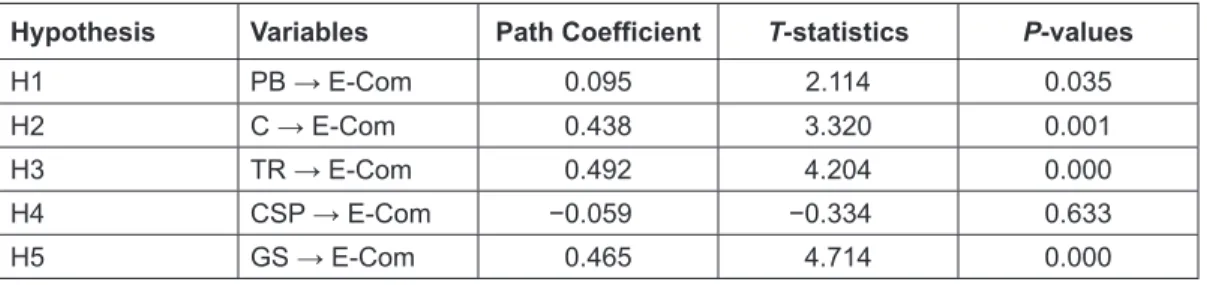
The study seeks to identify the determinants of the adoption of e-commerce by small and medium-sized enterprises (SMEs) in developing countries, in our case, in Indonesia. The aim of this study is to examine the factors influencing e-commerce adoption. This study uses the method of quantitative data collection based on a questionnaire survey of SMEs in Indonesia. The research relies on Regional Project stipulations regarding Business Development in Indonesia, to capture businesses with a range of 5 to 100 employees that are classified as SMEs. This study randomly chose 100 SMEs in Indonesia from the IndoNetwork database. Partial least square (PLS) structural model data processing was used for path coefficients analysis. Structural equation modeling is applied in this study to analyze the determinant factors on the e-commerce adoption. The study findings reveal that four factors, namely, perceived benefits, compatibility, technology readiness, and government support, significantly influence the adoption of e-commerce, whereas customer/supplier pressure does not have influence. So, this study concludes that perceived benefits, compatibility, technology readiness, and government support had a significant and positive relationship with e-commerce adoption. Meanwhile, customer/supplier pressure had no effect on the e-commerce adoption of by Indonesia SMEs.
Keywords: E-Commerce, Technological Context, Organizational Context, Environmental Context, Indonesia JEL Classification Code: L20, L81, M15, O32
money circulation. Previously, transactions are done traditionally, through direct interactions and exchange between the seller and the buyer, creating terms and reaching agreements. Today, with the presence of computer technology, all constraints such as facilities, distance, and time can be easily resolved. One of the information technology innovations that is developing today is e-commerce.
Businesses are compelled to adopt this technology in order to retain competitive advantage in the modern economy.
The majority of studies on e-commerce were done in developed countries, up until 2008. According to Williams et al. (2009), who carried out a substantive review of 345 papers related to information technology developments between 1985 and 2007In developing countries, 82.7 percent of information technology studies were performed, In contrast, only a few studies were performed in developed countries, and the majority of these studies still focused on large corporations only. Studies on e-commerce in developing countries have begun to be performed in recent years, but they are mostly for African and Arab countries, as well as China.
As a result, the recent rise in popularity of e-commerce has been noted. It has been shown by the growing use of
1
First Author and Corresponding Author. Lecturer, Accounting Department, Faculty of Economics and Business, Universitas Pembangunan Nasional Veteran Jakarta, Indonesia [Postal Address: Jl. RS. Fatmawati Raya, Pd. Labu, Kec. Cilandak, Kota Depok, Daerah Khusus Ibukota Jakarta 12450, Indonesia]
Email: [email protected]
2
Accounting Department, Faculty of Economics and Business, Universitas Pembangunan Nasional Veteran Jakarta, Indonesia.
Email: [email protected]
3
Accounting Department, Faculty of Economics and Business, Universitas Singabangsa Karawang, Indonesia.
Email: [email protected]
4
Accounting Department, Faculty of Economics and Business, Universitas Riau, Indonesia. Email: [email protected]
5
Accounting Department, Faculty of Economics and Business, Universitas Riau, Indonesia. Email: [email protected]
© Copyright: The Author(s)
This is an Open Access article distributed under the terms of the Creative Commons Attribution Non-Commercial License (https://creativecommons.org/licenses/by-nc/4.0/) which permits unrestricted non-commercial use, distribution, and reproduction in any medium, provided the original work is properly cited.