ISSN 1226-9999(print) ISSN 2287-7851(online) Korean J. Environ. Biol. 34(1) : 37~40(2016) http://dx.doi.org/10.11626/KJEB.2016.34.1.037
INTRODUCTION
The springtail family Tomoceridae(Collembola) contains 166 species in 16 genera over the world(Janssens 2010).
The rare tomocerid genus Lethemurus was described by Yosii(1970) based on the type species Lethemurus finitimus Yosii, 1970 from Japan. Yosii(1970) also recombined To- mocerus(Tritomurus) missus Mills, 1940 with Lethemurus missus(Mills) that had been described from the USA. Pres- ently, two species in this genus are known in the world.
In this study, we describe a new species of Lethemurus from Korea. Comparison of diagnostic characters between congeneric species is provided with a key to the species.
MATERIALS AND METHODS
Specimens were collected using aspirator and brush and preserved in 80-100% ethanol in 10-20mL glass vials. Dis-
section, slide preparation, and observation were conducted using same methods as described in Chang et al.(2015).
Materials of the new species are deposited in the Korean Institute of Biospeleology(KIB) in Daejeon, Korea. The following materials of the congeneric species were also ex- amined: Lethemurus missus(Mills): 1 female, Paulter Cave, Monroe CO, Illinois, USA, SJ Taylor & FN Soto-Adames, 14 ix 2009, Natural History Survey Collection, University of Illinois(Urbana-Champaign).
TAXONOMIC ACCOUNTS Genus Lethemurus Yosii, 1970
Lethemurus Yosii, 1970(Type species: Lethemurus finitimus Yosii, 1970; Type locality: Nakatonbetsu Cave, Hokkai- do, Japan.
Diagonosis. Eyes absent. Trochanteral organ well devel- oped with ca 40 setae. Base of dentes without large lateral macrochaetae.
Distribution. Korea, Japan, USA.
* Corresponding author: Yeon Jae Bae, Tel. 02-3290-3408, Fax. 02-3290-3623, E-mail. [email protected]
ⓒ2016. Korean Society of Environmental Biology.
A New Species of the Cave-dwelling Springtail Lethemurus (Collembola: Tomoceridae) from Korea
Gyu Dong Chang1, Young Gun Choi2 and Yeon Jae Bae1,3,*
1Department of Life Science, Graduate School, Korea University, Seoul 02841, Korea
2Institute for Conservation of Wild Species, Daejeon 34093, Korea
3Division of Environmental Science and Ecological Engineering, Korea University, Seoul 02841, Korea
Abstract - A new species of the cave-dwelling springtail Lethemurus coreanus Chang and Bae, sp. n.
is described from Korea. Lethemurus coreanus can be distinguished from congeners by the spine- like setae on the tibiotarsus, numbers of dental spines, number of setae on the trochanteral organ, and body macrochaetae chaetotaxy. A key to the species of Lethemurus is provided.
Key words : Lethemurus coreanus, Tomoceridae, description, new species, troglobiont springtails, Korea
<Review paper>
Gyu Dong Chang, Young Gun Choi and Yeon Jae Bae 38
Lethemurus coreanus Chang and Bae,sp.n.
(Fig. 1-3)
(Korean name: Han-guk-gul-ga-si-tok-to-gi)
Material examined. Holotype: ♂, Gangwon-do, Sam- cheok-si, Singi-myeon, Daei-ri, Hwanseon-gul Cave(cave NO. 31), 8 i 1974, J Namgung, YG Choi[KIB]. Paratypes:
2♂(same data as holotype).
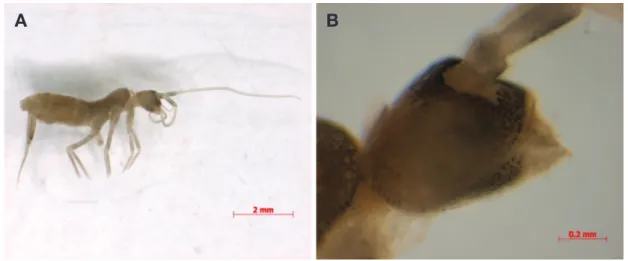
Description(Holotype). Body light brown; some parts darker(Fig. 1A). Body size 5.0mm; antennae longer than body size up to 4.8mm, 4 times longer than head length(Fig.
2A). Body segment ratio 17:9 in thorax, 34:38:80:53:28 :17 in abdomen. Antennae segment ratio 23:49:308:25.
Third antennal organ not differentiated. Eyes and PAO ab- sent(Fig. 1B). Head macrochaetae 2+2 / 5+5 / 2+2(Fig.
2B). Labrum with smooth setae 6 / 5, 5, 4 and 4 spinules on distal margin(Fig. 3A). Chaetae of mesothoracic collar long.
Distribution of body macrochaetae as in Fig. 2C. Leg seg- ment ratio(coxa: trochanter: femur: tibiotarsus) 36:29:66: 107. Trochanteral organ with 40 setae in trochanter, 35 setae in femur(Fig. 3B). Mid-legs with 1 femoral spine; hind-legs with 2 femoral spines(Fig. 3C). Unguis, unguiculus, and tenent hair ratio 14:9:8. Unguis with 1 small proximal inner tooth; unguiculus with 3 small teeth from proximal to middle part(Fig. 3D). Tenent hair tapering, acuminate(Fig.
3D). Ventral tube with numerous setae on posterior part(Fig.
3E, F). Retinaculum quadridentate with only 1 seta on cor- pus(Fig. 3G). Furca ratio 57:76:11. Dental spines simple form, 8-10 / 2, I, 1, I, 1, I, 1, I without lateral macrochaetae
(Fig. 3H). Mucro long and slender, with 3 evenly spaced teeth; basal tooth with a clear membrane(Fig. 3I).
Diagnosis(Table 1). Antennae 4 times longer than head length, almost as long as body length(Fig. 2A). Eyes absent (Fig. 2B). Manubrium without marcochaetae in lateral side (Fig. 3A). Trochanteral organ present with ca 40 setae(Fig.
3B). Un guis with 1 tooth and unguiculus with 3 teeth(Fig.
3D). Dentes with several spines(Fig. 3H).
Etymology. The species epithet “coreanus” is from the
A B
Fig. 1. Lethemurus coreanus: A. Whole body; B. Head part.
A C
B
Fig. 2. Lethemurus coreanus: A. Whole body; B. Head cheatotaxy;
C. Body cheatotaxy. Scale bars: 2mm(A, C), 0.3mm(B).
New Species of Lethemurus 39
country name Korea where the species is described.
Remarks. Type specimens of this species were collected from “Manmulsang” area in Hwanseon-gul Cave, located 200-250m from entrance, a dark zone with constant tem- perature.
Key to the species of Lethemurus
1. Trochanteral organ with ca. 40 setae in trochanter and
femur(Fig. 3B) ··· Lethemurus coreanus, sp. n.
Trochanteral organ with <40 setae in trochanter and femur ··· 2 2. 8 / 5, 5, 4 labrum seta and 4 marginal spinules(Fig. 4A in
Yosii 1970) ··· Lethemurus finitimus 6 / 5, 5, 4 labrum seta and 4 marginal spinules ···
··· Lethemurus missus Table 1. Comparison of diagnostic characters between three species of Lethemurus
Species L. finitimus L. missus L. coreanus
Distribution Japan USA Korea
Habitat Cave Cave Cave
Tenent hair Spiny Variable Spiny
Unguis and Unguiculus teeth 1 & 2-3 1 & 3 1 & 3
Lateral macrochaetae on dentes None None None
Dental spines 10 / 2, I, 1, I-II 5-8 / 3-5, I 8-10 / 2, I, 1, I, 1, I, 1, I
Mucro teeth 2 / 1 / 2 2 / 1 / 2 2 / 1 / 2
Antenna length 3 Segments on one side and 2 on the other. Not seemingly very long
2 Times longer than head
diagonal More than 5 times longer
than head diagonal Trochantral organ 4 Spiny and some 7 minute
setae in trochanter, irregular assembly of about 8, some of them are very long in femur
4 Setae in trochanter and 14 setae in femur. Setae size is irregular.
More than 40 setae in trochanter, also almost 40 setae in femur
Labral setae 8 / 5, 5, 4 6 / 5, 5, 4 6 / 5, 5, 4
A C D G H
B
I E F
Fig. 3. Lethemurus coreanus: A. Labral setae; B. Trochanteral organ; C. Hind-leg tibiotarsus; D. Hind-leg claw; E & F. Ventral tube; G. Reti- naculum; H. Dental spines; I. Mucro. Scale bars: 0.5mm(A-F), 0.3mm(G, H), 0.15mm(I)
Gyu Dong Chang, Young Gun Choi and Yeon Jae Bae 40
Remarks. Key characters of L. missus were examined from the female specimen in Materials and Methods.
ACKNOWLEDGEMENT
We sincerely thank Dr. Felipe Soto-Adames(Natural His- tory Survey, University of Illinois at Urbana-Champaign) for his kind invitation and comments about Lethemurus sys- tematics when GDC visited University of Illinois at Urbana- Champaign in 2013. This work was supported by a grant from the National Institute of Biological Resources(NIBR), funded by the Ministry of Environment(MOE) of the Re- public of Korea.
REFERENCES
Chang GD, BH Lee, YG Choi and YJ Bae. 2015. Taxonomic review of the cave-dwelling springtail Tomoceridae(Coll- embola) in Korea. Entomol. Res. Bull. 31:65-76.
Janssens F. 2010. Checklist of the Collembola. Available from URL: http://www.collembola.org/ [cited date: 2013-VI-29]
Mills HR. 1948. New North American Tomocerinae. Ann. En- tomol. Soc. Am. 41:352-359.
Yosii R. 1970. On some Collembola of Japan and adjacent country II. Contributions from the Biological Laboratory.
Kyoto Univ. 23:1-32.
Received: 10 March 2016 Revised: 20 March 2016 Revision accepted: 20 March 2016