199
Research Article Weed & Turfgrass Science
Weed & Turfgrass Science was renamed from both formerly Korean Journal of Weed Science from Volume 32 (3), 2012, and formerly Korean Journal of Turfgrass Science from Volume 25 (1), 2011 and Asian Journal of Turfgrass Science from Volume 26 (2), 2012 which were launched by The Korean Society of Weed Science and The Turfgrass Society of Korea founded in 1981 and 1987, respectively.
경남지역 밭 잡초 발생분포 및 군락변화
성덕경1·배성문1·김영광1·조용조1·이상대1·심상인2·정정성2*
1
경상남도농업기술원,
2경상대학교 농업식물과학과
Weed Population Distribution and Change of Dominant Weed Species on Upland Field in Gyeongnam Province of Korea
Deok-Gyeong Seong
1, Sung-Mun Bea
1, Young-Gwang Kim
1, Yong-Cho Cho
1, Sang-Dae Lee
1, Sang-In Shim
2, and Jung-Sung Chung
2*1
Gyeongsangnamdo Agricultural Research & Extension Services, Jinju 52733, Korea
2
Department of Agricultural Plant Science, Gyenogsang National University, Jinju 52828, Korea
서 론
농경지에서 잡초는 작물의 생육기간 동안에 양분과 광합 성의 경합, 병해충의 기주식물 등으로 작용하여 작물의 생 육을 억제시키고, 수량감소, 품질저하 및 농작업의 방해요 인으로 작용한다. 따라서 작물재배를 통한 수익을 얻기 위 해서 일정수준의 잡초방제는 필수적이다. 농경지의 효과적 인 잡초관리를 위해서는 작물재배지에서 발생하는 잡초의 주기적 파악이 우선되어야 한다. 농경지에서 잡초군락 변 화의 주요 요인은 작부체계 등 경지이용형태의 변화, 토지 기반정비에 의한 입지조건의 변화, 경운정지나 잡초방제법 의 변화이며, 이중 가장 큰 요인은 잡초방제법의 변화 중
제초제의 사용이다(Kim and Shin, 2007). 특히 밭 잡초는 논 잡초와 달리 잡초 초종이 다양하고 방제에 어려움이 많다. 따라서 농경지에서 잡초관리를 위하여 주기적인 우 점잡초 및 난방제 초종 조사는 필수적이다. 우리나라 논에 는 일년생잡초가 52종, 월년생잡초 3종, 다년생잡초 35종 을 포함한 28과 90종의 잡초가 발생한(Ha et al., 2014) 반 면에 밭 작물 재배지에 발생되는 잡초는 46과 216종으로 동작물 보다 하작물 재배지에서 많은 초종이 발생하였고, 동작물 재배지에서 뚝새풀, 명아주, 벼룩나물, 별꽃, 갈퀴덩 굴, 속속이풀, 냉이 등이 하작물 재배지에서는 바랭이, 쇠 비름, 깨풀, 강아지풀, 방동사니 등이 우점하였다(Kim et al., 1992). 2002년 조사에서는 우리나라 밭에서 33과 112 ABSTRACT. This study was conducted to provide basic information for weed control by surveying the occurrence of weed species in upland crop fields in Gyeongnam province of Korea. The result of this survey, 55 weed species 21 families in barley fields, 56 weed species 22 families in garlic fields, 47 weed species 19 families in onion fields, 68 weed species 26 families in Chinese cabbage fields, 54 weed species 22 families in potato fields, 62 weed species 25 families in sweet potato fields, 87 weed species 29 families in red pepper fields, 79 weed species 28 families in corn fields, 84 weed species 29 families in soybean fields.
The most dominant weed species in upland crop fields of Gyeongnam province were Alopecurus aequalis var. amurensis 20.7%
(barley fields), Cardamine flexuosa 12.3% (garlic fields), Chenopodium ficifolium 18.7% (onion fields), Portulaca oleracea 8.1%
(Chinese cabbage fields), Chenopodium ficifolium 13% (potato fields), Digitaria ciliaris 12.6% (sweet potato fields and red pepper fields) and Digitaria ciliaris 11.3% (corn fields), 13.2% (soybean fields). This information could be useful for establishment of future weed control methods in Gyeongnam province.
Key words: Gyeongnam, Occurrence of weed species, Upland crop field
Received on August 21, 2015; Revised on September 3, 2015; Accepted on September 8, 2015
*
Corresponding author: Phone) +82-55-772-1876, Fax) +82-55-772-1897; E-mail) [email protected]
© 2015 The Korean Society of Weed Science and The Turfgrass Society of Korea
This is an Open-Access article distributed under the terms of the Creative Commons Attribution Non-Commercial License (http://cre-
ativecommons.org/licenses/by-nc/3.0) which permits unrestricted noncommercial use, distribution, and reproduction in any medium,
provided the original work is properly cited.
초종으로 잡초가 발생하였고, 과별 발생종수는 국화과가 25종, 화본과 14종, 마디풀과 9종, 메꽃과 7종 등의 순으로 발생량이 많은 것으로 조사되었다(Park et al., 2003). 이러 한 농경지에서 발생하는 잡초군락 변화의 주요 요인 중 하 나는 다양한 경로로 침입되는 외래잡초를 들 수 있다. 농 산물 및 가축사료의 해외의존도가 수입량 증가와 함께 그 상대국의 잡초종자가 섞여 들어와 국내 농경지에 확산될 가능성이 높고, 항만이나 이들의 운송이 이루어지는 도로 변에서 새로운 외래잡초가 발견되는 등 외래잡초의 발생 이 확산되고 있다(Oh et al., 2003; Oh et al., 2004; Kang et al., 2001). 최근에는 다양한 작물이 도입되어 재배됨에 따 라 잡초발생의 변화는 더욱 클 것으로 판단된다. 따라서 경 남지역 밭에서 발생하는 잡초의 종류를 조사하여 효율적 인 관리를 위한 기초자료를 얻고자 본 연구를 수행하였다.
재료 및 방법
조사지역
경상남도지역의 밭 잡초 조사를 위하여 거창군, 고성 군, 김해시, 남해군, 밀양시, 사천시, 산청군, 의령군, 진주 시, 창녕군, 창원시, 통영시, 하동군, 함안군, 함양군, 합천 군에서 작목별 주산지 위주로 조사 시·군을 선정하였다.
총 조사는 920개 지점으로 작목별로는 동작물 재배지인 보 리 88개, 마늘 85개, 양파 93개, 김장배추 154개과 하작물
재배지인 감자 104개, 고구마 68개, 고추 132개, 옥수수 68 개, 콩 128개에서 발생하는 잡초를 조사하였다(Fig. 1).
잡초조사 방법
작목별 조사필지는 잡초 무방제 또는 방제가 불량한 재 배지를 선정하여 보리, 마늘, 양파, 감자 재배지는 4월에 고 구마, 고추, 옥수수, 콩 재배지는 7월에 배추는 11월에 조 사하였다. 조사방법은 한국 잡초도감(Kim and Park, 2009) 을 이용하여 잡초의 특성을 확인하여 동정하였다. 잡초조 사 지점으로 선정된 필지를 달관조사로 Braun-Blanquet (1964) 의 방법으로 7개 등급(r, +, 1, 2, 3, 4, 5)을 기준으로 나누 었고, 등급별 기준은 극히 드물게 최소 피도의 출현은 r, 낮 은 피도로 적은 개체수 출현시 +, 개체수는 많지만 피도가 조사면적의 10% 이하로 출현시 1, 피도가 조사면적의 10~25%
로 출현시 2, 피도가 조사면적의 25~50%로 출현시 3, 피도 가 조사면적의 50~75%로 출현시 4, 피도가 조사면적의 75%
이상 출현할 때 5의 기준으로 조사하였다.
잡초분석
잡초조사 결과는 국가표준식물목록(KNA, 2007)에 의거 하여 목록을 작성하였고, 외래잡초는 한국귀화식물 원색도 감(Park, 2009)에 의해 표기하였다. 출현한 잡초 종에 대해 서는 Raunkiaer (1934)의 생활형을 기준으로 일년생과 다 년생을 구분하였고, 과별 분포비율을 산정하였다. 잡초의
Fig. 1. The location of survey sites in Gyeongnam province in 2014.
우점 순위를 알아보기 위하여 중요치(IV)분석을 실시하였 다(Curtis and Mc Intosh, 1950).
Important value (IV) = (RF + RC) / 2
결과 및 고찰
경남지역의 대표적인 밭 작목의 잡초조사를 위하여 보리, 마늘, 양파, 김장배추, 감자, 고구마, 고추, 옥수수, 콩에 대 하여 주산지 위주로 총 920개 지점에서 조사하였다. 조사 시기는 보리, 마늘, 양파, 감자는 4월에, 고구마, 고추, 옥수
수는 7월에, 김장배추는 11월에 실시하였다. Table 1과 같 이 보리 재배지에서는 21과로 국화과 10종, 십자화과 7종, 마디풀과 5종 벼과 5종 등으로 55종이 발생되었고, 마늘 재배지에는 22과로 국화과 14종, 석죽과 6종, 십자화과 6 종 순으로 총 56종이었다. 양파 재배지에서는 19과로 국화 과 9종, 벼과 6종, 십자화과 6종 등으로 47종이었고, 배추 재배지에는 26과로 국화과 20종, 벼과 7종, 십자화과 6종 등의 순으로 총 68종이 발생되었고, 감자 재배지에서는 22 과로 국화과 11종, 마디풀과 6종, 벼과 5종, 십자화과 5종 등 54종이, 고구마 재배지에서는 25과로 국화과 16종, 벼 과 6종 등으로 총 62종이, 고추 재배지에서는 29과로 국화 과 18종, 벼과 9종 등 총 87종이 발생되었다. 또 옥수수 재 배지에서는 28과로 국화과 18종, 벼과 10종으로 총 79종이 나타났으며 콩 재배지에서는 29과로 국화과 19종, 벼과 6 종, 십자화과 6종 순으로 총 84종이 발생되는 것으로 조사 되었다. 양파와 마늘 등 동작물 재배지의 잡초 종이 적은 Relative frequency
(RF) (%) =
Frequency of any species Total cover of all species ×100
Relative cover (RC) (%) =
Cover of any species Total cover of all species ×100
Table 1. Distribution of weed flora ordered by family name in upland crop fields in Gyeongnam province.
Family name
Upland crop Barley Garlic Onion Chinese
cabbage Potato Sweet potato
Red
pepper Corn Soybean
Solanaceae 1 1 2 2 2 3
Oxalidaceae 1 1 1 1 1 1 1
Compositae 10 14 9 20 11 16 18 18 19
Rubiaceae 1 1 1 1 1 1
Labiatae 2 1 1 3 1 2 2 2
Commelinaceae 1 1 1 1 1 1 1 1 1
Euphorbiaceae 1 1 2 1 3 3 3 3
Crassulaceae 1 1 1 1
Leguminosae 4 4 3 1 1 2 5 4 3
Polygonaceae 5 3 3 2 6 2 4 2 4
Convolvulaceae 2 2 2 1 2 2 5 3 5
Chenopodiaceae 2 2 3 3 2 2 2 2 4
Ranunculaceae 1 1 1 1
Onagraceae 1 1 1 1 1 1
Asclepiadaceae 1 1 1
Gramineae 5 3 6 7 5 6 9 10 6
Amaranthaceae 1 1 4 4 5 3
Umbelliferae 1 1 1
Cannabaceae 1 1 1 1 1 1 1
Molluginaceae 1 1 1 1 1
Caryophyllaceae 4 6 3 5 3 3 3 3 2
Cyperaceae 1 2 2 3 2 3
Equisetaceae 1 1 1 1 1 1 1 1 1
요인은 하작물에 비하여 연작재배를 많이 하고, 특히 작물 과의 경합을 우려하여 잡초를 손으로 제거하거나 잡초발 생을 줄이기 위하여 관리기를 이용하여 비닐 피복 위로 흙 을 덮어 재배하는 요인인 것으로 판단된다.
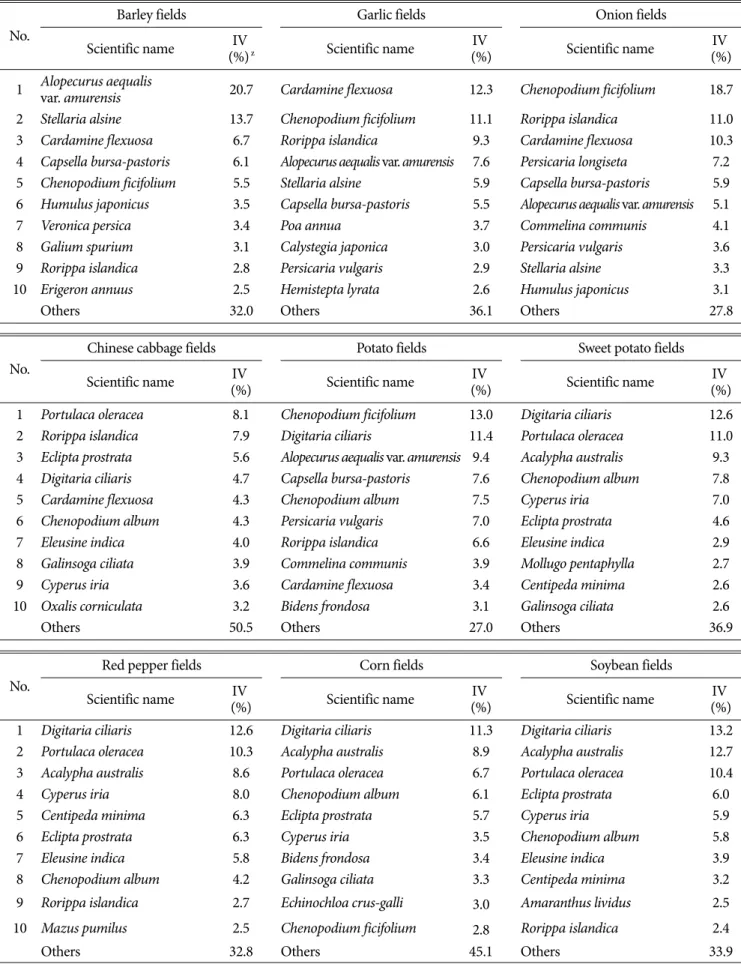
작목별로 주요 우점하는 10종은 Table 2와 같다. 보리 재 배지에서 주요 초종은 뚝새풀, 명아주, 냉이, 갈퀴덩굴 등 이며 뚝새풀은 답리작에서 갈퀴덩굴은 밭에서 많이 발생 한다(Chang et al., 1990)는 결과와 유사하게 뚝새풀 20.7%
로 가장 높은 수준으로 우점하였고, 벼룩나물 13.7%, 황새 냉이 6.7%, 냉이 6.1%, 좀명아주 5.5% 순으로 우점하였다.
갈퀴덩굴의 우점도가 낮은 이유는 경남의 보리재배는 답 리작이 주를 이루고 있기 때문이다. 특히 뚝새풀은 벼 수 확 전에 대부분 발생하여 작물과의 경합력이 매우 크고 따 라서, 답리작에서 맥류 재배 시 가장 피해가 큰 잡초이며 (Chin et al., 1977; Kim et al., 1975; Im et al., 1998), 냉이는 엽면적을 감소시켜 보리의 수량을 감소시키는 것으로 알 려져 있다(Chang et al., 1986). 마늘 재배지에서는 황새냉 이가 12.3%로 가장 우점도가 높았고, 좀명아주 11.1%, 속 속이풀 9.3%, 뚝새풀 7.6%, 벼룩나물 5.9% 등의 순이었다.
양파 재배지에서는 좀명아주가 18.7%로 가장 높게 우점하 였고, 속속이풀 11%, 황새냉이 10.3%, 개여뀌 7.2%, 냉이 5.9% 등의 순이었다. 배추 재배지에서는 쇠비름이 8.1%로 가장 우점하였고, 속속이풀 7.9%, 한련초 5.6%, 바랭이 4.7%, 황새냉이와 흰명아주가 각각 4.3% 등의 순이었다. 감자 재 배지에서는 좀명아주가 13%로 가장 우점하였고 바랭이
11.4%, 뚝새풀 9.4%, 냉이 7.6%, 흰명아주 7.5% 등의 순이 었으며, 고구마 재배지에서는 바랭이가 12.6%로 가장 우점 하였고, 쇠비름 11%, 깨풀 9.3%, 흰명아주 7.8%, 참방동사 니 7% 등의 순으로 우점하였다. 고추 재배지에서는 바랭 이가 12.6%로 가장 우점하였고, 쇠비름 10.3%, 깨풀 8.6%, 참방동사니 8.0%, 중대가리와 한련초가 각각 6.3% 등의 순 으로 발생하였다. 옥수수와 콩 재배지에서도 다른 하작물 과 같이 바랭이가 가장 우점하였고, 깨풀, 쇠비름, 한련초, 참방동사니, 흰명아주 등의 순으로 발생이 많았다. 특히 바 랭이는 모든 하계작물 재배지에서 우점하는 것으로 조사 되었는데, 이는 전북지역의 밭작물 경작지에서 가장 우점 한다는 결과와 유사하였다(Ryang et al., 1984).
경남지역의 밭 작물 재배지에 발생한 잡초는 Table 3과 같이 총 143종으로 일년생 잡초가 54종(37.7%)으로 가장 많았고, 다음은 월년생이 52종(36.4%)이었으며 다년생이 37 종(25.9%) 이었다. 종별 중요치는 바랭이(Digitaria cilialis) 가 8.48%로 가장 높았고, 쇠비름(Portulaca oleracea) 7.03%, 깨풀(Acalypha australis) 6.01%, 속속이풀(Rorippa islandica) 4.79%, 흰명아주(Chenopodium album) 4.59%, 한련초(Eclipta prostrate) 4.17%, 좀명아주(Chenopodium ficifolium) 4.16% 등 의 순이었다. 경남지역의 동작물 재배지에서는 뚝새풀, 벼 룩나물, 명아주, 갈퀴덩굴, 속속이풀 등이 하작물 재배지에 서는 바랭이, 깨풀, 쇠비름, 개비름, 방동사니 등이 우점한 다(Chang et al., 1990)는 결과와 다소 차이가 있는데 이는 조사지역 및 조사작목의 차이에 의한 것으로 판단된다.
Table 1. Distribution of weed flora ordered by family name in upland crop fields in Gyeongnam province (continued).
Family name
Upland crop Barley Garlic Onion Chinese
cabbage Potato Sweet potato
Red
pepper Corn Soybean
Portulacaceae 1 1 1 1 1 1 1
Cruciferae 7 6 6 6 5 4 6 5 6
Primulaceae 1
Papaveraceae 1 1 1 1
Phytolaccaceae 1 1
Rosaceae 1 2 1 1 2 1 1 1 2
Violaceae 1 1 2 1 2
Geraniaceae 1 1 1
Boraginaceae 2 2 2 1 2 1 2 1
Plantaginaceae 1 1
Araceae 1
Scrophulariaceae 2 1 1 3 3 2 4 4 4
Fumariaceae 1
Sum 55 56 47 68 54 62 87 79 84
Table 2. Occurrence of weed flora ordered by importance value in upland fields in Gyeongnam province (top 10 weeds).
No.
Barley fields Garlic fields Onion fields
Scientific name IV
(%)
zScientific name IV
(%) Scientific name IV (%) 1 Alopecurus aequalis
var. amurensis 20.7 Cardamine flexuosa 12.3 Chenopodium ficifolium 18.7
2 Stellaria alsine 13.7 Chenopodium ficifolium 11.1 Rorippa islandica 11.0
3 Cardamine flexuosa 6.7 Rorippa islandica 9.3 Cardamine flexuosa 10.3
4 Capsella bursa-pastoris 6.1 Alopecurus aequalis var. amurensis 7.6 Persicaria longiseta 7.2
5 Chenopodium ficifolium 5.5 Stellaria alsine 5.9 Capsella bursa-pastoris 5.9
6 Humulus japonicus 3.5 Capsella bursa-pastoris 5.5 Alopecurus aequalis var. amurensis 5.1
7 Veronica persica 3.4 Poa annua 3.7 Commelina communis 4.1
8 Galium spurium 3.1 Calystegia japonica 3.0 Persicaria vulgaris 3.6
9 Rorippa islandica 2.8 Persicaria vulgaris 2.9 Stellaria alsine 3.3
10 Erigeron annuus 2.5 Hemistepta lyrata 2.6 Humulus japonicus 3.1
Others 32.0 Others 36.1 Others 27.8
No.
Chinese cabbage fields Potato fields Sweet potato fields Scientific name IV
(%) Scientific name IV
(%) Scientific name IV (%)
1 Portulaca oleracea 8.1 Chenopodium ficifolium 13.0 Digitaria ciliaris 12.6
2 Rorippa islandica 7.9 Digitaria ciliaris 11.4 Portulaca oleracea 11.0
3 Eclipta prostrata 5.6 Alopecurus aequalis var. amurensis 9.4 Acalypha australis 9.3
4 Digitaria ciliaris 4.7 Capsella bursa-pastoris 7.6 Chenopodium album 7.8
5 Cardamine flexuosa 4.3 Chenopodium album 7.5 Cyperus iria 7.0
6 Chenopodium album 4.3 Persicaria vulgaris 7.0 Eclipta prostrata 4.6
7 Eleusine indica 4.0 Rorippa islandica 6.6 Eleusine indica 2.9
8 Galinsoga ciliata 3.9 Commelina communis 3.9 Mollugo pentaphylla 2.7
9 Cyperus iria 3.6 Cardamine flexuosa 3.4 Centipeda minima 2.6
10 Oxalis corniculata 3.2 Bidens frondosa 3.1 Galinsoga ciliata 2.6
Others 50.5 Others 27.0 Others 36.9
No.
Red pepper fields Corn fields Soybean fields
Scientific name IV
(%) Scientific name IV
(%) Scientific name IV (%)
1 Digitaria ciliaris 12.6 Digitaria ciliaris 11.3 Digitaria ciliaris 13.2
2 Portulaca oleracea 10.3 Acalypha australis 8.9 Acalypha australis 12.7
3 Acalypha australis 8.6 Portulaca oleracea 6.7 Portulaca oleracea 10.4
4 Cyperus iria 8.0 Chenopodium album 6.1 Eclipta prostrata 6.0
5 Centipeda minima 6.3 Eclipta prostrata 5.7 Cyperus iria 5.9
6 Eclipta prostrata 6.3 Cyperus iria 3.5 Chenopodium album 5.8
7 Eleusine indica 5.8 Bidens frondosa 3.4 Eleusine indica 3.9
8 Chenopodium album 4.2 Galinsoga ciliata 3.3 Centipeda minima 3.2
9 Rorippa islandica 2.7 Echinochloa crus-galli 3.0 Amaranthus lividus 2.5
10 Mazus pumilus 2.5 Chenopodium ficifolium 2.8 Rorippa islandica 2.4
Others 32.8 Others 45.1 Others 33.9
z
IV: Importance value.
Table 3. Occurrence of weed species on upland fields in Geongnam province.
Rank Family Life cycle Scientific name IV (%)
z1 Gramineae annual Digitaria ciliars 8.48
2 Portulacaceae annual Portulaca oleracea 7.03
3 Euphorbiaceae annual Acalypha australis 6.01
4 Cruciferae perennial Rorippa islandica 4.79
5 Chenopodiaceae annual Chenopodium album 4.59
6 Compositae annual Eclipta prostrata 4.17
7 Chenopodiaceae annual Chenopodium ficifolium 4.16
8 Cyperaceae annual Cyperus iria 4.09
9 Cruciferae biennial Cardamine flexuosa 3.49
10 Gramineae biennial Alopecurus aequalis var. amurensis 3.17
11 Gramineae annual Eleusine indica 2.89
12 Compositae annual Centipeda minima 2.33
13 Cruciferae biennial Capsella bursa-pastoris 2.25
14 Compositae annual Galinsoga ciliata 2.05
15 Caryophyllaceae biennial Stellaria alsine 2.02
16 Oxalidaceae perennial Oxalis corniculata 1.93
17 Polygonaceae annual Persicaria vulgaris 1.68
18 Commelinaceae annual Commelina communis 1.68
19 Amaranthaceae annual Amaranthus lividus 1.60
20 Compositae annual Bidens frondosa 1.59
21 Polygonaceae annual Persicaria longiseta 1.52
22 Scrophulariaceae biennial Mazus pumilus 1.36
23 Gramineae annual Echinochloa crus-galli 1.35
24 Equisetaceae perennial Equisetum arvense 1.20
25 Molluginaceae annual Mollugo pentaphylla 1.14
26 Compositae biennial Erigeron annuus 1.11
27 Scrophulariaceae biennial Veronica persica 1.05
28 Caryophyllaceae biennial Stellaria media 1.00
29 Labiatae biennial Lamium amplexicaule 0.93
30 Gramineae biennial Poa annua 0.89
31 Compositae biennial Erigeron canadensis 0.89
32 Compositae biennial Sonchus asper 0.88
33 Cannabaceae annual Humulus japonicus 0.84
34 Cruciferae biennial Rorippa cantoniensis 0.81
35 Rosaceae biennial Potentilla amurensis 0.79
36 Boraginaceae biennial Trigonotis peduncularis 0.63
37 Compositae perennial Taraxacum officinale 0.61
38 Compositae biennial Hemistepta lyrata 0.58
39 Compositae perennial Artemisia princeps var. orientalis 0.56
40 Convolvulaceae perennial Calystegia japonica 0.55
41 Convolvulaceae perennial Calystegia sepium 0.49
42 Solanaceae annual Solanum nigrum 0.48
Table 3. Occurrence of weed species on upland fields in Geongnam province (continued).
Rank Family Life cycle Scientific name IV (%)
z43 Euphorbiaceae annual Euphorbia supina 0.43
44 Gramineae annual Eragrostis multicaulis 0.40
45 Compositae annual Bidens pilosa 0.37
46 Compositae perennial Ixeris debilis 0.35
47 Leguminosae biennial Vicia hirsuta 0.33
48 Rubiaceae biennial Galium spurium 0.32
49 Compositae biennial Conyza sumatrensis 0.29
50 Compositae biennial Ixeris polycephala 0.29
51 Caryophyllaceae biennial Cerastium glomeratum 0.27
52 Compositae biennial Senecio vulgaris 0.27
53 Scrophulariaceae annual Lindernia procumbens 0.27
54 Compositae biennial Crepidiastrum sonchifolium 0.26
55 Gramineae annual Setaria faberii 0.26
56 Compositae biennial Youngia japonica 0.26
57 Amaranthaceae annual Amaranthus viridis 0.24
58 Cruciferae biennial Lepidium virginicum 0.23
59 Compositae annual Siegesbeckia glabrescens 0.19
60 Cyperaceae annual Cyperus nipponicus 0.18
61 Compositae biennial Lactuca indica var. laciniata 0.17
62 Cruciferae perennial Rorippa indica 0.16
63 Boraginaceae biennial Bothriospermum tenellum 0.16
64 Polygonaceae annual Persicaria lapathifolia 0.16
65 Leguminosae perennial Trifolium repens 0.15
66 Solanaceae annual Physalis angulata 0.15
67 Caryophyllaceae perennial Stellaria aquatica 0.14
68 Compositae perennial Breea segeta 0.14
69 Labiatae biennial Leonurus japonicus 0.14
70 Gramineae annual Leptochloa chinensis 0.14
71 Violaceae perennial Viola patrinii 0.14
72 Gramineae perennial Elymus tsukushiensis 0.13
73 Papaveraceae perennial Chelidonium majus var. asiaticum 0.12
74 Cyperaceae annual Fimbristylis miliacea 0.12
75 Asclepiadaceae perennial Metaplexis japonica 0.11
76 Onagraceae biennial Oenothera odorata 0.11
77 Ranunculaceae perennial Ranunculus japonicus 0.11
78 Convolvulaceae annual Quamoclit angulata 0.11
79 Cruciferae biennial Draba nemorosa 0.11
80 Crassulaceae perennial Sedum bulbiferum 0.11
81 Compositae biennial Sonchus oleraceus 0.10
82 Leguminosae biennial Vicia angustifolia 0.10
83 Amaranthaceae annual Amaranthus patulus 0.10
84 Leguminosae biennial Vicia tetrasperma 0.10
Table 3. Occurrence of weed species on upland fields in Geongnam province (continued).
Rank Family Life cycle Scientific name IV (%)
z85 Euphorbiaceae annual Euphorbia maculata 0.10
86 Amaranthaceae perennial Achyranthes fauriei 0.10
87 Polygonaceae annual Polygonum aviculare 0.09
88 Caryophyllaceae biennial Arenaria serpyllifolia 0.09
89 Cruciferae biennial Thlaspi arvense 0.09
90 Compositae annual Xanthium canadense 0.09
91 Leguminosae annual Cassiamimosoides var. nomame 0.08
92 Polygonaceae perennial Rumex crispus 0.08
93 Caryophyllaceae biennial Cerastium holosteoides 0.08
94 Leguminosae annual Amphicarpaea bracteata 0.07
95 Convolvulaceae perennial Calystegia hederacea 0.07
96 Geraniaceae biennial Geranium carolinianum 0.07
97 Labiatae biennial Salvia plebeia 0.06
98 Convolvulaceae annual Ipomoea purpurea 0.05
99 Cruciferae biennial Cardamine fallax 0.05
100 Convolvulaceae annual Ipomoea hederacea 0.04
101 Compositae perennial Aster yomena 0.04
102 Violaceae perennial Viola mandshurica 0.04
103 Rosaceae biennial Potentilla paradoxa 0.03
104 Phytolaccaceae perennial Phytolacca americana 0.03
105 Umbelliferae perennial Oenanthe javanica 0.03
106 Compositae biennial Conyza parva 0.03
107 Compositae perennial Cirsium japonicum 0.03
108 Chenopodiaceae annual Chenopodium pumilio 0.03
109 Gramineae biennial Alopecurus japonicus 0.03
110 Compositae annual Sigesbeckia pubescens 0.03
111 Compositae biennial Gnaphalium calviceps 0.03
112 Fumariaceae perennial Corydalis ternata 0.02
113 Polygonaceae annual Persicaria senticosa 0.02
114 Scrophulariaceae annual Lindernia crustacea 0.02
115 Leguminosae annual Aeschynomene indica 0.02
116 Cruciferae biennial Descurainia sophia 0.02
117 Plantaginaceae perennial Plantago asiatica 0.02
118 Compositae perennial Taraxacum coreanum 0.02
119 Gramineae biennial Avena fatua 0.02
120 Compositae biennial Erigeron bonariensis 0.02
121 Polygonaceae annual Persicaria thunbergii 0.02
122 Amaranthaceae annual Amaranthus retroflexus 0.02
123 Leguminosae perennial Vicia amoena 0.01
124 Caryophyllaceae biennial Sagina japonica 0.01
125 Polygonaceae annual Persicaria viscosa 0.01
126 Chenopodiaceae annual Kochia scoparia 0.01
요 약
본 연구는 경남지역의 밭에서 발생하는 잡초의 분포현황 을 조사하기 위하여 수행하였다. 보리 재배지에서는 21과 55종, 마늘 재배지 22과 56종, 양파 재배지 19과 47종, 배 추 재배지 26과 68종, 감자 재배지 22과 54종, 고구마 재배 지 25과 62종, 고추 재배지 29과 87종, 옥수수 재배지 28과 79종, 콩 재배지 29과 84종이 발생되었다. 작목별 우점하는 초종은 보리 재배지 뚝새풀 20.7%, 마늘 재배지 황새냉이 12.3%, 양파 재배지 좀명아주 18.7%, 배추 재배지 쇠비름 8.1%, 감자 재배지 좀명아주 13%, 고구마 재배지 바랭이 12.6%, 고추 재배지 바랭이 12.6%, 옥수수 재배지 11.3%, 콩 재배지 바랭이 13.2%로 발생되었다. 동작물 재배지에서 는 뚝새풀, 황새냉이 및 좀명아주가, 하작물 재배지에서는 바랭이, 쇠비름, 깨풀이 가장 문제시 되었다. 이러한 잡초 발생 정보는 경남지역 밭잡초 관리방안 수립에 기여할 것 으로 판단된다.
주요어: 경남, 밭작물, 잡초 발생
Acknowledgements
This study was supported by grant of the Rural
Development Administration, Republic of Korea (Project number: PJ009319).
References
Braun-Blanquet, J. 1964. Pflanzensoziologie, grundzfige der vegetationskunde, 3rd ed. Springer, Wien-New York, USA. p. 865.
Chang, Y.H., Ha, Y.W. and Maeng, D.J. 1986. Germination behavoir of Capsella bursa-pastoris medicus and the density effect on barley grain yield. Kor. J. Weed Sci. 6(1):13-17. (In Korean) Chang, Y.H., Kim, C.S. and Youn, K.B. 1990. Weed occurrence in
upland crop fields of Korea. Kor. J. Weed Sci. 10(4):294-304. (In Korean)
Chin, M.S., Park, C.S., Ham, Y.S. and Noh, S.P. 1977. Ecological analysis of the water foxtail (Alopecurus aequalis Sobol. var.
amurensis) damage in barley cultivation on drained paddy fields. RDA. J. Crop Sci. 19:157-170. (In Korean)
Curtis, J.T. and McIntosch, R.P. 1950. The interrelations of certain analytic and synthetic phytosociological characters. Ecol.
31:434-455.
Ha, H.Y., Hwang, K.S., Suh, S.J., Lee, I.Y., Oh, Y.J., et al. 2014. A survey of weed occurrence on paddy field in Korea. Weed Turf.
Sci. 3(2):71-77. (In Korean)
Im, I.B., Back, N.H., Huh, S.M. and Ko, Y.W. 1998. Physioecological Table 3. Occurrence of weed species on upland fields in Geongnam province (continued).
Rank Family Life cycle Scientific name IV (%)
z127 Compositae biennial Gnaphalium affine 0.01
128 Polygonaceae annual Persicaria perfoliata 0.01
129 Gramineae perennial Paspalum distichum 0.01
130 Solanaceae annual Solanum americanum 0.01
131 Scrophulariaceae annual Lindernia dubia 0.01
132 Gramineae annual Digitaria violascens 0.01
133 Araceae perennial Pinellia ternata 0.01
134 Cyperaceae perennial Cyperus cyperoides 0.01
135 Compositae perennial Erigeron philadelphicus 0.01
136 Umbelliferae biennial Apium leptophyllum 0.01
137 Primulaceae biennial Androsace filiformis 0.01
138 Rosaceae perennial Potentilla fragarioides 0.01
139 Leguminosae biennial Astragalus sinicus 0.01
140 Ranunculaceae biennial Ranunculus chinensis 0.01
141 Gramineae perennial Paspalum thunbergii 0.01
142 Chenopodiaceae annual Chenopodium glaucum 0.01
143 Gramineae perennial Bromus unioloides 0.01
z