Article
http://dx.doi.org/10.4217/OPR.2012.34.4.385
Ocean and Polar Research December 2012
애기거머리말 추출물의 암세포 성장 억제효과
정명은
1·홍주완
1·이정임
1·공창숙
3·장재수
2·서영완
1*1한국해양대학교 해양과학기술대학 해양환경·생명과학부
2한국해양대학교 공과대학 환경공학과 (606-791) 부산광역시 영도구 태종로 727
3신라대학교 의생명과학대학 식품영양학과
(617-736) 부산광역시 사상구 사상구 백양대로 700번길 140
Inhibitory Effect of Zostera japonica on Growth of Human Cancer Cells
Myung Eun Jung
1, Joo Wan Hong
1, Jung Im Lee
1, Chang-Suk Kong
3, Jae-Soo Chang
2, and Youngwan Seo
1*1Division of Marine Environment & Bioscience, College of Maritime Sciences, Korea Maritime University
2Department of Environmental Engineering, College of Engineering, Korea Maritime University Busan 609-791, Korea
3Department of Food and Nutrition, College of Medical and Life Sciences, Silla University Busan 617-736, Korea
Abstract : In this study, crude extracts of the marine eelgrass Zostera japonica and their solvent-partitioned fractions were evaluated for their inhibitory effect against AGS, HT-1080 and MCF-7 human cancer cells using MTT assay. Each of the crude extracts (acetone/methylene, chloride, and methanol) of Z. japonica showed a significant inhibitory effect on the growth of human cancer cells. The combined crude extracts were partitioned between CH2Cl2 and water. The organic layer was further partitioned between 85% aq.
MeOH and n-hexane, and the aqueous layer was then fractionated into n-BuOH and H2O, successively.
Growth inhibition effects of solvent-partitioned fractions from Z. japonica on human cancer cells increased in a dose-dependent manner. Among these tested samples, the 85% aq. MeOH fraction revealed good inhibitory effects on the growth of AGS and HT-1080 human cancer cells, while the n-hexane fraction exhibited good inhibitory effects on the growth of AGS and MCF-7 human cancer cells. In addition, 85%
aq. MeOH and n-hexane fractions enhanced mRNA expression of p53 gene. These results suggest that there is further scope for the isolation of active compounds from Z. japonica, which should show much stronger anticancer activity.
Key words : Zostera japonica, antiproliferative effect, human cancer cells
1. 서 론
해초(seagrass)는 해산 현화식물(flowering plant)을 말
하며 4과(Posidoniaceae, Zosteraceae, Hydrocharitaceae, Cymodoceaceae) 13속 58종이 알려져 있다. 형태학적으로 잎, 줄기 및 뿌리의 구분이 명확하고 관다발 조직이 잘 발 달되어 있고 바닥에 고착하여 조간대에서부터 조하대까지 출현한다. 해양 현화식물은 대부분 길고 가는 잎을 가지고
*Corresponding author. E-mail : [email protected]
있어 이들이 군집을 이루어 자라는 모습이 육지의 초원처 럼 보이기 때문에 해조류와 구별하여 바다에서 자라는 풀 즉 해초라 불린다. 모든 자가영양 식물들처럼 대부분이 빛 이 잘 도달할 수 있는 수심이 얕은 곳에서 자란다. 해초는 넓은 해중림을 형성하여 다른 생물들의 좋은 서식처가 되 므로 온갖 종류의 해양생물들이 서식하며 매우 높은 1차 생산력을 갖는다(Huh et al. 1998; Lee et al. 2005; Kim et al. 2009; 2010).
우리나라에서 흔히 잘피로 불리는 해산 현화식물은 거 머리말과(Zosteraceae)의 거머리말속에 속하며 전세계적으 로 3속 12종이 발견되었으며 우리나라에는 9종이 서식하 는 것으로 알려져 있다. 애기거머리말(Zostera japonica)은 수심 1-3 m 깊이의 모래나 진흙땅에 서식하는 다년생 속 씨식물(angiosperm)로서 동아시아의 아열대해역에서부터 베트남, 사할린, 러시아까지 분포하며 북아메리카의 서부 연안에서 발견되기도 한다. 해양 현화식물 잘피에 대한 연 구는 생태나 환경적인 영향에 대한 연구가 대부분이며 (Huh et al. 1998; Choi et al. 2005; Lee et al. 2005;
Khotimchenko et al. 2006; Kim et al. 2009, 2010), 천연 물화학적인 연구는 거머리말속(Zostera)에 속한 종을 제외 하고 거의 이루어지지 않았다(Kumar et al. 2008). 최근 이루어진 거머리말속에 대한 천연물화학적인 연구도 거머 리말(Z. marina)에 집중되었으며 다른 종에 대한 연구는 매우 드물었다(Hua et al. 2006; Archamlale et al. 2009).
지금까지 거머리말에 대해서는 항산화, 항미생물 등의 생 리활성(Roth et al. 1988; Kim et al. 2004; Kolenchenko et al. 2005; Sonina et al. 2007; Kumar et al. 2008; Choi et al. 2009; Yang et al. 2010)과 flavonoid 같은 이차 대사 물질들(Kim et al. 2004; Archamlale et al. 2009)이 보고 되었으며 애기거머리말에 대해서는 추출물의 항염증 효과 에 대해서만 보고되었다(Hua et al. 2006).
본 연구에서는 해양 현화식물인 애기거머리말을 대상으 로 인체 암세포의 종류에 따른 생리활성효과의 특이성을 파악하고, 생리활성에 의한 발암물질의 생성방지 및 생체 방어작용 그리고 더 나아가 항암물질 개발을 위한 기초 연구로서 활용할 수 있는지 탐색하고자 하였다. 따라서 애 기거머리말의 추출물 및 용매 분획물을 제조하여 각 시료 의 일정량을 인체 암세포들인 위암세포(AGS), 섬유육종 세포(HT-1080), 유방암세포(MCF-7)에 첨가함으로써 이들 암세포들에 대한 증식 억제효과를 검토하였다.
2. 재료 및 방법
실험재료
실험에 사용한 애기거머리말(Zostera japonica)는 2007년 7월 경상남도 창원시 진동면 다구리에서 직접 채집하였으
며 응달에서 건조한 후 추출하기 전까지 −25oC에서 냉동 보관하였다.
사용시약
세포 배양에 필요한 Dulbecco's modified Eagle medium (DMEM)은 Hyclone사(Logan, UT)에서 구입하였으며, RPMI 1640 medium, fetal bovine serum(FBS), penicillin- streptomycin, phosphate buffered saline(PBS) 등은 GIBCO사 (Grand Island, NY) 제품을 사용하였다. 암세포의 증식 억제 효과를 실험하기 위한 시약으로 MTT[3-(4,5- dimethylthiazol-2-yl)-2,5-diphenyl tetrazolium bromide]는 Sigma사(St. Louis, MO)로부터 구입하였으며, 그 외의 연 구에 사용된 용매는 Junsei사(Tokyo, Japan)의 일급시약을 증류하여 사용하였다.
시료의 추출 및 순차분획
애기거머리말(Zostera japonica)를 −25oC의 냉동고에 보관하였다가 해빙하여 잘게 자른 후, acetone과 methylene chloride (1:1)의 혼합 용매를 사용하여 24시간 동안 추출한 후 여과하였다. 이 과정을 2번 반복하였으며, 얻어진 추출 액을 40oC 수욕 상에서 rotary vacuum evaporator (EYELA JAPAN, N-N series)로 농축하여 acetone/methylene chloride (A+M) 조추출물을 얻었다. 남은 잔사에는 동량의 methanol 을 부어 위와 동일한 과정을 통해 methanol 추출물을 얻 었다(acetone/dichloromethane 추출물: 1.59 g, methanol 추출물: 208.14 g). 두 추출물을 합한 조추출물 209.73 g을 용매 극성에 따라 순차적으로 분획하고 각 분획층을 감압 농축 후 건조한 분말로 만들어 시료로 사용하였다. 이 때 얻어진 n-hexane, 85% aq. MeOH, n-BuOH, H2O 분획물 은 각각 13.3 g, 7.7 g, 22.5 g, 141.7 g이었다(Fig. 1).
Fig. 1. Total polyphenol contents in crude extracts and solvent fractions from Zostera japonica. A+M represents the extract of a mixture of 1:1 ratio of acetone (A) and methylene chloride (M). a-dMeans with the different letters are significantly different (p < 0.05) by Duncan's multiple range test
총 폴리페놀 함량 측정
애기거머리말로부터 얻은 추출물과 용매 분획물에 포함 된 폴리페놀의 함량은 Folin-Denis 법으로 측정하였다. 추 출물 및 용매분획물을 1 mg/ml의 농도로 희석시킨 후, 희 석액 20 µl에 Folin-Ciocalteu's reagent solution을 500 µl 를 가하고 3분간 정치시킨 뒤 10% Na2CO3 용액을 500 µl 가하여 혼합하여 20분간 정치시킨 뒤 750 nm에서 흡광도 를 측정하였다. Gallic acid를 증류수에 녹여 농도를 1250 µg/ml로 조제하고, 이를 2배씩 연속적으로 희석하여 얻어 진 용액들을 이용하여 위와 동일한 방법으로 분석한 후 얻어진 표준 검량선으로부터 각 추출물과 용매분획물의 총 폴리페놀 함량을 산출하였다.
암세포배양
본 실험에 사용한 암세포주인 AGS 인체 위암세포 (AGS human gastric adenocarcinoma cell)와 HT-1080 인 체 섬유육종 세포(HT-1080 human sarcoma cell), MCF-7 인체 유방암 세포(MCF-7 human breast cancer cell)는 한 국 세포주 은행(서울의대)으로부터 분양받아 배양하여 실험에 사용하였다. AGS와 HT-1080, MCF-7 인체 암세포 는 100 units/ml의 penicillin-streptomycin과 10%의 FBS가 함유된 RPMI 1640을 사용하여 37oC, 5% CO2 incubator (Forma Scientific, Japan)에서 배양하였다. 배양된 각각의 암세포는 일주일에 2-3회 refeeding하고 6-7일 만에 PBS 로 세척한 후 0.05% Trypsin −0.02% EDTA로 부착된 세 포를 분리하여 원심분리한 후 집적된 암세포에 배지를 넣 고 피펫으로 암세포가 골고루 분산되도록 잘 혼합하여 75 ml cell culture flask에 10 ml씩 일정 수 분할하여 주 입하고 계속 6-7일마다 계대 배양하여 실험에 사용하였다.
MTT assay
MTT assay는 생존 암세포의 미토콘드리아 내의 dehy-
drogenase의 효소작용에 의해 황색의 수용성 물질인 MTT 가 환원되어 dark blue formazan crystal로 생성하는 원리 를 이용한 실험법으로, formazan crystal이 침전되는 정도 를 흡광도로 측정함으로서 항암제에 의해 암세포가 사멸 또는 증식 억제되는 정도를 결정할 수 있다(Hansen et al.
1989). 배양된 암세포는 well당 2×10⁴ cells/ml가 되도록 96 well plate에 분주하여 37oC, 5% CO2 배양기에서 24시 간 배양 후 전 배양에 사용된 배지를 제거하고 배지 180 µl 와 일정농도의 시료 20 µl(10% aq. DMSO)를 첨가하여 37oC, 5% CO2 배양기에서 48시간 배양하였다. 대조군에 는 시료 대신 phosphate buffered saline(PBS) 20 µl를 첨가 하였다. 48시간 배양 후 5 mg/ml의 농도로 제조한 3-(4,5- dimethylthiazol-2-yl)-2,5-diphenyltetrazolium bromide(MTT) 용액 20 µl를 첨가하여 동일한 배양 조건에서 4시간 동안 더 배양하였다(Park et al. 1990). 이때 생성된 formazan결 정을 DMSO에 녹여서 ELISA reader(Bio-Tek instruments, USA)를 이용하여 540 nm에서 흡광도를 측정하여 억제율 (%)을 구하였다.
역전사 중합 연쇄 반응(Reverse transcription-polymerase chain reaction, RT-PCR) 분석
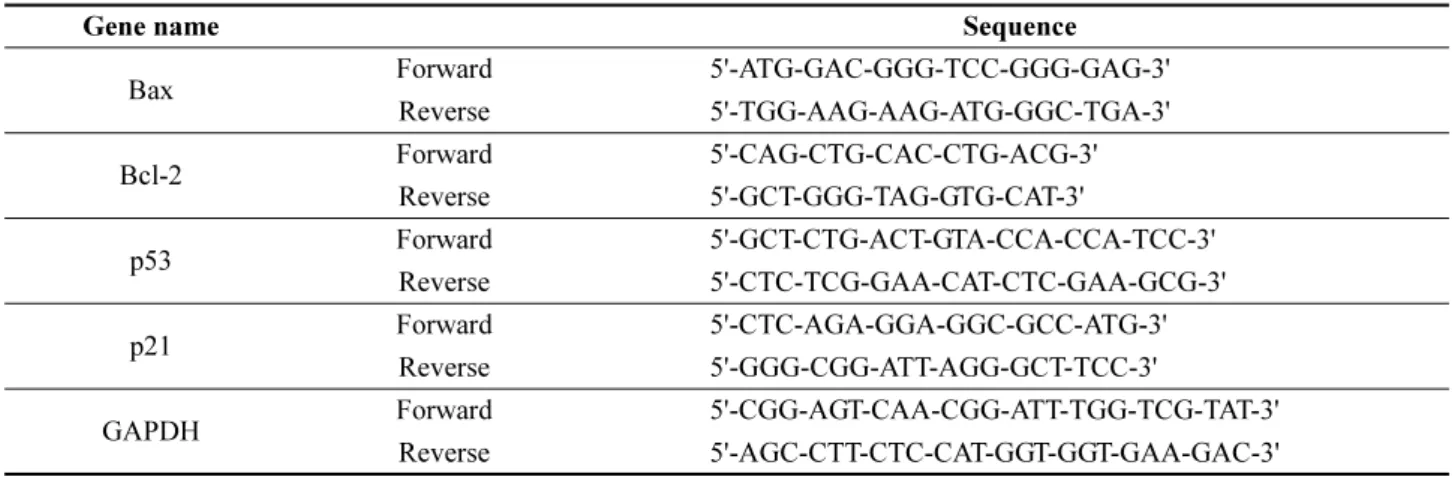
실험에 사용된 암세포에 RNAzol B(GIBCO, USA)를 이용하여 total RNA를 분리하였다. 분리된 RNA를 정량 한 뒤, oligo dT primer(Invitrogen, USA)와 AMV reverse transcriptase를 이용하여 cDNA를 합성하였다. 이 cDNA 를 template를 사용하여 Bax, Bcl-2, p53, p21 유전자를 polymerase chain reaction (PCR) 방법으로 증폭하였다 (Table 1). 이때 housekeeping 유전자인 GAPDH 유전자를 internal control로 사용하였다. 각 PCR 산물들은 1%
Cytotoxicity(%)=대조구의 흡광도−시료처리구의 흡광도 ×100 대조구의 흡광도
Table 1. Sequence of primer used for RT-PCR
Gene name Sequence
Bax Forward 5'-ATG-GAC-GGG-TCC-GGG-GAG-3'
Reverse 5'-TGG-AAG-AAG-ATG-GGC-TGA-3' Bcl-2 Forward 5'-CAG-CTG-CAC-CTG-ACG-3'
Reverse 5'-GCT-GGG-TAG-GTG-CAT-3'
p53 Forward 5'-GCT-CTG-ACT-GTA-CCA-CCA-TCC-3' Reverse 5'-CTC-TCG-GAA-CAT-CTC-GAA-GCG-3' p21 Forward 5'-CTC-AGA-GGA-GGC-GCC-ATG-3'
Reverse 5'-GGG-CGG-ATT-AGG-GCT-TCC-3'
GAPDH Forward 5'-CGG-AGT-CAA-CGG-ATT-TGG-TCG-TAT-3' Reverse 5'-AGC-CTT-CTC-CAT-GGT-GGT-GAA-GAC-3'
agarose gel을 이용하여 전기영동하여 ethidium bromide (EtBr, Sigma)를 이용하여 염색한 후 UV 하에서 확인하 였다.
통계처리
대조군과 각 시료로부터 얻은 실험 결과들의 유의성을 검정하기 위하여 분산분석(ANOVA)을 행한 후 p<0.05 수준에서 Duncan's multiple range test를 실시하였으며, 그 결과는 평균(Mean)±표준편차(Standard deviation, SD) 로 표시하였다. 모든 통계 분석은 Statistic Analysis System (v8.2 SAS Institute Inc., NC, USA) 통계프로그램을 이용 하여 처리하였다.
3. 결과 및 고찰
총 폴리페놀 함량
애기거머리말의 조추출물과 용매분획물을 1 mg/ml로 희석하여 총 폴리페놀 함량을 측정하였다. 그 결과, acetone/methylene chloride(A+M)과 methanol(MeOH) 추 출물은 총 폴리페놀 함량이 각각 635.0, 652.2 µg/mg로 측 정이 되었다. 그리고 조추출물을 용매극성도에 따라 H2O, n-BuOH, 85% aq. MeOH, n-hexane 순서로 얻은 각 용매 분획물을 1 mg/ml로 희석하여 동일한 방법으로 총 폴리페 놀 함량을 측정하였다. 그 결과, H2O, n-BuOH, 85% aq.
MeOH, n-hexane 분획물에서 526.8, 548.6, 769.5, 270.4 µg/mg의 폴리페놀을 포함하고 있음을 확인하였다(Fig. 1).
조추출물의 인체 암세포 증식 억제 효과
해양 현화식물인 애기거머리말의 항암 생리활성 물질 탐색을 위한 기초 연구로서 애기거머리말의 조추출물을 이용하여 AGS 인체 위암세포, HT-1080 인체 섬유육종 세포 및 MCF-7 인체 유방암 세포에 증식에 미치는 영향 을 관찰하였다. 애기거머리말의 용매추출물을 5, 10, 50, 100 및 200 µg/ml로 처리한 결과 시료 처리 농도의 증가 에 따라 농도 의존적으로 암세포의 증식 억제율이 증가하 는 경향을 나타내었다(Fig. 2).
Acetone/methylene chloride(A+M)와 methanol(MeOH) 추출물을 AGS 세포에 10 µg/ml의 농도로 처리했을 때에 는 암세포 증식 억제 효과가 각각 9.6%와 8.4%로 약한 활성을 나타냈지만 50 µg/ml로 처리했을 때에는 각각 41.1%와 26.1%를 나타내었고 100 µg/ml과 200 µg/ml로 농도를 높여 처리하였을 경우, 각각 79.6%과 68.2%, 90.2%과 82.7%으로 급격히 증가하였다. HT-1080 인체 섬 유육종 세포의 증식억제 실험에서도 비슷한 경향이 관찰 되었다. 10 µg/ml의 농도에서는 acetone/methylene chloride (A+M)와 methanol(MeOH) 추출물이 약한 암세포 성장
억제 활성을 나타내지만 농도가 증가될 때 마다 농도 의 존적으로 억제 활성이 증가하였으며 200 µg/ml의 농도에 서는 각각 75.9%와 90.8%의 높은 암세포 성장 억제 활성 을 나타내었다. MCF-7 인체 유방암 세포의 경우에도 acetone/methylene chloride(A+M)와 methanol(MeOH) 추 출물을 5, 10, 50, 100 및 200 µg/ml의 농도로 처리하였을 경우 시료 처리 농도의 증가에 따라 인체 유방암세포의 생존율은 농도 의존적으로 감소하는 경향을 나타내었다.
시료 처리농도 100 µg/ml에서는 acetone/methylene chloride (A+M)와 methanol(MeOH) 추출물은 대조군에 비해 각 각 73.4%와 75.7% 암세포 증식억제효과를 나타내었으며, 시료의 처리농도 200 µg/ml에서는 각각 82.9%와 88.0%
의 높은 암세포 증식 억제율을 보여 주었다. 각 조추출물 의 암세포주들에 대한 IC50 값은 Table 2에 보여 진다.
조추출물의 용매 분획물의 인체 암세포 증식 억제 효과 애기거머리말의 acetone/methylene chloride(A+M)와 methanol(MeOH) 추출물은 인체 암세포에 대하여 높은 증식억제효과를 나타내었으므로, 암세포 증식 억제물질의 특성을 확인하기 위하여 acetone/methylene chloride(A+M) 와 methanol(MeOH) 추출물들을 혼합하여 극성도에 따라 H2O, n-BuOH, 85% aq. MeOH, n-hexane 순서로 용매 분 획하여 그 분획물을 얻었으며 각각의 분획물을 이용하여 인체 암세포의 성장에 미치는 영향을 관찰하였다.
AGS 인체 위암세포에 애기거머리말의 용매별 분획물 을 농도별로 첨가하여 암세포 증식억제정도를 관찰한 결 과는 Fig. 3과 같다. 시료처리 농도 1, 5, 10, 50, 100 및 200 µg/ml에서, 85% aq. MeOH 분획층은 대조군에 비해 각각 5.7, 10.0, 13.3, 30.0, 54.1 및 83.7%의 암세포 증식 억제효과를 나타내었으며, n-hexane 분획층은 각각 10.5, 12.1, 11.6, 15.4, 51.5 및 89.5%의 암세포 증식억제효과를 나타내었다. n-BuOH과 H2O 분획층의 경우에 모든 처리 농도에서 각각 32.5%와 19.2% 이하의 낮은 억제율을 보 여 다른 분획물에 비해 암세포 증식억제에는 크게 영향을 미치지 않았다.
애기거머리말의 용매 분획물의 HT-1080 인체 섬유육종 세포에 대한 증식 억제 활성도 조사되었다(Fig. 4). 애기거 머리말의 용매 분획물을 1, 5, 10, 50, 100 및 200 µg/ml의 농도로 첨가하여 암세포 증식억제 정도에 미치는 영향을 관찰한 결과, 85% aq. MeOH 분획층에서 농도 의존적으 로 우수한 암세포 증식 억제효과를 보였으며 그 억제율은 각각 7.1, 7.1, 12.1, 42.5, 87.4, 92.3%였다. H2O 층의 경 우에도 농도 의존적으로 유의적인 섬유육종 세포 성장 억 제 효과를 나타내었으며 200 µg/ml의 농도에서 57%의 억 제효과를 나타내었다. n-BuOH 층은 200 µg/ml의 고농도 에서도 22.3%의 낮은 억제율을 보였으며 n-hexane 층의
경우에는 100 µg/ml의 농도에서는 15.3%의 낮은 억제율 을 보였으나 200 µg/ml의 농도에서 약간 증가한 44.3%의 암세포 성장 억제율을 보였다.
동일한 조건하에서 애기거머리말의 용매 분획물을 1, 5, 10, 50, 100 및 200 µg/ml의 농도로 MCF-7 인체 유방 암 세포에 처리하고 세포독성을 확인한 결과(Fig. 5) 다른 인체 암세포들과는 달리 n-hexane 층이 가장 높은 암세포 증식 억제효과를 가짐을 확인할 수 있었다. 억제율은 농 도 의존적으로 각각 5.2, 6.7, 26.4, 77.6, 91.6, 93.1%였 다. H2O과 n-BuOH 층은 200 µg/ml의 농도에서 각각 37.7%, 28.9%의 낮은 억제효과를 나타내었으며 85% aq.
Table 2. IC50 values of crude extracts and solvent fractions from Zostera japonica against three human cancer cell lines (µg/ml)
AGS HT-1080 MCF-7
A+M ext. 104.5 115.5 92.9
MeOH ext. 114.7 135.4 88.5 H2O fr. 364.2 173.8 284.5 n-BuOH fr. 362.1 595.5 396.7 85% aq. MeOH fr. 108.5 100.2 152.4 n-hexane fr. 109.5 222.3 96.7 A+M represents the extract of a mixture of 1:1 ratio of acetone (A) and methylene chloride (M).
Fig. 2. Inhibitory effects of crude extracts from Zostera japonica on the growth of human cancer cell lines (A) AGS, (B) HT-1080, (C) MCF-7. a-fMeans with the different letters are significantly different (p < 0.05) by Duncan's multiple range test. A+M ext.represents the extract of a mixture of 1:1 ratio of acetone (A) and methylene chloride (M)
Fig. 3. Inhibitory effects of solvent fractions (A) H2O (B) n-BuOH (C) 85% aq. MeOH and (D) n-hexane from Zostera japonica on the growth of AGS human gastric adenocarcinoma cells. a-fMeans with the different letters are significantly different (p < 0.05) by Duncan's multiple range test
Fig. 4. Inhibitory effects of solvent fractions (A) H2O (B) n-BuOH (C) 85% aq. MeOH and (D) n-hexane from Zostera japonica on the growth of HT-1080 human sarcoma cells. a-fMeans with the different letters are significantly different (p<0.05) by Duncan's multiple range test
MeOH 층은 동일한 농도에서 62.1%의 억제효과를 나타 내었다. 이 용매분획들의 인간 암세포주들에 대한 IC50 값 은 Table 2에 보여 진다.
용매 분획물이 apoptosis 관련 mRNA 발현에 미치는 효과 애기거머리말의 분획물의 MTT assay의 결과를 분석해 보면 85% aq. MeOH 분획이 세 종류 암세포 모두에 비교 적 좋은 활성을 보였기 때문에 이를 고려하여 높은 암세 포 성장 억제효과를 보인 AGS에 대해 apoptosis 관련 유 전자들의 발현에 미치는 효과를 관찰하였다. apoptosis 관 련 유전자로서는 세포사 억제 유전자인 Bcl-2 유전자와 이와 상호작용하는 Bax 유전자, 종양억제유전자로 많이 알려진 p53 유전자와 이에 의해 조절을 받는 p21 유전자 의 발현양상을 비교하였다.
AGS 세포에 200 µg/ml의 농도로 용매분획물을 처리하 여 각 유전자의 발현 양상을 관찰한 결과(Fig. 6), 용매추 출물에 의해 Bcl-2 유전자의 발현은 감소하였으며, Bax 유전자와 p21 유전자의 발현은 증가시켰다. 특히, 종양억 제유전자인 p53 유전자의 경우 85% aq. MeOH 처리군에 서 가장 높은 발현율을 보였다. 용매분획물 중에서 85%
aq. MeOH 추출물은 다른 용매 분획물에 비해 Bax, Bcl-
2, p53, p21 등 apoptosis 관련 유전자들의 발현을 가장 적 절히 조절하는 효과를 보였다.
이상의 결과로부터 해양 현화식물의 한 종류인 애기거 머리말은 높은 암세포성장 억제 활성을 보였으며, 특히 모 든 인체 암세포에 좋은 성장억제율을 보인 애기거머리말 의 85% aq. MeOH 용매분획층에서 항암 생리활성물질의 존재 가능성을 살펴 볼 수 있었다. 잘피는 잎과 땅속줄기·
관다발 조직이 잘 발달되어 있으며 바다에 서식하는 해조 류와는 매우 다른 바다풀로, 꽃이 피는 현화식물이며 뿌리 는 식용으로도 이용된다. 따라서 해양 현화식물중에 하나 인 애기거머리말은 기존의 해조류와 매우 다른 이차 대사 물질을 함유할 가능성이 매우 높으므로 이 식물에 대한 집중적인 연구를 통해 새로운 항암 생리활성물질의 개발 이 기대된다.
이러한 결과를 바탕으로 농도 변화에 따른 이들 유전자 의 양상을 200 µg/ml, 100 µg/ml, 50 µg/ml의 처리 농도에 서 관찰하였다. 85% aq. MeOH 분획물은 농도 의존적으 로 Bax, p53, p21 유전자의 발현을 증가시켰다(Fig. 7). 이 결과로 보아 애기거머리말의 85% aq. MeOH 분획물은 이들 유전자의 발현을 조절하여 apoptosis를 촉진하여 암 세포 증식을 억제하는 것으로 사료된다.
Fig. 5. Inhibitory effects of solvent fractions (A) H2O (B) n-BuOH (C) 85% aq. MeOH and (D) n-hexane from Zostera japonica on the growth of MCF-7 human breast cancer cells. a-eMeans with the different letters are significantly different (p < 0.05) by Duncan's multiple range test
이상의 결과로부터 해양 현화식물의 한 종류인 애기거 머리말은 높은 암세포성장 억제 활성을 보였으며, 특히 용 매 분획물중 높은 암세포 성장억제율을 보인 애기거머리 말의 85% aq. MeOH 분획층에 항암 생리활성물질의 존 재 가능성을 살펴 볼 수 있었다. 또한 애기거머리말 추출 물의 주 구성성분을 확인하기 위하여 조추출물 및 용매분 획의 총 폴리페놀 함량을 분석하였다. 이미 거머리말속에 속하는 잘피 중에 한 종류인 거머리말(Zostera marina)이 높은 폴리페놀 함량을 가지고 있음이 보고된 바 있다 (Choi et al. 2009). 분석결과 애기거머리말도 높은 폴리페 놀 함량을 보였으며 그 중에서 85% aq. MeOH 용매분획
이 가장 높은 폴리페놀 함량을 보였다. 이 용매분획의 극 성을 고려할 때 폴리페놀 종류들중에서도 상대적으로 극 성이 낮은 폴리페놀 성분이 좋은 항암활성을 나타낸다고 여겨지며 이는 또한 두 가지 종류의 조추출물들중에 상대 적으로 극성이 낮은 acetone/methylene chloride(A+M) 조 추출물이 methanol(MeOH) 조추출물보다 더 높은 항암활 성을 보이는 것과 잘 일치한다고 할 수 있다.
잘피는 잎과 땅속줄기·관다발 조직이 잘 발달되어 있 으며 바다에 서식하는 해조류와는 매우 다른 바다풀로, 꽃 이 피는 현화식물이며 뿌리는 식용으로도 이용된다. 따라 서 해양 현화식물중에 하나인 애기거머리말은 기존의 해 Fig. 6. Effect of solvent fractions from Zostera japonica on apoptosis related gene expression (A) Bax (B) Bcl-2 (C) p53
(D) p21 in AGS human gastric adenocarcinoma cells. a-dMeans with the different letters are significantly different (p < 0.05) by Duncan's multiple range test
조류와 매우 다른 이차 대사물질을 함유할 가능성이 매우 높으므로 이 식물에 대한 집중적인 연구를 통해 새로운 항암 생리활성물질의 개발이 기대된다.
사 사
본 연구는 2012년 교육과학기술부의 재원으로 한국연 구재단의 지원을 받아 수행된 기초연구사업(No. 2012R1- A1A2002851)이며 국토해양부의 지원으로 수행한 해양에 너지 전문인력 양성사업의 연구결과입니다.
참고문헌
Achamlale S, Rezzonico B, Grignon-Dubois M (2009) Rosmarinic acid from beach waste: isolation and HPLC quantification in Zostera detritus from Arcachon lagoon.
Food Chem 113:878-883
Choi HG, Lee JH, Park HH, Sayegh FAQ (2009) Antioxidant and antimicrobial activity of Zostera marina L. extract.
Algae 24:179-184
Choi TS, Kim KY, Lee BG, Lee JS (2005) Preliminary study on the toxicity and transfer of heavy metals and tributyltin to seagrass Zostera marina. Algae 20:157-166
Hansen MB, Nielsen SE, Berg K (1989) Re-examination and further development of a precise and rapid dye method for measuring cell growth/cell kill. J Immunol Methods 119:203-210
Hua K-F, Hsu H-Y, Su Y-C, Lin I-F, Yang S-S, Chen Y-M, Chao LK (2006) Study on the antiinflammatory activity of methanol extract from seagrass Zostera japonica. J Agric Food Chem 54:306-311
Huh SH, Kwak SN, Nam KW (1998) Seasonal variations of eelgrass (Zostera marina) and Epiphytic algae in eelgrass beds in Kwangyang Bay. J Korean Fish Soc 31:56-62 Khotimchenko MY, Lenskaya KV, Petrakova MY, Khotimchenko
YS, Kovalev VV (2006) The mercury binding activity of pectin isolated from the seagrass Zostera marina. Russ J Mar Biol 32:312-215
Kim JB, Park JI, Choi WJ, Lee JS, Lee KS (2010) Spatial distribution and ecological characteristics of Zostera marina and Zostera japonica in the Seomjin Estuary.
Korean J Fish Aquat Sci 43:351-361
Kim JB, Park JI, Lee KS (2009) Seagrass distribution in Deukryang Bay. Korean J Fish Aquat Sci 42:509-517 Kim JH, Cho YH, Park SM, Lee KE, Lee JJ, Lee BC, Pyo
HB, Song KS, Park HD, Yun YP (2004) Antioxidants and inhibitor of matrix metalloproteinase-1 expression from Fig. 7. Effect of 85% aq. MeOH fraction from Zostera japonica on apoptosis related gene expression (A) Bax (B) p53
(C) p21 in AGS human gastric adenocarcinoma cells. a-cMeans with the different letters are significantly different (p < 0.05) by Duncan's multiple range test
leaves of Zostera marina L. Arch Pharm Res 27:177-183 Kolenchenko EA, Sonina LN, Khotimchenko YS (2005) Comparative in vitro assessment of antioxidant activities of low-etherified pectin from the eelgrass Zostera marina and antioxidative medicines. Russ J Mar Biol 31:331- 334
Kumar CS, Sarada DVL, Gideon TP, Rengasamy R (2008) Antibacterial activity of three South Indian seagrasses, Cymodocea serrulata, Halophila ovalis and Zostera capensis. World J Microbiol Biotechnol 24:1989-1992 Lee SH, Ma SM, Lim YS, Choi HK, Shin HC (2004)
Genetic diversity and its implications in the conservation of endangered Zostera japonica in Korea. J Plant Biol 47:275-281
Lee SM, Lee SY, Choi CI (2005) Reproductive phenology of four Korean seagrasses, Zostera caespitosa, Z.
caulescens, Z. japonica and Z. marina. Ocean and Polar Res 27:125-133
Lee SY, Kwon CJ, Choi CI (2000) Distribution of Zostera (Zosteraceae) and habitat characteristics in the eastern coastal waters of Korea. J Korean Fish Soc 33:501-507 Lee SY, Kwon CJ, Kim TJ, Suh YB, Choi CI (1999)
Morphological examination of Zostera asiatica Miki (Zosteraceae) from various habitats. Korean J Environ Biol 17:503-512
Park JG, Frucht H, LaRocca RV, Bliss DP, Kurita Y, Chen TR, Henslee JG, Trepel JB, Jensen RT, Johnson BE, Bang YJ, Kim JP, Gazdar AF (1990) Characterization of cell lines established from human gastric carcinoma.
Cancer Res J 50:2773-2780
Roth NC, Pregnall AM (1988) Nitrate reductase activity in Zostera marina. Mar Biol 99:457-463
Sonina LN, Khotimchenko MY (2007) Effectiveness of pectin extracted from the eelgrass Zostera marina for alleviating lead-induced liver injury. Russ J Mar Biol 33:2004-206
Yang L, Guoliang J, Zhiqiang W (2010) Antibacterial activity of extracts from Zostera marina against pathogens of Apostichopus japonicus skin ulceration disease. J Ocean Univ Chin 9:68-70
Received May 29, 2012 Revised Oct. 26, 2012 Accepted Nov. 12, 2012