INTRODUCTION
Prostate-specific antigen (PSA) screening has result- ed in a robust migration of the clinical stage in newly detected prostate cancers [1,2]. The American Cancer
Society predicted 180,890 new prostate cancer cases in 2016, with 35%–40% of those being low risk [3]. This increasing detection of low-risk disease enables active surveillance as a viable treatment option for prostate cancer [4-6]. Moreover, owing to the increased life ex-
Received: Feb 11, 2020 Revised: Apr 9, 2020 Accepted: Apr 13, 2020 Published online Jun 25, 2020 Correspondence to: Sung Kyu Hong https://orcid.org/0000-0002-8344-6774
Department of Urology, Seoul National University Bundang Hospital, 82 Gumi-ro 173beon-gil, Bundang-gu, Seongnam 13620, Korea.
Tel: : +82-31-787-7343, Fax: +82-31-787-4057, E-mail: [email protected] Copyright © 2021 Korean Society for Sexual Medicine and Andrology
Testosterone Replacement Therapy in Men with Untreated or Treated Prostate Cancer: Do We Have Enough Evidences?
Myong Kim1 , Seok-Soo Byun2 , Sung Kyu Hong2
1Department of Urology, Ewha Womans University Seoul Hospital, Seoul, 2Department of Urology, Seoul National University Bundang Hospital, Seongnam, Korea
Purpose:
Purpose: To investigate the oncologic safety of testosterone replacement therapy (TRT) in men with untreated or treated pros- tate cancer.
Materials and Methods:
Materials and Methods: We systematically searched PubMed, Embase, and Cochrane library database from January 1941 to March 2019.
Results:
Results: In total, 36 articles met the eligibility criteria for this systematic review. They included a total of 2,459 TRT-treated patients, with a median of 20 patients per study (range: 1–1,142). Except for four studies, all were single-armed studies with poor quality scores (median MINOR, 9 of 24). Of the 36 studies, prostate cancer was managed through active surveillance (AS), in 5 studies; radical prostatectomy, in 11 studies; radiation therapy, in 5 studies; multiple intervention modalities, in 5 studies; and systemic therapy, in 9 studies. In comparison with TRT-treated and untreated patients, the pooled risk ratio (RR) was not significantly higher than one in comparisons of risk for disease progression (pooled RR, 0.83; 95% confidence interval, 0.57–1.21). The results of systematic review implied that TRT might be harmful in men with advanced disease (pro- gression rate: 38.5%–100.0%), who undergo AS (15.4%–57.1%), and who successfully treated but having high-risk disease (0.0%–50.0%).
Conclusions:
Conclusions: Compared to TRT-untreated patients, TRT-treated patients may not have increased risks for disease progression in prostate cancer. However, the quality of currently available evidence is extremely poor. TRT may be harmful in men with advanced disease burden, in those with untreated prostate cancer undergoing AS, and in those with successfully treated pros- tate cancer but having high-risk disease.
Keywords:
Keywords: Eunuchism; Hormone replacement therapy; Prognosis; Prostatic neoplasms; Safety; Testosterone
This is an Open Access article distributed under the terms of the Creative Commons Attribution Non-Commercial License (http://creativecommons.org/licenses/by-nc/4.0) which permits unrestricted non-commercial use, distribution, and reproduction in any medium, provided the original work is properly cited.
pISSN: 2287-4208 / eISSN: 2287-4690 World J Mens Health 2021 Oct 39(4): 705-723 https://doi.org/10.5534/wjmh.190158
Hormonal regulation of male reproduction and hypogonadism
pectancy caused by downward stage migration, an expanding population of patients successfully treated for prostate cancer strongly desire testosterone replace- ment therapy (TRT) for hypogonadal symptoms accom- panied by decreased serum testosterone levels [7].
However, the effectiveness of TRT for men with un- treated or treated prostate cancer is controversial. Per the demonstration of hormonal responsiveness in 1941 by Huggins and Hodges [8], the relationship between serum testosterone and prostatic health has been thought to be an “old dogma” in the form of “fuel for a fire.” The United States Food and Drug Administration (FDA) stated, in all testosterone package inserts, that TRT is contraindicated in men with known or suspect- ed prostate cancer, but it did not substantiate this con- traindication [9]. The clinical guidelines by Endocrine Society recommend against treating hypogonadism in men with prostate cancer, citing lack of sufficient data to make a general recommendation in men previously treated for prostate cancer (‘recommendation with low quality evidence’) [10].
Meanwhile, the European Association of Urology stated that there is no conclusive evidence that TRT increases the risk of prostate cancer (‘level of evi- dence=4’), and that men with prostate cancer can re- ceive TRT with careful monitoring for prostate safety (‘level of evidence=3’) [11]. Similarly, the recent treat- ment guideline by the American Urologic Association stated that patients should be informed that there is inadequate evidence for TRT (‘expert opinion’), but TRT can be considered in men who have undergone radical prostatectomy with favorable pathology (e.g., negative margins, negative seminal vesicles, negative lymph nodes), without PSA recurrence [12].
The prescribing patterns of TRT in patients with treated [13] and untreated prostate cancer [14] are rapidly changing. In the Unites States, 94% of urolo- gists prescribed TRT to patients who had been treated for prostate cancer previously [13]. Additionally, 65%
of Canadian urologists stated that they would offer TRT to men who were on active surveillance for pros- tate cancer [14]. However, it remains unclear whether there are sufficient evidences for these beliefs. To our knowledge, no randomized studies have been reported regarding the safety of TRT in men with untreated or treated prostate cancer. There have been some review articles (‘mainly by authors advocating TRT in prostate cancer’) summarizing optimistic results from small-
scale studies for TRT in patients with prostate cancer who have undergone active surveillance or other treat- ments [15-21]. However, the existing evidences have rarely been evaluated and synthesized in a systematic manner. Owing to the scarcity of reports in this regard, quality assessment and summation of these existing evidences (‘if possible’) to reach a reasonable conclusion are necessary. Therefore, we performed a systematic review and meta-analysis of published literature inves- tigating the safety of TRT in men with untreated and treated prostate cancer.
MATERIALS AND METHODS
1. Search strategy for relevant studies
The entire process of this systematic review and me- ta-analysis followed the recent MOOSE and PRISMA recommendations [22,23]. We systematically searched online PubMed, Embase, and Cochrane library data- base from their respective inspections until March 2019. Our overall search strategies included terms for prostate cancer (prostatic neoplasm, prostate carci- noma, or prostate adenocarcinoma), treatments (watch- ful waiting, active surveillance, focal therapy, surgery, radiation therapy, androgen deprivation therapy, or chemotherapy), testosterone deficiency (hypogonad- ism or androgen deficiency), and hormone replacement therapy (testosterone replacement and testosterone supplementation). Detailed queries for the search strategy are presented in Appendix. Some studies were manually searched by referring the review articles or original research articles on similar subjects.
2. Selection criteria of eligible studies for meta-analysis
Original research articles or abstracts, articles in which the subjects were only patients with prostate cancer with or without treatment; those in which pa- tients received TRT owing to symptomatic testosterone deficiency; those in which oncological outcome param- eters were objectively described using standard inves- tigation tools, such as biochemical recurrence or ra- diographic progression; those in which the sample size was provided; and double-armed studies (TRT-treated vs. TRT-untreated) in which the risks for progression in each group were presented separately for the esti- mation of risk ratio (RR) were included in this system- atic review. In case of suspected duplication of patient
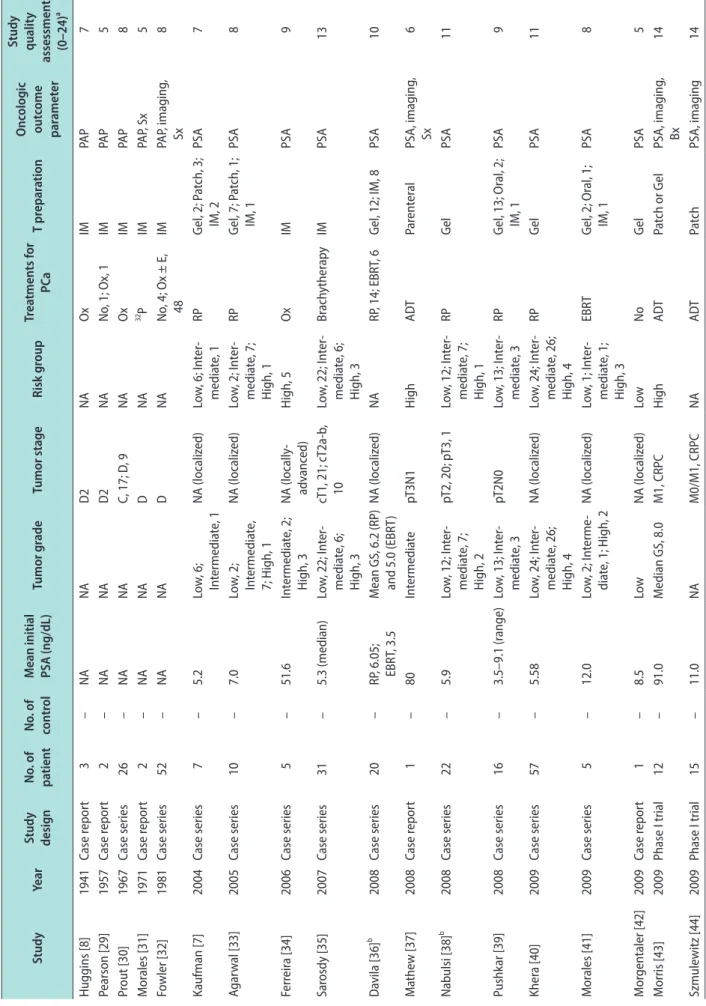
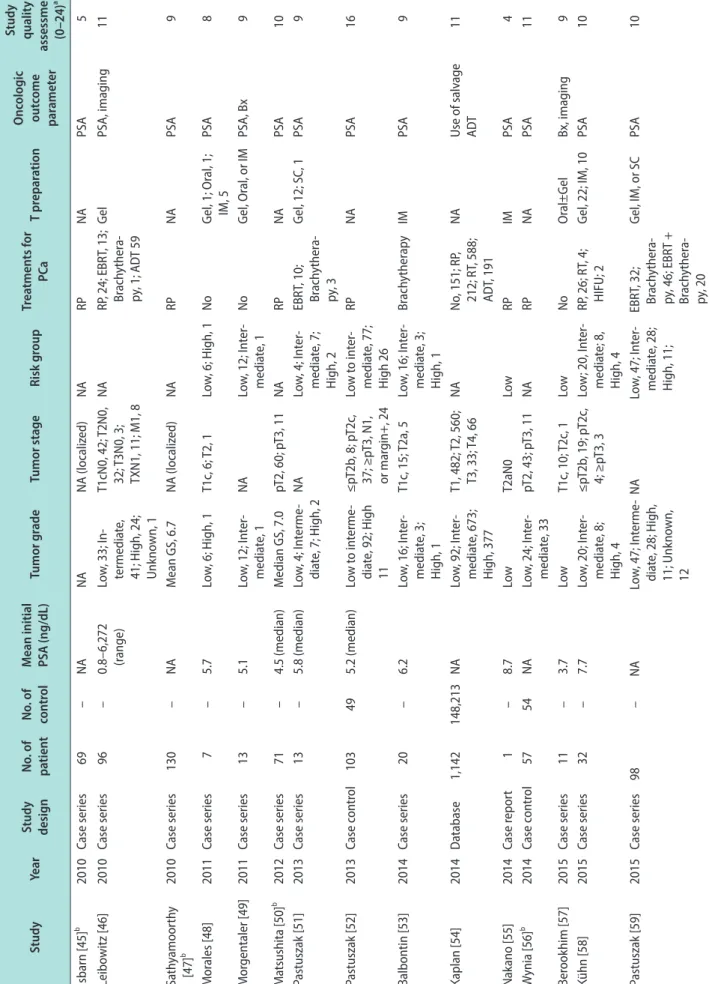
Table 1. Main characteristics of the eligible studies StudyYearStudy designNo. of patient No. of controlMean initial PSA (ng/dL)Tumor gradeTumor stageRisk groupTreatments for PCaT preparationOncologic outcome parameter
Study quality assessment (0–24)a Huggins [8]1941Case report3–NANAD2NAOxIMPAP7 Pearson [29]1957Case report2–NANAD2NANo, 1; Ox, 1IMPAP5 Prout [30] 1967Case series26–NANAC, 17; D, 9NAOxIMPAP8 Morales [31]1971Case report2–NANADNA32 PIMPAP, Sx5 Fowler [32]1981Case series52–NANADNANo, 4; Ox ± E, 48IMPAP, imaging, Sx8 Kaufman [7]2004Case series7–5.2Low, 6; Intermediate, 1NA (localized)Low, 6; Inter- mediate, 1RPGel, 2; Patch, 3; IM, 2PSA 7 Agarwal [33]2005Case series10–7.0Low, 2; Intermediate, 7; High, 1
NA (localized)Low, 2; Inter- mediate, 7; High, 1
RPGel, 7; Patch, 1; IM, 1PSA8 Ferreira [34]2006Case series5–51.6Intermediate, 2; High, 3NA (locally- advanced)High, 5OxIMPSA9 Sarosdy [35]2007Case series31–5.3 (median)Low, 22; Inter- mediate, 6; High, 3
cT1, 21; cT2a-b, 10Low, 22; Inter- mediate, 6; High, 3
BrachytherapyIMPSA13 Davila [36]b 2008Case series20–RP, 6.05; EBRT, 3.5 Mean GS, 6.2 (RP) and 5.0 (EBRT)NA (localized)NARP, 14; EBRT, 6Gel, 12; IM, 8PSA10 Mathew [37]2008Case report1–80IntermediatepT3N1HighADTParenteralPSA, imaging, Sx6 Nabulsi [38]b 2008Case series22–5.9Low, 12; Inter- mediate, 7; High, 2
pT2, 20; pT3, 1Low, 12; Inter- mediate, 7; High, 1
RPGelPSA11 Pushkar [39]2008Case series16–3.5–9.1 (range)Low, 13; Inter- mediate, 3pT2N0Low, 13; Inter- mediate, 3RPGel, 13; Oral, 2; IM, 1PSA9 Khera [40]2009Case series57–5.58Low, 24; Inter- mediate, 26; High, 4
NA (localized)Low, 24; Inter- mediate, 26; High, 4
RPGelPSA 11 Morales [41]2009Case series5–12.0Low, 2; Interme- diate, 1; High, 2NA (localized)Low, 1; Inter- mediate, 1; High, 3
EBRTGel, 2; Oral, 1; IM, 1PSA 8 Morgentaler [42]2009Case report1–8.5LowNA (localized)LowNoGelPSA 5 Morris [43]2009Phase I trial12–91.0Median GS, 8.0M1, CRPCHighADTPatch or GelPSA, imaging, Bx14 Szmulewitz [44]2009Phase I trial15–11.0NAM0/M1, CRPCNAADTPatchPSA, imaging14
Table 1. Continued StudyYearStudy designNo. of patient No. of controlMean initial PSA (ng/dL)Tumor gradeTumor stageRisk groupTreatments for PCaT preparationOncologic outcome parameter
Study quality assessment (0–24)a Isbarn [45]b 2010Case series69–NANANA (localized)NARPNAPSA5 Leibowitz [46]2010Case series96–0.8–6,272 (range)Low, 33; In- termediate, 41; High, 24; Unknown, 1
T1cN0, 42; T2N0, 32; T3N0, 3; TXN1, 11; M1, 8 NARP, 24; EBRT, 13; Brachythera- py, 1; ADT 59
Gel PSA, imaging11 Sathyamoorthy [47]b2010Case series130–NAMean GS, 6.7NA (localized)NARPNAPSA9 Morales [48]2011Case series7–5.7Low, 6; High, 1T1c, 6; T2, 1Low, 6; High, 1NoGel, 1; Oral, 1; IM, 5PSA8 Morgentaler [49]2011Case series13–5.1Low, 12; Inter- mediate, 1NALow, 12; Inter- mediate, 1NoGel, Oral, or IMPSA, Bx9 Matsushita [50]b 2012Case series71–4.5 (median)Median GS, 7.0pT2, 60; pT3, 11NARPNAPSA10 Pastuszak [51]2013Case series13–5.8 (median)Low, 4; Interme- diate, 7; High, 2NALow, 4; Inter- mediate, 7; High, 2
EBRT, 10; Brachythera- py, 3
Gel, 12; SC, 1PSA 9 Pastuszak [52]2013Case control103495.2 (median)Low to interme- diate, 92; High 11
≤pT2b, 8; pT2c, 37; ≥pT3, N1, or margin+, 24 Low to inter- mediate, 77; High 26
RPNAPSA16 Balbontin [53]2014Case series20–6.2Low, 16; Inter- mediate, 3; High, 1
T1c, 15; T2a, 5Low, 16; Inter- mediate, 3; High, 1
BrachytherapyIMPSA9 Kaplan [54]2014Database1,142 148,213 NALow, 92; Inter- mediate, 673; High, 377
T1, 482; T2, 560; T3, 33; T4, 66NANo, 151; RP, 212; RT, 588; ADT, 191
NAUse of salvage ADT11 Nakano [55]2014Case report1–8.7LowT2aN0LowRPIMPSA4 Wynia [56]b 2014Case control5754NALow, 24; Inter- mediate, 33pT2, 43; pT3, 11NARPNAPSA11 Berookhim [57]2015Case series11–3.7LowT1c, 10; T2c, 1LowNoOral±GelBx, imaging9 Kühn [58]2015Case series32–7.7 Low, 20; Inter- mediate, 8; High, 4
≤pT2b, 19; pT2c, 4; ≥pT3, 3Low; 20, Inter- mediate; 8, High, 4
RP, 26; RT, 4; HIFU; 2Gel, 22; IM, 10PSA10 Pastuszak [59]2015Case series98–NALow, 47; Interme- diate, 28; High, 11; Unknown, 12
NALow, 47; Inter- mediate, 28; High, 11;
EBRT, 32; Brachythera- py, 46; EBRT + Brachythera- py, 20
Gel, IM, or SCPSA 10
data, the most recently published or the most informa- tive single article was selected. If the study population underwent two or more treatment modalities, each datum was processed separately by the treatment type, or presented all at once when the separation was im- possible. Owing to the scarcity of double-armed studies, all single-armed studies and case reports were included in the eligible studies. Studies that failed to satisfy the previously mentioned inclusion criteria, review articles or letters, laboratory studies, such as studies on ex-vivo or animal models, and studies with insufficient data to estimate the effects of TRT on oncological outcomes and its RR for progression were excluded.
To minimize bias, abstract screening and full text assessment for eligibility were independently per- formed by all three reviewers (MK, SSB, and SKH). All screened abstracts were classified into three categories:
not eligible, unclear, and potentially eligible. The full texts of “potentially eligible” and “unclear” studies were obtained and assessed for eligibility. Any dis- agreements between the three reviewers were resolved by consensus.
3. Data extraction and quality assessments
The extracted data elements were 1) overall char- acteristics of the eligible studies: name of the first author, publication year, study design, population size (intervention and control group); 2) characteristics of the patients: mean PSA level at initial diagnosis, tumor grade, stage, and risk group; 3) treatment data: type of treatment for prostate cancer, type of TRT; and 4) outcome parameters: oncologic parameters for progres- sion, median follow-up periods from initial diagnosis and commencement of TRT, and the number and risks for progression in each arm. The study quality was as- sessed independently by all three reviewers using the MINOR criteria (score range: 0–24) [24]. Any disagree- ment was resolved by discussion.
4. Statistical analysis
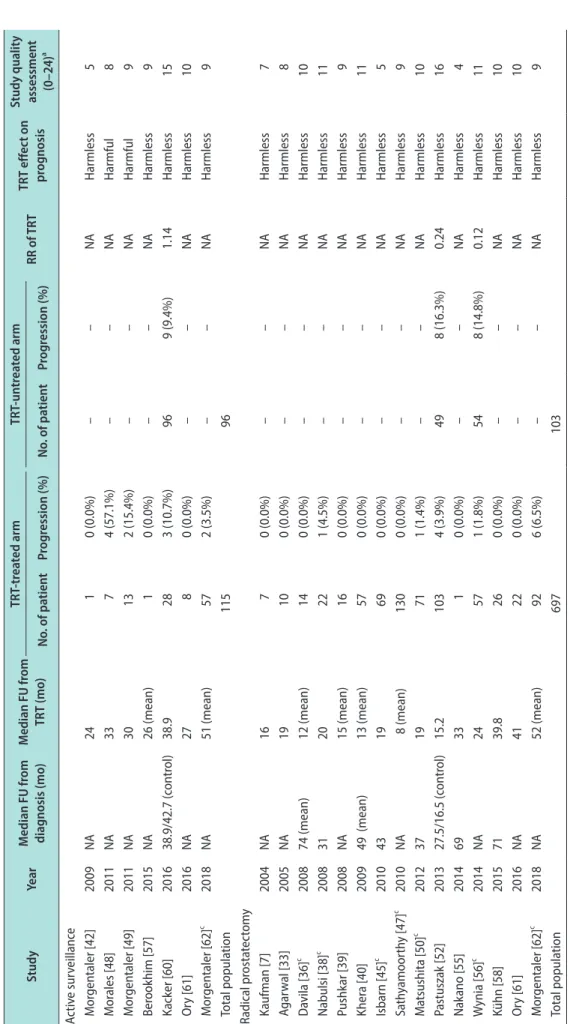
1) Primary analysis (narrative systematic review) Existing evidences for TRT in men with untreated or treated prostate cancer were summarized (Table 1).
The effects of TRT on prostate cancer progression were evaluated according to the treatment modality, as fol- lows: active surveillance, radical prostatectomy, radia- tion therapy, multiple modalities, or systemic therapy Table 1. Continued StudyYearStudy designNo. of patient No. of controlMean initial PSA (ng/dL)Tumor gradeTumor stageRisk groupTreatments for PCaT preparationOncologic outcome parameter
Study quality assessment (0–24)a Kacker [60]2016Case control28963.3Low, 22; Inter- mediate, 6NALow, 22; Inter- mediate, 6NoGel, 8; IM, 14; SC, 6 PSA, Bx15 Ory [61]2016Case series82–NALow, 32; Inter- mediate, 39; High, 11
NALow, 23; Inter- mediate, 30; High, 29 RP, 22; RT, 50; HIFU, 1; Cryotherapy, 1; No, 8
NAPSA, Bx10 Morgentaler [62]b 2018Case series199–NANANANARP, 92; RT, 50; No, 57NAPSA, Bx9 No.: number, PSA: prostate-specific antigen, PCa: prostate cancer, NA: not available, Ox: orchiectomy, IM: intramuscular injection, PAP: prostatic acid phosphatase, Sx: symptom, E: estrogen, RP: radical prostatectomy, EBRT: external beam radiation therapy, GS: Gleason score, ADT: androgen deprivation therapy, CRPC: castration-resistant prostate cancer, Bx: biopsy, SC: subcutaneous injec- tion, RT: radiation therapy, HIFU: high intensity focused ultrasound. a Evaluated using Methodological Index for Non-Randomized Studies (MINORS) [24]; b Only published in abstract forms.
Table 2. Effect of TRT on oncologic outcomes in men with untreated and treated prostate cancer StudyYearMedian FU from diagnosis (mo)Median FU from TRT (mo) TRT-treated armTRT-untreated arm RR of TRTTRT effect on prognosis
Study quality assessment (0–24)a No. of patientProgression (%)No. of patientProgression (%) Active surveillance Morgentaler [42]2009NA24 10 (0.0%)––NAHarmless5 Morales [48]2011NA33 74 (57.1%)––NAHarmful8 Morgentaler [49]2011NA30 132 (15.4%)––NAHarmful9 Berookhim [57]2015NA26 (mean)10 (0.0%)––NAHarmless9 Kacker [60]201638.9/42.7 (control)38.9 283 (10.7%)969 (9.4%)1.14Harmless15 Ory [61]2016NA27 80 (0.0%)––NAHarmless10 Morgentaler [62]c 2018NA51 (mean)572 (3.5%)––NAHarmless9 Total population11596 Radical prostatectomy Kaufman [7]2004NA1670 (0.0%)––NAHarmless7 Agarwal [33]2005NA19 100 (0.0%)––NAHarmless8 Davila [36]c 200874 (mean)12 (mean)140 (0.0%)––NAHarmless10 Nabulsi [38]c 200831 20 221 (4.5%)––NAHarmless11 Pushkar [39]2008NA15 (mean)160 (0.0%)––NAHarmless9 Khera [40]200949 (mean)13 (mean)570 (0.0%)––NAHarmless11 Isbarn [45]c 201043 19 690 (0.0%)––NAHarmless5 Sathyamoorthy [47]c 2010NA 8 (mean)1300 (0.0%)––NAHarmless9 Matsushita [50]c 201237 19 711 (1.4%)––NAHarmless10 Pastuszak [52]201327.5/16.5 (control)15.2 1034 (3.9%)498 (16.3%)0.24Harmless16 Nakano [55]201469 33 10 (0.0%)––NAHarmless4 Wynia [56]c 2014NA24 571 (1.8%)548 (14.8%)0.12Harmless11 Kühn [58]201571 39.8 260 (0.0%)––NAHarmless10 Ory [61]2016NA41 220 (0.0%)––NAHarmless10 Morgentaler [62]c 2018NA52 (mean)926 (6.5%)––NAHarmless9 Total population697103
Table 2. Continued StudyYearMedian FU from diagnosis (mo)Median FU from TRT (mo) TRT-treated armTRT-untreated arm RR of TRTTRT effect on prognosis
Study quality assessment (0–24)a No. of patientProgression (%)No. of patientProgression (%) Radiation therapy Sarosdy [35]2007NA60311 (3.2%)––NAHarmless13 Davila [36]c 200857 (mean) 9 (mean)60 (0.0%)––NAHarmless10 Morales [41]2009NA15 51 (20.0%)––NAHarmful8 Pastuszak [51]2013NA29.7 131 (7.7%)––NAHarmless9 Balbontin [53]2014NA31 200 (0.0%)––NAHarmless9 Kühn [58]20157139.8 40 (0.0%)––NAHarmless10 Pastuszak [59]2015NA40.8 966 (6.3%)––NAHarmless10 Ory [61]2016NA41 503 (6.0%)––NAHarmless10 Morgentaler [62]c 2018NA47 (mean)501 (2.0%)––NAHarmless9 Total population2750 Multiple modalities Leibowitz [46]2010NA159641 (42.7%)––NAHarmful11 Kaplan [54]2014NA12b 1,14218 (1.6%)b 148,2131,942 (1.3%)b 1.19Harmless11 Total population1,238148,213 Advanced disease Huggins [8]1941NA0.5 33 (100.0%)––NAHarmful7 Pearson [29]1957NA0.5–1 (range)20 (0.0%)––NAHarmless5 Prout [30]1967NA0.1–11 (range)2610 (38.5%)––NAHarmful 8 Morales [31]19713–24 7–9 20 (0.0%)––NAHarmless5 Fowler [32]1981NA1 5245 (86.5%)––NAHarmful 8 Ferreira [34]2006NA25 53 (60.0%)––NAHarmful9 Mathew [37]2008180 27 11 (100.0%)––NAHarmful9 Morris [43]2009NA2 126 (50.0%)––NAHarmful14 Szmulewitz [44]2009NA2 1512 (80.0%)––NAHarmful14 Total population1180 TRT: testosterone replacement therapy, FU: follow-up, No.: number, RR: relative risks, NA: not available. a Evaluated using Methodological Index for Non-Randomized Studies (MINORS) [24]; b Estimated from the expected events per 100-person years; c Only published in abstract forms.
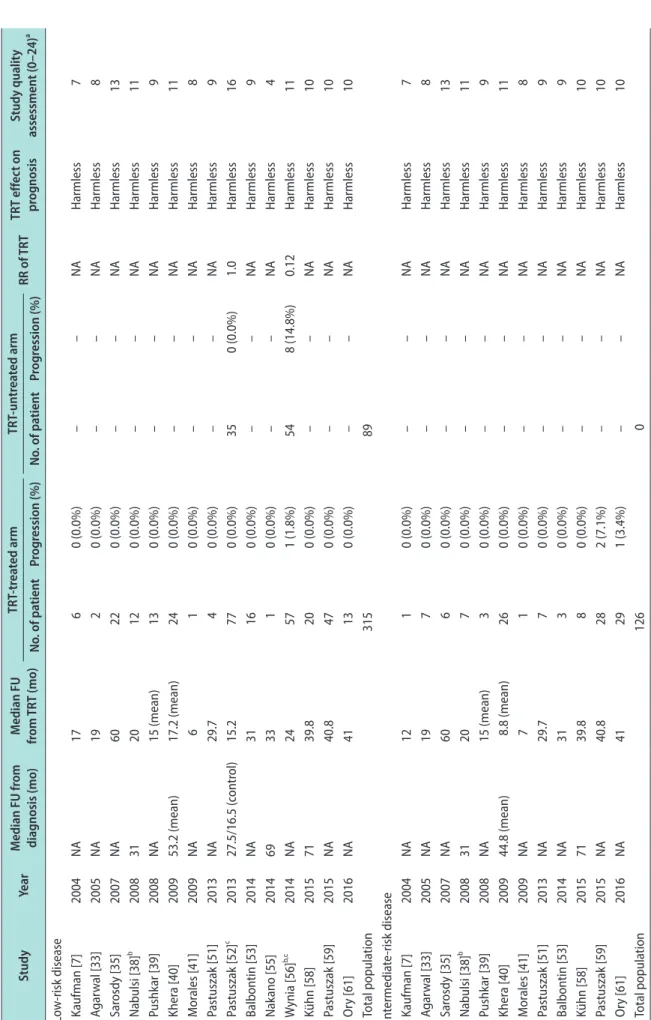
Table 3. Effect of TRT on oncologic outcomes in men with local definitive treatment according to risk groups StudyYearMedian FU from diagnosis (mo)Median FU from TRT (mo)TRT-treated armTRT-untreated arm RR of TRTTRT effect on prognosisStudy quality assessment (0–24)a No. of patientProgression (%)No. of patientProgression (%) Low-risk disease Kaufman [7]2004NA1760 (0.0%)––NAHarmless7 Agarwal [33]2005NA19 20 (0.0%)––NAHarmless8 Sarosdy [35]2007NA60 220 (0.0%)––NAHarmless13 Nabulsi [38]b 200831 20 120 (0.0%)––NAHarmless11 Pushkar [39]2008NA15 (mean)130 (0.0%)––NAHarmless9 Khera [40]200953.2 (mean)17.2 (mean)240 (0.0%)––NAHarmless11 Morales [41]2009NA6 10 (0.0%)––NAHarmless8 Pastuszak [51]2013NA29.740 (0.0%)––NAHarmless9 Pastuszak [52]c 201327.5/16.5 (control)15.2 770 (0.0%)350 (0.0%)1.0Harmless16 Balbontin [53]2014NA31 160 (0.0%)––NAHarmless9 Nakano [55]201469 33 10 (0.0%)––NAHarmless4 Wynia [56]b,c 2014NA24 571 (1.8%)548 (14.8%)0.12Harmless11 Kühn [58]201571 39.8 200 (0.0%)––NAHarmless10 Pastuszak [59]2015NA40.8 470 (0.0%)––NAHarmless10 Ory [61]2016NA41 130 (0.0%)––NAHarmless10 Total population31589 Intermediate-risk disease Kaufman [7]2004NA12 10 (0.0%)––NAHarmless7 Agarwal [33]2005NA19 70 (0.0%)––NAHarmless8 Sarosdy [35]2007NA60 60 (0.0%)––NAHarmless13 Nabulsi [38]b 200831 20 70 (0.0%)––NAHarmless11 Pushkar [39]2008NA15 (mean)30 (0.0%)––NAHarmless9 Khera [40]200944.8 (mean)8.8 (mean)260 (0.0%)––NAHarmless11 Morales [41]2009NA7 10 (0.0%)––NAHarmless8 Pastuszak [51]2013NA29.7 70 (0.0%)––NAHarmless9 Balbontin [53]2014NA31 30 (0.0%)––NAHarmless9 Kühn [58]201571 39.8 80 (0.0%)––NAHarmless10 Pastuszak [59]2015NA40.8 282 (7.1%)––NAHarmless10 Ory [61]2016NA41 291 (3.4%)––NAHarmless10 Total population1260
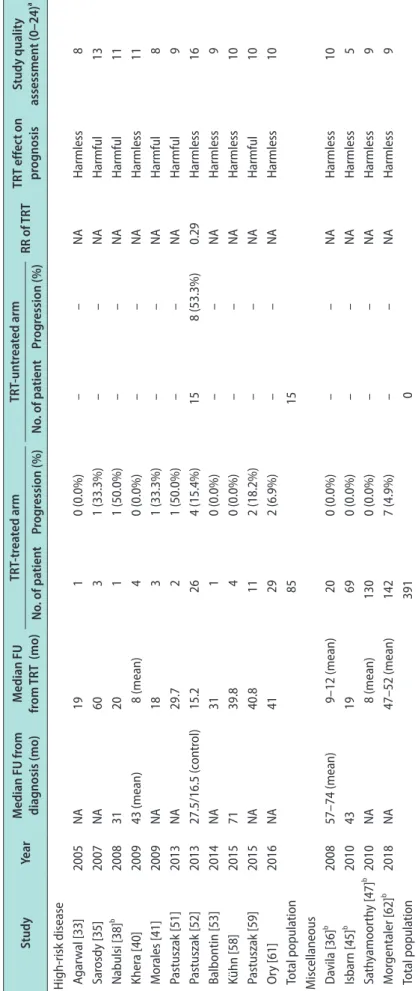
Table 3. Continued StudyYearMedian FU from diagnosis (mo) Median FU from TRT (mo)TRT-treated armTRT-untreated arm RR of TRTTRT effect on prognosisStudy quality assessment (0–24)a No. of patientProgression (%)No. of patientProgression (%) High-risk disease Agarwal [33]2005NA19 10 (0.0%)––NAHarmless8 Sarosdy [35]2007NA60 31 (33.3%)––NAHarmful13 Nabulsi [38]b 200831 20 11 (50.0%)––NAHarmful11 Khera [40]200943 (mean)8 (mean)40 (0.0%)––NAHarmless11 Morales [41]2009NA18 31 (33.3%)––NAHarmful8 Pastuszak [51]2013NA29.7 21 (50.0%)––NAHarmful9 Pastuszak [52]201327.5/16.5 (control)15.2 264 (15.4%)158 (53.3%)0.29Harmless16 Balbontin [53]2014NA31 10 (0.0%)––NAHarmless9 Kühn [58]201571 39.8 40 (0.0%)––NAHarmless10 Pastuszak [59]2015NA40.8112 (18.2%)––NAHarmful10 Ory [61]2016NA41292 (6.9%)––NAHarmless10 Total population8515 Miscellaneous Davila [36]b 200857–74 (mean)9–12 (mean)200 (0.0%)––NAHarmless10 Isbarn [45]b 201043 19690 (0.0%)––NAHarmless5 Sathyamoorthy [47]b 2010NA8 (mean)1300 (0.0%)––NAHarmless9 Morgentaler [62]b 2018NA47–52 (mean)1427 (4.9%)––NAHarmless9 Total population3910 TRT: testosterone replacement therapy, FU: follow-up, No.: number, RR: relative risks, NA: not available. a Evaluated using Methodological Index for Non-Randomized Studies (MINORS) [24]; b Only published in abstract forms; c Low to intermediate risk group.
for advanced disease (Table 2). The effects of TRT on the prognosis of the patients in each study were as- sessed and the qualities of evidences were evaluated.
In studies with local-intent modalities such as radical prostatectomy or radiation therapy, the effects of TRT on oncologic outcomes were assessed according to the risk groups (low, intermediate, and high; Table 3).
2) Secondary analysis (meta-analysis)
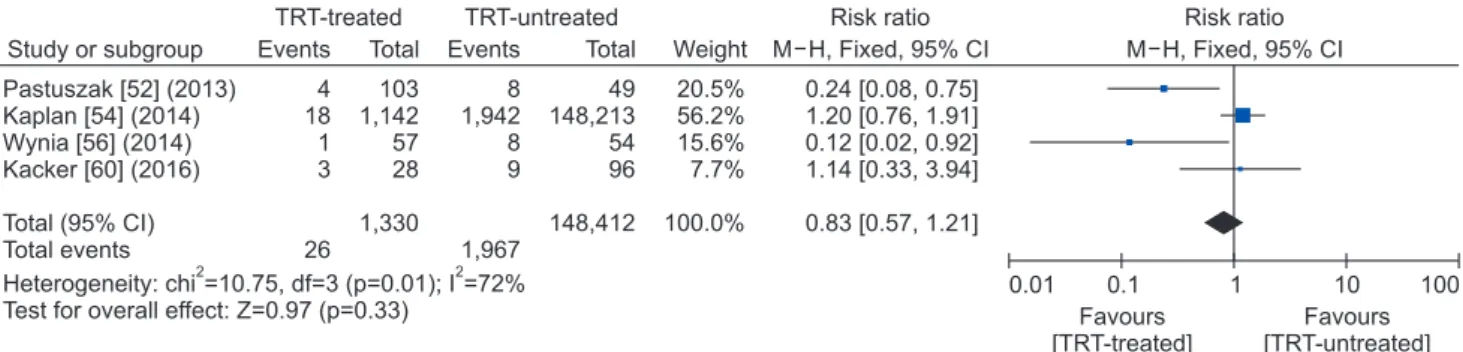
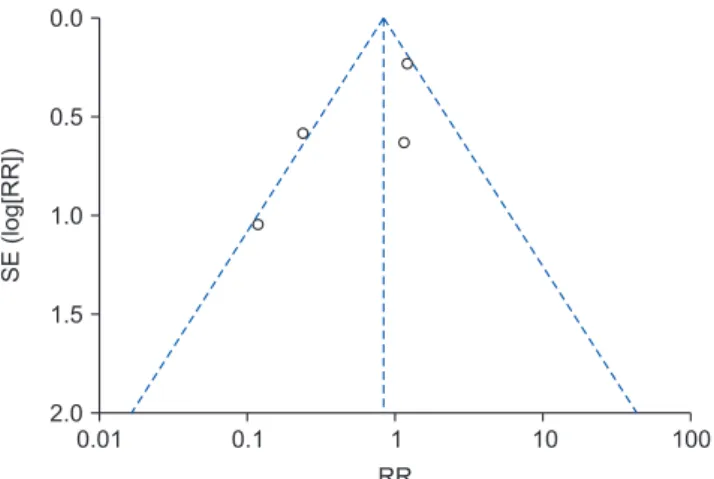
Using the double-armed studies, quantitative synthe- sis was performed to assess the risk of progression of prostate cancer in patients receiving TRT (Fig. 1). As a summarizing statistic for meta-analysis, the pooled RR was utilized. Owing to the relatively small number of selected studies, a fixed-effects model was adopted for meta-analysis. Weights between the studies were es- timated using the Mantel–Haenszel method to obtain the summary with a pooled RR and its 95% confidence interval (CI) [25]. A pooled RR >1 indicated increased risks for disease progression in the study group (TRT- treated group) relative to the reference group (TRT- untreated group), and would be considered statistically significant if the 95% CI did not overlap the pooled MD value of one, with p<0.05. Inter-study heterogene- ity was assessed using the Higgin’s H-test (I2 statistic) [26] and heterogeneity χ2 test [27], and p>0.05 indicated the absence of significant heterogeneity. Possibilities of publication bias were assessed by drawing a funnel plot [28]. A non-commercialized software (RevMan ver- sion 5.3.5; The Nordic Cochrane Center, The Cochrane Collaboration, Copenhagen, Denmark) was used for data synthesis.
5. Ethics statement
The present study protocol waived the requirement for approval by the institutional review board, because
we reviewed and analyzed already published articles.
RESULTS
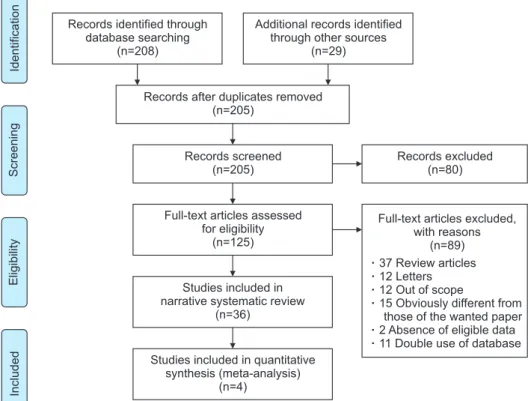
A methodological flow chart of the entire systematic review process is shown in Fig. 2. Our search strategy identified 208 articles (PubMed, 78 articles; Embase, 124 articles; Cochrane library database, 6 articles). Ad- ditionally, 29 articles were found by manual searching.
After removal of duplicates, 205 abstracts were inde- pendently screened by three independent reviewers.
After abstract screening, 125 articles were included for full text assessment. After careful review of the full articles, 89 articles were excluded for the follow- ing reasons: 37 were review articles, 12 were letters to the editor, 12 were out of scope, 15 covered the relevant subject but failed to satisfy the inclusion criteria in detailed methodology, 2 lacked eligibility data, and 11 studies were excluded owing to duplication of popula- tion. Eventually, 36 studies were selected for the nar- rative systematic review [7,8,29-62]. Among them, four studies had a double-armed design [52,54,56,60]; quan- titative synthesis was performed using these studies to assess the risk of prostate cancer progression in pa- tients receiving TRT.
1. Characteristics of included studies
The characteristics of the eligible studies are shown in Table 1. The 36 eligible studies included 2,459 TRT- treated patients, with a median number of 20 TRT- treated patients per study (range: 1–1,142). None of the selected studies were randomized prospective studies.
Of the 36 included studies, two were single-armed prospective studies [43,44], four were double-armed retrospective studies [52,54,56,60], and the remaining studies had single-armed retrospective features (case
Study or subgroup M H, Fixed, 95% CI
TRT-treated TRT-untreated Risk ratio
Pastuszak [52] (2013) Kaplan [54] (2014) Wynia [56] (2014) Kacker [60] (2016)
Total (95% CI) Total events
Heterogeneity: chi =10.75, df=3 (p=0.01); I =72%
Test for overall effect: Z=0.97 (p=0.33)
2 2
4 18 1 3
26 Events Total
103 1,142 57 28
1,330
8 1,942 8 9
1,967
Events Total 49 148,213 54 96
148,412
Weight 20.5%
56.2%
15.6%
7.7%
100.0%
M H, Fixed, 95% CI Risk ratio
0.24 [0.08, 0.75]
1.20 [0.76, 1.91]
0.12 [0.02, 0.92]
1.14 [0.33, 3.94]
0.83 [0.57, 1.21]
0.01 0.1 1 10 100
Favours [TRT-treated]
Favours [TRT-untreated]
Fig. 1. A forest plot assessing the risk ratio for prostate cancer progression in patients with or without testosterone replacement therapy (TRT), using the fixed-effects model. M–H: Mantel–Haenszel, CI: confidence interval, df: degree of freedom.