ABSTRACT
Purpose: Thyroglossal duct cyst is the most common congenital anomaly of the neck, and malignancy arising from a thyroglossal duct cyst occurs only in approximately 1% of patients.
Ultrasound examination and fine-needle aspiration should be performed to make an accurate diagnosis before surgery. Sistrunk operation is known as a surgical treatment for thyroglossal duct cyst. We describe the clinical characteristics of thyroglossal duct cyst carcinoma in eight cases and the treatment methods for each.
Methods: This is a retrospective study of thyroglossal duct cyst detected in patients undergoing surgery at two separate tertiary medical institutions in Korea from July 2006 to August 2020.
Results: Among 346 patients with thyroglossal duct cyst, eight were diagnosed with thyroglossal duct cyst carcinoma. In four out of these eight patients, cysts and thyroid nodules were observed, and thyroidectomy and Sistrunk operation were performed together.
Modified radical neck dissection was performed only in two patients with confirmed lymph node metastasis before surgery. All four patients who underwent total thyroidectomy and Sistrunk operation received radioactive iodine treatment and did not receive radiation therapy. None of the patients had distant metastasis.
Conclusion: Thyroglossal duct cyst carcinoma is rare, and an initial evaluation is critical in determining the extent of surgery. Fine needle aspiration should be performed in patients who are clinically diagnosed with thyroglossal duct cyst, and a thyroid ultrasound scan should also be performed.
Keywords: Thyroglossal duct cyst; Thyroid cancer; Fine-needle aspiration
INTRODUCTION
Thyroglossal duct cysts (TGDCs) are the most common congenital anomaly of thyroid development that occur in infancy and childhood and mostly present as midline neck masses (1). In general, the thyroid gland develops as a midline endodermal invagination in the foramen caecum during the third week of fetal development. At 7–8 weeks of intrauterine development, the thyroid gland reaches its normal position under the thyroid cartilage and descends through the thyroglossal duct (TGD). The TGD disappears physiologically at 10 weeks of fetal development. The remnants of the TGD will remain as cysts, ducts, or ectopic tissue (2,3).
Original Article
Received: Nov 1, 2020 Revised: Nov 30, 2020 Accepted: Dec 2, 2020 Correspondence to Yong Sang Lee
Department of Surgery, Thyroid Cancer Center, Gangnam Severance Hospital, Institute of Refractory Thyroid Cancer, Yonsei University College of Medicine, 211 Eonju-ro, Gangnam- gu, Seoul 06273, Korea.
E-mail: [email protected]
Copyright © 2020. Korean Association of Thyroid and Endocrine Surgeons; KATES This is an Open Access article distributed under the terms of the Creative Commons Attribution Non-Commercial License (https://
creativecommons.org/licenses/by-nc/4.0/).
ORCID iDs Hee Jun Kim
https://orcid.org/0000-0001-6549-381X Yong Sang Lee
https://orcid.org/0000-0002-8234-8718 Hang-Seok Chang
https://orcid.org/0000-0002-5162-103X Conflict of Interest
No potential conflict of interest relevant to this article was reported.
Authors Contributions
Conceptualization: Hee Jun Kim, Yong Sang Lee, Hang-Seok Chang; Data curation: Hee Jun Kim; Methodology: Yong Sang Lee; Writing - original draft: Hee Jun Kim.
Hee Jun Kim , Yong Sang Lee , Hang-Seok Chang
Department of Surgery, Thyroid Cancer Center, Gangnam Severance Hospital, Institute of Refractory Thyroid Cancer, Yonsei University College of Medicine, Seoul, Korea
Thyroid Cancer Arising from
Thyroglossal Duct Cyst
Although the prevalence of TGDC is approximately 7%, malignancy arising from a TGDC occurs only in approximately 1% of patients with TGDC, and papillary thyroid cancer (PTC) is the most common type (4). This malignant tumor was first reported by Brentano in 1911 (5). When a clinical diagnosis of a TGDC is made, it should be closely examined be using ultrasound scan, computed tomography (CT) scan, and fine-needle aspiration (FNA) test.
Examinations for TGDC carcinoma before surgery are performed to determine the optimal surgical extent and to plan radioactive iodine (RAI) treatment (6).
In general, the Sistrunk operation is the surgical procedure of choice for TGDC. This method of removing TGDC, the central part of the hyoid bone, and the tissues around the thyroglossal tract is the surgery of choice for low-risk patients. However, high-risk patients need additional surgical resection beyond this range (2,7).
In this report, a series of a rare case of papillary carcinoma arising from a TGDC is presented, its clinical characteristics are investigated, and an appropriate treatment method is sought along with a literature review.
MATERIALS AND METHODS
A retrospective chart review study was conducted at two separate tertiary medical institutions in Korea. The clinical records were reviewed between July 2006 and August 2020, and patients with a histological diagnosis of carcinoma of TGDC were identified. The patients' demographics, such as age, sex, surgical method, surgical extent, preoperative FNA results, site of TGDC, type of carcinoma, clinical course, postoperative radio-iodine ablation, and follow-up, were analyzed. This study was approved by the Institutional Review Board of Gangnam Severance Hospital (approval No. 3-2020-0415).
RESULTS
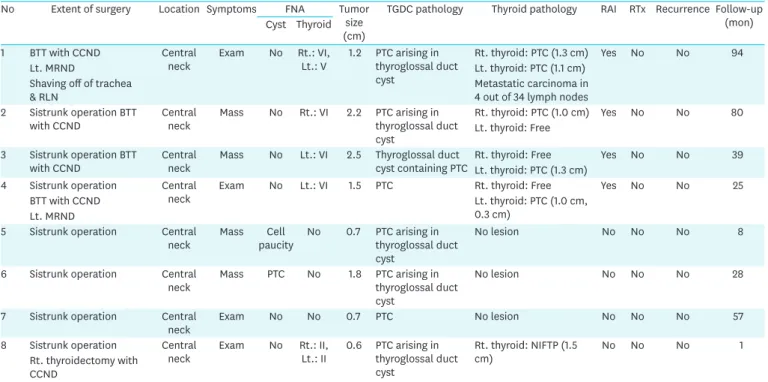
During the research period, 346 patients underwent TGDC surgery in two separate tertiary care centers; eight patients were diagnosed with papillary carcinoma arising from TGDC and underwent surgery. The female-to-male ratio was 7:1. The average age at the time of surgery was 42.25 years (range, 26–68 years). In four patients, the masses were noticeable or palpable, while the masses in the other four patients were accidentally discovered upon ultrasound examination of the thyroid gland. Two patients underwent FNA due to TGDC prior to surgery, one of which was reported as PTC and the other as inappropriate. Four patients (50%) had a coexisting thyroid carcinoma, all of which were PTC. The average tumor size was 1.6 mm (range, 0.6–2.5 mm). Four patients received RAI treatment and no recurrence was reported. The average follow-up period was 42 months (range, 1–94 months) (Tables 1 and 2).
All patients were included in an imaging study followed by surgery. In one patient, only the thyroid gland was imaged, and no cyst was observed. Of the eight patients, three had normal thyroid glands, and the five patients had nodules. According to histopathological findings, out of the five patients who underwent thyroidectomy, four patients had papillary thyroid cancer and one patient had noninvasive follicular thyroid neoplasm with papillary-like nuclear features (NIFTP).
Table 1. The image finding of TGDC, the thyroid gland, and LNs
No Operation Extent of surgery Age Sex Imaging finding
TGDC Thyroid LNs
1 MRND, left BTT with CCND 52 M Cyst not imaged Rt. thyroid with 1.5 cm lesion at
mid portion 0.8 cm LN at Lt.
submental area
Lt. MRND Lt. thyroid with 1.4 cm lesion
(extrathyroidal invasion) at mid portion close to the esophagus and the trachea
0.5 cm, 0.7 cm, 1.0 cm LNs at Lt. level IV
Shaving off of trachea &
RLN Lt. isthmus with 0.4 cm lesion
2 Sistrunk
operation Sistrunk operation BTT
with CCND 29 F 3 cm sized low-density cystic mass with calcification in anterior neck
Rt. thyroid with 1.0 cm lesion at
upper portion No nodes
3 Excision of thyroglossal duct cyst
Sistrunk operation BTT
with CCND 26 F 3 cm cystic lesion with solid component in midline of anterior neck
Lt. thyroid with 1.1 cm lesion at mid
portion No nodes
4 Sistrunk
operation Sistrunk operation 53 F 1.7 cm cystic lesion in Rt.
midline anterior neck Lt. isthmus with 1.0 cm lesion 1.1 cm metastatic LN at Lt. level III
BTT with CCND Lt. thyroid with 0.3 cm at upper
portion Left. MRND
5 Sistrunk
operation Sistrunk operation 28 F 1.4 cm cystic lesion with
calcification, solid component Normal thyroid No nodes 6 Sistrunk
operation Sistrunk operation 48 F 1.7 cm cystic lesion with
calcification Normal thyroid No nodes
7 Sistrunk
operation Sistrunk operation 34 F 1.5 cm ovoid hypoechoic Cystic
lesion Normal thyroid No nodes
8 Sistrunk
operation Sistrunk operation 68 F 1.1 cm cystic lesion with
calcification Rt. thyroid with 2.2 cm lesion at
mid portion No nodes
Rt. thyroidectomy with
CCND Lt. thyroid with multiple benign
nodules
PTC = papillary thyroid carcinoma; CCND = central compartment lymph node dissection; TGDC = thyroglossal duct cyst; BTT = bilateral total thyroidectomy;
MRND = modified radical neck dissection; RLN = recurrent laryngeal nerve; LN = lymph node.
Table 2. Clinicopathologic features of the patients in this case series
No Extent of surgery Location Symptoms FNA Tumor
size (cm)
TGDC pathology Thyroid pathology RAI RTx Recurrence Follow-up (mon) Cyst Thyroid
1 BTT with CCND Central
neck Exam No Rt.: VI,
Lt.: V 1.2 PTC arising in thyroglossal duct cyst
Rt. thyroid: PTC (1.3 cm) Yes No No 94
Lt. MRND Lt. thyroid: PTC (1.1 cm)
Shaving off of trachea
& RLN Metastatic carcinoma in
4 out of 34 lymph nodes 2 Sistrunk operation BTT
with CCND Central
neck Mass No Rt.: VI 2.2 PTC arising in thyroglossal duct cyst
Rt. thyroid: PTC (1.0 cm) Yes No No 80 Lt. thyroid: Free
3 Sistrunk operation BTT
with CCND Central
neck Mass No Lt.: VI 2.5 Thyroglossal duct
cyst containing PTC Rt. thyroid: Free Yes No No 39 Lt. thyroid: PTC (1.3 cm)
4 Sistrunk operation Central
neck Exam No Lt.: VI 1.5 PTC Rt. thyroid: Free Yes No No 25
BTT with CCND Lt. thyroid: PTC (1.0 cm,
0.3 cm) Lt. MRND
5 Sistrunk operation Central
neck Mass Cell
paucity No 0.7 PTC arising in thyroglossal duct cyst
No lesion No No No 8
6 Sistrunk operation Central
neck Mass PTC No 1.8 PTC arising in
thyroglossal duct cyst
No lesion No No No 28
7 Sistrunk operation Central
neck Exam No No 0.7 PTC No lesion No No No 57
8 Sistrunk operation Central
neck Exam No Rt.: II,
Lt.: II 0.6 PTC arising in thyroglossal duct cyst
Rt. thyroid: NIFTP (1.5
cm) No No No 1
Rt. thyroidectomy with CCND
FNA = fine-needle aspiration; TGDC = thyroglossal duct cyst; RAI = radioactive iodine; RTx = radiation therapy; BTT = bilateral total thyroidectomy; CCND = central compartment lymph node dissection; MRND = modified radical neck dissection; RLN = recurrent laryngeal nerve; PTC = papillary thyroid cancer; NIFTP = noninvasive follicular thyroid neoplasm with papillary-like nuclear features.
Among all cases, only Sistrunk operation was performed in three cases. In four cases, cystic lesion and thyroid nodules were identified on ultrasound images, and thyroidectomy and Sistrunk operation were performed together. In the first case, thyroid nodules and lateral neck lymph node were seen in the ultrasound image, but cystic lesion was not visible.
Furthermore, lateral neck node metastasis was confirmed by FNA test before surgery. Thus, total thyroidectomy and modified radical neck dissection (MRND) were performed. In another patient, lateral neck node metastasis was also confirmed and MRND was performed.
Four patients who underwent total thyroidectomy and Sistrunk operation did not have malignant disease or recurrence between 25 and 94 months (average 60 months). All patients received RAI treatment, and none received radiation therapy (RTx) No patients had distant metastasis.
DISCUSSION
TGDC is the most common midline neck cyst and is a congenital anomaly. It accounts for 70%
of congenital neck masses (8). In general, TGDC is benign but has been reported to undergo malignant transformation in approximately 1% of cases (9,10). Weiss and Orlich (9) reported that thyroid cysts and the thyroid gland were associated with thyroid papillary cancer in 11.4%
of 115 cases, and Chrisoulidou et al. (11) reported the same in 66% of six cases. In our study, four (50%) out of eight patients with TGDC had papillary thyroid cancer. Carcinoma arising from TGDC has an excellent prognosis and a metastasis rate of less than 2% (12).
In terms of sex distribution at the two tertiary institutions in our series, women outnumbered men. Türkyilmaz et al. (13) also reported a high distribution among women. However, some studies have reported that TGDC has the same distribution between men and women (14). In our study, seven out of eight patients with carcinomas arising from TGDC were women. This distribution might be due to geographic differences in Korea, where thyroid papillary cancer more commonly occurs in women than in men.
The main cause of patients visiting the hospital for TGDC is a mass that is visible, palpable, or infected. In cases where a mass is present, it is usually solitary, midline, and moves with swallowing, and when infected, it causes pain, fever, dysphagia, dyspnea, or could lead to a fistula (15). Among the patients we analyzed, four patients (50%) had been treated because of the presence of a palpable mass.
A detailed clinical history must be obtained to make an accurate diagnosis before surgery.
Making a diagnosis before surgery is difficult; therefore, imaging tests, such as ultrasound, neck CT, and magnetic resonance imaging, which help to determine whether the thyroid tissue is normal, are mainly performed. In general, an imaging test cannot confirm a malignant disease; therefore, an FNA test is performed as well. However, due to the hypocellularity of samples, only 66% of cases show accurate results (16). In our study, FNA test was performed in only two of the seven cases where a cystic lesion was detected upon preoperative imaging examination. A diagnosis of PTC was made in one case, and in the other case, a diagnosis could not be made due to hypocellularity.
Much controversy exists over the extent of surgical treatment for carcinomas arising from TGDC. Some consider a Sistrunk operation as sufficient, while others recommend both a Sistrunk operation and a total thyroidectomy (12,14,17). Sistrunk operation was introduced
in 1920 by Sistrunk as a procedure for removing structures that make up a cyst, its tract, the middle part of the hyoid bone, and the base of the tongue (18). The recurrence rate was reduced to 3%–6% compared with that of the previous techniques in which a simple incision is made to drain the cyst and remove the middle part of the hyoid bone along with cyst.
Currently, the Sistrunk operation is the standard surgical technique that is performed (13,19).
Sistrunk operation is a safe procedure with few complications. The major complications (abscess, hematoma, nerve palsies etc.) are known to be extremely rare (15).
Most surgeons determine surgical strategies based on risk stratification and perform Sistrunk operation in clinically low risk patients with normal thyroid glands. Total thyroidectomy is also performed in high-risk patients and in patients with a positive thyroid FNA test. This is because performing total thyroidectomy generally is a way to cause lifelong hormone replacement therapy and possible complications in low-risk patients. In a review study involving more than five cases, the average rate of Sistrunk operation and total thyroidectomy performed together was 46.3% (20).
In our study, 50% (four out of eight cases) were had thyroid cancer. Sistrunk operation and total thyroidectomy were performed in three cases, right total thyroidectomy and Sistrunk operation were performed together in one case, and only Sistrunk operation was performed in three cases. In two cases, modified radical neck dissection was performed because a metastasis node was present in the lateral part of the neck.
CONCLUSION
Carcinomas arising from TGDCs are rare and were reported in only eight cases out of the 346 cases we reviewed. An initial evaluation, which is important in determining the extent of surgery, should be properly performed because of lack of a clear guideline on the extent of surgery or the need for adjuvant therapy, such as RAI or RTx. Therefore, in order to make accurate preoperative diagnosis of malignancies and to determine the extent of surgery, TGDC, thyroid ultrasound scans and FNA tests should be performed for patients who have been clinical diagnosed with TGDC.
The analysis of the results of the cases reviewed here suggests that the surgical method and conservative management suitable for each patient should be performed according to the preoperative examination results of TGDC, and continuous observation and examination are required.
REFERENCES
1. Heshmati HM, Fatourechi V, van Heerden JA, Hay ID, Goellner JR. Thyroglossal duct carcinoma: report of 12 cases. Mayo Clin Proc 1997;72:315-9.
PUBMED | CROSSREF
2. Kartini D, Panigoro SS, Harahap AS. Sistrunk procedure on malignant thyroglossal duct cyst. Case Rep Oncol Med 2020;2020:6985746.
PUBMED | CROSSREF
3. Plaza CP, López ME, Carrasco CE, Meseguer LM, Perucho AL. Management of well-differentiated thyroglossal remnant thyroid carcinoma: time to close the debate? Report of five new cases and proposal of a definitive algorithm for treatment. Ann Surg Oncol 2006;13:745-52.
PUBMED | CROSSREF
4. Rayess HM, Monk I, Svider PF, Gupta A, Raza SN, Lin HS. Thyroglossal duct cyst carcinoma: a systematic review of clinical features and outcomes. Otolaryngol Head Neck Surg 2017;156:794-802.
PUBMED | CROSSREF
5. Brentano H. Struma aberrata lingual mit druzen metastasen. Dtsch Med Wochenschr 1911;37:665-6.
6. George P, Mani S, Telugu RB, Michael RC. Management of the thyroid gland in papillary carcinoma of the thyroglossal cyst: a case report. JNMA J Nepal Med Assoc 2020;58:497-500.
PUBMED | CROSSREF
7. Wood CB, Bigcas JL, Alava I, Bischoff L, Langerman A, Kim Y. Papillary-type carcinoma of the
thyroglossal duct cyst: the case for conservative management. Ann Otol Rhinol Laryngol 2018;127:710-6.
PUBMED | CROSSREF
8. Shahin A, Burroughs FH, Kirby JP, Ali SZ. Thyroglossal duct cyst: a cytopathologic study of 26 cases.
Diagn Cytopathol 2005;33:365-9.
PUBMED | CROSSREF
9. Weiss SD, Orlich CC. Primary papillary carcinoma of a thyroglossal duct cyst: report of a case and literature review. Br J Surg 1991;78:87-9.
PUBMED | CROSSREF
10. Dedivitis RA, Guimarães AV. Papillary thyroid carcinoma in thyroglossal duct cyst. Int Surg 2000;85:198-201.
PUBMED
11. Chrisoulidou A, Iliadou P, Doumala E, Mathiopoulou L, Boudina M, Alevizaki M, et al. Thyroglossal duct cyst carcinomas: is there a need for thyroidectomy? Hormones (Athens) 2013;12:522-8.
PUBMED | CROSSREF
12. Park MH, Yoon JH, Jegal YJ, Lee JS. Papillary thyroglossal duct cyst carcinoma with synchronous occult papillary thyroid microcarcinoma. Yonsei Med J 2010;51:609-11.
PUBMED | CROSSREF
13. Türkyilmaz Z, Sönmez K, Karabulut R, Demirgoullari B, Sezer C, Basaklar AC, et al. Management of thyroglossal duct cysts in children. Pediatr Int 2004;46:77-80.
PUBMED | CROSSREF
14. Allard RH. The thyroglossal cyst. Head Neck Surg 1982;5:134-46.
PUBMED | CROSSREF
15. Zaman SU, Ikram M, Awan MS, Hassan NH. A decade of experience of management of thyroglossal duct cyst in a tertiary care hospital: differentiation between children and adults. Indian J Otolaryngol Head Neck Surg 2017;69:97-101.
PUBMED | CROSSREF
16. Bardales RH, Suhrland MJ, Korourian S, Schaefer RF, Hanna EY, Stanley MW. Cytologic findings in thyroglossal duct carcinoma. Am J Clin Pathol 1996;106:615-9.
PUBMED | CROSSREF
17. Kennedy TL, Whitaker M, Wadih G. Thyroglossal duct carcinoma: a rational approach to management.
Laryngoscope 1998;108:1154-8.
PUBMED | CROSSREF
18. Sistrunk WE. The surgical treatment of cysts of the thyroglossal tract. Ann Surg 1920;71:121-2.
PUBMED | CROSSREF
19. Wagner G, Medina JE. Excision of thyroglossal duct cyst: the Sistrunk procedure. Oper Tech Otolayngol Head Neck Surg 2004;15:220-3.
CROSSREF
20. Patel SG, Escrig M, Shaha AR, Singh B, Shah JP. Management of well-differentiated thyroid carcinoma presenting within a thyroglossal duct cyst. J Surg Oncol 2002;79:134-9.
PUBMED | CROSSREF