신경재활치료과학 제6권 제2호
Therapeutic Science for Neurorehabilitation Vol. 6. No. 2. 2017.
Does a cognitive-exercise combined dual-task training have better clinical outcomes for the elderly people with mild cognitive impairment than a
single-task training?
Jin-Hyuck Park*
*Department of Occupational Therapy, Kyungbok University
국문초록
Abstract
Objective: This study was to develop and verify the effects of the exercise-cognitive combined dual-task training program on cognitive function and depression of the elderly with mild cognitive impairment(MCI).
Methods: The subjects were randomly assigned to the exercise-cognitive combined dual-task training group(n=32) or single-task training group(n=31). To identify the effects on cognitive function, general cognitive function, frontal lobe function, and attention/working memory were measured. Depression was evaluated using Korean version of Geriatric Depression Scale. The outcome measurements were performed before and after the 8 weeks of intervention(2 days per week).
Results: After 8 weeks, general cognitive function, frontal cognitive function, attention/working memory function, depression of the dual-task training group were significantly increased than those of the single-task training group(p<0.05).
Conclusion: The results indicated that an exercise-cognitive combined dual-task training for MCI was effective in improving general cognitive function, frontal /executive function, attention/working memory function and reducing depression.
Key words: Cognitive function, Depression, Dual-task training, Mild cognitive impairment
교신저자 :박진혁([email protected]) || 접수일: 2017. 8. 3 || 심사일: 2017. 8. 11
|| 게재승인일: 2017. 8. 18
Ⅰ. Introduction
Recently, the incidence of dementia, representative chronic disease among the elderly has been increasing due to the rapidly aging society in Korea. Accordingly, the awareness of mild cognitive impairment (MCI), pre-dementia stage has increased. 12~30% of the pa- tients with MCI develops into dementia of Alzheimer's type or vascular dementia with the growth of ageing population(Ministry of Health & Welfare, 2012).
Generally, MCI exhibits marked memory deterioration although intellectual ability or activities of daily living are maintained and also shows partial cognitive dys- function in terms of language skill, spatio-temporal divi- sion, and frontal lobe functioning(Winblad et al., 2014).
The elderly with MCI accompanies emotional symptoms including mood and behavioral symptoms as well as cognitive deterioration and among which, the rate of those who suffer from depression is 20.1~44.3%(Panza et al., 2010). Among the emotional symptoms, the rate of depression occupies the most. If depression occurs, hippocampus and anterior cingulate cortex deteriorate due to neurochemical change, which leads to memory deterioration(Bremner, Vythilingam, Bermetten, Vaccarino, & Charney, 2004). Therefore, cognitive func- tion is closely related to depression. If depressive symp- toms are severe, there is a clear deterioration in frontal lobe executive function and cognitive intelligence such as attention, inhibition ability, working memory, and spatio-temporal function declines(Chui, Cheung, & Lam, 2011), which can be interpreted that if it is accom- panied with depression, it adds to extensive cognitive decline.
For such reasons, there is an increasing interest in pharmacologic/non-pharmacologic intervention for im- proving cognitive and emotional functions in MCI and various interventions are attempted, but it is difficult to
check the effectiveness of each intervention because its specific therapeutic method differs and each inter- vention shows different study findings. The interventions for treating MCI are mostly single task-centered inter- ventions such as exercise therapy and cognitive therapy in the exercise or medical fields. Each intervention pro- gram has limitations in that the standards for the type or frequency of single task are not clear and the differ- ence in the effectiveness due to repetition of single task is not clearly identified. Also, cognitive therapy was commonly effective for memory only in terms of the ef- fectiveness of intervention and exercise therapy did not show a consistent effect in memory, emotional, and ex- ecutive ability(Kim, Han, Heo, Kang, & Jeon, 2011).
Therefore, diversified and complex intervention needs to be developed for the prevention and delay of the de- mentia in the elderly with MCI(Lee & Park, 2007).
As non-pharmacologic therapy related to dementia, combined therapy has already been applied a lot com- pared to other fields of study in the medical field(Kim, Park, & Kim, 2012) and the intervention for treating MCI has attempted to develop complex intervention for improving emotional functions as well as cognitive ones(Lee & Park, 2007; Ji & Kim, 2014) but there are few relevant studies. One of the complex intervention methods that can be considered in relation to MCI is dual task, which indicates that while performing one task, one can perform another task or continue to per- form two or more tasks constantly and simultaneously.
Dual task performance is associated with working mem- ory capability or executive function among cognitive functions(Springer, Gilade, Peretz, Yogev, Simon, &
Hausdorff, 2006). If both working memory capability and execution function continue to deteriorate in the patients with MCI, it may lead to a higher risk of devel- oping into dementia(Makizako, Doi, Shimada, Yoshida, Takayama, & Suzuki, 2013). If performing dual task, cer- ebral blood flow(CBF) increases(Erickson et al., 2007), a
much wider area of brain is activated than performing a single task(Lee & Lee, 2007), and cognitive function is influenced. The dual task related to the improvement of cognitive function performs exercise therapy and cogni- tive therapy simultaneously and thus is a complex form that influences the performance of one side or both sides(Michael, Tania, Peter, & Klaus, 2010). When the elderly with MCI were applied aerobic exercise, mus- cle-boosting exercise, or program designed to stimulate cognitive function, 79.2% of the experiment group showed improved cognitive functions(Makizako, Doi, Shimada, Yoshida, Takayama, & Suzuki, 2013) and inter- vention had a positive effect on cognitive and behav-
ioral or psychological symptoms in the cognitive pro- gram combined with exercise(Tay, Lim, Chan, & Chong, 2016). The application of complex tasks similar to dual task has a positive effect on not only cognitive function but also self-efficacy, depression, and quality of life(Michael, Tania, Peter, & Klaus, 2010; Park et al., 2013; Kim, Han, & Lee, 2014; Ji & Kim, 2014) and thus is considered as an appropriate intervention method for patients with MCI. So this seems to be the very time to develop interventions using various dual tasks and verify the effectiveness.
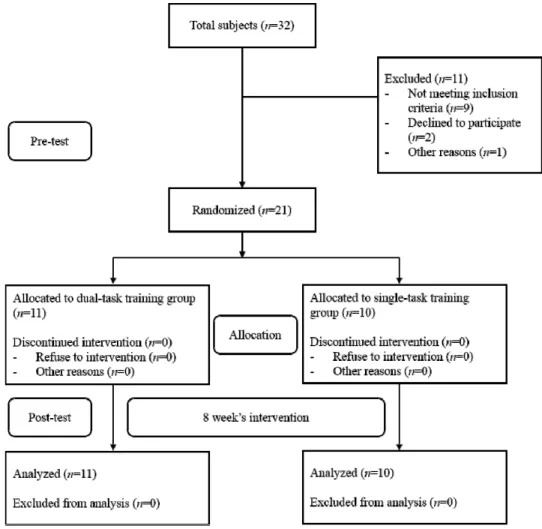
Figure 1. Flow diagram of subjects in the study
Ⅱ. Methods
1. Design
This study was a single-blind study, and subjects were allocated randomly to the dual-task or single- task training group. Randomization was computer-generated by one occupational therapist who was not involved in subject recruitment. All assessors were blinded to group allocation. This study was conducted for 8 weeks, and subjects were assessed before and after the intervention.
This study was approved by the local research ethics committee. All subjects provided informed consent be- fore study inclusion according to the Declaration of Helsinki (2004).
2. Subjects
Elderly people over 60 years old with amnestic MCI recruited from a local community welfare center in Korea. In total, 32 elderly subjects were pre-screened by a blinded assessor, and 21 were selected (Figure 1).
The inclusion criteria derived from a previous study(Petersen, 2004). The inclusion criteria were as fol- lows: (a) subjective memory complaint, (b) MCI was de- fined by Korean version of Montreal Cognitive Assessment ≤ 26, and (c) intact activities of daily living as determined by the Seoul-instrumental activities of daily livings score ≥ 8. Exclusion criteria were as fol- lows: (a) neurological, psychiatric, or medical disorders, (b) absence of auditory, visual, motor or language im- pairments that would hinder use of a computer, and (c) participation in cognitive training within 3 months, and (e) the diagnosis of dementia was confirmed by a neurologist.
The author conducted the dual task and single task
training inside of a community welfare center. Each training was conducted by the author who had more than 3 years of clinical experience in occupational therapy. The subjects performed only the intervention which is assigned to each group.
3. Intervention
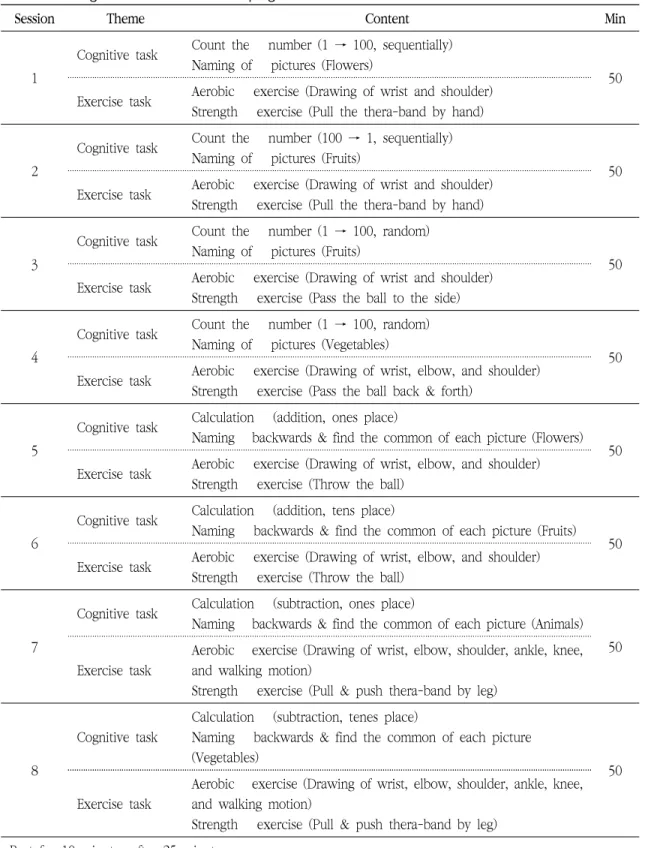
The program used in this study was an intervention program designed to improve the cognitive function of the elderly with MCI and reduce depression and con- ducted referring to ‘Cognitive Dual Task Training Program’(Michael, Tania, Peter, & Klaus, 2010; Kim et al., 2014). Each session started from a simple dual-task form to a more complex form of dual-task perform- ance(Table1). Intervention was performed twice a week:
8 weeks in total and for 60 minutes per session.
Program was directed by the author and aided by one assistant instructor. Dual-task training group performed the entire program twice by performing cognitive train- ing and exercise program simultaneously and single-task training group performed the entire program once by performing cognitive training and exercise program by turns per session.
4. Measurement
The evaluation was completed before the intervention. The same evaluation was conducted after 8 weeks. One occupational therapist who not involved the intervention with more than 5 years of experience con- ducted all the evaluations.
1) General cognitive function
Overall cognitive function was measured by using the Korean Version of Montreal Cognitive Assessment
Session Theme Content Min
1
Cognitive task Count the number (1 → 100, sequentially) Naming of pictures (Flowers)
50 Exercise task Aerobic exercise (Drawing of wrist and shoulder)
Strength exercise (Pull the thera-band by hand)
2
Cognitive task Count the number (100 → 1, sequentially) Naming of pictures (Fruits)
50 Exercise task Aerobic exercise (Drawing of wrist and shoulder)
Strength exercise (Pull the thera-band by hand)
3
Cognitive task Count the number (1 → 100, random) Naming of pictures (Fruits)
50 Exercise task Aerobic exercise (Drawing of wrist and shoulder)
Strength exercise (Pass the ball to the side)
4
Cognitive task Count the number (1 → 100, random) Naming of pictures (Vegetables)
50 Exercise task Aerobic exercise (Drawing of wrist, elbow, and shoulder)
Strength exercise (Pass the ball back & forth)
5
Cognitive task Calculation (addition, ones place)
Naming backwards & find the common of each picture (Flowers) 50 Exercise task Aerobic exercise (Drawing of wrist, elbow, and shoulder)
Strength exercise (Throw the ball)
6
Cognitive task Calculation (addition, tens place)
Naming backwards & find the common of each picture (Fruits) 50 Exercise task Aerobic exercise (Drawing of wrist, elbow, and shoulder)
Strength exercise (Throw the ball)
7
Cognitive task Calculation (subtraction, ones place)
Naming backwards & find the common of each picture (Animals) 50 Exercise task
Aerobic exercise (Drawing of wrist, elbow, shoulder, ankle, knee, and walking motion)
Strength exercise (Pull & push thera-band by leg)
8
Cognitive task
Calculation (subtraction, tenes place)
Naming backwards & find the common of each picture (Vegetables)
50
Exercise task
Aerobic exercise (Drawing of wrist, elbow, shoulder, ankle, knee, and walking motion)
Strength exercise (Pull & push thera-band by leg) Rest for 10 minutes after 25 minutes
Table 1. The cognitive-exercise combined program
(MoCA-K)(Lee et al., 2008). MoCA-K consists of six areas such as visuospatial/executive ability, vocabulary ability, memory, attention, writing ability, ab- straction/delayed remembrance, and orientation and score 30 points as perfect score. If it scored less than 22 points, it was classified as MCI and if the score got higher, the cognitive function got higher. MoCA-K’s Cronbach's ⍺ was .86 and in this study, Cronbach's ⍺ was .79.19
2) Frontal lobe functioning
Frontal lobe functioning was measured with Frontal Assessment Battery (FAB) and Korean-Color Word Stroop Test (K-CWST)(Kang, Jang, & Na, 2012). FAB consisted of six items such as intellectualization and abstract thinking, thinking flexibility and verbal fluency, motion planning, and reaction to extraneous intervention, in- hibitory regulation, and automaticity. The maximum score per item was 3 points and the minimum score 0.
The total score was 18 points. This suggested that the higher the score, the higher the frontal lobe functioning.
The Stroop Color-Word Test contains color words print- ed in an incongruous ink color, for example, the word blue printed in green ink. The subjects were asked to read the words, name the ink color of the printed words as quickly and as accurately as possible. It is used to assess the frontal lobe executive function.
3) Attention/Working memory
It was measured using the Tests the Wechsler Adult Intelligence Scale Digit Span sub-test. It consists of two separate tasks (Digit Span Forward and Digit Span Backward) which required subjects to listen to a string of digits and repeat back the numbers in the same or- der or reverse order. This indicate that the score got higher, the attention/working memory got high- er(Wechsler, 2008).
4) Depression
The standardized Korean version of Geriatric Depression Scale (K-GDS)22 was used as depression measurement scale. This scale consisted of 30 questions in total and was made to be answered‘Yes’or‘No.’It was rated‘0’or‘1’per question. The tallied score of points for each question was total score and the higher the score, the more severe the degree of depression. The possible range of score was from 1point min to 30 points max.
14-18 points indicate borderline level and mild depres- sion, 19-21 points indicate moderate depression, 22 points or higher indicate severe depression. Cronbach's
⍺ was. 88(Jung et al., 1997).
5. Statistical analysis
SPSS for Windows (version 22.0) was used to analyze the data in this study. All measurements were described as mean value ± standard deviation. The Shapiro-Wilk test was used to determine the normal distribution of the general characteristics and outcome measures of the subjects. To compare the general characteristics of the subjects between both groups, Chi-square test and in- dependent t-test were used. After the intervention, the author examined the difference between eyeball and functional exercises. The author used repeated-measures analysis of variance (ANOVA) with pre- and post- inter- vention as the within group variable, and dual-task and single-task training as the between-group variable. The effect size (ES) of each intervention group was calcu- lated using partial η2 value. Partial η2≥.14 was con- sidered a large effect; between ≥ .06 and < .14, mod- erate effect; between≥ .01 and < .06, small ef- fect(Cohen, 1988). The level of statistical significance was accepted at p < 0.05.
Ⅲ. Results
1. Subjects’ characteristics
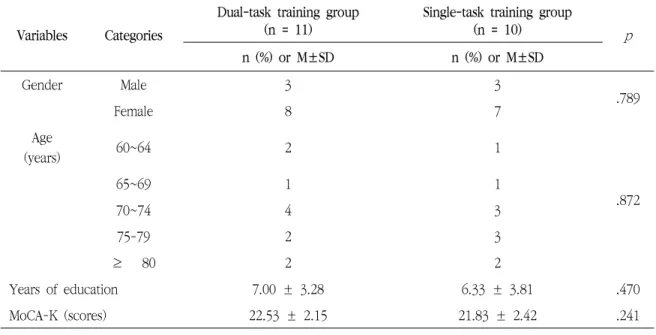
There were no statistically significant differences in subjects’ characteristics between both groups (Table 2).
2. General cognitive function
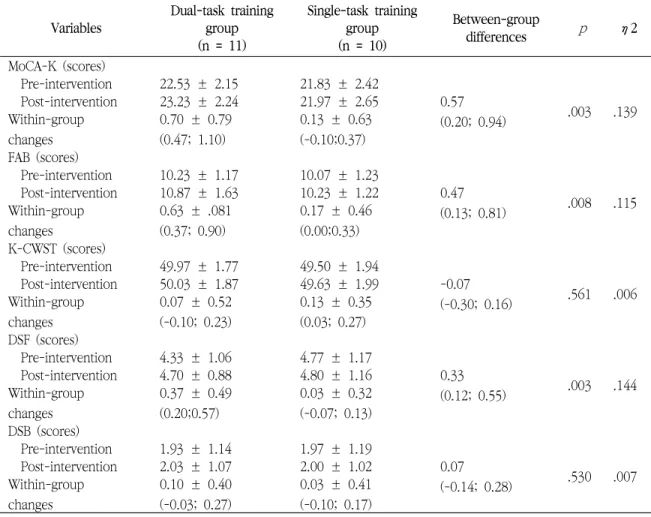
Table 3 showed the clinical outcomes. Repeated-meas- ure ANOVA indicated that group × time interaction was significant for MoCA-K (p = .003; η2 = .139), indicating significant difference between both groups in general cognitive function.
3. Frontal lobe function
Repeated-measure ANOVA indicated that group × time interaction was significant FAB (p = .008; η2=.115).
However, there was no significant in group × time inter- action for K-CWST (p = .561; η2 = .006)(Table 3).
4. Attention/Working memory
Repeated-measure ANOVA indicated that group × time interaction was significant for DSF (p = .003; η2
= .144). However, there was no significant in group × time interaction for DSB (p = .530; η2 = .007)(Table 3) Variables Categories
Dual-task training group (n = 11)
Single-task training group
(n = 10) p
n (%) or M±SD n (%) or M±SD
Gender Male 3 3
Female 8 7 .789
Age
(years) 60~64 2 1
.872
65~69 1 1
70~74 4 3
75-79 2 3
≥ 80 2 2
Years of education 7.00 ± 3.28 6.33 ± 3.81 .470
MoCA-K (scores) 22.53 ± 2.15 21.83 ± 2.42 .241
MoCA-K=Korean version of Montreal Cognitive Assessment
Table 2 Subjects' characteristics in both groups (N=21)
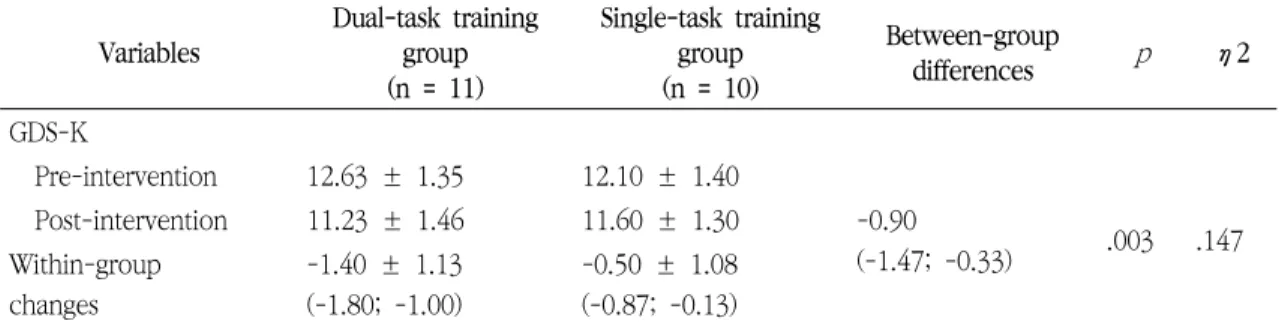
5. Depression
Table 4 showed the clinical outcomes. Repeated-meas- ure ANOVA indicated that group × time interaction was significant for GDS-K (p = .003; η2 = .147), indicating significant difference between both groups in depression.
Ⅳ. Discussion
This study was conducted to identify the effects of exercise and cognitive dual-task program on cognitive functions and depression in the elderly with mild cogni- tive impairment. Dual-task training group showed sig- nificantly improved functions in general cognitive func- tion, frontal lobe functioning, and attention/working memory function after applying the exercise and cogni- tive dual-task program. Also, the difference in average Variables
Dual-task training group (n = 11)
Single-task training group (n = 10)
Between-group
differences p η2
MoCA-K (scores)
Pre-intervention 22.53 ± 2.15 21.83 ± 2.42
0.57
(0.20; 0.94) .003 .139
Post-intervention 23.23 ± 2.24 21.97 ± 2.65 Within-group
changes
0.70 ± 0.79 (0.47; 1.10)
0.13 ± 0.63 (-0.10;0.37) FAB (scores)
Pre-intervention 10.23 ± 1.17 10.07 ± 1.23
0.47
(0.13; 0.81) .008 .115
Post-intervention 10.87 ± 1.63 10.23 ± 1.22 Within-group
changes
0.63 ± .081 (0.37; 0.90)
0.17 ± 0.46 (0.00;0.33) K-CWST (scores)
Pre-intervention 49.97 ± 1.77 49.50 ± 1.94
-0.07
(-0.30; 0.16) .561 .006
Post-intervention 50.03 ± 1.87 49.63 ± 1.99 Within-group
changes
0.07 ± 0.52 (-0.10; 0.23)
0.13 ± 0.35 (0.03; 0.27) DSF (scores)
Pre-intervention 4.33 ± 1.06 4.77 ± 1.17
0.33
(0.12; 0.55) .003 .144
Post-intervention 4.70 ± 0.88 4.80 ± 1.16 Within-group
changes
0.37 ± 0.49 (0.20;0.57)
0.03 ± 0.32 (-0.07; 0.13) DSB (scores)
Pre-intervention 1.93 ± 1.14 1.97 ± 1.19
0.07
(-0.14; 0.28) .530 .007
Post-intervention 2.03 ± 1.07 2.00 ± 1.02 Within-group
changes
0.10 ± 0.40 (-0.03; 0.27)
0.03 ± 0.41 (-0.10; 0.17)
Note: Values are means as standard deviation for pre and post-intervention data and as mean (95% confidence interval) for within and between-group changes.
MoCA-K, Korean version of Montreal Cognitive Assessment; FAB, Frontal Assessment Battery; K-CWST, Korean Color Word Stroop Test; DSF, Digit Span Forward; DSB, Digit Span Backward.
*Significant group x time interaction (p < 0.05).
Table 3. Cognitive functions in both groups (N=21)
in dual-task training group improved significantly after intervention compared to single-task training group, which suggested that the dual-task training was effective.
As a result of evaluating the general cognitive func- tion through Cognitive Capacity Screening Examination (CCSE) in a study that applied cognitive and exercise dual-task to stroke subjects similarly to this study de- spite the difference in subjects and measurement scale(Kim, Han, & Lee, 2014), cognitive functions were found to be improved, which was consistent with the results of this study. Also, in a study that applied a complex program with cognitive stimulation and ex- ercise combined in the same context as dual-task to the elderly in the community(Park et al., 2013), MMSE-K score, the general cognitive function was improved. On the contrary, in a study that applied exercise program, a single-task form to the elderly with MCI(Kim et al., 2013), no MMSE-K changes were found and in a study that performed a single-task cognitive training pro- gram(Jean et al., 2010) as well, memory showed limited improvements. The characteristic symptoms of mild cognitive impairment include extensive cognitive func- tion deterioration as the ‘memory disorder’ or mild cog-
nitive impairment progresses. Therefore, it seems that complex tasks in the same form of dual-task by consid- ering the regions where the cognitive functions of brain deteriorate is more effective for improving overall cog- nitive function rather than a single task that acts to a particular function of brain.
As a result of analyzing the frontal lobe functioning by dividing it into frontal lobe cognitive function and frontal lobe executive function, it was found that the frontal lobe cognitive function in dual-task training group increased significantly more than single-task training group, whereas the frontal lobe executive func- tion did not show any significant difference in average between the two groups. Frontal lobe cognitive function was relatively low as it scored 10.23 point on average before intervention, but Andrea et al. (2004) demon- strated that the frontal lobe cognitive function value in the elderly with dementia was 7.6 point, which sug- gested that the frontal lobe cognitive function was high- er than the group with dementia(Andrea et al., 2004).
As there are no study findings drawn by using the same tool targeting the subjects with mild cognitive impair- ment, it is difficult to compare, but in this study, the frontal lobe cognitive function has significantly improved Variables
Dual-task training group (n = 11)
Single-task training group (n = 10)
Between-group
differences p η2
GDS-K
Pre-intervention 12.63 ± 1.35 12.10 ± 1.40
-0.90
(-1.47; -0.33) .003 .147 Post-intervention 11.23 ± 1.46 11.60 ± 1.30
Within-group changes
-1.40 ± 1.13 (-1.80; -1.00)
-0.50 ± 1.08 (-0.87; -0.13)
Note: Values are means as standard deviation for pre and post-intervention data and as mean (95% confidence interval) for within and between-group changes.
GDS-K, Korean Form of Geriatric Depression Scale.
*Significant group x time interaction (p < 0.05).
Table 4. Depression in both groups (N=21)
in dual-task training group after intervention. The fron- tal lobe executive function did not show a significant difference between both groups, but the frontal lobe executive function was improved more greatly in du- al-task training group than in single-task training group.
Takeuchi et al. (2014) who applied cognitive and ex- ercise dual-task to stroke patients demonstrated that frontal lobe executive function improved(Takeuchi et al., 2014), where as Han et al.(2008) applied a single task cognitive enhancing program to the elderly with MCI, but memory only showed a significant effect and exec- utive function did not produce any effects(Han et al., 2008). This suggests that dual-task program has a pos- itive effect on the frontal lobe executive function com- pared to single-task program. Also, dual-task perform- ance, unlike single-task, is closely related to executive functions that bring about changes in abstract thinking, inhibition ability, and social behavior and executive function largely happens in frontal lobe(Andrea et al., 2004). Therefore, it can be predicted that repeated du- al-task performance has a positive effect on improving executive function and cognitive function in frontal lobe. If MCI occurs, executive function deteriorates and if it develops into dementia, executive function deterio- rates significantly. In this respect, it is necessary to have an intervention strategy to apply a dual-task that is di- rectly related to executive function.
In case of attention/working memory function,
‘immediate memorizing of numbers’ improved sig- nificantly in dual-task training group than in single-task training group. Although it is difficult to make a direct comparison as there are few studies on mild cognitive impairment, there is a high risk of developing into vas- cular dementia, and in case of stroke patients whose cognitive function was likely to decline, their attention increased significantly when applying a dual-task per- formance program(Hyndman, Pickering, & Ashburn, 2009; Kizony, Levin, Hughey, Perez, & Fung, 2010) and
their attention/working memory function showed a sig- nificant difference(Kim, Han, & Lee, 2014), which proved that the application of dual-task would be effective. On the other hand, in a study that performed a single-task training using a computer, general old people showed significant changes in frontal lobe, whereas the elderly with dementia who had cognitive impairment showed no significant changes(Kang, Kang, Yang, Koo, & Kim, 2009). This study also revealed pos- itive effects on attention/working memory function, which is consistent with the finding that the wider sec- tion of the brain including frontal cortex and parietal lobe related to working memory was more activated in the dual-task condition than in the single-task one(Michael, Tania, Peter, & Klaus, 2010), which sug- gests that the dual-task performance can improve the attention/working memory function. The application of dual-task rather than single-task to subjects with MCI whose cognitive function deterioration had progressed to some extent like dementia would be effective for im- proving attention concentration/working memory function. However, ‘memorizing numbers backwards’did not show a significant difference and so it seems neces- sary to keep studying the application of dual-task to subjects with cognitive function deterioration and atten- tion concentration/working memory function.
This study evaluated the GDS-K to identify the ef- fects of exercise and cognitive dual-task program on the degree of depression in the elderly with mild cogni- tive impairment. As a result of applying the dual-task program, it was found that the depression score after intervention was reduced more significantly in dual-task training group than in single-task training group. In studies on cognitive training program combined with laughter that is performed complexly similarly to the dual-task performance without repeating single-task(Ji &
Kim, 2014) and integrated cognitive intervention pro- gram(Eckroth-Bucher & Siverski, 2009), when each pro-
gram was applied to the elderly with MCI, the depres- sion level as well as cognitive function was significantly reduced, similarly to this study. On the other hand, in Han et al.(2008) who applied cognitive ability improve- ment program, a single-task to the elderly with MCI, there was an improvement in the memory related func- tion only and no significant influence in depression(Han et al., 2008). This seems to suggest that as the existing cognitive function training program consisted of passive single-tasks including education and repeated memo- rization of words, it would not be effective for such emotional symptoms like depression. Also, the sin- gle-task that applied music or exercise to the subjects with MCI showed a significant effect in depression on- ly(Kim & Yang, 2013), which represents that it has limi- tations in that it is common that every single-task shows effects in cognitive function or psychological and emotional functions only.
Depression in subjects with MCI is deeply related to cognitive function deterioration as well as psychological problems. Therefore, specific intervention that might have an influence on cognitive function and depression is needed to develop depression related intervention.
Dual-task performance is a process that requires up- per-level cognitive activities that must perform two tasks simultaneously without simply remembering things or repeating physical activities. Some subjects felt that their pride was hurt at the beginning of the program because they had difficulty in performing two tasks si- multaneously, were bothered with it, wrong in doing so, or made a mistake in the process. However, they gradu- ally became familiar with it while repeating dual-task when they were explained that they might be slow or wrong in performing another task. They showed self-confidence in performing a task well from the mid- dle of the program, showed concentration in performing a task, and expressed that they felt a sense of accomplishment. Also, when exercise and cognitive
training were combined to the elderly with cognitive function impairment, psychological and emotional symp- toms as well as cognitive functions were relieved(Tay, Lim, Chan, & Chong, 2016). This study also revealed that the combined use of exercise and cognitive pro- gram improved depressive symptoms rather than the simple application of cognitive program.
This study had some limitations. First, environmental factors that may affect cognitive function and depres- sion were not completely controlled. Second, despite evaluating the basic cognitive abilities of the elderly, it was impossible to fully understand their learning abil- ities, and it was difficult to judge whether the improve- ments in cognitive function was the result of the accu- rate dual-task training. In addition, further follow-up is needed on how to sustain dual-task and single-task training to achieve long-term effects, as well as a com- parison of various programs.
Ⅴ. Conclusion
The purpose of this study was to investigate the effects of cognitive-exercise combined dual-task training on clinical outcomes for elderly people with MCI. In elderly people with MCI, the dual-task training can be beneficial for improving general cognitive function, frontal/executive function, attention/working memory function and reducing depression. In the future study, it is necessary to develop effective dual-task training methods by applying various types for people with MCI.
References
Andrea, S., Juan, M. V., Marie, S., Valerie, H. B., Bernard, P., & Bruno, D. (2004). Frontal assessment
battery and differential diagnosis of frontotemporal dementia and Alzheimer disease. Archives of Neurology, 61(7), 1104-1107.
Bremner, J. D,, Vythilingam, M,, Vermetten, E., Vaccarino, V., & Charney, D. S. (2004). Deficits in hippocampal and anterior cingulate functioning dur- ing verbal declarative memory encoding in midlife major depression. The American Journal of Psychiatry, 161(4), 637-645.
Chui, W., Cheung, E., & Lam, L. (2011).
Neuropsychological profiles and short-term outcome in late-onset depression. International Journal of Geriatric Psychiatry, 26(5), 458-465.
Cohen J. (1988). Statistical power analysis for the be- havioral science. Hillsdale, Routledge Academic.
Eckroth-Bucher, M. C., & Siverski, J. (2009). Preserving cognition through an integrated cognitive stimulation and training program. American Journal of Alzheimer’s Disease and Other Dementia, 24(3), 234-245.
Erickson, K. I., Colcombe, S. J., Wadhwa, R., Bherer, L., Peterson, M. S., Scalf, P. E., ... Kramer, A. F. (2007).
Training-induced functional activation changes in dual-task processing: an FMRI study. Cerebral Cortex, 17(1), 192-204.
Han, J. H., Ko, S. G., Kwon, J. H., Cho, I. H., Han, C.
S., ... Park, M. H. (2007). Efficacy of a multifactorial cognitive ability enhancement program in mild cog- nitive impairment. Korean Journal of Clinical Psychology, 27(4), 805-821.
Hyndman, D., Pickering, R. M., & Ashburn, A. (2009).
Reduced sway during dual task balance performance among people with stroke at 6 and 12 months after discharge from hospital. Neurorehabilitation and Neural Repair, 23(8), 847-854.
Jean, L., Simard, M., Wiederkehr, S., Bergeron, M. E., Turgeon, Y., Hudon, C., ... van Reekum, R. (2010).
Efficacy of a cognitive training programme for mild cognitive impairment: Results of a randomized con- trolled study. Neuropsychological Rehabilitation, 20(3), 377-405.
Ji, E. J., & Kim, O. S. (2014). Effect of the laughter therapy combined with cognitive reinforcement pro- gram for the elderly with mild cognitive impairment.
Korean Journal of Adult Nursing, 26(1), 34-45.
Jung, I. K., Kawk, D. I., Shin, D.K., Lee, M. S., Lee, H.
S., & Kim, J. Y. (1997). A reliability and validity study of geriatric depression scale. Korean Neuropsychiatry Association, 36(1), 103-112.
Kang, Y. O., Jang, S. M., Na, D. L. (2012). Seoul neuro- psychological screen battery-II (SNSB-II). Seoul:
Human Brain Research & Consulting.
Kang, W. G., Kang, M. H., Yang, J. L., Koo, E. J., &
Kim, S. K. (2009). The comparison of EEG activity by computer assisted cognitive rehabilitation program in the normal elderly and the elderly with dementia.
Journal of Korean Society Occupational Therapy, 17(3), 1-13.
Kim, C. M., Park, Y. S., & Kim, S. H. (2012). Analysis of trends in non-pharmacological studies for elders with dementia in Korea. Korean Journal of Adult Nursing, 14(2), 129-141.
Kim, D. Y., & Yang, E. A. (2013). The effect of ther- apeutic music activity upon mood state and power- lessness in the elderly with mild cognitive impairment. Korean Journal of Music Therapy, 15(2), 73-94.
Kim, G. Y., Han, M. R., & Lee, H. G. (2014). Effect of dual-task rehabilitative training on cognitive and motor function of stroke patients. Journal of Physical Therapy Science, 26(1), 1-6.
Kim, H. J., Park, S., Kim, J. H., Cho, E. H., Oh, J. S., Lee, O., ... Jun, T. W. (2013). Effect of Pilates-com- bined exercise program on blood markers of mild cognitive impairment. Korean Journal of Growth Development, 21(4), 287-292.
Kim, W. Y., Han, C. H., Heo, E. J., Kang, H. W., &
Jeon, W. K. A. (2011). A review of non-pharmaco- logical intervention efficacy in patients with mild cognitive impairment. Korean Society Oriental Neuropsychiatry, 22(3), 1-11.
Kizony, R., Levin, M. F., Hughey, L., Perez, C., Fung, J.
(2010). Cognitive load and dual-task performance during locomotion poststroke: A feasibility study us- ing a functional virtual environment. Physical Therapy, 90(2), 252-260.
Lee, B. T., & Lee, K. M. (2007). Neural basis involved in the interference effects during dual task: Interaction between calculation and memory retrieval. Korean Journal of Cognitive Science, 18, 159-178.
Lee, Y. M., & Park, N. H. (2007). The effects of de- mentia prevention program on cognition, depression, self-esteem and quality of life in the elderly with mild cognitive disorder. Korean Journal of Adult Nursing, 19(5), 104-114.
Lee, J. Y., Lee, D. W., Cho, S.J., Na, D. L., Hong, J. J., Kim, S. K., ... Cho, M. J. (2008). Brief screening for mild cognitive impairment in elderly outpatient clin- ic: Validation of the Korean version of the Montreal cognitive assessment. Journal of Geriatry Psychiatry and Neurology, 21(2), 104-110.
Makizako, H., Doi, T., Shimada, H., Yoshida, D., Takayama, Y., & Suzuki, T. (2013). Relationship be- tween dual-task performance and neurocognitive measures in older adults with mild cognitive impairment. Geriatrics and Gerontology International, 13(2), 314-321.
Michael, S., Tania, Z., Peter, O., & Klaus, H. (2010).
Dual-task performances can be improved in patients with dementia: A randomized controlled trial.
Neurology, 74(24), 1961-1968.
Ministry of Health & Welfare. (2012). Dementia preva- lence rate survey. Seoul: Ministry of Health &
Welfare.
Panza, F., Frisardi, V., Capurso, C., D’introno, A., Colacicco, A. M., Imbimbo, B. P., ... Solfrizzi, V.
(2010). Late-life depression, mild cognitive impair- ment and dementia: possible continuum? The American Journal of Geriatric, 18(2), 98-116.
Park, K. S., Jung, H. Y., So, S. Y., Park, Y. H., Yang, H.
J., Jung, K. R., ... Yang, K. H. (2013). The effects of the activity program for preventing dementia against depression, cognitive function, and quality of life for the elderly. Journal of Oriental Neuropsychiatry, 24(4), 353-362.
Petersen, R. C. (2004). Mild cognitive impairment as a diagnostic entity. Journal of Internal Medicine, 256(3), 183-194.
Springer, S., Gilade, N., Peretz, C., Yogev, G., Simon, M., & Hausdorff, K. (2006). Dual-tasking effects on gait variability: the role of aging, falls, and executive function. Movement Disorders, 21(7), 950-957.
Takeuchi, H., Taki, Y., Nouchi, R., Hashizume, H., Sekiguchi, A., Kotozaki, Y., ... Kawashima, R. (2014).
Effects of multitasking-training on gray matter struc-
ture and resting state neural mechanisms. Human Brain Mapping, 35(8), 3646-3660.
Tay, L., Lim, W. S., Chan, M., Chong, M. S. (2016). A combined cognitive stimulation and physical exercise programme (MINDVital) in early dementia:
Differential effects on single- and dual-task gait performance. Gerontology, 62(6), 604-610.
Wechsler, D. (2008). Technical and interpretive manual. San Anotionio, TX: Pearson.
Winblad, B., Palmer, K., Kivipelto, M., Jelic, V., Fratiqlioni, L., Wahlund, L. O., ... Petersen, R. C.
(2014). Mild cognitive impairment-beyond con- troversies, towards a consensus: report of the inter- national working group on mild cognitive impairment. Journal of Internal Medicine, 256(3), 240-246.