⋅교신저자 : Sang-Ryong Lee, Dept. of Meridian & Acupuncture College of Oriental Medicine Woosuk University, Tel.
063-290-1563, E-mail :
[email protected]
⋅This work was supported by Woosuk Universiry(2009)
․ 투고 : 2009/11/18 심사 : 2009/12/18 채택 : 2009/12/20
A Comparative Study on the Compositions of Hwangryeonhaedok-tang's Essential Oils Obtained
by Supercritical Carbon Dioxide Extraction and Hydrodistillation Methods
Myeong-Jun Chang, Sang-Ryong Lee
Dept. of Meridian & Acupoint, College of Oriental Medicine, Woosuk University.
Abstract
초임계추출법과 수증기증류법을 이용하여 황련해독탕의 정유성분을 추출하여 성분 패턴을 비교하였다. 이때 초임 계추출조건은 압력 200 atm, 45℃ 그리고 추출시간 25분 이었다. 이때의 추출된 성분의 93.9%인 37개의 성분을 가스크로마토그래피/질량분석기로 확인하였다. 주요성분으로는 tetradecenoic acid (11.7%), Vanillin (5.9%), dl-Limonene (5.5%) 및 Eicosane (4.6%)으로 나타났다. 수증기증류법으로 추출한 정유에서는 34개 성분을 확 인할수 있었다. 주요성분으로는 tetradecenoic acid (8.9%), Vanillin (5.8%)및 Eicosane (4.7%)를 확인 할 수 있었다. 또한 구강내의 12균주를 이용하여 항균효과를 측정하여 최소엑제농도(MIC)와 사멸농도(MBC) 0.025 - 12.8 ㎎/㎖와 0.05 - 12.8 ㎎/㎖ 각각 나타났다.
Keywords : Hwangryeonhaedok-tang, herbal acupuncture, supercritical fluid extraction, hydrodistillation, antimicrobial action
Introduction
Herbal acupuncture refers to a kind of acupuncture technique that one injects the extract of herbal medicine into the region for acupuncture. It differs from the ordinary acupuncture in the sense that medicinal substances are injected. It also differs from the injection therapy in the western medical clinic because injection is made exactly onto the region for
acupuncture.
Hwangryeonhaedok-tang (H-tang) has been widely used as a medicinal substance for herbal acupuncture for the treatment of fever, inflammation, toxin etc.
in Oriental Medicine. The compound H-tang recipe is officially recorded in Bang-Yak-Hap-Pyun
1), and has the efficacy in removing toxic heat and reducing inflammation. H-tang is composed of four herbs: Scutellariae Radix, Coptis Rhizome, Phellodendri Cortex and Gardenia Fructus .
Scutellariae Radix is from the root of
Scutellaria baicalensis Georgi, family Labiatae. It is dug up and collected in spring and autumn and usually cut into pieces. It can be used as is crude, stir-baked with wine or carbonized. The medicinal properties of Scutellariae Radix are bitter in flavor, cold in nature and attributive to lung, stomach, gallbladder and large intestine meridians. Its major actions include clearing away heat, removing dampness, purging sthenic fire, removing toxic materials, cooling blood and stopping bleeding to prevent miscarriage
2).
Coptis Rhizome is gathered from Rhizome of Coptis chinensis Franch. The medicinal material is dug and collected in autumn and dried. It can be used as is crude or stir-baked with wine. Its medicinal properties are bitter in flavor, cold in nature and attributive to heart, liver, stomach and large intestine meridians. The major actions of Coptis Rhizome are clearing away heat and removing dampness, purging the sthenic fire and eliminating toxic materials
2).
Phellodendri Cortex is collected from the bark of a deciduous arbor, Phellodendrou amurense Rupr. or P.
chinense Schneid, family Rutaceae.
Usually the crude one is cut into thin pieces or further stir-baked with salt solution or with wine for medication. Its
medicinal properties are bitter in flavor, cold in nature and attributive to the kidney, bladder and large intestine meridians. The major actions of Phellodendri Cortex are clearing away heat and removing dampness, purging sthenic fire and eliminating toxic materials, reducing asthenia-heat and bone steaming
2).
Gardenia Fructus is extracted from a fruit of Gardenia jasminoides Ellis var.
radicans(Thunb.) Makino, family Rubiaceae. Its medicinal properties are bitter in flavor, cold in nature and attributive to heart, liver and triple energizer meridians. Its major actions include purging sthenic fire to relieve vexation, clearing away heat, removing dampness, cooling blood, removing toxic materials, and subsiding swelling to alleviate pain
2).
H-tang herbal acupuncture has been much studied for the past few years.
Notable studies among them include the
followings: the effect of H-tang herbal
acupuncture at PC6(Naegwan) on the
EEG
3), effects of H-tang herbal
acupuncture at GB21(Kyŏnjŏng: 肩井) on
the heart rate variability
4), the clinical
study on acupuncture sensation in H-tang
herbal acupuncture and hominis placenta
herbal acupuncture
5), pharmacological
effect of H-tang on experimental
triglyceride accumulated HepG2 cells
6), and a study on the physical reactions with administration of BU mixed H-tang herbal acupuncture
7).
In the above-mentioned studies, the essential oils of plants have been isolated usually by either hydrodistillation or solvent extraction. The methods, however, have exposed some disadvantages such as low yield, losses of volatile compounds, long extraction times, toxic solvent residues, degradation of unsaturated compounds, and giving off the undesirable compounds due to heat.
Supercritical fluid extraction (SFE) instead has received increasing attention in a variety of fields these days especially due to the following features:
8-12)(a) Supercritical fluid provides high solubility and improved mass- transfer rate.
(b) Its operation can be easily controlled by changing pressure or temperature.
In the SFE method, carbon dioxide (CO
2) is used as the supercritical fluid mainly because it is a safe, noncombustible, inexpensive, odorless, colorless, tasteless, nontoxic, and readily available solvent.
The low viscosity of CO
2also enables it to penetrate the matrix to reach the material to be extracted, and its low
latent heat of evaporation and high volatility allow it to be easily removed without leaving a solvent residue. In addition, by varying the temperature and pressure of CO
2during the extraction process, the components of specific flavor or odor can be selectively extracted
13-17).
The SFE method often involves the investigation of many variables which may affect the efficiency of extraction.
The selection of the variables and the decision on their levels are critical.
Several statistical techniques, such as simplex optimization and factorial design, are employed to ensure the optimization of analytical methods
18-19).
Factorial design has certain advantages over simplex optimization for the following reasons: global optimum can be provided, large amounts of quantitative information can be extracted and both discrete and continuous factors can be estimated.
One obvious disadvantage of factorial design is a number of experiments are required when several variables are examined. However, the number of the experiments can be considerably reduced by employing orthogonal array design.
Despite the obvious advantages of the
SFE, no existent study on H-tang has
employed the SFE method. The present
study, based on the prevailing scholarly
achievements on H-tang, examines the availability and efficacy of the SFE for H-tang. In particular, it aims at a thorough investigation of the effects of different parameters, such as pressure, temperature, modifier volume and dynamic extraction of H-tang. This study, along with the essential oil obtained through the SFE method, uses the one through hydrodistillation for comparison's purpose.
The antimicrobial actions of the essential oil and some of its major components are also investigated
20-25).
Materials and Methods Preparation of Hwangryeonhaedok-tang
Each component of H-tang is listed in Table 1. All materials were obtained from the College of Oriental Medicine, Woosuk University. This prescription was prepared according to the method of Bang-Yak-Hap-Pyun.
Table 1. Component of H-tang
Medicinal Plants Weight(g)
Scutellariae Radix 5.0
Coptis Rhizome 5.0
Phellodendri Cortex 5.0
Gardenia Fructus 5.0
Total amount 20.0
Reagents
CO
2(99.9% purity), contained in a
cylinder with an eductor tube, was obtained from Hansin Co.(Jeonju, KOREA).
Hydrodistillation Extraction
H-tang (20.0g) was powdered by a blender and then distilled for three hours in a modified Clevenger type apparatus in order to obtain essential oil. Anhydrous sodium sulphate was used to absorb the little amount of water that the essential oil contained. The oil was taken by dissolving in HPLC grade n -hexane(2 ㎖) and stored in a deep freezer to minimize the loss of volatile compounds.
Supercritical Fluid Extraction
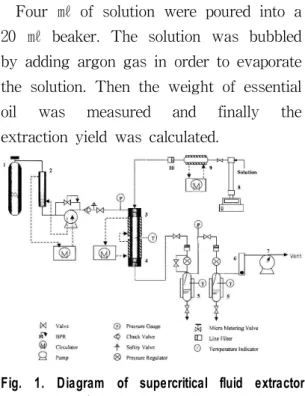
A Suprex MPS/225 system (Pittsburgh, PA, Fig. 1) in the SFE mode was used for all the extractions. The extraction vessel was a 10ml stainless steel vessel.
Supercritical fluid extractions were conducted at three pressure levels of 100, 200 and 300 atm by alternating different three temperature levels of 35, 45 and 5 5℃ for each pressure level, for the duration of 25 min, static, followed by each duration of 15, 25 and 35 min, dynamic, respectively.
A Duraflow manual variable restrictor
was used in the SFE system to collect
the extracted analysis. In order to prevent
sample plugging, the restriction point was warmed electrically. The supercritical carbon dioxide flow rate through the Duraflow restrictor was approximately 0.3-0.4 ㎖/min (compressed). Plant powder (50 g) was well mixed with 2 ㎜ diameter glass beads, and then charged into the 10
㎖ extraction vessel.
The essential oil was extracted from the plant by using supercritical CO
2under various conditions according to the Taguchi method
26). Table 2 shows the experimental conditions under which to run each SFE. In order to improve the collection efficiency, a 5.0 ㎖ volumetric flask was placed in an ice bath during the dynamic extraction stage.
Four ㎖ of solution were poured into a 20 ㎖ beaker. The solution was bubbled by adding argon gas in order to evaporate the solution. Then the weight of essential oil was measured and finally the extraction yield was calculated.
Fig. 1. Diagram of supercritical fluid extractor apparatus.
Table 2. SFE experimental conditions and extraction yields for H-tang.
Run No. Pressure
(atm) Temperature (℃) Dynamic
time (min) Extraction
yield (w/w) Refractive Index(nD20)
1 100 35 15 1.01 1.3465
2 100 45 25 1.19 1.3501
3 100 55 35 0.82 1.4573
4 200 35 15 2.31 1.4891
5 200 45 25 3.66 1.4937
6 200 55 35 1.82 1.5122
7 300 35 15 2.23 1.5156
8 300 45 25 3.50 1.5232
9 300 55 35 3.65 1.5221
Measurement of Refractive Index
The refractive index of chemical compounds is considered important because it indicates characteristic physical properties. I determined the index of the oil extracted at each extraction using an Abbe refractometer equipped with a sodium lamp
27,28).
GC and GC-MS Analyses
The essential oil was analyzed with GC
using a Perkin-Elmer Sigma-115 gas
chromatograph with a data-handling
system and FID. A DB-5 fused silica
capillary column (30 m × 0.25 ㎜ i.d., film
thickness 0.25 μm) was used, with He as
carrier gas (1 ㎖/min). The operating
conditions were as follows: injector and
detector temperature, 240 ℃ and 250 ℃,
respectively; oven temperature program, 5
min isothermal at 40 ℃, subsequently
rising at 2 ℃/min to 240 ℃, then held
isothermally at 240 ℃ for 20 min;
injection mode, split-less (1μl 1 : 1000 n -hexane solution).
Linear retention indices were determined in relation to a homologous series of n -alkanes (C
8-C
22) under the same operating conditions. GC-MS analyses were performed by employing the same chromatographic conditions as described above, and using a Hewlett-Packard 5890 A apparatus linked on-line with a HP Mass Selective Detector (MDS 5970 HP).
The GC-MS instrument was equipped with a DB-5 fused-silica column (30 m × 0.25 ㎜ i.d., film thickness 0.25 μm) with He as carrier gas (1 ㎖/min). MS was recorded at 70 eV; electron multiplier energy, 2000 V; mass range, 28-400 m/z.
Identification of Compounds
The identification of oil components was established on the basis of the comparison of the retention indices and MS spectra with those reported in literature
29). In order to identify oil components, this study also employed computer matching with the NIST 98 and Wiley 5 libraries, as well as, whenever possible, co-injections with authentic compounds available in the laboratory.
Bacterial Strains
Antimicrobial actions of the essential oil against some bacteria and reference strains were determined with the broth dilution method. The oral bacterial strains used in this study were: Streptococcus mutans (ATCC 25175), Streptococcus sanguinis (ATCC 10556), Streptococcus sobrinus (ATCC 27607), Streptococcus anginosus (ATCC 31412), Streptococcus gordonii (ATCC 10558), Actinobacillus actinomycetemcomitans (ATCC 43717), Fusobacterium nucleatum (ATCC 10953), Prevotella intermedia (ATCC 25611), and Porphylomonas gingivalis (ATCC 33277).
The reference strains used in this study were: Escherichia coli (ATCC 25922), Staphylococcus aureus (ATCC 29213), Staphylococcus epidermidis (ATCC 12228), and Streptococcus pyogenes (ATCC 21059). Brain-Heart Infusion broth supplemented with 1% yeast extract (Difco Laboratories, Detroit, MI) was used for all bacterial strains except P.
intermedia and P. gingivalis . For P.
intermedia and P. gingivalis , Brain-Heart Infusion broth containing hemin and menadione was used.
Minimum Inhibitory Concentrations / Minimum Bactericidal Concentrations Assay
The minimum inhibitory concentrations
(MICs) were determined for the essential oil by the broth dilution method, and were carried out in triplicate. The antibacterial actions were examined after incubation at 37 ℃ for 18 h (facultative anaerobic bacteria), for 24 h (microaerophilic bacteria), and for 1-2 days (obligate anaerobic bacteria) under anaerobic conditions. MICs were determined as the lowest concentration of test samples that resulted in a complete inhibition of visible growth in the broth.
Following anaerobic incubation of MICs plates, the minimum bactericidal concentrations (MBCs) were determined on the basis of the lowest concentration of the essential oil that kills 99.9 % of the test bacteria by plating out onto each appropriate agar plate. Ampicillin and Gentamicin were used as standard antibiotics in order to compare the sensitivity with the essential oil and some of its major compounds against test bacteria.
Result and Discussion
Optimization for the Extraction of Essential Oil from H-tang by the SFE method.
The first step for the extraction of the essential oil by the SFE method was to
optimize the operating conditions (especially pressure and temperature) to obtain an efficient extraction of terpenic compounds that are responsible for the aroma and to avoid the co-extraction of undesired compounds such as fatty acid and their esters. In addition, obtained essential oil extractions in the nine SFE conditions were investigated for their physico-chemistries (refractive index).
As can be concluded from Table 1, Run 5 was the best extraction condition (T = 45 ℃, P= 200 atm, and dynamic time 25 min) with a resultant essential oil yield of 3.66 w/w. The pressure and temperature conditions of Run 5 were most recommendable for essential oil extraction with the SFE method, because their solubility is sufficient under the conditions, whereas the solubility of fatty oils, resins and waxes present in the plant material is negligible under the same conditions. The results revealed that the oil extraction would be performed most efficiently under the conditions of the pressure of 200 atm, the temperature of 45 ℃ and the dynamic extraction time of 25 min.
Chemical Composition of Essential Oil
of H-tang Identified by GC and GC-MS
Analyses.
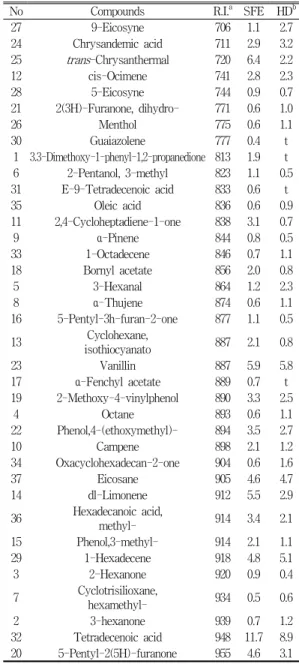
The chemical compounds of the essential oil identified by GC and GC-MS analyses are listed in Table 3.
Thirty-seven compounds were identified in the SFE oil, which is equal to 93.9 % of the total oil. The main compounds with concentrations higher than 3 % as percentage peak area of GC analysis included tetradecenoic acid(11.7 %), Vanillin(5.9 %), dl -Limonene(5.5 %) and Eicosane(4.6 %). In the hydrodistilled oil, however, only thirty-four compounds were identified. The major compounds in the hydrodistilled oil were tetradecenoic acid(8.9 %), Vanillin(5.8 %) and Eicosane(4.7 %).
Analyses of Physicochemical Parameter
The physiochemical properties of essential oil were d
20=0.9856, and [α]
D22= 24.8 (CHCl
3, c 0.28). The refractive index (n
D20) of essential oils extracted from H-tang is presented in Table 3, which ranged from 1.3465 to 1.5232 as determined by the D-line of a sodium lamp 20 ℃. Variation in the refractive index was observed between each set of SFE condition. As was the case in Table 2, Run 5(n
D20= 1.4937) was the best extraction condition. The refractive index of liquid oil or fatty acids depends on the numbers of carbon and double bonds and
No Compounds R.I.
aSFE HD
b27 9-Eicosyne 706 1.1 2.7
24 Chrysandemic acid 711 2.9 3.2
25 trans-Chrysanthermal 720 6.4 2.2
12 cis-Ocimene 741 2.8 2.3
28 5-Eicosyne 744 0.9 0.7
21 2(3H)-Furanone, dihydro- 771 0.6 1.0
26 Menthol 775 0.6 1.1
30 Guaiazolene 777 0.4 t
1 3.3-Dimethoxy-1-phenyl-1,2-propanedione 813 1.9 t
6 2-Pentanol, 3-methyl 823 1.1 0.5
31 E-9-Tetradecenoic acid 833 0.6 t
35 Oleic acid 836 0.6 0.9
11 2,4-Cycloheptadiene-1-one 838 3.1 0.7
9 α -Pinene 844 0.8 0.5
33 1-Octadecene 846 0.7 1.1
18 Bornyl acetate 856 2.0 0.8
5 3-Hexanal 864 1.2 2.3
8 α -Thujene 874 0.6 1.1
16 5-Pentyl-3h-furan-2-one 877 1.1 0.5
13 Cyclohexane,
isothiocyanato 887 2.1 0.8
23 Vanillin 887 5.9 5.8
17 α -Fenchyl acetate 889 0.7 t
19 2-Methoxy-4-vinylphenol 890 3.3 2.5
4 Octane 893 0.6 1.1
22 Phenol,4-(ethoxymethyl)- 894 3.5 2.7
10 Campene 898 2.1 1.2
34 Oxacyclohexadecan-2-one 904 0.6 1.6
37 Eicosane 905 4.6 4.7
14 dl-Limonene 912 5.5 2.9
36 Hexadecanoic acid,
methyl- 914 3.4 2.1
15 Phenol,3-methyl- 914 2.1 1.1
29 1-Hexadecene 918 4.8 5.1
3 2-Hexanone 920 0.9 0.4
7 Cyclotrisilioxane,
hexamethyl- 934 0.5 0.6
2 3-hexanone 939 0.7 1.2
32 Tetradecenoic acid 948 11.7 8.9
20 5-Pentyl-2(5H)-furanone 955 4.6 3.1
a
Kovats retention indices on DB-5 column.
b
Hydrodistillation
c