406
©The Korean Society of Food Science and Technology
흑미가루 복합분의 이화학적 특성과 스펀지 케이크 품질특성
박영서·장학길*경원대학교 식품생물공학과
Quality Characteristics of Sponge Cakes Containing Various Levels
of Black Rice Flour
Young-Seo Park and Hak-Gil Chang*
Department of Food Science and Biotechnology, Kyungwon University
Abstract In this study the replacement of wheat flour with 5 to 30% black rice flour was tested to examine its effect
on sponge cake making properties. We evaluated the effects of the substitutions on various quality parameters of the cake, such as physicochemical and rheological properties, cake making quality, and texture characteristics. The water holding capacity value increased with increasing amounts of black rice flour, whereas the alkaline water retention capacity, Pelshenke value and sedimentation value decreased. The mixograph peak time and peak height, and the Rapid Visco Analyser peak, minimum, and final viscosity decreased with the addition of black rice flour. Increasing proportions of black rice flour resulted in reduced loaf volume. However, replacing 15% of the wheat flour with black rice flour did not significantly affect the characteristics of the sponge cake. The textural characteristics of the sponge cake crumb were influenced by the addition of black rice flour, and sponge cakes containing the additives showed increases in hardness, gummines, and chewiness.
Key words: sponge cake, black rice, cake quality
서 론 식품에있어서다양성 및기능성에 대한관심과 요구가증가 함에따라 쌀에있어서도흑미, 발아현미등다양한 특수미가육 성또는개발되고 있다. 흑미는단백질, 식물성지방, 섬유소, 무 기질, 비타민 등영양성분이 풍부하고, 특히 식품의안토시아닌 색소에대한 기능성이밝혀짐에 따라 흑미에대한각종 연구가 다양하게진행되고있다(1). 흑미의 색소는 흑자색의 안토시아닌으로 cyanidin 3-glucoside
(C3G), cyanidin 3-rhamnoside, malvidin 3-galactoside, peonidin 3-glucoside(P3G) 등이알려져 있으며(2), 현재까지 국내에서재배
되고있는흑미에는 C3G와 P3G가주요성분으로, 특히 C3G의
함량이높은것으로보고되었다(3). 기능성성분중 C3G는강력
한항산화 기능중 oxygen radical absorbance capacity에서 14종
의안토시아닌가운데가장높은활성을보였다(4). 그밖에도유 색미의항돌연변이, 항암기능, 콜레스테롤저하능력에대한기능 성이밝혀진바있다(5,6). 현재우리나라에서 유통되고 있는 유색미의 종류로는 색깔로 구분하여흑미, 적미, 그리고적미와색이유사하나향이강한흑 향미의 3종류로 대별된다(7). 이런유색미는 이용실태에 있어서 밥에혼용하는 잡곡의형태로대부분이용되고있으며, 그밖에 떡과빵류에소량이 소비되고있다. 흑미를이용한연구는흑미 가루를 첨가한식빵의 품질특성(1), 검물질, 지방질및활성 글루 텐의 첨가에따른쌀빵의 특성(8), 유색미의품종별 호화특성(9) 등이있으나아직미흡한실정이다. 따라서본연구에서는흑미가루를첨가한복합분의특성및스 펀지케이크의제반특성을조사한바그결과를보고한다. 재료 및 방법 재료 본연구에 사용된 흑미는 2004년도에 전남 진도군 군내면에 서 생산된 것을 구입하여 분쇄기(IKA MF10, IKA-WERKE
GMBH & Co. KG, Staufen, Germany)로분쇄하여 사용하였다. 흑미가루(100 g)의 입도측정은 sieve shaker(Rotap RX-29, W.S. Tyler, USA)에서 1시간 동안 진탕한 후통과한 흑미가루의 중 량을 측정하였다. 밀가루는 중력분(대한제분)을 구입하여 사용 하였다. 재료의 이화학적 특성 일반성분의분석은 AACC 법(10)에따라서 측정하였다. 즉, 수 분함량은 air oven method(AACC Method 44-16), 조지방함량은 추출법(AACC Method 30-10), 조회분 함량은 basic method
(AACC Method 08-01), 조단백질 함량은 micro-Kjeldahl method
(AACC Method 46-13)로 측정하였다. Alkaline water retention
capacity(AWRC)는 AACC Method 56-10에따라서원심분리관에 시료 1.0 g을 측량하여 넣은 후, 0.1 N sodium bicarbonate 용액
*Corresponding author: Hak-Gil Chang, Department of Food Sci-ence and Biotechnology, Kyungwon University, San 65 Bokjeong-dong, Sujeong-gu, Seongnam 461-701, Korea
Tel: 82-31-750-5382 Fax: 82-31-750-5273 E-mail: [email protected]
5 mL을첨가하여 voltex shaker로교반한다음, 1,000×g에서 15
분간원심분리한후, 상등액을제거하고 남은시료의중량과원
심분리전시료중량 대비백분율로 표시하였다. Water hydration
capacity(WHC)는 Collins와 Post(11)의 방법을 다소 변형하여 측 정하였다. 즉, 원심분리관에시료 3 g을취한후 15 mL의증류수 를첨가하고 3분간교반한다음 1시간실온에방치하였다. 2,000×
g에서 30분간 원심분리한 후상등액을 분리하고 침전된 시료의
무게를측정하여백분율로표시하였다. 시료의호화특성은 Rapid
Visco Analyser(RVA, Model 3d, Newport Scientific, Narrabeen, N.S.W., Australia)를이용하여시료 3.50 g을평량하여 test canister 에넣고 증류수 25.0 mL를첨가하여 현탁액을 만든 후, 25oC에
서 95oC까지 그리고 다시 50oC까지 5oC/min의 속도로 가열 및
냉각시켜 호화온도(initial pasting temperature), 최고점도(peak
viscosity), 최소점도(minimum viscosity) 및최종점도(final viscosity) 를측정하였다(12,13).
Mixograph 특성
Mixograph 특성은 AACC Method 54-40A 방법에따라서 10-g
Mixograph(MIXSMART Version 4.0, National Mfg. Co., Lincoln,
NE, USA)를 사용하여 박력분의 최적 흡수율을 구한 다음, 각
시료에 박력분을기준으로증류수를첨가하여다음과 같이 peak
time, peak height, width at peak, width at 8 min 등을 측정하 였다. 스펀지 케이크의 제조 및 특성 스펀지케이크의배합비는밀가루 100%, 설탕(fine-granulated) 100%, 달걀 100%, 증류수 40%로서 스펀지 케이크의 제조는 달걀의 기포성을 향상시키고 설탕의 용해성을 증가시키며 제품 의 부피를 크게 하기 위하여 53oC의 물로 중탕하여 mixing
bowl을 40oC로 유지시키는 hot mixing method를 사용하였다
(14,15). 즉, 스펀지 케이크 반죽은 저속에서 30초, 고속에서 8 분동안 혼합한 다음, 증류수 140 mL을첨가하여 2분동안 혼 합하고, 저속에서 30초간혼합하여 cream mass(egg-sugar batter)
를만들었다.
Cream mass 240 g을 bowl에 옮기고 시료(밀가루, 흑미 가루 가첨가된 밀가루) 100 g을첨가한 다음, 나무 스푼으로 40회빠 르게혼합한케이크반죽을 pan(내부지름 14.8 cm; 깊이 6.9 cm; 내부부피 1260 mL)에 330 g 넣고, 180oC에서 30분간 baking 하 였다. 흑미가루의첨가량은 5, 10, 15, 20, 25, 30%로서케이크반죽 의 pH와비중을측정하였다. 한편굽기가끝난스펀지케이크를 30분간 pan에서 냉각시킨 후, 부피, 무게, 비용적을 측정하였고,
volume index, symmetry index, uniformity index는 AACC
Method 10-91의기준에따라측정하였다. 스펀지케이크의 crust 와 crumb의 색깔은 색도계(Model CR-200, Minolta Co., Osaka,
Japan)를사용하여 L, a, b value를측정하였다.
스펀지 케이크의 텍스처는 Texture analyzer(TA-XT2, Stable
Micro Systems Co., Haslemere, England)로경도등을측정하였다. 이때사용된 probe는직경 2.5 cm, 측정속도는 1.0 mm/sec이었다.
관능검사는 13명을선정하여충분히교육시킨뒤검사에응하도
록하였으며, 향미, 조직및종합적기호도는 9-point scale scoring
test 방법에따라조사하였다.
통계분석은 Statistical Analysis System(SAS) 통계 package를사 용하여 Duncan’s multiple range 값과상관관계를 구하여각측정
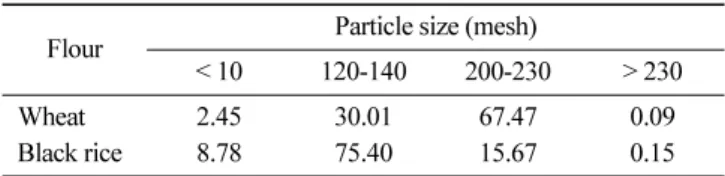
치들간의관계를검토하였다. 결과 및 고찰 재료의 이화학적 특성 공시된재료의 일반성분은 Table 1과같다. 단백질함량은 중 력분이 10.95%로서흑미의 6.70%보다 4.25% 높았고, 회분함량 은흑미가 1.15%로서중력분보다높은값을보였다. 중력분과 흑미가루의 입도 분포를 보면 Table 2와 같이중력 분은 140-230 mesh에 97%, 흑미가루는 91%로분포되어있어 흑 미가루의 입도가다소큰것을 알수있었다. Choi 등(16)은제 분조건에 따른흑미가루 품질특성에관한연구내용에서, 흑미가 루의평균입도는 건조조건, 침지조건에 상관없이 39.1-41.5µm로 유사한 입도분포를나타냈다고 보고한바있다. 일반적으로 가루 의입도분포는 페이스트 특성과 젤점조도등의 이화학적특성 을 변화시킴으로써최종제품의 품질에 직접적인 영향을 미치는 것으로알려져있다(17).
Water holding capacity(WHC)와 alkaline water retention capacity
(AWRC)는 밀가루의 품질을 예측하는 지표로서 쿠키나 케이크 제품을생산하는데 있어서중요한지표로 쓰이고있다. 본연구 에서밀가루에흑미가루를 5-30% 첨가하였을때 WHC와 AWRC 의변화를 보면 Table 3과같다. 흑미가루의 첨가량이 30%까지 증가함에 따라서 WHC는 21.4% 증가하였고, AWRC는 약 10% 가감소하였다. Quinn과 Patton(18)에의하면 WHC는식품중단 백질의 최대흡수율을 표시하는 것으로 WHC 측정과정 중대부 분의수용성 단백질은제거되나 WHC로서수용성과불용성을정 확하게비교측정되는아니다라고밝힌바있다. 한편, Lin 등(19) 은변성때문에용해성이감소됨으로써 흡수율이증가한다고보
Table 1. Composition of wheat and black rice flour samples
Flours Moisture(%) Protein(%) (%)Fat Carbohydrate(%) AshFiber Non- (%) fibrous Wheat flour 13.30 10.95 1.10 0.30 74.30 0.35 Black rice flour 11.75 6.70 1.75 1.50 78.65 1.15
Table 2. Particle size distributions of wheat and black rice flour
(Unit: %) Flour < 10 120-140Particle size (mesh)200-230 > 230
Wheat 2.45 30.01 67.47 0.09
Black rice 8.78 75.40 15.67 0.15
Table 3. Water holding capacity (WHC), alkaline water retention capacity (AWRC), Pelshenke (PK) value, and sedimentation value of wheat and black rice flour blends
Blend
ratio (%) WHC(%) AWRC(%) PK value(min) Sedimentation value (mL) 0 64.1±0.7a1) 69.7±0.1c 41.5±2.1a 25.0±1.4e 5 66.1±1.8a 66.8±0.2bc 41.0±1.4a 22.7±1.1d 10 74.9±1.9b 65.7±0.1b 41.5±0.7a 21.0±1.1cd 15 76.5±1.3b 66.6±0.2bc 40.5±0.7a 20.0±0.0bc 20 77.3±0.2b 65.2±0.2b 40.5±2.1a 19.2±0.4bc 25 76.9±1.0b 65.1±0.3b 40.0±2.8a 17.7±0.4b 30 77.8±1.1b 62.7±0.1a 38.5±0.7a 15.5±0.7a
1)The same superscripts in a column are not significantly different
고하였는데, 이러한사실로미루어보아흑미가루의 단백질이밀 가루단백질에비하여쉽게변성됨을알수있다. AWRC는 cookie
spread와는부의 상관을갖는데, sugar-snap cookie의제조를위한
밀가루의품질을예측하는데 주로적용하고 있다(20,21). 한편, 흑미가루를첨가한복합분의 Pelshenke 값과침전가의변 화를보면, PK 값은흑미가루첨가량이증가되어도변화가없었 으나침전가는 흑미가루의 첨가량이 증가함에 따라서 25 mL에 서 15.5 mL로약 38% 감소하는현상을 보였다. 일반적으로박력 분의침전가가 20 mL 이하인 것과비교해보면중력분에 흑미가 루를첨가함으로써 밀가루의 단백질 특성이 박력분과 같아지는 것을알수있다. 흑미가루를첨가한복합분의 WHC, AWRC, PK 값및침전가 와관계를보면 Fig. 1과같다. WHC와 AWRC 및침전가와는각 각 r =−0.852**, r =−0.877**의상관이있어 WHC가증가함에따 라 AWRC와 침전가는 각각 고도의 정의 상관(r = 0.818*, r = 0.946**)이 있었다. PK값과 침전가 사이에도 고도의 정의 상관 (r = 0.892)을나타내었다. Mixogrpah 특성 Mixograph는밀품종육성에서밀의유전적특성인반죽특성을 예측하는데 주로 이용되어 왔으나, mixograph는 밀 초기세대에 있어서반죽의리올로지특성을평가하는것은물론밀가루의흡 수율, 반죽의정도, 최종제품의품질등을예측하는데매우유용 하게이용되고있다(22). 밀가루에 흑미가루를 0-30% 첨가한혼 합분에 대하여 58% 흡수율에서 mixograph 특성을 조사한 결과
는 Table 4와같이흑미가루첨가량이증가함에따라서 peak time,
peak height 및 width at peak는감소하는경향을보였고 width at
8 min은증가하는경향을 보였다.
Mixograph의 리올로지 특성은 유전적으로 조절되는
gluten-forming protein에의하면결정되며, 따라서각밀품종은품종고 유의 mixograph pattern을 갖게 된다. 본 연구에서 peak time,
peak height 및 width at peak가감소하는 것은흑미가루의 첨가 에의하여 복합분의 gluten-forming protein이감소함으로써 밀가
루의반죽에대한저항성이감소되는것으로판단된다(1).
한편 mixograph 특성과 이화학적 특성과의 상관관계를 보면
Table 5와같이조사항목전체가대부분 고도의정또는 부의상
관이있었다. 즉, 흑미가루의 첨가량이 증가함에 따라서 PK 값
과침전가및 AWRC가감소하였고아울러 mixograph peak time
이 감소하는 현상을 보였다. 이와 같은 현상은 peak height와
width at peak에서도동일한 경향을볼수있었다. WHC와 peak
time, peak height 및 width at peak와는부의상관을보였다. Rapid Visco Analyse(RVA)에 의한 호화특성
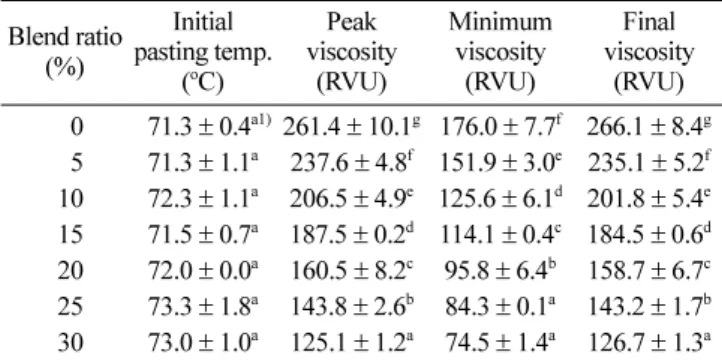
공시재료의 RVA에의한호화특성은 Table 6과같다. 흑미가루
의 첨가량이 증가함에 따라서 호화온도는 71.3oC에서 73.0oC로
다소 증가하는경향을 보였으나통계적인유의성은없었다. 그러
나 peak viscosity와 minimum viscosity는흑미가루의첨가량이증 가함에 따라서 각각 261.4에서 125.1 RVU 및 176.0에서 74.5
RVU로점도가급격하게 감소하는경향을보였다. 이와같은현
Table 4. Mixograph characteristics of wheat and black rice flour blends
Blend ratio
(%) Peak time(min) Peak height(mm) peak (mm)Width at 8 min (mm)Width at 0 5.8±4.3b1) 58.8±1.4f 26.2±2.5cd 9.4±0.5a 5 5.8±0.5b 56.0±0.7e 20.0±2.1abc 11.8±2.5ab 10 5.1±0.2b 52.9±0.7d 18.7±2.1a 11.9±0.1ab 15 4.7±0.1ab 50.9±0.8c 17.5±0.5a 12.2±0.8ab 20 4.5±0.1ab 48.0±0.8b 16.9±2.9a 13.1±0.6b 25 2.4±1.0a 45.7±0.2a 16.7±0.8a 14.0±0.4a 30 2.0±0.3a 47.8±0.2b 16.4±0.1a 14.5±0.9a
1)The same superscripts in a column are not significantly different
each other at p< 0.05.
Table 5. Correlation coefficients between mixograph and physicochemical characteristics of wheat and black rice flour blends
Physicochemical character
Mixograph characteristics Peak time
(min) Peak height(mm) Width peak(mm) 8 min (min)Width at Pelshenke value (min) 0.719*1) 0.913** 0.866** −0.850** Sedimentation value (cc) 0.724* 0.922** 0.843** −0.856** Water holding capacity (%) −0.736* −0.909** −0.749** 0.868** Alkaline water retention cap. (%) 0.778* 0.884** 0.881** −0.853**
1)*, **: Significant at the 5 and 1% levels probability, respectively.
Table 6. Rapid Visco Analyser pasting characteristics of wheat and black rice flour blends
Blend ratio
(%) pasting temp.Initial(oC)
Peak viscosity (RVU) Minimum viscosity (RVU) Final viscosity (RVU) 0 1)71.3±0.4a1)261.4±10.1g 176.0±7.7f 266.1±8.4g 5 71.3±1.1a 237.6±4.8f 151.9±3.0e 235.1±5.2f 10 72.3±1.1a 206.5±4.9e 125.6±6.1d 201.8±5.4e 15 71.5±0.7a 187.5±0.2d 114.1±0.4c 184.5±0.6d 20 72.0±0.0a 160.5±8.2c 95.8±6.4b 158.7±6.7c 25 73.3±1.8a 143.8±2.6b 84.3±0.1a 143.2±1.7b 30 73.0±1.0a 125.1±1.2a 74.5±1.4a 126.7±1.3a
1)The same superscripts in a column are not significantly different
each other at p< 0.05.
Fig. 1. Relationship among water holding capacity (WHC), alkaline water retention capacity (AWRC), Pelshenke (PK) value, and sedimentation value of wheat and black rice flour blends.
상은흑미가루의첨가량이증가함으로써 gluten-forming protein이 함량이감소함으로써 나타나는결과로 생각되고, 특히 전분의노 화정도를반영하는 final viscosity가흑미가루첨가량이증가함에 따라낮아진 것은페이스트의 전분분자 사이의회합이 일어날 때망상구조의 형성이약하기때문인것으로생각된다(23). 재료의이화학적특성과 RVA와의상관관계를 보면 Table 7과 같다. RVA 호화온도와침전가및 AWRC는각각 r =−0.846** 및
r =−0.783*의 부의 상관이, peak, minimum, 및 final viscosity와
침전가, PK치및 AWRC와는고도의정의상관이있었으나 WHC
와는고도의부의 상관이있었다. RVA 특성간에도고도의 정또
는 부의 상관이 있었는데, 호화온도와 Peak, minimum 및 final
viscosity와는부의상관이 있어호화온도가 증가함에 따라점도
가 감소함을 알 수 있었다. Peak viscosity와 final 및 minimum
viscosity와는각각 고도의정의 상관이있었다. 이와 같은경향
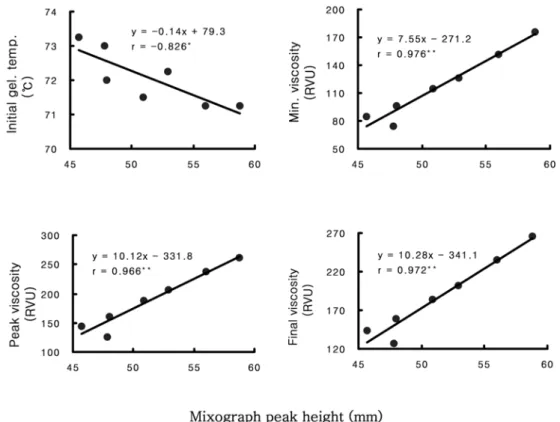
은 Chang과 Kim(24) 및 Zeng 등(25)의연구 결과와일치하였다. 한편, mixograph peak height와 RVA 특성간의 관계를 보면
Fig. 2와같다. Mixograph peak height와 RVA 호화온도만이부의 상관(r =−0.826*)이 있었을 뿐 RVA peak, minimum 및 final
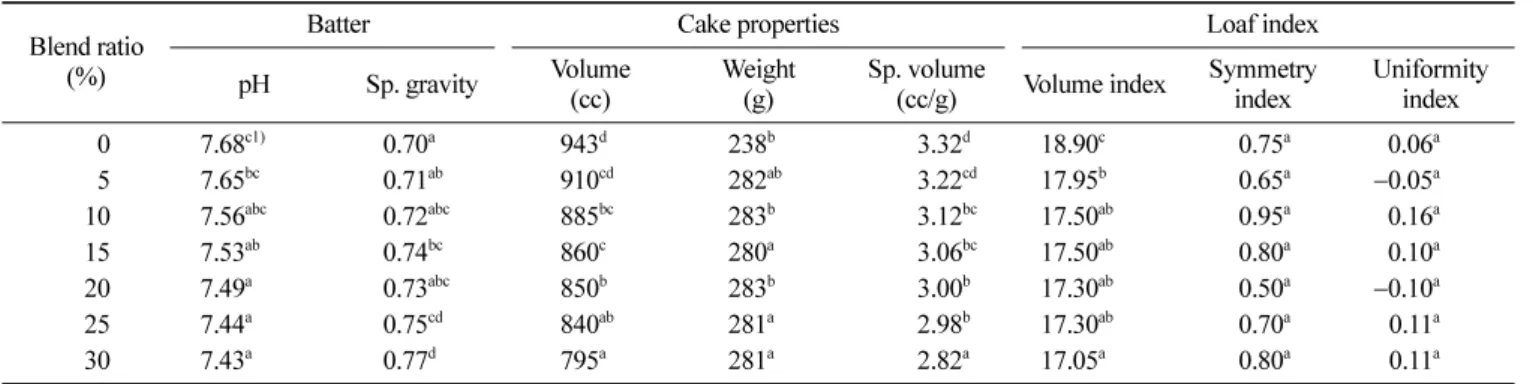
viscosity와는고도의정의상관이 있었다. 스펀지 케이크의 제조 및 특성 흑미가루의첨가가 스펀지케이크 batter의 pH 및비중에 미치 는영향을보면 Table 8과같다. 케이크 batter의 pH는흑미가루 의첨가량이증가함에따라서감소폭은 3.3%로서 크지않았으며, 비중은 다소 증가하는 경향을 보였다. Chang(15)의 연구에서도 스펀지케이크제조시조분말을첨가함으로써 pH는감소하고 비중은증가하는경향을보였으며, Sung 등(26)의연구에서도유 사한결과를보였다. 흑미가루를 첨가한 스펀지 케이크의 부피, 무게및 비용적의 변화를보면흑미가루의 첨가량이 0-30% 증가함에따라서케이 크의부피와비용적은대조구에비해서각각 15.7% 및 15.1% 감 소하였으며, 무게는변화가없었다.
한편, 스펀지케이크의 volume index는 Table 8에서 보는 바와
같이 18.90-17.05로서통계적으로유의적인차이가적을뿐만아
니라 symmetry index와 uniformity index는유의성이없어스펀지
케이크제조시흑미가루의첨가가케이크에큰영향을 미치지않
는다고 판단된다. Chang(15)의연구에의하면 스펀지케이크 제
조시 조분말을 첨가함으로써 케이크의 symmetry index와
uniformity index가유의적인 차이가 있다고 보고하였는데, 이는
Table 7. Correlation coefficients between Rapid Visco Analyser (RVA) pasting properties and physicochemical characteristics of wheat and black rice flour blends
Characteristics RVA properties Initial gel. temp. (%) Peak viscosity (RVA) Minimum viscosity (RVA) Final viscosity (RVA) Sedimentation value (mL) -0.846**1) 0.985** 0.981** 0.985**
Pelshenke value (min) -0.689 0.852** 0.812** 0.830** Water holding capacity
(%) -0.681 -0.887** -0.924** -0.912**
Alkaline water
retention capacity (%) -0.783* 0.905** 0.914** 0.915** Final viscosity (RVA) -0.841** 0.998** 0.999**
Minimum viscosity
(RVA) -0.840** 0.995**
Peak viscosity (RVA) -0.849**
1)*, **: Significant at the 5 and 1% levels probability, respectively.
첨가재료에따른특성이라고 볼수있다.
스펀지케이크의 비용적과 흑미가루 혼합분의 이화학적 특성
및반죽의성질과의관계를보면 Table 9와같다. 케이크의비용
적과 water holding capacity, 호화온도 및반죽의비중과는 부의 상관(r =−0.802* ~−0.878**)이있었으나, 대부분의 특성과는정의 상관(r = 0.824* ~−0.995**)이있었다. 이와같은결과는 Sung 등 (26)의농축콩단백을첨가한스펀지케이크의연구결과와유사한 경향을보였다. 스펀지 케이크의 crust color는흑미가루의 첨가량이 증가함에 따라서 L, a 및 b값 모두가 감소하는 경향을 보였으며, crumb color는흑미가루의첨가량이증가함에따라서 L값과 b값은감소 하였으나 a값은 유의적으로 증가하는 경향을 보였다(Table 10). 이는흑미가루가가지는독특한자홍색에의하며그의첨가비율 이증가함에따라서자홍색이강하게 나타난것으로본다. 이와같은결과는 Jung 등(1)의흑미가루를첨가한식빵의 품 질에관한연구에서도흑미가루의첨가량이증가함에따라서빵 의 색깔은 안토시아닌 색소의 자홍색이 강해지면서 전체적으로 색상이어둡게나타났다는 결과와일치하는것이다. 케이크의텍스처에영향을미치는요인은케이크의수분함량, 기공의발달정도, 부피등이있는데, 일반적으로기공이잘발달
Table 10. Crust and crumb color of sponge cakes prepared from wheat and black rice flour blends
Blend ratio
(%) L Crust colora b L Crumb colora b
0 50.5±1.5e1) 18.2±0.2f 33.1±0.7g 83.4±1.9f -4.2±0.2a 21.8±0.7e 5 49.8±2.1e 17.0±0.5e 31.5±0.9f 69.5±1.3e -0.6±0.2b 12.7±0.4c 10 45.0±1.2d 16.3±0.4d 28.2±0.6e 61.9±1.0d 0.4±0.4c 13.7±0.3d 15 44.3±1.1cd 15.3±0.4c 27.1±0.4d 52.7±1.8c 2.4±0.7d 10.7±0.4b 20 43.0±1.2bc 13.8±0.2b 24.8±0.5c 47.3±1.7b 4.5±0.4e 10.3±0.1b 25 42.2±0.9ab 13.4±0.3a 23.6±0.3b 45.1±1.3a 5.1±0.3f 9.7±0.4a 30 40.8±1.4a 13.4±0.3a 22.9±0.5a 44.7±0.6a 6.3±0.4g 9.7±0.4a
1)Means in a column sharing a common superscript letter (s) are not significantly different (p< 0.05).
Table 11. Texture properties of sponge cake prepared from wheat and black rice flour blends
Blend
ratio (%)Initial stress(×1000) Hardness(g) Springiness Gumminess Chewiness
0 264a1) 153a 0.85ab 101a 86a
5 274a 156ab 0.87b 101a 88a
10 259a 174abc 0.83a 113ab 94ab
15 239a 181abcd 0.85ab 119abc 101abc
20 249a 186bcd 0.88b 128bc 112bc
25 306a 193cd 0.87b 126bc 110bc
30 275a 208d 0.87b 138c 120c
1)Means in a column sharing a common superscript letter (s) are not
significantly different (p< 0.05).
Table 8. Properties of sponge cake prepared from wheat and black rice flour blends
Blend ratio (%)
Batter Cake properties Loaf index
pH Sp. gravity Volume(cc) Weight(g) Sp. volume(cc/g) Volume index Symmetry index Uniformity index
0 7.68c1) 0.70a 943d 238b 3.32d 18.90c 0.75a 0.06a 5 7.65bc 0.71ab 910cd 282ab 3.22cd 17.95b 0.65a −0.05a 10 7.56abc 0.72abc 885bc 283b 3.12bc 17.50ab 0.95a 0.16a 15 7.53ab 0.74bc 860c 280a 3.06bc 17.50ab 0.80a 0.10a 20 7.49a 0.73abc 850b 283b 3.00b 17.30ab 0.50a −0.10a 25 7.44a 0.75cd 840ab 281a 2.98b 17.30ab 0.70a 0.11a 30 7.43a 0.77d 795a 281a 2.82a 17.05a 0.80a 0.11a
1)Means in a column sharing a common superscript letter (s) are not significantly different (p< 0.05).
Table 9. Correlation coefficients between specific loaf volume of sponge cake and physicochemical characteristics of wheat and black rice flour blends
Physicochemical characteristics Specific loaf volume (cc/g)
Sedimentation value (mL) 0.994**
Pelshenke value (min) 0.894**
Water holding capacity (%) −0.878**
Alkaline water retention capacity (%) 0.995** RVA1) characteristics
Initial pasting temp. (oC) −0.805*
Peak viscosity (RVU) 0.983**
Minimum viscosity (RVU) 0.977**
Final viscosity (RVU) 0.981**
Mixograph characteristics
Peak time (min) 0.630
Peak height (mm) 0.908**
Width at peak (mm) 0.824*
Width at 8 min (mm) −0.492
Batter pH 0.963**
Specific gravity −0.802*
된케이크일수록 부피가 크고경도가 낮은것으로보고되고 있 다. 흑미가루를 첨가한 스펀지 케이크의 crumb 텍스처는 Table 11에서보는바와같이 initial stress(×1000)는 239-306으로처리간 에통계적유의성이 없었다. 스펀지케이크의경도는흑미가루의 첨가량이증가함에따라서 153에서 208로증가하였으나 Sung(26) 의농축콩단백을 첨가한 스펀지 케이크의 경도가 210-607에비 하면극히낮은수준이었다. Springiness는처리간에큰차이가없 었으나 gumminess와 chewiness는흑미가루의첨가량이증가함에 따라서증가하는경향을보였다. 요 약 흑미가루첨가비율(5-30%)에따른 복합분의이화학적 특성, 호 화특성, mixograph 특성 및스펀지케이크의제조적성을 측정하 고, 이들특성간의상관관계를구명하고자 일련의실험을실시 하였다. 흑미가루 첨가량이 증가함에 따라서 alkaline water
retention capacity, Pelshenke value, sedimentation value는 증가하 였으나 water holding capacity는 감소하는 경향을 보였다.
Mixograph peak time, height, width at peak와 Rapid Visco
Analyser peak, minimum viscosity도 감소하였다. 스펀지 케이크
반죽의 pH와비중은 증가하였지만케이크의부피는 감소하는경
향을보였으며, 케이크의경도는증가하였다.
문 헌
1. Jung DS, Lee FZ, Eun JB. Quality properties of bread made of wheat flour and black rice flour. Korean J. Food Sci. Technol. 34: 232-237 (2002)
2. Ryu SN, Park SZ, Kang SS, Han SJ. Determination of C3G con-tent in blackish purple rice using HPLC and UV-Vis spectropho-tometer. Korean J. Crop Sci. 48: 369-371 (2003)
3. Ryu SN, Park SZ, Ho CT. High performance liquid chromato-graphic determination of anthocyanin pigments in some varieties of black rice. J. Food Drug Anal. 6: 729-736 (1998)
4. Wang H, Cao H, Prior RL. Oxygen radical absorbing capacity of anthocyanins. J. Agr. Food Chem. 45: 3362-3367 (1997)
5. Wang J, Mazza J. Effects of anthocyanins and other phenolic compounds on the production of tumor necrosis factor alpha in LPS/IFN gamma-activated RAW 264.7 macrophages. J. Agr. Food Chem. 50: 4183-4189 (2002)
6. Nam SH, Kang MY. Comparison of inhibitory effect of rice bran-extracts of the colored rice cultivars on carcinogenesis. Agric. Chem. Biotechnol. 41: 78-83 (1998)
7. Oh GS, Kim K, Park JH, Kim SK, Na HS. Physical properties on waxy black rice and waxy rice. Korean J. Food Sci. Technol. 34: 339-342 (2002)
8. Kang MY, Choi YH, Choi HC. Effects of gums, fats, and glutens
adding on processing and quality of milled rice bread. Korean J. Food Sci. Technol. 29: 700-704 (1997)
9. Ha TY, Park SH, Lee SH, Kim DC. Gelatinization of pigmented rice varieties. Korean J. Food Sci. Technol. 32: 564-567 (1999) 10. AACC. Approved Methods of the AACC. 10th ed. Method 44-16,
30-10, 08-01, 46-13, 56-10, 54-40A, 10-91. American Association of Cereal Chemists, St. Paul, MN, USA (2000)
11. Collins JL, Post AR. Peanut hull flour as a potential source of dietary fiber. J. Food Sci. 46: 445-448 (1981)
12. Bason ML, Ronalds JA, Wrigley CW, Hubbard LJ. Testing for sprout damage in malting barley using the Rapid Visco-Analyser. Cereal Chem. 70: 269-272 (1993)
13. Ross AS, Walker CE, Booth RI, Orth RA, Wrigley CW. The Rapid Visco-Analyzer: A new technique for the estimation of sprout damage. Cereal Food World 32: 827-829 (1987)
14. Nagao S, Imai S, Sato T, Kaneko Y, Otsubo H. Quality character-istics of soft wheats and their use in Japan. 1. Methods of assess-ing wheat suitability for Japanese products. Cereal Chem. 53: 988-997 (1976)
15. Chang HG. Quality characteristics of sponge cakes containing various levels of millet flour. Korean J. Food Sci. Technol. 36: 952-958 (2004)
16. Choi BK, Kum JS, Lee HY, Park JD. Physicochemical properties of black rice flours (BRFs) affected by milling conditions. Korean J. Food Sci. Tecnnol. 38: 751-755 (2006)
17. Kim YJ, Kim SS. Comparison of size distribution of rice flour measured by microscope, sieve, coulter counter, and aerodynamic methods. Korean J. Food Sci. Technol. 24: 184-187 (1994) 18. Quinn JR, Patton D. A practical measurement of water hydration
capacity of protein materials. Cereal Chem. 56: 38-40 (1979) 19. Lin MJY, Humbert ES, Sosulski FW. Certain functional properties
of sunflower meal products. J. Food Sci. 39: 368-372 (1974) 20. Bettge AD, Morris CF. Relationships among grain hardness,
pen-tosan fractions, and end-use quality of wheat. Cereal Chem. 77: 241-247 (2000)
21. Chang HG, Kim JY. Physicochemical characteristics and sugar-snap cookie potentialities of Korean wheats. Korean J. Food Sci. Technol. 36: 754-760 (2004)
22. Finney KF, Shogren MD. A ten-gram mixograph for determining and predicting functional properties of wheat flour. Bakers Dig. 4: 32-42 (1972)
23. Lee YT, Chang HG. Effects of waxy and normal hull-less barleys flours on bread-making properties. Korean J. Food Sci. Technol. 35: 918-923 (2003)
24. Chang HG, Kim JY. Physicochemical characteristics and sugar-snap cookie potentialities of Korean wheats. Korean J. Food Sci. Technol. 36: 754-760 (2004)
25. Zeng M, Morris CF, Batey IL, Wrigley CW. Sources of variation for starch gelatinization, pasting, and gelation properties in wheat. Cereal Chem. 74: 63-71 (1997)
26. Sung MJ, Park YS, Chang HG. Quality characteristics of sponge cake supplemented with soy protein concentrate. Food Sci. Bio-technol. 15: 860-865 (2006)