INTRODUCTION
Allergic rhinitis is one of the most prevalent allergic dis- eases. A number of studies have shown that there has been an increase in the prevalence of allergic rhinitis all over the world in recent years (1, 2). In numerous reports on the preva- lence of allergic rhinitis in many countries, the figures were so confusing and did not always coincide with one another, probably due to differences in the populations studied and the diagnostic criteria employed in each study.
Little is known about the incidence and the prevalence of perennial allergic rhinitis (PAR) in Korea. Min et al. report- ed that the overall prevalence of PAR in Korea in 1991 was 1.14% (3). In U.S.A., 23-yr cumulative incidence of peren- nial allergic rhinitis in selected college graduates was report- ed to be 14.0% by Hagy et al. (4, 5).
Unlike the ambiguity of research concerning the prevalence of PAR, its strong familial tendency and its assocation with other allergic diseases, such as atopic dermatitis, asthma and/
or conjunctivitis are relatively well documented (6, 7).
We aimed to determine the current prevalence of PAR and to investigate its symptoms, hereditary tendency, and its asso-
ciation with other allergic diseases by the questionnaire sur- vey and rhinologic examination. This study also revealed many clinical aspects and physical findings regarding PAR.
MATERIALS AND METHODS
The study population was the subjects who had visited the otolaryngology outpatient clinics at 23 randomly selected tertiary referral hospital out of 43 tertiary referral hospitals in Korea between November 1999 and April 2000. The total number of subjects targeted was 71,120. The male subjects (41,672) ranged in age from 5 to 67 yr (median, 45 yr). The female subjects (29,448) ranged in age from 4 to 71 yr (medi- an, 48 yr) (Table 1).
PAR was diagnosed using the history taking, skin test, ra- dioallergosorbent test (RAST), and multiple allergosorbent test (MAST). Subjects were asked whether they were troubled by sneezing, runny nose, nasal obstruction, and/or itchy nose all through the year recently. When subjects complained of two or more of these symptoms recently, the skin test, RAST or MAST, and rhinologic examination were performed. Sub-
Yang-Gi Min, Byung Yoon Choi, Seong Keun Kwon, Seung Sin Lee, Young-Ho Jung, Jeong-Whun Kim, Seung Jun Oh
Department of Otorhinolaryngology-Head and Neck Surgery, Seoul National University College of Medicine, Seoul, Korea
Received : 3 May 2001 Accepted : 13 August 2001
Address for correspondence Yang-Gi Min, M.D.
Department of Otorhinolaryngology-Head and Neck Surgery, Seoul National University College of Medicine, 28 Yongon-dong, Chongno-gu, Seoul 110-744, Korea
Tel : +82.2-760-2446, Fax : +82.2-745-9945 E-mail : [email protected]
*This study was supported by a 99-Grant from the Korean Academy of Medical Sciences (KMA).
697
Multicenter Study on the Prevalence of Perennial Allergic Rhinitis and Allergy-Associated Disorders
This study was aimed to determine the prevalence of perennial allergic rhinitis (PAR) using the skin test, radioallergosorbent test (RAST), or multiple allergosor- bent test (MAST) and to clarify the clinical aspects of the patients diagnosed as having PAR by the questionnaire survey and rhinologic examination. The 71,120 subjects who had visited the 23 otolaryngology clinics at the randomly selected tertiary referral hospitals in Korea between November 1, 1999 and April 30, 2000 were studied. PAR was diagnosed when subjects complained of two or more associated symptoms and the skin test, RAST, or MAST using perennial inhalant allergens was positive. The questionnaire survey and rhinologic examination were performed in subjects with PAR. The prevalence of PAR was 3.93%. We could find no significant difference in the prevalence of PAR between the two sexes.
However, there was a significant difference in the prevalence of PAR between the child and adult groups. The chief complaints were, in order of decreasing frequency, nasal obstruction, watery rhinorrhea, and sneezing. There was a family history of PAR in 40.2% of the subjects. The 39.6% of the subjects had associated allergic diseases, being atopic dermatitis most common. In conclu- sion, the prevalence of PAR in tertiary referral hospitals in Korea is 3.93%. Many subjects with PAR have family history and appear to be associated with other allergic diseases.
Key Words : Prevalence; Rhinitis, Allergic, Perennial; Family History; Dermatitis, Atopic
jects with flu were excluded. Flu was diagnosed when sub- jects had symtoms such as fever, sore throat, or malaise.
The skin test, RAST, or MAST was performed in 4,660 of 71,120 subjects. PAR was confirmed when the skin test, RAST, or MAST showed positive reactions.
The skin test was interpreted as positive when the wheal caused by one of the allergens was the same size or larger than half of that caused by the histamine control.
The result of RAST was taken as positive when the RAST value to one of the allergens exceeded 2.0. The result of MAST was taken as positive when the MAST value to one of the al- lergens was more than class 2. The skin test, RAST, or MAST was performed using common perennial allergens in Korea:
Dermatophagoides pteronyssinus, Dermatophagoides farinae, cock- roach, Aspergillus, Cladosporum, Alternaria, dog fur, and cat fur (8).
Physical examination was done using nasal endoscopes in subjects diagnosed as having PAR. Questionnaire survey was performed in the subjects, regarding symptoms the family history, and the presence of other associated allergic diseases.
RESULTS
The prevalence of PAR at the tertiary referral hospital was 3.93% (Table 1).
The prevalence in males (4.00%) was slightly higher than that in females (3.82%), but there was no statistically signif- icant difference in prevalence between the sexes.
The 2,796 subjects were divided into 5 age groups by ten year intervals. The 10- to 19-yr-old group had the highest prevalence (6.02%) (Table 1).
The subjects were divided into two groups: the child group (15 yr or younger) and the adult group (older than 16 yr) (Table 2). The adult group showed higher prevalence (4.11%) than the child group (3.43%) and the difference was statis- tically significant ( 2=23.97, p<.005). In the child group, the prevalence in males was slightly higher than that in fe- males and the difference was statistically significant ( 2= 14.09, p<.005). However, there was no statistically signifi- cant difference in prevalence between the sexes in the adult group.
The positivity rate of the skin test, RAST, or MAST in sub- jects with allergic nasal symptoms was 60.0% (2,796 of 4,660 subjects). The subjects who were diagnosed as having PAR revealed positive reactions to Dermatophagoides pteronyssinus in 89.3% and Dermatophagoides farinae in 83.3%. Only 1.0%
of subjects revealed positive reaction to the Cladosporum (Table 3).
The potential environmental factors such as urban resi- dence, high educational attainments and the potential host factors, such as history of breast feeding or single state were frequently detected in subjects with PAR but no statistical meaning could be achieved because we had no information about control groups. The aggravating factors were, in order of decreasing frequency, temperature change (22.9%), dust in the house (21.4%), and windy weather (10.5%) (Table 4).
The 25.8% of the subjects with PAR had radiographically proven sinus infection (Table 5).
According to the questionnaire, the most frequent symp-
Age (yr) Number of study
population
Perennial allergic rhinitis n Prevalence, %
-9 male 6,250 185 2.96
female 5,006 114 2.27
subtotal 11,256 299 2.65
10-19 male 8,751 628 7.17
female 6,773 308 4.54
subtotal 15,524 936 6.02
20-29 male 8,334 406 4.87
female 6,184 336 5.43
subtotal 14,518 688 4.73
30-39 male 9,584 247 2.57
female 5,889 172 2.92
subtotal 15,473 419 2.70
40- male 8,753 205 2.34
female 5,596 95 1.69
subtotal 14,349 300 2.09
Total male 41,672 1,671 4.00
female 29,448 1,125 3.82
Total 71,120 2,796 3.93
Table 1.Prevalence of perennial allergic rhinitis according to age and sex
Age (yr) Number of study
population
Perennial allergic rhinitis n Prevalence, %
-15 male 10,591 413 3.90
(Child group) female 8,446 240 2.84
subtotal 19,037 653 3.43*
16- male 31,081 1,258 4.04
(Adult group) female 21,002 885 4.21
subtotal 52,083 2,143 4.11*
Table 2.Prevalence of PAR according to sexes and child and adult groups
*p<.005 by chi-square test
Allergen
Number of (+) reaction to each
allergen
Positivity rate of each allergen Dermatophagoides pteronyssinus 2,496 89.3%
Dermatophagoides farinae 2,468 88.3%
Cockroach 187 6.7%
Aspergillus 75 2.7%
Alternaria 42 1.5%
Cladosporum 28 1.0%
Cat fur 218 7.8%
Dog fur 70 2.5%
Table 3.The results of skin test, RAST, and MAST (N=2,796)
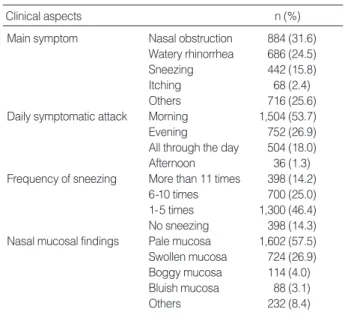
tom was nasal obstruction, followed by watery rhinorrhea and sneezing (Table 6).
Allergic nasal symptoms occurred most frequently in the morning (53.1%), followed by in the evening (27.0%) and throughout the day (18.0%). The 39.2% of subjects com- plained of sneezings six times or more per day (Table 6). Ac- cording to the rhinologic examination, variable findings were observed. The most frequent nasal mucosal finding was pale mucosa (57.5%). Edematous mucosa and boggy mucosa were also found in 26.9% and 4.09% of subjects, respective- ly (Table 6).
In most of the subjects (78.7%), PAR disturbed their every- day lives to a mild degree or less. Only 10.7% of the subjects complained that their everyday lives were seriously disturbed by PAR.
There was a family history of PAR in 40.2% of subjects.
The siblings had more chance of having PAR than did par- ent or grandparent (Table 7).
Of subjects with PAR, 39.4% had other associated allergic diseases, such as atopic dermatitis, asthma, and/or allergic conjunctivitis, being atopic dermatitis (20.9%) most com- mon (Table 8).
DISCUSSION
A prevalence of 3.93% of PAR was found in this study.
This value is almost 2 times greater than the value of 1.14%
which was reported previously as the prevalence of perennial
allergic rhinitis in 1991 by Min et al. (3). The several expla- nations for the difference may be as follows. One explanation is actual increase of allergic rhinitis patients. PAR is one of the most prevalent allergic diseases and the number of cases has increased all over the world along with asthma. In U.S.A., 23-yr cumulative incidence of perennial allergic rhinitis in selected college graduates was reported to be 14.0% by Hagy et al. (4, 5). The prevalence of PAR in Swedish 18-yr-old boys preparing for military service almost doubled from 4.4% in 1971 to 8.4% in 1981 (9). The prevalence of PAR in 15-yr- old boys in Geneva increased from 4.4% in 1968 to 6.1%
Potential risk factors n (%)
Residency Urban 2,415 (86.4)
Rural 381 (14.6)
Marital status Single 2,025 (72.4)
Married 771 (27.6)
Educational attainment Elementary 291 (10.4)
Junior high 378 (13.5)
Senior high 1,103 (39.4)
College 1,024 (36.7)
Aggravating factors Temperature change 640 (22.9) Dust in home 598 (21.4) Windy weather 293 (10.5)
Smoking 363 (13.0)
Others 892 (32.0)
Table 4.Potential environmental risk factors in PAR (N=2,796)
Potential risk factors n (%)
History of breast feeding Yes 2,025 (72.4)
No 771 (27.6)
Nasal operation history Yes 546 (19.5)
No 2,250 (80.5)
Sinusitis in X-ray Yes 654 (25.8)
No 2,142 (74.2)
Table 5.Potential host risk factors in PAR (N=2,796)
Clinical aspects n (%)
Main symptom Nasal obstruction 884 (31.6) Watery rhinorrhea 686 (24.5)
Sneezing 442 (15.8)
Itching 68 (2.4)
Others 716 (25.6)
Daily symptomatic attack Morning 1,504 (53.7)
Evening 752 (26.9)
All through the day 504 (18.0)
Afternoon 36 (1.3)
Frequency of sneezing More than 11 times 398 (14.2) 6-10 times 700 (25.0) 1-5 times 1,300 (46.4) No sneezing 398 (14.3) Nasal mucosal findings Pale mucosa 1,602 (57.5) Swollen mucosa 724 (26.9) Boggy mucosa 114 (4.0) Bluish mucosa 88 (3.1)
Others 232 (8.4)
Table 6.Various clinical aspects in PAR (N=2,796)
Family member with PAR No. of subjects with family history (%)
Parent only Father 168 (6.0)
Mother 150 (5.3)
Both father
34 (1.2) and mother
Subtotal 352 (12.5 )
Siblings only 378 (13.5)
Both parents and siblings 250 (8.9) Grandparents or grandchildren 56 (2.0)
Children 38 (1.3)
Cousin only 19 (0.6)
Total 1,123/2,796= 40.2 % of total PAR subjects Table 7.Family history in subjects with PAR
Associated allergic diseases n (%)
Atopic dermatitis 584 (20.9)
Asthma 282 (10.1)
Conjunctivitis 236 (8.4)
Total 1102 (39.4)
Table 8.Associated other allergic diseases in subjects with PAR (N=2,796)
in 1981 (10).
Although the prevalence of PAR has varied from region to region due to the various diagnostic criteria and different study populations, most reports indicate increasing trends in its prevalence. The factors that might contribute to the in- creased prevalence of allergic diseases include the exposure to indoor allergens, air pollution, house pets, decreased con- sumption of fruits, vegetables, and fish, and change of life style, specifically a more sedentary life style than ever before (11). Decreased early viral infection, which has been suggest- ed to protect allergy sensitization, is also considered to be one of the plausible causes of recent increase in PAR (12).
Another explanation is that our study population was drawn from the otolaryngology outpatient clinic visitors who were expected to have higher prevalence than the general popula- tion. The other explanation is that Min et al. included the pale mucosal findings in the inclusion criteria (3). In this study, the pale mucosa was found in only half of the patients, per- mitting the possibility of underestimating prevalence at that time.
In this study, no significant difference in the prevalence of PAR was found between the sexes. The age group of 10 to 19 yr accounts for the largest portion (31.7%) of PAR sub- jects with the highest prevalence (Table 1). Viner and Jack- man (13) reported that allergic rhinitis could start at any age and that 30% of their subjects presented with allergic symp- toms before the age of 10 yr. The average duration of symp- toms of PAR in this study was 76.7 months (6.4 yr) and more than one third of subjects with PAR belonged to the age groups of 0 to 9 yr and 10 to 19 yr. It is thus inferrable in this study that symptoms of PAR can start before the age of 15 yr in one third of subjects. This result is not quite dif- ferent from that of Viner and Jackman’s report.
In this study, the adult group significantly exhibited a high- er prevalence than the child group. In addition, this study showed a high prevalence of PAR in both the age groups of 10 to 19 yr and 20 to 29 yr and a relatively low prevalence in the age group of 0 to 9 yr.
In the child group, the prevalence in males was significant- ly higher than that in females. However, there was no statis- tically significant difference between the sexes in the adult group although the prevalence in females was slightly high- er than that in males. These results coincide with those of other articles. It has been reported that in adolescents, the prevalence of PAR in males is slightly higher than that in females but that with age, the tendency reverses and there is no difference in prevalence of PAR between the sexes overall (14, 15).
In this study, subjects who had allergic symptoms were given the skin test for the common perennial allergens includ- ing D. pteronyssinus, D. farinae, cockroach, Aspergillus, Al- ternaria, Cladosporum, cat fur, and dog fur and regarded as PAR patients when skin test, RAST, or MAST was positive.
The 60% of subjects with allergic symptoms showed posi-
tive reactions to the perennial allergens. The remaining 40%
of subjects may be considered as false negative PAR patients, seasonal allergic rhinitis patients, and/or nonallergic rhinitis patients.
This study found that symptoms that bothered the sub- jects most seriously in decreasing order were nasal obstruc- tion, watery rhinorrhea, and sneezing. It has been reported that among the Korean subjects with allergic rhinitis, nasal obstruction was the most common symptom (16, 17). Ac- cording to a Southeast London report on perennial allergic rhinitis, nasal obstruction was also the most common and bothersome symptom. However, in patients with seasonal allergic rhinitis, sneezing and itching are more common than nasal obstruction (17).
Hereditary factor and family history are known to play im- portant roles in PAR (11, 17). According to some reports, a subject with family history of allergic rhinitis has a fivefold to sixfold risk of developing the condition (18). Lans’study also reported that, in children without a family history of allergic diseases, the prevalence was 10% or less. However, when both parents are allergic patients, up to 75% of chil- dren have allergic diseases (19). In this study, 40.2% of PAR subjects had family history of the same disease. The siblings occupied the larger portion of the family member with the same disease than parents or grandparents (Table 7). It is well known that life-style also contribute to the development of allergic conditions. In this study, the urban residents, single unmarried subjects, and subjects with host factors such as history of being breast-fed and high educational attainment were predominant among subjects diagnosed as having PAR but no statistical meaning could be achieved because this study had no control group.
Urban inhabitants can be considered to be much more ex- posed to indoor house dust mite and air pollutants, which are known to contribute to sensitization to allergic rhinitis than rural inhabitants. The life in well-developed cities de- prives children of many chances of early viral infection, which has been suggested to protect against the subsequent devel- opment of allergic diseases (12). High educational attainment and higher affluence can be considered to expose subjects to a more westernized city-life, which may contribute to sensi- tization to allergic rhinitis. Correlations have been noted be- tween the prevalence of the disease and higher affluence and lower number of siblings (12, 20).
The significant determinants of indoor air quality favoring the development of PAR are house dampness and high indoor humidity, and unmarried subjects have more chances of being exposed to these situations than married ones. In this study, breast-fed subjects occupied 72.4% of subjects with PAR.
This may be related to the fact that allergen exposure in early life is important to later development of specific allergic con- ditions, probably due to the increased immunological vulner- ability during the first year of life (21).
Inhalent allergens floating in the air are the most frequent
inducers of asthma, atopic dermatitis, and allergic conjunc- tivitis, as well as allergic rhinitis. It is inferable that PAR sub- jects may have other associated allergic diseases. According to this study, 39.4% of subjects having PAR also had other allergic diseases, being atopic dermatitis most common.
As for the nasal mucosal findings of allergic rhinitis sub- jects, pale and swollen mucosa and watery rhinorrhea are the characteristic features. In this study, the most frequent nasal mucosal finding was pale mucosa (57.5%). Swollen mucosa and boggy mucosa were found in 26.0% and 4.09% of the subjects, respectively. In the nasal cavity, 57.5% of the sub- jects had watery nasal discharge and 19.7% of the subjects had mucoid nasal discharge.
It would be relatively hard to diagnose a patient as having allergic rhinitis only by nasal mucosal findings because swell- ing in nasal mucosa was variable.
In conclusion, the prevalence of PAR at the otolaryngolo- gy outpatient clinics of tertiary referral hospitals in Korea is 3.93% (4.00% in males and 3.82% in females). The age group of 10 to 19 yr showed the highest prevalence of PAR.
About 40% of subjects with PAR have family history and are associated with other allergic diseases such as atopic der- matitis and bronchial asthma.
ACKNOWLEDGMENT
The authors would like to thank “The James and Agnes Kim Foundation”.
REFERENCES
1. Ninan TK, Russell G. Respiratory symptoms and atopy in Aberdeen schoolchildren. Evidence from two surveys 25 years apart. Br Med J 1992; 304: 873-5.
2. Wright AL, Holberg CJ, Martinez FD, Halonen M, Morgan W, Taus- sig LM. Epidemiology of physician-diagnosed allergic rhinitis in childhood. Pediatrics 1994; 94: 895-901.
3. Min YG, Jung HW, Kim HS, Park SK, Yoo KY. Prevalence and risk factors for perennial allergic rhinitis in Korea: results of a nationwide survey. Clin Otolaryngol 1997; 22: 139-44.
4. Hagy GW, Settipane GA. Bronchial asthma, allergic rhinitis, and allergy skin tests among college students. J Allergy 1969; 44: 323-
32.
5. Greisner WA III, Settipane RJ, Settipane GA. Natural history of hay fever: a 23-year follow-up of college students. Asthma Allergy Proc 1998; 19: 271-5.
6. Mckee WD. The incidence and familial occurrence of allergy. J Allergy 1966; 38: 226-35.
7. Diepgen TL, Blettner M. Analysis of familial aggregation of atopic eczema and other atopic diseases by odds ratio regression models.
J Invest Dermatol 1996; 106: 977-81.
8. Cho SH, Kim YK, Sohn JW, Lee SR, Park JK, Min KU, Ha MN, Ahn YO, Jee YK, Lee SI, Kim YY. Prevalence of chronic rhinitis in Korean children and adolescents. Asthma and Allergy 1999; 19:
452-8.
9. Wuthrich B. Epidemiology of the allergic diseases: are they really on increase? Int Arch Allergy Appl Immunol 1989; 90: 3-10.
10. Aberg N. Asthma and allergic rhinitis in Swedish conscripts. Clin Exp Allergy 1989; 19: 59-63.
11. Platts-Mills TA. How environment affects patients with allergic dis- ease: indoor allergens and asthma. Ann Allergy 1994; 72: 381-4.
12. Strachan DP, Harkins LS, Johnston ID, Anderson HR. Childhood antecedents of allergic sensitization in young British adults. J Aller- gy Clin Immunol 1997; 99: 6-12.
13. Viner AS, Jackman N. Retrospective survey of 1,271 patients diag- nosed as perennial rhinitis. Clin Allergy 1976; 6: 251-9.
14. Pederson PA, Weeke ER. Allergic rhinitis in Danish general prac- tice. Allergy 1981; 36: 375-9.
15. Fleming DM, Crombie DL. Prevalence of asthma and hay fever in England and Wales. Br Med J 1987; 294: 279-83.
16. Yoo SY, Kim KI, Jeung WC, Kang SW. The analysis of question- naire in allergic rhinitis patients. Korean J Otolaryngol 1995; 38:
1542-8.
17. Sibbad B, Rink E. Epidemiology of seasonal and perennial rhinitis;
clinical presentation and medical history. Thorax 1991; 46: 895-901.
18. Ronmark E, Lundback B, Jonsson EA, Jonsson A-C, Lindstrom M, Sandstrom T. Incidence of asthma in adults report from the obstruc- tive lung disease in northern Sweden study. Allergy 1997; 52: 1071- 81.
19. Lans DM, Alfano N, Rocklin R. Nasal eosinophilia in allergic and non-allergic rhinitis: usefulness of nasal smear in the diagnosis of allergic rhinitis. Allergy Proc 1989; 10: 275-80.
20. Parikh PH, Holmberg K. Allergic rhinitis. Br Med J 1997; 314:
1392-5.
21. Aberg N. Birth season variation in asthma and allergic rhinitis. Clin Exp Allergy 1989; 19: 643-8.
. . . .
. .