Received on March 5, 2013. Revised on March 18, 2013. Accepted on March 22, 2013.
CC This is an open access article distributed under the terms of the Creative Commons Attribution Non-Commercial License (http://creativecommons.org/licenses/by-nc/3.0) which permits unrestricted non-commercial use, distribu- tion, and reproduction in any medium, provided the original work is properly cited.
*Corresponding Authors. Jae Seung Kang, Laboratory of Anti-oxidant Immunology and Vitamin C, Department of Anatomy, Seoul National University College of Medicine, Seoul, Korea. Tel: 82-2-740-8132; Fax: 82-2-741-8202;
E-mail: [email protected]
Wang Jae Lee, Laboratory of Anti-oxidant Immunology and Vitamin C, Department of Anatomy, Seoul National University College of Medicine, Seoul, Korea. Tel: 82-2-740-8208; Fax: 82-2-745-9528; E-mail: [email protected] Keywords: Vitamin C, Anti-viral immune response, Influenza A virus, Gulo (-/-) mice
Abbreviations: IFN, interferon; TNF, tumor necrosis factor; IL, interleukin; Gulo, L-gulono-gamma-lactone oxidase; BAL, bronchoalveolar
Vitamin C Is an Essential Factor on the Anti-viral Immune Responses through the Production of Interferon-α/β at the Initial Stage of Influenza A Virus (H3N2) Infection
Yejin Kim, Hyemin Kim, Seyeon Bae, Jiwon Choi, Sun Young Lim, Naeun Lee, Joo Myung Kong, Young-il Hwang, Jae Seung Kang* and Wang Jae Lee*
Laboratory of Anti-oxidant Immunology and Vitamin C, Department of Anatomy, Seoul National University College of Medicine, Seoul 110-799, Korea
L-ascorbic acid (vitamin C) is one of the well-known antiviral agents, especially to influenza virus. Since the in vivo anti- viral effect is still controversial, we investigated whether vita- min C could regulate influenza virus infection in vivo by using Gulo (-/-) mice, which cannot synthesize vitamin C like humans. First, we found that vitamin C-insufficient Gulo (-/-) mice expired within 1 week after intranasal inoculation of in- fluenza virus (H3N2/Hongkong). Viral titers in the lung of vi- tamin C-insufficient Gulo (-/-) mice were definitely in- creased but production of anti-viral cytokine, interferon (IFN)-α/β, was decreased. On the contrary, the infiltration of inflammatory cells into the lung and production of pro-in- flammatory cytokines, tumor necrosis factor (TNF)-α and in- terleukin (IL)-α/β, were increased in the lung. Taken togeth- er, vitamin C shows in vivo antiviral immune responses at the early time of infection, especially against influenza virus, through increased production of IFN-α/β.
[Immune Network 2013;13(2):70-74]
INTRODUCTION
Vitamin C is known as an essential anti-oxidant (1,2) and en-
zymatic co-factor for physiological reactions such as hormone production, collagen synthesis (3) and immune potentiation (4-6). Naturally, an insufficiency of vitamin C leads to severe injuries to multiple organs, especially to the heart and brain, since they are both highly aerobic organs that produce more oxygen radicals. In fact, studies of in vivo effect on vitamin C are difficult since most animals, except human and some primate, are capable of synthesizing vitamin C endogenously (7). However, Gulo (-/-) mice were recently developed by the L-gulono-γ-lactone oxidase (Gulo) gene deletion like hu- man, thus they should be supplied with dietary vitamin C (8).
It already has been reported that vitamin C concentration was decreased by 10∼15% in plasma of the Gulo (-/-) mice with- out supplementation of vitamin C for 2 weeks (8). We also reported that vitamin C level was remarkably decreased in the most organs in the Gulo (-/-) mice without supplementa- tion of vitamin C for 3 weeks (9).
In addition, we found that numbers of T cell was de- creased in the spleen of vitamin C-insufficient Gulo (-/-) mice (10). Even though it is thought that vitamin C shows its an- ti-viral or anti-tumor effects through the up-regulation of the
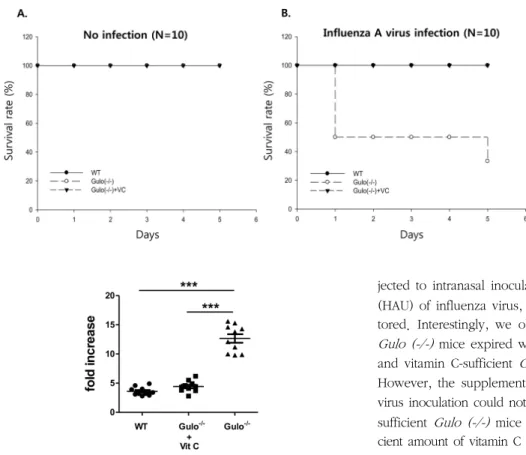
Figure 1. Increase of mortality of vitamin C-insufficient Gulo (-/-) mice by the infection of influenza A virus.
Twenty hemagglutination units (HAU) of influenza A virus (H3N2/
1/68/HongKong) was intranasally inoculated into wild type (n=10), vitamin C-sufficient Gulo (-/-) mice (n=10) and vitamin C-insufficient Gulo (-/-) mice (n=10) was as described in Materials and Methods.
And then the survival of mice was monitored for 7 days after virus inoculation. (A) Mice without H3N2 infection, (B) Mice with 20 HAU of H3N2 infection.
Figure 2. Increase of influenza A virus replication in the lung of vitamin C-insufficient Gulo (-/-) mice. To analyze the effect of vitamin C on the suppression of viral replication in the lung, the lungs were excised from sacrificed mice (n=10 per each group) and total RNA was purified from lung homogenate as described in Materials and Methods. The virus replication in the presence or absence of vitamin C was determined real time RT-PCR by using of specific primers for influenza virus M2 gene and β2m.
activity of natural killer (NK) cells and tumor specific cytolytic T lymphocytes (CTLs), its related evidences in vivo are still unclear. The reason why it is impossible to investigate in vivo effect of vitamin C is that all of animals could synthesize vita- min C from glucose thorough the action of L-glunolactone-γ -oxidase (Gulo), as described above (7). However, we con- firmed that vitamin C up-regulates NK cell activity through the regulation of activating/inhibitory receptors on the surface of NK cell (our unpublished data). Since it is commonly known that vitamin C and NK cells are closely related to the prevention of common cold and the flu (11-13), we evaluated in vivo anti-viral effect of vitamin C and its related mechanism in Gulo (-/-) mice against influenza virus (H3N2/Hon- kong/1/68). First, wild type, vitamin C-sufficient Gulo (-/-) mice and vitamin C-insufficient Gulo (-/-) mice were sub-
jected to intranasal inoculation of 20 hemagglutination units (HAU) of influenza virus, and then their survival was moni- tored. Interestingly, we observed that vitamin C-insufficient Gulo (-/-) mice expired within 1 week, but all of wild type and vitamin C-sufficient Gulo (-/-) mice survived (Fig. 1B).
However, the supplementation of vitamin C on a day after virus inoculation could not prevent the death of vitamin C-in- sufficient Gulo (-/-) mice (Fig. 1B). It suggests that a suffi- cient amount of vitamin C is needed to prevent in vivo patho- genesis of influenza virus. Also, considering that H3N2 influ- enza virus shows a good circulation in humans and pigs as well as a slow antigenic drift in swine (14), we believe that the antigenic divergence between human and swine influenza virus might be increased. Therefore, our results shown in Fig.
1 suggest that vitamin C may effectively prevent severe or fa- tal damages in humans by the infection of influenza virus as well. To clarify the underlying mechanisms on the survival by the presence of the sufficient amounts vitamin C in the mice, we examined the viral titers in the lung of each ex- perimental group. As shown in Fig. 2, viral titer in the lung from vitamin C-insufficient Gulo (-/-) mice was 10 to 15-fold increased, when it was compared with viral titer in wild type and vitamin C-sufficient Gulo (-/-) mice. However, when Gulo (-/-) mice were supplemented with vitamin C after virus inoculation, we could not observe a definite suppression of viral replication. This provides the importance of the vitamin C concentration at the initial stage of influenza virus infection.
That is to say, damages through the replication of influenza viruses can be effectively prevented, when vitamin C concen- tration is sufficiently high at the initial stage of viral infection.
If it is insufficient, however, the pathogenesis of influenza vi- rus could not be prevented.
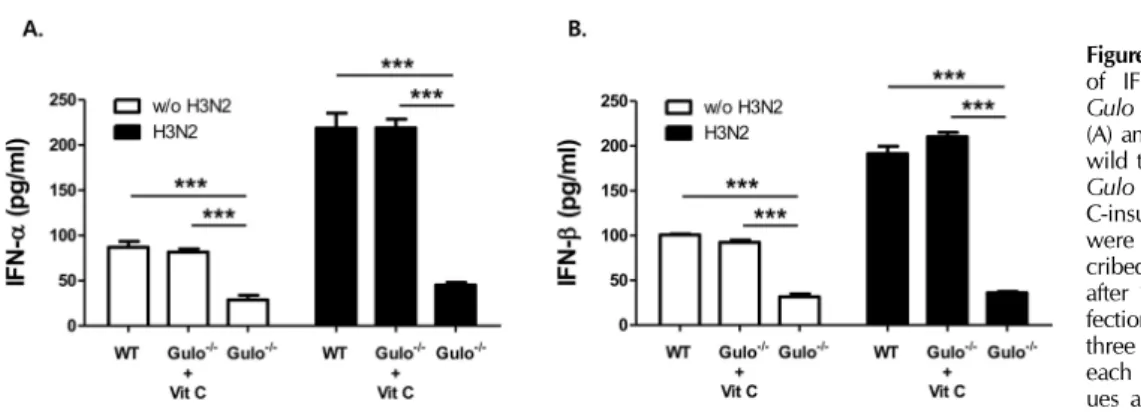
Figure 3. Defect on the production of IFN-α/β vitamin C-insufficient Gulo (-/-) mice. The levels of IFN-α (A) and IFN-β (B) in BAL fluids from wild type (n=6), vitamin C-sufficient Gulo (-/-) mice (n=6) and vitamin C-insufficient Gulo (-/-) mice (n=6) were measured by ELISA as des- cribed in Materials and Methods, after 1 day of influenza A virus in- fection. Results are representative of three independent experiments and each performed in triplicates. Val- ues are the mean±SD.
It is known that type I interferons (IFNs), IFN-α and -β, play an important role in prevention of viral pathogenesis as their amounts increase within 1 or 2 days after virus infection (15,16). We then measured the amounts of IFN-α and -β in bronchoalveolar (BAL) fluid and plasma in each mice after intranasal inoculation of influenza virus. As we expected, the lev- els of IFN-α and -β in BAL fluid and plasma from vitamin C-in- sufficient Gulo (-/-) mice were quiet lower than those in wild type and vitamin C-sufficient Gulo (-/-) mice (Fig. 3A and B).
This result proves that vitamin C is an essential factor for the production of anti-vital immune response during the early phase of virus infection through the production of type I IFNs. The phosphorylation of signal transducers and activa- tors of transcription (STATs) is the critical signaling process after the dimerization of its receptors, when type I IFNs are increased (17,18). Even though it is not presented this re- ports, we found the defects on the phosphorylation of STAT3 in T cells from Gulo (-/-) mice upon vitamin C insufficiency (10). Therefore, the activation of STATs in vitamin C-sufficient Gulo (-/-) mice upon virus infection should be further investigated.
The defects on the production of type I IFNs followed by the activation of STATs are closely related to the inflammatory responses due to the failure of controlling virus replication at the initial stage of its infection (19). To investigate the in- flammatory response in vitamin C-sufficient Gulo (-/-) mice by influenza virus infection, we compared the levels of pro-inflammatory cytokines, IL-1α/β and TNF-α in the BAL fluids from wild type, vitamin C-sufficient Gulo (-/-) mice and vitamin C-insufficient Gulo (-/-) mice after virus infection. As a result, the production of IL-IL-1α/β and TNF-α was defi- nitely increased in vitamin C-insufficient Gulo (-/-) mice (Fig.
4A∼C). At the same time, the infiltration of inflammatory cells into the lung is increased approximately 2.5-fold in vita-
min C-insufficient Gulo (-/-) mice than in others (Fig. 4D).
In our previous report regarding the preventive role of vita- min C on the pathogenesis of acute liver inflammation, we have observed that the increase of the infiltration of immune cells into the liver and slight increase of TNF-α production in vitamin C-insufficient Gulo (-/-) mice (10). And then the excessive inflammatory responses were occurred by the in vivo challenge of concanamycin A (10). Taken together, it seems that in vivo vitamin C insufficient status induces hy- per-reactive immune responses against virus/bacterial in- fection or chemicals.
It is generally known that plasma concentration of vitamin C in the mice is approximately 80∼100μM. When the amount of vitamin C is present less than 20μM in the plasma, we called it as vitamin C insufficiency or “sub-scurvy” (9). Considering that systemic concentration of vitamin C in Gulo (-/-) mice at 3 weeks after vitamin C withdrawal was 10∼20μM, we presented the effect of vitamin C insufficiency, not vitamin C deficiency. In conclusion, vitamin C plays a critical role in vivo anti-viral immune responses against influenza virus through the increase of IFN-IL-1α/β production. Therefore, it might be possible that the maintaining sufficient levels of vitamin C in the plasma by the continuous uptake through the diet or supplement could effectively prevent in vivo pathogenesis of influenza virus at the initial stage of viral infection.
MATERIALS AND METHODS Mice and viruses
The Gulo (-/-) mice were obtained from the Mutant Mouse Regional Resource Center (University of California, Davis, USA). C57BL/6J wild-type and the Gulo (-/-) mice were main- tained in a specific pathogen-free condition at an animal fa-
Figure 4. Increased production of IL- α/β and TNF-α in the lung of vitamin C-insufficient Gulo (-/-) mice by influenza A virus infection. The levels of IL-1α (A), IL-1β (B) and TNF-α (C) in BAL fluids obtained from wild type (n=6), vitamin C-sufficient Gulo (-/-) mice (n=6) and vitamin C-insufficient Gulo (-/-) mice (n=6) were measured by ELISA as described in Materials and Methods. Results are representative of three independent experiments and each performed in triplicates.
Values are the mean±SD. (D) After centrifugation of BAL fluids, the numbers of infiltrated immune cells into the lung upon influenza A virus infection of in the presence or absence of vitamin C were counted under microscope.
cility in the Seoul National University College of Medicine.
Male Gulo (-/-) mice (4∼5 weeks old) were maintained for about 3 weeks with or without vitamin C supplementation (Sodium L-ascorbate, 3.3 g/L, Sigma, St. Louis, MO, USA) in their drinking water. The influenza A virus (IAV) strain was kindly provided by Huan H Nguyen (International Vaccine Institute, Seoul, Korea). IAV (HongKong/1/68, H3N2) was grown for 7∼
10 days in embryonated hens eggs, and then titrated by he- magglutination inhibition assay (20).
Intranasal inoculation of IAV
Mice were anesthetized and intranasally administered 30μl PBS containing 20 HAU IAV (HongKong/1/68, H3N2). The illness and mortality of mice were then monitored daily for 7 day.
Blood and bronchoalveolar (BAL) fluids collection After 1 day of IAV, blood was collected from the intra-orbital plexus with a heparinized capillary tube. The levels of IFN-α/β (PBL Interferon Source, Piscataway, NJ, USA), IL-1α/β and TNF-α (R&D system, Minneapolis, MN, USA) were measured using ELISA, according to the manufacturer's instructions.
BAL fluids were collected by lavaging the trachea and lungs with a total of 2 ml PBS containing 1% bovine serum albumin
and 0.1% NaN 3 (blocking solution). Total cell numbers per BAL was determined by counting under the microscope.
Analysis of viral replication by real time RT-PCR Total RNAs of naive or IAV-infected mice were isolated using Trizol Reagent (Invitrogen, Carlsbad, CA, USA) and were re- verse- transcribed into cDNA using oligo (dT) primers and AMV reverse transcriptase (iNtRON, Daejeon, Korea). The re- al-time RT-PCR was processed with SYBR Green PCR master mix (MBI Fermentas, St. Leon-Rot, Germany) and performed using an ExiCyclerTM (Bioneer, Daejeon, Korea). The specific primers for IAV M2 gene (5'-AAGACCAATCCTGTCACCTC- TGA-3' and 5'-CAAAGCGTCTACGC TGCAG TCC-3') and mo- use β2m gene (5'-TGTCTCACTGACCGGCCTGT-3' and 5'-GTT- CAGTATGTTCGGCTTCC-3'). The difference between expression of IAV M2 and β2m was calculated using the 2-∆(∆CT) method.
Statistical analysis
Data were presented as the means±SDs. Unpaired two-tailed t test was used to compare the two groups (WT vs. Gulo (-/-) or Gulo (-/-) vs. Gulo (-/-)+vitamin C). p-values of
<0.05 were considered statistically significant. Statistical tests were carried out using GraphPad InStat version 5.01 (GraphPad Software, Le Jolla, CA).
ACKNOWLEDGEMENTS
This work was supported by the grants from the National R&D Program for Cancer Control (Grant #1020030), Ministry of Health, Welfare & Family Affairs to Jae Seung Kang.
CONFLICTS OF INTERESTS
The authors have no financial conflict of interest.
REFERENCES
1. Padayatty, S. J., A. Katz, Y. Wang, P. Eck, O. Kwon, J. H.
Lee, S. Chen, C. Corpe, A. Dutta, S. K. Dutta, and M. Levine.
2003. Vitamin C as an antioxidant: evaluation of its role in disease prevention. J. Am. Coll. Nutr. 22: 18-35.
2. Kojo, S. 2004. Vitamin C: basic metabolism and its function as an index of oxidative stress. Curr. Med. Chem. 11: 1041- 1064.
3. Boyera, N., I. Galey, and B. A. Bernard. 1998. Effect of vita- min C and its derivatives on collagen synthesis and cross-link- ing by normal human fibroblasts. Int. J. Cosmet. Sci. 20:
151-158.
4. Englard, S. and S. Seifter. 1986. The biochemical functions of ascorbic acid. Annu. Rev. Nutr. 6: 365-406.
5. Noh, K., H. Lim, S. K. Moon, J. S. Kang, W. J. Lee, D. Lee, and Y. I. Hwang. 2005. Mega-dose Vitamin C modulates T cell functions in Balb/c mice only when administered during T cell activation. Immunol. Lett. 98: 63-72.
6. Wintergerst, E. S., S. Maggini, and D. H. Hornig. 2006.
Immune-enhancing role of vitamin C and zinc and effect on clinical conditions. Ann. Nutr. Metab. 50: 85-94.
7. Linster, C. L. and E. Van Schaftingen. Vitamin C. Biosyn- thesis, recycling and degradation in mammals. FEBS J. 274:
1-22.
8. Maeda, N., H. Hagihara, Y. Nakata, S. Hiller, J. Wilder, and R. Reddick. 2000. Aortic wall damage in mice unable to syn- thesize ascorbic acid. Proc. Natl. Acad. Sci. U. S. A. 97: 841- 846.
9. Kim, H., S. Bae, Y. Yu, Y. Kim, H. R. Kim, Y. I. Hwang,
concentration in organs of gulo(-/-) mice upon vitamin C withdrawal. Immune Netw. 12: 18-26.
10. Bae, S., C. H. Cho, H. Kim, Y. Kim, H. R. Kim, Y. I. Hwang, J. H. Yoon, J. S. Kang, and W. J. Lee. 2013. In Vivo Consequence of Vitamin C Insufficiency in Liver Injury:
Vitamin C Ameliorates T-Cell-Mediated Acute Liver Injury in Gulo(-/-) Mice. Antioxid. Redox Signal. [Epub ahead of print]
11. Pauling, L. 1971. The significance of the evidence about ascor- bic acid and the common cold. Proc. Natl. Acad. Sci. U. S.
A. 68: 2678-2681.
12. Hemilä, H. and E. Chalker. 2013. Vitamin C for preventing and treating the common cold. Cochrane Database Syst. Rev. 1: CD000980. doi: 10.1002/14651858.CD000980.pub4.
13. Hwang, I., J. M. Scott, T. Kakarla, D. M. Duriancik, S. Choi, C. Cho, T. Lee, H. Park, A. R. French, E. Beli, E. Gardner, and S. Kim. 2012. Activation mechanisms of natural killer cells during influenza virus infection. PLoS One 7: e51858.
doi: 10.1371/journal.pone.0051858.
14. Zhou, N. N., D. A. Senne, J. S. Landgraf, S. L. Swenson, G. Erickson, K. Rossow, L. Liu, K. J. Yoon, S. Krauss, and R. G. Webster. 1999. Genetic reassortment of avian, swine, and human influenza A viruses in American pigs. J. Virol. 73: 8851-8856.
15. Müller, U., U. Steinhoff, L. F. Reis, S. Hemmi, J. Pavlovic, R. M. Zinkernagel, and M. Aguet. 1994. Functional role of type I and type II interferons in antiviral defense. Science 264:
1918-1921.
16. Trinchieri, G. 2010. Type I interferon: friend or foe? J. Exp.
Med. 207: 2053-2063.
17. Horvath, C. M. 2004. The Jak-STAT pathway stimulated by interferon gamma. Sci. STKE 2004: tr8.
18. Darnell, J. E. Jr, I. M. Kerr, and G. R. Stark. 1994. Jak-STAT pathways and transcriptional activation in response to IFNs and other extracellular signaling proteins. Science 264: 1415- 1421.
19. Gongora, C. and N. Mechti. 1999. Interferon signaling path- ways. Bull. Cancer 86: 911-919.
20. Aymard-Henry, M., M. T. Coleman, W. R. Dowdle, W. G.
Laver, G. C. Schild, and R. G. Webster. 1973. Influenzavirus neuraminidase and neuraminidase-inhibition test procedures.
Bull. World Health Organ. 48: 199-202.