347 서 론
신세포암은 매년 꾸준히 증가하고 있으며 성인에서 발생 하는 악성 종양의 3%, 신에서 발생하는 암의 85%를 차지한 다. 신세포암 환자의 20-50% 정도에서 진단 시 이미 원격전 이가 있으며, 이 경우 예후가 불량하여 적절한 치료에도 불 구하고 대부분 1년 이내에 사망하고 5년 생존율이 0-20%에 불과하다.1 그러나 최근에는 일반인들의 건강에 대한 관심
증가와 초음파 (ultrasonogram; US)와 전산화단층촬영 (com- puted tomography; CT) 등과 같은 진단방법의 발전으로 조 기에 진단되는 신장암이 늘고 있다. 그럼에도 불구하고, 국 소성 신세포암 환자에서도 근치적 신적출술 후 약 30%에서 재발 또는 전이가 발생하므로2 이러한 빈도를 낮추기 위해 수술 전후에 예후인자를 확인하고자 하는 연구가 진행되고 있다.
신세포암 수술 후 예후에 관여하는 인자는 병리학적인 병기, 핵분화도, 세포유형 및 종양의 크기 등이 있다.3 최근
Metalloproteinase-9 발현의 임상적 의의
The Clinical Significance of the Expression of Matrix Metalloproteinase-2 and Matrix Metalloproteinase-9 in Renal Cell Carcinoma
Ji Yoon Kim, Tong Choon Park, Suk Hwan Baek1
From the Departments of Urology, 1Biochemistry and Molecular Biology, Yeungnam University College of Medicine, Daegu, Korea
Purpose: Matrix metalloproteinases (MMPs) are endogenous peptidases that are capable of degrading various components of the basement mem- branes. To evaluate the clinical significance of the expressions of MMPs in renal cell carcinomas (RCCs), the MMPs’ expression in RCCs and non- neoplastic kidney tissues was examined to evaluate the clinical significance of the expressions of MMPs in renal cell carcinomas (RCCs).
Materials and Methods: Twenty-two patients with RCCs (the RCC group), and eleven patients with non-neoplastic kidneys (the control group), were enrolled in this study between November 2002 and November 2003. The MMP-2 and MMP-9 activities were estimated using gelatin zymography, and they were quantified using a laser densitometer. The results were compared with the clinicopathological characteristics.
Results: The expression of MMP-9 was significantly elevated in the RCC group compared with the control group (p<0.01). There was no difference in MMP-2 activity between the RCC group and the control group (p>0.05).
The levels of MMP-9 expression in the RCC patients with a large tumor (>4cm) or vascular invasion were significantly higher than that in the patients without these clinical manifestations (p<0.01). There were also significant differences in the expression of MMP-9 among the T stages (p<0.01).
Conclusions: The present study shows a close relationship between the expression of MMP-9 and the tumor size and tumor stage in RCC. MMP-9 may be used as a prognostic marker and for the development of a novel treatment modality for RCC. (Korean J Urol 2006;47:347-352)
ꠏꠏꠏꠏꠏꠏꠏꠏꠏꠏꠏꠏꠏꠏꠏꠏꠏꠏꠏꠏ
Key Words: Matrix metalloproteinases, Renal cell carcinoma
대한비뇨기과학회지 제 47 권 제 4 호 2006
영남대학교 의과대학 비뇨기과학교실,
1생화학분자생물학교실
김지윤․박동춘․백석환1
접수일자:2005년 10월 18일 채택일자:2005년 11월 4일
교신저자: 박동춘
영남대학교 부속병원 비뇨기과 대구시 남구 대명동 317-1 ꂕ 705-035
TEL: 053-620-3691 FAX: 053-627-5535 E-mail: [email protected].
ac.kr
에는 종양세포의 분자생물학적 연구로 암의 침윤과 전이과 정에 대한 연구가 있다. 신생혈관 생성의 첫 단계로 주로 제4형 collagen으로 구성된 기저막 용해가 침윤과 전이의 중 요한 과정이며, 이와 같은 단백분해 과정에는 기저막 단백 분해효소 (matrix metalloproteinases; MMPs)들이 매우 중요 한 역할을 하고 있다.4-6 현재 23종류의 MMPs가 밝혀져 있 는데 이 중 MMP-2 (gelatinase A), MMP-7 (matrilysin)과 MMP-9 (gelatinase B)이 제4형 및 5형 collagen에 특이적으로 작용하며, gelatinase 발현정도가 암의 전이능력과 밀접한 관련이 있다.7 특히, MMP-2와 MMP-9이 제4형 collagen을 주로 분해하며 신세포암에서 발현이 증가된다.
최근 여러 종양에서 단백분해효소 분비와 암의 악성도에 대한 연구가 이루어져 왔으며, 이를 신세포암 환자의 예후 측정인자로 사용하려는 시도가 진행되고 있다.
이에 본 연구에서는 향후 신세포암 환자들의 예후를 예 측하고 치료방침을 결정하는 데 도움을 얻고자 제4형 colla- genase 중 대표적인 MMP-9과 MMP-2의 발현정도를 정상 신조직과 신세포암 조직에서 비교하였고, 또 암의 침윤 및 전이정도와의 관계와 다른 임상적 인자들과의 상관성을 분 석하여 암의 단계적 진행과정에서의 MMP-9과 MMP-2의 발현변화에 대하여 조사하였다.
대상 및 방법
1. 대상
2002년 11월부터 2003년 11월까지 근치적 또는 부분 신 절제술을 시행받고 병리학적으로 투명형 (clear cell type)의 신세포암으로 확진된 22명의 환자조직을 대상으로 하였다.
이에 대한 대조군으로 신세포암이 아닌 다른 질환 (무기능 신; 4명, 외상성 신손상 혹은 열상; 4명, 중복신; 3명)으로 개복술을 시행한 11명의 환자 신조직을 대상으로 하였다.
신세포암군에서 병기는 2002년에 개정된 TNM staging8을 기준으로 나누었고, 암의 분화도 (grade)는 Fuhrman 분류법9 을 이용하였다.
2. 조직 검체
수술 시 획득한 신세포암 조직에서 zymography를 위하여 채취된 조직을 잘게 잘라 단백분해완충용액 (protein lysis buffer solution)에 넣고 homogenizer로 균질화한 후, 13,000 rpm에서 15분간 원심분리하여 단백질이 용해된 상층액을 취하였다. 전체 단백질은 Bradford 정량방법을 사용하여 각 각의 표본에서 동일한 양의 단백질을 추출하여 실험에 이 용하였다.
3. Zymography
MMPs의 역할 및 발현의 변화를 확인하고자 정상 및 암 조직의 세포질에 대한 zymography를 시행하였다. 각각의 표본을 0.1% gelatin이 포함된 10% polyacrylamide gel을 사 용하여 전기영동으로 분리하였다. Gel을 25% Triton X-100 용액인 renaturing buffer로 실온에서 30분간 세척한 다음 30 분간 activation buffer에서 반응시킨 후 다시 37oC의 신선한 developing buffer에서 15시간 이상 반응시켰다. 그 후 2%
brilliant blue, 50% ethanol, 10% acetic acid 용액에 담가 1시 간 염색시킨 후 30% methanol, 10% acetic acid 용액에서 30 분간 탈색시키고 증류수에서 고정시켜 2020 Ultrascan Laser Densitometer (LKB, Sweden)로 각각의 lytic band의 밀도를 측정하였다. 이때 MMPs marker로 HT1080 세포주 배양에서 추출한 conditioned media를 92kD와 72kD의 표지자로 사용 하였다.
4. 임상양상의 통계학적 분석
신세포암 조직과 정상 신조직에서의 MMPs의 발현율을 비교하였으며, 신세포암 조직에서의 MMPs의 발현율을 종 양의 크기, 조직학적 분화도, 종양의 병기에 따라 분석하였 다. 실험결과는 평균±표준편차로 표시하였고, Student's t-test, ANOVA 및 Mann-Whitney test로 검정하여 p값이 0.05 미만인 경우에 통계적 유의성이 있는 것으로 하였다.
결 과
신세포암군은 총 22명이었으며 남자 15명, 여자 7명이었 고 평균연령은 57.5±13.3세였다. 정상 신조직을 가진 대조 군은 총 11명이었으며 남자 7명, 여자 4명이었고 평균연령
Table 1. Characteristics of the patients with RCC and the control group
ꠚꠚꠚꠚꠚꠚꠚꠚꠚꠚꠚꠚꠚꠚꠚꠚꠚꠚꠚꠚꠚꠚꠚꠚꠚꠚꠚꠚꠚꠚꠚꠚꠚꠚꠚꠚꠚꠚꠚꠚꠚꠚꠚꠚꠚꠚꠚꠚꠚꠚꠚꠚꠚꠚꠚ
RCC Control
ꠏꠏꠏꠏꠏꠏꠏꠏꠏꠏꠏꠏꠏꠏꠏꠏꠏꠏꠏꠏꠏꠏꠏꠏꠏꠏꠏꠏꠏꠏꠏꠏꠏꠏꠏꠏꠏꠏꠏꠏꠏꠏꠏꠏꠏꠏꠏꠏꠏꠏꠏꠏꠏꠏꠏ
Number 22 11
Sex (male:female) 15:7 7:4
Age (years)* (range) 57.5 (34-74) 50.2 (28-75) Operation
Radical nephrectomy 18 Partial nephrectomy 4
Simple nephrectomy 6
Heminephrectomy 3
Primary closure 2
ꠏꠏꠏꠏꠏꠏꠏꠏꠏꠏꠏꠏꠏꠏꠏꠏꠏꠏꠏꠏꠏꠏꠏꠏꠏꠏꠏꠏꠏꠏꠏꠏꠏꠏꠏꠏꠏꠏꠏꠏꠏꠏꠏꠏꠏꠏꠏꠏꠏꠏꠏꠏꠏꠏꠏ RCC: renal cell carcinoma, *Age: mean age
은 50.2±17.9세였다 (Table 1). 신세포암군과 대조군 모두에 서 pro-MMPs만 발현이 되었다.
1. 실험군과 대조군의 MMPs의 발현
신세포암군과 대조군 간의 MMP-9 (92kD) 발현과 활성 을 비교 분석하였다. 비교분석을 위하여 densitometer로 측 정하였을 때, 신세포암군에서는 141.2±30.3, 대조군에서는 84.4±8.7로 신세포암군에서 통계적으로 유의 있게 높았다.
MMP-2 (72kD)의 경우 신세포암에서 72.0±6.7, 대조군에서 는 68.2±5.9로 통계적 유의성이 없었다 (Fig. 1).
2. 신세포암의 크기와 MMP-9의 발현
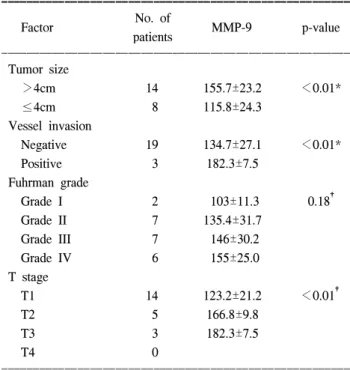
신세포암의 크기와 MMP-9과의 발현을 비교 분석하기 위 해 암종의 크기를 4cm 미만군, 4cm 이상인 군으로 분류하 였다. 4cm 미만인 군은 8명으로 MMP-9의 발현은 115.8±
24.3이었고 4cm 이상인 군은 14명이었고 MMP-9의 발현은 155.7±23.2으로 암종의 크기가 큰 군에서 유의하게 높았다 (Table 2).
3. 혈관의 침범유무와 MMP-9의 발현
조직학적 검사상 혈관의 침범이 있었던 군과 없었던 군 간 MMP-9의 발현을 비교한 결과 침범이 있는 경우가 총 3 례였고 MMP-9의 발현은 182.3±7.5였으며 혈관침범이 없 는 군은 총 19례로 MMP-9의 발현은 134.7±27.1이었다. 혈 관침범이 있는 군에서 혈관침범이 없는 군에 비해 MMP- 9의 발현은 통계적으로 유의하게 높았다 (Table 2).
4. 조직의 분화도와 MMP-9의 발현
종양의 Fuhrman 병리조직학적 분화도에 따른 MMP-9의 발현은 분화도가 좋은 G1에서는 103±11.3이었고 분화도가 중등도인 G2는 135.4±31.7, G3는 146±30.2였으며 분화도 가 나쁜 G4인 경우 MMP-9의 발현은 155±25.0이었다. 병리 조직학적 분화도가 높을수록 MMP-9의 발현도 증가하였으 나 통계학적인 유의성은 없었다 (Table 2).
Fig. 1. Expression of MMP-2 and MMP-9 in the patients with RCC and the control group. The expression of MMP-9 is significantly elevated in the RCC group compared with the control group (p<0.01). There is no difference in MMP-2 activity between the RCC group and the control group (p>0.05). *: p<0.01 com- pared with the control values; Mann-Whitney test. Au: arbitrary units, MMP: matrix metalloproteinase, RCC: renal cell carcinoma.
Fig. 2. Gelatin zymography for MMP-2 and MMP-9. The protein isolated from the homogenate are analyzed for the MMP-9 and MMP-2 expression by gelain zymography. The standard shows bright bands of MMP-9 (active) and MMP-2 (pro-and active).
Normal kidney tissues (N1 and N2) show faint reaction bands for pro-MMP-9. Tumor samples of RCC (T1-T5) show apparent gelatinolytic activity of pro-MMP-9. Notice a strong expression of pro-MMP-9 in the T stage III with renal vein thrombosis (T1 and T4). Standard: conditioned media from the HT1080 culture, MMP:
matrix metalloproteinase, RCC: renal cell carcinoma.
N1 N2 T1 T2 T3 T4 T5 Standard
Pro MMP-9 Active MMP 9- Pro MMP 2- Active MMP 2- Table 2. Correlation between the clinicopathologic factors and the expression of MMP-9
ꠚꠚꠚꠚꠚꠚꠚꠚꠚꠚꠚꠚꠚꠚꠚꠚꠚꠚꠚꠚꠚꠚꠚꠚꠚꠚꠚꠚꠚꠚꠚꠚꠚꠚꠚꠚꠚꠚꠚꠚꠚꠚꠚꠚꠚꠚꠚꠚꠚꠚꠚꠚꠚꠚꠚ No. of
Factor MMP-9 p-value
patients
ꠏꠏꠏꠏꠏꠏꠏꠏꠏꠏꠏꠏꠏꠏꠏꠏꠏꠏꠏꠏꠏꠏꠏꠏꠏꠏꠏꠏꠏꠏꠏꠏꠏꠏꠏꠏꠏꠏꠏꠏꠏꠏꠏꠏꠏꠏꠏꠏꠏꠏꠏꠏꠏꠏꠏ Tumor size
>4cm 14 155.7±23.2 <0.01*
≤4cm 8 115.8±24.3
Vessel invasion
Negative 19 134.7±27.1 <0.01*
Positive 3 182.3±7.5
Fuhrman grade
Grade I 2 103±11.3 0.18†
Grade II 7 135.4±31.7
Grade III 7 146±30.2
Grade IV 6 155±25.0
T stage
T1 14 123.2±21.2 <0.01†
T2 5 166.8±9.8
T3 3 182.3±7.5
T4 0
ꠏꠏꠏꠏꠏꠏꠏꠏꠏꠏꠏꠏꠏꠏꠏꠏꠏꠏꠏꠏꠏꠏꠏꠏꠏꠏꠏꠏꠏꠏꠏꠏꠏꠏꠏꠏꠏꠏꠏꠏꠏꠏꠏꠏꠏꠏꠏꠏꠏꠏꠏꠏꠏꠏꠏ Values are mean±SD. *Student's t-test, †ANOVA test, all values are in arbitrary units, MMP: matrix metalloproteinase
5. 종양의 T병기와 MMP-9의 발현
신세포암의 T병기를 1기, 2기, 3기, 4기로 나누고 이에 따 른 MMP-9의 발현을 비교 분석한 결과 1기에 해당하는 환 자는 14명이었고 발현은 123.2±21.2, 2기는 5명이었고 발 현은 166.8±9.8, 3기는 3명이었고 발현은 182.3±7.5였다. 4 기에 포함되는 대상은 없었다. 통계적 결과 병기가 올라갈 수록 MMP-9의 발현 증가는 유의하게 높았다 (Table 2). 특 히 3기에 해당하는 3례 중 신정맥 혈전을 동반한 2례에서 전 예 중 가장 높은 MMP-9의 발현을 보였다 (Fig. 2).
고 찰
신세포암의 20-30%는 진단 시 전이성 암으로 발견되고, 임상적으로 신장 내에 국한된 국소암으로 근치적 수술을 받는 환자의 20-30%는 술 후 추적관찰 중 전이 또는 재발이 발견된다.10 이러한 전이성 신세포암의 평균 생존기간은 1 년 미만이며, 3년 무병 생존율은 5% 미만이다.11 무엇보다 도 수술적 절제가 가능한 신세포암을 조기에 진단하는 것 이 중요하지만 절제 가능한 신세포암 환자에 있어 술 후 재발의 예방과 재발된 경우 효과적인 치료방법의 개발이 필요하다. 최근까지 이를 예측할 수 있는 독립적인 예후인 자들로 병리학적인 병기, 핵분화도, 세포아형 등이 알려져 있다.3 이러한 예후인자들은 대부분 종양의 병리학적인 진 단에 근거하므로 술 전 예측에 한계가 있다. 그리하여 신세 포암의 예후 예측에 있어 분자생물학적인 인자에 관한 연 구가 활발히 이루어지고 있다.
암의 침윤, 진행 및 전이는 몇 가지 단계적 과정이 연속 적으로 발생하면서 일어난다. 종양의 증식에 필수적인 신 생혈관생성의 기전은 아직까지 명확하게 규명되지 않았으 나 암세포에서 생산되는 혈관생성인자와 암세포 주위의 정상세포 사이의 상호작용에 의해 발생된다. 즉, 암세포는 혈관내피세포 성장인자인 vascular endothelial growth factor
(VEGF)/vascular permeability factor (VPF)와 basic fibroblast growth factor (bFGF)를 분비하여 혈관내피세포의 증식을 유 도하고 혈관의 막투과성을 증가시켜 혈관내피세포의 증식 과 이동을 일으킨다. 혈관내피세포는 여러 가지 종양 성장 인자 (basic fibroblast growth factor; bFGF, platlet derived growth factor; PDGF, Insulin-like growth factor-1; IGF-1, in- terleukin-6; IL-6, colony-stimulating factor; G-CSF, heparin- binding epidermal growth factor-like growth factor; HB-EGF) 를 생성함으로써 종양의 증식을 일으키고 암세포의 전이가 발생된다. 최근 들어 이와 같은 일련의 과정 중 암세포에서 분비되는 내피세포 성장인자뿐만 아니라 기존의 혈관 기저
막을 용해시켜 내피세포의 이동을 유발시키는 단백분해효 소의 역할이 주목받기 시작하였다.12-16
전이능이 있는 암세포는 기적막에 부착 시 용해구역을 형성한 뒤 기적막을 분해시킨다. 이와 같은 기저막 파괴에 는 여러 종류의 단백분해효소들이 관여하며, 그중에서도 MMPs는 결합조직의 단백을 파괴하여 암의 전이를 유발할 뿐만 아니라, 정상조직의 증식 발달, 조직재생 및 상처치유 에도 중요한 역할을 한다.17-19
MMPs는 세포 외 기질을 용해하는 효소로서 일반적으로 암세포에서 발현이 증가하는데 특히 암과 정상조직과의 경 계 부위에서 많이 발현된다.5 암의 전이와 관련하여 처음에 는 주로 기저막 용해 등 혈관 외 유출 (extravasation)에 관여 하는 것으로 생각되었으나, 최근에는 일차성 및 전이성 종 양의 증식 및 혈관생성에 직접 관여하여 전이에 미치는 영 향이 광범위하다.20 MMP군은 세포 외 기질의 다양한 구성 요소의 단백분해에 중요한 역할을 하며 MMP-2와 MMP-9 은 기저막의 주요 구성요소인 제4형 collagen의 변성을 일으 킨다. 이들 효소의 생산은 결체조직뿐만 아니라 암조직에 서도 생성이 된다.21,22
Kugler 등23과 Lein 등24은 정상적인 신조직에 비해 신세포 암의 조직에서 MMP-9와 MMP-2의 발현이 증가됨을 확인 하였다. 본 연구의 결과에서도 신세포암의 조직에서 정상 적인 신세포조직에서 보다 더 많은 MMP-9의 발현율을 확 인할 수 있었다. 그러나, 신세포암 조직에서 MMP-2의 발현 이 더 많다는 보고들23,24과는 달리 본 연구에서는 정상적인 신세포 조직과 신세포암 조직에서 MMP-2의 발현율이 통계 적으로 유의한 차이를 보이지 않았다. Walther 등25의 연구 에서도 높은 MMP-2 mRNA 발현정도가 신세포암 cell lines 의 생존율과 비례하지는 않았다.
본 연구 결과 신세포암의 크기에 따른 MMP-9의 발현은 종양의 크기가 4cm 이상인 군에서 그리고 혈관침범이 있는 군에서 의미 있는 증가를 보였다. 신세포암의 병기와 MMP- 9의 발현 사이의 비교에서도 통계적으로 유의하였는데, 이 는 종양이 크고 혈관침습이 있는 경우 병기가 증가하는 것 과 일치한다. 따라서 MMP-9의 발현율이 높은 군에서 예후 가 더 나쁠 것으로 예견된다. 조직학적 분화도와 MMP- 9의 발현율과의 비교에서도 유의한 차이를 확인할 수 있었는데 이는 MMP-9가 기저막 침습 기전뿐만 아니라 조직의 분화 도에도 관여하였음을 의미한다.
신세포암의 경우 현재 진단과 예후판정에 가치 있는 뚜 렷한 종양지표가 없는 상태이다. 앞서 언급한 바와 같이 신 세포암 환자의 예후는 병기와 가장 관련이 높으며 다음으 로 핵분화도 및 종양의 크기가 중요한 것으로 알려져 있지 만, 술 전에 예후를 예측하는 데는 한계가 있다. 그밖에 술
전 측정이 가능한 erythropoietin, ferritin, c-reactive protein (CRP), p-53, fibrinogen 및 vimentin 등을 예후 인자로 사용하 려는 시도가 있었으나 결과는 제한적이었다. 본 연구에서 종양의 병기가 높을수록 MMP-9의 발현도 증가되는 것으로 보아, 높은 MMP-9의 발현은 재발과 전이의 불량한 예후를 시사하는 것으로 생각한다. Zeng 등26은 높은 병기의 대장 암군에서 MMP-9 mRNA 발현이 증가됨을 보고하였으며, Sier 등27은 불량한 예후를 보인 위암환자에서 MMP-2와 MMP-9이 과발현됨을 증명하여, 비록 종양 발생부위는 다 르지만 종양의 진행과 MMPs의 발현에 유의한 상관관계가 있음을 알 수 있다. 신세포암에 대한 뚜렷한 종양표지자가 없는 현재 상황을 고려할 때, 본 연구의 결과는 신세포암 조직에서 MMP-9의 측정이 유용한 종양표지자로서의 가능 성을 갖고 있음을 의미한다. 그러나 이를 임상에 적용하기 위해서는 혈청이나 소변을 대상으로 하는 부가적인 연구결 과가 필요할 것으로 생각한다.
결 론
본 연구에서는 정상 신조직에 비해 신세포암 조직에서 MMP-9의 발현이 증가되며 암의 크기가 크고 혈관침범이 있으며 병기가 높을수록 MMP-9의 발현이 증가되었다. 이 는 MMP-9 발현의 증가가 신세포암의 발생과정 및 암의 후 기 진행에 관여함을 시사하므로 향후 신세포암의 예후척도 로 사용되어 치료방침을 결정하는 데 도움을 줄 수 있을 것으로 생각한다.
REFERENCES
1. Linehan WM, Zbar B, Bates SE, Zelefsky MJ, Yang JC. Can- cer of the kidney and ureter. In: Devita VT, Hellman S, Rosen- berg SA, editors. Cancer: principles and practice of oncology.
6th ed. Philadelphia: Lippincott; 2001;1362-95
2. Rafla S. Renal cell carcinoma. Natural history and results of treatment. Cancer 1970;25:26-40
3. Ficarra V, Righetti R, Pilloni S, D'amico A, Maffei N, Novella G, et al. Prognostic factors in patients with renal cell car- cinoma: retrospective analysis of 675 cases. Eur Urol 2002;
41:190-8
4. Curran S, Murray GI. Matrix metalloproteinases: molecular aspects of their roles in tumour invasion and metastasis. Eur J Cancer 2000;36:1621-30
5. Murray GI. Matrix metalloproteinases: a multifunctional group of molecules. J Pathol 2001;195:135-7
6. Tryggvason K, Hoyhtya M, Pyke C. Type IV collagenases in invasive tumors. Breast Cancer Res Treat 1993;24:209-18
7. Jiang Y, Goldberg ID, Shi YE. Complex roles of tissue inhibitors of metalloproteinases in cancer. Oncogene 2002;21:
2245-52
8. Sobin LH, Wittekind CH. TNM classification of malignant tumours: UICC International Union Against Cancer. 6th ed.
New York: Wiley-Liss; 2003;193
9. Fuhrman SA, Lasky LC, Limas C. Prognostic significance of morphologic parameters in renal cell carcinoma. Am J Surg Pathol 1982;6:655-63
10. Motzer RJ, Russo P. Systemic therapy for renal cell carci- noma. J Urol 2000;163:408-17
11. Figlin RA. Renal cell carcinoma: management of advanced disease. J Urol 1999;161:381-6
12. Liotta LA. Tumor invasion and metastases-role of the extracel- lular matrix: Rhoads Memorial Award lecture. Cancer Res 1986;46:1-7
13. Nakajima M, Welch DR, Belloni PN, Nicolson GL. Degrada- tion of basement membrane type IV collagen and lung sub- endothelial matrix by rat mammary adenocarcinoma cell clones of differing metastatic potentials. Cancer Res 1987;
47:4869-76
14. Tryggvason K, Hoyhtya M, Salo T. Proteolytic degradation of extracellular matrix in tumor invasion. Biochim Biophys Acta 1987;907:191-217
15. Collier IE, Wilhelm SM, Eisen AZ, Marmer BL, Grant GA, Seltzer JL, et al. H-ras oncogene-transformed human bronchial epithelial cells (TBE-1) secrete a single metalloprotease capa- ble of degrading basement membrane collagen. J Biol Chem 1988;263:6579-87
16. Nicolson GL. Metastatic tumor cell interactions with endothe- lium, basement membrane and tissue. Curr Opin Cell Biol 1989;1:1009-19
17. Sato H, Takino T, Okada Y, Cao J, Shinagawa A, Yamamoto E, et al. A matrix metalloproteinase expressed on the surface of invasive tumour cells. Nature 1994;370:61-5
18. Kleiner DE, Stetler-Stevenson WG. Quantitative zymography:
detection of picogram quantities of gelatinases. Anal Biochem 1994;218:325-9
19. Kleiner DE, Stetler-Stevenson WG. Matrix metalloproteinsases and metastasis. Cancer Chemother Pharmacol 1999;43 (Suppl):
S42-51
20. Arii S, Mise M, Harada T, Furutani M, Ishigami S, Niwano M, et al. Overexpression of matrix metalloproteinase 9 gene in hepatocellular carcinoma with invasive potential. Hepato- logy 1996;24:316-22
21. Sato H, Kida Y, Mai M, Endo Y, Sasaki T, Tanaka J, et al.
Expression of genes encoding type IV collagen-degrading metalloproteinases and tissue inhibitors of metalloproteinases in various human tumor cells. Oncogene 1992;7:77-83 22. Rao JS, Steck PA, Mohanam S, Stetler-Stevenson WG, Liotta
LA, Sawaya R. Elevated levels of M (r) 92,000 type IV collagenase in human brain tumors. Cancer Res 1993;53(Suppl
10):S2208-11
23. Kugler A, Hemmerlein B, Thelen P, Kallerhoff M, Radzun HJ, Ringert RH. Expression of metalloproteinase 2 and 9 and their inhibitors in renal cell carcinoma. J Urol 1998;160:1914-8 24. Lein M, Jung K, Laube C, Hubner T, Winkelmann B, Stephan
C, et al. Matrix-metalloproteinases and their inhibitors in plasma and tumor tissues of patients with renal cell carcinoma.
Int J Cancer 2000;85:801-4
25. Walther MM, Kleiner DE, Lubensky IA, Pozzatti R, Nyguen T, Gnarra JR, et al. Progelatinase A mRNA expression in cell
lines derived from tumors in patients with metastatic renal cell carcinoma correlates inversely with survival. Urology 1997;50:
295-301
26. Zeng ZS, Huang Y, Cohen AM, Guillem JG. Prediction of colorectal cancer relapse and survival via tissue RNA levels of matrix metalloproteinase-9. J Clin Oncol 1996;14:3133-40 27. Sier CF, Kubben FJ, Ganesh S, Heerding MM, Griffioen G, Hanemaaijer R, et al. Tissue levels of matrix metallopro- teinases MMP-2 and MMP-9 are related to the overall survival of patients with gastric carcinoma. Br J Cancer 1996;74:413-7