2011, Vol. 55, No. 4
Printed in the Republic of Korea DOI 10.5012/jkcs.2011.55.4.603
Vicinal Oxime 리간드의 새로운 구리(II) 착물에 대한 합성, 특성 및 ESR 연구
Abdou S. El-Tabl*, Mohamad M. E. Shakdofa†, and Ahmed M. A. El-Seidy† Department of Chemistry, Faculty of Science, Menoufia University, Shebin El-Kom, Egypt
†Inorganic Chemistry Department, National Research Center, P.O. 12622 Dokki, Cairo, Egypt (접수 2011. 1. 14; 수정 2011. 5. 6; 게재확정 2011. 6. 3)
Synthesis, Characterization and ESR Studies of New Copper(II) Complexes of Vicinal Oxime Ligands
Abdou S. El-Tabl*, Mohamad M. E. Shakdofa†, and Ahmed M. A. El-Seidy†
Department of Chemistry, Faculty of Science, Menoufia University, Shebin El-Kom, Egypt. *E-mail: [email protected]
†Inorganic Chemistry Department, National Research Center, P.O. 12622 Dokki, Cairo, Egypt (Received January 14, 2011; Revised May 6, 2011; Accepted June 3, 2011)
요 약. Ethoxylacetyl oxime 리간드 [HL, (1) 및 H2L1, (3)]와 아세트산 구리(II) 일수화물을 반응시켜 팔면체 및 사각평면 착물을 각각 얻었다. 이들 착물을 원소분석, IR 및 UV-Vis 스펙트럼, 자기수자율, 전기전도도 및 ESR 스펙트럼으로 조사 하였다. DMF에서 이들 착물의 몰전기전도도 측정한 결과 비이온성을 보였다. 실온 및 77 K에서 [(L)2Cu(H2O)2], (2) 착
물의 ESR 스펙트럼은 배위결합성을 갖는 축대칭(dx2-y2)의 특성을 보이며, 또한 전형적인 쌍극자 상호작용에 의해 큰 띠나
비를 갖는다. 그러나 착물 [(L1)Cu], (4)는 고체상태에서 큰 띠넓임으로 인해 초미세 갈라짐이 관찰되지 않았는데, 이는 구
리(II) 결합자리들 사이의 스핀-교환 상호작용에 의한 것으로 확인되었다. 실온에서 도포된 구리(II) 착물의 스펙트럼은 배
위된 질소원자로 인해 극초미세 갈라짐을 보였다. 또한 이 물질은 공유 결합성을 갖는 축형태(dx2-y2)의 특성을 보이고, 구
리(II) 이온의 환경은 기본적으로 사각-평면 배열을 갖는다. 77 K의 얼어있는 메탄올에서 [(L1)Cu], (4)의 스펙트럼은 이합 체 화합물의 삼중항 상태의 특성을 보이며, 두 구리(II) 이온 중심 사이의 거리를 계산한 결과 4.8 이다.
주제어: 착물, 전기전도도, 자기적 성질, 구리(II), Oximes, ESR 분광학
ABSTRACT. Ethoxylacetyl oxime ligands [HL, (1) and H2L1, (3)] react with copper(II) acetate monohydrate yield octa- hedral and square planar complexes, respectively. The complexes have been postulated due to elemental analyses, IR, UV- Vis. spectra, magnetic susceptibility, conductivity and ESR spectra. Molar conductance of the complexes in DMF indicates a non-ionic character. The ESR spectra of [(L)2Cu(H2O)2], (2) complex at room temperature and 77K are characteristic of an axial symmetry (dx2-y2) with covalent bond character and have a large line width typical of dipolar interactions. However, [(L1)Cu], (4) complex in the solid state showed spectra of marked broadening and loss of hyperfine splitting confirming spin- exchange interactions between the copper(II) sites. The spectrum of the doped copper(II) complex at room temperature showed super-hyperfine splitting from coordinated nitrogen atoms and it has an axial type (dx2-y2) with covalent bond character and an essentially square-planar arrangement around the copper(II) ion. The spectrum of [(L1)Cu], (4) in frozen methanol at 77K was characteristic of the triplet state of a dimer species and the distance found between the two copper(II) centers was calculated and is equal to 4.8 Å.
Keywords: Complexes, Conductivity, Magnetism, Copper(II), Oximes, ESR Spectroscopy
INTRODUCTION
Recently, considerable attention has been given to oximes and their coordination compounds due to their biological activities as fungicides,1,2 bactericides,1-3 anal- gesic anti-inflammatory4 antioxidant1 antitumor5-7 and insecticidal against Aphis craccivora. Also it displayed plant growth regulatory activities8 and catalytic proper- ties.9 Oximes form complexes with metals as such or in
the presence of another base e.g. pyridine, imidazole etc, to form mixed ligand complexes that are very similar to those found in nature.10 The bioactivity indicated by oximes and their metal complexes was related to the coor- dination mode of the oxime site (N and O coordination modes)11,12 as well as to the bridging capacity of the coor- dinated oximato group to transition metal ions.13,14 Earlier studies concerning the transition metal complexes of vic- inal oxime-imine ligands revealed that, the bridging oxy-
gen atom of the oximato group could serve as a binding site for developing super-molecular structures.15 Series of Mn(II), Fe(III), Co(II), Ni(II) and Cu(II) complexes derived from the reaction of diacetyloxime and 1,2-diaminopro- pane have been synthesized and characterized.16 N,N-eth- ylene-bis-(isonitroacetylacetoneimine) showed coordination through both oxygen and both nitrogen or one oxygen and one nitrogen towards Co(II), Ni(II) and Cu(II)). Some inter-conversion of the isomer was observed.12 Also, Co(II), Ni(II) and Cu(II) complexes of benzidinediacetyloxime and m-phenylenediimine diacetylmonooxime have been prepared and characterized.17,18 ESR studies of paramag- netic transition metal ions yield a great deal of informa- tion about the magnetic properties of the unpaired electrons.19 They may consequently lead to some under- standing of the nature of bonding of the metal ion with its ligand. The most important d9 system studied was cop- per(II). Such investigations had been reported by several authors on copper(II) complexes.2,16-19 The main object of this paper is to prepare and characterize copper(II) com- plexes of vicinal oxime-imine Ligands and to study the ESR spectra at room and liquid nitrogen temperature to investigate the ESR and electronic absorption data in con- nection with the structures in order to identify the nature of the bonding in these complexes. This kind of investi- gation seems to be fundamentally important for the struc- tural estimation of various metal complexes and the metal binding sites of various metalloenzymes.20
EXPERIMENTAL Materials
All the reagents employed for the preparation of the lig- ands and their complexes were of the best grade available and used without further purification. Ethoxy acetyloxime was synthesized according to the literature.21
Physical measurements
C, H and N contents were analyzed at the Microana- lytical Laboratory, Faculty of Science, Cairo University, Egypt. The metal ion contents of the complexes were also determined by the previously reported methods.22 IR spectra of the ligands and their metal complexes were measured using KBr discs with a Perkin Elmer 683 spec- trophotometer (4000-200 cm-1). Electronic spectra (DMF) were recorded on a Perkin Elmer 550 spectrophotometer (900-190 nm). Molar conductivities of the metal com- plexes in DMF (10-3 M) were measured using a dip cell and a Bibby conductimeter MC1 at 25oC. The resistance
measured in ohms and the molar conductivities were cal- culated according to the equation: Λ=V×K×Mw/gΩ, where L, molar conductivity (ohm-1 cm2 mol-1); V, volume of the complex solution (mL); K, cell constant 0.92 cm-1; Mw, molecular weight of the complex; g, weight of the complex; and Ω, resistance measured in ohms. Magnetic moments at 298 K were determined using the Gouy method with Hg[Co(SCN)4] as a calibrant.23 Diamagnetic corrections were made using Pascal’s constant.23 Mag- netic moments were calculated using the equation: µeff
= 2.84 ·T. ESR measurements at 77 and 300 K were made using a Varian E-109 X-band or Q-band spectro- photometers (Leicester University, England). DPPH was used as a standard material. 1H NMR spectrum was obtained on Brucker Advance 400-DRX spectrometers. Chemical shifts (ppm) are reported relative to TMS. The purity of all compounds was confirmed by TLC.
Synthesis of the ligands
Ethyl-2-(hydroxyimino)-3-(phenylimino)butanoate, HL (1), was prepared by adding dropwise the solution of aniline (5.8 g, 63.0 mmol) in 50 cm3 ethanol to the solu- tion of ethoxy acetyloxime (10.0 mg, 63.0 mmol) in 50 cm3 ethanol. The mixture was refluxed for 2 h, then left to cool at room temperature. The yellow precipitated was fil- tered off, washed with ethanol, dried and recrystalized from ethanol; m.p.=170oC, Elemental analyses for HL, (C12H14N2O3): Calcd. C(61.5), H(6.0), N(12.0); Found C(61.3), H(6.1), N(12.3); Yield (70%).
Diethyl-3,3'-(ethane-1,2-diylbis(azan-1-yl-1-ylidene))bis(2- (hydroxyimino)butanoate) [H2L1], (3) was prepared by adding dropwise the solution of ethylenediamine (1.9 g, 1.55 mmol) in 50 cm3 ethanol to the solution of ethoxy acety- loxime (10.0 g, 3.1 mmol) in 50 cm3 ethanol. The mixture was refluxed for 2 h, then left to cool at room temperature.
The yellow precipitated was filtered off, washed with eth- anol, dried and recrystalized from ethanol; m.p.=210oC, Elemental analyses for H2L1, (C14H22N4O6): Calcd. C(49.1), H(6.4), N(16.4); Found C(48.8), H(6.3), N(16.5). Yield; 72%.
Synthesis of the copper(II) complexes
Complex [(L)2Cu(H2O)2], (2). A filtered ethanolic (100 cm3) of Cu(OAc)2·H2O (2.2 g, 10.0 mmol) was added to an ethanolic (100 cm3) of the ligand HL, (1) (5.0 g, 20.0 mmol). The mixture was refluxed with stirring for 3h. The green complex was then filtered off, washed several times with ethanol and dried under vacuo over P2O5, m.p.=225oC, Elemental analyses for [(L)2Cu(H2O)2], (2) (C24H30N4O8Cu):
Calcd. C(50.9), H(5.3), N(9.9), Cu(11.3); Found C(50.6), XMCoor
H(5.4), N(10.0), Cu(11.0). Yield; 80%.
Complex [(L1)Cu], (4). using a 1:1 molar ratio of 3 (5.0 g, 14.0 mmol): Cu(OAc)2.H2O (2.9 g, 14.0 mmol). The reac- tion was carried out as described for complex 2. m.p.=275 oC, brown, Elemental analyses for [(L1)Cu], (4) (C14H20N4O6Cu):
Calcd. C(41.6), H(5.0), N(13.8), Cu(15.8); Found C(41.2), H(5.1), N(13.9), Cu(15.5). Yield; 78%.
RESULTS AND DISCUSSION
The complexes are stable at room temperature, non- hygroscopic, insoluble in water and partially soluble in organic solvents as CHCl3 but soluble in DMF and DMSO. The molar conductance values of complexes 2 and 4 in DMF (10-3 M) are 21.3 and 28 W-1cm2 mol-1 indi- cating non-electrolytic nature.24 The analytical, physical and spectral data are compatible with the suggested struc- tures (Fig. 1). Many attempts have been made to grow Single crystal but unfortunately it was failed.
Mass spectra of the ligands
The mass spectra of the ligands revealed the molecular ion peaks observed at m/e 234 and 342 which is coinci- dent with the formulae weights 234.25 and 342.35 for the ligands HL and H2L1, respectively and supports the iden- tity of their structures.
Infrared spectra
The spectra of the ligands HL and H2L1 showed a
strong band at 1690 and 1685 cm-1 respectively due to the carbonyl group.25-27 This observation indicates that, the carbonyl groups of the ligands and their copper(II) com- plexes are involved in neither hydrogen bonding in ligands nor in the coordination to the copper(II) ion in complexes. Whereas the medium band at 1590, 1625; and 1580, 1620 cm-1 may be assigned to ν(C=N) of the oxime and imine groups respectively.17,24 The two strong bands appeared at 1025 and 1008 cm-1; 1022 and 1005 cm-1were assigned to the oxime group ν(N-O) for the two ligands respectively.26,28 The IR spectrum of 1 showed broad band in the 3450-3300 cm-1 range, may be due to the intra- molecular hydrogen bonding of OH of the oxime group with the imino nitrogen, however, 3 showed two (OH) bands in the 3500-3280 cm-1 and 3210-2560 cm-1 ranges, indicating the presence of two types of hydrogen bonded oxime groups which could be intra- and inter-molecular hydrogen bonded to the basic imino-nitrogen, thus, the higher frequency band is associated with a weaker hydro- gen bonding compared with lower frequency band of the relatively stronger hydrogen bonding.17
By comparison the spectra of the complexes with that of the free ligand, the mode of bonding between the ligand and the metal ions can be established. The IR spectra of complexes 2 and 4 showed that the bands characteristic to the oximato n(C=N-O) and imine n(C=N) groups were shifted to lower frequency and it appeared at 1560, 1608 cm-1 in complex 2 and at 1555, 1605 cm-1 in complex 4.
This observation indicates that, the ligands bonded to the metal ions via the oximato n(C=N-O) and imine n(C=N) groups. At the same time, the ν(N-O) band appears at 1165 for 4 and at 1160 for 2 cm-1, characteristic of N-coor- dination of oximato group.17 The appearance of new bands at 545, 485 and 560, 477 cm-1 for complexes 2 and 4 assigned to the ν(M-N) and ν(M←N) respectively.17,26 The appearance of these bands was taken as confirmation of the bonding of the ligand with the metal ions occurred via the oximato and imine groups. The n(C=O) of com- plexes 2 and 4 appeared at 1665 and 1670 cm-1 respec- tively. This vibration is located in the region of non- coordinated carbonyl group attached to a five-membered chelate ring.17 These assignments are consistent with those reported for the copper(II) complexes of dioximato ligands such as dimethylglycoxime26,29 and cyclohexanedi- onedioxime.32 The IR spectrum of complex 2 showed a broad band in the 3450-3320 cm-1 range, assigned to n(OH) of coordinated water molecules31 which is con- firmed by the presence of bands at 3482 cm-1, 1615 cm-1, 953 cm-1 and 632 cm-1 due to OH stretching, HOH defor- Fig. 1. Structure representation of the ligands and their cop-
per(II) complexes.
mation, H2O rocking and H2O wagging, respectively.32
Electronic spectra and magnetic moments
The electronic spectra of the ligands in DMF showed three bands at 280 nm (ε=4.5×10³ mol-1 cm-1), 350 nm (ε=
5.6×10³ mol-1 cm-1), 385 nm (ε=6.2×10³ mol-1 cm-1) for 1 and at 275 nm (ε=4.4×10³ mol-1 cm-1), 340 nm (ε=5.5×10³ mol-1 cm-1), 380 nm (ε=6.1×10³ mol-1 cm-1) for 3 which may be assigned to the π→π* and n→π* transitions17,33 The electronic spectra for 2 and 4 in DMF showed peaks at 275, 335, 495, 585 and 645 and 270, 335, 485 and 510 nm, respectively. The first bands are assigned to intra- ligand transitions within the ligands. Other bands for 2 corresponded to 2B1g→2Eg, 2B1g→2B2g and 2B1g→2A1g
transitions of copper(II) ion in a tetragonally elongated octahedral.2,34 However, for 4 the bands are assigned to
2B1g→2B2g and 2B1g→2A1g transitions of a square planar copper(II) complexes.2 Room temperature magnetic moments for 2 and 4 are 1.70 and 1.65 B.M., indicating that, the complexes were in octahedral or square planar geometry.2
1H NMR spectra
The 1H-NMR spectra of 1 and 3 in deuterated DMSO showed signals consistent with the proposed structure (Fig. 1). Ethoxy group showed triplet and a distinct quar- tet signals in the region 3.2-3.8 ppm. The signals at 12.55 and 12.32 ppm correspond to OH of oximato group of ligands 1 and 3, respectively.2 The resonance at 2.52 and 2.33 ppm are due to methyl group protons.31,35 The aro- matic protons for 1 appears as multiples in the 6.42-7.1 range, however, the methylene group protons appeared at 4.3 ppm for 3.31
Electron spin resonance studies of copper(II) com- plexes
The ESR spectra of the polycrystalline samples of the copper(II) complexes were recorded at room temperature and at 77 K. The experimental ESR parameters are pre- sented in Tables 1 and 2. Fig. 2 depicts the ESR spectra of 2 at room temperature and 77 K. These are characteristic of a compound having an axial symmetry type of ground state which is the most common for copper(II) complexes30,36
and has a large line width typical of dipolar interactions.
The lack of hyperfine structure in the ESR spectra sug- gested that, intermolecular exchange interactions are operative, but these interactions are not strong enough to combat the dipolar interactions.37 The shift to slightly lower g|| at liquid nitrogen indicates stronger metal-ligand bonding consistent with a flattening of any tetrahedral dis- tortion present in this compound at room temperature.38 The hexa-coordinate copper(II) complexes are usually arranged in a distorted octahedral environment about the metal ion with four ligands disposed in an approximate plane including the copper(II) ion with short bonds , and thus strongly bonded . The other two ligands are arranged on a straight line including the copper(II) ion and per- pendicular to the plane, they are usually much more weakly bonded than those in the plane and play only minor role in both magnetic and optical properties of the copper(II) complex. According to the Jahn-Teller theorem,30 all sym- metrical hexa-coordinated complexes of copper are asso- ciated with a tetragonal distortion reducing the symmetry from Oh to D4h.40,41 This results in anisotropy of the g ten- sor. Such dynamic behavior may be expected only for sys- tems like CuX6, where the central ion is bonded to six identical ligands. For this complex, where the coordinat- ing ligands are not identical, only static distortion can occur. The value of g|| is greater than g^. in the complex.
This Indicates a tetragonal distortion,37 corresponding to elongation along the four fold symmetry axis Z. This is Table 1. ESR parameters of polycrystalline complex 2 or in methanol
Polycrystalline
Temp. g|| g⊥ A||(G) A⊥(G) giso Aiso aG g||/A|| (cm) 2B ad%
293K 2.219 2.034 135 15 2.095 55 6.44 159.6 -140 60
77K 2.21 2.031 140 20 2.090 60 6.77 153.5 -147 63
methanol 77K 2.214 2.029 130 10 2.09 50 7.38 165.2 -132 56
aG=(g||-2)/(g⊥-2). giso=(g|| +2g⊥)/3. Aiso=(A|| +2A⊥)/3.
Fig. 2. ESR spectra of polycrystalline complex [(L)2Cu(H2O)2], (2) at room temperature (A) and at 77K (B).
further confirmed from the Symons plot of Fig. 342 which indicates that, the complex falling close to the line can be considered to be distorted tetrahedral species rather than octahedral or square-planar. The orbital of the unpaired electron is still dx2-y2 because Jahn-Teller induced distor- tion generally favors dx2-y2 and dz2 configurations are rare.43 Also, the values of g||/A|| may be considered44,45 as diagnostic of the stereochemistry. It has been suggested that this quotient may be used as an empirical index of geometry.44 The range reported for square-planar com- plexes are 105-135 cm and for tetrahedrally distorted com- plexes 150-250 cm.44 The g||/A|| values for the compound under consideration lie just in the range expected for tet- rahedral distorted complexes. The g-values are related by the expression G=(g||-2)/(g⊥-2).46 If G > 4.0, then the local tetragonal axes are aligned parallel or only slightly mis- aligned, If G<4.0, significant exchange coupling30 is present. For this complex the G value is greater than 4.0, this value is in agreement with local tetragonal geometry.
The isotropic value of the hyperfine coupling constant Aiso
is calculated as follows using Eq. (1)
Aiso = (A|| + 2A⊥)/3 (1)
Also giso, is calculated by substituting in Eq. (2)
giso = (g|| + 2g⊥)/3 (2)
The isotropic value of the hyperfine coupling constant, Aiso is related to the σ-bonding parameter47 through the following Eq. (3)
(3)
where P is the free ion dipole term proportional to (r-3)and K is the Fermi contact term occurring in the equation for the magnetic parameters given by Gersmann and Swalen.48 If α2=1, the bond would be completely ionic. And α2=0.5,
the bond would be completely covalent. The calculated value of α2 assuming P=0.036 cm-1 and K=0.4347 was 0.64 and this value of α2 suggests mixed ionic-covalent boning using the electronic transition energies from the absorp- tion spectrum. Hence, the values of the other bonding parameters could be calculated. The complex (2) shows β12and β2 equal to 0.88 and 0.65, indicating a moderate degree of covalency in the in-plane π-bonding and cova- lent character of the out-of-plane π bonding.49 Kivelson and Neiman50 have reported that the g|| value in a cop- per(II) complex can be used as a measure of the covalent character of the metal-ligand bond. If this value is more than 2.3 the environment is essentially ionic and values less than this limit are indicative of a covalent environ- ment. The g|| value for the present complex showed con- siderable mixed ionic-covalent bonding character.
The ESR spectrum of a frozen solution at 77 K of com- plex 2 in methanol in the form of small beads was obtained as shown in Fig. 4. The g and A components showed axial type symmetry with dx2-y2 ground state.49 The hyperfine coupling constants and g values are given in Table 1. In the present case, where the copper is coor- dinated to four nitrogen atoms as shown in Fig. 1, line broadening was detected but no nitrogen super-hyperfine splitting was observed. It is considered that, the prominent broadening stems from the interaction of the unpaired electron spin with the nuclear magnetic moment of the 14N nuclei. This is further confirmed from the Peisach plot (Fig. 5).51 The spectral values for the copper(II) ion of the complex lie just inside the region describing four nitrogen ligands per metal.
The room temperature spectrum in chloroform shows the four copper hyperfine lines having an Aiso=65 G with its center at giso=2.09. The superhyperfine splitting of nitrogen (14N) nuclei were observed in the narrow (-3/2) line which is not resolved at lower temperature. This indi-
α2 Aiso
PK--- giso–2.0023 ---K +
=
Fig. 3. Plot of A|| against ∆g|| for range of copper(II) complexes.
Fig. 4. ESR spectrum of complex [(L)2Cu(H2O)2], (2) in meth- anol at 77 K.
cates the presence of four almost equivalent nitrogen nuclei (Aiso=9 G). Fig. 6 showed the spectrum of 2 in chlo- roform at room temperature.
It is possible to calculate approximate orbital popula- tions for s, p or d orbital using the following equations43 (4) (5)
(6)
where A0 and 2B0 are the calculated dipolar coupling for unit occupancy of s and d orbitals respectively.
When the data are analyzed, the components of the 63Cu hyperfine coupling were considered with all the sign com- binations. The only physically meaningful results are found when A|| and A⊥ were negative and the parallel compo- nent of the dipolar coupling 2B is negative. These results can only occur for an orbital involving the dx2-y2 atomic orbital on copper. The value for 2B is quite normal for
copper(Il) complexes.48 The |Aiso| value was relatively small. The 2B value divided by 2Bo (The calculated dipo- lar coupling for unit occupancy of dx2-y2 (-235.11 G), using equation (6) suggests all orbital population close to the orbital of the unpaired electron in dx2-y2,43 Tables 1,2.
ESR spectra of a polycrystalline sample of complex 4 were recorded at both room and liquid nitrogen temper- ature as shown in Fig. 7A,B. These spectra showed marked broadening and loss of hyperfine splitting, suggesting spin-exchange interactions between the copper sites.52-54 The shift of the signal in the low field region to a slightly lower value at 77 K indicates stronger metal-ligand bond- ing consistent with a flattening of any tetrahedral distor- tion present in this complex at room temperature. The Q- band spectrum showed a weak signal in the low field region as shown in Fig. 7C.
In order to avoid spin-exchange, a doped sample was obtained by crystallization of complex 4 in chloroform solution containing the Ni(II) analogue in concentration (1:50) so that the individual paramagnets are well sepa- rated.
A||=Aiso–2B 1( ±(7/4)∆g||) A⊥=Aiso+B 1( ±(7/4)∆g||) as2=Aiso/A0
ap d2, =2B/2B0
Fig. 5. Peisach plot showing the relationship between g|| and A||
for the complexes [(L)2Cu(H2O)2], (2) and [(L1)Cu], (4) with four nitrogen ligands.
Fig. 6. The ESR spectrum of copper(II) complex [(L)2Cu(H2O)2], (2) in CHCl3 at room temperature.
Fig. 7. The ESR spectrum of polycrystalline copper(II) complex [(L1)Cu], (4) at room temperature (A), 77 K (B), Q-band (C).
Fig. 8. The ESR spectrum of doped complex [(L1)Cu], (4) at room temperature.
The X-band powder spectrum of the doped copper(II) complex 4 obtained at room temperature was shown in Fig. 8 showing super-hyperfine splitting from four coor- dinated nitrogen atoms. The spectrum at 77 K is almost identical. This indicated that there is no significant change in the planarity of the complex at both temperatures. The Q-band spectrum gives identical parameters which pro- vided good reconstructions for both spectra. It showed an axial symmetry type with two g values, which indicates a predominantly dx2-y2 ground state and an essentially square- planar arrangement around the copper(II) ion.55-57 It is known that, for four-coordinated copper(II) complexes, the distortion from square-planar towards tetrahedral geom- etry causes g|| to increase and A|| to decrease and that the g||/A|| ratio is a reliable index of the degree of distortion.
The ratio from ca. 105-135 cm is the limit of the square planar geometry, but is increased markedly when tetra- hedral distortion takes place.44 It is observed that, there is no change in g and A values at room and liquid nitrogen temperature and the value of g||/A|| is 107.2 which lies in the range for square planar geometry.58 The values are listed in Table 2. As the nuclear spins of 63Cu and 65Cu iso- topes are 3/2, the ESR spectrum showed a hyperfine split- ting of four features. For this complex, the copper(II) ion is ligated to four almost equivalent nitrogen nuclei having a nuclear spin of unity. Super-hyperfine splitting of var- ious features should be observed from the magnetic inter- action of the unpaired electron spin with the nuclear magnetic moment or nitrogen atoms. In this case, the complex showed a very well resolved spectrum which indicates monomeric species. The parallel component of the hyperfine splitting, of the copper appears well resolved with a relatively high A||(Cu) Table 2. This splitting is not observed in the perpendicular component because the A⊥
(Cu) must be very low59 The four coordinated nitrogen atoms of the copper(II) complex are almost equivalent and showed their maximum coupling along one or other of x, y direction, and their minimum coupling along the parallel direction. The estimated σ-spin density on each of the four nitrogen atoms is then 2.16% 2s.43 The 2B value of -230 G as shown in Table 2, corresponds to a d orbital population of ca. 97% for this complex 4. The super- hyperfine pattern consists of nine features having inten- sities of about 1:4:10:16:19:16:10:4 1. The super-hyper- fine splitting of the 14N atoms of the ligands was obtained
in both parallel and perpendicular components indicating that the four nitrogen atoms are almost equivalent and the metal was ligated by four nitrogen atoms. Also, this is fur- ther-confirmed from the Peisach plot Fig. 5.51 This com- plex showed G < 4 as shown in Table 2. This value indicates a spin-exchange interaction is still happening.51 The ESR spectrum of this complex in chloroform at room temper- ature Fig. 9 showed the four copper hyperfine lines hav- ing an Aiso=80 G with its center at giso=2.077. This isotropic value fits the equation: (3giso=2g⊥+g||). The super-hyper- fine splitting of (14N) nuclei were observed. This indicates the presence of four almost equivalent nitrogen nuclei (Aiso=12 G), this is further confirmed from the Peisach plot Fig. 5.51
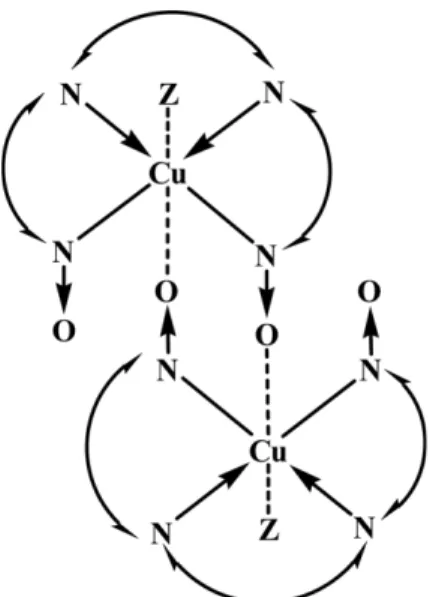
The ESR spectrum of 4 in frozen methanol at 77 K was also recorded (Fig. 10). The spectrum showed that, two species are formed. The monomer species is identical to that of the doped copper(II) complex in the powder form
Table 2. The ESR parameters of a doped copper(II) complex 4 and hyperfine coupling of nitrogen atoms
14N Aiso (G) g|| g⊥ giso A||(G) A⊥(G) Aiso g||/A|| (cm) aG 2B ad%
12.0 2.145 2.004 2.077 207 16.5 80 107.2 3.3 -230 97
Fig. 9. The ESR spectrum of copper(II) complex [(L1)Cu], (4) in CHCl3 at room temperature.
Fig. 10. The ESR spectrum of complex [(L1)Cu], (4) in meth- anol at 77 K.
at room temperature. However, a complex spectrum hav- ing seven lines in the low and high field regions with some lines in the centre field region were also observed. This is characteristic of the triplet-stat for a dimmer species. One possible structure of the dimeric complex is shown in Fig.
11. The ESR spectrum showed the following parameters g|| (2.17), g⊥ (2.04) and A|| (95 G). The spectrum showed g||>g⊥>2.0, this indicates that, the two unpaired electrons are in dx2-y2 orbital on copper.
The zero field splitting parameter (D) for the parallel components of the dimmer complex was estimated from the spectrum, and is equal to 435 G. The distance between two copper centers was calculated using the following equation.43
D = (7)
where µβ is the magnetic moment of the electron. R is the distance (0A) between two electrons.
For parallel component (D) θ=0, by substitute on in equa- tion (7), D is equal to.
For a bi-radical system in the triplet-state, it is found that D for the paralleled components is equal to 402G and the distance between the two radicals is equal to 5.2 A. From these data, the distance between the two copper(II) cen- ters was calculated and is equal to 4.87 Å. This value is close to that for a dimeric copper(II) compound in the trip- let state.62 However, the absence of any clear splitting of the two perpendicular features and the fact that this split- ting is close to half that of the parallel lines seems to sug-
gest that the g, hyperfine, and zero-field splitting axes .are very close to each other. This should not be the case for structure (a) since the two copper ions are considerably displaced off their Z axes as indicated. Thus, there must be some doubt about the structure of the species responsible for the spectrum in Fig. 10.
CONCLUSIONS
Copper(II) complexes of ethoxy acetyloxime have been prepared and spectrally characterized. The conductivity data indicate that, the complexes are non-electrolyte. The ESR spectra of solid or liquid state at room temperature or 77 K indicates a dx2-y2 ground state with mixed ionic-cova- lent bond.
REFERENCES
1. Colak, A.; Terzi, .; Col, M.; Karaoglu, . A.; Karaböcek, S.; Küçükdumlu, A.; Ayaz, F. A. Eur. J. Med. Chem. 2010, 45, 5169.
2. El-Tabl, A. S.; Plass, W.; Buchholz A.; Shakdofa, M. M.
E. J. Chem. Res. 2009, 582.
3. Yllmaz, A.; Taner, B.; Deveci, P.; Obal, A.Y.; Arslan, U.;
ahin, E.; Uçan, H.I.; Özcan, E. Polyhedron 2010, 29, 2991.
4. El-Gamal, M. I.; Bayomi, S. M.; El-Ashry, S. M.; Said, S.
A.; Abdel-Aziz, A. A.-M.; Abdel-Aziz, N. I. Eur. J. Med.
Chem. 2010, 1403.
5. Krsti, N. M.; Bjelakovi, M. S.; Žižak, Ž.; Pavlovi , M. D.;
Jurani , Z. D.; Pavlovi , V. D. Steroids 2007, 72, 406.
6. Park, H.-J.; Lee, K.; Park, S.-J.; Ahn, B.; Lee, J.-C.; Cho, H. Y.; Lee, K.-I. Bioorg. Med. Chem. Lett. 2005, 15, 3307.
7. Dodof, N. I.; Kubiak, M.; Kuduk-Jaworska, J.; Mastalarz, A.; Kochel, A.; Vassilieva, V.; Vassilev, N.; Trendaflova, N.; Georgieva, I.; Lalia-Kantouri, M.; Apostolova, M.
Chemija. 2009, 20, 208.
8. Dai, H.; Yu,H.-B.; Liu, J.-B.; Li, Y.-Q.; Qin, X.; Zhang, X.; Qin, Z.-F.; Wang, T.-T.; J.- Fang, X. ARKIVOC 2009, vii, 126.
9. Pande, K. C. U.S. Patent 3,252,672, 1966; Chem. Abstr.
1967, 66, 28, 89.
10. Dash, K. C. J. Indian Chem. Soc. 1994, 71, 227.
11. Kukushkin, V. Y.; Tudela D.; Pombeiro, A. J. Coord.
Chem. Rev. 1992, 114, 169.
12. Baghlaf, A. O.; Aly M. M.; Ganji, N. S. Polyhedron 1987, 6, 205.
13. Coacio, E.; Dominguezvera, J. M.; Escuer, A.; Klinga, M.;
Kivekas, R.; Romerosa, A. J. Chem. Soc. Dalton Trans.
1995, 343.
14. Ruiz, R.; Sanz, J.; Lloret, F.; Julve M.; Faus, J.; Bois, C.;
Munoz, M. J. Chem. Soc. Dalton Trans. 1993, 3035.
3µβ 2R3
--- 3Cos( 2–1)
U·· S¸
S¸
c´
c´ c´
Fig. 11. Structure representation of the dimer copper(II) complex of complex 4.
15. Aly, M. M.; J. Coord. Chem. 1998, 43, 89.
16. El-Tabl, A. S.; Kashar, T. I. Polish J. Chem. 1998, 72, 519.
17. El-Tabl, A. S. Trans. Met. Chem. 2002, 27, 166.
18. El-Tabl, A. S. Trans. Met. Chem. 1969, 21, 1.
19. Ayad, M. I.; El-Tabl, A. S. Polish J. Chem. 1999, 73, 263.
20. Balch, A. L.; Mazzani M.; Olmstead, M. M. Inorg. Chem.
1993, 32, 4737.
21. Welcher, F. J. Organic Analyical Reagents; Van Nostrand:
NewYork, 1955; p 280.
22. Vogel, A. I. A Text Book of Quantitative Inorganic Anal- yses, 2nd Ed., Longman: London, 1951.
23. Bas, K. S.; Sharma, B. C.; Patel, C. C. Inorg. Chem. 1973, 12, 120.
24. El-Tabl, A. S.; Issa, R. M. J. Coord. Chem. 2004, 57, 509.
25. Aly, M. M. Baghlaf, A. O.; Ganji, N.S. Polyhedron 1985, 4, 1301.
26. El-Tabl, A. S. Trans. Met. Chem. 1997, 22, 400.
27. Aly, M. M.; El-Saied F. A. J. Inorg. Nucl. Chem. 1981, 43, 287.
28. Ma, M. S.; Angelici, R. J. Inorg. Chem. 1980, 19, 363.
29. Bigatto, A.; Costa, G.; Galasso, V.; Alti, D. G. Spectro- chim. Acta Part 1970, 25, 1939.
30. Eisenstein, J. C. J. Chem. Phys. 1958, 28, 323.
31. El-Tabl, A. S.; El-Saied F. A.; Al-Hakimi A. N. Trans. Met.
Chem. 2007, 32, 689.
32. Teotia, M.; Gurthu, I. N.; Rama U. B. J. Inorg. Nucl.
Chem. 1980, 42, 821.
33. Gao, E.; Bi, S.; Sun H.; Liv, S. Synth. Reac. Inorg. Met.- Org. Chem. 1997, 27, 115.
34. El-Tabl, A. S. Polish J. Chem. 1997, 71, 1213.
35. K Gudasi, B.; Patil, S. A.; Vadravi, R. S.; Shenoy, R. V.;
Nethaji, M. Trans. Met. Chem. 2006, 31, 586.
36. Hathaway, B. J.; Billing, T. E. Coord Chern. Rev. 1970, 5, 143.
37. Mahajan, M.; Saxena, K.N.; Saxen, C. P. J. Inorg. Nucl.
Chem. 1981, 43, 2148.
38. Brown, D. R.; West, D. X. J. Inorg. Nucl. Chem. 1981, 43, 1017.
39. Jahn, H. A.; Teller E. Proc. Roy. Soc. (London) A. 1937, 161, 220.
40. Hudson, A. J. Mol. Phys. 1966, 10, 575.
41. Bersuker, L. B. Coord. Chem. Rev. 1975, 14, 357.
42. Symons, M. C. R.; West, D. X.; Wilkinson, G. J. Chem.
Soc. Dalton Trans. 1975, 1696.
43. Natarajan, C.; Shanthi, P.; Athappan P.; Murugesan, R.
Trans. Met. Chem. 1992, 17, 39.
44. Sakaguchi, U.; Addison, A. W. J. Chem. Soc. Dalton Trans.
1979, 600.
45. Nickles, D. E.; Power, M. J.; Vrbach, F. L. Inorg. Chem.
1983, 22, 3210.
46. Procter, L. M.; Hathaway, B. J.; Nicholls, P. J. Chem.
Soc.(A) 1969, 1678.
47. Kuska, H. A.; Rogers, M. T. Coordination Chemistry; A. E.
Martell, Ed.; Van Nostrand Reinhold Co.: New York, 1971.
48. Mcgarvey, B. R. Trans. Met. Chem. 1966, 3, 89.
49. El-Boraey, H. A.; El-Tabl, A. S. Polish J. Chem. 2003, 77, 1775.
50. Kivelson, D.; Neiman, R. J. Chem. Phys. 1961, 35, 149.
51. Peisach, J.; Blumberg, W. E. Arch. Biochem. Biophy.
1974, 165, 691.
52. Shanna, K. K.; Chandra, S. Trans. Met. Chem. 1984, 9, 401.
53. Demertzi, O. K.; Tsangaris, J. M.; Hadjiliadis, N. Trans.
Mel. Chem. 1983, 8, 140.
54. Abragam, A.; Bleaney, B. EPR of Transition Ions; Clar- endon Press: Oxford, 1970.
55. Richardson, H.; Wasson, J.; Estes, W.; Hatfield, W. Inorg.
Chem. Acta 1977, 23, 205.
56. Srivastava, M.; Tewari, R.; Srivastava, Y.; Bhargava, G.;
Vishnoi, A. J. Inorg. Nucl. Chem. 1976, 43, 897.
57. Marcotrigiano, G.; Menabue, L.; Carlopellacani, G. Inorg.
Chim. Acta 1980, 46, 107.
58. Massacesi, M.; Ponticelii, G.; Devoto, G.; Micera G.; Piu, P. Trans. Met. Chem. 1984, 9, 362.
59. Maslejova, A.; Kirmse R.; Stack, J. Z. Anorg. Algem. Chem.
1980, 461, 61.
60. Delgado, S.; Moran M.; Fernandez, V. J. Coord. Chem.
1982, 12, 105.
61. Falk, K. E.; Lvanova, E.; Roos, B.; Vanngard, T. Inorg.
Chem. 1970, 9, 556.
62. Bertrand, J. A.; Black, T. D.; Eller, P. G.; Helm, F. T.;
Mahmood, R. Inorg. Chem. 1976, 15, 2965.
![Fig. 2. ESR spectra of polycrystalline complex [(L) 2 Cu(H 2 O) 2 ], ( 2) at room temperature (A) and at 77K (B).](https://thumb-ap.123doks.com/thumbv2/123dokinfo/5299364.154543/4.892.463.809.150.356/fig-esr-spectra-polycrystalline-complex-cu-room-temperature.webp)
![Fig. 4. ESR spectrum of complex [(L) 2 Cu(H 2 O) 2 ], ( 2) in meth- meth-anol at 77 K.](https://thumb-ap.123doks.com/thumbv2/123dokinfo/5299364.154543/5.892.466.809.878.1063/fig-esr-spectrum-complex-cu-meth-meth-anol.webp)
![Fig. 6. The ESR spectrum of copper(II) complex [(L) 2 Cu(H 2 O) 2 ], ( 2) in CHCl 3 at room temperature.](https://thumb-ap.123doks.com/thumbv2/123dokinfo/5299364.154543/6.892.87.429.443.627/fig-esr-spectrum-copper-complex-chcl-room-temperature.webp)
![Fig. 9. The ESR spectrum of copper(II) complex [(L 1 )Cu], ( 4) in CHCl 3 at room temperature.](https://thumb-ap.123doks.com/thumbv2/123dokinfo/5299364.154543/7.892.465.805.762.987/fig-esr-spectrum-copper-complex-chcl-room-temperature.webp)