• 검색 결과가 없습니다.

Single-Port Thoracic Surgery: A New DirectionCalvin S. H. Ng, M.D., F.R.C.S. (C.Th.)

N/A
N/A
Protected

Academic year: 2021

Share "Single-Port Thoracic Surgery: A New DirectionCalvin S. H. Ng, M.D., F.R.C.S. (C.Th.)"

Copied!
6
0
0

로드 중.... (전체 텍스트 보기)

전체 글

(1)

Department of Surgery, The Chinese University of Hong Kong

Received: June 18, 2014, Revised: June 30, 2014, Accepted: July 1, 2014, Published online: August 5, 2014

Corresponding author: Calvin S. H. Ng, Division of Cardiothoracic Surgery, The Chinese University of Hong Kong Prince of Wales Hospital, 30-32 Ngan Shing Street, Shatin, NT, Hong Kong SAR, China

(Tel) 852-2632-2629 (Fax) 852-2637-7974 (E-mail) [email protected]

C

The Korean Society for Thoracic and Cardiovascular Surgery. 2014. All right reserved.

CC

This is an open access article distributed under the terms of the Creative Commons Attribution Non-Commercial License (http://creative- commons.org/licenses/by-nc/3.0) which permits unrestricted non-commercial use, distribution, and reproduction in any medium, provided the original work is properly cited.

Single-port video-assisted thoracic surgery (VATS) has slowly established itself as an alternate surgical approach for the treatment of an increasingly wide range of thoracic conditions. The potential benefits of fewer surgical incisions, better cosmesis, and less postoperative pain and paraesthesia have led to the technique’s popularity worldwide.

The limited single small incision through which the surgeon has to operate poses challenges that are slowly being addressed by improvements in instrument design. Of note, instruments and video-camera systems that are narrower and angulated have made single-port VATS major lung resection easier to perform and learn. In the future, we may see the development of subcostal or embryonic natural orifice translumenal endoscopic surgery access, evolu- tion in anaesthesia strategies, and cross-discipline imaging-assisted lesion localization for single-port VATS procedures.

Key words: 1. DynaCT 2. Hookwire 3. Hybrid

4. Magnetic anchoring and guidance systems 5. Non-intubated lung resection

6. Natural orifice translumenal endoscopic surgery

INTRODUCTION

Single-port, also known as uniportal or single-incision, vid- eo-assisted thoracic surgery (VATS) has become increasingly popular [1,2]. The development of single-port VATS has come a long way, from the beginning for performing simple procedures such as sympathectomy and pleurodesis over a decade ago, to the rapid progression in the past 2 years of complex major lung resections, including segmentectomy, pneumonectomy, lung resection with chest wall resection, sleeve resection, and double-sleeve resection [3-9]. Further- more, there is growing evidence that single-port VATS can be performed safely with good early outcomes that are at

least comparable to those of conventional VATS major lung resection [10,11]. Although publications relating to single-port VATS account for less than 1% of all publications on VATS in general, there is a steady rise in literature, particularly from the Asian region, on this technique, accounting for over 50% of all publications on single-port VATS in the past 2 years.

The idea of performing thoracic surgery through a single

small incision has led to a radical change in the thought

process of VATS surgeons in terms of surgical access, ap-

proach to the procedure, and the need for specialized

equipment. An added benefit of this new direction is the un-

precedented growth in collaboration between thoracic sur-

(2)

Fig. 1. Illustration of the positions of the surgeon and assistants during single-port video-assisted thoracic surgery lung resection. During sur- gery, the surgeon and the assistant may exchange positions for more er- gonomic access. (A) Surgeon cranial.

(B) Surgeon caudal.

geons and industry to achieve these goals. The current review will describe the developments in these areas, which should be of particular interest to surgeons who perform single-port VATS.

SURGICAL ACCESS & APPROACH

Single-port VATS represents a radical change in the ap- proach to lung resection compared with the conventional three-port VATS. By requiring the placement of all the oper- ating instruments and the camera within the same incision, single-port VATS can pose a challenge for both the surgeon and the assistant. Furthermore, the position of the single-port incision becomes even more important than in two- or three-port VATS. In general, our approach to the dissection of hilar structures is from the anterior; hence, the incision is centered around the anterior axillary line, at the 5th inter- costal space [12]. The surgeon and the first assistant, who holds the camera, usually stand on the side that is anterior to the patient, while a second assistant may stand on the oppo- site side (Fig. 1). It should be highlighted that the relative positions of the surgeon and the first assistant can be ex- changed during single-port VATS when surgery is performed for the upper and the lower chest cavities in order to facili- tate instrumentation and improve ergonomics (Fig. 1). Often, the single-port surgeon may find the visualization and dis- section of structures, as well as the identification of the cor- rect angles for instrumentation and endostapler deployment,

difficult. Changing the order of the instruments along the sin- gle-port incision can sometimes help facilitate these manoeu- vres, without the need to enlarge the incision or exert force onto the wound. During most of the dissection, the scope is placed at the posterior aspect of the incision. It is noteworthy that the placement of the scope in the middle position is less often used because it is ‘floating’ in the incision wound and makes it difficult to keep the camera steady [13].

Despite the minimally invasive nature of single-port VATS,

placing an incision through an intercostal space can result in

chronic pain or paraesthesia, even when strategies to reduce

the incision size and decrease the risk of intercostal nerve in-

jury are followed [14]. In 2013, Liu [15] successfully per-

formed the first single-port VATS lobectomy via a sub-

xiphoid approach for left upper lobectomy. The small incision

placed inferior to the costal margin may reduce the risk of

intercostal nerve injury and potentially avoid the limitations

imposed by narrow rib spaces [15]. The subxiphoid approach,

when implemented close to the midline, also allows for ac-

cess to the bilateral thoracic cavities for bilateral lung re-

sections through one incision [16]. However, the transmitted

cardiac pulsation to the VATS instruments, particularly during

left chest surgery, makes this approach challenging. Further-

more, in the event of a significant vascular injury, due to the

distance of the subxiphoid incision from the hilar, bleeding

control may be much more difficult. If a conversion to open

surgery becomes necessary, an extension of the subxiphoid

incision is unlikely to be useful and an additional thor-

(3)

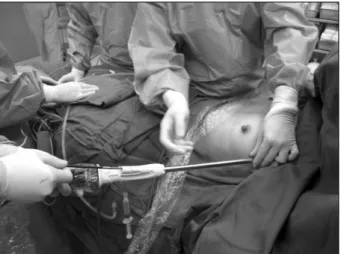
Fig. 2. Endoscopic vein harvesting device with an instruments channel, a carbon dioxide insufflator channel, an endoscope, and a lens cleaning system, as an example of an integrated instru- ment design for single-port video-assisted thoracic surgery surgery.

acotomy incision may be necessary. As the VATS equipment continues to become smaller with more angles of articulation, another potential single-incision VATS approach would be through the axilla. Although such an approach would not ad- dress the problem of intercostal neuralgia, placing the incision in the axilla may be superior at least from a purely aesthetic point of view.

To improve ergonomics and particularly to avoid the fenc- ing from individual instruments placed through the small in- cision of single-port VATS, rapid progress in instrument de- sign has taken place. The narrower shafted double-hinged sin- gle-port instruments and thoracoscopes that have greater de- grees of vision may all contribute to a reduction of some of the challenges associated with single-port VATS [13,17]. The greater lens flexibility improves visibility in single-port VATS when all the instruments and the scope pass through a single small incision in a parallel manner, particularly for surgeons on the learning curve and in difficult cases [13,17]. Further innovations that have led to a reduction in thoracoscope–in- strument interference include the replacement of the conven- tional thoracoscope with remote wireless camera systems, such as the magnetic anchoring guidance system (MAGS) [17]. The MAGS uses magnets to hold and control a remote wireless camera placed within the operating cavity, eliminat- ing the need for light and transmission cables. To further re-

an energy source has been developed. In fact, the first report was the utilization of a modified pediatric cysto-resectoscope in single-port bilateral VATS thoracic sympathectomy for hy- perhidrosis [18]. Subsequently, along the same lines of thought, a more modern version of the single-instrument unit for single-port VATS sympathectomy uses the VasoView device. Through a 1-cm incision, the instrument originally de- signed for endoscopic vein harvesting can be placed into the thoracic cavity, and via the in-built instrument channel, cam- era, and carbon dioxide insufflation channel, the sym- pathectomy can be completed with good results [19,20] (Fig.

2).

To avoid an unsightly incision scar, embryonic natural or- ifice translumenal endoscopic surgery (e-NOTES) has been successfully performed for certain simple thoracic procedures.

E-NOTES involves the passage of an endoscope through a single incision at the umbilicus in order to reach the thoracic cavity transdiaphragmatically. Zhu et al. [21] reported the use of a 5-mm ultrathin flexible gastroscope to perform e-NOTES thoracic sympathectomy in patients suffering from palmar hyperhidrosis. The 35 patients who underwent this procedure suffered no early or late complications, and experienced less pain and higher satisfaction with the aesthetic results when compared with conventional needlescopic sympathectomy [22]. Most recently, a group in Taiwan has ventured into e-NOTES anatomic pulmonary lobectomy in a canine model, and developments in this area are eagerly awaited [23].

Although the e-NOTES approach using the currently available

endoscopes may be adequate for performing simple thoracic

procedures, a more sophisticated endoscopic platform is need-

ed to accomplish more complex surgical tasks. Flexible endo-

scopic platforms such as Anubiscope (Karl Storz, Tuttlingen,

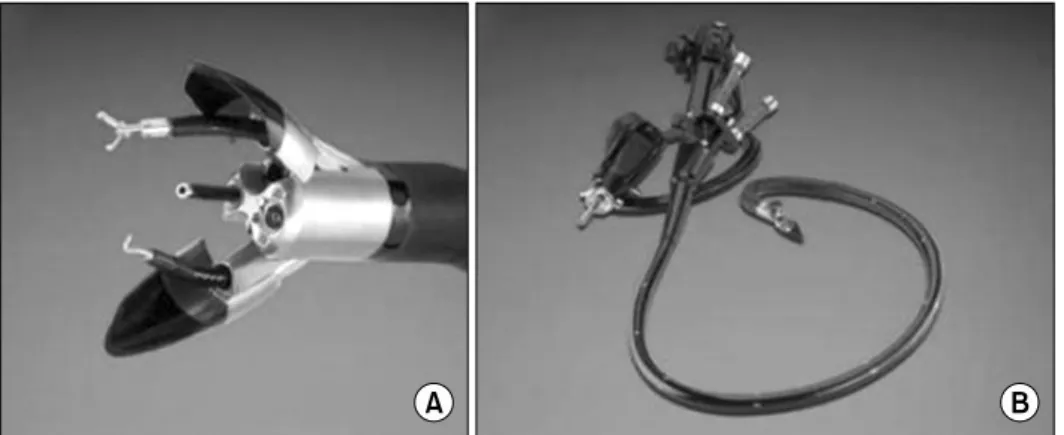
Germany) are under development for NOTES [24] (Fig. 3). A

steerable endoscope has three channels that allow specialized

instruments mimicking standard surgical cautery, graspers,

and clips to perform the necessary surgery. Therefore, these

advanced endoscopic platforms provide the operator with bet-

ter control and ability to have traction and counter-traction as

compared to standard endoscopes. However, the use of these

(4)

Fig. 3. (A, B) Advanced single-in- cision endoscopic platforms for natu- ral orifice translumenal endoscopic surgery, such as the Anubiscope, are being developed to allow more complex surgical procedures to be performed.

endoscopes for NOTES of the chest by breeching the in- tegrity of the trachea or the oesophagus to enter the pleural cavity requires further refinement.

CROSSING DISCIPLINES

The single-port VATS approach may further reduce access trauma and has brought about a new line of thought on the role of an ‘awake’ non-intubated technique in fast-tracking patients postoperatively. Rocco et al. [25] first described the use of mild sedation, single-shot epidural regional anaesthesia, and bronchoscopically guided Fogarty balloon placement into the lobar bronchus to facilitate selective lung collapse as techniques for ‘awake,’ non-intubated single-port VATS wedge resection. Subsequently, the same group described their ‘awake’ technique for performing single-port VATS pleurodesis for spontaneous pneumothorax [26]. More re- cently, Gonzalez-Rivas reported the first successful non-in- tubated single-port VATS right middle lobectomy case with- out epidural or vagus blockade in a 46-year-old man with carcinoid tumour [27]. However, it should be emphasized that case selection is important for this approach and that the an- aesthetists should be familiar with the technique and be skil- led at intubation under difficult conditions. The gradual matu- ration of the ‘awake’ non-intubated lung surgery concept over the years may allow it to become a useful adjunct in sin- gle-port VATS for early postoperative ambulation and hospi- tal discharge.

One of the concerns with single-port VATS lung resection is the limited access for accurately palpating and assessing the thoracic tumour. Despite the overall satisfactory accessi-

bility to most of the thoracic cavity through a single incision usually positioned around the mid-thoracic region, localization of small tumours with a low solid component and ground-glass opacities may be difficult. Classically, the use of pre-oper- ative computed tomography (CT)-guided marking by dye or even hookwire localization can be very useful to aid the in- traoperative identification of the lung lesion. In selected cas- es, hookwire localization may also allow the single-port VATS incision to be minimized [28]. However, dye marking from a percutaneous image-guided approach can be associated with significant dye diffusion and artifacts, thereby reducing its accuracy and applicability. The disadvantages of hookwire localization are pneumothorax, hemothorax, and hookwire dislodgement. Furthermore, when multiple lung lesions re- quire pre-operative marking, these percutaneous techniques become even less desirable. Electromagnetic navigational bronchoscopy (ENB) may become a very useful tool in the future, either preoperatively or intraoperatively, to localize pulmonary lesions by dye injection or by the placement of metal fiducials [29,30]. The accuracy of the ENB systems has improved over the past decade, and these systems can now competently localize peripheral lung lesions that are several millimetres in size. The risks of complications following ENB are few as compared to those of percutaneous image-guided methods, and multiple lesions can be conveniently marked in the same session.

The recent development of hybrid operating rooms and

their application in surgery have opened new opportunities in

the image-guided localization of lung lesions. The integration

of real-time on-table image guidance technology into clinical

practice is well-established in other specialties, including car-

(5)

Ground-glass opacity in the right lower lobe located by real-time on-table DynaCT, with a frozen sec- tion showing adenocarcinoma, fol- lowed by image-guided single-port video-assisted thoracic lobectomy.

diology and vascular surgery. However, its use in minimally invasive thoracic surgery, also known as image-guided VATS, was only first reported in 2013 by Prof. Raphael Bueno at Harvard University, Brigham and Women Hospital, Boston.

In the subsequent year, the group at The Chinese University of Hong Kong, Hong Kong, became the first to pioneer hy- brid operating room image guidance for single-port VATS (iSPVATS) for small ground-glass pulmonary lesions [31]

(Fig. 4). The real-time DynaCT scan in the hybrid theatre can be used to guide hookwire insertion, then proceeding immedi- ately to single-port VATS lung resection of the lesion in the same setting, thereby reducing risks associated with transfers and delays when the patient may have pneumothorax, hook- wire displacement, and discomfort. Should the hookwire mi- grate or dislodge, for example during lung deflation, a CT scan must be performed immediately to re-hookwire or re-lo- calize the lesion. For lung lesions that are not feasible for hookwire insertion, a real-time on-table scan can aid in local- izing the lung lesion for resection and may provide additional information on resection margins [31]. In the future, a combi- nation of ENB-guided metal fiducial placement and hybrid operating theatre image-guided localization may further im- prove the resection accuracy and safety of iSPVATS.

CONCLUSION

Although the increasing application of single-port VATS has brought about new challenges both for the surgeon and for the industry that provides us the technology to push the boundaries of surgery, it has also created unique opportunities for collaboration and to explore novel techniques. In the fu- ture, the difficulty will be to decide upon the most appro-

priate approach or technology to apply for each unique patient.

CONFLICT OF INTEREST

No potential conflict of interest relevant to this article was reported.

REFERENCES

1. Ng CS, Lau KK, Gonzalez-Rivas D, Rocco G. Evolution in surgical approach and techniques for lung cancer. Thorax 2013;68:681.

2. Ng CS. Uniportal VATS in Asia. J Thorac Dis 2013;5(S3):

S221-5.

3. Ng CS, Rocco G, Yim AP. Video-assisted thoracoscopic surgery (VATS) pleurodesis for pneumothorax. Multimed Man Cardiothorac Surg 2005;2005:mmcts.2004.000349.

4. Gonzalez D, Paradela M, Garcia J, Dela Torre M. Single-port video-assisted thoracoscopic lobectomy. Interact Cardiovasc Thorac Surg 2011;12:514-5.

5. Gonzalez-Rivas D, Fieira E, Mendez L, Garcia J. Single-port video-assisted thoracoscopic anatomic segmentectomy and right upper lobectomy. Eur J Cardiothorac Surg 2012;42:

e169-71.

6. Gonzalez-Rivas D, de la Torre M, Fernandez R, Garcia J.

Video: Single-incision video-assisted thoracoscopic right pneumonectomy. Surg Endosc 2012;26:2078-9.

7. Gonzalez-Rivas D, Fernandez R, Fieira E, Rellan L.

Uniportal video-assisted thoracoscopic bronchial sleeve lo- bectomy: first report. J Thorac Cardiovasc Surg 2013;145:

1676-7.

8. Gonzalez-Rivas D, Fernandez R, Fieira E, Mendez L.

Single-incision thoracoscopic right upper lobectomy with chest wall resection by posterior approach. Innovations (Phila) 2013;8:70-2.

9. Gonzalez-Rivas D, Delgado M, Fieira E, Mendez L. Single-

(6)

port video-assisted thoracoscopic lobectomy with pulmonary artery reconstruction. Interact Cardiovasc Thorac Surg 2013;17:889-91.

10. Lau RW, Ng CS, Kwok MW, et al. Early outcomes follow- ing uniportal video-assisted thoracic surgery lung resection.

Chest 2014;145(3 Suppl):50A.

11. Gonzalez-Rivas D, Paradela M, Fernandez R, et al. Unipor- tal video-assisted thoracoscopic lobectomy: two years of experience. Ann Thorac Surg 2013;95:426-32.

12. Ng CS, Lau KK, Wong RH, et al. Single port video-assisted thoracoscopic lobectomy for early stage non-small cell lung carcinoma. Surg Pract 2013;17:35-6.

13. Ng CS, Wong RH, Lau RW, Yim AP. Minimizing chest wall trauma in single-port video-assisted thoracic surgery. J Thorac Cardiovasc Surg 2014;147:1095-6.

14. Yim AP. Minimizing chest wall trauma in video-assisted thoracic surgery. J Thorac Cardiovasc Surg 1995;109:1255-6.

15. Liu CC. First report: 20131209 subxiphoid single port VAT [Internet]. [place unknown]: [publisher unknown]; 2013 [cited 2014 May 10]. Available from: http://www.youtube.

com/ watch? v=Hi_gn8s0VzU.

16. Liu CC. First report: 20131211 subxiphoid single port VATS for bilateral NPC lung mets [Internet]. [place unknown]:

[publisher unknown]; 2013 [cited 2014 May 10]. Available from: http://www.youtube.com/watch?v=xNBTuFJV3bQ.

17. Ng CS, Wong RH, Lau RW, Yim AP. Single port video-as- sisted thoracic surgery: advancing scope technology. Eur J Cardiothorac Surg. In press 2014.

18. Lardinois D, Ris HB. Minimally invasive video-endoscopic sympathectomy by use of a transaxillary single port approach. Eur J Cardiothorac Surg 2002;21:67-70.

19. Ng CS, Yeung EC, Wong RH, Kwok MW. Single-port sym- pathectomy for palmar hyperhidrosis with Vasoview Hemopro 2 endoscopic vein harvesting device. J Thorac Cardiovasc Surg 2012;144:1256-7.

20. Ng CS, Lau RW, Wong RH, Ho AM, Wan S. Single-port vasoview sympathectomy for palmar hyperhidrosis: a clinical update. J Laparoendosc Adv Surg Tech A 2014;24:32-4.

21. Zhu LH, Chen L, Yang S, et al. Embryonic NOTES thoracic

sympathectomy for palmar hyperhidrosis: results of a novel technique and comparison with the conventional VATS procedure. Surg Endosc 2013;27:4124-9.

22. Zhu LH, Du Q, Chen L, et al. One-year follow-up period after transumbilical thoracic sympathectomy for hyper- hidrosis: outcomes and consequences. J Thorac Cardiovasc Surg 2014;147:25-8.

23. Yin SY, Chu Y, Wu YC, et al. Feasibility of transumbilical anatomic pulmonary lobectomy in a canine model. Surg Endosc 2014 May 23 [Epub].

24. Perretta S, Dallemagne B, Barry B, Marescaux J. The ANUBISCOPEflexible platform ready for prime time: de- scription of the first clinical case. Surg Endosc 2013;27 :2630.

25. Rocco G, Romano V, Accardo R, et al. Awake single-access (uniportal) video-assisted thoracoscopic surgery for periph- eral pulmonary nodules in a complete ambulatory setting.

Ann Thorac Surg 2010;89:1625-7.

26. Rocco G, La Rocca A, Martucci N, Accardo R. Awake sin- gle-access (uniportal) video-assisted thoracoscopic surgery for spontaneous pneumothorax. J Thorac Cardiovasc Surg 2011;142:944-5.

27. Gonzalez-Rivas D, Fernandez R, de la Torre M, Rodriguez JL, Fontan L, Molina F. Single-port thoracoscopic lobectomy in a nonintubated patient: the least invasive procedure for major lung resection? Interact Cardiovasc Thorac Surg 2014 Jul 7 [Epub].

28. Ng CS, Hui JW, Wong RH. Minimizing single-port access in video-assisted wedge resection, with a hookwire. Asian Cardiovasc Thorac Ann 2013;21:114-5.

29. Gildea TR, Mazzone PJ, Karnak D, Meziane M, Mehta AC.

Electromagnetic navigation diagnostic bronchoscopy: a pro- spective study. Am J Respir Crit Care Med 2006;174:982-9.

30. Kupelian PA, Forbes A, Willoughby TR, et al. Implantation and stability of metallic fiducials within pulmonary lesions.

Int J Radiat Oncol Biol Phys 2007;69:777-85.

31. Ng CS, Chu CM, Kwok MW, Wong RH. Hybrid DynaCT

guided localization single port lobectomy. Chest. In press

2015.

수치

Fig. 1. Illustration of the positions of  the surgeon and assistants during  single-port video-assisted thoracic  surgery lung resection
Fig. 2. Endoscopic vein harvesting device with an instruments  channel, a carbon dioxide insufflator channel, an endoscope, and  a lens cleaning system, as an example of an integrated  instru-ment design for single-port video-assisted thoracic surgery surg
Fig. 3. (A, B) Advanced single-in- single-in-cision endoscopic platforms for  natu-ral orifice translumenal endoscopic  surgery, such as the Anubiscope,  are being developed to allow more  complex surgical procedures to be  performed.

참조

관련 문서

Fi g.7.Uni vari ate anal ysi s of 163 pati ents of gastri c adenocarci noma shows a si gni fi cantdi fference i n the overal lsurvi valaccordi ng to the Ets-1expressi on(p=0..

Immunohi stochemi cal stai ni ng of gastri c adenoma (a) and adenocarci noma(b)formPGES. Immunohi stochemi cal stai ni ng of gastri c adenocarci noma for 15-PGDH.a:negati

In thi s study,a pl an for desi gni ng the pri mary hul lform has been provi ded based on thei ncreasi ng demandsofhi gh speed patrolboatsthat

di d often grow notor very sl owl y under BBL anaerobi c gas system.Authorhas therefore devel oped a new di sposabl e anaerobi c gas system bei ng abl e to create the absol

“Well it‟s a it‟s a it‟s a place and it‟s a g-girl and a boy + and the-they‟ve got obviously something which is made some made made made well it‟s just beginning to go

– Given an equilibrated gas-liquid system containing only a single condensable component A, a correlation for , and any two of the variables y A (mole fraction of A in

1 John Owen, Justification by Faith Alone, in The Works of John Owen, ed. John Bolt, trans. Scott Clark, "Do This and Live: Christ's Active Obedience as the

 äM EEEEEEEEEEEEEEEEEEEEEEEEEEEEEEEEEEEEEEEEEEEEEEEEEEEEEEEEEEEEEEEEEEEEEEEEEEEEEEEEEEEE F s  Ċ äM ¾Œ