- 26 -
KISEP Original Articles J Rhinol 4((((1)))), 1997
Measurement of the so-called“ “ “ “ Nasal Valve” ” ”in Japanese Subjects* ”
Keiichi Ichimura, M.D., Ph.D. and Tetsuo Ishizuka, M.D.
ABSTRACT
Because Mongoloids have been considered to have a wider nasal valve angle than Caucasians, fewer Japanese patients expe- rience nasal obstruction due to stenotic nasal valve. However, there have been no studies measuring the nasal valve angle of Mongoloids. Accordingly, one aim of this study is to measure the nasal valve angle in Japanese subjects and obtain its standard value. Another aim is to measure the cross-sectional area at the nasal valve area. One hundred and sixteen healthy adult Jap- anese volunteers showing no symptoms or histories of nasal disease participated in this study. Each subject’s nose was scanned, by endoscopy, and images of the subjects’ nasal valve area were recorded using a video camera. The nasal valve angle was me- asured in video-printed photographs. Acoustic rhinometry was performed in each case. The subject’s mean nasal valve angle was 28.9±6.3 degree, ranging from 16 to 45. The mean cross-sectional area at the I-notch was 0.95±0.16 cm2 . No relationship was found between the nasal valve angle and the cross-sectional area around the valve.
KEY WORDS:Nasal valve·Nasal valve angle·Endoscopy·Acoustic rhinometry.
INTRODUCTION
The so-called“nasal valve”is currently regarded as the slit-like opening between the caudal end of the upper lateral cartilage and the septum.
1)2)In Western countries, valve sur- gery has been successfully performed for patients with nasal obstruction due to the stenotic nasal valve.
1)The“ideal”
nasal valve angle in Caucasians has been regarded as 10-15 degrees.
1)2)3)Because the Mongoloids have been considered to have a wider nasal valve angle than Caucasians, fewer Ja- panese patients suffer from stenotic nasal valve. Perhaps in part for that reason, the measurement of the nasal valve angle in Japanese has been unnecessary. In addition, we have not been able to find any study measuring the nasal valve angle of other Mongoloids. Accordingly, the first aim of this study is to measure the nasal valve angle in Japanese subjects and obtain its standard value. Another aim is to measure the cr- oss-sectional area surrounding the nasal valve.
SUBJECTS AND METHODS
One hundred and sixteen healthy adult Japanese volunt- eers showing no symptoms or histories of nasal disease pa- rticipated in this study. Fifty five subjects were male and 61 were female. Their ages ranged from 20 to 69 with a mean age of 47.7 years. They underwent endoscopy and acoustic rhinometry.
Measurement of nasal valve angle
Endoscopy, using a 0 degree rigid endoscope, was perf- ormed on each subject’s nose. The endoscope was inserted parallel to the caudal end of the upper lateral cartilage. Images of the nasal valve were recorded using a video camera and printed with a video printer. The nasal valve angle was mea- sured in video-printed photographs. We defined the nasal valve angle as the angle between the imaginary lines made by superior elongation of the upper part of the septum and medial elongation of the lower end of the upper lateral car- tilage. Since the angle obtained from our photographic study can be easily affected by the position and angle of the end- oscopes inserted in the nose, and thus, affect the reliability of our data, we paid close attention to the position and angle of the endoscope.
Acoustic rhinometry
Each subject’s nasal cross-sectional area and volume were measured using an A1 acoustic rhinometer (GM instruments).
*Prelimimary work on this paper was presented at the 16th World Congress of Otolaryngology and Head and Neck Sur- gery held in Sydney, Australia, on March 2-7, 1997.
Department of Otolaryngology and Head & Neck Surgery, Graduate School of Medicine, the University of Tokyo, Tokyo, Japan
Address correspondence and reprint requests to Keiichi Ichi- mura, M.D., Ph.D., Department of Otolaryngology-Head and Neck Surgery, Graduate School of Medicine, the University of Tokyo, 7-3-1 Hongo, Bunkyo-ku, Tokyo 113, Japan
Tel:81-3-5800-8665, Fax:81-3-3814-9486 Accepted for publication May 10, 1997
Keiichi Ichimura et al.:Nasal Valve Measurement / 27
Each side was measured three times. The data collected were the median values of the three measurements.
RESULTS Measurement of the nasal valve angle
Seventy-two photographs of the subject’s nose were judged as inappropriate for accurate measurement. The mean nasal valve angle described by the other 160 photographs was 28.9
±6.3 degree, ranging from 16 to 45. The angle in male nose was 28.5±6.9 degree and that in female nose was 29.4±5.3.
We observed no significant difference between them.
Acoustic rhinometry
The mean cross-sectional area of the I-notch was 0.95±
0.16 cm
2, ranging from 0.54 to 1.36. Men were likely to have larger cross-sectional area at the I-notch than women (1.01
±0.15 vs. 0.89±0.14), although not to a significant degree.
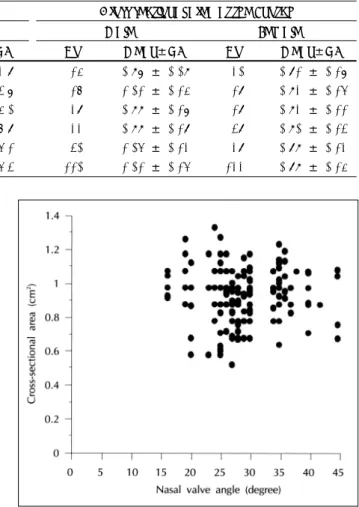
The result by age is demonstrated in Table 1. We observed no relationship between the nasal valve angle and the cross-sec- tional area of the valve (r =-0.006)(Fig. 1).
DISCUSSION
There have been debates on the concept of“nasal valve”.
Nasal valve (Nasenklappe) was first named by Mink
4)in 1903. He regarded it as the upper lateral wall of the nasal vestibulum. namely, the area from the limen nasi posterosu- periorly to the mucosa covering the upper lateral cartilage (ULC). It is medialized by lowering the internal pressure in the nose. It was Hindrer
3)in 1963 that mislead the concept of the nasal valve. He mentioned that the nasal valve which was first described by Mink in 1903 was the narrow passage be- tween the lower margin of the ULC and the septum. Since then, various authors used the nasal valve as the part with minimal cross-sectional area or the portion showing the ma- ximal flow resistance in the nasal cavity. This usage const-
ituted an erroneous interpretation of Mink’s term. The former should be called the isthmus nasi
5)6)and the latter the flow- limiting segment.
7)Although different from the original defi- nition by Mink, the nasal valve is now regarded as the slit-like opening between the septum and the caudal end of the upper lateral cartilage, since papers from Mayo Clinic have referred vigorously to“nasal valve surgery”.
1)2)Bachman and Leg- ler
6)defined the nasal valve not merely as the lower edge of the ULC, but rather proposed that the whole of the mobile lateral wall of the nasal vestibulum be considered as the fu- nctional unit in the regulation of the nasal resistance. This definition is, by chance, just the same as the original one by Mink. Therefore, it is better to use“so-called nasal valve”for the area between the caudal end of the ULC and the septum.
Regarding the angle between the ULC and the septum, no other term exists besides“nasal valve angle”. Thus, in this paper we decided to use this term. Although the nasal valve angle of Caucasians has been frequently referred to as 10- 15 degree, so far we have not been able to find the original
Table 1. Result of measurements according to age
Nasal valve angle Cross-sectional area at the I-notch
Male Female Male Female Age
No. Mean±S.D. No. Mean±S.D. No. Mean±S.D. No. Mean±S.D.
20 - 29 6 22.5 ± 7.2 12 29.0 ± 2.8 14 0.97 ± 0.09 20 0.81 ± 0.17 30 - 39 14 28.1 ± 6.6 16 29.4 ± 3.7 16 1.01 ± 0.14 18 0.92 ± 0.15 40 - 49 26 27.3 ± 6.5 12 25.5 ± 4.0 28 0.99 ± 0.17 18 0.92 ± 0.11 50 - 59 18 30.7 ± 7.5 24 31.7 ± 6.8 22 0.99 ± 0.18 38 0.90 ± 0.13 60 - 69 24 29.7 ± 6.2 8 29.3 ± 5.1 30 1.05 ± 0.12 28 0.89 ± 0.12 Total 88 28.5 ± 6.9 72 29.4 ± 5.3 110 1.01 ± 0.15 122 0.89 ± 0.14
Fig. 1. The nasal valve angle and the cross-sectional area at the I-notch in 160 subjects’ nose. No relationship was observed between these parameters.
28 / J Rhinol 4(1), 1997
report measuring Caucasians’ nasal valve angle. The first lit- erature which we found mentioning the nasal valve angle in Caucasians was by Hinderer.
3)He mentioned that the normal relationship of the ULC to the septum is at an approximate angle of 10 to 15 degree from the septum. However, he did not describe the source of the data nor the method of measu- rement. The only report measuring Caucasians’ nasal valve angle was by Arbour and Bilgen.
8)After taking measurements on a cadaver the angle of the valve was calculated by trigo- nometry. The result was 24 degree. Since, in all probability, different methods used in the study of Caucasians and in the present study, a comparison of the raw data of the angle was not possible. Therefore, it is reasonable to say that our nasal valve angles are bigger, but we cannot conclude that Mong- oloids have noses with valve angles twice as wide as those of Caucasians.
According to the data from acoustic rhinometry on 134 no- rmal controls by Lenders and Pirsig,
9)the I- notch represents the minimal cross-sectional area with 0.73±0.2 cm
2at 1.3 cm distance from the nostril. The C-notch with a cross-sectional area of 1.1±0.29 cm
2at 3.3 cm corresponds to the head of the inferior concha. The I-notch corresponds to the isthmus nasi, namely the area between the pyriform aperture and the septum.
Thus, strictly speaking, the I-notch does not correspond to the so-called nasal valve area, but seems to be closely related to it. Concerning the racial differences in the minimal cross- sectional area, Morgan et al.
10)described that the area in orie- ntals was almost the same as that in caucasians but was lower than negroes. However, the distance at the minimal cross-se- ctional area was longer in orientals than in caucasians and negroes. Namely, the flow-limiting segment in orientals seems to be at the C-notch. This observation was supported by our former study
11)measuring the cross sectional area of the I- and C-notch using acoustic rhinometry in 50 healthy Japanese volunteers. The cross-sectional area at the I-notch was 0.81
±0.16 cc, while that at the C-notch was 0.63±0.30 cc. The present study showed that the cross-sectional area at the I- notch (0.95±0.16 cm
2) was almost the same as that of the C-notch (0.98±0.14 cm
2). We cannnot explain the discre- pancy of these results except that in the former study, the subjects did not have subjective nasal obstruction during the examination, but were admitted into study regardless of the pathological history regarding nasal diseases. In contrast, the
present study was confined to subjects who presented no hi- story of nasal symptoms, except those of the common cold.
Ohki,
12)based on his investigation for 20 normal adults, pre- sented the mean cross-sectional area at the I-notch as 0.88±
0.17 cm
2in men and 0.72±0.22 in women, while that of the C-notch was 1.01±0.39 cm
2in men and 0.98±0.43 in wo- men. Therefore, at present we cannot find agreement in the minimal cross-sectional area in the nose of Japanese subjects.
In the present study, no relationship was found between the nasal valve angle and the cross-sectional area of the I-notch in healthy subjects. However, we often encounter patients with stuffy and narrow noses having narrow valve angles. Whether this result can be applied to the subjects with stenotic valve or those with stuffy nose has not been elucidated. Further ac- oustic rhinometric studies, comprised of subjects with patho- logically narrower valve angles, need to be conducted.
REFERENCES
1) Kern EB. Surgical approach to abnormalities of the nasal valve.
Rhinology 1978;16:165-89.
2) Kasperbauer JL, Kern EB. Nasal valve physiology. Otolaryngol Clin North Am 1988;20:699-719.
3) Hinderer KH. Diagnosis of anatomic obstructions of the airways.
Arch Otolaryngol 1963;78:660-2.
4) Mink PJ. Le nez comme voie respiratoire. Presse Otol Laryngol Belg 1903;2:481-96.
5) Bachmann W. Die Nasenklappe. Ein functionell falsch verstan- dner Begriff. Arch Klin Exp Ohres Usw-Heilk 1969;194:451-9.
6) Bachmann W, Legler U. Studies on the structure and function of the anterior section of the nose by means of luminal impressions.
Acta Otolaryngol 1972;73:433-42.
7) Bridger GP. Physiology of the nasal valve. Arch Otolaryngol 1970;
543-53.
8) Arbour P, Bilgen E. Understanding aerodynamics in the correction of the narrow nose. Rhinology 1986;24:41-7.
9) Lenders H, Pirsig W. Diagnostic value of acoustic rhinometry:
patients with allergic and vasomotor rhinitis compared with normal controls. Rhinology 1990;28:5-16.
10) Morgan NJ, MacGregor FB, Birchall MA, et al. Racial differences in nasal fossa dimensions determined by acoustic rhinometry. Rh- inology 1995;33:224-8.
11) Ichimura K, Nibu K, Shimazaki Y, et al. Surgical Approach to the Nasal Valve Stenosis. Nippon Jibiinnkokagakkai Kaiho 1993;96:
1051-7. (abstract in English)
12) Ohki M, Usui N. Nasal valve and its surroundings and acoustic rhinometry. JOHNS 1994;10:834-7. (in Japanese)