Vol. 17, No. 8 pp. 673-683, 2016
해외 우수사례를 통한 국가직무능력표준(NCS) 기반 산학협력모델에 관한 연구
김경희
백석문화대학교 스마트폰미디어학부
A Study on the Collaboratory curriculum Model of the foundation NCS through exemplary international cases.
Kyung-Hee Kim
Division of Smartphone Media, Baekseok Culture University
요 약 ‘NCS 기반 교육과정’의 목적은, 국가와 산업계가 주도하여 개발·인증·고시한 NCS를 학교 교육과정에 반영함으로써 교육생들이 산업현장에서 요구하는 직무수행능력을 갖추도록 하는 것이다. 이러한 교육과정의 목적달성을 위해 교육기관은, 급변하는 산업현장에 적응할 수 있고 산업체의 요구에 부합된 직무능력을 갖춘 인재양성을 위해 모든 역량을 집결하여야 한다. 고등교육법 제47조는 전문대학의 존립목적을 설명하고 있고, 이는 산업발전이 국가사회발전과 관련되어 있음을 고려 할 때, ‘NCS 기반 교육과정’의 목적과 동일하다. 이러한 전문대학의 교육목표와 ‘NCS 기반 교육과정’의 목적을 달성하는 것은 산업체와 대학의 효율적이고도 긴밀한 협력구조를 필요로 한다. 본 논문은 이러한 우리나라 전문대학들의 산학협력모 델을 분석하고, ‘NCS 기반 교육과정’의 목적에 부합하는 모델을 찾음과 동시에, 해외 우수대학의 뛰어난 산학협력모델을 분석하여, 우리나라 대학과 ‘NCS 기반 교육과정’에 적합한 ‘NCS 기반 산학협력모델’을 제안하고 이를 위한 프로세스와 가이 드라인을 제안한다. 본 연구에서 제안하는 ‘NCS 기반 산학협력모델’은, ‘'NCS 기반 교육과정’이 효율적으로 산업현장에 부합 되도록 함과 동시에, 대학과 산업체가 효과적인 협력구조를 가지고 각자의 목표를 추구하도록 돕는다. 'NCS 기반 산학협력모 델'은, 대학의 취업률 향상과 산업체의 우수인력확보를 가능하도록 하며, 효율적 대학교육과 우수인력양성을 통한 국내 산업 발전에 기여할 것으로 기대된다.
Abstract The purpose of the NCS-based curriculum is to prepare students for practical competencies to perform tasks demanded by industries by applying nationally and industrially developed and certified NCS to the currently held curriculum. In order to achieve this academic goal, education institutions must dedicate their utmost efforts to train trainees to attain flexibility in rapidly changing industry environments and competitiveness to perform the various tasks demanded by industries. The 47th article of the Higher Education Law explains that the purpose of the College corresponds with that of the NCS-based curriculum because the contribution of national and social development is related to the development of an industry. The college purpose and the NCS-based curriculum require close collaboration and cooperation between industries and colleges. This thesis analyzes cases of industry and college cooperation, researches adequate cases that suit the purpose of the NCS-based curriculum and proposes an appropriate industrial-education cooperation model that suits college and NCS-based curriculum by analyzing the cooperation model held by highly acknowledged universities oversea. In addition, this paper proposes a process and guideline to establish the industrial-education cooperation model. The industrial-education cooperation model proposed herein not only practically aligns the NCS-based curriculum to fit the industry environments, but also supports each party in pursuing and achieving its goals through an effective cooperative structure. The NCS-based industrial education model is anticipated to improve colleges' employment rates, allow industries' procurement of brilliant human resources, and contribute to the development of domestic industries through effective college education and training competent professionals for society.
Keywords : Collaboratory, Collaboratory based on NCS, Guideline for Collaboratory based on NCS’s curriculum, Process for Collaboratory based on NCS’s curriculum, Ringling College Collaboratory
이 논문은 2015년 대한민국 교육부와 한국연구재단의 지원을 받아 수행된 연구임 (NRF-2015S1A2A1A01026540)
*Corresponding Author : Kyung-Hee Kim(Baeseok Culture Univ.) Tel: +82-41-550-0485 email: [email protected]
Received July 21, 2016 Accepted August 11, 2016
Revised August 10, 2016 Published August 31, 2016
1. 서론
1.1 연구목적
본 연구는 NCS 기반 교육과정에 적합하고 효율적인 산학협력의 방향과 모델을 제안하고, 이를 NCS 기반 교 육과정에 적용하는 절차와 가이드라인을 제시하는 것이 목적이다. 이를 위하여, 기존의 국내 산학협력방법들을 분석하고 해외 우수사례인 미국 링링대학교의 산학협력 방법을 연구한다.
2013년 12월에 발표한 교육부의 ‘창조경제 생태계 조 성을 위한 산학협력 활성화 10대 중점 추진과제’의 6번 째 과제는 ‘글로벌 산학협력 정책교류 활성화’이다[1].
현대는 글로벌 시대로서, 한 나라의 국가산업 경쟁력은 국내 산업뿐 아니라 국제적 산업의 위상에 의해 결정된 다. 따라서 각 대학과 산업체는 글로벌한 산학협력 체제 를 갖출 필요가 있다. 이는, 해외의 우수한 산학협력 시 스템을 이해하고 해외기업이나 대학과의 협력시스템을 구축하는 것을 포함하며, 해외 우수대학의 산학협력 시 스템을 분석함으로써 우리나라 대학의 산학협력시스템 을 국제화하는 것을 통해 이루어진다.
본 연구는 해외 우수산학협력 사례인 링링대학교 (Ringling College of Art and Design)의 산학협력모델 (Collaboratory)을 연구하여, 우리나라의 현실에 기초하 고 NCS 기반 교육과정에 적합한 글로벌 산학협력모델 을 찾아 제안하는 것을 목적으로 한다.
2002년부터 개발이 시작된 NCS(National Competency Standards)는 2013년 240개 표준개발을 기점으로, 2014 년 557개의 표준개발에 이어, 2015년 50개의 표준을 개 발함으로써 총 847개의 NCS개발을 완료하였다[2].
NCS는 산업현장에서 직무를 수행하기 위해 요구되는 지식·기술·소양 등의 내용을 국가가 산업부문별·수준별 로 체계화한 것으로, 산업현장의 직무를 성공적으로 수 행하기 위해 필요한 능력(지식, 기술, 태도)을 국가적 차 원에서 표준화한 것을 의미한다[3].
2014년 6월부터 시작된 ‘특성화 전문대학 육성사업’
은 이러한 NCS를 교육과정에 적용한 ‘NCS 기반 교육과 정’을 중요한 사업내용으로 제안하고, 2019년 2월까지 전국에서 90개 이내의 전문대학을 지원하겠다고 발표하 였다[4]. ‘NCS 기반 교육과정’의 목적은, 국가와 산업계 가 주도하여 개발·인증·고시한 NCS를 학교 교육과정에 반영함으로써 교육생들이 산업현장에서 요구하는 직무
수행능력을 갖추도록 하는 것이다.
전문대학의 설립 목적은, 고등교육법 제47조 ,"전문대 학은 사회 각 분야에 관한 전문적인 지식과 이론을 가르 치고 연구하며 재능을 연마하여 국가사회의 발전에 필요 한 전문직업인을 양성함을 목적으로 한다.[5]”에 제시된 바와 같이, 국가와 산업계 및 사회가 요구하는 인재를 양 성하는 측면에서 ‘NCS 기반 교육과정’의 목적은 전문대 학의 설립목적과 동일하다. 또한, 전문대학은 4년제 대 학과 병립하는 고등교육기관으로서, 산업현장이나 직업 사회에 바로 진출할 수 있는 중견직업인 양성을 목적으 로 하는 단기 직업교육기관이다. 이러한 직업교육기관으 로서의 기능을 수행하면서 ‘NCS 기반 교육과정’의 목적 을 달성하는 것은 산업체와 대학의 효율적이고도 긴밀한 협력구조를 필요로 한다.
본 논문은 전문대학의 설립목적과 ‘NCS 기반 교육과 정’의 목적에 부합하는 산학협력모델을 찾기 위하여, 기 존의 우리나라 전문대학 산학협력모델들을 분석하고, 해 외 우수대학의 뛰어난 산학협력모델을 분석한 후, 우리 나라 대학과 ‘NCS 기반 교육과정’에 적합한 산학협력모 델을 제안한다. 또한 ‘NCS 기반 산학협력모델’을 위한 프로세스와 필요한 가이드라인을 제시한다.
이는 현재 진행되고 있는 우리나라 대학의 산학협력 모델을 국제적 차원으로 제고하고, 대학과 산업체의 효 율적인 상생발전을 도모하여, 대학이 재학생과 졸업생에 대한 본연의 교육목적을 가장 효과적으로 유지하면서 산 업체와 협력할 수 있도록 돕는 모델이 될 것이다.
1.2 연구의 필요성
전문대학은 국가사회와 산업체의 요구에 부응하는 전 문직업인 양성이 목표인 직업교육기관으로서의 기능과, 산업현장의 요구에 따라 직무수행능력을 갖춘 인재양성 을 목표하는 ‘NCS 기반 교육과정’의 목적달성을 위해, 산업체와 효율적이고도 긴밀하게 협력해야 한다. 그러나 정부의 다양한 취업지원 정책과 전문대학의 지속적인 노 력에도 불구하고, 2016년 2월 청년 실업률은 12.5%로 역대 최고치를 기록하였으며, 2016년 4월 청년실업률은 10.9%로 1999년 6월 실업자 기준을 구직 기간 1주일에 서 4주일로 바꾼 이후 4월 수치로는 가장 높았다[6].
2000년대 초부터 정부는 산학협력 촉진정책을 추진 하고 있다. 또한, 2003년 대학 내 산학협력단 설립을 제 도화하고 2004년에 시작된 산학협력중심대학 육성사업
과 같은 재정지원도 지속적으로 확대하고 있다[7]. 그러 나 이러한 지속적인 정부의 산학협력지원과 대학과 산업 체의 산학협력프로그램 운영에도 불구하고, 계속되는 실 업률 증가와 청년취업률 악화는, 기존의 산학협력모델 재점검과 새로운 방안모색의 필요성을 갖게 한다.
지금까지의 산학협력모델이 국가·사회적 문제인 청년 실업과 대학의 사회적 기능을 해결하지 못하는 상황은, 우리가 처한 산업현장과 대학 및 사회의 상황에 적합한 산학협력모델에 대한 연구의 가속화를 요구한다. 정부지 원과 더불어 다양한 방법으로 이루어진 기존의 산학협력 모델을 재분석하고, 해외의 우수한 산학협력모델을 벤치 마킹함으로써, 우리나라 상황에 부합되고 세계화에 대비 할 수 있는 산학협력모델을 찾는 것은, 대학의 존립과 산 업경쟁력 및 현존하는 사회문제 해결을 위해서 필요하 다.
본 논문에서 제안하는 ‘NCS 기반 산학협력모델은’, 대학의 취업률 향상과 산업체의 우수인력확보를 가능하 도록 하며, 효율적 대학교육과 우수인력양성을 통한 국 내 산업의 국제적 경쟁력을 향상시키는데 기여할 것으로 기대된다. 또한, 대학의 교육이 재학생뿐 아니라, 재학생 과 졸업생의 상호협력 관계를 형성하도록 함으로써, 대 학의 효과적인 평생교육체제로의 진입에 도움이 될 것이 다.
2. 기존의 산학협력모델
2.1 산학협력 인프라
한국의 대학들은 2014년 현재 67.6%가 산학협력 친 화형 교원인사제도를 운영하고 있다. 전임교원의 교원평 가제도를 SCI논문 1편 대비 산학협력 실적배점을 계산 하였으며, 이를 다시 산업체연계, 산학협력교육, 산학협 력연구로 세분화하고 있다. 여기에서 산업체연계는 기술 경영자문, 산업체파견의 활동을 의미하고, 산학협력교육 은 현장실습지도, 교원창업, 창업교육실행, 산학협력프 로그램개발의 활동을 의미하며, 산학협력연구는 기술이 전, 해외특허등록, 국내특허등록, 공동연구, 소프트웨어 의 성과 및 활동을 의미한다[8]. 이러한 변화는 대학들이 산학협력을 효과적으로 운영하기 위해 대학 인프라를 변 경하고 있음을 보여준다.
2.2 산학협력 활동 형태 2.2.1 기업규모와 산업체 위치비교
2014년 기준 대학교수들의 산학협력 활동은, 중소기 업의 활동이 대기업에 비해 많았으며 지역 내 활동이 지 역 외에 비해 많았다.
Fig. 1.
Cooperation activities form
2.2.2 가족회사
가족회사는 대학이 관련기업들과 유기적인 산학협력 활동을 펼치기 위해 최신 연구기자재공유, 공동연구개 발, 기술인력 교류 등의 산학협력 협정을 맺는 제도이다.
가족회사는 대학 내에서 공동연구개발, 연구장비 공동활 용, 현장실습, 재직자 교육, 대학장학금 지원 및 지원금 참여, 학생취업연계 등의 역할을 수행한다[9]. 2014년 현재, 전국 대학의 가족회사 총 개수는 60,556개이고 참 여형태는 다음의 그림과 같다.
Fig. 2. Participation form of the family company
(Unit : Gae)
2.2.3 캡스톤디자인
캡스톤디자인은 산업체에서 필요한 프로젝트를 대학 의 정규교육과정에서 다루도록 함으로써, 학생들이 종합 적이고 현장감 있는 창의력과 실무능력, 팀워크, 리더십,
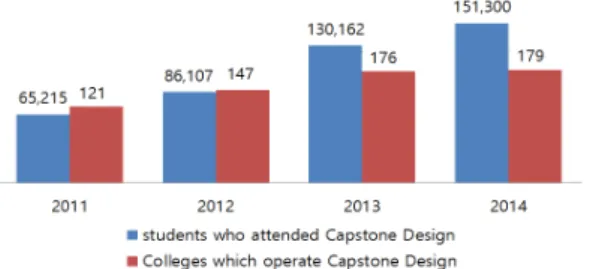
기획능력과 문제해결능력을 키우도록 하는 정규교과목 이다. 2014년 현재 전국의 179개 대학이 캡스톤디자인 교과목을 운영하고 있으며 이는 해마다 16%가량 증가 하는 수치이다. 다음의 그림은 캡스톤디자인 교과목 운 영대학과 이수학생 수를 년도 별로 보인 그림이다.
Fig. 3. Capstone Design
2.2.4 계약학과
계약학과란, 국가·지방자치단체 또는 산업체 등과의 계약에 의해 정원 외로 개설·운영할 수 있는 학위과정을 일컫는다.
2014년 현재 전국에는 683개의 계약학과가 운영되고 있고, 이는 2011년 859개에서 2012년 508로 감소했다 가 2013년 648개로 다소 증가하고 있는 추세이다. 다음 은 전국대학의 계약학과 수와 계약학과 정원수를 보인 그림이다.
Fig. 4. Department Contact
2.2.5 학교기업
학교기업은 학교 교육과정의 하나로서 학생들의 현장 실습교육에 활용하고 교육기관에서 개발된 기술의 이전 및 사업화, 수익창출을 동시에 충족하기 위한 학교의 부 서를 의미한다[8].
전문대학은 일반대학에 비해 학교기업 수가 약 16%
많고, 현장실습 학생 수도 일반대학이 88%가 많았으나, 매출액은 전문대학이 일반대학보다 46%가량 높았다. 일 반대학과 전문대학을 각기, 학교기업 수와 현장실습 학
생 수, 그리고 매출액을 통해 년도 별로 비교한 그림은 다음과 같다.
Fig. 5. Current Situation of The School Enterprise
(Universities)
2014년 현재, 전국의 학교기업 수는 157개로 전년대 비 감소하였다. 다음 그림은 학교기업의 운영현황을 년 도 별로 보인 것이다.
Fig. 6. Current Situation of The School Enterprise
(Colleges)
3. 링링대학교의 특화된 산학협력모델
3.1 링링대학교
링링대학교(Ringling College of Art and Design)는 1931년에 설립된 미국의 디자인예술 대학이며, 2016년
현재 약 1,300여명의 재학생들이 광고디자인, 아트 & 디 자인 비즈니스, 컴퓨터 애니메이션, 필름, 파인아트, 게 임아트, 그래픽 디자인, 일러스트레이션, 인테리어 디자 인, 모션디자인 그리고 사진 및 이미지 등의 11개 전공 을 운영하고 있다.
링링대학교는 학사학위만을 제공하고 있음에도, 미국 에서 최고의 혁신적인 산학협력 프로그램을 운영함으로 써 세계적으로 우수한 산업체들과 활발하게 협력활동을 하고 있는 시각 예술 대학으로 알려져 있다. 링링대학이 가지고 있는 독특한 산학협력 프로그램인 Collaboratory 는 학위와 관계없이 채용된 교수진과 우수한 교육과정 및 교수·산업체·재학생·졸업생들의 효율적인 협력을 통 해 운영된다.
2015년 현재 링링대학교의 컴퓨터 애니메이션 전공 은 미국전체에서 관련 분야 2위이며, 매년 디즈니 (Disney), 픽사(Pixar), 홀마크(Hallmark), 타겟(Target), 드림웍스(DreamWorks), 소니(Sony), 애플(Apple)등의 업체들과 인턴십을 운영한다[10].
본 논문에서는 링링대학교의 산학협력 프로그램을 분 석하여, 국제적이면서 한국 상황에 적합한 산학협력모델 을 찾고자 한다.
3.2 링링대학교의 협력체
(The Collaboratory at Ringling College) 링링대학교의 산학협력 프로그램인 CRC(the Collaboratory at Ringling College)는 2013년 여름에 조 직을 구성하고, 이를 위한 교직원을 채용하면서 업체에 CRC의 가능성에 대해 홍보를 시작하였다. 2014년 여름, CRC가 진행되면서, 학생들과 산업체 간의 계약조건과 학생들에게 돌아갈 유익 및 고객인 산업체에 제공될 서 비스 등을 정리하고 서비스가 시작되었다. 이어서, 2014 년 가을, 작은 업체에서부터, 비영리 단체 및 포춘 50대 기업에 이르기까지 수많은 조직 및 업체들과 프로젝트를 진행하면서 CRC가 확대됨과 동시에 미국에서 독특하고 효과적인 산학협력모델로 발전하고 있다.
CRC는 기업, 비영리 단체, 정부 및 기타 기관이 각 분야에서 링링 대학의 재학생 및 졸업생들과 공동으로 작업하는 학습 환경이다[11]. 학생들은 이 프로그램을 통해 자신의 전공분야에 관련된 현장의 문제와 기획, 구 현에 참여하고 창의적 해결책을 찾아 개발·완성을 경험 함으로써 현장성과 전문성을 동시에 키워나간다. CRC
는 교실학습의 한계를 넘어 현실세계의 다양한 경험을 통해 학생들의 현장학습능력을 향상시킨다. 또한 CRC 는 직업 세계에 대한 대학의 참여를 높이고, 끊임없이 변 화하는 글로벌 고용 시장의 요구에 부응하기 위한 전문 지식인들의 커뮤니티를 구축함으로써 학생들이 자신의 경력을 준비하도록 돕는다.
CRC는 다음의 프로세스를 통해 진행된다.
① 산업체가 링링대학교에 CRC를 요청함
② CRC부서에서 요청된 CRC의 가능성과 효과를 평가함
③ 요청된 CRC가 적합하다고 판명된 경우, CRC부 서는 관련 전공의 교수들에게 해당 CRC를 설명 하고 합의사항을 도출함
④ 산업체에 합의된 CRC 내용을 제공하고 회사가 이에 동의하면 CRC 체결
⑤ 학생들에게 체결된 CRC의 구체적 내용을 설명·홍 보하고 지원하도록 요청함
⑥ 지원서를 제출한 학생들 중에서 적합한 학생들을 선발
⑦ 교수회와 학생지원처의 협력에 의해 졸업생과 재 학생 및 교수진과 산업체인사로 구성된 CRC 추진
⑧ CRC의 기간(1주일에서 수년으로 각기 CRC에 따 라 기간이 다름)에 따라 해당 CRC를 위해 위원회 를 구성하고 미팅을 통해 업무 진행
⑨ 학생과 산업체 미팅은 첫 미팅과 중간보고 및 결 과보고 미팅으로 구성되어 일반적으로 약 3회 이 루어짐
⑩ 결과보고 미팅에서 학생과 교수 및 회사가 각각 CRC 결과에 대해 평가함
3.3 협력체의 종류
3.3.1 단기 협업(Charrettes)[12]
CRC 중에서 가장 인기 있는 협력방법으로, 72시간 이내의 작업과 토론을 통해 결과물이 나온다. 빠르게 창 조적인 결과물을 도출하고, 학생들은 수업에 지장을 주 지 않는 주말에 작업을 수행한다.
각기 다른 전공의 학생들이 필요에 의해 팀으로 구성 되고, 교직원들의 지도하에 로고제작, 브랜드 표준화, 광 고 슬로건 제작 등과 같은 간단한 작업들이 진행된다.
업체가 학생 팀들에 경쟁을 붙여 최종보고회에서 작 품을 선정하기도 하며, 학생들에게 상금을 수여하기도 한다. 이러한 상세한 업무조건 등은 대학과 업체가 CRC
계약을 맺을 때 정리하며, 계약내용과 작업일정은 대학 의 CRC 부서에서 전체적으로 관리하되 담당교수와 팀 으로 구성된 교직원들이 CRC부서의 위원회로 구성되어 학생들과의 팀 작업을 관리·운영한다.
3.3.2 수업형 CRC(Class Projects)[12]
수업형 CRC는 학기단위로 제공되고 정규수업으로 진행된다. 따라서 한 학기인 16주 과정으로 진행되며, 프로젝트가 큰 경우에는 2개 학기를 연결하여 1년 동안 작업을 진행할 수 있다. 해당 과목을 담당하는 교수가 학 생들로 구성된 팀들과 밀접하게 관여하면서 작업팀을 조 직하고 관리하며, 업체에서 요구하는 문제들과 사업결과 물들을 CRC 부서에서 총괄 관리하고 산출한다. 일반적 으로 작업은 주간회의로 진행되고, 업체와 시작회의 및 중간발표 회의와 결과발표 회의 등을 통해 프로젝트가 진행된다.
이론적인 교실학습과 전문적인 현장작업이 적용되며, 학생 팀은 이론적 토대를 기반으로 활발한 연구와 효과 적인 해결책을 제공함으로써 업체가 요구하는 문제를 창 조적이고 다양한 개발방법으로 결과물을 완성한다.
수업형 CRC는 단기협업에 비해 학생과 교수들이 느 끼는 부담이 큰 반면, 업체와 일정기간 동안 실제적인 협 력을 통해 의미 있는 결과물을 산출함으로써, 학생들에 게는 향후 산업현장에서 전문가로서 자신감을 갖도록 하 고, 교수는 학생들을 수업을 통해 지도하면서 현장의 변 화를 인식하고 자신의 전문성을 확장할 수 있다. 또한 업 체는 교수와 학생들의 작업을 통해 참신한 아이디어와 전문성을 겸비한 작업 결과물을 비교적 저렴한 비용으로 얻을 수 있다.
3.3.3 장기형 CRC(Long-Term Projects)[12]
장기형 CRC는 수년 동안 진행될 수 있는 협업형태로, 장기적인 연구와 분석이 필요한 작업에 적용된다. 다양 한 전공분야와 업체 및 조직들로 구성될 수 있으며, 수년 간에 걸쳐서 지속적으로 관계를 맺으며 작업이 진행될 수 있다.
링링대학교에서는 장기형 CRC로 대학이 위치한 지 역의 경찰국을 이미지화하고 브랜드화하기 위해 심벌마 크를 개발하고, 웹사이트를 제작하였으며, 지역사회의 시민참여와 긍정적인 상호작용 캠페인을 위해 소셜 미디 어를 제작하는 등의 다양한 작업을 수년 동안 진행하였다.
이를 위해 그래픽 디자인 전공, 모션 디자인, 인테리 어 디자인 전공이 협력하였으며, 대학이 위치한 사라소 타 지역의 사업관리자에서부터 노숙자에 이르기까지 다 양한 사람들과 인터뷰를 실시함과 동시에 경찰관을 인터 뷰함으로서 경찰의 역할을 찾고 시민과 경찰관과의 긍정 적인 상호작용 요소들을 찾았다. 사라소타 지역의 커뮤 니티 활성화를 위한 이벤트를 기획하고 영화의 밤과 같 은 프로그램개발 및 “BLUE + YOU”와 같은 브랜드를 설계하여 사라소타 경찰국을 이미지화하는 데 성공하였다.
4. NCS 기반 교육과정에 적합한 산학협력모델 제안
4.1 NCS 기반 교육과정과 산학협력
교육과정(curriculum)은 학습경험의 계획을 조정 또 는 지시하는 문서화된 자료로, 국가별 차이가 있으나 일 반적으로 학습성과, 학습목표, 학습내용, 학습장소 및 학 습기간, 교수평가 방법 등을 규정한다. 이와 관련하여, NCS란 산업현장에서 직무를 수행하기 위하여 요구되는 지식․기술․ 소양 등의 내용을 국가가 산업부문별 수준 별로 체계화한 것(「자격기본법」 제2조)으로, NCS 기 반 교육과정은 NCS를 기반으로 학습자의 학습경험, 특 히 산업현장에서 요구하는 지식, 기술, 소양 등의 직무능 력을 높이기 위한 학습경험을 목적으로 한다[13].
산학협력이 산업체에서 요구되는 업무나 프로젝트를 공동으로 작업하거나 일부분을 담당하는 것임을 고려할 때, NCS 기반 교육과정의 목적인 산업현장 직무를 수행 하기 위한 지식․기술․소양 교육수행은 산학협력을 통 해서 더욱 강화될 수 있다.
이에 본 연구에서는 ‘NCS 기반 산학협력모델’을 제 안한다. 이 모델은, 산업체의 요구에 의해 시작되어 교수 자가 프로젝트를 총괄하고, 재학생과 졸업생이 팀원으로 함께 프로젝트를 진행하도록 함으로써, 산업현장의 각 전문분야에서 졸업생 멘토와 재학생 멘티의 팀워크를 통 한 교육효과를 극대화하는 산학협력 교육방법이다. 졸업 생들의 산학협력 프로젝트 참여는 졸업생들의 멘토 역할 수행 뿐 아니라 추수교육이 이루어지도록 설계할 수 있 으며, 졸업생과 재학생이 상생발전 할 수 있는 연결고리 를 제공함으로써 대학의 교육적 기능을 제고할 수 있는 산학협력 교육모델이다.
Steps What to do 1. Announce
“Short-Term Collaboratory”
to Enterprise
- Majors what can cooperate with enterprise - The Outcomes that student can do - Project periods
- Range of budget that Enterprise support to pay for students outcomes
- Others 2. Compose
Committee - Professor Committee - Faculty Members
3. Mapping NCS with the needs
- Select Competency Units and Competency Unit elements of NCS for the enterprise’s needs - Mapping Competency Units and Competency Unit
elements of NCS
- Plan the Curriculum based on NCS for the project - Plan Outcome of the project with mapping
Competency Units and Competency Unit elements of NCS and enterprise’s needs
4. Promoting Students &
Selection
- The requested information session held in industrial projects
- Graduates included
- Select students who work on that project Table 2. The Process of “The Short-Term Collaboratory
based on NCS” proposed
이 산학협력모델을 통해 대학은 산업현장의 수요에맞는 교육을 실시하고, 학생들은 자신들이 졸업이후에 취업하게 될 산업체에서 요구하는 기술과 전문성을 실제 로 수행하게 됨으로 학습참여도와 학습몰입도 및 학습효 과가 높을 것으로 추정된다. 또한 산업체는 전문성을 갖 춘 인력을 용이하고 효율적으로 제공받을 수 있음으로 신규인력의 교육비용을 절약할 수 있다.
본 논문에서는 NCS 기반 교육과정을 위한 산학협력 모델을 링링대학교의 사례와 연계하여 단기협업과 정규 교과목형 협업 그리고 장기협업의 세 가지 모형으로 분 류하며, 협업을 진행하기 위한 프로세스를 각기 제안하 고, 정규교과목형 협업을 위한 가이드라인을 제시한다.
4.2 NCS 기반 산학협력모델
지금까지 우리나라 대학의 산학협력단은 교육프로그 램과 별개로 운영되는 경우가 대부분으로, 대학이 산업 체와의 협력을 통해 진행하는 사업이나 프로젝트에 관련 된 행정업무와 연구업무를 주로 담당하였다. 그러나 본 연구에서 제안하는 산학협력은 대학교육 프로그램과 밀 접하게 관련된 산학협력 프로그램으로, 이는 기존의 산 학협력 업무를 수정하거나 교육적 산학협력을 위한 새로 운 부서를 필요로 한다. NCS 기반의 교육과정이 산업체 의 수요를 위한 교육목적을 가지고 있음을 상기할 때, 이 제 대학부서의 변화와 더불어 운영의 변화를 모색해야 할 것이다.
4.2.1 NCS 기반 산학협력을 위한 위원회 구성 현재 대학에서 진행되고 있는 현장실습, 인턴십, 캡스 톤 디자인, 계약학과 등의 교육적 산학협력 프로그램들 은, 대학의 상황에 따라서 담당하는 부서가 각기 다르다.
그러나 이제 시대적 상황변화에 따라, 대학은 전문부서 를 통해 이러한 교육적 산학협력 프로그램을 효과적으로 성장·확대할 조직을 구성하고 확대할 필요가 있다.
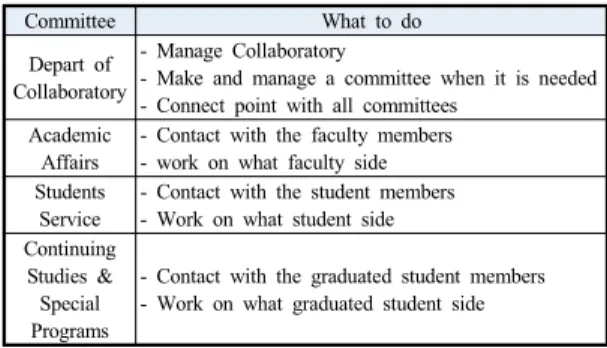
다음은 교육적 산학협력 프로그램 운영을 위한 조직 구성의 기본적인 사항을 정리하여 제안한 것이다. 이는 링링대학교의 산학협력을 위한 조직을 참고하고 우리나 라 대학의 조직구성을 고려하여 제시한 것으로, 각 대학 의 상황과 여건에 따라 다음의 표에서 제시한 위원회들 을 참고하여, NCS 기반의 교육적 산학협력모델을 위한 조직구성을 할 수 있다.
Committee What to do
Depart of Collaboratory
- Manage Collaboratory
- Make and manage a committee when it is needed - Connect point with all committees
Academic Affairs
- Contact with the faculty members - work on what faculty side Students
Service
- Contact with the student members - Work on what student side Continuing
Studies &
Special Programs
- Contact with the graduated student members - Work on what graduated student side
Table 1. To propose Committee for the Collaboratory
based on NCS
4.2.2 NCS 기반 단기협업
단기 협업은 정규교육과정이 아니므로, 산업체에서 요구하는 프로젝트의 내용에 따라 학생들을 모집하고 일 정에 맞추어 프로젝트를 융통성 있게 산출할 수 있는 가 장 편리하고 용이한 산학협력 모형이다. 단기 협업은, 산 업체의 요구를 분석하여 이에 적합한 학생들을 선발하 고, 졸업생과 학생들이 연합하여 각기 자신의 능력과 적 성 및 관심도에 따라 역할을 분배하며 최적의 효율성을 갖도록 프로젝트를 계획하는 내용을 포함한다.
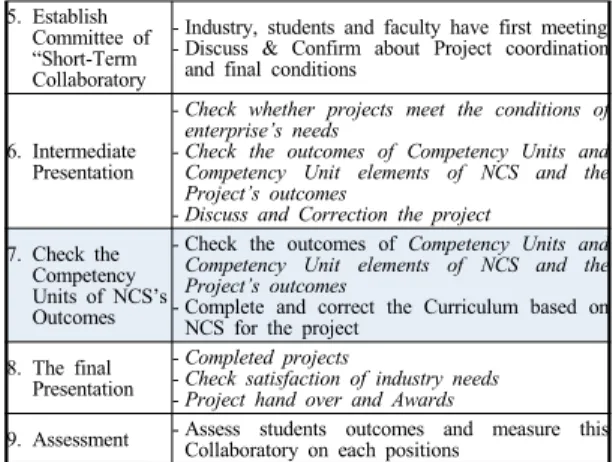
다음은 본 논문에서 제안하는 “NCS 기반 단기협업”
을 위한 프로세스를 보인 것이다. 이는 링링대학교의 CRC를 참고하고, 우리나라의 인턴십과 현장실습 등 단 기협업과 가장 유사한 프로그램의 운영 프로세스를 참고 하여 작성되었다. 다음의 표에서, NCS와 관련된 부분은 표 색깔을 달리 나타냈으며, 이태리체로 표기된 글은 제 시한 세 가지 방법들에서 서로 다른 부분들을 표시하였다.
Indicator Not Acceptable Weak Acceptable
1-1. The Regular Courses Process
- No evidence provided of process used for developing the Regular Course.
- The core of the Colleges & NCS’s needs develops topic/plan of the Regular Course.
- Some attempt is made to tie topic/plan of the Regular Course on the Colleges &
NCS’s needs.
- The Topic of Regular Course is directly related to the Colleges &
NCS’s Needs which had involved all of conditions for the broad based effort.
- The Regular Course developed by key individuals/groups on the purpose of College.
1-2. The Regular Courses key issues identified that emerge from the Assessment of Colleges
& NCS.
- No evidence of relationship of the Regular Course to Colleges &
NCS’s data/analysis/as sessment.
- The Enterprises Needs seems to be an isolated topic unrelated to Colleges &
NCS’s needs and/or never tied to those needs.
- General Colleges
& NCS’s needs addressed, but no clear linkage to the Regular Courses topic in terms of how needs would be addressed by successful the Regular Courses implementation.
- A direct relationship established between the Regular Courses topic and Colleges
& NCS’s needs.
- The Regular Courses may indirectly affect the Colleges &
NCS’s needs.
2-1. Focus on learning outcomes and accomplishi ng the mission of the College
& NCS
- The Enterprises Needs focuses only on establishing processes and strategies with no clear identification of outcomes directly related to the purpose of College &
NCS.
- Some outcomes focus on student learning, but many represent process/strategies with no clear outcomes identified.
- Those that address student learning may not be clearly related to Colleges & NCS’s purpose and needs.
- Outcomes are generally related to student learning and reasonably address the accomplishment of Colleges &
NCS’s specific goals
2-2. Focus on the environment supporting student learning and accomplishi ng the mission of the College
& NCS
- No relationship of the Regular Course activities/proce sses to the support of student learning.
- Student learning left undefined or poorly defined.
- Activities of Regular Course to some extent are related to improvement of student learning;
no relationship established the Colleges & NCS's needs.
- Activities of the Regular Course focus, generally, on the improvement of student learning, with some that may not be directly tied to that effort.
Table 3. A Guideline for the Regular Course based on NCS 5. Establish
Committee of
“Short-Term Collaboratory
- Industry, students and faculty have first meeting - Discuss & Confirm about Project coordination
and final conditions
6. Intermediate Presentation
- Check whether projects meet the conditions of enterprise’s needs
- Check the outcomes of Competency Units and Competency Unit elements of NCS and the Project’s outcomes
- Discuss and Correction the project 7. Check the
Competency Units of NCS’s Outcomes
- Check the outcomes of Competency Units and Competency Unit elements of NCS and the Project’s outcomes
- Complete and correct the Curriculum based on NCS for the project
8. The final Presentation
- Completed projects
- Check satisfaction of industry needs - Project hand over and Awards
9. Assessment - Assess students outcomes and measure this Collaboratory on each positions
4.2.3 NCS 기반 정규교과목형 협업(Class Project) 정규교과목형 협업은 대학의 의지나 산업체와의 협력 정도에 따라 1학기 또는 3학기이상으로 계획할 수 있다.
산업체와의 협업 목적이, 학생들이 산업체 현장을 경 험하도록 함으로써 산업체에서 요구되는 전문성을 갖추 도록 하고, 대학과 교수자가 빠르게 진화하는 산업현장 의 요구를 파악하여 그에 부합된 교육을 계획하고 실행 할 수 있도록 하는 것임을 고려할 때, 정규교과목형 협업 은 정규수업을 통해 가장 적극적으로 학생들의 참여를 독려하는 협력 프로그램이다.
전공에 대한 자신감과 전문성은 학생들의 현장경험과 현장에서 요구하는 실제 프로젝트를 산출하는 경험을 통 해서 만들어지는 것임을 고려할 때, 정규교과목 협업은 대학이 적극적으로 활성화할 필요가 있다.
정규교과목형 협업은 단기 협업과 달리 대학의 교육 목적과 교육부의 교육과정 규정 등 정규교과목으로서 갖 추어야 하는 조건들, 특히 NCS 기반 교육과정의 조건에 부합되어야 한다. 따라서 산업체에서 요구하는 조건과 대학이 교육과정에서 고려해야하는 내용을 동시에 만족 하도록 교과목의 기간과 교과목 산출물 및 평가를 계획 하고, 이에 맞추어 강의계획서를 구성하여야 한다.
본 논문에서는 정규교과목 협업이 대학의 정규교과목 의 조건과 NCS 기반 교육과정에 부합되도록 하는 ‘정규 교과목 협업을 위한 가이드라인’을 제안하고, 정규교과 목 협업을 위한 작업순서도를 제안함으로써, 정규교과목 협업이 대학에서 가능하도록 한다.
다음은 대학의 정규교과목으로서 갖추어야 하는 조건 과 산업체의 요구사항을 동시에 만족하기 위한 ‘정규교 과목 협업을 위한 가이드라인’을 보인 것이다. 이는
NCS 기반 교과목을 위한 협력을 기획하기 위한 것이다.
산업체의 요구가 대학과 학부 및 NCS 기반 교육과정의 목적에 부합되는지 여부를 결정할 때 ‘NCS 기반 정규교 과목 협업을 위한 가이드라인’을 이용할 수 있으며, 산업 체와 협력을 협상할 때 활용될 수 있는 중요한 지침이 될 것이다. 이는 SACSCOC(Southern Association of Colleges and Schools Commission On Colleges)[14]를 참조하여 우리나라 실정에 맞도록 수정하였다.
3-1.
Capability to initiate the Enterprises Needs
- No attention given to personnel, budget, other support needed to implement and complete the Enterprises Needs.
- While some basic information on budgetary, personnel and other needs are presented, some or all of that support is “soft”
and not committed-to by the Regular Course & NCS.
- Vague details about personnel, organizational control, and budget needs.
- Yearly, overall, budget, with basic descriptions of personnel needs including the Colleges & NCS’s Needs needed to carry out the Enterprises Needs.
3-2 Capability to implement and complete the Enterprises Needs
- No timetable is provided for year by year activities including specific actions, budgetary expenditures and assessment processes.
- Sketchy timetable is provided for year by year activities including specific actions, budgetary expenditures and assessment processes.
- Detailed timetable is provided for year by year activities including specific actions, budgetary expenditures and assessment processes.
4-1.
Broad-based involvement Colleges constituencie s in the development of the Enterprises Needs
- The Regular Course developed by one individual or small group of individuals not representative of key constituencies.
- The Regular Course developed by one individual or small group;
some attention given to obtaining input from key constituencies on campus, but no real involvement.
- Process used to develop the Regular Course involved representative of key constituencies.
4-2.
Broad-based involvement Colleges constituencie s in the proposed implementati on of the Enterprises Needs
- No indication of how relevant constituencies will be involved in implementation .
- Implementation of the Enterprise Needs will involve some representative of key constituencies, but carried out by only a few individuals or a single group on campus.
- All relevant constituencies involved in implementation, either directly or indirectly.
5-1.
Identified goals for the quality enhancement the Enterprises Needs
- Goals not present or those stated are not goals but, rather, processes that will be implemented.
- Goals include mix of process and expected accomplishments.
- Goals deal with expected accomplishments.
5-2 A plan to assess the achievement of the goals of the quality enhancement the Enterprises Needs
- Assessment the Enterprises Needs not present or is not clear in determining expected outcomes and means of assessment.
- Assessment the Enterprises Needs present; outcomes are often processes that are to be
implemented.
- Assessment of goals not directly related to outcomes.
- Assessment plan is based on clear outcomes;
assessment methods related to outcomes.
Overall Evaluation of Acceptabilit y of the Regular Course
- When looked at as a whole, the Enterprises Needs clearly does not meet the requirements for an acceptable the Regular Course.
- While one or None
- While there may be weaknesses in one or more of the components, overall the Enterprises Needs is acceptable due to the strength of a number of the components.
more of the components may be acceptable, those that are not acceptable make the overall Enterprises Needs inappropriate.
The Ministry of Education
Five Components of the Enterprises Needs review on The Regular Course of College
1. The Colleges & NCS’s Process – The College & NCS uses their process for identifying key issues emerging from the Colleges &
NCS’s assessment.
2. Focus of the Enterprises Needs – The College & NCS identifies a significant issue that focuses on learning outcomes and/or environment supporting student learning and accomplishes the mission of the college & NCS.
3. The Colleges & NCS’s capability for the Initiation, Implementation, and Completion of the Enterprises Needs – The College & NCS provides evidence that it has sufficient resources to initiate, implement, sustain, and complete the Regular Course & Enterprises Needs.
4. Broad-Based Involvement of the Colleges & NCS’s constituencies – The College & NCS demonstrates the involvement of its constituencies in the development and proposed implementation of the Enterprises Needs.
5. Assessment of the Enterprises Needs - The College & NCS identifies goals and the Enterprises Needs to assess the achievement of those goals.
Steps What to do
1. Announce
“Regular Courses Collaborator y” to Enterprise
- Majors what can cooperate with enterprise - Regular Courses periods
- Budget that Enterprise should support to pay for students outcomes
- The Outcomes that student can do - Conditions for the Regular Course - Others
2. Announce to the related department that operate the Regular Course
- Who is the Enterprises Partner
- What’s purpose and condition of the Enterprises Partner
- How can make efficiency for the Regular Courses 3. Based on
the Guideline of the Regular Course
- The Enterprise and College discuss about the their needs based on a Guideline for the Regular Course - And if the conditions of the Enterprise and College
meet each other and discuss the contents to proceed to the Regular Course
4. Mapping NCS with based on the Guideline
- Select Competency Units and Competency Unit elements of NCS based on a Guideline Course - Mapping Competency Units and Competency Unit
elements of NCS based on a Guideline of the Regular Course
- Plan the Curriculum based on NCS for the project Table 4. The Process of “The Regular Courses Collaboratory
based on NCS” proposed
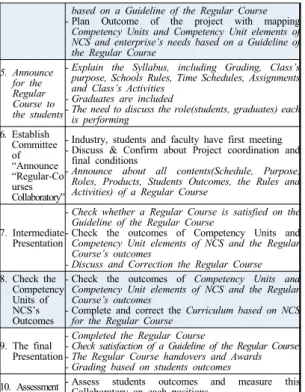
다음은, 본 논문에서 제안하는 “NCS 기반 정규교과 목 협업”을 위한 프로세스를 보인 것이다. NCS 기반 교 과목을 산업체와의 협력교과목으로 기획하고자 할 때, 사용할 수 있는 프로세스이다. 다음의 프로세스를 통해 산업체와 협력하는 “NCS 기반 정규 협업 교육과정”을 개설할 수 있다.
based on a Guideline of the Regular Course - Plan Outcome of the project with mapping
Competency Units and Competency Unit elements of NCS and enterprise’s needs based on a Guideline of the Regular Course
5. Announce for the Regular Course to the students
- Explain the Syllabus, including Grading, Class’s purpose, Schools Rules, Time Schedules, Assignments and Class’s Activities
- Graduates are included
- The need to discuss the role(students, graduates) each is performing
6. Establish Committee of “Announce
“Regular-Co urses Collaboratory”
- Industry, students and faculty have first meeting - Discuss & Confirm about Project coordination and
final conditions
- Announce about all contents(Schedule, Purpose, Roles, Products, Students Outcomes, the Rules and Activities) of a Regular Course
7. Intermediate Presentation
- Check whether a Regular Course is satisfied on the Guideline of the Regular Course
- Check the outcomes of Competency Units and Competency Unit elements of NCS and the Regular Course’s outcomes
- Discuss and Correction the Regular Course 8. Check the
Competency Units of NCS’s Outcomes
- Check the outcomes of Competency Units and Competency Unit elements of NCS and the Regular Course’s outcomes
- Complete and correct the Curriculum based on NCS for the Regular Course
9. The final Presentation
- Completed the Regular Course
- Check satisfaction of a Guideline of the Regular Course - The Regular Course handovers and Awards - Grading based on students outcomes
10. Assessment - Assess students outcomes and measure this Collaboratory on each positions
Steps What to do
1. Announce “The Long-Term Collaboratory”
to Enterprise
- Majors what can cooperate with enterprise - The Outcomes that student can do - The period of Long-Term Collaboratory - Budget
- Conditions and Outputs of the Long-Term Collaboratory
- Others 2. Compose
Committee - Professor Committee - Faculty Members
3. Mapping NCS with the needs
- Select Competency Units and Competency Unit elements of NCS for the enterprise’s needs - Mapping Competency Units and Competency Unit
elements of NCS
- Plan the Curriculum based on NCS for the project - Plan Outcome of the project with mapping
Competency Units and Competency Unit elements of NCS and enterprise’s needs
4. Promoting Students &
Selection
- What is the purpose of that project - Who is industrial partner
- Which are rewards and merits for students - All information about the project - Graduates included
- Select students who work on that project
5. Establish Committee of
“Long-Term Collaboratory”
- Industry, students and faculty have first meeting - Discuss & Confirm about Project coordination
and final conditions
- Discuss and decide all conditions about times to meet, when student exchange, whats purpose for each modules and rules for long-term collaboratory - Make long-term project’s article for the students
and enterprise
- Discuss about conditions whether the project continue or not
6. Intermediate Presentation
- Check whether projects meet the conditions of enterprise’s needs
- Check the outcomes of Competency Units and Competency Unit elements of NCS and the Project’s outcomes
- Discuss and Correction the project - Decide whether or not to continue 7. Check the
Competency Units of NCS’s Outcomes
- Check the outcomes of Competency Units and Competency Unit elements of NCS and the Projects outcomes
- Complete and correct the Curriculum based on NCS for the Projects
8. The final Presentation
- Completed the projects
- Check satisfaction of industrial needs - Project hand over and Awards - Decide whether or not to continue
- Make contract for next Long-Term Collaboratory when they decide to continue
11. Assessment - Assess students outcomes and measure this Collaboratory on each positions
Table 5. The Process of “The Long-Term Collaboratory
based on NCS” proposed
4.2.4 NCS 기반 장기협업
장기협업은 정규교육과정이 아니므로, 정규교육과정 의 규정을 준수할 필요가 없고, 장기간 산업체와 대학이 협력하여 산출물을 내야하는 다양한 내용으로 진행될 수 있다. 또한 단기협업으로 진행되었던 협력이 서로의 필 요에 의해 장기적인 협력으로 진행될 수도 있다. 예를 들 자면, 시청의 내부 인테리어를 대학과 협력하여 주기적 으로 개선하고 수정한다거나, 기업에서 진행하는 직원교 육 프로그램을 대학과 협력하여 정기적으로 진행하는 등 의 작업을 협력할 수 있다.
기간은 한 학기 이상으로 몇 년 동안 진행될 수 있고, 지도교수가 주말이나 기타 학생들과 함께 작업하는 요일 과 시간을 정해서 작업을 하거나, 과제형식으로 작업을 분배하고, 온라인으로 협업을 진행할 수도 있다. 산업체 에서 요구하는 작업의 내용에 따라 기간과 협업하는 스 타일 및 협업을 위해 미팅하는 회수 등을 결정할 수 있다.
이러한 협업을 통해, 기업은 대학이 가지고 있는 창의 성과 열정을 업무를 통해 지원받을 수 있고, 대학은 실제 산업체에서 진행되는 작업을 학생들이 수행하도록 함으 로써 가장 효과적이고 학생들의 높은 학습의욕을 고취시 키는 교육을 진행할 수 있다.
다음은 본 논문에서 제안하는 “NCS 기반 장기협업”
을 위한 프로세스를 보인 것이다. 이는 링링대학교의 CRC 프로세스를 참고하여, 우리나라 실정과 NCS 기반 교육과정에 적합하도록 수정하여 구성하였다.
5. 결론
본 논문에서는 기존의 우리나라 전문대학 산학협력모 델들을 분석하고, 해외 우수대학의 뛰어난 산학협력모델 을 분석한 후, 우리나라 대학과 ‘NCS 기반 교육과정’에 적합한 산학협력모델을 제안하였다. 또한 ‘NCS 기반 산
학협력모델’을 NCS 기반 교육과정에 적용하기 위한 프 로세스와 필요한 가이드라인을 제시하였다.
이 산학협력모델은, 대학이 NCS와 대학설립 목적에 부합된 교육을 실시하도록 하고, 산업체 수요에 맞는 효 과적인 현장교육을 통해 학생들이 자신들의 졸업이후 취 업할 산업체 현장업무교육을 받도록 함으로써, 학습참여 도와 학습몰입도를 높일 수 있는 최고의 학습방법이다.
또한 이 모델을 통해, 산업체는 전문성을 갖춘 인력을 용 이하고 효율적으로 제공받을 수 있음으로 신규인력의 교 육비용을 절약할 수 있고, 대학은 산업체에서 요구되는 교육을 재학생과 졸업생에게 제공할 수 있음으로 대학의 평생교육목적을 수행할 수 있다.
본 논문에서는 NCS 기반 교육과정을 위한 산학협력 모델을 단기협업, 정규교과목형 협업 그리고 장기협업의 세 가지 모형으로 분류하여 제시하며, 본 모델을 진행하 기 위한 프로세스를 각기 제안하고, 정규 교과목형 협업 을 위한 가이드라인을 제시하였다. 제시한 세 가지 협력 모델과 이를 위한 프로세스를 참고하여, 각 대학들이 효 과적으로 NCS 기반의 산학협력모델을 만들고 운영할 수 있기를 바라고, NCS 기반 교육과정의 정규교과목형 협업을 구성하기 위한 가이드라인을 통해, 국제적이고 대학교육의 목적에 부합된 NCS 기반의 산학협력형 정 규교과목들을 구성하는데 도움을 받을 수 있을 것으로 기대된다.
지속적인 연구로는, 제시한 모델을 구체화하여 실제 로 운영한 후, 일반적인 NCS 기반 교육과정과 본 연구 에서 제안한 ‘NCS 기반 산학협력 교육모델’을 비교․분 석하고 제안한 모델을 수정·정제하는 연구가 필요하다.
References
[1] Department of Cooperation at Ministry of Education, For the creative economy ecosystem composition Cooperation initiatives focused activated 10, pp.18-19, Ministry of Education, Dec, 2013.
[2] Human Resources Development Service of Korea.
Introduce of the NCS [Internet]. Available From:
http://www.hrdkorea.or.kr/3/8/1 (accessed Jun., 11, 2016) [3] National Competency Standards. What is the NCS(National
Competency Standards)? [Internet]. Available From:
http://www.ncs.go.kr/ncs/page.do?sk=P1A1_PG01_001(a ccessed Jun., 11, 2016)
[4] Ministry of Education, 2016 Specialized College of Korea (SCK) Program Plan finalized Announcement, pp.1, Ministry of Education, February, 2016.
[5] Korea Ministry of Government Legislation, The Higher Education Act [Internet], Available From:
http://www.law.go.kr/lsInfoP.do?lsiSeq=183496&efYd=2 0160529#0000 (accessed Jun., 11, 2016)
[6] The Huffington Post Korea, The youth unemployment rate in April is recorded 'best ever 10.9% [Internet], Available From:
http://www.huffingtonpost.kr/2016/05/11/story_n_989666 4.html (accessed May., 11, 2016)
[7] Eunok Choi, “Cooperation with the University through the development of enterprise commensal : Policy Commentary”, The HRD Review, p.122-131, May, 2012.
[8] Animation Carrer Review, Top 50 Animation Schools and Colleges in the U.S.
–
2015 [Internet]. Ringling College of Art and Design, c2016[cited 2016 Jun 24], Available From:http://www.animationcareerreview.com/articles/top-50-an imation-schools-and-colleges-us-%E2%80%93-2015 (accessed Jun., 24, 2016)
[9] Moonsoo Park, Seungkun Kim, Taeyoung Kim, Taesik Park, Haedo Kim, Hanki Kim, “2014 University Cooperation Activities Survey Report”, Ministry of Education & National Research Foundation of Korea, pp.21, January, 2016.
[10] Ringling College of Art and Design, Make it to the top [Internet], Available From:
http://www.ringling.edu/awardsandaccolades (accessed Jun., 24, 2016)
[11] The Patterson Foundation, The Collaboratory at Ringling College [Internet], Available From:
http://www.thepattersonfoundation.org/collaboratory.html (accessed Jun., 28, 2016)
[12] Ringling College of Art and Design, Inside The Collaboratory Commitment [Internet], Available From:
http://www.ringling.edu/TheCollaboratory (accessed Jun., 29, 2016)
[13] Dongsun Choi, “NCS based on the introduction of training courses key issues and challenges”, The HRD Review, p.36-47, Sep, 2015.
[14] Quality Enhancement Plan Guidelines Indicators of an Acceptable Quality Enhancement Plan, Available From:
http://www.sacscoc.org/pdf/Quality%20Enhancement%20 Plan%20Guidelines.pdf (accessed July., 10, 2016)
김 경 희(Kyung-Hee Kim) [정회원]
•1993년 2월 : 숙명여자대학교 대학 원 전산학과 (이학석사)
•1999년 8월 : 숙명여자대학교 대학 원 전산학과 (이학박사)
•2007년 2월 : 가톨릭대학교 상담대 학원 상담심리학과 (상담학석사)
•1999년 3월 ~ 현재 : 백석문화대 학교 교수
<관심분야>
NCS 기반 교육과정, 소프트웨어공학, 디지털콘텐츠