Background and PurposezzThe requirement for neurology liaison is increasing in accor- dance with the growing health care demands associated with aging populations. The aim of this study was to characterize the nature of neurological inpatient liaisons (NILs) to help plan for the appropriate use of neurology resources.
MethodszzThis was a retrospective cross-sectional study of NILs in a secondary referral hos- pital over a 12-month period.
ResultszzThere were 853 neurological consultations with a liaison rate of 3% per admission case. Chest medicine, gastroenterology, and infectious disease were the three most frequent specialties requesting liaison, and altered consciousness, seizure, and stroke were the three most frequent disorders for which a NIL was requested. Infection was the most common cause of altered consciousness. Epilepsy, infection, and previous stroke were common causes of seizure disorders. Acute stroke accounted for 44% of all stroke disorders. Electroencepha- lography was the most recommended study, and was also the most frequently performed.
Ninety-five percent of emergency consultations were completed within 2 hours, and 85% of regular consultations were completed within 24 hours. The consult-to-visit times for emer- gency and regular consultations were 44±47 minutes (mean±standard deviation) and 730±768 minutes, respectively, and were shorter for regular consultations at intensive care units (p=0.0151) and for seizure and stroke disorders (p=0.0032).
ConclusionszzAltered consciousness, seizure, and stroke were the most common reasons for NILs. Half of the patients had acute neurological diseases warranting immediate diagno- sis and treatment by the consulting neurologists. Balancing increasing neurologist workloads and appropriate health-care resources remains a challenge.
Key Wordszz consultation, liaison, inpatient, neurology.
Common Neurological Disorders Involving Inpatient Liaisons at a Secondary Referral Hospital in Taiwan:
A Retrospective Cross-Sectional Study
INTRODUCTION
Taiwan has one of the fastest aging populations in the world, with 11.3% of the general population being over 65 years of age.1 At the current growth rate, that percentage is ex- pected to exceed 14% by 2017. The aging population of those aged 80 years and older is also expanding proportionally. Consequently, the health-care system is challenged by the growing service demand and complex comorbidities of the expanding geriatric popula- tion. The prevalence of chronic illnesses among the elderly population reached 65.2% ac- cording to the Foundation for Chinese Labor-Management Affairs.2 Neurological problems are frequently encountered during admission, accounting for 15–20% of all admissions to medical wards.3 One-third of patients admitted into intensive care units (ICUs) have a neu- Chih-Yang Liua
Han-Lin Chianga Ser-Chen Fua Yu-Chin Sua Cheng-Lun Hsiaoa Fu-Yi Yanga Shinn-Kuang Lina,b
a Stroke Center and Department of Neurology, Taipei Tzu Chi Hospital,
Buddhist Tzu Chi Medical Foundation, Taipei, Taiwan
b School of Medicine, Tzu Chi University, Hualien, Taiwan
pISSN 1738-6586 / eISSN 2005-5013 / J Clin Neurol 2016;12(1):93-100 / http://dx.doi.org/10.3988/jcn.2016.12.1.93
Received April 29, 2015 Revised June 28, 2015 Accepted June 30, 2015 Correspondence Shinn-Kuang Lin, MD Department of Neurology, Taipei Tzu Chi Hospital,
Buddhist Tzu Chi Medical Foundation, No 289, Jian Guo Road, 231, Xindian district, New Taipei City, Taiwan Tel +886-2-66289779, ext. 5731 Fax +886-2-66289009 E-mail [email protected]
cc This is an Open Access article distributed under the terms of the Creative Commons Attribution Non-Com- mercial License (http://creativecommons.org/licenses/by-nc/3.0) which permits unrestricted non-commercial use, distribution, and reproduction in any medium, provided the original work is properly cited.
JCN
Open Access ORIGINAL ARTICLECommon Neurological Disorders Involving Inpatient Liaisons
JCN
rological complication detrimental to their outcome, which can double the length of the hospital stay and the likelihood of death.4 However, nonneurologists care for most patients with neurological diseases,5 and so neurological inpatient li- aisons (NILs) are frequently requested for the further diag- nosis and management of these patients.6,7 This requirement and its clinical relevance to NILs have grown in the past few years. NIL consultations halve the length of hospital stays for patients with acute neurological emergencies and result in more accurate diagnoses, with obvious clinical and financial advantages to the patients with acute neurological disorders.4,8 Understanding the characteristics of NIL facilitates the de- livery of rapid and appropriate responses. The current study describes the impact of NILs on inpatient care.
METHODS
All NIL consultations were collected retrospectively from a computer-based consultation system during a 12-month pe- riod (July 1, 2012 to June 30, 2013) in a secondary referral hospital in New Taipei City, Taiwan. The hospital is a 995- bed general hospital with 256 visiting staff that serves approx- imately 2,700 inpatients and 80,000 outpatients per month.
In the neurological department, the responsibility for NILs is assigned to eight consultant neurologists according to a reg- ular schedule. When a neurological regular consultation is requested by a physician from another department through the computer-based consultation system, the system auto- matically sends an assignment and notification of the consul- tation to the neurologist on rotation. The time from the con- sultation request to the neurologist visiting the patient (consult- to-visit time) is recommended to be within 2 hours (120 minutes) for an emergency consultation and within 24 hours (1,440 minutes) for a regular consultation. Detailed informa- tion about each NIL and its corresponding responses were retrieved from the hospital consultation system. All of the imaging studies were reviewed in the picture archiving and communication system of the hospital. Other information was obtained by reviewing medical charts and the neuro- logical laboratory database. Altered consciousness, includ- ing coma, stupor, obtundity, delirium, confusion, and drows- iness, was categorized based on the consultation request form.
All symptoms regarding suspicion of stroke were catego- rized as stroke disorder. Neuromuscular disorders included symptoms of radiculopathy, neuropathy, myofascial pain, and nonspecific pain syndrome. Unexplained or suspected focal limb weakness that was not believed to arise from a stroke was categorized as limb weakness.
SPSS software (SPSS Inc., Chicago, IL, USA) was used for data analysis, and means with standard deviations and pro-
portions with confidence intervals were calculated. Statisti- cal comparisons were made using chi-square analysis, analy- sis of variance (ANOVA), and Student’s t-tests, as appropriate.
The threshold for statistical significance was set at p<0.05.
This study was approved by the Taipei Tzu Chi Hospital, Buddhist Tzu Chi Medical Foundation Institutional Review Board (approval no. 02-X24-110).
RESULTS
A total of 853 NILs occurred throughout the 1-year study period, during which 33,211 patients were admitted to the hospital. After excluding 649 patients who were admitted to the neurology ward and 4,051 pediatric patients, the liaison rate was about 3% per eligible admission case (n=28,511).
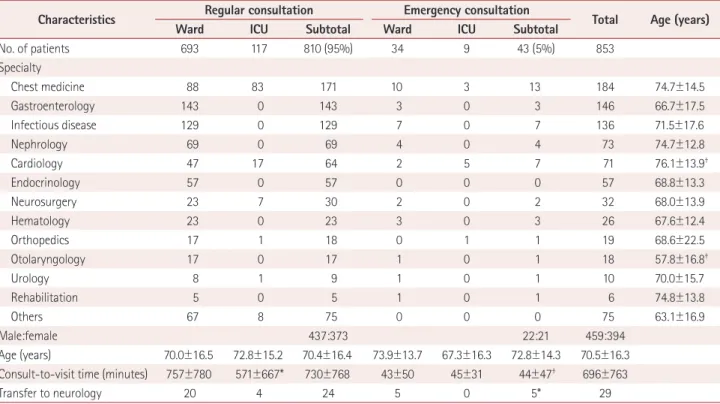
The age of the patients was 70.5±16.3 years (mean±standard deviation). There was no significant difference in either mean patient age or male-to-female ratio between patients who received regular and emergency consultations or between patients in the regular wards and in the ICU (Table 1). The otolaryngology patients with NILs were younger (57.8±16.8 years) than for cardiology patients (76.1±13.9 years; p<
0.0001, ANOVA). Patients with dementia were the oldest (82.2±8.9 years), while those with headache were the young- est (55.6±18.7 years; p<0.0001, ANOVA).
Source of referral and accomplishment of consultations
Emergency consultations comprised 5% of all consultations (43/853), and 15% (126/853) of consultation requests arose from the ICU, of which 68% (86/126) originated from phy- sicians in the department of chest medicine. The depart- ments of chest medicine, gastroenterology, and infectious disease were the three most frequently requested specialties for liaison, and comprised 55% of all NILs (466/853). The consulting neurologists completed 95% of emergency con- sultations within 2 hours and 85% of regular consultations within 24 hours. The consult-to-visit times for emergency and regular consultations were 44±47 minutes and 730±768 minutes, respectively; the overall was 696±763 minutes. The mean consult-to-visit time did not differ between the ICU and regular wards for emergency consultations. For regular consultations, the duration was shorter in the ICU (571±667 minutes) than in the regular wards (757±780 minutes; p=
0.0151, unpaired t-test). The consult-to-visit time was short- er in cases of seizure (536±665 minutes) and stroke (601±
888 minutes), and longer for neuromuscular disorders (935±
861 minutes) and headache (902±1,101 minutes; p=0.032, ANOVA) (Table 2).
Liu CY et al.
JCN
Common neurological disorders on liaison
Altered consciousness, seizure, stroke, and movement dis- orders were the most often requested disorders, comprising 57% (488/853) of all NILs (Table 2). Doctors in the depart- ment of chest medicine most commonly requested NILs for these four conditions. Stroke, seizure, and altered conscious- ness were the most common reasons for emergency consul- tations (40/43, 93%). Of the 853 patients, 29 (3.4%) were trans-
ferred to the neurology ward after consultation. The transfer rate was higher for emergency consultations (5/43, 11.6%) than for regular consultations (24/810, 2.9%; p=0.0087, chi- square test).
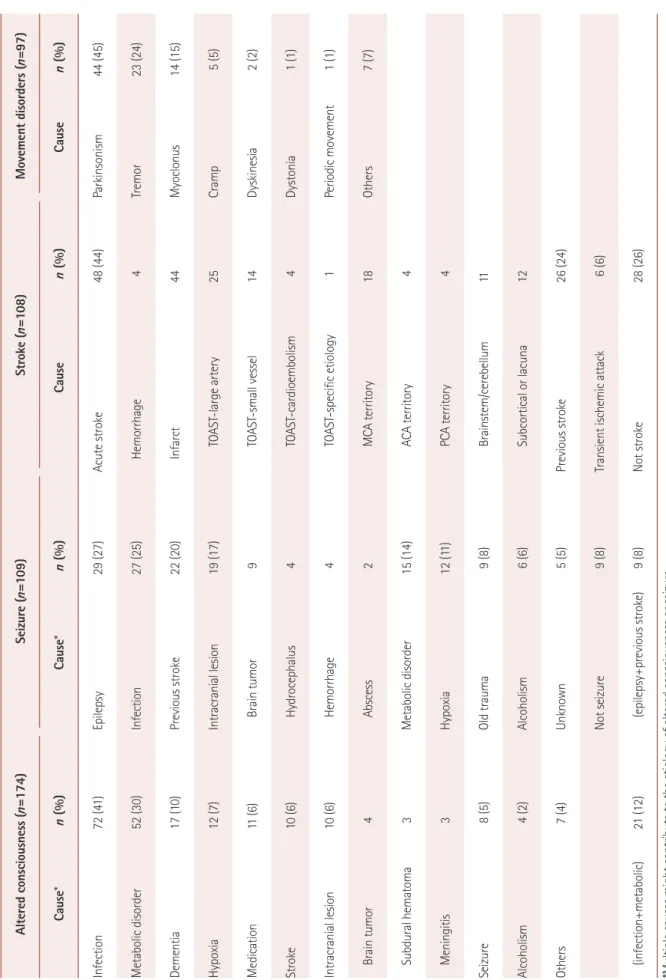
Table 3 lists the plausible etiologies for the four most com- mon disorders prompting NILs. Causes of each disorder were multifarious in some cases; for example, sepsis and hy- ponatremia could occur simultaneously, with both contrib- Table 1. Specialties requesting neurological inpatient liaison (NILs) in the 853 study patients by types of consultations and wards
Characteristics Regular consultation Emergency consultation
Total Age (years)
Ward ICU Subtotal Ward ICU Subtotal
No. of patients 693 117 810 (95%) 34 9 43 (5%) 853
Specialty
Chest medicine 88 83 171 10 3 13 184 74.7±14.5
Gastroenterology 143 0 143 3 0 3 146 66.7±17.5
Infectious disease 129 0 129 7 0 7 136 71.5±17.6
Nephrology 69 0 69 4 0 4 73 74.7±12.8
Cardiology 47 17 64 2 5 7 71 76.1±13.9†
Endocrinology 57 0 57 0 0 0 57 68.8±13.3
Neurosurgery 23 7 30 2 0 2 32 68.0±13.9
Hematology 23 0 23 3 0 3 26 67.6±12.4
Orthopedics 17 1 18 0 1 1 19 68.6±22.5
Otolaryngology 17 0 17 1 0 1 18 57.8±16.8†
Urology 8 1 9 1 0 1 10 70.0±15.7
Rehabilitation 5 0 5 1 0 1 6 74.8±13.8
Others 67 8 75 0 0 0 75 63.1±16.9
Male:female 437:373 22:21 459:394
Age (years) 70.0±16.5 72.8±15.2 70.4±16.4 73.9±13.7 67.3±16.3 72.8±14.3 70.5±16.3 Consult-to-visit time (minutes) 757±780 571±667* 730±768 43±50 45±31 44±47† 696±763
Transfer to neurology 20 4 24 5 0 5* 29
Except where indicated otherwise, data are mean±standard deviation values.
*p<0.05, †p<0.0001 (analysis of variance).
ICU: intensive care unit.
Table 2. Reasons for requesting NILs in 853 patients by type of consultation, age, consult-to-visit time, specialty, and transfer to the neurology ward
Disorder RC EC Total (%) Mean age Consult-to-visit
time Specialty (%) Transfer
Altered consciousness 163 11 174 (20) 73.8±14.0 637±645 Chest (26) 7
Seizure 96 13 109 (13) 67.8±17.7 536±665* Chest (36) 3
Stroke 92 16 108 (13) 74.9±12.0 601±888 Chest (23) 10
Movement disorders 97 0 97 (12) 75.0±13.3 693±614 Chest (26) 1
Dizziness/vertigo 84 1 85 (10) 69.9±16.8 708±773 GE (31) 2
Neuromuscular disorder 72 0 72 (8) 62.5±16.1 935±861* GE (29) 1
Dementia 45 0 45 (5) 82.2±8.9† 747±657 ID (22) 0
Headache 43 1 44 (5) 55.6±18.7† 902±1101 GE (36) 3
Limb weakness 40 0 40 (5) 64.5±16.3 711±686 Chest (18) 1
Syncope 22 1 23 (3) 66.0±19.2 841±930 GE (43) 1
Others 56 0 56 (6) 68.8±17.6 776±781 Chest (23) 0
Total 810 43 853 (100) 70.5±16.3 696±763 29
*p<0.05, †p<0.0001 (analysis of variance).
EC: emergency consultation, GE: gastroenterology, ID: infectious disease, NIL: neurological inpatient liaison, RC: regular consultation.
Common Neurological Disorders Involving Inpatient Liaisons
JCN
Table 3. Plausible causes of the four most common disorders prompting NILs in 488 patients Altered consciousness (n=174)Seizure (n=109)Stroke (n=108)Movement disorders (n=97) Cause*n (%)Cause*n (%)Causen (%)Causen (%) Infection72 (41)Epilepsy29 (27)Acute stroke48 (44)Parkinsonism44 (45) Metabolic disorder52 (30)Infection27 (25)Hemorrhage4Tremor23 (24) Dementia17 (10)Previous stroke22 (20)Infarct44Myoclonus14 (15) Hypoxia12 (7)Intracranial lesion19 (17)TOAST-large artery25Cramp5 (5) Medication11 (6)Brain tumor9TOAST-small vessel14Dyskinesia2 (2) Stroke10 (6)Hydrocephalus4TOAST-cardioembolism4Dystonia1 (1) Intracranial lesion10 (6)Hemorrhage4TOAST-specific etiology1Periodic movement1 (1) Brain tumor4Abscess2MCA territory18Others7 (7) Subdural hematoma3Metabolic disorder15 (14)ACA territory4 Meningitis3Hypoxia12 (11)PCA territory4 Seizure8 (5)Old trauma9 (8)Brainstem/cerebellum11 Alcoholism4 (2)Alcoholism6 (6)Subcortical or lacuna12 Others7 (4)Unknown5 (5)Previous stroke26 (24) Not seizure9 (8)Transient ischemic attack6 (6) (infection+metabolic)21 (12)(epilepsy+previous stroke)9 (8)Not stroke28 (26)
*Multiple causes might contribute to the etiology of altered consciousness or seizure. ACA: anterior cerebral artery
, MCA: middle cerebral artery, NILs: neurological inpatient liaisons, PCA: posterior cerebral artery, TOAST: Trial of ORG 10172 in Acute Stroke Treatment diagnostic classifica- tion of ischemic stroke.
Liu CY et al.
JCN
uting to altered consciousness. Infection was the most com- mon cause of altered consciousness (72/174, 41%), followed by metabolic disorders (52/174, 30%), dementia (17/174, 10%), and hypoxia (12/174, 7%). Concurrent infection and metabolic disorder were observed in 12% (21/174) of pa- tients. Delirium was the primary symptom of patients with dementia causing altered consciousness. A history of epilep- sy (29/109, 27%) in patients who had seizures during hos- pitalization was the most common cause of seizure disorder.
Other causes of seizure included infection (27/109, 25%), previous stroke (22/109, 20%), intracranial lesion (19/109, 17%), and metabolic disorder (15/109, 14%). Intracranial le- sions included brain tumor, hydrocephalus, intracranial hem- orrhage, and brain abscess. A history of epilepsy due to an old stroke occurred in 8% (9/109) of patients. Seizure disor- der was excluded in 8% (9/109) patients after neurological consultation. Acute stroke was found in 44% (48/108) of pa- tients with stroke disorder, followed by old stroke (26/108, 24%), and transient ischemic attack (6/108, 6%). Stroke was excluded in 26% (28/108) of patients. Four of the 48 patients with acute stroke developed intracranial hemorrhage. An- other 44 patients experienced acute ischemic stroke. Of these patients, 57% (25/44) had large-artery atherosclerosis ac- cording to the Trial of ORG 10172 in Acute Stroke Treatment criteria;9 41% (18/44) of strokes occurred in the middle cere- bral arterial territory. The most common cause of movement disorders was Parkinson’s disease and related disorders (44/94, 45%), followed by tremor (23/97, 24%). Tension headache and migraine comprised 66% (29/44) of head- ache disorders. Other particular causes of headache included meningitis in four patients, metastatic brain tumor in three patients, and intracranial hypotension in two patients. Causes of limb weakness included myelopathy from metastatic spi- nal tumors in four patients, neuropathy in three, myositis in three, radiculopathy in two, and cerebrovascular disorder in two patients.
Neurological liaison in ICU
There was no difference in gender or mean age among pa- tients in the regular wards and ICU (Table 4). The percentage of emergency consultations in the ICU (9/126, 7.1%) did not differ statistically from that in the regular wards (34/727, 4.6%). The average consult-to-visit time was shorter in the ICU than in the regular wards (533±657 minutes vs. 724±
777 minutes; p=0.004, unpaired t-test). As indicated in Table 1, this difference was significant for regular consultations but not for emergency consultations. Altered consciousness, seizure, and stroke accounted for 84% of neurological con- sultations in the ICU but only 39% of them in the regular wards (p<0.001, chi-square test).
Investigations recommended by neurologists Six main studies were suggested by neurologists during NILs: magnetic resonance imaging (MRI), computed tomog- raphy (CT), electroencephalography (EEG), nerve conduc- tion velocity (NCV), color-coded carotid (CCD) with or with- out transcranial (TCCS) duplex sonography, and evoked potential. Table 5 lists the studies recommended by the con- sulting neurologists and those that were actually performed by the referring physicians after consultation. The overall performance rate for all six recommended studies was 73%
(553/760). EEG was the most often recommended investiga- tion, and was most frequently requested due to altered con- sciousness and seizure disorder. MRI and CT were recom- mended for disorders of altered consciousness and stroke.
CCD with or without TCCS was recommended for stroke and dizziness. NCV was suggested for neuromuscular dis- orders and limb weakness. The measurement of evoked po- tentials was recommended for patients with dizziness or vertigo. EEG was performed in 83% (241/289) of recom- mendations and was the study that was performed most of- ten after NILs. The performance rates for other studies var- ied between 55% and 70%. Epileptiform discharge on EEG was found in 31 out of 241 patients (13%). Ten of these cases proved to be nonconvulsive status epilepticus (five patients with altered consciousness, four with seizure, and one with stroke disorder). Twenty out of 53 patients (38%) had extra- cranial carotid stenosis of 50% or more or intracranial ath- erosclerosis during CCD/TCCS, which required antiplatelet treatment.
DISCUSSION
The Taiwan Joint Commission on Hospital Accreditation rec- Table 4. Comparison of neurological consultations in the ICU and regular wards in 853 patients
Characteristics Ward ICU p
No. of patients (%) 727 (85) 126 (15)
Male:female (%) 53:47 59:41 0.270
Age, years 70.2±16.4 72.4±15.3 0.161
Male (n=459) 69.6±16.6 70.8±16.5 0.581
Female (n=394) 70.9±16.2 74.7±13.3 0.104 Emergency consultation (%) 34 (4.6) 9 (7.1) 0.343 Consult-to-visit time (minutes) 724±777 533±657 0.004
Symptom (%) <0.001
Altered consciousness 18 34
Seizure 9 33
Stroke 12 17
Others 61 16
ICU: intensive care unit.
Common Neurological Disorders Involving Inpatient Liaisons
JCN
ommends that inpatient emergency and regular consulta- tions be completed within 2 hours and 24 hours, respectively.
Nevertheless, there is no recommendation on the ideal per- centages of those consultations completed within these time limits. In the present analysis, 95% of emergency consulta- tions were completed within 2 hours and 85% of regular consultations were completed within 24 hours. These per- centages are in line with quality control targets in our hospi- tal setting (90% for emergency consultations and 85% for reg- ular consultations). Ali et al.10 reported that the use of a Web- based internal neurology referral service resulted in them seeing 77% (782/1016) of patients within 24 hours of refer- ral, of which 40% were seen in the emergency room and 87% were reviewed by consultant neurologists. In the pres- ent study, all of the referred patients were inpatients and were reviewed by a consultant neurologist.
The liaison rate per each admission case was 3% in this study, which was lower than the previously observed per- centage of 15–20% of inpatients with neurological prob- lems.3 There are several possible reasons for the low inpa- tient liaison rate:
1) Most patients with significant neurological symptoms in the emergency room had been evaluated by neurologists through emergency consultations and were admitted to the neurology ward. This is also likely to be a reason for the small percentage of emergency consultations (5%) among all NILs.
2) Patients who have neurological disorders might already have received treatment at the outpatient neurology clinic, and physicians tended to contact the neurologist directly via
a phone call to obtain recommendations.
3) Some minor neurological symptoms that are clearly not correlated with the patient’s hospitalization might not be considered as a problem requiring an NIL.
The chest medicine, gastroenterology, and infectious dis- ease departments had the largest numbers of inpatients in the medical wards and thus requested more than half of all the NILs, with the department of chest medicine requesting the most NILs. In addition, half of these inquiries arose from the ICU. It is not surprising that cardiology patients were much older than the otolaryngology patients, since coronary and cerebral arterial diseases share similar pathogeneses and commonly occur in older people. Similarly, patients with dementia, movement disorders, and stroke were older than patients with headache disorders.
Common neurological disorders involving liaison varied according to the practice setting and the fundamental char- acteristics of each institution. In this study, which focused on the inpatient wards, altered consciousness, seizure, stroke, and movement disorder contributed to 58% of the NILs. Al- tered consciousness was the problem that the other special- ties were most concerned about, despite the presence of se- vere medical illness. A neurological evaluation is frequently requested to exclude the possible coexistence of a brain le- sion, such as a stroke or seizure. However, systemic infec- tions and metabolic disorders were the two most common causes of altered consciousness in this study. In septic en- cephalopathy, the release of cytokines, procalcitonin, tumor necrosis factor α, and interleukin 6 might lead to altered ce- Table 5. Recommended and carried out investigations according to neurological consultation
Study Most common
disorders
No. of recommended studies No. of studies performed Performance rate (%)
RC EC Total RC EC Total
Magnetic resonance imaging 143 10 153 94 6 100 65
Altered consciousness 49 28
Stroke 28 25
Computed tomography 117 10 127 76 8 84 66
Altered consciousness 30 22
Stroke 21 17
Electroencephalography 268 21 289 225 16 241 83
Altered consciousness 110 91
Seizure 89 78
Nerve conduction velocity 90 0 90 63 0 63 70
Neuromuscular disorder 39 31
Limb weakness 19 17
CCD/TCCS 77 2 79 53 0 53 69
Stroke 27 17
Dizziness/vertigo 25 18
Evoked potential 22 0 22 12 0 12 55
Dizziness/vertigo 12 8
CCD/TCCS: color-coded carotid and transcranial duplex sonography, EC: emergency consultation, RC: regular consultation.
Liu CY et al.
JCN
rebral hemodynamics, disruption of the blood-brain barrier, cerebral edema, and disturbed neuronal function.4,11 In met- abolic encephalopathy, interruption of the delivery of ener- gy substrates to the brain (in hypoglycemia and hypoxia) or altered neuronal excitability (in hepatic and renal failure, and electrolyte imbalance) result in an altered mental state.4 Stroke, intracranial lesion, and seizure only contributed to 16% (28/174) of altered-consciousness NIL requests in the present study.
Previous studies have shown that cerebrovascular disease is the most common reason for NILs, prompting 17.2–29%
of total NIL requests.3,5-7,12 Stroke is the most common neu- rological disorder in our hospital, but since neurologists care for most patients with acute stroke in the emergency room, stroke occurs infrequently in specialty wards. None of the 62 patients who experienced acute stroke in the hospital ful- filled the criteria for intravenous thrombolytic therapy. Some strokes occurred during night sleeping, but they exceeded the 3-hour “golden time,” and some patients had concomi- tant severe illness that precluded thrombolytic therapy. It is interesting that stroke was excluded in 26% of patients who were initially suspected of stroke syndrome. The probability of a stroke diagnosis after a NIL was close to the value of 72%
on the Cincinnati Prehospital Stroke Scale for the presence of any one of three signs (arm weakness, speech, and facial droop).13 Ferro et al.14 noted that nonneurologists make a correct diagnosis of acute stroke in up to 85% of cases. Vali- dating a stroke diagnosis may be more difficult in inpatients due to the presence of concomitant illnesses.
Seizure and collapse were the most commonly reported reasons for neurological referrals in two studies.10,15 A high level of diagnostic agreement exists between neurologists and former specialists regarding convulsive seizures. A histo- ry of epilepsy was noted in 27% of patients who developed seizures during hospitalization. Withdrawal of anticonvul- sant medications or acute illness, such as infection or meta- bolic disorders, may be precipitating factors for seizure re- currence. The first episode of seizure had various etiologies.
Newly diagnosed intracranial lesions corresponding to sei- zure were found in 17% (19/109) of patients, and 15 of these 19 patients required prompt treatment of the lesion (tumor, hemorrhage, and abscess) in addition to seizure control. Al- though epileptiform discharges were detected in only 13%
of all EEG studies, abnormal EEG findings indicated to the referring physicians that ten patients had nonconvulsive sta- tus epilepticus. All of these patients improved gradually af- ter receiving appropriate anticonvulsant treatment. Towne et al.16 reported that nonconvulsive status epilepticus oc- curred in 8% of all comatose patients without signs of sei- zure activity. They recommended that EEG be included in
the routine evaluation of comatose patients, even when clini- cal seizure activity is not apparent.16
Parkinson’s disease and related disorders were the primary disorders in the patients with movement disorders. Aggra- vation of rigidity or tremor, or unfamiliarity with the appro- priate dosage of antiparkinsonism medications prompted the need for an NIL. Stroke, seizure, and altered consciousness were the most common disorders, comprising 93% (40/43) of all emergency consultations and 84% (106/126) of con- sultations in the ICU. Active intracranial lesions were found in 89 of the 391 patients (17%) with these 3 disorders. These lesions included acute stroke in 62 patients, brain tumor in 13, transient ischemic attack in 6, central nervous system in- fection in 5, and subdural hematoma in 3 patients. Combined with the other 95 patients with seizures (85 with seizure dis- orders, 8 with altered consciousness, and 2 with stroke dis- order but not with stroke), and 9 patients with delirium due to dementia, 193 patients out of 391 patients (49%) warrant- ed an immediate diagnosis and prompt treatment as suggest- ed by consulting neurologists. In addition, intracranial lesions such as meningitis, metastatic brain tumor, and intracranial hypotension were found in 9 out of 44 patients (20%) with headache disorder.
Patients were transferred to the neurology ward more of- ten after an emergency consultation (11.6%) than after a reg- ular consultation (2.9%). Most patients transferred to the neu- rology ward had acute stroke or intractable seizures. The consult-to-visit times were almost the same for patients re- quiring emergency consultations, regardless of whether they were in a regular ward or the ICU. Only 7.1% of NILs in the ICU were emergency consultations. A consult-to-visit time within 24 hours for a regular consultation is considered acceptable by most ICU physicians in this hospital. The av- erage consult-to-visit time for a regular consultation was 33% shorter for patients in the ICU (571 minutes) than in the ward (757 minutes). Neurologists had a higher level of alertness and tended to visit patients earlier when they re- ceived liaison requests from the ICU. The consult-to-visit times are shorter for seizure disorders and stroke and are longer for neuromuscular disorder and headache. The symp- toms prompting the liaisons also affect the time taken for neurologists to visit patients.
EEG was both the most common recommended and per- formed study, particularly in patients with altered conscious- ness and seizure disorder. MRI and CT were recommended more in patients with altered consciousness and stroke. Al- though CT is more convenient, rapid, and widely available than MRI, one explanation for there being fewer recommen- dations for CT than for MRI by neurologists is that some patients had already had CT studies before their NIL. CCD/
Common Neurological Disorders Involving Inpatient Liaisons
JCN
TCCS is regarded as an essential study for patients with stroke in Taiwan. In the present study, stenotic carotid artery dis- ease or intracranial atherosclerosis was detected in 6 out of 18 patients with dizziness or vertigo, and these patients received long-term antiplatelet treatment after the study.
NILs are typically time-consuming and sometimes require several revisits and follow-ups. The secondary referral hos- pital where this study was conducted did not have a resident doctor trained in neurology. In addition to daily neurologi- cal work at the outpatient clinic, inpatient ward service, and the neurological electrophysiology laboratory, neurologists also rotate through the hospital, providing a 24-hour service for inpatient care and consultation. There were 1,340 emer- gency consultations arising from the emergency room dur- ing the same 1-year period as in this study. Together with the 853 NILs, there were 2,193 neurological consultations dur- ing the 1-year period. The requested consult-to-visit time for an emergency consultation from the emergency room was 30 minutes, which was much shorter than that for inpatient emergency consultations (120 minutes). When a special “cere- brovascular accident call” is initiated from the emergency room for a suspected acute stroke occurring within 3 hours, the on-duty neurologist is required to evaluate the patient in the emergency room immediately so that intravenous throm- bolytic therapy can be provided within 1 hour of the patient’s arrival. Although not all neurologists in Taiwan participate in emergency consultations outside of office hours, the new workload burden of neurologists for emergency consulta- tions associated with 24-hour acute thrombolytic therapy—
particularly for so-called stroke neurologists—has developed a “neurophobia” among young doctors. Fewer and fewer medical students are willing to devote themselves to clinical neuroscience. The “invisible” work from inpatient and emer- gency room referrals with very little resources has become a hazard for neurologists.5 A new concept of a “neurohospi- talist” for inpatient neurological care is a possible solution to this problem.17
In conclusion, half of the patients presenting with altered consciousness, seizure, and stroke have acute neurological diseases that warrant immediate diagnosis and treatment by neurologists. Balancing increasing neurologist workloads and appropriate health-care resources remains a significant chal- lenge.
Conflicts of Interest
The authors have no financial conflicts of interest.
Acknowledgements
We wish to thank to Professor Meei-Shyuan Lee for her help on review- ing the statistic analysis.
The study was supported by grants from the Taipei Tzu Chi Hospital, Buddhist Tzu Chi Medical Foundation (TCRD-TPE-103-RT-16) and (TCRD-TPE-103-RT-7).
REFERENCES
1. Department of Statistics, Ministry of Interior, ROC. Interior Affair Statistic Bulletin [Internet]. Taiwan: Department of Statistics, Minis- try of the Interior, R.O.C. Taiwan, 2013. Available from: http://www.
moi.gov.tw/files/news_file/week10233.pdf.
2. Lin MH, Chou MY, Liang CK, Peng LN, Chen LK. Population aging and its impacts: strategies of the health-care system in Taipei. Ageing Res Rev 2010;9 Suppl 1:S23-S27.
3. Morrow JI, Patterson VH. The neurological practice of a district gen- eral hospital. J Neurol Neurosurg Psychiatry 1987;50:1397-1401.
4. Razvi SS, Bone I. Neurological consultations in the medical intensive care unit. J Neurol Neurosurg Psychiatry 2003;74 Suppl 3:iii16-iii23.
5. Douglas MR, Peake D, Sturman SG, Sivaguru A, Clarke CE, Nicholl DJ. The inpatient neurology consultation service: value and cost. Clin Med 2011;11:215-217.
6. Steiger MJ, Enevoldson TP, Hammans SR, Ginsberg L. Influence of obtaining a neurological opinion on the diagnosis and management of hospital inpatients. J Neurol Neurosurg Psychiatry 1996;61:653-654.
7. Costello DJ, Renganathan R, O’Hare A, Murray B, Lynch T. Audit of an inpatient neurology consultation service in a tertiary referral cen- tre: value of the consulting neurologist. Ir Med J 2005;98:134-137.
8. Forbes R, Craig J, Callender M, Patterson V. Liaison neurology for acute medical admissions. Clin Med 2004;4:290.
9. Adams HP Jr, Bendixen BH, Kappelle LJ, Biller J, Love BB, Gordon DL, et al. Classification of subtype of acute ischemic stroke. Defini- tions for use in a multicenter clinical trial. TOAST. Trial of Org 10172 in Acute Stroke Treatment. Stroke 1993;24:35-41.
10. Ali E, Chaila E, Hutchinson M, Tubridy N. The ‘hidden work’ of a hos- pital neurologist: 1000 consults later. Eur J Neurol 2010;17:e28-e32.
11. Howard RS. Neurological problems on the ICU. Clin Med 2007;7:
148-153.
12. Carroll C, Zajicek J. Provision of 24 hour acute neurology care by neurologists: manpower requirements in the UK. J Neurol Neurosurg Psychiatry 2004;75:406-409.
13. Kothari R, Hall K, Brott T, Broderick J. Early stroke recognition: de- veloping an out-of-hospital NIH Stroke Scale. Acad Emerg Med 1997;
4:986-990.
14. Ferro JM, Pinto AN, Falcão I, Rodrigues G, Ferreira J, Falcão F, et al.
Diagnosis of stroke by the nonneurologist. A validation study. Stroke 1998;29:1106-1109.
15. Perkin GD. Necessity for inpatient services in neurological practice. J R Soc Med 1983;76:920-923.
16. Towne AR, Waterhouse EJ, Boggs JG, Garnett LK, Brown AJ, Smith JR Jr, et al. Prevalence of nonconvulsive status epilepticus in comatose patients. Neurology 2000;54:340-345.
17. Barrett KM, Freeman WD. Emerging subspecialties in neurology:
neurohospitalist. Neurology 2010;74:e9-e10.