Effects of Sodium Citrate on Salt Sensitivity and Kidney Injury in Chronic Renal Failure
Metabolic acidosis, which is observed in salt-sensitive hypertension, is also associated with kidney injury. Alkali therapy in chronic renal failure (CRF) may ameliorate the progression of kidney disease; however, few studies have examined the effects of alkali therapy on salt sensitivity and kidney injury in CRF. We randomly administered standard diet (SD), sodium chloride with 20% casein diet (NACL), or sodium citrate with 20% casein diet (NACT) to Sprague-Dawley rats after a CRF or a sham operation. Four weeks after 5/6 nephrectomy, serum bicarbonate levels were higher in the NACT-treated group. On the pressure- natriuresis curve, NACT-treated CRF rats were more salt-resistant than NACL-treated CRF rats. Additionally, the NACT-treated CRF group showed less tubulointerstitial damage than the NACL-treated CRF group. The expression and immunoreactivity of NHE3 in the kidney in the NACT-treated CRF group were lower than those in the NACL-treated CRF group. We observed that dietary NACT as alkali therapy in CRF might improve the altered salt- sensitivity and ameliorate the progression of kidney injury compared to the NACL diet, which may be related to reduced renal NHE3 expression.
Keywords: Kidney Failure, Chronic; Citrates; Acidosis; Natriuresis Sejoong Kim,1,2 Jin Young Yang,1
Eun Sook Jung,2 Jeonghwan Lee,3 Nam Ju Heo,2,4 Jae Wook Lee,5 Ki Young Na,1,2 and Jin Suk Han2
1Department of Internal Medicine, Seoul National University Bundang Hospital, Seongnam;
2Department of Internal Medicine, Seoul National University College of Medicine, Seoul; 3Department of Internal Medicine, Hallym University Hangang Sacred Heart Hospital, Seoul; 4Department of Internal Medicine, Healthcare System Gangnam Center, Seoul National University Hospital, Seoul, Korea; 5Epithelial Systems Biology Laboratory, National Heart, Lung, and Blood Institute, National Institutes of Health, Bethesda, MD, USA
Received: 18 June 2014 Accepted: 29 July 2014 Address for Correspondence:
Jin Suk Han, MD
Department of Internal Medicine, Seoul National University Hospital, 103 Daehak-ro, Chongno-gu, Seoul 110-744, Korea Tel: +82.2-2072-2392, Fax: +82.2-741-4876
E-mail: [email protected]
Funding: This work was supported by grant from the Seoul National University Bundang Hospital Research Fund (No. 03- 2012-020) and grant (No. 2013R1A1A1012689) from the National Research Foundation of Korea.
http://dx.doi.org/10.3346/jkms.2014.29.12.1658 • J Korean Med Sci 2014; 29: 1658-1664
INTRODUCTION
Alkali therapy in chronic renal failure (CRF) ameliorates the progression of kidney injury (1-4) and better preserves renal function (5). Several mechanisms behind its effects have been evaluated, including the reduction of inflammation (6, 7), cyto- kines (8) and endothelin production (5). In our previous study, bicarbonate therapy downregulated apical Na/H exchanger type 3 (NHE3) expression in CRF (9). Luminal NHE3 is a signifi- cant transporter for renal Na+ and HCO3- absorption (10) and could be a main therapeutic target of alkali therapy for renal disease progression (9).
Pressure-natriuresis is a classical concept that describes the association between blood pressure and sodium balance; kid- ney damage alters pressure-natriuresis and the positive sodium balance. Salt sensitivity, which shifts rightward on the pressure- natriuresis curve, is a risk factor for cardiovascular outcomes in hypertensive patients (11). Salt sensitivity may increase not only intraglomerular pressure but also an additional risk of glomer-
ular damage and microalbuminuria (12-14); therefore, preserv- ing the pressure-natriuresis relationship may be a preventive method for the progression of kidney injury. In addition, meta- bolic acidosis is observed in salt-sensitive hypertension (15), and NHE activity in platelet is increased in some essential hy- pertensive patients (16). In animal studies, altered NHE3 expres- sion has been associated with the change in salt sensitivity (17).
However, few reports have investigated the effects of alkali ther- apy on salt sensitivity and kidney injury in CRF. We used a rem- nant kidney model to evaluate the beneficial effects of dietary sodium citrate on salt sensitivity and on ameliorating renal dis- ease progression in rats.
MATERIALS AND METHODS
Twenty-four 6-week-old male, specific pathogen-free Sprague- Dawley rats, purchased from Orient Bio Inc. (Seongnam, Ko- rea) were given ad libitum access to water. Experimental CRF was induced by the sequential excision of approximately two-
thirds of the left kidney and total right kidney (9, 18). After 5/6 nephrectomy, the CRF animals were randomly distributed to the standard diet group (Agribrands Purima Korea, Seongnam City, Korea), sodium chloride (NACL)-treated group or sodium citrate (NACT)-treated group. The NACL-treated CRF rats were fed a 20% casein diet with 174 µM/g NACL (DYET #113811, Dy- ets Inc., Bethlehem, PA, USA), and the NACT-treated CRF rats were fed a 20% casein diet with 174 µM/g NACT (DYET #103316).
Sham-operated rats were divided into 3 groups and adminis- tered the same diet. All operated animals were sacrificed post- operatively at week 4.
We measured blood pressure using the tail-cuff plethysmog- raphy method (IITC Life Sciences, Woodland Hills, CA, USA).
We collected 24-hr urine samples in the metabolic cages on the day before sacrifice, and blood samples from the abdominal aor- ta at the time of sacrifice for measuring urea nitrogen, creatinine, osmolality, and electrolytes. We performed biochemical tests using an automatic chemistry analyzer (Hitachi 7070; Hitachi, Tokyo, Japan). We used indirect ion-selective electrode meth- ods for electrolyte levels, and the enzyme method for total CO2
levels. We measured plasma and urine osmolality with a cryo- scopicosmometer (Osmomat 030-D-M; Gonotec, Berlin, Ger- many). We calculated the glomerular filtration rate (GFR) using the average of the urea clearance and creatinine clearance (10).
Total extracted protein concentration was measured using the bicinchoninic acid protein assay method (BCA Reagent Kit;
Sigma, St. Louis, MO, USA). Briefly, samples were fractionated by SDS-PAGE. After transfer onto the Protran Nitrocellulose Transfer Membrane (Whatman, Gassel, Germany), the blots were probed with the primary antibodies (9, 10). Previously characterized polyclonal antibodies were used for semiquanti-
tative immunoblotting and immunohistochemistry, as de- scribed in the previous studies (9, 10). In addition, affinity-puri- fied polyclonal antibodies against sodium dicarboxylate trans- porter (NaDC1, sc-23539, Santa Cruz Biotechnology, Inc., Santa Cruz, CA) were used.
As previously described (9, 10), the glomerulosclerosis index and the tubulointerstitial damage index were evaluated using a semiquantitative scoring system, which were performed in a blinded fashion. The immunostaining procedure was performed according to the protocol of the Dako Cytomationkit (Envision + Dual Link System-HRP; Carpinteria, CA, USA) (9, 10). Multiple fields of each kidney sections were photographed with 40 × ob- jective lens using a light microscope (Axioskop40, Carl Zeiss, Goettingen, Germany), and staining intensity was quantified using region in Axiovision software (v4.8.2).
Tissue endothelin (ET)-1 levels were measured by quantita- tive enzyme immunoassay using QuantiGlo ET-1 ELISA (QET00B, R&D Systems, Minneapolis, MN, USA).
Statistical analysis
The Mann-Whitney U test was used in the comparisons between two groups, and the Kruskal-Wallis test in the comparisons among three groups (SPSS software, SPSS Inc., Chicago, IL, USA). P values less than 0.05 were considered statistically sig- nificant.
Ethics statement
The experimental protocol was approved by the institutional animal care and use committee (Seoul National University Bundang Hospital) (No. BA1203-101/017-01).
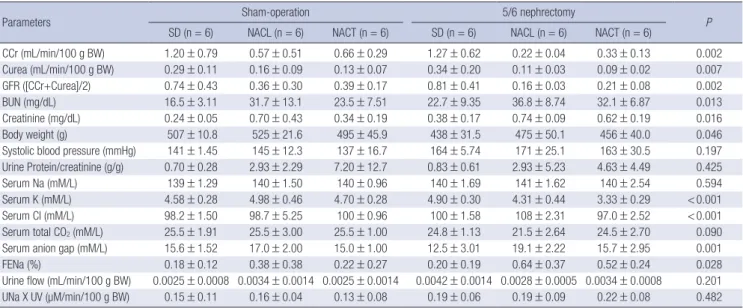
Table 1. Physiologic data from animals treated with 4-week standard diet (SD), sodium chloride (NACL) with 20% casein diet, and sodium citrate (NACT) with 20% casein diet, 4 weeks after the sham operation or 5/6 nephrectomy
Parameters Sham-operation 5/6 nephrectomy
SD (n = 6) NACL (n = 6) NACT (n = 6) SD (n = 6) NACL (n = 6) NACT (n = 6) P
CCr (mL/min/100 g BW) 1.20 ± 0.79 0.57 ± 0.51 0.66 ± 0.29 1.27 ± 0.62 0.22 ± 0.04 0.33 ± 0.13 0.002 Curea (mL/min/100 g BW) 0.29 ± 0.11 0.16 ± 0.09 0.13 ± 0.07 0.34 ± 0.20 0.11 ± 0.03 0.09 ± 0.02 0.007
GFR ([CCr+Curea]/2) 0.74 ± 0.43 0.36 ± 0.30 0.39 ± 0.17 0.81 ± 0.41 0.16 ± 0.03 0.21 ± 0.08 0.002
BUN (mg/dL) 16.5 ± 3.11 31.7 ± 13.1 23.5 ± 7.51 22.7 ± 9.35 36.8 ± 8.74 32.1 ± 6.87 0.013
Creatinine (mg/dL) 0.24 ± 0.05 0.70 ± 0.43 0.34 ± 0.19 0.38 ± 0.17 0.74 ± 0.09 0.62 ± 0.19 0.016
Body weight (g) 507 ± 10.8 525 ± 21.6 495 ± 45.9 438 ± 31.5 475 ± 50.1 456 ± 40.0 0.046
Systolic blood pressure (mmHg) 141 ± 1.45 145 ± 12.3 137 ± 16.7 164 ± 5.74 171 ± 25.1 163 ± 30.5 0.197 Urine Protein/creatinine (g/g) 0.70 ± 0.28 2.93 ± 2.29 7.20 ± 12.7 0.83 ± 0.61 2.93 ± 5.23 4.63 ± 4.49 0.425
Serum Na (mM/L) 139 ± 1.29 140 ± 1.50 140 ± 0.96 140 ± 1.69 141 ± 1.62 140 ± 2.54 0.594
Serum K (mM/L) 4.58 ± 0.28 4.98 ± 0.46 4.70 ± 0.28 4.90 ± 0.30 4.31 ± 0.44 3.33 ± 0.29 < 0.001
Serum Cl (mM/L) 98.2 ± 1.50 98.7 ± 5.25 100 ± 0.96 100 ± 1.58 108 ± 2.31 97.0 ± 2.52 < 0.001
Serum total CO2 (mM/L) 25.5 ± 1.91 25.5 ± 3.00 25.5 ± 1.00 24.8 ± 1.13 21.5 ± 2.64 24.5 ± 2.70 0.090 Serum anion gap (mM/L) 15.6 ± 1.52 17.0 ± 2.00 15.0 ± 1.00 12.5 ± 3.01 19.1 ± 2.22 15.7 ± 2.95 0.001
FENa (%) 0.18 ± 0.12 0.38 ± 0.38 0.22 ± 0.27 0.20 ± 0.19 0.64 ± 0.37 0.52 ± 0.24 0.028
Urine flow (mL/min/100 g BW) 0.0025 ± 0.0008 0.0034 ± 0.0014 0.0025 ± 0.0014 0.0042 ± 0.0014 0.0028 ± 0.0005 0.0034 ± 0.0008 0.201 UNa X UV (µM/min/100 g BW) 0.15 ± 0.11 0.16 ± 0.04 0.13 ± 0.08 0.19 ± 0.06 0.19 ± 0.09 0.22 ± 0.08 0.482 Values are presented as the means ± SD. CCr, Creatinine clearance; Curea, urea clearance; FENa, fractional excretion of sodium; UV, urine volume.
RESULTS
Physiologic data, salt sensitivity, and pathologic data As shown in the Table 1, the NACT-treated CRF group had great- er levels of the serum total CO2 than the NACL-treated group 4 weeks after surgical reduction of the kidney mass. Regarding the pressure-natriuresis relationship (Fig. 1), the point of pres- sure-natriuresis in the SD-treated animals was shifted to the right after nephrectomy. Also, the point was additionally shifted to the right in the NACL-treated rats, compared to the SD-treat- ed groups, regardless of whether they were sham-operated or nephrectomized. In the CRF groups, the systolic blood pressure in the NACT-treated group showed a tiny reduction, compared with the NACL-treated group. The NACT diet triggered an in- creased urinary sodium excretion rate, with elevated blood pressure. Conversely, the urinary sodium excretion rate in the NACL-treated CRF group was not increased, although systolic blood pressure was increasing; the pressure-natriuresis rela- tionship was shifted to the right.
At week 4, a small rise in the GFR in the NACT-treated CRF group was found compared to the NACL-treated CRF group, though the GFRs of both CRF groups were lower than those of SD-treated CRF group (Table 1). The glomerulosclerosis index and cortical tubulointerstitial damage index in the NACT-treat- ed CRF group were relatively modest compared to the NACL- administrated CRF group, although not statistically significant (Fig. 2). The medullary tubulointerstitial damage index in the NACL-administrated and SD-fed CRF group was twice that of the sham-operated group; however, the NACT treatment abro- gated the kidney injury caused by nephrectomy (Fig. 2).
Change of renal transporters
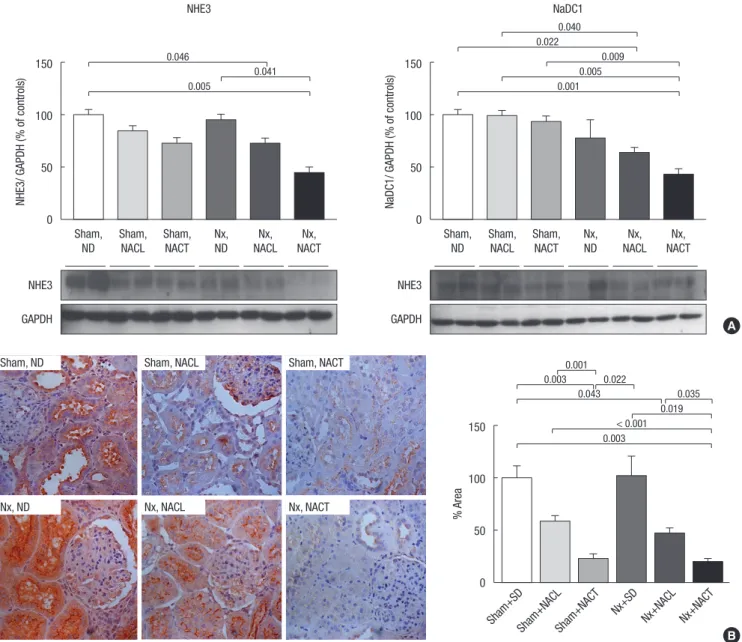
After nephrectomy, NHE3 expression in the NACT-treated group had fallen compared to the NACL-treated group. Simi- larly, immunohistochemistry indicated weaker expression for
NHE3 in the NACT-treated group than the other groups (Fig. 3).
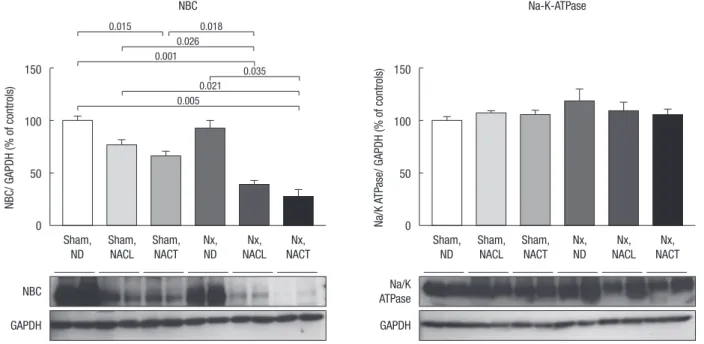
The densities of NKCC2, NCC, ENaCs and H-ATPase were de- creased after nephrectomy compared to the sham-operated groups; however, no differences between NACL- and NACT- treated CRF groups were shown. SGLT1 and pendrin expres- sions did not differ in the six groups (data not shown). NBC ex- pression decreased after the NACT treatment in both the CRF and sham-operated groups; however, no difference between the NACL- and NACT-treated groups was found (Fig. 4). The Na-K- ATPase expression did not differ in all of the six groups (Fig. 4).
The renal ET-1 levels increased after nephrectomy with the SD and NACL treatments. ET-1 in the NACT-treated group was slightly lower than that in the NACL-treated group although not statistically significant (Fig. 5).
DISCUSSION
The study data demonstrated that dietary NACT in nephrecto- mized models may improve the pressure-natriuresis relation- ship and ameliorate kidney damage, compared to the NACL diet. The underlying mechanisms of these beneficial effects can be associated with a preserved pressure-natriuresis relation- ship, which may be caused by the decreased expression of NHE3, with the correction of metabolic acidosis.
Some studies have indicated that salt sensitivity is associated with substantial kidney damage (12-14). Additionally, salt sensi- tivity is a major risk factor for kidney injury (12-14) and cardio- vascular events (11). In the current study, alkali therapy contrib- uted to the reverse of the pressure-natriureis points, which shift- ed to the right after the NACL treatment. In alkali-treated CRF rats, NHE3 expression was dramatically suppressed; this sup- pression may lead to increased sodium excretion. It may help to maintain pressure-natriuresis and decreased blood pressure despite the renal mass reduction. Other alkali therapies, such as sodium bicarbonate, also reduced NHE3 expression in CRF models (9); these beneficial effects of alkali therapy in CRF may improve pressure-natriuresis relationship.
Sharma et al. showed that NACL increases blood pressure in salt-sensitive subjects whereas NACT does not (15). Additionally, the authors demonstrated that the elevated blood pressure in- duced by NACL is associated with metabolic acidosis and that NACT can correct acidosis in salt-sensitive subjects (15). This re- sult is fully consistent with our data. We demonstrated altered NHE3 expression and the shift of pressure-natriuresis. The proxi- mal tubule reabsorbs two-thirds of the filtered sodium. As blood pressure changes, this fraction of reabsorption is appropriately adapted. Zhang et al. showed that more than half of the apical NHE3 immunoreactivity was redistributed to membranes after blood pressure increased and that all NHE3 returned to the origi- nal distribution levels after blood pressure normalized (17);
therefore, NHE3 may affect the regulation of sodium reabsorp- Fig. 1. Pressure-natriuresis curves by group. Data are presented as the means ±
SEM. SD, standard diet; Nx, nephrectomy; NACL, sodium chloride with 20% casein diet; NACT, sodium citrate (NACT) with 20% casein diet.
Urine sodium excretion (µM/min/100 g BW)
Systolic blood pressure (mmHg)
120 140 160 180
0.3
0.2
0.1
0
Sham group Nx group
Standard diet NaCl+20% casein diet NaCitrate+20% casein diet
Fig. 2. Histological analysis of kidney tissue. Histological sections include glomerular lesions (A) on periodic-acid Schiff-stained sections at a magnification of ×400 and cortical (B) and medullary (C) tubulointerstitial lesions on Masson’s trichrome stained sections at a magnification of ×100. Data are presented as the means ± SEM. P values are pre- sented between the groups. SD, standard diet; Nx, nephrectomy; NACL, sodium chloride with 20% casein diet; NACT, sodium citrate with 20% casein diet.
Glomerulosclerosis indexCortical tubulointerstitial damage indexMedullary tubulointerstitial damage index
Sham+SD
Sham+SD
Sham+SD Sham+NACL
Sham+NACL
Sham+NACL Sham+NACT
Sham+NACT
Sham+NACT Nx+SD
Nx+SD
Nx+SD Nx+NACL
Nx+NACL
Nx+NACL Nx+NACT
Nx+NACT
Nx+NACT 1.5
1.0
0.5
0
2.0
1.5
1.0
0.5
0
4
3
2
1
0
0.032
< 0.001 0.015
< 0.001
< 0.001 0.017
0.023 0.023 0.004 0.001
0.022 Sham, SD
Sham, SD
Sham, SD Nx, SD
Nx, SD
Nx, SD
Sham, NACL
Sham, NACL
Sham, NACL Nx, NACL
Nx, NACL
Nx, NACL
Sham, NACT
Sham, NACT
Sham, NACT Nx, NACT
Nx, NACT
Nx, NACT
A
B
C
tion in response to fluctuations in sodium or blood pressure (19).
Acid retention during kidney failure induces ET production, which leads to progressive GFR decline (20). ET-1 plays a role in pathophysiology in the development and maintenance of salt sensitivity, and an ET receptor antagonist may be useful in treat- ing salt-sensitive hypertension (21). Previously, apical NHE3 ex- pression had fallen in the bicarbonate-treated group with a slight reduction of ET levels (9). In the current study, NACT ther- apy reduced the kidney levels of ET in CRF rats, but it was not statistically significant, which suggests that ET-1 may not be a main mechanism, although reducted ET might influence the re- lationship between pressure-natriuresis and alkali therapy. In addition, alkalization can directly influence on the downregula- tion of apical NHE3 activity in the renal proximal tubule unlike
other sodium transporters, such as SGLT1, NKCC2, NCC, and ENaC (22). Interestingly, Na-K-ATPase was not decreased, con- trary to the previous study, which described decreased Na-K- ATPase after bicarbonate therapy (9, 23). This result may suggest that citrate may not affect NHE3 via Na-K-ATPase. Unlike NHE3 expression, H-ATPase or NBC abundances, which are crucial mediators of acid-base balance, may not be connected with ci- trate treatment in CRF; therefore, NHE3 will be one of the major targets of alkali treatment based on citrate.
Citrate is reabsorbed in the renal proximal tubule by a sodi- um-dicarboxylate cotransporter (NaDC) and produces bicar- bonate. Aruga et al. indicated that metabolic acidosis increased NaDC abundance and that alkali loading did not alter NaDC expression (24). In addition, citrate can be metabolized or shut-
NHE3/ GAPDH (% of controls) NaDC1/ GAPDH (% of controls) % Area
Sham, ND
Sham, ND Sham,
NACL
Sham, NACL Sham,
NACT
Sham, NACT Nx,
ND
Nx, ND Nx,
NACL
Nx, NACL Nx,
NACT
Nx, NACT
Sham+SD
Sham+NACLSham+NACT Nx+SD
Nx+NACL Nx+NACT 150
100
50
0
150
100
50
0
150
100
50
0
0.005 0.001
0.022
0.041 0.005
0.040 0.009 0.046
0.003 0.043
0.003 0.022
0.001
< 0.001 0.019
0.035 Sham, ND
Nx, ND
Sham, NACL
Nx, NACL
Sham, NACT
Nx, NACT
A
B
NHE3 NaDC1
NHE3 NHE3
GAPDH GAPDH
Fig. 3. Immunoblots (A) of NHE3 and NaDC1, and immunohistochemistry of NHE3 (B). Immunoblot analysis shows band density values that were standardized by dividing them by the average value of the control group, and the mean for the control group was defined as 100%. Data are presented as the means±SEM. P values are presented between the groups. SD, standard diet; Nx, nephrectomy; NACL, sodium chloride with 20% casein diet; NACT, sodium citrate (NACT) with 20% casein diet.
tled into the mitochondria where it enters the citric acid cycle (25). It may be possible that the beneficial effect of citrate, such as improvement of mitochondrial dysfunction in chronic renal failure, may assist in ameliorating kidney injury, a mechanism that differs from alkali therapy based on bicarbonate.
In conclusion, we found that citrate therapy in CRF may have positive effects on salt sensitivity and ameliorate the progres- sion of kidney injury, and that these effects could be related to the altered expression of NHE3 and correction of metabolic aci-
dosis. These results suggest that alkali therapy might be applied to other salt-sensitive pathologic conditions as well as CRF.
ACKNOWLEDGEMENTS
We thank Yun-mi Lee, Eun seong Lee (Seoul National Universi- ty Bundang Hospital, Seongnam, Korea) and Minkyung Park (Seoul National University Hospital, Seoul, Korea) for excellent technical assistance.
DISCLOSURE
The authors have declared that no conflict of interest exists.
ORCID
Sejoong Kim http://orcid.org/0000-0002-7238-9962 Jin Young Yang http://orcid.org/0000-0002-4249-2440 Eun Sook Jung http://orcid.org/0000-0002-3264-3866 Jeonghwan Lee http://orcid.org/0000-0003-3199-635X Nam Ju Heo http://orcid.org/0000-0003-3721-4830 Jae Wook Lee http://orcid.org/0000-0003-0120-8164 Ki Young Na http://orcid.org/0000-0002-8872-8236 Jin Suk Han http://orcid.org/0000-0001-6892-5518 REFERENCES
1. Shah SN, Abramowitz M, Hostetter TH, Melamed ML. Serum bicarbon- ate levels and the progression of kidney disease: a cohort study. Am J
NBC/ GAPDH (% of controls) Na/K ATPase/ GAPDH (% of controls)
Sham,
ND Sham,
ND Sham,
NACL Sham,
NACL Sham,
NACT Sham,
NACT Nx,
ND Nx,
ND Nx,
NACL Nx,
NACL Nx,
NACT Nx,
NACT 150
100
50
0
150
100
50
0 0.005
0.001
0.015 0.018
0.026
0.021 0.035
NBC Na-K-ATPase
NBC Na/K
ATPase
GAPDH GAPDH
Fig. 4. Immunoblots of NBC and Na-K-ATPase. In immunoblot analysis, the band density values were standardized by dividing them by the average value of the control group, and the mean for the control group was defined as 100%. Data are presented as the means ± SEM. P values are presented between the groups. SD, standard diet; Nx, ne- phrectomy; NACL, sodium chloride with 20% casein diet; NACT, sodium citrate (NACT) with 20% casein diet.
Fig. 5. Kidney tissue endothelin-1 levels in the animals treated with the standard diet (SD), sodium chloride (NACL) with 20% casein diet, and sodium citrate (NACT) with 20% casein diet after nephrectomy (Nx) or sham operation. Data are presented as the means±SEM. P values are presented between the groups.
Endothelin-1/protein ([pg/mL]/[mg/mL])
Sham+SD
Sham+NACL Sham+NACT Nx+SD
Nx+NACL Nx+NACT 50
40
30
20
10
0
< 0.001 0.027
0.006 0.021
Kidney Dis 2009; 54: 270-7.
2. de Brito-Ashurst , Varagunam M, Raftery MJ, Yaqoob MM. Bicarbonate supplementation slows progression of CKD and improves nutritional status. J Am Soc Nephrol 2009; 20: 2075-84.
3. Mahajan A, Simoni J, Sheather SJ, Broglio KR, Rajab MH, Wesson DE.
Daily oral sodium bicarbonate preserves glomerular filtration rate by slowing its decline in early hypertensive nephropathy. Kidney Int 2010;
78: 303-9.
4. Raphael KL, Wei G, Baird BC, Greene T, Beddhu S. Higher serum bicar- bonate levels within the normal range are associated with better survival and renal outcomes in African Americans. Kidney Int 2011; 79: 356-62.
5. Phisitkul S, Khanna A, Simoni J, Broglio K, Sheather S, Rajab MH, Wes- son DE. Amelioration of metabolic acidosis in patients with low GFR re- duced kidney endothelin production and kidney injury, and better pre- served GFR. Kidney Int 2010; 77: 617-23.
6. Nath KA, Hostetter MK, Hostetter TH. Pathophysiology of chronic tubu- lo-interstitial disease in rats. Interactions of dietary acid load, ammonia, and complement component C3. J Clin Invest 1985; 76: 667-75.
7. Gadola L, Noboa O, Márquez MN, Rodriguez MJ, Nin N, Boggia J, Fer- reiro A, Garcia S, Ortega V, Musto ML, et al. Calcium citrate ameliorates the progression of chronic renal injury. Kidney Int 2004; 65: 1224-30.
8. Phisitkul S, Hacker C, Simoni J, Tran RM, Wesson DE. Dietary protein causes a decline in the glomerular filtration rate of the remnant kidney mediated by metabolic acidosis and endothelin receptors. Kidney Int 2008; 73: 192-9.
9. Kim S, Lee J, Heo NJ, Lee JW, Han JS. Alkali therapy attenuates the pro- gression of kidney injury via Na/H exchanger inhibition in 5/6 nephrec- tomized rats. J Korean Med Sci 2014; 29: 691-8.
10. Kim S, Heo NJ, Jung JY, Son MJ, Jang HR, Lee JW, Oh YK, Na KY, Joo KW, Han JS. Changes in the sodium and potassium transporters in the course of chronic renal failure. Nephron Physiol 2010; 115: p31-41.
11. Morimoto A, Uzu T, Fujii T, Nishimura M, Kuroda S, Nakamura S, Ine- naga T, Kimura G. Sodium sensitivity and cardiovascular events in pa- tients with essential hypertension. Lancet 1997; 350: 1734-7.
12. Bigazzi R, Bianchi S, Baldari D, Sgherri G, Baldari G, Campese VM. Mi- croalbuminuria in salt-sensitive patients. A marker for renal and cardio- vascular risk factors. Hypertension 1994; 23: 195-9.
13. Kimura G, Brenner BM. A method for distinguishing salt-sensitive from non-salt-sensitive forms of human and experimental hypertension. Curr Opin Nephrol Hypertens 1993; 2: 341-9.
14. Campese VM. Salt sensitivity in hypertension. Renal and cardiovascular implications. Hypertension 1994; 23: 531-50.
15. Sharma AM, Kribben A, Schattenfroh S, Cetto C, Distler A. Salt sensitiv- ity in humans is associated with abnormal acid-base regulation. Hyper- tension 1990; 16: 407-13.
16. Schmouder RL, Weder AB. Platelet sodium-proton exchange is increased in essential hypertension. J Hypertens 1989; 7: 325-30.
17. Zhang Y, Magyar CE, Norian JM, Holstein-Rathlou NH, Mircheff AK, McDonough AA. Reversible effects of acute hypertension on proximal tu- bule sodium transporters. Am J Physiol 1998; 274: C1090-100.
18. Griffin KA, Picken M, Bidani AK. Method of renal mass reduction is a critical modulator of subsequent hypertension and glomerular injury. J Am Soc Nephrol 1994; 4: 2023-31.
19. McDonough AA. Mechanisms of proximal tubule sodium transport reg- ulation that link extracellular fluid volume and blood pressure. Am J Physiol Regul Integr Comp Physiol 2010; 298: R851-61.
20. Wesson DE, Simoni J. Acid retention during kidney failure induces endo- thelin and aldosterone production which lead to progressive GFR decline, a situation ameliorated by alkali diet. Kidney Int 2010; 78: 1128-35.
21. Ikeda T, Ohta H, Okada M, Kawai N, Nakao R, Siegl PK, Kobayashi T, Maeda S, Miyauchi T, Nishikibe M. Pathophysiological roles of endothe- lin-1 in Dahl salt-sensitive hypertension. Hypertension 1999; 34: 514-9.
22. Amlal H, Chen Q, Greeley T, Pavelic L, Soleimani M. Coordinated down- regulation of NBC-1 and NHE-3 in sodium and bicarbonate loading.
Kidney Int 2001; 60: 1824-36.
23. Liu J, Yan Y, Liu L, Xie Z, Malhotra D, Joe B, Shapiro JI. Impairment of Na/K-ATPase signaling in renal proximal tubule contributes to Dahl salt- sensitive hypertension. J Biol Chem 2011; 286: 22806-13.
24. Aruga S, Wehrli S, Kaissling B, Moe OW, Preisig PA, Pajor AM, Alpern RJ.
Chronic metabolic acidosis increases NaDC-1 mRNA and protein abun- dance in rat kidney. Kidney Int 2000; 58: 206-15.
25. Simpson DP. Citrate excretion: a window on renal metabolism. Am J Physiol 1983; 244: F223-34.