ISSN 2288-0585
Active Surveillance for Multidrug-resistant Organisms
Sung Kuk Hong
1, Taek Soo Kim
1,2, Kyoung Un Park
1,2, Jae-Seok Kim
3, Eui-Chong Kim
1Department of Laboratory Medicine,
1Seoul National University College of Medicine, Seoul,
2Seoul National University Bundang Hospital, Seoul National University College of Medicine, Seongnam,
3Hallym University College of Medicine, Seoul, Korea
Infections and outbreaks of antimicrobial-resistant ba- cteria, such as methicillin-resistant Staphylococcus aureus (MRSA) and vancomycin-resistant enteroco- ccus (VRE), have been increasing. Detection meth- ods for antimicrobial-resistant bacteria have been changed from traditional culture methods to chromo- genic media culture and molecular methods. Strain- typing methods using various molecular technologies are essential tools for epidemiologic surveillance.
Furthermore, outbreak detection, using syndromic sur- veillance as well as passive and active surveillance,
has been applied. However, it is difficult to establish effective and robust guidelines and systems for using these various methods to control antimicrobial-resi- stant bacteria. Therefore, clinical microbiologists and policy makers must possess expertise in the control of antimicrobial resistant bacteria, discuss the issue sufficiently, and, finally, create a system to accom- plish this control. (Ann Clin Microbiol 2013;16:53-60)
Key Words: Active surveillance, Mandatory active sur- veillance, Multidrug resistant organism
Received 4 October, 2012, Revised 7 November, 2012 Accepted 7 November, 2012
Correspondence: Kyoung Un Park, Department of Laboratory Medicine, Seoul National University Bundang Hospital, 173-82 Gumi-ro, Bun- dang-gu, Seongnam 463-707, Korea. (Tel) 82-31-787-7692, (Fax) 82-31-787-4015, (E-mail) [email protected]
53 INTRODUCTION
메티실린내성황색포도알균(methicillin-resistant Staphylococcus aureus, MRSA)과 반코마이신내성장알균(vancomycin-resistant enterococcus, VRE)과 같은 다제내성세균에 의한 감염이 증가 하면서[1,2] 이들에 의한 집단감염발생(outbreak, 집단감염)도 증가하였다. 집단감염이 발생한 경우 감시를 위한 배양이나 검 사(surveillance testing)를 시행하여 내성세균의 전파를 막기 위 해 노력해 왔으나, 이제 다제내성세균의 문제는 각 병원 또는 각 지역에 한정시킬 수 있는 수준을 넘어섰다[3,4]. 따라서 다 제내성세균의 확산을 차단하고 이들에 의한 집단감염을 감시 하고 통제하는 일은 의료관련감염 전문가뿐만 아니라 정책입 안자까지 함께 고민하고 해결방안을 모색해야 하는 의제가 되 었다. 이에 본 종설에서는 내성세균을 검출하고 집단감염을 발 견하는 방법 및 체계들을 효과적으로 관리하여 다제내성세균 과 관련된 중요한 현안을 해결하는 방안에 대해 논하고자 한다.
RAPID DETECTION OF MULTIDRUG RESISTANT ORGANISMS FOR SURVEILLANCE: MRSA AND VRE
감염감시를 위한 MRSA와 VRE의 검출에 있어 노동집약적
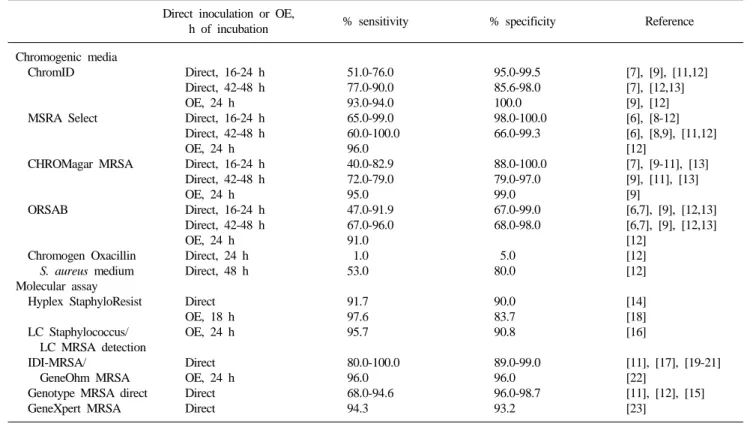
이며 검사의 결과를 확인하기까지 오랜 시간이 필요한 기존의 배양법을 대신하여 발색배지(chromogenic agar)를 이용한 배양 법의 도입이 모색되고 있다[5]. 발색배지를 이용한 배양법은 미 생물 검사실에서 추가적인 장비의 도입 없이 24시간 이내에 내 성세균의 유무를 확인할 수 있는 효율적인 방법이다. 검사실에 서 MRSA 검출에 이용할 수 있는 발색배지의 종류는 다양하 며, 배양 24시간 이후 대부분 높은 특이도를 보이나, 민감도의 경우 사용된 배지 및 조건에 따라 상당한 차이를 보인다(Table 1) [5-13]. VRE 검출에 사용될 수 있는 ChromID VRE (bioMérieux, Marcy l'Etoile, France) 및 CHROMagar GRE (Becton Dickin- son, Sparks, MD, USA)의 경우 높은 민감도와 특이도를 보인 다[5]. 내성세균의 검출에 발색배지를 사용하면 신속하게 결과 를 확인할 수 있다는 장점이 있지만, 전통적인 배지를 이용한 배양법에 비해 비용이 추가로 발생하여 일상적인 검사에 발색 배지를 이용하기에는 제한이 따른다.
발색배지를 이용한 배양법은 내성세균의 생화학적 특성을 이용하는 것임에 반해, 분자진단법은 내성세균의 항균제에 대 한 저항성에 영향을 미치는 유전자를 이용한다. 일반적으로 MRSA 검출을 위해서는 S. aureus 특이 부위 및 mecA 또는 SCCmec을 표적으로 하며, 이 방법은 높은 민감도와 특이도를 보인다(Table 1) [14-23]. VRE 검출에는 vanA 및 vanB 유전자 를 표적으로 사용하는데[5], 이 방법은 높은 민감도를 보여서 배양 음성인 VRE 보균자도 찾을 수 있으나, vanB 유전자를 가 지고 있는 비장알균도 양성소견을 보일 수 있으므로 주의를 요 한다[24].
Table 1. Sensitivity and specificity of currently available chromogenic media and molecular assays for methicillin-resistant Staphylococcus aureus Direct inoculation or OE,
h of incubation % sensitivity % specificity Reference
Chromogenic media ChromID
MSRA Select
CHROMagar MRSA
ORSAB
Chromogen Oxacillin S. aureus medium Molecular assay Hyplex StaphyloResist
LC Staphylococcus/
LC MRSA detection IDI-MRSA/
GeneOhm MRSA Genotype MRSA direct GeneXpert MRSA
Direct, 16-24 h Direct, 42-48 h OE, 24 h Direct, 16-24 h Direct, 42-48 h OE, 24 h Direct, 16-24 h Direct, 42-48 h OE, 24 h Direct, 16-24 h Direct, 42-48 h OE, 24 h Direct, 24 h Direct, 48 h Direct OE, 18 h OE, 24 h Direct OE, 24 h Direct Direct
51.0-76.0 77.0-90.0 93.0-94.0 65.0-99.0 60.0-100.0 96.0 40.0-82.9 72.0-79.0 95.0 47.0-91.9 67.0-96.0 91.0 1.0 53.0 91.7 97.6 95.7 80.0-100.0 96.0 68.0-94.6 94.3
95.0-99.5 85.6-98.0 100.0 98.0-100.0 66.0-99.3 88.0-100.0 79.0-97.0 99.0 67.0-99.0 68.0-98.0 5.0 80.0 90.0 83.7 90.8 89.0-99.0 96.0 96.0-98.7 93.2
[7], [9], [11,12]
[7], [12,13]
[9], [12]
[6], [8-12]
[6], [8,9], [11,12]
[12]
[7], [9-11], [13]
[9], [11], [13]
[9]
[6,7], [9], [12,13]
[6,7], [9], [12,13]
[12]
[12]
[12]
[14]
[18]
[16]
[11], [17], [19-21]
[22]
[11], [12], [15]
[23]
Table is adapted from Malhotra-Kumar et al., 2008.
Abbreviation: OE, overnight enrichment.
STRAIN TYPING FOR SURVEILLANCE
세균의 균주형별분류(strain typing)는 세균감염의 진단과 치 료에도 중요하지만, 역학감시에도 중요한 역할을 한다. 균주형 별분류의 방법은 DNA 절편분석법(DNA banding pattern-based method), DNA 염기서열분석법(DNA sequencing-based meth- od), DNA 교잡법(DNA hybridization-based method)으로 크게 분류된다[25]. DNA 절편분석법은 증폭이나 제한효소에 의해 생성된 DNA 분절의 크기 차이를 기반으로 한 방법으로서 pulsed-field gel electrophoresis (PFGE), restriction fragment length polymorphism (RFLP), arbitrarily primed PCR (AP-PCR), repetitive sequencing-based PCR (REP-PCR), multiple-locus variable number tandem repeat analysis (MLVA), denaturing gel electrophoresis (DGE), high-resolution melting (HRM) analysis, PCR-RFLP, amplified fragment length polymorphism (AFLP) 등을 포함한다. DNA 염기서열분석법은 특정 부위의 염기서열 을 비교하여 세균 사이의 다형성을 판별하는 방법으로서 multi- locus sequence typing (MLST), multispacer typing (MST), ge- nome sequencing 등을 포함한다. DNA 부합분석법은 탐색자를 이용하는 방법으로서 macroarray 및 microarray 등을 포함한다.
모든 세균에 대해 용이하게 수행이 가능하며, 식별력과 재현성 이 높으며, 비용이 적게 드는 것이 이상적인 균주형별분류의 조건이지만, 단일한 균주형별분류가 항상 이들 조건을 모두 만 족시킬 수는 없으므로 각 상황에 적합한 균주형별분류를 선택 하여야 한다.
MRSA의 균주형별분류에는 PFGE, REP-PCR, MLVA, MLST, spa 염기서열분석 등이 주로 이용된다[26]. PFGE의 경우 세균 의 전체 염색체를 대상으로 하므로 높은 식별력을 가지나, 노 동집약적이며 검사실 간 비교가 불가능하다. REP-PCR의 경우 염색체의 inter-repeat element spacers를 대상으로 하는 방법으 로 신속하게 다량의 검체를 분석할 수 있으나, 낮은 식별력과 검증된 해석 기준이 없다는 단점이 있다. MLVA의 경우 염색 체의 variable number tandem repeat (VNTR)을 대상으로 하여 신속하게 다량의 검체를 분석할 수 있으나, 식별력이 떨어진다.
MLST의 경우 항존(housekeeping) 유전자의 염기서열의 차이 를 이용하며 유전체의 계통학적 구조를 파악할 수 있으며 표준 화된 명명법이 있다는 장점이 있으나, 식별력이 떨어지고 검사 비용이 비싸다. spa 염기서열분석의 경우 신속하게 표준화된 명명법에 따른 분석을 수행할 수 있으나, 유전자의 상동성과 재조합으로 인해 균주형별분류에 오류가 발생할 가능성이 있다.
Fig. 1. Syndromic surveillance: rationale for early detection. *Time between detection by syndromic (prediagnostic) surveillance and detection by traditional (diagnosis-bases) surveillance. Figure is adapted from MMWR, 2004;53.
OUTBREAK DETECTION
집단감염은 역학적으로 특정 시간과 장소에서 예측치 이상 으로 감염질환이 발생한 상황을 말하며 드문 감염질환의 경우 두 명의 감염자만으로도 충분히 집단감염으로 여겨질 수 있다.
집단감염은 감염균의 균주형별분류 결과에 따라 클론성과 비 클론성의 두 가지 범주로 구별된다[27]. 비클론성 집단감염은 일반적으로 손씻기 등 감염관리의 기본수칙이 잘 지켜지지 않 을 때 흔히 발생하고 그 규모가 크기 때문에 상대적으로 신속 하게 발견된다. 이에 비해 클론성 집단감염은 감염환자의 수가 많지 않은 경우가 대부분으로 집단감염이 병원 전체 감염률에 큰 영향을 미치지 않는 경우가 흔하여 발견하기 쉽지 않다.
병원에 입원한 환자에서는 의료진이나 오염된 장비 등을 통 해서 집단감염이 언제든지 발생할 수 있기 때문에 집단감염의 발생을 인지하는 과정에 상당한 관심과 노력이 필요하다. 집단 감염의 발견에는 전체 감염환자의 수와 집단감염과 관련된 환 자의 수가 핵심적인 인자이다[28]. 일반적으로 전체 감염환자의 수가 집단감염과 관련된 환자 수보다 상대적으로 적을 때에는 집단감염을 비교적 쉽게 발견할 수 있고, 전체 감염환자의 수가 집단감염 환자의 수보다 상대적으로 많을 때에는 집단감염을 발견하기 어렵다. 집단감염을 신속하게 확인하기 위해서는 전 체 감염환자 사이에서 집단감염과 관련된 환자를 신속하고 정 확하게 인지하는 것이 중요하다[28]. 집단감염을 발견하기 위해 서는 전통적인 방법으로 감염과 관련된 환자의 정보를 모으고 분석하는 수동적 감염감시(passive surveillance), 집단감염의 발 견에 사용할 수 있는 정보를 능동적으로 생성하는 적극적 감염 감시(active surveillance), 증상이 나타나기 전의 일반의약품 판 매나 응급실을 방문하는 환자의 주증상과 같은 자료를 이용하 는 증후군적 감시(syndromic surveillance) 등을 이용할 수 있다.
SYNDROMIC SURVEILLANCE
2001년에 탄저병에 의한 테러가 있기 전부터 미국의 공중보 건담당자들은 신종감염과 생물학적 물질에 의한 질병을 신속 하게 발견하기 위한 노력을 시작하였고, 2001년 테러 이후에는 증후군적 감시를 체계화하였다[28-30]. 증후군적 감시는 환자 의 질병이 확진되기 전에 기침, 열, 호흡곤란과 같은 환자의 증 상, 학교나 직장의 결근율, 일반의약품 판매량 등과 같은 보완 적인 자료들을 이용하여 조기에 집단감염을 확인하는 시스템 이다(Fig. 1) [30]. 방대한 자료를 이용하는 증후군적 감시의 근 본적인 목적은 최대한 빨리 집단감염 환자들을 확인하고 신속 하게 대응하여 이환율과 사망률을 낮추는 것이다.
증후군적 감시는 계획된 기간과 자료 수집 방법에 따라 분류 된다. 사건 중심의 단기적인 증후군적 감시는 올림픽과 같은 특수한 상황에 적용될 수 있고 강화된 감시체계를 구축할 수
있다는 장점이 있지만, 노동력이 많이 들어 오랫동안 유지할 수 없다는 단점이 있다[31]. 지속적인 증후군적 감시는 자료를 수집하는 방법에 따라 수기식과 전자식으로 구분된다. 수기식 의 지속적인 증후군적 감시는 시작하기 쉽고 상세한 자료를 얻 을 수 있으나, 감시체계를 유지하기 힘들고 노동력이 많이 든 다[32]. 자동적으로 병원의 정보가 전송되는 것과 같은 전자식 의 지속적인 증후군적 감시는 정보제공자의 노력이 최소화되 고 자료가 표준화되고 쉽게 지속적으로 정보를 모을 수 있으 나, 정보 전문가와 체계화된 프로그램을 필요로 하고 비밀유지 에 어려움이 따른다[33-35].
증후군적 감시를 이용할 경우 전통적인 감염감시에 비해서 집단감염을 더 빠르게 발견할 수 있는지 아직 구체적으로 검증 되지는 않았지만, 증후군적 감시는 집단감염을 규명하는 유용 한 도구 중 하나이며 감염질환이 아닌 다른 공공의료 부분에서 도 유용하게 이용될 수 있을 것으로 판단된다[30]. 증후군적 감 시를 집단감염 발견에 실용적으로 사용하기 위해서는 적절한 자료의 선정 및 합리적인 알고리즘의 개발 등과 같은 부분에 대한 추가적인 연구 및 평가가 지속적으로 이루어져야 할 것이다.
ACTIVE SURVEILLANCE
MRSA와 VRE 같은 내성세균에 의한 감염이 급증하면서 [1,2] 다제내성세균의 보균자나 감염 환자를 발견하고, 내성세 균이 검출된 환자를 격리하는 적극적 감염감시가 시행되고 있 다. 적극적 감염감시를 시행하는 근거는 대부분의 다제내성세 균은 환자에게 감염을 일으키지 않고 피부나 점막에 존재하고 있으나[36,37], 면역력이 약화된 환자에게 전파될 수 있고 환자 의 면역력이 약화되면 내성세균에 의한 감염이 발생할 수 있기 때문이다. 내성세균의 보균자에서 감염이 발생하는 경우는 MRSA에서 11%-28% 정도이며[38-40], VRE에서는 더 낮은 빈
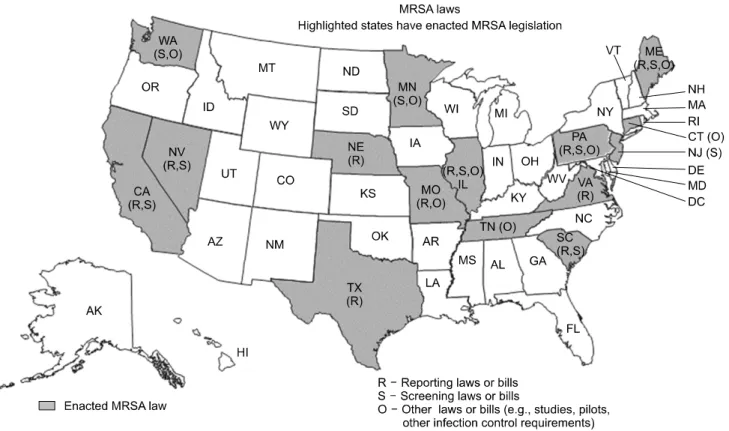
Fig. 2. Legislative maps of methicillin-resistant Staphylococcus aureus in the United States. Figure is adapted from http://apic.org.
Table 2. Required elements of an effective active surveillance program Screening test
Must be timely, affordable, and reliable Clinical efficacy
Should reduce transmission rate to patients and healthcare workers Should reduce infection rate by preventing acquisition
Implementation
Hospital and administrative financial support Systems and staff to screen patients
Systems and staff to monitor effectiveness and compliance Education of patients, staff, and families
Adequate physical plant and supplies
(e.g., private rooms, gloves, gowns, and antimicrobial agents) Plan to manage social isolation and safety of patients under
contact precautions
Table isadapted from Weber et al., 2007.
도로 감염이 발생한다[41-43]. 다제내성세균이 병원 안에서 환 자 간에 전파될 수 있음은 많은 역학 연구를 통해서 확인되었으며, 이를 통제하는 것이 적극적 감염감시의 주된 목적이다[44-47].
적극적 감시를 위한 배양이나 검사를 통해 내성세균의 보균 자나 감염자로 확인되면, 내성세균의 병원 내 확산을 방지하기 위하여 예방적 격리와 의료진의 접촉제한을 시행하게 된다[48, 49]. 이와 같은 방법은 주로 집중치료실을 중심으로 한 연구를 통해서 MRSA와 VRE의 집단감염의 확산을 방지하는데 효과 가 있음이 확인되었다[50-58]. 한편 최근의 한 다기관임상시험 에 따르면 적극적 감시를 위한 배양이나 검사, 환자의 격리, 의 료진의 접촉제한 등의 방법은 MRSA와 VRE의 병원 내 전파를 효과적으로 감소시키지 못하였으며[59], 또한 집중치료실 이외 의 일반병실이나 전체 병원 등에서의 적극적 감시를 위한 배양 이나 검사의 유용성을 뒷받침하는 증거는 여전히 충분하지 않 다[60-63].
집단감염에 따른 집중치료실에서의 적극적 감시를 위한 배 양이나 검사의 조기 시행은 MRSA의 전파를 방지하는 효과가 있으므로, 결과적으로 MRSA 감염에 따른 비용을 상당히 줄일 수 있었다[64]. 또한 적극적 감시를 위한 배양이나 검사를 고위 험군 환자에게 VRE 발생을 줄일 목적으로 시행하였을 때, VRE 감염환자 수와 이에 사용될 의료비용을 유의하게 감소시 킬 수 있었다[63]. 이와 같이 몇몇 연구들이 고위험군 환자나
집단감염 상황에서 적극적 감시를 위한 배양이나 검사의 수행 에 따른 비용효과적인 유용성을 보여주었지만, 적극적 감시를 위한 배양이나 검사의 범위를 병원 규모 이상으로 확대하여 시 행하는 경우의 비용효과적인 측면에 대한 연구는 아직 이루어 지지 않았다. 병원 규모 이상에서 적극적 감시를 위한 배양이 나 검사의 유용성을 평가하기 위해서는 먼저 관련된 필수요소 들을 구축하고(Table 2) [65], 이를 바탕으로 하는 체계적인 역 학연구들이 이루어져야 할 것이다.
OVERSEAS CASE OF ACTIVE SURVEILLANCE TESTING
미국의 일부 주에서는 MRSA와 VRE에 대해서 보균자들과 감염자들을 검사를 통해 확인하고 격리하는 것을 법제화하여 시행 중이며 일부 주에서는 그에 대한 논의가 진행 중이다(Fig. 2).
적극적 감시를 위한 배양이나 검사의 법제화가 이루어진 주 에서는 수술을 위해서 입원하는 환자, 입원 30일 이내에 퇴원 한 기록이 있는 환자, 집중치료실에 입원하는 환자, 투석치료를 위해 입원하는 환자, 요양병원에서 전원된 환자 등은 입원 24 시간 이내에 적극적 감염감시의 목적으로 특정 내성세균에 대 한 선별검사를 시행하여야 한다. 그러나 미국의 주된 병원감염 관리 전문가단체인 Association for Professionals in Infection Control (APIC) 및 Society for Healthcare Epidemiology of America (SHEA)는 공동으로, MRSA와 VRE를 포함한 내성세 균의 확산을 줄이는 것은 중요한 일이지만 모든 입원 환자를 대상으로 적극적 감시를 위한 배양이나 검사를 시행하도록 법 제화하는 것에는 반대한다는 공식적인 입장을 발표하였다. 이 들 단체는 적극적 감시를 위한 배양이나 검사의 적절한 적응증 과 비용효과 측면 등에 대해 더 연구하고 논의해야 할 내용들 이 많음에도 불구하고 서둘러 법제화가 이루어지는 것에 대해 서 다제내성세균의 관리라는 감염역학적인 문제를 정치적으로 해결하려 한다고 비판하고 있다[66,67].
유럽연합에서는 임상미생물학자를 비롯한 의료관련감염 전 문가를 중심으로 MRSA의 감시와 통제를 위한 정보를 제공하 고[26], 지속적으로 그 정보를 갱신하고 있다[68]. 이들은 MRSA 보균자들을 대상으로 하는 적극적 감시를 위한 배양이나 검사 가 병원에서 MRSA를 통제하는 중요한 방법이지만, MRSA의 집단감염의 증거가 있을 때에만 시행할 것과 집단감염이 나타 난 부서와 환자의 특성에 따라 적극적 감시를 위한 배양이나 검사의 범위를 정하여야 한다고 기술하고 있다[26]. 그리고 MRSA 적극적 감염감시에 중심에 되는 정보를 제공하는 MRSA 의 검출법과 균주형별분류의 방법에 대한 상세한 정보를 제공 하고 있다[26]. 또한 선별검사와 진단에 있어서 어떤 검사가 가 장 적합한 것인지, MRSA에만 관심을 둘지 아니면 MSSA를 포 함한 모든 내성세균을 관리하는 것이 좋을지 등의 추후 해결이 필요한 현안들을 제시하고 이에 대한 추가적인 연구가 필요함 을 주장하고 있다[68].
CONSIDERATION OF LEGISLATION FOR ACTIVE SURVEILLANCE TESTING
적극적 감시를 위한 배양이나 검사의 법제화를 검토하기에 앞서 법제화했을 때 발생할 수 있는 문제점을 사전에 검토하고 이에 대한 적절한 해결책을 미리 시행하려는 노력이 반드시 필
요하다. 충분한 고려와 실질적인 준비 없이 법제화를 진행하는 경우 현 의료체계에 큰 혼란을 초래할 수도 있을 것이다. 적극 적 감시를 위한 배양이나 검사를 법제화했을 때 발생할 수 있 는 가장 큰 두 가지의 문제점은 의료기관이 직면하게 될 병실 의 부족과 미생물검사실이 직면하게 될 검사업무량의 증가이 다[65].
적극적 감시를 위한 배양이나 검사의 법제화를 시행할 경우, 많은 수의 다제내성세균에 대한 보균자와 감염자가 확인될 것 이고 이들은 원칙적으로 접촉이 제한되는 공간에 격리되어야 함으로, 대부분의 의료기관은 필연적으로 병실의 부족에 직면 하게 될 것이다. 이는 숙련된 간호인력과 재활치료를 필요로 하는 내성세균을 가진 환자들의 입원, 전원, 퇴원의 지연으로 이어질 것이다. 적극적 감시를 위한 배양이나 검사가 요양병원 에서도 의무적으로 시행될 경우 요양병원의 병실 부족 문제뿐 만 아니라 전국적으로 환자의 입퇴원 업무에 지장을 초래할 수 있을 것이다. 또한 미생물검사를 실질적으로 책임지고 수행할 인력 및 관련된 보험체계에 대한 충분한 고려 없이 법제화가 진행된다면, 미생물검사실은 감당하기 힘든 검사업무량의 증 가에 직면하게 될 것이다. 현재 대부분의 의료기관의 미생물검 사실은 현시점에서 적극적 감시를 위한 배양이나 검사를 시행 할 경우, 증가할 검체의 처리와 결과를 해석할 인력과 장비가 마련되어 있지 않다. 이는 전반적인 미생물검사의 지연을 필연 적으로 초래하게 되어 전체 의료관련감염의 관리체계에 큰 위 험요소로 부각될 여지가 있다.
다제내성세균을 관리하는 방법을 결정할 때는 환자, 검사의 특성, 비용, 보균자 비율, 의료 현실 등에 대한 충분한 고려가 반드시 필요하다[68]. 최적의 감염감시체계를 구축하기 위해서 는 임상미생물학자를 비롯한 의료관련감염 전문가와 정책입안 자가 함께 고민하고 해결방안을 모색하여야 한다. 또한 내성세 균의 감시와 관련한 전문 지식을 숙지하고 내성세균의 관리에 필요한 다양한 고려사항에 대한 충분한 토의를 거쳐 순차적으 로 체계를 확립해가는 과정이 필수적일 것으로 판단된다.
REFERENCES
1. National Nosocomial Infections Surveillance System. National Nosocomial Infections Surveillance (NNIS) System Report, data summary from January 1992 through June 2004, issued October 2004. Am J Infect Control 2004;32:470-85.
2. Obritsch MD, Fish DN, MacLaren R, Jung R. National surveillance of antimicrobial resistance in Pseudomonas aeruginosa isolates obtained from intensive care unit patients from 1993 to 2002.
Antimicrob Agents Chemother 2004;48:4606-10.
3. Yong D, Toleman MA, Giske CG, Cho HS, Sundman K, Lee K, et al. Characterization of a new metallo-beta-lactamase gene, blaNDM-1, and a novel erythromycin esterase gene carried on a unique genetic structure in Klebsiella pneumoniae sequence type 14 from India. Antimicrob Agents Chemother 2009;53:5046-54.
4. Hishinuma A and Ishida T. New Delhi metallo-beta-lactamase-1 (NDM-1) producing bacteria. Nihon Rinsho 2012;70:262-6.
5. Malhotra-Kumar S, Haccuria K, Michiels M, Ieven M, Poyart C, Hryniewicz W, et al; MOSAR WP2 Study Team. Current trends in rapid diagnostics for methicillin-resistant Staphylococcus aureus and glycopeptide-resistant Enterococcus species. J Clin Microbiol 2008;46:1577-87.
6. Ben Nsira S, Dupuis M, Leclercq R. Evaluation of MRSA Select, a new chromogenic medium for the detection of nasal carriage of methicillin-resistant Staphylococcus aureus. Int J Antimicrob Agents 2006;27:561-4.
7. Compernolle V, Verschraegen G, Claeys G. Combined use of Pastorex Staph-Plus and either of two new chromogenic agars, MRSA ID and CHROMagar MRSA, for detection of methicillin- resistant Staphylococcus aureus. J Clin Microbiol 2007;45:154-8.
8. Louie L, Soares D, Meaney H, Vearncombe M, Simor AE.
Evaluation of a new chromogenic medium, MRSA select, for detection of methicillin-resistant Staphylococcus aureus. J Clin Microbiol 2006;44:4561-3.
9. Nahimana I, Francioli P, Blanc DS. Evaluation of three chromogenic media (MRSA-ID, MRSA-Select and CHROMagar MRSA) and ORSAB for surveillance cultures of methicillin-resistant Staphylo- coccus aureus. Clin Microbiol Infect 2006;12:1168-74.
10. Stoakes L, Reyes R, Daniel J, Lennox G, John MA, Lannigan R, et al. Prospective comparison of a new chromogenic medium, MRSASelect, to CHROMagar MRSA and mannitol-salt medium supplemented with oxacillin or cefoxitin for detection of methi- cillin-resistant Staphylococcus aureus. J Clin Microbiol 2006;44:
637-9.
11. van Hal SJ, Stark D, Lockwood B, Marriott D, Harkness J.
Methicillin-resistant Staphylococcus aureus (MRSA) detection:
comparison of two molecular methods (IDI-MRSA PCR assay and GenoType MRSA Direct PCR assay) with three selective MRSA agars (MRSA ID, MRSASelect, and CHROMagar MRSA) for use with infection-control swabs. J Clin Microbiol 2007;45:2486-90.
12. Cherkaoui A, Renzi G, François P, Schrenzel J. Comparison of four chromogenic media for culture-based screening of meticillin- resistant Staphylococcus aureus. J Med Microbiol 2007;56:500-3.
13. Perry JD, Davies A, Butterworth LA, Hopley AL, Nicholson A, Gould FK. Development and evaluation of a chromogenic agar medium for methicillin-resistant Staphylococcus aureus. J Clin Microbiol 2004;42:4519-23.
14. Daeschlein G, Assadian O, Daxboeck F, Kramer A. Multiplex PCR-ELISA for direct detection of MRSA in nasal swabs advanta- geous for rapid identification of non-MRSA carriers. Eur J Clin Microbiol Infect Dis 2006;25:328-30.
15. Holfelder M, Eigner U, Turnwald AM, Witte W, Weizenegger M, Fahr A. Direct detection of methicillin-resistant Staphylococcus aureus in clinical specimens by a nucleic acid-based hybridisation assay. Clin Microbiol Infect 2006;12:1163-7.
16. Levi K and Towner KJ. Rapid detection of methicillin-resistant Staphylococcus aureus from screening enrichment broths by real- time PCR. Eur J Clin Microbiol Infect Dis 2005;24:423-7.
17. Paule SM, Hacek DM, Kufner B, Truchon K, Thomson RB Jr, Kaul KL, et al. Performance of the BD GeneOhm methicillin- resistant Staphylococcus aureus test before and during high-volume clinical use. J Clin Microbiol 2007;45:2993-8.
18. Wagenvoort JH, van de Cruijs MF, Meuwissen CT, Gronenschild JM, De Brauwer EI. Comparison of an enrichment broth-enhanced commercial PCR procedure versus bacteriological culture for separating non-colonized from suspected or colonized MRSA
individuals. Eur J Clin Microbiol Infect Dis 2007;26:155-60.
19. Bishop EJ, Grabsch EA, Ballard SA, Mayall B, Xie S, Martin R, et al. Concurrent analysis of nose and groin swab specimens by the IDI-MRSA PCR assay is comparable to analysis by individual- specimen PCR and routine culture assays for detection of colonization by methicillin-resistant Staphylococcus aureus. J Clin Microbiol 2006;44:2904-8.
20. Rossney AS, Herra CM, Fitzgibbon MM, Morgan PM, Lawrence MJ, O'Connell B. Evaluation of the IDI-MRSA assay on the SmartCycler real-time PCR platform for rapid detection of MRSA from screening specimens. Eur J Clin Microbiol Infect Dis 2007;
26:459-66.
21. Zhang SX, Drews SJ, Tomassi J, Katz KC. Comparison of two versions of the IDI-MRSA assay using charcoal swabs for prospe- ctive nasal and nonnasal surveillance samples. J Clin Microbiol 2007;45:2278-80.
22. Desjardins M, Guibord C, Lalonde B, Toye B, Ramotar K.
Evaluation of the IDI-MRSA assay for detection of methicillin- resistant Staphylococcus aureus from nasal and rectal specimens pooled in a selective broth. J Clin Microbiol 2006;44:1219-23.
23. Wolk DM, Picton E, Johnson D, Davis T, Pancholi P, Ginocchio CC, et al. Multicenter evaluation of the Cepheid Xpert methicillin- resistant Staphylococcus aureus (MRSA) test as a rapid screening method for detection of MRSA in nares. J Clin Microbiol 2009;47:
758-64.
24. Domingo MC, Huletsky A, Giroux R, Boissinot K, Picard FJ, Lebel P, et al. High prevalence of glycopeptide resistance genes vanB, vanD, and vanG not associated with enterococci in human fecal flora. Antimicrob Agents Chemother 2005;49:4784-6.
25. Li W, Raoult D, Fournier PE. Bacterial strain typing in the genomic era. FEMS Microbiol Rev 2009;33:892-916.
26. Struelens MJ, Hawkey PM, French GL, Witte W, Tacconelli E.
Laboratory tools and strategies for methicillin-resistant Staphy- lococcus aureus screening, surveillance and typing: state of the art and unmet needs. Clin Microbiol Infect 2009;15:112-9.
27. Carnevale RJ, Talbot TR, Schaffner W, Bloch KC, Daniels TL, Miller RA. Evaluating the utility of syndromic surveillance algori- thms for screening to detect potentially clonal hospital infection outbreaks. J Am Med Inform Assoc 2011;18:466-72.
28. Buckeridge DL. Outbreak detection through automated surveillance:
a review of the determinants of detection. J Biomed Inform 2007;
40:370-9.
29. Jernigan JA, Stephens DS, Ashford DA, Omenaca C, Topiel MS, Galbraith M, et al; Anthrax Bioterrorism Investigation Team.
Bioterrorism-related inhalational anthrax: the first 10 cases reported in the United States. Emerg Infect Dis 2001;7:933-44.
30. Centers for Disease Control and Prevention (CDC). Syndromic surveillance. Reports from a national conference, 2003. MMWR Morb Mortal Wkly Rep 2004;53 Suppl:1-264.
31. Centers for Disease Control and Prevention (CDC). Syndromic surveillance for bioterrorism following the attacks on the World Trade Center--New York City, 2001. MMWR Morb Mortal Wkly Rep 2002;51:13-5.
32. Begier EM, Sockwell D, Branch LM, Davies-Cole JO, Jones LH, Edwards L, et al. The National Capitol Region's Emergency Department syndromic surveillance system: do chief complaint and discharge diagnosis yield different results? Emerg Infect Dis 2003;9:393-6.
33. Gesteland PH, Wagner MM, Chapman WW, Espino JU, Tsui FC, Gardner RM, et al. Rapid deployment of an electronic disease surveillance system in the state of Utah for the 2002 Olympic
Winter Games. Proc AMIA Symp 2002:285-9.
34. Lazarus R, Kleinman K, Dashevsky I, Adams C, Kludt P, DeMaria A Jr, et al. Use of automated ambulatory-care encounter records for detection of acute illness clusters, including potential bioterrorism events. Emerg Infect Dis 2002;8:753-60.
35. Wagner MM, Tsui FC, Espino JU, Dato VM, Sittig DF, Caruana RA, et al. The emerging science of very early detection of disease outbreaks. J Public Health Manag Pract 2001;7:51-9.
36. Kenner J, O'Connor T, Piantanida N, Fishbain J, Eberly B, Viscount H, et al. Rates of carriage of methicillin-resistant and methicillin-susceptible Staphylococcus aureus in an outpatient po- pulation. Infect Control Hosp Epidemiol 2003;24:439-44.
37. van den Braak N, Ott A, van Belkum A, Kluytmans JA, Koeleman JG, Spanjaard L, et al. Prevalence and determinants of fecal colonization with vancomycin-resistant Enterococcus in hospitalized patients in The Netherlands. Infect Control Hosp Epidemiol 2000;21:520-4.
38. Coello R, Glynn JR, Gaspar C, Picazo JJ, Fereres J. Risk factors for developing clinical infection with methicillin-resistant Staphy- lococcus aureus (MRSA) amongst hospital patients initially only colonized with MRSA. J Hosp Infect 1997;37:39-46.
39. Huang SS and Platt R. Risk of methicillin-resistant Staphylococcus aureus infection after previous infection or colonization. Clin Infect Dis 2003;36:281-5.
40. Pujol M, Peña C, Pallares R, Ayats J, Ariza J, Gudiol F. Risk factors for nosocomial bacteremia due to methicillin-resistant Staphylococcus aureus. Eur J Clin Microbiol Infect Dis 1994;13:
96-102.
41. Henning KJ, Delencastre H, Eagan J, Boone N, Brown A, Chung M, et al. Vancomycin-resistant Enterococcus faecium on a pediatric oncology ward: duration of stool shedding and incidence of clinical infection. Pediatr Infect Dis J 1996;15:848-54.
42. Yeh KM, Siu LK, Chang JC, Chang FY. Vancomycin-resistant enterococcus (VRE) carriage and infection in intensive care units.
Microb Drug Resist 2004;10:177-83.
43. Zirakzadeh A and Patel R. Vancomycin-resistant enterococci:
colonization, infection, detection, and treatment. Mayo Clin Proc 2006;81:529-36.
44. Pittet D, Hugonnet S, Harbarth S, Mourouga P, Sauvan V, Touveneau S, et al. Effectiveness of a hospital-wide programme to improve compliance with hand hygiene. Infection Control Progra- mme. Lancet 2000;356:1307-12.
45. Johnson PD, Martin R, Burrell LJ, Grabsch EA, Kirsa SW, O'Keeffe J, et al. Efficacy of an alcohol/chlorhexidine hand hygiene program in a hospital with high rates of nosocomial methicillin-resistant Staphylococcus aureus (MRSA) infection. Med J Aust 2005;183:509-14.
46. Rosenthal VD, Guzman S, Safdar N. Reduction in nosocomial infection with improved hand hygiene in intensive care units of a tertiary care hospital in Argentina. Am J Infect Control 2005;33:
392-7.
47. Dancer SJ, Coyne M, Speekenbrink A, Samavedam S, Kennedy J, Wallace PG. MRSA acquisition in an intensive care unit. Am J Infect Control 2006;34:10-7.
48. Jernigan JA, Titus MG, Gröschel DH, Getchell-White S, Farr BM.
Effectiveness of contact isolation during a hospital outbreak of methicillin-resistant Staphylococcus aureus. Am J Epidemiol 1996;
143:496-504.
49. Puzniak LA, Leet T, Mayfield J, Kollef M, Mundy LM. To gown or not to gown: the effect on acquisition of vancomycin-resistant enterococci. Clin Infect Dis 2002;35:18-25.
50. Karanfil LV, Murphy M, Josephson A, Gaynes R, Mandel L, Hill BC, et al. A cluster of vancomycin-resistant Enterococcus faecium in an intensive care unit. Infect Control Hosp Epidemiol 1992;13:
195-200.
51. Montecalvo MA, Horowitz H, Gedris C, Carbonaro C, Tenover FC, Issah A, et al. Outbreak of vancomycin-, ampicillin-, and amino- glycoside-resistant Enterococcus faecium bacteremia in an adult oncology unit. Antimicrob Agents Chemother 1994;38:1363-7.
52. Back NA, Linnemann CC Jr, Staneck JL, Kotagal UR. Control of methicillin-resistant Staphylococcus aureus in a neonatal intensive- care unit: use of intensive microbiologic surveillance and mupirocin.
Infect Control Hosp Epidemiol 1996;17:227-31.
53. Armstrong-Evans M, Litt M, McArthur MA, Willey B, Cann D, Liska S, et al. Control of transmission of vancomycin-resistant Enterococcus faecium in a long-term-care facility. Infect Control Hosp Epidemiol 1999;20:312-7.
54. Byers KE, Anglim AM, Anneski CJ, Germanson TP, Gold HS, Durbin LJ, et al. A hospital epidemic of vancomycin-resistant Enterococcus: risk factors and control. Infect Control Hosp Epide- miol 2001;22:140-7.
55. Saiman L, Cronquist A, Wu F, Zhou J, Rubenstein D, Eisner W, et al. An outbreak of methicillin-resistant Staphylococcus aureus in a neonatal intensive care unit. Infect Control Hosp Epidemiol 2003;24:317-21.
56. Khoury J, Jones M, Grim A, Dunne WM Jr, Fraser V. Eradication of methicillin-resistant Staphylococcus aureus from a neonatal intensive care unit by active surveillance and aggressive infection control measures. Infect Control Hosp Epidemiol 2005;26:616-21.
57. Singh N, Léger MM, Campbell J, Short B, Campos JM. Control of vancomycin-resistant enterococci in the neonatal intensive care unit. Infect Control Hosp Epidemiol 2005;26:646-9.
58. Mascini EM, Troelstra A, Beitsma M, Blok HE, Jalink KP, Hopmans TE, et al. Genotyping and preemptive isolation to control an outbreak of vancomycin-resistant Enterococcus faecium. Clin Infect Dis 2006;42:739-46.
59. Huskins WC, Huckabee CM, O'Grady NP, Murray P, Kopetskie H, Zimmer L, et al; STAR*ICU Trial Investigators. Intervention to reduce transmission of resistant bacteria in intensive care. N Engl J Med 2011;364:1407-18.
60. Dembry LM, Uzokwe K, Zervos MJ. Control of endemic glycopeptide-resistant enterococci. Infect Control Hosp Epidemiol 1996;17:286-92.
61. Jochimsen EM, Fish L, Manning K, Young S, Singer DA, Baker R, et al. Control of vancomycin-resistant enterococci at a community hospital: efficacy of patient and staff cohorting. Infect Control Hosp Epidemiol 1999;20:106-9.
62. Siddiqui AH, Harris AD, Hebden J, Wilson PD, Morris JG Jr, Roghmann MC. The effect of active surveillance for vancomycin- resistant enterococci in high-risk units on vancomycin-resistant enterococci incidence hospital-wide. Am J Infect Control 2002;30:
40-3.
63. Huang SS, Yokoe DS, Hinrichsen VL, Spurchise LS, Datta R, Miroshnik I, et al. Impact of routine intensive care unit surveillance cultures and resultant barrier precautions on hospital-wide methi- cillin-resistant Staphylococcus aureus bacteremia. Clin Infect Dis 2006;43:971-8.
64. Karchmer TB, Durbin LJ, Simonton BM, Farr BM. Cost-effecti- veness of active surveillance cultures and contact/droplet precautions for control of methicillin-resistant Staphylococcus aureus. J Hosp Infect 2002;51:126-32.
65. Weber SG, Huang SS, Oriola S, Huskins WC, Noskin GA,
Harriman K, et al; Society for Healthcare Epidemiology of America; Association of Professionals in Infection Control and Epidemiology. Legislative mandates for use of active surveillance cultures to screen for methicillin-resistant Staphylococcus aureus and vancomycin-resistant enterococci: position statement from the Joint SHEA and APIC Task Force. Infect Control Hosp Epidemiol 2007;28:249-60.
66. Fraser V, Murphy D, Brennan PJ, Frain J, Arias KM, Perl TM;
Boards of Directors of APIC and SHEA. Politically incorrect:
legislation must not mandate specific healthcare epidemiology and infection prevention and control practices. Infect Control Hosp Epidemiol 2007;28:594-5.
67. Farr BM. Political versus epidemiological correctness. Infect Control Hosp Epidemiol 2007;28:589-93.
68. Harbarth S, Hawkey PM, Tenover F, Stefani S, Pantosti A, Struelens MJ. Update on screening and clinical diagnosis of meti- cillin-resistant Staphylococcus aureus (MRSA). Int J Antimicrob Agents 2011;37:110-7.
=국문초록=
다제내성세균에 대한 적극적 감염감시
1서울대학교 의과대학, 2서울대학교 의과대학 분당서울대학교병원, 3한림대학교 의과대학 진단검사의학교실 홍성극1, 김택수1,2, 박경운1,2, 김재석3, 김의종1
메티실린내성황색포도알균과 반코마이신내성장알균 등의 다제내성세균에 의한 감염과 집단감염이 증가하고 있다. 내성 세균의 검출 방법의 경우 전통적인 배양법에서 발색배지를 이용한 배양법과 분자진단법으로 발전되어 왔으며, 다양한 분자기법을 통한 균주형별분류는 역학적인 감염감시에서 중요한 위치를 차지하고 있다. 뿐만 아니라 집단감염을 발견하 는 체계는 전통적인 수동적 감염감시에서 적극적 감염감시 및 증후군적 감시 등으로 발전되어 왔다. 그러나 다제내성세 균의 관리라는 당면한 문제 앞에 이러한 다양한 도구를 효과적으로 사용하기 위한 지침과 제도를 구축하는 것은 쉽지 않은 일이다. 최적의 감염감시체계를 구축하기 위해서는 임상미생물학자를 비롯한 의료관련감염 전문가와 정책입안자 가 함께 고민하고 해결방안을 모색하여야 한다. 또한 내성세균의 감시와 관련한 전문 지식을 숙지하고 내성세균의 관리 에 필요한 다양한 고려사항에 대한 충분한 토의를 거쳐 순차적으로 체계를 확립해가는 과정이 필수적일 것으로 판단된 다. [Ann Clin Microbiol 2013;16:53-60]
교신저자 : 박경운, 463-707, 경기도 성남시 분당구 구미로 173-82 분당서울대학교병원 진단검사의학과
Tel: 031-787-7692, Fax: 031-787-4015 E-mail: [email protected]