• 검색 결과가 없습니다.

Strength Increase of Medium Temperature-carbonized PAN Nano Fibers Made by Mechano-electrospinning

N/A
N/A
Protected

Academic year: 2021

Share "Strength Increase of Medium Temperature-carbonized PAN Nano Fibers Made by Mechano-electrospinning"

Copied!
5
0
0

로드 중.... (전체 텍스트 보기)

전체 글

(1)

Paper

Strength Increase of Medium Temperature-carbonized PAN Nano Fibers Made by Mechano-electrospinning

J.H Kim* , **, B. Bajaj* , ***, S.J Yoon*, S.H Kim**, J.R Lee* , ***

ABSTRACT: In this study, the effect of phosphoric acid (PA) as a fiber spinning aid on the strength increase of polyacrylonitrile (PAN) nano-fibers by using modified mechano-electrospinning technologies has been analyzed. The medium carbonization temperature of 800°C has been selected for the future economic production of these new materials. The concentration of PAN in dimethyl sulfoxide (DMSO) was fixed as 5 wt%. The weight fraction of PA was selected as being 2%, 4%, 6%, and 8% in comparison to PAN. These solutions have been used to make the nano- fibers. The mechano-electrospinning apparatus installed in KRICT was made by our own design. By using this apparatus the continous and highly aligned precursor nano-fibers have been obtained. The bundle of 50 well aligned nano diameter continuous fibers with the diametr of 10 microns with 6 wt% phosphoric acid for addition showed maximum mechanical properties of 1.6 GPa as tensile strength and 300 GPa as Young’s modulus. The weight of final product can be increased 19%, which can improve the economical benefits for the application of these new materials.

Key Words: PAN, carbon nano fiber, electrospinning, strength, medium temperature

1. INTRODUCTION

PAN carbon fibers are well known strongest. fibers for the various applications since 1960’s. The commercial grade of PAN carbon fibers has the diameter of 5-7 micrometers and the strength of 3-6 GPa. The price and the processing com- plexity of the carbon fiber are the main obstacles for their more popular applications. In general the highest strenhgth of PAN carbon fibers require the high temperature of 1400- 1500°C. The reduced diameter of fibers can increase the final stregth of fibers [1] and lower the processing temperature. It can improve the economic benefits for more wide application of PAN carbon nano-fibers.

In these days the need of nano sized strong fibers has been sharply increased because of requirement of new green tech- nology development. Various techniques to produce nano- fibers have been introduced i.e. drawing technology using micropipette, template synthesis method, nano-fiber arrays and thermally induced phase separation method for produc- ing nano-porous nano-fibers [2]. However, these techniques

generally are lacking of the economical and technical con- siderations for the industrial applications. Electrospinning is a strong candidate to produce various nano-fibers for industrial use in near future [3-8]. Since 1960’s the webs of nano-fibers has been popularly made because of the instability of the elec- trospinning [9-12]. Recently, the modified elecrospinning to make the continuous and aligned nano-fibers has been devel- oped by Korea Research Institute of Chemical Technology (KRICT) and followed by other institutes [13-18]. Recently the nano-diameter carbon fibers producing technologies by using the modified electrospinning attracted so many researchers [19-25]. But they have adopted conventional oxidation and carbonization conditions ofr micron diameter carbon fibers, because of that their results remained as useless technology in economic point of view. The phosphoric acid has been utilized for the surface of carbon fiber modification to improve the interfacial stregth of final composite [26,27]. In this study, we have used the phosphoric acid as a processing aid to make the PAN nano fibers by using modified mechano-electrospinning and to increase their strength at the final carbonization tem-

접수: 2013년 5월 10일, 수정: 2013년 6월 1일, 게재승인: 2013년 6월 13일

**

**

***

Advanced Materials Division, Korea Research Institute of Chemical Technology

Advanced Materials Division, Korea Research Institute of Chemical Technology, Corresponding author(E-mail: [email protected]) Department of Fiber and Polymer Engineering, Hanyang University

Nanomaterials Science and Engineering, University of Science and Technology (UST)
(2)

perature of 800

o

C, so called medium temperature. These results will enhance the development of more economic pro- duction of continous nano carbon fibers for more various applications of these new materials.

2. EXPERIMENT

2.1 Materials

The PAN copolymers with methyl acrylate were synthesized in KRICT. The resulting average molecular weight of utilized PAN was about 700,000 g mol

-1

. Dimethyl sulfoxide (DMSO) was selected as a dissolving solvent of synthesized PAN copol- ymer and Phosphoric acid (PA) was selected as the processing aid for fiber spinning. They were purchased from Sigma Ald- rich Co. (USA), and Jin Chemical Co. (Korea).

2.2 Experimental procedures

2.2.1 Preparation of continuously unidirectional aligned PAN precursor

The concentration of PAN in DMSO was fixed as 5 wt%.

The weight fraction of PA was selected as being 2 wt%, 4 wt%, 6 wt%, and 8 wt% in comparison to PAN. These solutions have been used to make the bundle of nano-fibers. The mech- ano-electrospinning apparatus (MEA) installed in KRICT made by our own design is shown in Fig. 1. The MEA consists of a syringe pump (KD Scientific-100, USA), a high voltage supply (SHV200RD-40K, Korea), a fixed collector (distilled water bath), and an alumina tube (AT) roll collector. PAN solutions were loaded into the 50 ml syringe and the syringe pump was used to supply a constant throughput (0.003 ml/

min) of solutions. Subsequently, the electrode was clipped onto the stainless steel needle (19G-13, Iwashita Engineering, Japan), then the voltage of 11 kV was applied. First, the fixed collector having water as a coagulation took the precursor fibers, and the AT roll collector took up the continuous and highly aligned precursor bundle of nano-fibers. In average each bundle contains 50 nano-fibers and has 10 microns as its diameter in average.

2.2.2 Drying and Stabilization

The precursor bundle of nano fibers were subjected to dry- ing process to eliminate the solvent in the vacuum applying chamber at 190

o

C for 1hr. After drying the precursor fibers were stabilized in oxidizer. The maximum temperature was 250

o

C. The retention time was 1 hr and the heating rate was fixed as 5

o

C min

-1

.

2.2.3 Carbonization

The stabilized precursor fibers were subsequently carbon- ized in the gas purging furnace. The maximum temperature was 800

o

C. The retention time was 10 minutes at this max- imum temperature and the heating rate was fixed as 10

o

C min

-1

under nitrogen atmosphere.

2.3 Characterization

Differential scanning calorimetry (DSC) data was obtained with a Perkin-Elmer DSC-7. The system was calibrated by using elemental indium and 4.0±1.0 mg of the sample was used for each run. Each run was performed from 30

o

C to 400

o

C at a heating rate of 10

o

C min

-1

. Thermal gravity ana- lyzer (TGA, SDT Q600, TA Instruments, USA) was used to investigate the pyrolytic behavior of precursor fibers. The TGA was operated at a heating rate of 10

o

C min

-1

from 30

o

C to 900

o

C under nitrogen atmosphere. The surface of carbonized fibers was investigated by X-ray photoelectron spectroscopy (XPS). We have used X-ray diffractometer (XRD) to deter- mine their internal structures. Mechanical properties of car- bonized fibers were tested by using Universal testing machine (LR-5k) and KS L 2515 guidelines. The gauge length of the specimens was 30.0 mm and the cross-head speed was 10.0 mm min

-1

. For each condition, 20 specimens were tested. And the surface of tested specimens was analyzed by using Scan- ning electron microscope (SEM, TESCAN VEGA-II, Bruker, USA).

3. RESULT AND DISCUSSION

At the beginning of experiments, the solution of PAN with 10 wt% of PA has been tested to obtain the precursor fibers.

But it was very difficult to obtain well aligned and smooth round shaped precursor fibers. To maintain the high quality comparison these results had been omitted. Thermal prop- erties were investigated with a DSC and TGA. DSC was car- ried out to study for the oxidative stabilization conditions.

PAN precursors exhibit the sharp exothermic peaks as shown

in Fig. 2. These peaks are associated with oxidation, dehy-

drogenation and cyclization reactions. The initial peak tem-

perature (T

ip

), peak temperature (T

pk

), and heat of reaction

associated with the process should be as low as possible to pro-

duce carbon fibers having a good mechanical property. In

order to understand in detail the differences in the DSC peaks

were listed in Table 1. Through the DSC data, it has been

Fig. 1. Shematic set-up of electrospinning device.

(3)

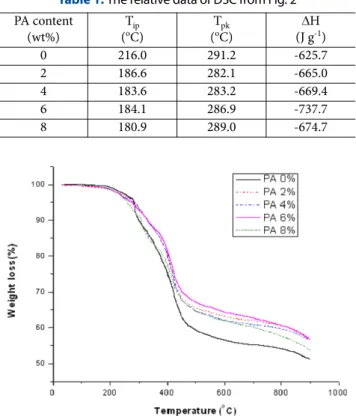
found that with the increase in content of PA, Tip has been sharply decreased with the low concentration of PA, and then re-increased. The lowest heat of reaction has been observed with 6 wt% of PA and then it has been increased for 8 wt% of PA. TGA was carried out to study for the carbonization con- ditions. The TGA curves of various PAN precursors treated by the vacuum drying at 190

o

C are presented in Fig. 2. TGA

result shows that the amount of residue are dependent on PA contents. The PAN precursor without PA exhibits higher yield than other PAN precursor with PA until about 300

o

C, however the yields are reversed at over 300

o

C. When the temperature reaches 900

o

C, PAN precursors with 2, 4, and 6 wt% PA show about 42% weight loss, on the other hand the PAN precursor without PA shows about 50% weight loss. It means that the weight of product can be increased 19% which can assure more economical output.

XPS was carried out to study the chemical composition of the carbon fiber surfaces. As shown in Table 2, the amounts of oxygen group increased with an increase in the PA contents until 4 wt%. In 6 wt% the oxygen content decreased and then the oxygen content level attained slightly higher than the value at 4 wt%. This phenomenon seems to come from the variation of total fiber surface area and their structures which can be analyzed by SEM images in further.

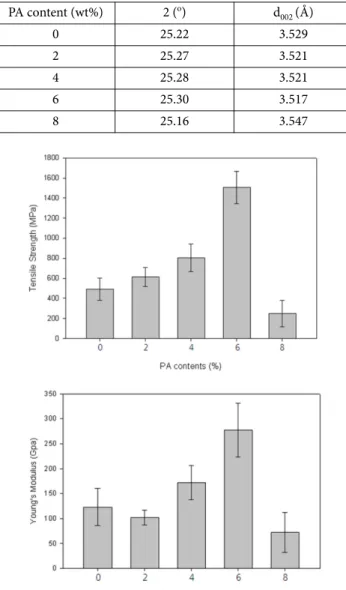
XRD was carried out to study the microstructure of the car- bon fibers. Fig. 5 shows the XRD diffraction patterns of car- bonized PAN fibers containing various PA ratio and the result of XRD measurements is presented in Table 3. The interlayer spacing (d002) of carbonized PAN fibers showed its minimum 3.517 at PA 6 wt%. It means that this structure can give highest Fig. 2. Effect of PA contents on DSC curves; (a) 0 wt%, (b) 2 wt%,

(c) 4 wt%, (d) 6 wt%, and (e) 8 wt%.

Table 1. The relative data of DSC from Fig. 2 PA content

(wt%)

T

ip

(

o

C)

T

pk

(

o

C)

∆H (J g

-1

)

0 216.0 291.2 -625.7

2 186.6 282.1 -665.0

4 183.6 283.2 -669.4

6 184.1 286.9 -737.7

8 180.9 289.0 -674.7

Fig. 3. Effect of various PA contents with (a) 0 wt%, (b) 2 wt%, (c) 4 wt%, (d) 6 wt%, and (e) 8 wt% on weight loss of PAN precursor.

Fig. 4. Effect of PA contents on XPS spectra of carbonized PAN;

(a) 0 wt%, (b) 2 wt%, (c) 4 wt%, (d) 6 wt%, and (e) 8 wt%.

Table 2. Oxygen content of carbonized PAN with various PA ratio.

PA content (wt%)

Elementary analysis (mol.%)

O

1s

O

1s

/C

1s

0 5.2 5.8

2 6.3 7.5

4 8.8 10.7

6 7.5 9.0

8 9.0 11.0

(4)

strength because of the most tight packing of carbonized rib- bon-like internal structures. And carbonized PAN fibers with 8 wt% showed sharply increased value of 3.547 Å. It revealed a kind of deterioration in its interlayer structure arrangements.

As shown in Fig. 6, the strength and the modulus with 6 wt% of PA has been increased 3 times and 2 times, respec- tively in comparing with 0 wt% of PA. But these values have been sharply decreased with 8 wt% as predicted from the XRD data analysis. The average tensile strength of 1.6GPa and Young’s modulus of 300 GPa with 6 wt% PA is remarkable value. Their mechanical properties are sufficient for the elec- trical and light weight automotive body application of these materials. After optimization of the mass production condi- tions the mechanical properties and the economy of this mate- rial can be highly improved. It will give us wide open new opportunity of various new applications of these materials from space craft structures to functional electronic devices.

SEM images of the effect of PA on carbonfiber surfaces are presented in Fig. 7. The semi-carbonized nano fiber without PA showed many small flaws but the addition of PA has elim- inated these flaws until 6 wt%. The over addition of PA, such as 8 wt% made some big flaws. The most smooth surface has been obtained with 6 wt% of PA, which inhibits the crack ini- tiation at the surfaces in the course of loading application.

Fig. 5. Effect of PA contents on XRD patterns of carbonized PAN;

(a) 0 wt%, (b) 2 wt%, (c) 4 wt%, (d) 6 wt%, and (e) 8 wt%.

Table 3. Result of XRD measurements.

PA content (wt%) 2 (

o

) d

002

(Å)

0 25.22 3.529

2 25.27 3.521

4 25.28 3.521

6 25.30 3.517

8 25.16 3.547

Fig. 6. Effect of PA contents on tensile strength and Young’s modulus of carbonized PAN filaments.

Fig. 7. Effect of PA contents on high magnification SEM images

of carbonized PAN filaments; (a) 0 wt% (b) 2 wt%, (c)

4 wt%, (d) 6 wt%, and (e) 8 wt%.

(5)

So it can give us the results of highest strength and highest modulus.

4. CONCLUSION

In this newly developed mechano-electro spinning system of the PAN nano fiber, we have found a new possibility to increase the strength and modulus of these nano fibers by the addition of adequate portion of PA. The PAN nano fibers with 6 wt% of PA showed an excellent mechanical properties improvement, such as 3 times of strength, 1.6 GPa and 2 times of modulus, 300 GPa. The addition of PA can decrease the weight loss of PAN nano fibers during medium temperature, 800

o

C, carbonization process. Also the fiber surface flaws have been suppressed by the appropriate addition of PA, 6 wt%.

The economy of product can be increased more than 19%.

REFERENCES

1. Morgan, P., “Carbon Fibers and Their Composites,” Taylor &

Francis, 2005.

2. He, J.H., Liu, Y., Mo, L.F., Wan, Y.Q., and Xu, L., “Electrospun Nanofibers and Their Application,” Smither, 2008, pp. 6-7.

3. Greiner, A., and Wendorff, J.H., “Electrospinning: A Fascinat- ing Method for the Preparation of Ultrathin Fibers,”

Angewandte Chemie International Edition, Vol. 46, 2007, pp.

5670-5703.

4. Gu, S.Y., Ren, J., and Vansco, G.J., “Process Optimization and Empirical Modeling for Electrospun Polyacrylonitrile (PAN) Nanofiber Precursor of Carbon Nanofibers,” European Polymer Journal, Vol. 41, 2005, pp. 2259-2568.

5. Yeo, L.Y., and Friend, J.R., “Electrospinning Carbon Nanotube Polymer Composite Nanofibers,” Journal of Experimental Nanoscience, Vol. 1, No. 2, 2006, pp. 177-209.

6. Baumgarten, P.K., “Electrostatic Spinning of Acrylic Microfi- bers,” Journal of Colloid Interface Science, Vol. 36, 1971, pp. 71.

7. Fromhals, A., “Process and Apparatus for Preparing Artificial Threads”, US Patent No. 1,975,504, 1934.

8. Gladding, E.K., “Apparatus for the Production of Filaments, Threads and the Like,” US Patent No. 2,168,027, 1939.

9. Yarin, A.L., Koombhongse, S., and Renker, D.H., “Bending Instability in Electrospinning of Nanofibers,” Journal of Applied Physics, Vol. 89, 2001, pp. 3018-3026.

10. Ramakrishna, S., Fujihara, K., Teo, W.E., Yong, T., Ma, Z., and Ramaseshan, R., “Electrospun Nanofibers: Solving Golbal Issues,” Materials Today, Vol. 9, No. 3, 2006, pp. 40-50.

11. Kong, C.S., Lee, T.H., Lee, S.H., and Kim, H.S., “Nano-web For- mation by the Electrospinning at Various Electric Fields,” Jour- nal of Materials Science, Vol. 42, 2007, pp. 8106–8112.

12. Im, J.S., Kim, M.I., and Lee, Y.S., “Preparation of PAN-based Electrospun Nanofiber Webs Containing TiO

2

for Photocata- lytic Degradation,” Materials Letters, Vol. 62, 2008, pp . 3652–

3655.

13. Dzenis, Y., “Spinning Continuous Fibers for Nanotechnology,”

Science, Vol. 304, No. 25, 2004, pp. 1917-1919.

14. Fennessey, S.F., and Farris, R.J., “Fabrication of Aligned and Molecularly Oriented Electrospun Polyacrylonitrile Nanofibers and the Mechanical Behavior of Their Twisted Yarns,” Polymer, Vol. 45, 2004, pp. 4217-4225.

15. Zhou, Z., Lai, C., Zhang, L., Qian, Y., Hou, H., Reneker, D.H., and Fong, H., “Development of Carbon Nanofibers from Aligned Electrospun Polyacrylonitrile Nanofiber Bundles and Characterization of Their Microstructural, Electrical, and Mechanical Properties,” Polymer, Vol. 50, 2009, pp. 2999-3006.

16. Smit, E., Buttner, U., and Sanderson, R.D., “Continuous Yarns From Electron Fibers,” Polymer, Vol. 46, 2005, pp. 2419-2423.

17. Lee, J.R., Jee, S.Y., Hong, Y.T., and Park, S.J., “Preparation and Characterization of Ultra-fine PAI Continuous Fibers Using Electrospinning Process,” Journal of the Korean Industrial and Engineering Chemistry, Vol. 17, No. 3, 2006, pp. 331-334.

18. Lee , S.H., Kim, S.Y., Youn, J.R., Seong, D.G., Jee, S.Y., Choi, J.I., and Lee, J.R., “Processing of Continuous Poly(amide-imide) Nanofibers by Electrospinning,” Polymer International, Vol. 59, 2010, pp. 212–217.

19. Rahaman, M.S.A., Ismail, A.F., and Mustafa, A., “A Review of Heat Treatment on Polyacrylonitrile Fiber,” Polymer Degrada- tion and Stability, Vol. 92, 2007, pp. 1421-1432.

20. Moon, S.C., and Farris, R.J., “Strong Electrospun Nanometer- diameter Polyacrylonitrile Carbon Fiber Yarns,” Carbon, Vol.

47, 2009, pp. 2829-2839.

21. Wu, S., Zhang, F., Yu, Y., Li, P., Yang, X., Lu, J., and Ryu, S.,

“Preparation of PAN-based Carbon Nanofibers by Hot-stretch- ing,” Composite Interfaces, Vol. 15, No. 7-9, 2008, pp. 671-677.

22. Chen, J.C., and Harrison, I.R., “Modification of Polyacryloni- trile (PAN) Carbon Fiber Precursor Via Post-spinning Plasti- cization and Stretching in Dimethyl Formamide (DMF),”

Carbon, Vol. 40, 2002, pp. 25-45.

23. Nataraj, S.K., Kim, B.H., Yun, J.H., Lee, D.H., Aminabhavi, T.M., and Yang, K.S., “Effect of Added Nickel Nitrate on the Physical, Thermal and Morphological Charateristics of Poly- acrylonitrile-based Carbon Nanofibers,” Materials Science and Engineering B, Vol. 162, 2009, pp. 75-81.

24. Nataraj, S.K., Kim, B.H., Yun, J.H., Lee, D.H., Aminabhavi, T.M., and Yang, K.S., “Morphological Characterization of Elec- tronspun Carbon Nanofiber Mats of Polyacrylonitrile Contain- ing Heteropolyacids,” Synthetic Metals, Vol. 157, 2009, pp. 1496- 1504.

25. Zhou, Z., Liu, K., Lai, C., Zhang, L., Li, J., Hou, H., Reneker, D.H., and Fong, H., “Graphitic Carbon Nanofibers Developed From Bundles of Aligned Electrospun Polyacrylonitrile Nanofi- bers Containing Phosphoric Acid,” Polymer, Vol. 51, 2010, pp.

2360-2367.

26. Park, S.J., and Kim, M.H., “Effect of Acidic Anode Treatment on Carbon Fibers for Increasing Fiber-matrix Adhesion and Its Relationship to Interlaminar Shear Strength of Composites,”

Journal of Materials Science, Vol. 35, 2000, pp. 1901-1905.

27. Lu, W., and Chung, D.D.L., “Oxidation Protection of Carbon

Materials by Acid Phosphate Impregnation,” Carbon, Vol. 40,

2002, pp. 1249-1254.

수치

Table 2. Oxygen content of carbonized PAN with various PA ratio.
Fig. 6. Effect of PA contents on tensile strength and Young’s modulus of carbonized PAN filaments.

참조

관련 문서

1 John Owen, Justification by Faith Alone, in The Works of John Owen, ed. John Bolt, trans. Scott Clark, "Do This and Live: Christ's Active Obedience as the

In this thesis, we studied the enhancement of the light extraction efficiency in InGaN-based light-emitting diodes (LEDs) patterned with nano structures.. The

In particular, the dependences of maximum temperature increase and decay time constant on the laser pulse width, beam diameter, and absorption coefficient

By analysing the dependences of the maximum increase in temperature and the maximum acceleration on the medium properties and the information of the damage

Within the limitation of this study, it can be concluded that pretreatment with EDTA or phosphoric acid have negative effect in apical part on push out bond strength of fiber

This study, made up of 6 chapters in all, aims to handle the details and problems of the spouse inheritance system under existing law, as well as to review the draft of

6 Miscellaneous Applications: The high strength and wear resistance of BMGs along with their biocompatiability, smooth surface finish, and aesthetic appearance determine the

SEM micrographs of electrospun fibers fabricated with two different collector speeds (CS) for the (a) normal electrospinning process, (b) modified electrospinning process with