Review Article
Received November 18, 2014, Revised February 10, 2015, Accepted February 27, 2015 Correspondence to: Yoon-Jung Chang
Hospice and Palliative Care Branch, National Cancer Control Institute, National Cancer Center 323, Ilsan-ro, Ilsandong-gu, Goyang, Gyeonggi-do 410-769, Korea
Tel: +82-31-920-2190, Fax: +82-31-920-2199, E-mail: [email protected]
This is an Open Access article distributed under the terms of the Creative Commons Attribution Non-Commercial License (http://creativecommons.org/licenses/by-nc/3.0) which permits unrestricted non-commercial use, distribu- tion, and reproduction in any medium, provided the original work is properly cited.
호스피스완화의료 사회복지사 e-learning 교육과정 개발
심 혜 영ㆍ장 윤 정
국립암센터 호스피스완화의료사업과
Development of e-learning Education Programs for Social Workers in Hospice and Palliative Care
Hye-Young Shim, Ph.D. and Yoon-Jung Chang, M.D., Ph.D.
Hospice and Palliative Care Branch, National Cancer Control Institute, National Cancer Center, Goyang, Korea
Education is essential for specialists in charge terminal care of cancer patients. In the second 10-year plan to conquer cancer under the Cancer Control Act, the Korean government announced a plan to train more hospice and palliative care (HPC) specialists based on quantitative HPC expansion. Specifically, the government aims to develop e-learning programs to foster social workers in HPC, following those offered to doctors and nurses. In HPC, social workers have served a vital role in helping patients overcome psychological and social issues. As professionals, they have carried out their responsibilities and played their part in the field to help HPC to take root and be institutionalized in Korea. To date, it has been difficult to obtain practical knowledge and skills for social workers due to the lack of systematic training program. Development of an e-learning program for social workers, as proposed in this study, should strengthen social workers in charge of terminally-ill cancer patients in terms of their identity, expertise, and practical skills in clinical setting and improve their access to education. We also hope the program to be further developed by the government by introducing an education system that offers refresher courses to guarantee social workers’ continued expertise through.
Key Words: Hospice care, Palliative care, Social work, Distance education
서 론
우리나라 통계청 사망원인 1위는 암이며, 2013년 전 체 암 사망자 수는 75,334명으로 10년 전과 비교했을 때 암 사망자 수는 꾸준히 증가하는 추세를 보이고 있다 (1). 한국인의 사망 형태를 살펴보면 사망 인구 중 30%
는 심근경색, 뇌졸중, 사고 등 예측하지 못한 갑작스러
운 죽음으로, 70%는 암과 같이 예측 가능한 경과와 투 병 기간이 짧은 ‘말기’로 사망한다(2). 특히, 말기 암은 여러 치료에도 불구하고 암이 계속 진행 및 악화하는 상태를 의미하며, 말기암환자들은 통증, 피로감, 쇠약감, 식욕 부진 등과 같은 신체적 증상과 불안, 우울과 같은 정신적인 증상으로 고통을 겪게 된다(3). 더불어, 말기암 환자의 가족은 장기간 환자 간병으로 인해 신체적, 정 신적으로 많은 부담을 겪고 고가의 진료비로 인한 경제
Table 1. Second Phase of the 10 years to Conquer Cancer Professional Workforce Plan (2006∼2015). (unit : person)
Job category 2010 2015
Physician 130 260
Nurse 900 1,800
Social worker 65 130
Spiritual counsellor 65 130
Volunteer 10,000 20,000 Figure 1. WHO (2007) Palliative care eduation steps.
적인 어려움도 겪을 수 있다(4). 말기암환자 완화의료는 통증과 증상의 완화 등을 포함한 신체적, 심리사회적, 영적 영역에 대한 종합적인 평가와 치료를 통하여 말기 암환자와 가족의 삶의 질을 향상하는 것이 목적이다(5).
보건복지부는 2006년 제2기 암정복 10개년 계획(2006∼
2015)을 수립하면서 말기암환자들이 여러 신체 증상으 로 고통 받고 있으나 적절한 의료제공이 되지 않는 점 을 지적하고, 말기암환자 지원을 위한 완화의료전문기 관을 지정하여 인력, 시설, 장비를 지원하는 내용을 암 정복 10개년 계획에 포함하였다. 그 중, 완화의료 직종 별 말기암환자 관리 전문 인력 확충 목표 인원을 다음 과 같이 제시하였다(Table 1)(6).
호스피스완화의료는 의사, 간호사, 사회복지사, 성직 자, 자원봉사자 등 다양한 전문가들이 하나의 팀을 이 루어 전인적인 돌봄을 제공하는 다학제적 활동을 의미 한다(7-9). 특히, 호스피스완화의료에서 사회복지사의 역 할은 환자와 가족 문제의 해결을 위한 상담과 심리사회 적, 법적, 경제적 도움 제공, 환자와 가족의 협조, 팀 모 임 참석, 사별가족지지, 상담 의뢰, 지역사회 자원 연계, 장례준비 지원, 팀원과의 의사소통, 기록 및 기록보관, 자원봉사자 모집 및 관리 등을 중심으로 호스피스 환자 와 가족에게 질 높은 전인적인 돌봄 서비스를 제공하는 핵심 인력이다(10).
정부에서는 호스피스완화의료의 질적ㆍ양적 확대와 함께 이를 뒷받침 할 수 있는 인력을 양성하기 위해 제 2기 암정복 10개년 계획에서 전문인력 확충 목표 달성 을 위해 직종별로 2010년 간호 e-learning, 2012년 의사 e-learning을 개발 완료하였고, 2013년부터는 호스피스완 화의료 사회복지사 e-learning 교육 과정을 개발하여 2014년 5월부터 운영하고 있다. 호스피스완화의료 사회 복지사 e-learning 과정의 목적은 교육 참여의 접근성을 높여 호스피스완화의료 사회복지영역의 전문성을 함양 하고, 호스피스 완화의료 서비스 제공을 위한 필수적 지식 및 기술을 학습함으로써, 호스피스완화의료에 대
한 사회복지사의 인식 고취로 호스피스완화의료의 서 비스 제공 질을 향상하는 것이다.
본 연구는 호스피스완화의료 사회복지사 e-learning 개 발 과정에 대해 국내외 호스피스완화의료 사회복지사 교육 과정을 비교 분석하고 교육 개발 과정을 소개하고 자 한다.
본 론
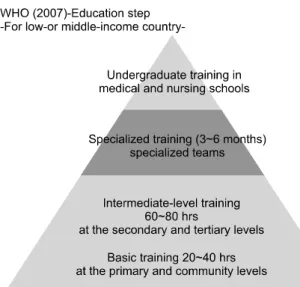
1. 호스피스완화의료 사회복지사 국내외 교육 현황 1) 세계보건기구(WHO) 호스피스완화의료 교육단계: 세 계보건기구(World Health Organization, 이하 WHO)는 호 스피스완화의료 기반이 없는 개발도상국의 호스피스완 화의료 전문인력 교육 체계를 제시하였는데 1단계 기본 교육은 의사, 간호사, 사회복지사를 대상으로 20∼40시 간, 2단계 중급교육은 의사, 간호사를 대상으로 60∼80 시간, 3단계 전문훈련은 돌봄 제공팀을 대상으로 3∼60 개월, 마지막 단계로 학부생 교육 단계로 권고하고 있 다(Figure 1)(11).
2) 국외 호스피스완화의료 교육 자격: 미국은 호스피스완 화의료협회(National Hospice and Palliative Care Organization) 와 사회복지사협회(National Association of Social Workers) 가 공동으로 호스피스완화의료 사회복지사 자격인증을 관리하고 있으며 전문 사회복지사와 일반 사회복지사 로 분류된다. 미국 호스피스완화의료 전문 사회복지사 (Advanced Certified Hospice and Palliative Care Social Worker, ACHP-SW)가 되기 위해서는 사회복지분야 석사
학위 소지자로서 완화의료 실무경력 최소 2년(3,000시 간) 이상, 관련 연수교육 20시간 이상을 받아야 한다. 또 한 사회복지사로서의 직무능력을 갖췄음을 입증할 수 있는 동료와 전문가의 평가결과가 요구되며 2년마다 갱 신해야 한다(12). 대만의 경우, 호스피스완화의료 사회 복지사는 공식적인 자격증은 없으나 의사와 간호사에 게 요구하는 80시간(실습 20시간)의 교육시간 보다 더 긴 100시간(실습 40시간)을 요구한다. 일본은 호스피스 팀원에 대한 필수교육을 요구하지는 않고 있다(13).
3) 국내 호스피스완화의료 사회복지사 교육 발전 과정:
호스피스완화의료 영역에서 사회복지사는 말기암환자 의 사회적, 경제적 지원을 담당하는 필수인력으로 국외 에서는 역할과 직무에 맞춘 교육들이 활발하게 제공되 고 있다. 국내의 호스피스완화의료 사회복지사의 교육 과 수련에 있어서는 교육체계의 미비, 지도 감독자의 부재, 실습 부족 등의 문제가 지적되어 왔는데(14), 2004 년 정부는 ‘호스피스완화의료 사업지원 평가단’을 구성 하여 의사 및 간호사, 사회복지사 각 직종에 호스피스 완화의료 교육 프로그램에 대한 개발연구를 수행하였 다. 이때 개발된 사회복지사의 시범교육 과정은 총 15 시간으로 1) 호스피스완화의료 사회복지사의 역할(2시 간), 2) 심리/사회적 평가(2시간), 3) 심리/사회적 상담(2 시간), 4) 사별관리(2시간), 5) 영적 돌봄(2시간), 6) 호스 피스협력체계 구축 및 자원활용(2시간), 7) 심리사회적 평가와 상담(실습 3시간)을 개발하였다. 그러나, 사회복 지사 교육은 총 15시간으로 36시간을 개발한 의사직과 총 78시간을 개발한 간호직에 비해 교육 시수가 짧고 교육내용이 개괄적이었다(15). 이후, 국립암센터는 2004 년 호스피스완화의료 종사자를 대상으로 직종별 교육 프로그램으로 실습 3시간을 포함한 총 15시간의 사회복 지사 교육안을 제안하고 1일 시범교육을 실시하였다 (16). 한편, 대한의료사회복지사협회 내 호스피스위원회 는 사회복지사의 양성과 교육개발 필요성을 인식하고 2007년 사회복지사를 대상으로 교육을 개발하고 운영하 였다. 교육 과정은 2004년 사회복지사의 시범교육 과정, 미국 National Hospice and Palliative Care Organization (NHPCO, 2004), 국립암센터의 호스피스 고위과정을 비 교하여 공통으로 다루고 있는 것과 국내 사회복지사에 게 요구되는 교육 내용을 단계별로 24주제 총 29시간의 기본교육(8시간), 전문교육 I, II (각각 7시간), 심화교육(8 시간)을 개발하였다. 2007년 교육에 참석한 대상자는 기 본교육 177명, 전문교육 168명, 심화교육 104명이 참석 하였고, 이는 호스피스완화의료에 대한 사회복지사의
높은 교육 수요와 호스피스 영역에 대한 사회복지사의 관심이 급증했음을 반영하였다. 그러나 이 과정은 암관 리법에서 요구하고 있는 완화의료전문기관에 근무하는 의사, 간호사, 사회복지사는 총 60시간 완화의료교육 과 정을 이수해야 한다”라는 기준을 충분히 반영하지 못하 였다. 또한, 사례 및 실무 중심의 보완이 필요하고, 교육 평가를 위한 구체적인 평가 척도가 필요하다는 의견이 있었다(17). 따라서 정부와 관련 학회는 정부주도의 호 스피스완화의료 교육을 일관성 있게 대표성 있도록 표 준화된 사회복지사 교육 프로그램의 개발과 시행의 필요 성을 인지하였다(2,18). 2006년 국립암센터는 Education in Palliative and End-of-life Care (EPEC)의 교육 과정을 국내 상황에 맞게 수정ㆍ보완하여 호스피스완화의료 표준교 육 과정을 필수 인력 공통 기본 과정으로 개발하였으 며, 교육 과정은 실습교육 16시간을 포함하여 총 60시 간으로 구성하고 사회복지 영역은 말기환자 돌봄의 철 학 및 원리(4개 주제)와 환자와 가족 돌봄(18개 주제)을 포함하였다. 이후, 공통 직종의 기본 과정인 표준교육 이수자들의 직종별 상급 교육 과정에 대한 요구가 있어 2009년 사회복지사 상급교육교재는 국립암센터 교육훈 련소위원회 중심으로 2011년에 호스피스완화의료 사회 복지사 상급교육 과정 교재를 완성하여 이를 바탕으로 이번 사회복지사 e-learning 교육 프로그램을 개발하였 다.
4) 국내외 호스피스완화의료 사회복지사 교육 내용 비교:
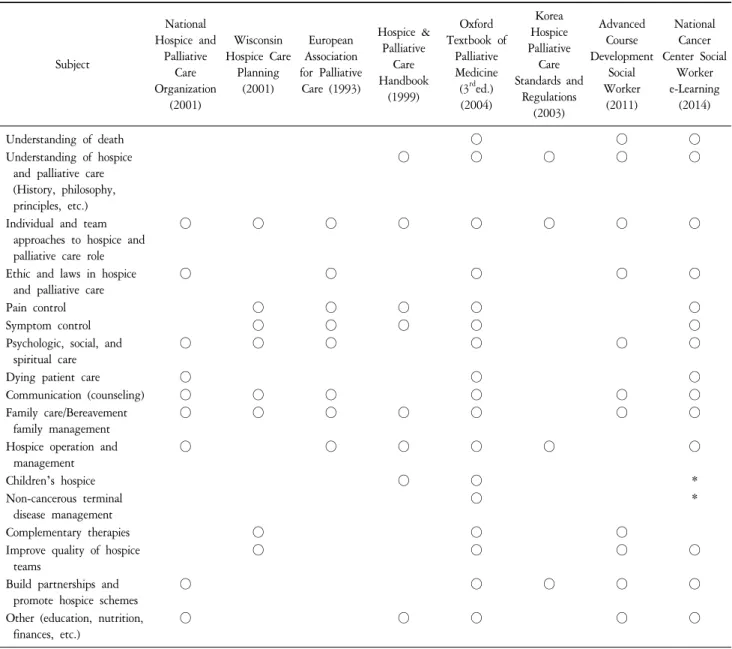
본 사회복지사 e-learning 교육 과정은 2011년에 개발한 호스피스완화의료 사회복지사 상급교육 교재를 바탕으 로 34차시를 구성하였고 크게 호스피스완화의료 사회 복지사의 역할, 심리/사회적 평가, 심리/사회적 상담, 사 별관리, 영적 돌봄, 호스피스 협력체계 구축 및 자원 활 용, 심리사회적 평가와 상담 영역으로 나눌 수 있다. 본 교육 내용은 미국의 National Hospice and Palliative Care Organization, 위스콘신 Hospice Care Planning, 유럽 European Association for Palliative Care, Hospice & Palliative Care Handbook과 한국의 호스피스 완화의료 표준과 규정을 포괄하고 있다. 구체적인 교육 내용 비교는 다음과 같 다(Table 2)(15).
2. 호스피스완화의료 사회복지사 e-learning 과정 개발
설계
1) e-learning의 정의 및 특성: e-learning이란, 원격교육으 로 교육적 지식을 학습자들에게 정보기술을 활용하여 제공하는 것이며 컴퓨터 기반의 학습으로 멀티미디어
Table 2. Comparison of Educational Contents for Training Hospice and Palliative Care Social Workers.
Subject
National Hospice and
Palliative Care Organization
(2001)
Wisconsin Hospice Care
Planning (2001)
European Association for Palliative Care (1993)
Hospice &
Palliative Care Handbook
(1999)
Oxford Textbook of
Palliative Medicine (3
rded.) (2004)
Korea Hospice Palliative
Care Standards and
Regulations (2003)
Advanced Course Development
Social Worker
(2011)
National Cancer Center Social
Worker e-Learning
(2014)
Understanding of death ○ ○ ○
Understanding of hospice and palliative care (History, philosophy, principles, etc.)
○ ○ ○ ○ ○
Individual and team approaches to hospice and palliative care role
○ ○ ○ ○ ○ ○ ○ ○
Ethic and laws in hospice and palliative care
○ ○ ○ ○ ○
Pain control ○ ○ ○ ○ ○
Symptom control ○ ○ ○ ○ ○
Psychologic, social, and spiritual care
○ ○ ○ ○ ○ ○
Dying patient care ○ ○ ○
Communication (counseling) ○ ○ ○ ○ ○ ○
Family care/Bereavement family management
○ ○ ○ ○ ○ ○ ○
Hospice operation and management
○ ○ ○ ○ ○ ○
Children’s hospice ○ ○ *
Non-cancerous terminal disease management
○ *
Complementary therapies ○ ○ ○
Improve quality of hospice teams
○ ○ ○ ○
Build partnerships and promote hospice schemes
○ ○ ○ ○ ○
Other (education, nutrition, finances, etc.)
○ ○ ○ ○ ○
*Updated core curriculumof e-learning programs for Hospice-Palliative Care Specialists.
패키지를 활용하여 스스로 학습할 수 있도록 도와주는 교육방식이다(19). 또한, e-learning의 주요 특징으로 1) 많은 양의 최신의 정보를 실시간에 교류할 수 있고(20), 2) 양방향 의사소통 가능하며(21), 3) 학생의 학습속도에 맞는 교육과 다양한 학생의 교육 요구에 적합한 교육 과정을 운영할 수 있고(22), 4) 교수 중심의 정형화된 교 육에서 벗어나 학습자 중심의 자기 주도적 학습을 할 수 있다(23).
2) 사회복지사 e-learning 개발 위원회 구성: 본 과정은 국립암센터 호스피스완화의료사업과의 주도로 개발되 었다. 개발위원회를 구성하기 위해 한국호스피스완화의
료학회, 대한의료사회복지사협회의 추천을 받아 개발 위원 5명(교수 1명, 사회복지사 4명)과 검수위원 6명(교 수 2명, 사회복지사 4명)을 위촉하였다.
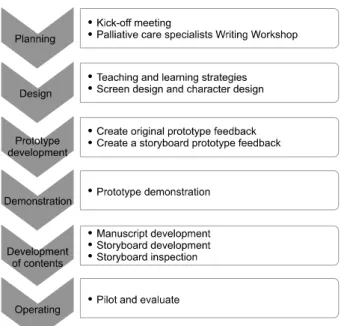
3) 사회복지사 e-learning 프로그램 개발 과정: 먼저, 기획 단계에서 원고 집필 방향과 일정을 논의하는 원고 집필 워크샵을 가졌다. 설계단계에서 교수 학습 전략을 설계 하고 e-learning 화면 디자인과 캐릭터를 설계하였으며, 개발단계에서 프로토타입 원고를 작성하고 피드백을 받고, 피드백을 반영하여 프로토타입 개발을 완료하였 다. 개발된 프로토타입을 시연하고 내용 개발단계에서 작성된 원고를 토대로 스토리보드를 개발하여 3차에 걸
Figure 2. Hospice and palliative care social worker e-learning course development process.
Figure 3. Hospice and palliative care social worker e-learning instruction design process.
쳐 이를 검수하였다(Figure 2, 3).
4) 호스피스완화의료 사회복지사 e-learning 교육 과정 커
리큘럼 및 프로그램 구성:
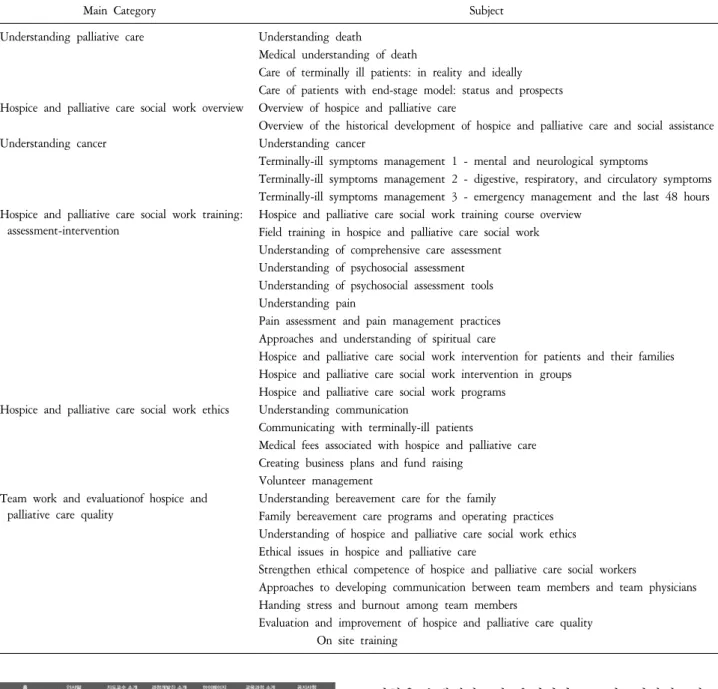
호스피스완화의료 사회복지사e-learning은 사회복지사 자격 소지자(1ㆍ2급)를 교육대 상자로 하고 교육 과정은 온라인교육 34차시, 실습교육 16시간, 평가시험으로 구성되어 있다(Table 3). 교육수료 기준은 3개월간 온라인 강의 진도율 90% 이상, 최종평 가시험 60점 이상, 실습보고서 제출을 완료한 경우로 한다. 실습교육은 완화의료전문기관에서 1회 8시간, 2일 간 총 16시간 현장 실습을 실시한다. 실습 1일차 학습 내용은 완화의료 기관소개, 팀미팅 참관, 병실 간호 참 관, 사회사업실 인수인계 참관, 심리사회적 사정, 상담 참관, 자원개발 연계가 이루어지고 2일차에는 case report, 기타 프로그램이 포함된 내용의 심화 실습교육으 로 운영된다(Figure 4).
결 론
의학적 치료 기술 발달에도 여전히 임종을 앞둔 환자 와 가족들은 신체적, 정신ㆍ심리적, 영적, 사회적으로 다양한 측면에서 총체적인 고통을 마주하고 있다. 특히, 호스피스완화의료 대상자는 전인적인 관리가 필요하며 이들의 삶의 질을 높이기 위해 각 분야의 전문가들이 다학제적 접근으로 호스피스완화의료 서비스를 제공하 고 있다. 그 중 사회복지사는 호스피스완화의료 대상자
들의 심리ㆍ사회적 문제를 해결하는 중추적 역할을 수 행해왔으며, 우리나라 호스피스완화의료가 정착되고 제 도화되기까지 현장에서 전문가의 책임과 역할을 다해 오고 있다.
그간, 국내에 사회복지사 전문인력만을 대상으로 하 는 체계적인 입문교육 과정이 부족한 실정이었고, 사회 복지사를 대상으로 하기보다 관련 의료인이 통합되어 완화의료 전반을 개괄하는 수준의 off-line의 표준교육 60시간이 전부였기 때문에 사회복지 실천 지식과 기술 을 충분히 습득하는 데 어려움이 있었다. 이번 호스피 스완화의료 사회복지사 e-learning 과정 개발을 통해 말 기암환자를 돌보는 사회복지사의 정체성과 전문성, 임 상현장에서의 실천능력이 함양되고 교육 접근성이 향 상될 것이며, 향후 보수교육 과정을 통한 지속적인 전 문성 보장을 위한 교육제도가 도입되어 더욱 발전하길 기대한다.
감사의 글
본 연구는 국립암센터 전문인력훈련 사업(52211)으로 지원되었습니다. 본 교육 과정 개발에 저자로 참여하신 김원철, 손미연, 이선영, 권숙희, 김정이 선생님과 검수 위원으로 참여하신 윤기영, 이기주, 김창곤, 임승희, 손 영순, 이정훈 선생님께 감사 드립니다. 또한, 연구에 참 여하신 최진영, 조현정, 모하나, 강진아, 최슬기 선생님 께도 감사 드립니다.
요 약
말기암환자 관리를 위해서 전문인력 교육은 필수적 이다. 정부에서는 암관리법을 통해 호스피스완화의료의 양적 확대를 기반으로 전문 인력을 양성하기 위해 제2 기 암정복 10개년 계획에서 전문인력 확충계획을 발표 하였다. 그간, 호스피스완화의료 전문인력 훈련을 위한 표준교육 과정과 의사/간호사 e-learning에 이어 이번 사 회복지사 e-learning을 개발하여 운영하게 되었다. 호스 피스완화의료 현장에서 사회복지사는 호스피스완화의 료 대상자들의 심리ㆍ사회적 문제를 해결하는 중추적
Figure 4. Homepage for the e-learning program on hospice and palliative care for doctors and nurese (http://hospice.el.or.kr).
Table 3. Curriculumof the e-Learning Program for Training Social Workers in Hospiceand Palliative Care.
Main Category Subject
Understanding palliative care Understanding death
Medical understanding of death
Care of terminally ill patients: in reality and ideally Care of patients with end-stage model: status and prospects Hospice and palliative care social work overview Overview of hospice and palliative care
Overview of the historical development of hospice and palliative care and social assistance
Understanding cancer Understanding cancer
Terminally-ill symptoms management 1 - mental and neurological symptoms
Terminally-ill symptoms management 2 - digestive, respiratory, and circulatory symptoms Terminally-ill symptoms management 3 - emergency management and the last 48 hours Hospice and palliative care social work training:
assessment-intervention
Hospice and palliative care social work training course overview Field training in hospice and palliative care social work Understanding of comprehensive care assessment Understanding of psychosocial assessment Understanding of psychosocial assessment tools Understanding pain
Pain assessment and pain management practices Approaches and understanding of spiritual care
Hospice and palliative care social work intervention for patients and their families Hospice and palliative care social work intervention in groups
Hospice and palliative care social work programs Hospice and palliative care social work ethics Understanding communication
Communicating with terminally-ill patients
Medical fees associated with hospice and palliative care Creating business plans and fund raising
Volunteer management Team work and evaluationof hospice and
palliative care quality
Understanding bereavement care for the family
Family bereavement care programs and operating practices Understanding of hospice and palliative care social work ethics Ethical issues in hospice and palliative care
Strengthen ethical competence of hospice and palliative care social workers
Approaches to developing communication between team members and team physicians Handing stress and burnout among team members
Evaluation and improvement of hospice and palliative care quality On site training
역할을 수행해왔으며, 우리나라 호스피스완화의료가 정 착되고 제도화되기까지 현장에서 전문가의 책임과 역 할을 다해오고 있다. 하지만 그간 사회복지사 직종을 위한 체계적인 교육 과정이 없는 실정으로 사회복지 실 천 지식과 기술을 충분히 습득하는 데 어려움이 있었 다. 이번 호스피스완화의료 사회복지사 e-learning 과정 개발을 통해 말기암환자를 돌보는 사회복지사의 정체 성과 전문성, 임상현장에서의 실천능력이 함양되고 교 육 접근성이 향상될 것이며, 향후 보수교육 과정을 통 한 지속적인 전문성 보장을 위한 교육제도가 제도적으 로 도입되어 더욱 발전하길 기대한다.